
In Depth
See Also

Lyre

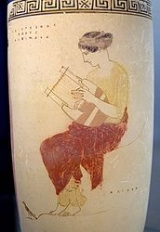
The lyre is a stringed musical instrument String instrument

[i] by means of [[vibrating string]... 

 well known for its use in Classical Antiquity Classical antiquity

Classical antiquity is a broad term for a long period of cultural history [i] centered on the Mediterranean Sea [i] ... 

. The recitations of the Ancient Greeks Ancient Greece

Ancient Greece is the period in Greek history [i] which lasted for around one thousand years and ended w ... 

 were accompanied by it. The lyre is a member of the zither Zither

The zither is a musical string instrument [i], mainly used in folk music [i], most commonly in the Germa ... 

 family, and was ordinarilly played by strumming, like a guitar Guitar

The guitar is a fretted and stringed musical instrument [i], used in a wide variety of musical styles, a ... 

, rather than being plucked, like a harp Harp

The harp is a stringed instrument [i] which has its strings positioned perpendicular to the soundboard [i] ... 

. According to ancient Greek mythology Greek mythology

Greek mythology consists in part of a large collection of narratives that explain the origins of the wo... 

, the young god Hermes Hermes

Hermes , in Greek mythology [i], is the Olympian god [i] of boundaries and of the trave ... 

 created the lyre from the body of a large tortoise shell which he covered with animal hide and antelope Antelope

Antelopes are a polyphyletic [i] group of herbivorous Africa [i]n and Asian animals of the fam ... 

 horns. Lyres were associated with Apollo Apollo

In Greek [i] and Roman mythology [i], Apollo , the ideal of the kouros [i], was the ... 

nian virtues of moderation and equilibrium, contrasting the Dionysian Dionysus

Dionysus and Dionysos or Dionysius , the Thracian [i] god of wine [i], represents not only t ... 

 pipes Pan flute

The pan flute is an ancient musical instrument [i] based on the principle of the stopped pipe, consisti ... 

 which represented ecstasy and celebration.

Discussions

  Discussion Features

   Ask a question about 'Lyre'

   Start a new discussion about 'Lyre'

   Answer questions about 'Lyre'

   'Lyre' discussion forum

Timeline

64   Great fire of Rome: A fire began to burn in the merchant area of Rome and soon burned completely out of control while Emperor Nero Nero

Nero 'Claudius Caesar Augustus Germanicus , born Lucius Domitius Ahenobarbus, also called ... 

 allegedly played his lyre and sang while watching the blaze from a safe distance, although there is no hard evidence to support this claim, and it is worth pointing out that fires were very common in Rome at the time. The fire destroyed close to one-half of the city and it was blamed on the Christians Christianity

Christianity is a monotheistic [i] religion [i] centered on Jesus of Nazareth [i] ... 

; a small but growing religious movement.


Encyclopedia


The lyre is a stringed musical instrument String instrument

[i] by means of [[vibrating string]... 

 well known for its use in Classical Antiquity Classical antiquity

Classical antiquity is a broad term for a long period of cultural history [i] centered on the Mediterranean Sea [i] ... 

. The recitations of the Ancient Greeks Ancient Greece

Ancient Greece is the period in Greek history [i] which lasted for around one thousand years and ended w ... 

 were accompanied by it.

The lyre is a member of the zither Zither

The zither is a musical string instrument [i], mainly used in folk music [i], most commonly in the Germa ... 

 family, and was ordinarilly played by strumming, like a guitar Guitar

The guitar is a fretted and stringed musical instrument [i], used in a wide variety of musical styles, a... 

, rather than being plucked, like a harp Harp

The harp is a stringed instrument [i] which has its strings positioned perpendicular to the soundboard [i] ... 

.

According to ancient Greek mythology Greek mythology

Greek mythology consists in part of a large collection of narratives that explain the origins of the wo... 

, the young god Hermes Hermes

Hermes , in Greek mythology [i], is the Olympian god [i] of boundaries and of the trave... 

 created the lyre from the body of a large tortoise shell which he covered with animal hide and antelope Antelope

Antelopes are a polyphyletic [i] group of herbivorous Africa [i]n and Asian animals of the fam... 

 horns. Lyres were associated with Apollo Apollo

In Greek [i] and Roman mythology [i], Apollo , the ideal of the kouros [i], was the ... 

nian virtues of moderation and equilibrium, contrasting the Dionysian Dionysus

Dionysus and Dionysos or Dionysius , the Thracian [i] god of wine [i], represents not only t... 

 pipes Pan flute

The pan flute is an ancient musical instrument [i] based on the principle of the stopped pipe, consisti... 

 which represented ecstasy and celebration.

Places in southern Europe Europe

Europe is one of the seven traditional continent [i]s of the Earth [i]. ... 

, western Asia Asia

Asia is the largest and most populous continent [i] or region, depending on the definition.... 

, or north Africa Africa

Africa is one of the greatest sized continents of the Earth.... 

 have been proposed as the historic birthplace of the genus. The instrument is still played in north-eastern parts of Africa Africa

Africa is one of the greatest sized continents of the Earth.... 

.

Some of the heroes and improvers of the lyre were of the Aeolia Aeolis

Alternative meaning: the Aeolis [i] region of Mars [i].
... 

n or Ionia Ionia

Ionia was an ancient region of southwestern coastal Anatolia [i] on the Aegean Sea [i]. ... 

n Greek colonies on the coasts of Asia bordering the Lydian empire. Some mythic masters like Orpheus Orpheus

In Greek legend [i], Orpheus was the chief representative of the arts of song and the lyre [i] ... 

, Musaeus, and Thamyris were believed to have been born in Thrace Thrace

Thrace is a historical and geographic area in southeast Europe [i]. ... 

, another place of heavy Greek colonization.
The name kissar given by the ancient Greeks to Egyptian box instruments reveals the apparent similarities recognized by Greeks themselves. The cultural peak of ancient Egypt Egypt

[i] country in [[North Africa]... 

, and thus the possible age of creation, predates the 5th century classic Greece Greece

Greece
Greece lies at the juncture of Europe [i], Asia [i], and Africa [i]. ... 

.
Thus we can infer that the instrument might have existed in one of Greece's adjacent countries, either Thrace Thrace

Thrace is a historical and geographic area in southeast Europe [i]. ... 

, Lydia Lydia

Lydia is a historic region of western Anatolia [i], congruent with Turkey [i]'s modern provinces of Izmir [i] ... 

, or Egypt Egypt

[i] country in [[North Africa]... 

, and was introduced into Greece at pre-classic times.


Construction

The frame of a lyre consists of a hollow body or sound-chest. From this sound-chest are raised two arms, which are sometimes hollow, and are bent both outward and forward. They are connected near the top by a crossbar or yoke. Another crossbar, fixed on the sound-chest, forms the bridge which transmits the vibrations of the strings. The deepest note was the farthest from the player; but, as the strings did not differ much in length, more weight may have been gained for the deeper notes by thicker strings, as in the violin Violin

The violin is a bowed [i] string instrument [i] with four string [i]s tuned in perfect fifth [i] ... 

 and similar modern instruments, or they were turned with slacker tension. The strings were of gut Gastrointestinal tract

The gastrointestinal tract or digestive tract, also referred to as the GI tract or the al... 

. They were stretched between the yoke and bridge, or to a tailpiece below the bridge. There were two ways of tuning: one was to fasten the strings to pegs which might be turned; the other was to change the place of the string upon the crossbar; probably both expedients were simultaneously employed.

Number of strings

The number of strings varied at different epochs, and possibly in different localities – four, seven and ten having been favourite numbers. They were used without a finger-board, no Greek description or representation having ever been met with that can be construed as referring to one. Nor was a bow possible, the flat sound-board being an insuperable impediment. The plectrum Plectrum

A plectrum is a device for plucking or strumming a stringed instrument [i]. ... 

, however, was in constant use. It was held in the right hand to set the upper strings in vibration; at other times it hung from the lyre by a ribbon. The fingers of the left hand touched the lower strings.

There is no evidence as to what the stringing of the Greek lyre was in the heroic age. Plutarch Plutarch

Mestrius Plutarchus , known in English as Plutarch, was a Greek [i] historian [i], ... 

 says that Olympus and Terpander used but three strings to accompany their recitation. As the four strings led to seven and eight by doubling the tetrachord, so the trichord is connected with the hexachord or six-stringed lyre depicted on so many archaic Greek vases. We cannot insist on the accuracy of this representation, the vase painters being little mindful of the complete expression of details; yet we may suppose their tendency would be rather to imitate than to invent a number. It was their constant practice to represent the strings as being damped by the fingers of the left hand of the player, after having been struck by the plectrum which he held in the right hand. Before Greek civilization had assumed its historic form, there was likely to have been great freedom and independence of different localities in the matter of lyre stringing, which is corroborated by the antique use of the chromatic and enharmonic tunings pointing to an early exuberance, and perhaps also to an Asiatic bias towards refinements of intonation.

Modern Greece

While the lyre is no longer played in modern Greece, the term lyra lives on as the name shared by various regional types of folk fiddles found throughout the country. There are two basic styles of lyra fiddles: 1) a pear-shaped instrument with a vaulted back which is found in the Greek islands – in particular, the Dodecanese and Crete Crete

Crete is the largest of the Greek [i] islands and the fifth largest in the Mediterranean Sea [i] ... 

 – and the northern mainland regions of Macedonia Macedonia (Greece)

Macedonia is the largest and second most populous region [i] of Greece [i]. ... 

 and Thrace Thrace

Thrace is a historical and geographic area in southeast Europe [i]. ... 

; and 2) an instrument with a narrow rectangular cylinder body of the Pontic Greeks who trace their roots to Pontos , the Black Sea region of northern Turkey. Both types of lyra typically have three strings. They are held vertically upright and bowed horizontally; if the player is seated, the instrument's tail end rests on the upper left thigh. The Cretan lyra is traditionally played in a duo with the laouto, a long-neck fretted lute that's strummed like a guitar.

See also

Types of the classic Greek lyre:
  • phorminx Phorminx

    The phorminx was one of the oldest of the Ancient Greek stringed musical instruments [i], intermediate b ... 

  • kithara
  • barbitos Barbiton

    The barbiton, or barbitos, is an ancient stringed instrument [i] known from Greek [i] ... 


Other folk lyres:
  • krar Krar

    The krar is a five- or six-stringed lyre [i] from Ethiopia [i] and Eritrea [i]. ... 


See also:
  • The Lyra of Crete
  • Lyra - a northern constellation depicting this musical instrument.
  • aulos Aulos

    The aulos or tibia was an ancient Greek [i] musical instrument. ... 

  • harp Harp

    The harp is a stringed instrument [i] which has its strings positioned perpendicular to the soundboard [i] ... 


References


Categories: