

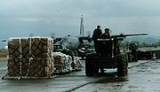
Humanitarian aid

Encyclopedia


Humanitarianism
In its most general form, humanitarianism is an ethic of kindness, benevolence and sympathy extended universally and impartially to all human beings. Humanitarianism has been an evolving concept historically but universality is a common element in its evolution...
purposes, typically in response to humanitarian crises
Humanitarian crisis
A humanitarian crisis is an event or series of events which represents a critical threat to the health, safety, security or wellbeing of a community or other large group of people, usually over a wide area...
including natural disaster
Natural disaster
A natural disaster is the effect of a natural hazard . It leads to financial, environmental or human losses...
and man-made disaster. The primary objective of humanitarian aid is to save lives, alleviate suffering
Suffering
Suffering, or pain in a broad sense, is an individual's basic affective experience of unpleasantness and aversion associated with harm or threat of harm. Suffering may be qualified as physical or mental. It may come in all degrees of intensity, from mild to intolerable. Factors of duration and...
, and maintain human dignity. It may therefore be distinguished from development aid
Development aid
Development aid or development cooperation is aid given by governments and other agencies to support the economic, environmental, social and political development of developing countries.It is distinguished...
, which seeks to address the underlying socioeconomic
Socioeconomics
Socioeconomics or socio-economics or social economics is an umbrella term with different usages. 'Social economics' may refer broadly to the "use of economics in the study of society." More narrowly, contemporary practice considers behavioral interactions of individuals and groups through social...
factors which may have led to a crisis or emergency.
According to The Overseas Development Institute, a London-based research establishment, whose findings were released in April 2009 in the paper 'Providing aid in insecure environments:2009 Update', the most lethal year in the history of humanitarianism was 2008, in which 122 aid workers were murdered and 260 assaulted. Those countries deemed least safe were Somalia
Somalia
Somalia , officially the Somali Republic and formerly known as the Somali Democratic Republic under Socialist rule, is a country located in the Horn of Africa. Since the outbreak of the Somali Civil War in 1991 there has been no central government control over most of the country's territory...
and Afghanistan
Afghanistan
Afghanistan , officially the Islamic Republic of Afghanistan, is a landlocked country located in the centre of Asia, forming South Asia, Central Asia and the Middle East. With a population of about 29 million, it has an area of , making it the 42nd most populous and 41st largest nation in the world...
.
Funding
Aid is funded by donationDonation
A donation is a gift given by physical or legal persons, typically for charitable purposes and/or to benefit a cause. A donation may take various forms, including cash, services, new or used goods including clothing, toys, food, and vehicles...
s from individuals, corporations, governments and other organizations. The funding and delivery of humanitarian aid is increasingly international, making it much faster, more responsive, and more effective in coping with to major emergencies affecting large numbers of people (e.g. see Central Emergency Response Fund
Central Emergency Response Fund
The Central Emergency Response Fund is a humanitarian funding mechanism established by the United Nations to enable more timely and reliable assistance to victims of natural disasters and armed conflicts...
). The United Nations Office for the Coordination of Humanitarian Affairs
Office for the Coordination of Humanitarian Affairs
The United Nations Office for the Coordination of Humanitarian Affairs , is a United Nations body formed in December 1991 by General Assembly Resolution 46/182...
(OCHA) coordinates the international humanitarian response to a crisis or emergency pursuant to Resolution 46/182 of the United Nations General Assembly
United Nations General Assembly
For two articles dealing with membership in the General Assembly, see:* General Assembly members* General Assembly observersThe United Nations General Assembly is one of the five principal organs of the United Nations and the only one in which all member nations have equal representation...
.
Composition
The total number of Humanitarian Aid workers around the world, has been calculated by ALNAPALNAP
ALNAP is a sector-wide network in the international humanitarian system made up of key international humanitarian organisations and experts...
, a network of agencies working in the Humanitarian System, as 210,800 in 2008. This is made up of roughly 50% from NGOs, 25% from the Red Cross/ Red Crescent Movement and 25% from the UN system.
The humanitarian fieldworker population has increased by approximately 6% per year over the past 10 years
Standards
During the past decade the humanitarian community has initiated a number of interagency initiatives to improve accountability, quality and performance in humanitarian action. Four of the most widely known initiatives are the Active Learning Network for Accountability and Performance in Humanitarian Action (ALNAP), Humanitarian Accountability Partnership (HAP), People In Aid and the Sphere Project. Representatives of these initiatives began meeting together on a regular basis in 2003 in order to share common issues and harmonise activities where possible.Working with its partners, disaster survivors, and others, Humanitarian Accountability Partnership International
Humanitarian Accountability Partnership International
Humanitarian Accountability Partnership International is the humanitarian sector's first international self-regulatory body, working towards the promotion of "Humanitarian Accountability"...
(or HAP International) produced the HAP 2007 Standard in Humanitarian Accountability and Quality Management. This certification scheme aims to provide assurance that certified agencies are managing the quality of their humanitarian actions in accordance with the HAP standard. In practical terms, a HAP certification (which is valid for three years) means providing external auditors with mission statements, accounts and control systems, giving greater transparency in operations and overall accountability.
As described by HAP-International, the HAP 2007 Standard in Humanitarian Accountability and Quality Management is a quality assurance tool. By evaluating an organisation's processes, policies and products with respect to six benchmarks setout in the Standard, the quality becomes measurable, and accountability in its humanitarian work increases.
Agencies that comply with the Standard:
- declare their commitment to HAP's Principles of Humanitarian Action and to their own Humanitarian Accountability Framework
- develop and implement a Humanitarian Quality Management System
- provide key information about quality management to key stakeholders
- enable beneficiaries and their representatives to participate in program decisions and give their informed consent
- determine the competencies and development needs of staff
- establish and implement complaints-handling procedure
- establish a process of continual improvement
The Sphere Project
Sphere Project
The Sphere Project was launched in 1997 to develop a set of minimum standards in core areas of humanitarian assistance. The aim of the project is to improve the quality of assistance provided to people affected by disasters, and to enhance the accountability of the humanitarian system in disaster...
handbook, Humanitarian Charter and Minimum Standards in Disaster Response, which was produced by a coalition of leading non governmental humanitarian agencies, lists the following principles of humanitarian action:
- The right to life with dignity
- The distinction between combatant and non-combatants
- The principle of non-refoulementNon-refoulementNon-refoulement is a principle in international law, specifically refugee law, that concerns the protection of refugees from being returned to places where their lives or freedoms could be threatened...
The Quality Project, based on The Quality COMPAS tool, is an alternative project to Sphere, taking into account the side effects of standardisation and those of an approach based on "minima" rather than the pursuit of quality. This project is led by Groupe URD.
See also
- HumanitarianismHumanitarianismIn its most general form, humanitarianism is an ethic of kindness, benevolence and sympathy extended universally and impartially to all human beings. Humanitarianism has been an evolving concept historically but universality is a common element in its evolution...
- :Category:Humanitarians
- :Category:Humanitarian and service awards
- Attacks on humanitarian workersAttacks on humanitarian workersHumanitarian aid workers belonging to United Nations organisations, PVOs / NGOs or the Red Cross / Red Crescent have traditionally enjoyed both international legal protection, and de facto immunity from attack by belligerent parties. However, attacks on humanitarian workers have occasionally...
- Humanitarian accessHumanitarian accessHumanitarian access is a specific legal term, referred to the ability by neutral humanitarian actors , to enter an area during a conflict, to provide humanitarian aid as well as monitor and promote human rights.As of 2007, a region where humanitarian access is a problem is Darfur...
- International humanitarian lawInternational humanitarian lawInternational humanitarian law , often referred to as the laws of war, the laws and customs of war or the law of armed conflict, is the legal corpus that comprises "the Geneva Conventions and the Hague Conventions, as well as subsequent treaties, case law, and customary international law." It...
- Vienna Declaration and Programme of ActionVienna Declaration and Programme of ActionThe Vienna Declaration and Programme of Action, also known as VDPA, is a human rights declaration adopted by consensus at the World Conference on Human Rights on 25 June 1993 in Vienna, Austria...
- Timeline of events in humanitarian relief and developmentTimeline of events in humanitarian relief and developmentThe following is a timeline of selected notable events in the history of humanitarian aid, international relief and development.* 1705 – Bhai Kanhaiya Ji , founder of the Sewa Panthi or Addenshahi sect of the Sikhs. He established a Dharamsala at Kavha village in the Attock district of...
- SadaqahSadaqahor Saddka is an Islamic term that means "voluntary charity".This concept encompasses any act of giving out of compassion, love, friendship or generosity.-Hadith on Sadaqah/Saddka:...
- ZakatZakatZakāt , one of the Five Pillars of Islam, is the giving of a fixed portion of one's wealth to charity, generally to the poor and needy.-History:Zakat, a practice initiated by Muhammed himself, has played an important role throughout Islamic history...
Organizations
- Humanitarian Accountability Partnership InternationalHumanitarian Accountability Partnership InternationalHumanitarian Accountability Partnership International is the humanitarian sector's first international self-regulatory body, working towards the promotion of "Humanitarian Accountability"...
- MedairMedairMedair is an international non-governmental organization NGO of humanitarian aid with a stated mission, "to seek out and serve the most vulnerable people affected by crises." Medair’s core competencies are emergency relief and rehabilitation...
, International Emergency Relief and Rehabilitation - World Vision InternationalWorld Vision InternationalWorld Vision International, founded in the USA in 1977, is an evangelical relief and development umbrella organization whose stated goal is "to follow our Lord and Saviour Jesus Christ in working with the poor and oppressed to promote human transformation, seek justice and bear witness to the good...
- World ConcernWorld ConcernWorld Concern is a Christian humanitarian organization that operates relief and development programsin 13 countries, and funds partnership programs in nine other countries. The organization’s mission...
- Médecins Sans FrontièresMédecins Sans Frontières' , or Doctors Without Borders, is a secular humanitarian-aid non-governmental organization best known for its projects in war-torn regions and developing countries facing endemic diseases. Its headquarters are in Geneva, Switzerland...
, MSF (Doctors Without Borders) - Mercy CorpsMercy CorpsMercy Corps is a global aid agency engaged in transitional environments that have experienced some sort of shock: natural disaster, economic collapse, or conflict. People working for it move as quickly as possible from bringing in food and supplies to enabling people to rebuild their economy with...
- AmeriCaresAmeriCaresAmeriCares is a non-profit disaster relief and humanitarian aid organization providing immediate response to emergency medical needs and supporting long-term health care initiatives for people in the United States and around the world. Since its founding in 1982, AmeriCares has provided more than...
- EU-CORD
- CARECARE (relief)CARE is a broad-spectrum secular relief, humanitarian, and development non-governmental organization fighting global poverty. It is non-political, non-sectarian and operates annually in more than 70 countries across the globe.One of the organization’s primary focuses in its fight to eradicate...
- Global Village Champions Foundation Inc., 501(c)(3)
- Islamic ReliefIslamic ReliefIslamic Relief Worldwide is a Muslim international relief and development organization consisting of a family of 15 aid agencies that aims to alleviate the suffering of the world’s poorest people...
- LDS Humanitarian ServicesLDS Humanitarian ServicesLDS Humanitarian Services is a branch of the Welfare Services department of The Church of Jesus Christ of Latter-day Saints...
- Malteser InternationalMalteser InternationalMalteser International is the worldwide relief agency of the Sovereign Military Order of Malta for humanitarian aid. The organisation covers around 200 projects in about 30 countries in Africa, Asia, Europe and the Americas...
- International Red Cross and Red Crescent Movement
- International Committee of the Red Cross
- Fundación Logistica Humanitaria
Organization types
- FoundationFoundation (charity)A foundation is a legal categorization of nonprofit organizations that will typically either donate funds and support to other organizations, or provide the source of funding for its own charitable purposes....
- Community serviceCommunity serviceCommunity service is donated service or activity that is performed by someone or a group of people for the benefit of the public or its institutions....
- Non-profit organizations
- Non-governmental organizations
External links
- Active Learning Network for Accountability and Performance
- APCN (Africa Partner Country Network)
- UN ReliefWeb
- AlertNet
- IRIN
- The ODI Humanitarian Policy Group
- Code of Conduct for the Red Cross and Red Crescent Movement and NGOs in Disaster Relief
- Professional Standards for Protection Work
- The Center for Disaster and Humanitarian Assistance Medicine (CDHAM)
- Centre for Safety and Development
- EM-DAT: The International Disaster Database
- CE-DAT: The Complex Emergency Database
- ATHA: Advanced Training in Humanitarian Action
Critiques of Humanitarian Aid
- A Bed for the Night: Humanitarianism in Crisis interview with David RieffDavid RieffDavid Rieff is an American polemicist and pundit. His books have focused on issues of immigration, international conflict, and humanitarianism...
and Joanne Myers - Journal of Humanitarian Assistance Sean Greenaway: Post-Modern Conflict and Humanitarian Action: Questioning the Paradigm