


Giulio Romano

Encyclopedia
Italy
Italy , officially the Italian Republic languages]] under the European Charter for Regional or Minority Languages. In each of these, Italy's official name is as follows:;;;;;;;;), is a unitary parliamentary republic in South-Central Europe. To the north it borders France, Switzerland, Austria and...
painter
Painting
Painting is the practice of applying paint, pigment, color or other medium to a surface . The application of the medium is commonly applied to the base with a brush but other objects can be used. In art, the term painting describes both the act and the result of the action. However, painting is...
and architect
Architecture
Architecture is both the process and product of planning, designing and construction. Architectural works, in the material form of buildings, are often perceived as cultural and political symbols and as works of art...
. A pupil of Raphael, his stylistic deviations from high Renaissance
Renaissance
The Renaissance was a cultural movement that spanned roughly the 14th to the 17th century, beginning in Italy in the Late Middle Ages and later spreading to the rest of Europe. The term is also used more loosely to refer to the historical era, but since the changes of the Renaissance were not...
classicism help define the 16th-century style known as Mannerism
Mannerism
Mannerism is a period of European art that emerged from the later years of the Italian High Renaissance around 1520. It lasted until about 1580 in Italy, when a more Baroque style began to replace it, but Northern Mannerism continued into the early 17th century throughout much of Europe...
. Giulio's drawings have long been treasured by collectors; contemporary prints
Old master print
An old master print is a work of art produced by a printing process within the Western tradition . A date of about 1830 is usually taken as marking the end of the period whose prints are covered by this term. The main techniques concerned are woodcut, engraving and etching, although there are...
of them engraved
Engraving
Engraving is the practice of incising a design on to a hard, usually flat surface, by cutting grooves into it. The result may be a decorated object in itself, as when silver, gold, steel, or glass are engraved, or may provide an intaglio printing plate, of copper or another metal, for printing...
by Marcantonio Raimondi
Marcantonio Raimondi
Marcantonio Raimondi, also simply Marcantonio, was an Italian engraver, known for being the first important printmaker whose body of work consists mainly of prints copying paintings. He is therefore a key figure in the rise of the reproductive print...
were a significant contribution to the spread of 16th-century Italian style throughout Europe.
Biography
Giulio Romano was born in RomeRome
Rome is the capital of Italy and the country's largest and most populated city and comune, with over 2.7 million residents in . The city is located in the central-western portion of the Italian Peninsula, on the Tiber River within the Lazio region of Italy.Rome's history spans two and a half...
.
In his native city, as a young assistant in Raphael
Raphael
Raffaello Sanzio da Urbino , better known simply as Raphael, was an Italian painter and architect of the High Renaissance. His work is admired for its clarity of form and ease of composition and for its visual achievement of the Neoplatonic ideal of human grandeur...
's studio, he worked on the frescos in the Vatican loggias to designs by Raphael and in Raphael's Stanze in the Vatican painted a group of figures in the Fire in the Borgo fresco. He also collaborated on the decoration of the ceiling of the Villa Farnesina
Villa Farnesina
The Villa Farnesina is a Renaissance suburban villa in the Via della Lungara, in the district of Trastevere in Rome, central Italy.The villa was built for Agostino Chigi, a rich Sienese banker and the treasurer of Pope Julius II. Between 1506–1510, the Sienese artist and pupil of Bramante,...
. After the death of Raphael in 1520, he helped complete the Vatican frescoes of the life of Constantine as well as Raphael's Coronation of the Virgin and the Transfiguration in the Vatican. In Rome, Giulio decorated the Villa Madama
Villa Madama
Villa Madama is situated half way up the slope of Monte Mario Which faces directly north-east and because the hill is curved the part which looks towards Rome faces south and the opposite faces north-west...
for Cardinal Giuliano de' Medici, afterwards Clement VII. The crowded Giulio Romano frescoes lack the stately and serene simplicity of his master.
Sack of Rome (1527)
The Sack of Rome on 6 May 1527 was a military event carried out by the mutinous troops of Charles V, Holy Roman Emperor in Rome, then part of the Papal States...
in 1527 and the death of Leo X, artistic patronage in Rome slackened. Vasari tells how Baldassare Castiglione
Baldassare Castiglione
Baldassare Castiglione, count of was an Italian courtier, diplomat, soldier and a prominent Renaissance author.-Biography:Castiglione was born into an illustrious Lombard family at Casatico, near Mantua, where his family had constructed an impressive palazzo...
was delegated by Federico Gonzaga to procure Giulio to execute paintings and architectural and engineering projects for the duchy of Mantua
Mantua
Mantua is a city and comune in Lombardy, Italy and capital of the province of the same name. Mantua's historic power and influence under the Gonzaga family, made it one of the main artistic, cultural and notably musical hubs of Northern Italy and the country as a whole...
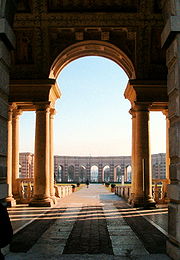
. His masterpiece of architecture and fresco painting in that city is the suburban Palazzo Te, with its famous illusionistic frescos (c. 1525–1535). He also helped rebuild the ducal palace in Mantua, reconstructed the cathedral, and designed the nearby Church of San Benedetto. Sections of Mantua that had been flood-prone were refurbished under Giulio's direction, and the duke's patronage and friendship never faltered: Giulio's annual income amounted to more than 1000 ducats. His studio became a popular school of art.
In Renaissance
Renaissance
The Renaissance was a cultural movement that spanned roughly the 14th to the 17th century, beginning in Italy in the Late Middle Ages and later spreading to the rest of Europe. The term is also used more loosely to refer to the historical era, but since the changes of the Renaissance were not...
tradition, many works of Giulio's were only temporary. According to Giorgio Vasari
Giorgio Vasari
Giorgio Vasari was an Italian painter, writer, historian, and architect, who is famous today for his biographies of Italian artists, considered the ideological foundation of art-historical writing.-Biography:...
:
He traveled to France
France
The French Republic , The French Republic , The French Republic , (commonly known as France , is a unitary semi-presidential republic in Western Europe with several overseas territories and islands located on other continents and in the Indian, Pacific, and Atlantic oceans. Metropolitan France...
in the first half of the 16th century and brought concepts of the Italian style to the French court of Francis I
Francis I of France
Francis I was King of France from 1515 until his death. During his reign, huge cultural changes took place in France and he has been called France's original Renaissance monarch...
.
Giulio also designed tapestries and the erotic album I Modi
I Modi
I Modi , also known as The Sixteen Pleasures or under the Latin title De omnibus Veneris Schematibus, is a famous erotic book of the Italian Renaissance in which a series of sexual positions were explicitly depicted in engravings. While the original edition was apparently completely destroyed by...
which was expertly engraved
Engraving
Engraving is the practice of incising a design on to a hard, usually flat surface, by cutting grooves into it. The result may be a decorated object in itself, as when silver, gold, steel, or glass are engraved, or may provide an intaglio printing plate, of copper or another metal, for printing...
by Marcantonio Raimondi
Marcantonio Raimondi
Marcantonio Raimondi, also simply Marcantonio, was an Italian engraver, known for being the first important printmaker whose body of work consists mainly of prints copying paintings. He is therefore a key figure in the rise of the reproductive print...
, a project that landed Raimondi in jail in Rome.
He died in Mantua in 1546.
Giulio Romano has the distinction of being the only Renaissance artist to be mentioned by William Shakespeare
William Shakespeare
William Shakespeare was an English poet and playwright, widely regarded as the greatest writer in the English language and the world's pre-eminent dramatist. He is often called England's national poet and the "Bard of Avon"...
. In Act V, Scene II of The Winter's Tale
The Winter's Tale
The Winter's Tale is a play by William Shakespeare, originally published in the First Folio of 1623. Although it was grouped among the comedies, some modern editors have relabelled the play as one of Shakespeare's late romances. Some critics, among them W. W...
Queen Hermione's statue is by "that rare Italian master, Julio Romano", although Giulio was not a sculptor.
Selected paintings and drawings
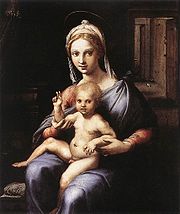
- The Stoning of St. Stephen (Santo Stefano, Genoa): "Giulio never did a finer work than this," said VasariGiorgio VasariGiorgio Vasari was an Italian painter, writer, historian, and architect, who is famous today for his biographies of Italian artists, considered the ideological foundation of art-historical writing.-Biography:...
. Domenico del Barbiere engraved the subject, so that it influenced designers who never saw the original in Genoa. - Adoration of the Magi (Louvre).
- Fire in the Borgo, fresco (Raphael RoomsRaphael RoomsThe four Stanze di Raffaello in the Palace of the Vatican form a suite of reception rooms, the public part of the papal apartments. They are famous for their frescoes, painted by Raphael and his workshop...
in Vatican City). - Emblematic Figures, pen and brown ink and wash over graphite (Fine Arts Museum of San Francisco).
- The Battle of the Milvian BridgeThe Battle of the Milvian Bridge (Giulio Romano)The Battle of the Milvian Bridge, or The Battle at Pons Milvius, is a fresco in one of the rooms that are now known as the Stanze di Raffaello, in the Apostolic Palace in the Vatican...
- The Triumph of Titus and Vespasian
External links
- Vitahttp://www.artist-biography.info/artist/giulio_romano/ by Giorgio VasariGiorgio VasariGiorgio Vasari was an Italian painter, writer, historian, and architect, who is famous today for his biographies of Italian artists, considered the ideological foundation of art-historical writing.-Biography:...
, who describes his meeting with Giulio:
- " At this time Giorgio Vasari a great friend of Giulio, though they only knew each other by report and by letters, passed through Mantua on his way to Venice to see him and his works. On meeting, they recognised each other as though they had met a thousand times before. Giulio was so delighted that he spent four days in showing Vasari all his works, especially the plans of ancient buildings at Rome, Naples, Pozzuolo, Campagna, and all the other principal antiquities designed partly by him and partly by others. Then, opening a great cupboard, he showed him plans of all the buildings erected from his designs in Mantua, Rome and all Lombardy, so beautiful that I do not believe that more original, fanciful or convenient buildings exist."