
All Topics  
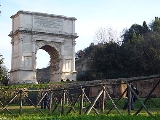
Arch of Titus

 
Arch of Titus

   Email Print
   Bookmark   Link


Arch of Titus


The Arch of Titus is a Pentelic marble triumphal arch
Triumphal arch

A triumphal arch is a structure in the shape of a monumental arch, in theory built to celebrate a victory in war, actually used to celebrate a ruler....
 with a single arched opening, located on the Via Sacra
Via Sacra

The Via Sacra is the main street of ancient Rome, leading from the top of the Capitoline Hill, through some of the most important religious sites of the Roman Forum , to the Colosseum....
 just to the south-east of the Forum
Roman Forum

The Roman Forum , sometimes known by its original Latin name, is located between the Palatine hill and the Capitoline hill of the city of Rome. It is the central area around which the Ancient Rome developed....
 in Rome
Rome

Rome is the capital city of Italy and Lazio, and is Italy's largest and most populous city, with 2,724,347 residents in an urban area of some ....
. It was constructed by the emperor Domitian
Domitian

Titus Flavius Domitianus , commonly known as Domitian, was a Roman Emperor who reigned from 14 September 81 until his death. Domitian was the last emperor of the Flavian dynasty, which ruled the Roman Empire between 69 and 96, encompassing the reigns of Domitian's father Vespasian , his elder brother Titus , and that of Domitian himself...
 shortly after the death of his older brother Titus
Titus

Titus Flavius Vespasianus, commonly known as Titus , was a Roman Emperor who briefly reigned from 79 until his death in 81. Titus was the second emperor of the Flavian dynasty, which ruled the Roman Empire between 69 and 96, encompassing the reigns of Titus's father Vespasian , Titus himself and his younger brother Domitian ....
 (born AD 41
41

Year 41 was a common year starting on Sunday of the Julian calendar....
, emperor 79
79

Year 79 was a common year starting on Friday of the Julian calendar....
-81
81

Year 81 was a common year starting on Monday of the Julian calendar....
), commemorating the capture and sack of Jerusalem in 70
70

Year 70 was a common year starting on Monday of the Julian calendar....
, which effectively terminated the Jewish War begun in 66
66

Year 66 was a common year starting on Wednesday of the Julian calendar....
 (although the Romans did not achieve complete victory until the fall of Masada
Masada

Masada is the name for a site of ancient palaces and fortifications in the South District of Israel on top of an isolated rock plateau, or large mesa, on the eastern edge of the Judean Desert overlooking the Dead Sea....
 in 73
73

Year 73 was a common year starting on Friday of the Julian calendar....
).

The Arch of Titus has provided the general model for many of the triumphal arch
Triumphal arch

A triumphal arch is a structure in the shape of a monumental arch, in theory built to celebrate a victory in war, actually used to celebrate a ruler....
es erected since the 16th century.

Arch of Titus is arranged in five bays with an ABA rhythm, the side bays perpendicular to the central axial arch.


Discussion
Ask a question about 'Arch of Titus'
Start a new discussion about 'Arch of Titus'
Answer questions from other users
Full Discussion Forum


Encyclopedia


The Arch of Titus is a Pentelic marble triumphal arch
Triumphal arch

A triumphal arch is a structure in the shape of a monumental arch, in theory built to celebrate a victory in war, actually used to celebrate a ruler....
 with a single arched opening, located on the Via Sacra
Via Sacra

The Via Sacra is the main street of ancient Rome, leading from the top of the Capitoline Hill, through some of the most important religious sites of the Roman Forum , to the Colosseum....
 just to the south-east of the Forum
Roman Forum

The Roman Forum , sometimes known by its original Latin name, is located between the Palatine hill and the Capitoline hill of the city of Rome. It is the central area around which the Ancient Rome developed....
 in Rome
Rome

Rome is the capital city of Italy and Lazio, and is Italy's largest and most populous city, with 2,724,347 residents in an urban area of some ....
. It was constructed by the emperor Domitian
Domitian

Titus Flavius Domitianus , commonly known as Domitian, was a Roman Emperor who reigned from 14 September 81 until his death. Domitian was the last emperor of the Flavian dynasty, which ruled the Roman Empire between 69 and 96, encompassing the reigns of Domitian's father Vespasian , his elder brother Titus , and that of Domitian himself...
 shortly after the death of his older brother Titus
Titus

Titus Flavius Vespasianus, commonly known as Titus , was a Roman Emperor who briefly reigned from 79 until his death in 81. Titus was the second emperor of the Flavian dynasty, which ruled the Roman Empire between 69 and 96, encompassing the reigns of Titus's father Vespasian , Titus himself and his younger brother Domitian ....
 (born AD 41
41

Year 41 was a common year starting on Sunday of the Julian calendar....
, emperor 79
79

Year 79 was a common year starting on Friday of the Julian calendar....
-81
81

Year 81 was a common year starting on Monday of the Julian calendar....
), commemorating the capture and sack of Jerusalem in 70
70

Year 70 was a common year starting on Monday of the Julian calendar....
, which effectively terminated the Jewish War begun in 66
66

Year 66 was a common year starting on Wednesday of the Julian calendar....
 (although the Romans did not achieve complete victory until the fall of Masada
Masada

Masada is the name for a site of ancient palaces and fortifications in the South District of Israel on top of an isolated rock plateau, or large mesa, on the eastern edge of the Judean Desert overlooking the Dead Sea....
 in 73
73

Year 73 was a common year starting on Friday of the Julian calendar....
).

The Arch of Titus has provided the general model for many of the triumphal arch
Triumphal arch

A triumphal arch is a structure in the shape of a monumental arch, in theory built to celebrate a victory in war, actually used to celebrate a ruler....
es erected since the 16th century.

Description

Arc De Titus Frontal
The Arch of Titus is arranged in five bays with an ABA rhythm, the side bays perpendicular to the central axial arch. The corners are articulated with a massive order of engaged column
Engaged column

In architecture, an engaged column is a column embedded in a wall and partly projecting from the surface of the wall, sometimes defined as semi or three-quarter detached....
s that stand on a high ashlar basement. The capitals are Corinthian
Corinthian order

The Corinthian order is one of the Classical orders of Greece and Rome architecture, characterized by a slender Fluting column and an ornate capital decorated with acanthus leaves and scrolls....
, but with prominent volute
Volute

A volute is a spiral scroll-like ornament that forms the basis of the Ionic order, found in the Capital of the Ionic column. It was later incorporated into Corinthian order and Composite order column capitals....
s of the Ionic order
Ionic order

The Ionic order column forms one of the Classical order of classical architecture, the other two canonic orders being the Doric order and the Corinthian order....
 projecting laterally above the acanthus foliage
Acanthus (ornament)

The acanthus is one of the most common ornaments used to depict foliage. Architectural ornaments are carved in stone or wood in the appearance of leaves from the Mediterranean Acanthus plant, with some resemblance to thistle, poppy and parsley leaves....
—the earliest example of the composite order
Composite order

The composite order is a mixed classical order, combining the volutes of the Ionic order capital with the acanthus leaves of the Corinthian order....
. Above the main cornice rises a high weighty attic on which is a central tablet bearing the dedicatory inscription. The entablatures break forward over the columns and the wide central arch, and the profile of the column shafts transforms to square. Flanking the central arch, the side bays now each contain a shallow niche-like blind aedicular window, a discreet early 19th century restoration.
Arch of Titus Detail
The soffit
Soffit

Soffit , in architecture, describes the underside of any construction element. Examples of soffits include:* the underside of an arch or architrave ,...
 of the axial archway is deeply coffer
Coffer

A coffer in architecture, is a sunken panel in the shape of a square, rectangle, or octagon in a ceiling, soffit or Vault . A series of these sunken panels were used as decoration for a ceiling or a vault, also called caissons , or lacunaria , so that a coffered ceiling can be called a lacunar ceiling....
ed with a relief of the apotheosis
Apotheosis

Apotheosis refers to the exaltation of a subject to divinity level. The term has meanings in theology, where it refers to a belief, and in art, where it refers to a genre....
 of Titus at the center. The sculptural program also includes two panel reliefs lining the passageway. Both commemorate the joint triumph
Roman triumph

A Roman triumph was a civil religion and religious rite of ancient Rome, held to publically celebrate the achievements of an army commander who had won great military successes, originally and traditionally, who had successfully completed a war....
 celebrated by Titus and his father Vespasian
Vespasian

Titus Flavius Vespasianus, commonly known as Vespasian , was a Roman Emperor who reigned from 69 A.D. until his death in 79 A.D. Vespasian was the founder of the short lived Flavian dynasty, which ruled the Roman Empire between 69 A.D....
 in the summer of 71
71

Year 71 was a common year starting on Tuesday of the Julian calendar....
. One of the panels depicts the spoils taken from the Temple
Temple in Jerusalem

The Temple in Jerusalem or Holy Temple , refers to a series of structures located on the Temple Mount in the old city of Jerusalem. Historically, two temples were built at this location, and a The Third Temple features in Jewish eschatology....
, while the other depicts Titus as triumphator attended by various genii and lictor
Lictor

The lictor, derived from the Latin ligare , was a member of a special class of Rome civil servant, with special tasks of attending and guarding magistrates of the Roman Republic and Roman Empire who held imperium; essentially, a bodyguard....
s. The sculpture of the outer faces of the two great piers was lost when the Arch of Titus was incorporated in medieval defensive walls. The attic
Attic style

In classical architecture, the term attic refers to a story or low wall above the cornice of a classical fa?ade. This usage originated in the 17th century from the use of Attica style pilasters as adornments on the top story's fa?ade....
 of the arch was originally crowned by more statuary, perhaps of a quadriga
Quadriga

A quadriga is a car or chariot drawn by four horses abreast . It was raced in the Ancient Olympic Games and other games. It is represented in profile as the chariot of Greek mythology on Greek vases and in bas-relief....
 pulled by elephants.

Based on the style of sculptural details, Domitian
Domitian

Titus Flavius Domitianus , commonly known as Domitian, was a Roman Emperor who reigned from 14 September 81 until his death. Domitian was the last emperor of the Flavian dynasty, which ruled the Roman Empire between 69 and 96, encompassing the reigns of Domitian's father Vespasian , his elder brother Titus , and that of Domitian himself...
's favored architect Rabirius
Rabirius (architect)

Rabirius was an Ancient Rome architect who lived during the 1st and 2nd Century AD. His designs included the massive Flavian Palace, situated on the Palatine Hill at Rome, and the Alban Villa at present-day Castel Gandolfo, both erected on a commission by his patron, Roman Emperor Domitian....
, sometimes credited with the Colosseum
Colosseum

The Colosseum or Roman Coliseum, originally the Flavian Amphitheatre , is an elliptical amphitheatre in the center of the city of Rome, Italy, the largest ever built in the Roman Empire....
, may have executed the arch. Without contemporary documentation, however, attributions of Roman buildings on basis of style are considered shaky.

"The arch was constructed of Pentelic marble, and is 13.50 metres wide, 15.40 high, and 4.75 deep. The archway is 8.30 metres high and 5.36 wide. Above it is a simple entablature, and an attic 4.40 metres in height, on which is the inscription, which is preserved only on the east side. On each side is an engaged and fluted Corinthian column, standing on a square pedestal. The capitals of these columns are the earliest examples of the Composite style. On the inner jambs of the arch are the two famous reliefs (PBS III.276-279; V.178; Strong, cit.), that on the south..."

The main inscription used to be ornamented by letters made of silver
Silver

Silver is a chemical element with the chemical symbol Ag and atomic number 47. A soft, white, lustrous transition metal, it has the highest electrical conductivity of any element and the highest thermal conductivity of any metal....
 or pehaps gold
Gold

Gold is a chemical element with the symbol Au and atomic number 79. It is a highly sought-after precious metal, having been used as money, as a store of value, in jewelry, in sculpture, and for ornamentation since the beginning of recorded history....
 or some other metal
Metal

In chemistry, a metal is a chemical element whose atoms readily lose electrons to form positive ions , and form metallic bonds between other metal atoms and ionic bonds between nonmetal atoms....
.

Inscription

Arch
The inscription in Roman square capitals
Roman square capitals

Roman square capitals, also called inscriptional capitals, elegant capitals and quadrata, are an ancient Rome form of writing, and the basis for modern capital letters....
 reads:

SENATVS
POPVLVSQVE·ROMANVS
DIVO·TITO·DIVI·VESPASIANI·F(ILIO)
VESPASIANO·AVGVSTO


Which means "The Senate and People of Rome
SPQR

SPQR is an Acronym and initialism from a Latin phrase, Senatus Populusque Romanus , referring to the government of the ancient Roman Republic, and used as an official signature of the government....
 (dedicate this) to the divine Titus Vespasianus Augustus, son of the divine Vespasian."

The opposite side of the Arch of Titus received new inscriptions after it was restored during the pontificate of Pope Pius VII
Pope Pius VII

Pope Pius VII, Order of Saint Benedict , born Count Barnaba Niccol? Maria Luigi Chiaramonti, was Pope from March 14, 1800 to August 20, 1823....
 by Giuseppe Valadier
Giuseppe Valadier

Giuseppe Valadier was an Italian architect and designer, urban planner and archeologist, a chief exponent of Neoclassicism in Italy....
 in 1821. The restoration was intentionally made in travertine
Travertine

Travertine is a sedimentary rock. It is a natural chemical precipitation of carbonate minerals; typically aragonite, but often recrystallized to, or primarily, calcite....
 to differentiate between the original and the restored portions.

The inscription reads:
Sack of Jerusalem
INSIGNE · RELIGIONIS · ATQVE · ARTIS · MONVMENTVM
VETVSTATE · FATISCENS
PIVS · SEPTIMVS · PONTIFEX · MAX(IMVS)
NOVIS · OPERIBVS · PRISCVM · EXEMPLAR · IMITANTIBVS
FVLCIRI · SERVARIQVE · IVSSIT
ANNO · SACRI · PRINCIPATVS · EIVS · XXIIII


(This) monument, remarkable in terms of both religion and art,
had weakened from age:
Pius the Seventh, Supreme Pontiff,
by new works on the model of the ancient exemplar
ordered it reinforced and preserved.
• In the year of his sacred rulership the 24th •


History

The Frangipani family
Frangipani family

The Frangipani or Frangipane was a powerful Romen patrician clan in the Middle Ages. The family was typically Ghibelline in sympathy and thus often at odds with the papacy....
 turned it into a fortified tower in the Middle Ages
Middle Ages

File:Karl 1 mit papst gelasius gregor1 sacramentar v karl d kahlen.jpgThe Middle Ages of European history are a period in history which lasted for roughly a millennium, commonly dated from the fall of the Roman Empire in the 5th century to the beginning of the Early Modern Period in the 16th century, marked by the division of Western Christi...


In a later era, Pope Paul IV made it the place of a yearly oath of submission
Loyalty oath

A loyalty oath is an oath of loyalty to an organization, institution, or state of which an individual is a member.In this context, a loyalty oath is not a pledge or oath of allegiance....
, forced by the Pope
Pope

The Pope is the Bishop of Rome, the leader of the Roman Catholic Church and head of state of Vatican City. The current pope is Pope Benedict XVI, who was elected April 19, 2005 in Papal conclave, 2005....
 on the Jews of the new Roman Ghetto
Roman Ghetto

The Roman Ghetto was located in the Sant'Angelo , in the area surrounded by today's Via del Portico d'Ottavia, Lungotevere dei Cenci, Via del Progresso and Via di Santa Maria del Pianto close to the Tiber and the Theater of Marcellus, in Rome, Italy....
.

It was one of the first buildings sustaining a modern restoration, starting with Raffaello Stern in 1817 and continued by Valadier under Pius VII in 1821, with new capitals and with travertine
Travertine

Travertine is a sedimentary rock. It is a natural chemical precipitation of carbonate minerals; typically aragonite, but often recrystallized to, or primarily, calcite....
 masonry, distinguishable from the original. The restoration was a model for the country side of Porta Pia
Porta Pia

Porta Pia is a gate in the Aurelian Walls of Rome. Italy. One of Pope Pius IV's civic improvements to the city, it is named after him. Situated at the end of a new street, the Via Pia, it was designed by Michelangelo in replacement for the Porta Nomentana situated several hundred meters southwards, which was closed up at the same time....
.

Historical significance

The Arch of Titus provides the only contemporary depiction of sacred articles from the Temple in Jerusalem
Temple in Jerusalem

The Temple in Jerusalem or Holy Temple , refers to a series of structures located on the Temple Mount in the old city of Jerusalem. Historically, two temples were built at this location, and a The Third Temple features in Jewish eschatology....
. The menorah and trumpet
Trumpet

The trumpet is a musical instrument with the highest Register in the brass instrument family. Trumpets are among the oldest musical instruments, dating back to at least 1500 BC....
s are clearly depicted, as well as what might be the Table of Showbread.

Due to the depiction of the destruction of Jerusalem and the desecration of the Temple, many Jews refuse to walk underneath the arch to this very day. A notable exception occurred in 1948 at the founding of Israel
Israel

Israel officially the State of Israel , is a country in the Middle East located on the eastern shore of the Mediterranean Sea. It borders Lebanon in the north, Syria in the northeast, Jordan in the east, and Egypt on the southwest, and contains geographically diverse features within its relatively small area....
, when a large contingent from the Roman Jewish community walked through the arch in the opposite direction from the original Ancient Roman triumphal march.

The depiction of the menorah (seven-branched lampstand) from the Temple in Jerusalem
Temple in Jerusalem

The Temple in Jerusalem or Holy Temple , refers to a series of structures located on the Temple Mount in the old city of Jerusalem. Historically, two temples were built at this location, and a The Third Temple features in Jewish eschatology....
 on the arch, was used for the coat of arms of Israel
Coat of arms of Israel

File:Coat of arms of Israel.svgThe Emblem of Israel shows a Menorah surrounded by an olive branch on each side, and the writing "?????" below it....
.

Works modeled on, or inspired by, the Arch of Titus

  • The National Memorial Arch
    National Memorial Arch

    The National Memorial Arch is dedicated "to the officers and private soldiers of the Continental Army December 19, 1777 June 19, 1778". The Arch is located in Valley Forge National Historical Park in Pennsylvania....
     (1910) at Valley Forge National Historical Park
    Valley Forge National Historical Park

    Valley Forge National Historical Park is the site where the Continental Army spent the winter of 1777–1778 near Valley Forge, Pennsylvania, during the American Revolutionary War....
    , Pennsylvania
    Pennsylvania

    The Commonwealth of Pennsylvania , often colloquially referred to as PA by natives and Northeasterners, is a U.S. state located in the Northeastern United States and Mid-Atlantic States regions of the United States....
    , USA.
  • San Andrea at Mantua by Leon Battista Alberti
  • The Arc de Triomphe
    Arc de Triomphe

    The Arc de Triomphe is a monument in Paris, France that stands in the centre of the Place Charles de Gaulle, also known as the Place de l'?toile....
     in Paris
    Paris

    Paris is the Capital of France and the country's largest city. It is situated on the river Seine, in northern France, at the heart of the ?le-de-France Regions of France ....

See also

  • Great Jewish Revolt
    First Jewish-Roman War

    The first Jewish-Roman War , sometimes called The Great Revolt , was the first of three Jewish-Roman wars by the Jews of Iudaea Province against the Roman Empire ....
  • Judaea Capta coinage
    Judaea Capta coinage

    Judaea Capta coins were a series of commemorative coins originally issued by the Roman Emperor Vespasian to celebrate the capture of Iudaea Province and the destruction of the Jewish Temple in Jerusalem by his son Titus in 70 AD during the First Jewish-Roman War....
  • List of artifacts significant to the Bible
    List of artifacts significant to the Bible

    The following is a list of Artifact , objects created or modified by a human culture, that are significant to the historicity of the Bible....
  • Siege of Jerusalem
    Siege of Jerusalem (70)

    The Siege of Jerusalem in the year 70 AD was a decisive event in the First Jewish-Roman War. It was followed by the Masada#History in 73 AD. The Roman Empire army, led by the future Emperor Titus, with Tiberius Julius Alexander as his second-in-command, besieged and conquered the city of Jerusalem, which had been occupied by its Jewish defend...
  • Temple in Jerusalem
    Temple in Jerusalem

    The Temple in Jerusalem or Holy Temple , refers to a series of structures located on the Temple Mount in the old city of Jerusalem. Historically, two temples were built at this location, and a The Third Temple features in Jewish eschatology....


External links

  • Arch of Titus
  • History and photos