
All Topics  
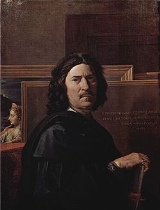
Nicolas Poussin

 
Nicolas Poussin

   Email Print
   Bookmark   Link


Nicolas Poussin


Nicolas Poussin (15 June 1594 – 19 November 1665) was a French painter
Painting

Painting is the practice of applying paint, pigment, color or other medium to a surface . In art, the term describes both the act and the result, which is called a painting....
 in the classical
Classicism

File:Nicolas Poussin 055.jpgClassicism, in the The Arts, refers generally to a high regard for classical antiquity, as setting standards for taste which the classicists seeks to emulate....
 style. His work predominantly features clarity, logic, and order, and favors line over color. Until the 20th century he remained the dominant inspiration for such classically-oriented artists as Jacques-Louis David
Jacques-Louis David

Jacques-Louis David was a highly influential France painter in the Neoclassicism style, considered to be the preeminent painter of the era. In the 1780s his cerebral brand of history painting marked a change in taste away from Rococo frivolity toward a classical austerity and severity, chiming with the moral climate of the final years of th...
 and Paul Cézanne
Paul Cézanne

Paul C?zanne was a French artist and Post-Impressionist Painting whose work laid the foundations of the transition from the 19th century conception of artistic endeavour to a new and radically different world of art in the 20th century....
.

He spent most of his working life in Rome
Rome

Rome is the capital city of Italy and Lazio, and is Italy's largest and most populous city, with 2,724,347 residents in an urban area of some ....
, except for a short period when Cardinal Richelieu ordered him back to France to serve as First Painter to the King.

las Poussin's early biographer was his friend Giovanni Pietro Bellori, who relates that Poussin was born near Les Andelys
Les Andelys

Les Andelys is a commune in France in the Eure Departments of France in Haute-Normandie in northern France. It lies on the Seine, 20 miles northeast of ?vreux....
 in Normandy
Normandy

Normandy is a geographical region corresponding to the former Duchy of Normandy. It is situated along the coast of France south of the English Channel between Brittany and Picardy and comprises territory in northern France and the Channel Islands....
 and that he received an education that included some Latin, which would stand him in good stead.


Discussion
Ask a question about 'Nicolas Poussin'
Start a new discussion about 'Nicolas Poussin'
Answer questions from other users
Full Discussion Forum


Quotations


Painting is the lover of beauty and the queen of arts.


Encyclopedia


Nicolas Poussin (15 June 1594 – 19 November 1665) was a French painter
Painting

Painting is the practice of applying paint, pigment, color or other medium to a surface . In art, the term describes both the act and the result, which is called a painting....
 in the classical
Classicism

File:Nicolas Poussin 055.jpgClassicism, in the The Arts, refers generally to a high regard for classical antiquity, as setting standards for taste which the classicists seeks to emulate....
 style. His work predominantly features clarity, logic, and order, and favors line over color. Until the 20th century he remained the dominant inspiration for such classically-oriented artists as Jacques-Louis David
Jacques-Louis David

Jacques-Louis David was a highly influential France painter in the Neoclassicism style, considered to be the preeminent painter of the era. In the 1780s his cerebral brand of history painting marked a change in taste away from Rococo frivolity toward a classical austerity and severity, chiming with the moral climate of the final years of th...
 and Paul Cézanne
Paul Cézanne

Paul C?zanne was a French artist and Post-Impressionist Painting whose work laid the foundations of the transition from the 19th century conception of artistic endeavour to a new and radically different world of art in the 20th century....
.

He spent most of his working life in Rome
Rome

Rome is the capital city of Italy and Lazio, and is Italy's largest and most populous city, with 2,724,347 residents in an urban area of some ....
, except for a short period when Cardinal Richelieu ordered him back to France to serve as First Painter to the King.

Early career


Nicolas Poussin 052
Nicolas Poussin's early biographer was his friend Giovanni Pietro Bellori, who relates that Poussin was born near Les Andelys
Les Andelys

Les Andelys is a commune in France in the Eure Departments of France in Haute-Normandie in northern France. It lies on the Seine, 20 miles northeast of ?vreux....
 in Normandy
Normandy

Normandy is a geographical region corresponding to the former Duchy of Normandy. It is situated along the coast of France south of the English Channel between Brittany and Picardy and comprises territory in northern France and the Channel Islands....
 and that he received an education that included some Latin, which would stand him in good stead. Early sketches attracted the notice of Quentin Varin, a local painter, whose pupil Poussin became, until he ran away to Paris at the age of eighteen. There he entered the studios of the Flemish
Flanders

Flanders is a geographical region located in parts of present-day Belgium, France, and the Netherlands. Over the course of history, the geographical territory that was called "Flanders" has varied....
 painter Ferdinand Elle and then of Georges Lallemand, both minor masters now remembered for having tutored Poussin. He found French art
French art

For practical purposes, the history of French art has been divided into a series of separate articles accessible through the template to the right. The template also gives direct access to French art category indexes, such as alphabetical lists of painters or sculptors....
 in a stage of transition: the old apprenticeship system was disturbed, and the academic training
Academic art

Academic art is a style of painting and sculpture produced under the influence of European academy or universities.Specifically, academic art is the art and artists influenced by the standards of the French Acad?mie des beaux-arts, which practiced under the movements of Neoclassicism and Romanticism, and the art that followed these two mo...
 destined to supplant it was not yet established by Simon Vouet
Simon Vouet

Simon Vouet was a France painter and draftsman, who helped introduce the Italian Baroque style to France.A French contemporary, lacking the term "Baroque", said, "In his time the art of painting began to be practiced here in a nobler and more beautiful way than ever before," and the allegory of "Riches" demonstrates a new heroic sen...
; but having met Courtois
Courtois

Courtois can refer to:* Courtois, Missouri, unincorporated community* Courtois Creek, Missouri* Jacques Courtois, French painter * Guillaume Courtois, French painter ...
 the mathematician
Mathematician

A mathematician is a person whose primary area of study and/or research is the field of mathematics....
, Poussin was fired by the study of his collection of engravings by Marcantonio Raimondi
Marcantonio Raimondi

Marcantonio Raimondi, also simply Marcantonio, was an Italy engraver, known for being the first important printmaker whose body of work consists mainly of prints copying paintings....
 after Italian masters.

Poussin Rapesabinelouvre
After two abortive attempts to reach Rome, he fell in with Giambattista Marino, the court poet to Marie de Medici, at Lyon
Lyon

||-||}Lyon, also known as Lyons in English, is a city in east-central France. Its name is pronounced in French language and Franco-Proven?al language, and or in English language....
. Marino employed him on illustrations to his poem Adone (untraced) and on a series of illustrations for a projected edition of Ovid's Metamorphoses
Metamorphoses (poem)

The Metamorphoses by the Ancient Rome poet Ovid is a Narrative poetry in fifteen books that describes the Creation myth and history of the world....
, took him into his household, and in 1624 enabled Poussin (who had been detained by commissions in Lyon and Paris) to rejoin him at Rome.

Early years in Rome

In Rome, his patron having died, Poussin, who lodged at first with Simon Vouet
Simon Vouet

Simon Vouet was a France painter and draftsman, who helped introduce the Italian Baroque style to France.A French contemporary, lacking the term "Baroque", said, "In his time the art of painting began to be practiced here in a nobler and more beautiful way than ever before," and the allegory of "Riches" demonstrates a new heroic sen...
, fell into great distress, with the departure for Spain of his early patron Cardinal Francesco Barberini
Francesco Barberini (seniore)

Francesco Barberini seniore was an Italy Cardinal of the Roman Catholic Church, a member of the powerful Barberini family....
 and the Cardinal's secretary, the antiquary Cassiano dal Pozzo
Cassiano dal Pozzo

Cassiano dal Pozzo , was an Italian scholar and patron of arts. The secretary of Cardinal Francesco Barberini , he was an antiquary in the classicizing circle of Rome, and a long-term friend and patron of Nicolas Poussin, whom he supported from his earliest arrival in Rome: Poussin in a letter declared that he was "a disciple of the house an...
, later a great friend and patron. The return of Barberini from Spain in 1626 stabilized and renewed the patronage of the Barberini and their circle. Two major commissions at this period resulted in Poussin's early masterwork the Barberini Death of Germanicus, partly inspired by the reliefs of the Meleager sarcophagus, and the commission for St. Peter's that amounted to a public debut, the Martyrdom of St. Erasmus (1630), with echoes of Pietro da Cortona
Pietro da Cortona

Pietro da Cortona, byname of Pietro Berrettini was an Italian artist and architect of High Baroque. He is best known for painting fresco ceilings, a pursuit in which he had ample competition in the Rome of his day, but he was equally adept and masterful with architectural design....
. Falling ill at this time, he was received into the house of his compatriot Gaspard Dughet
Gaspard Dughet

Gaspard Dughet was a French Painting.The adoptive son of Nicolas Poussin, he was actually the brother of Poussin's wife. He devoted himself to Landscape art painting and rendered admirably the severer beauties of the Roman Campagna; a noteworthy series of works in tempera representing various sites near Rome is to be seen in the Colonna P...
 and nursed by his daughter Anna Maria to whom, in 1630, Poussin was married.

Tancred
He lodged with the sculptor François Duquesnoy
François Duquesnoy

Fran?ois Duquesnoy was a prominent Baroque sculptor in Rome. His more idealized representations are often contrasted with the emotional character of Gian Lorenzo Bernini's works, while his style shows greater affinity to Alessandro Algardi's sculptures....
, of an equally classicizing artistic temperament, befriended Domenichino and joined an informal academy
Academy

An academy is an institution of higher learning, research, or honorary membership.The name traces back to Plato's school of philosophy, founded approximately 385 BC at Akademia, a sanctuary of Athena, the goddess of wisdom, north of Ancient Athens, Greece....
 of artists and patrons opposed to the current Baroque
Baroque

In the the arts, the Baroque was a Western cultural Epoch , starting roughly at the beginning of the 17th century in Rome, Italy. It was exemplified by drama and grandeur in Baroque sculpture, Baroque painting, literature, Baroque dance, and Baroque music....
 style that formed around Joachim von Sandrart
Joachim von Sandrart

Joachim von Sandrart was a Germany art-historian and Painting....
.

Among his first patrons, aside from Cardinal Francesco were: Cardinal Omodei, for whom he produced, in 1627, the Triumphs of Flora (Louvre
Louvre

The Louvre Museum , located in Paris, is a historic monument, and a national museum of France. It is a central landmark, located on the Rive Droite of the Seine in the 1st arrondissement of Paris ....
); Cardinal de Richelieu, who commissioned a Bacchanal (Louvre); Vincenzo Giustiniani
Vincenzo Giustiniani

Marchese Vincenzo Giustiniani was an aristocratic Italian banker, art collector and intellectual of the late 16th and early 17th centuries, known today largely for the Giustiniani art collection, assembled at Palazzo Giustiniani, by the Pantheon, Rome, and at the family palazzo at Bassano by Vincenzo and his brother Benedetto, and for his p...
, for whom was executed the Massacre of the Innocents, of which there is a first sketch in the British Museum
British Museum

The British Museum is a museum of human history and culture situated in London. Its collections, which number more than 7 million Object , are amongst the largest and most comprehensive in the world and originate from all continents, illustrating and documenting the story of human culture from its beginning to the present....
; Cassiano dal Pozzo
Cassiano dal Pozzo

Cassiano dal Pozzo , was an Italian scholar and patron of arts. The secretary of Cardinal Francesco Barberini , he was an antiquary in the classicizing circle of Rome, and a long-term friend and patron of Nicolas Poussin, whom he supported from his earliest arrival in Rome: Poussin in a letter declared that he was "a disciple of the house an...
, who became the owner of the first series of the Seven Sacraments (Belvoir Castle
Belvoir Castle

Belvoir Castle is a stately home in the England county of Leicestershire, overlooking the Vale of Belvoir . It is a Grade I listed building....
); and Paul Fréart de Chantelou
Paul Fréart de Chantelou

Paul Fr?art de Chantelou was a French collector. He patronised and encouraged major artists of this era, in particular Nicolas Poussin and Gian Lorenzo Bernini ....
, with whom in 1640 Poussin, at the call of Sublet de Noyers, returned to France.

Poussin in France

Louis XIII
Louis XIII of France

Louis XIII reigned as List of French monarchs and List of Navarrese monarchs from 1610 to 1643....
 conferred on him the title of First Painter in Ordinary. In two years at Paris he produced several pictures for the royal chapels (the Last Supper, painted for Versailles
Palace of Versailles

The Palace of Versailles, or simply Versailles, is a royal ch?teau in Versailles, the ?le-de-France region of France. In French language, it is known as the Ch?teau de Versailles....
, now in the Louvre), eight cartoons for the Gobelins
Gobelins manufactory

The Manufacture des Gobelins is a tapestry factory located in Paris, France, at 42 avenue des Gobelins, near the Les Gobelins Paris M?tro station in the XIIIe arrondissement....
 tapestry manufactory, the series of the Labors of Hercules for the Louvre, the Triumph of Truth for Cardinal Richelieu (Louvre), and much minor work.

In 1643, disgusted by the intrigues of Simon Vouet, Fouquières and the architect Jacques Lemercier
Jacques Lemercier

Jacques Lemercier was a France architect and engineer, one of the influential trio that included Louis Le Vau and Fran?ois Mansart who formed the classicizing French Baroque manner, drawing from French traditions of the previous century and current Roman practice the fresh, essentially French synthesis associated with Cardinal Richelieu an...
, Poussin withdrew to Rome. There, in 1648, he finished for de Chantelou
Paul Fréart de Chantelou

Paul Fr?art de Chantelou was a French collector. He patronised and encouraged major artists of this era, in particular Nicolas Poussin and Gian Lorenzo Bernini ....
 the second series of the Seven Sacraments (Bridgewater Gallery), and also his noble Landscape with Diogenes (Louvre). This painting shows the philosopher discarding his last worldly possession, his cup, after watching a man drink water by cupping his hands. In 1649 he painted the Vision of St Paul (Louvre) for the comic poet Paul Scarron
Paul Scarron

Paul Scarron , France poet, dramatist, novelist and first husband of Fran?oise d'Aubign?, marquise de Maintenon, was baptized on July 4 1610....
, and in 1651 the Holy Family (Louvre) for the duc de Créquy
Créquy family

Cr?quy , a France family which originated in Picardy and Artois, and took its name from a small lordship of Cr?quy, in the present Pas-de-Calais....
. Year by year he continued to produce an enormous variety of works, many of which are included in the list given by Félibien.

He suffered from declining health after 1650, and was troubled by a worsening tremor in his hand, evidence of which is apparent in his late drawings. He died in Rome on 19 November 1665 and was buried in the church of San Lorenzo in Lucina
San Lorenzo in Lucina

San Lorenzo in Lucina is a churches of Rome Rome, dating back to the 4th century, and dedicated to Saint Lawrence, Roman deacon and martyr.The name Lucina comes from the Roman matron owner of the house on which the church was built....
, his wife having predeceased him. Chateaubriand in 1820 donated the monument to Poussin.

Poussin left no children, but he adopted as his son Gaspard Dughet
Gaspard Dughet

Gaspard Dughet was a French Painting.The adoptive son of Nicolas Poussin, he was actually the brother of Poussin's wife. He devoted himself to Landscape art painting and rendered admirably the severer beauties of the Roman Campagna; a noteworthy series of works in tempera representing various sites near Rome is to be seen in the Colonna P...
 (Gasparo Duche), his wife's brother, who became a painter and took the name of Poussin.

Works

The finest collection of Poussin's paintings, in addition to his drawings, is located in the Louvre in Paris. Besides the pictures in the National Gallery and at Dulwich, England possesses several of his most considerable works: The Triumph of Pan is at Basildon House, near to Pangbourne
Pangbourne

Pangbourne is a large village and civil parish on the River Thames in the England county of Berkshire. Pangbourne is the home of the public school , Pangbourne College....
, (Berkshire
Berkshire

Berkshire is a Home Counties in the South East England of England. It is also often referred to as the Royal County of Berkshire because of the presence of the royal residence of Windsor Castle in the county; this usage, which dates to the 19th century at least, was recognised by the Queen in 1958, and Letters patent issued confirming...
), and his great allegorical painting of the Arts at Knowsley
Knowsley Hall

Knowsley Hall is a stately home near Prescot within the Metropolitan Borough of Knowsley, in Merseyside, England . It is a Grade II* listed building and is the ancestral home of the Stanley family, the Earls of Derby....
. The later version of Tancred and Erminia is at the Barber Institute
Barber Institute of Fine Arts

The Barber Institute of Fine Arts is an art gallery and concert hall in Birmingham, England. It is situated in purpose-built premises on the campus of the University of Birmingham....
 in Birmingham. At Rome, in the Colonna and Valentini Palaces, are notable works by him, and one of the private apartments of Prince Doria is decorated by a great series of landscape
Landscape art

Landscape art depicts scenery such as mountains, valleys, trees, rivers, and forests. Sky is almost always included in the view, and weather usually is an element of the composition....
s in distemper.

Throughout his life he stood aloof from the popular movement of his native school. French art in his day was purely decorative, but in Poussin we find a survival of the impulses of the Renaissance
Renaissance

The Renaissance was a cultural movement that spanned roughly the 14th to the 17th century, beginning in Italy in the late Middle Ages and later spreading to the rest of Europe....
 coupled with conscious reference to classic work as the standard of excellence. In general we see his paintings at a great disadvantage: for the color, even of the best preserved, has changed in parts, so that the harmony is disturbed; and the noble construction of his designs can be better seen in engravings than in the original. Among the many who have reproduced his works, Audran, Claudine Stella, Picart
Bernard Picart

Bernard Picart was a France engraver, son of Etienne Picart, also an engraver. He was born in Paris and died in Amsterdam. He moved to Antwerp in 1696, and then spent a year in Amsterdam before returning to France at the end of 1698....
 and Pesne are the most successful.

Poussin was a prolific artist. Among his many works are:
Nicolas Poussin 035
Poussinscipio
  • Some of the paintings by Poussin at the Louvre
    Louvre

    The Louvre Museum , located in Paris, is a historic monument, and a national museum of France. It is a central landmark, located on the Rive Droite of the Seine in the 1st arrondissement of Paris ....
    , Paris:
    • The Plague at Ashdod (1630)
    • Les Bergers d’Arcadie (late 1630s)
    • The Judgment of Solomon (1649)
    • The Blind Men of Jericho (1650)
    • The Adulteress (1653)


  • A few of Poussin’s other paintings:
    • Adoration of the Golden Calf (National Gallery, London
      National Gallery, London

      The National Gallery in London, founded in 1824, houses a rich collection of over 2,300 paintings dating from the mid-13th century to 1900 in its home on Trafalgar Square....
      )
    • Holy Family on the Steps (National Gallery, Washington, D.C.)
    • Cacus
      Cacus

      In Roman mythology, Cacus was a fire-breathing monster and the son of Vulcan . He lived in a cave in the Aventine Hill in Italy, the future site of Rome....
       (St. Petersburg)
    • The Testament of Eudamidas (Copenhagen)
    • The Rape of the Sabine Women
      The Rape of the Sabine Women

      The Rape of the Sabine Women is an episode in the legendary history of Rome in which the first generation of Roman men acquired wives for themselves from the neighboring Sabine families....
       (1636)
    • The Destruction of Jerusalem (1637)
    • Hebrews Gathering Manna (1639)
    • Moses Rescued from the Waters (1647)
    • Eliezer and Rebecca (1648)
    • The Funeral of Phocion
      The Funeral of Phocion

      The Funeral of Phocion is a 1648 painting, also known as The Burial of Phocion, Landscape with the Funeral of Phocion and Landscape with the Body of Phocion Carried out of Athens, by French artist Nicolas Poussin....
       (1648) (National Museum Cardiff
      National Museum Cardiff

      National Museum Cardiff is a museum and art gallery in Cardiff, Wales. It is part of the Edwardian civic complex of Cathays Park, which includes the City Hall, Cardiff Crown Court, Cardiff University and Crown Building, Cathays Park, which is a National Assembly for Wales building and the former Welsh Office building....
      )
    • Landscape with Polyphemus (1649)
    • Seven Sacraments
      Seven sacraments

      The seven sacraments can refer to:*The Catholic sacraments*The Seven Sacraments , a painting by Rogier van der Weyden...
        (Double series - The first series was commissioned by Cassiano del Pozzo in the second half of the 1630s and was sold to the Dukes of Rutland in 1784. One of the seven, "Penance", was destroyed in a fire at the Rutland's Belvoir Castle
      Belvoir Castle

      Belvoir Castle is a stately home in the England county of Leicestershire, overlooking the Vale of Belvoir . It is a Grade I listed building....
       in 1816, and "Baptism" was acquired by the National Gallery of Art
      National Gallery of Art

      The National Gallery of Art is a national art museum, located on the National Mall in Washington, D.C. The museum was established in 1938 by the United States Congress, with funds for construction and a substantial art collection donated by Andrew W....
       in Washington DC in 1939. The remaining 5 were still at Belvoir Castle at the time when Anthony Blunt wrote his catalogue in 1966. The second series was painted for Paul Freart de Chantelou from 1644-1648 and was acquired by the Dukes of Bridgewater in 1798. The paintings passed by descent to the Earls of Ellesmere, the last of whom became the Duke of Sutherland in 1964. All of the second series, which was commissioned by Chantelou, is currently on loan at the National Gallery of Scotland, Edinburgh. The images listed below are the remaining six paintings of the first series:
      1) Baptism
      2) Ordination
      3) Confirmation
      4) Penance
      5) Eucharist
      6) Marriage
      7) Extreme Unction
    • A Dance to the Music of Time
      A Dance to the Music of Time

      A Dance to the Music of Time is a twelve-volume cycle of novels by Anthony Powell, inspired by the painting of the same name by Nicolas Poussin....
       (1639-40), (Wallace Collection
      Wallace Collection

      The Wallace Collection is a museum in London, with a world-famous range of Fine art and decorative arts from the fifteenth to the nineteenth centuries with large holdings of French 18th-century paintings, furniture, arms & armour, porcelain and Old Master paintings arranged into 25 galleries....
      , London)


Legacy


Initially, Poussin's genius was recognized only by small circles of collectors. (In the two decades following his death, a particularly large collection of his works was amassed by Louis XIV.) At the same time, it was recognized that he had contributed a new theme of "classical severity" to French art.

Benjamin West
Benjamin West

Benjamin West Royal Academy was an England-United States Painting of historical scenes around and after the time of the American Revolution. He was the second president of the Royal Academy serving from 1792 to 1805 and 1806 to 1820....
, an American painter of the 18th century who worked in Britain, based his canvas of the death of General Wolfe
James Wolfe

General James Wolfe was a British Army officer, known for his training reforms but remembered chiefly for Battle of Quebec in Canada and establishing British rule there....
 at Quebec
Quebec

Quebec , in French language, Qu?bec , is a Provinces and territories of Canada in the Central Canada and Eastern Canada regions of Canada....
 on Poussin's example. As a result, the image is one in which each character gazes with appropriate seriousness on Wolfe's death after securing British domination of North America.

Jacques-Louis David
Jacques-Louis David

Jacques-Louis David was a highly influential France painter in the Neoclassicism style, considered to be the preeminent painter of the era. In the 1780s his cerebral brand of history painting marked a change in taste away from Rococo frivolity toward a classical austerity and severity, chiming with the moral climate of the final years of th...
 resurrected a style already known as "Poussinesque" during the French Revolution
French Revolution

The French Revolution was a period of political and social upheaval and radical change in the history of France, during which the French governmental structure, previously an absolute monarchy with feudalism for the aristocracy and Roman Catholic Church clergy, underwent radical change to forms based on Age of Enlightenment principles of cit...
 in part because the leaders of the Revolution looked to replace the frivolity and oppression of the court with Republican severity and civic-mindedness, most obvious in David's dramatic canvas of Brutus
Brutus

Brutus is a Ancient Rome Roman naming convention used by several politicians of the Junius family, especially in the Roman Republic. The plural of Brutus is Bruti, and the Vocative case form is Brute, as immortalized in the quotation "Et tu, Brute?"....
 receiving the bodies of his sons, sacrificed to his own principles, and the famous death of Marat
Jean-Paul Marat

Jean-Paul Marat , was a Switzerland-born physician, political theorist and scientist better known as a radical journalist and politician from the French Revolution....
.
Poussin   Nymphes Satyres
Throughout the 19th century, Poussin, available to the ordinary person's gaze because the Revolution had opened the collections of the Louvre, was inspirational for thoughtful and self-reflexive artists who pondered their own work methods, notably Cézanne, who strove to "recreate Poussin after nature", and the Post-Impressionists. The less thoughtful enjoyed the eroticism of some of Poussin's classicizing subjects (illustration, left).

In the twentieth century art critics have suggested that the "analytic Cubist" experiments of Pablo Picasso
Pablo Picasso

Pablo Diego Jos? Francisco de Paula Juan Nepomuceno Mar?a de los Remedios Cipriano de la Sant?sima Trinidad Ruiz y Picasso was a Spanish people Painting, drawing, and Sculpture....
 and Georges Braque
Georges Braque

Georges Braque was a major 20th century French Painting and sculpture who, along with Pablo Picasso, developed the art movement known as cubism....
 were founded upon Poussin's example.

The most famous 20th-century scholar of Poussin was the Englishman Anthony Blunt
Anthony Blunt

Anthony Frederick Blunt , known as Sir Anthony Blunt, Royal Victorian Order between 1956 and 1979, was a British spy, art history, formerly Professor of the History of Art, University of London and director of the Courtauld Institute of Art, London ....
, Keeper of the Queen's Pictures, who in 1979 was disgraced by revelations of his complicity with Soviet intelligence.

Today, Poussin's paintings at the Louvre
Louvre

The Louvre Museum , located in Paris, is a historic monument, and a national museum of France. It is a central landmark, located on the Rive Droite of the Seine in the 1st arrondissement of Paris ....
 reside in a gallery dedicated to him.

See also

  • Baroque
    Baroque

    In the the arts, the Baroque was a Western cultural Epoch , starting roughly at the beginning of the 17th century in Rome, Italy. It was exemplified by drama and grandeur in Baroque sculpture, Baroque painting, literature, Baroque dance, and Baroque music....
  • Western painting
    Western painting

    The history of Western painting represents a continuous, though disrupted, tradition from classical antiquity. Until the mid 19th century it was primarily concerned with Representational art and Classical antiquity modes of production, after which time more Modern art, Abstract art and Conceptual art forms gained favor....
  • History of painting
    History of painting

    The history of painting reaches back in time to artifacts from pre-historic humans, and spans all cultures, that represents a continuous, though disrupted, tradition from Antiquity....


Exhibitions

  • Paris 1960. "Poussin peintre: retrospectif." Galvanized the renewed interest in Poussin.
  • Fort Worth 1988. "Poussin: The Early Years in Rome: The Origins of French Classicism."
  • New York City 2008. "Poussin and Nature: Arcadian Visions." Metropolitan Museum of Art; Poussin's landscapes.


External links


  • at the
  • at the National Museum Cardiff
    National Museum Cardiff

    National Museum Cardiff is a museum and art gallery in Cardiff, Wales. It is part of the Edwardian civic complex of Cathays Park, which includes the City Hall, Cardiff Crown Court, Cardiff University and Crown Building, Cathays Park, which is a National Assembly for Wales building and the former Welsh Office building....
  • at the
  • 92 works by Nicolas Poussin