

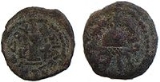
Herodian Dynasty

Encyclopedia
The Herodian Dynasty was a Jewish
dynasty
of Idumean descent, client Kings of Roman Judaea Province between 37 BCE and 92 CE.

ruler John Hyrcanus
134-104 BCE, Israel conquered Edom
(which the Romans called Idumea) and forced the Edomites to convert to Judaism
.
The Edomites were integrated into the Jewish people. In the days of Alexander Jannaeus
one of them, Antipas, was appointed governor of Edom.
His son Antipater
, founder of the Herodian Dynasty, was the chif adviser of Hyrcanus II
and managed to establish a good relationship with the Romans
, who at that time (63 BCE) had conquered Israel.
Julius Caesar
appointed Antipater to be procurator
of Judea in 47 BCE and he appointed his sons Phasael
and Herod
to be governors of Jerusalem and Galilee
respectively.
Antipater was murdered in 43 BCE; however, his sons managed to hold the reins of power and were elevated to the rank of tetrarch in 41 BCE by Mark Anthony
.
.
Herod the Great
, who was the son of Antipater the Idumean and Cypros, a Nabataean princess, managed to escape to Rome. There he was elected King of the Jews by the Roman Senate
. However Herod did not fully conquer all Israel until 37 BCE. He ruled for 34 years.
Herod ruled Israel until 4 BCE; at his death his kingdom was divided among his three sons.
Herod Archelaus
, son of Herod and Malthace the Samaritan
, was given the main part of the kingdom: Judea, Edom and Samaria. He ruled for ten years until 6 CE when he was "banished to Vienne
in Gaul
, where—according to Dion Cassius Cocceianus, "Hist. Roma," lv. 27—he lived for the remainder of his days." See also Census of Quirinius
.
Herod Philip I, son of Herod and his fifth wife Cleopatra of Jerusalem, was given jurisdiction over the northeast part of his father's kingdom; he ruled there until his death in 34.
Herod Antipas
, another son of Herod and Malthace, was made ruler of the Galilee
and Perea
; he ruled there until he was exiled to Spain
by emperor Caligula
in 39. Herod Antipas is also the person referenced in the Christian New Testament Gospels, playing a role in the death of John the Baptist
and the trial of Jesus
.
Agrippa I
was the grandson of Herod; thanks to his friendship with emperor Caligula he was appointed by him as ruler of the territories of Herod Philip after his death in 34, and in 39 he was given the territories of Herod Antipas. In 41 emperor Claudius
added to his territory the parts of Iudea province that previously belonged to Herod Archelaus. Thus Agrippa re-united his grandfather's kingdom under his rule. He died in 44.
His son Agrippa II
was appointed King and ruler of the northern parts of his father's kingdom. He was the last of the Herodians
, and with his death in 92 the dynasty was extinct.
In addition some members of the Herodian dynasty were rulers of Chalcis
and Armenia
.
Siege of Jerusalem (37 BC)
Jews
The Jews , also known as the Jewish people, are a nation and ethnoreligious group originating in the Israelites or Hebrews of the Ancient Near East. The Jewish ethnicity, nationality, and religion are strongly interrelated, as Judaism is the traditional faith of the Jewish nation...
dynasty
Dynasty
A dynasty is a sequence of rulers considered members of the same family. Historians traditionally consider many sovereign states' history within a framework of successive dynasties, e.g., China, Ancient Egypt and the Persian Empire...
of Idumean descent, client Kings of Roman Judaea Province between 37 BCE and 92 CE.
Origin
During the time of the HasmoneanHasmonean
The Hasmonean dynasty , was the ruling dynasty of Judea and surrounding regions during classical antiquity. Between c. 140 and c. 116 BCE, the dynasty ruled semi-autonomously from the Seleucids in the region of Judea...
ruler John Hyrcanus
John Hyrcanus
John Hyrcanus was a Hasmonean leader of the 2nd century BC.-Name:...
134-104 BCE, Israel conquered Edom
Edom
Edom or Idumea was a historical region of the Southern Levant located south of Judea and the Dead Sea. It is mentioned in biblical records as a 1st millennium BC Iron Age kingdom of Edom, and in classical antiquity the cognate name Idumea was used to refer to a smaller area in the same region...
(which the Romans called Idumea) and forced the Edomites to convert to Judaism
Judaism
Judaism ) is the "religion, philosophy, and way of life" of the Jewish people...
.
The Edomites were integrated into the Jewish people. In the days of Alexander Jannaeus
Alexander Jannaeus
Alexander Jannaeus was king of Judea from 103 BC to 76 BC. The son of John Hyrcanus, he inherited the throne from his brother Aristobulus I, and appears to have married his brother's widow, Shlomtzion or "Shelomit", also known as Salome Alexandra, according to the Biblical law of Yibbum...
one of them, Antipas, was appointed governor of Edom.
His son Antipater
Antipater the Idumaean
Antipater I the Idumaean was the founder of the Herodian Dynasty and father of Herod the Great. According to Josephus, he was the son of Antipas...
, founder of the Herodian Dynasty, was the chif adviser of Hyrcanus II
Hyrcanus II
Hyrcanus II, a member of the Hasmonean dynasty, was the Jewish High Priest and King of Judea in the 1st century BC.-Accession:Hyrcanus was the eldest son of Alexander Jannaeus, King and High Priest, and Alexandra Salome...
and managed to establish a good relationship with the Romans
Ancient Rome
Ancient Rome was a thriving civilization that grew on the Italian Peninsula as early as the 8th century BC. Located along the Mediterranean Sea and centered on the city of Rome, it expanded to one of the largest empires in the ancient world....
, who at that time (63 BCE) had conquered Israel.
Julius Caesar
Julius Caesar
Gaius Julius Caesar was a Roman general and statesman and a distinguished writer of Latin prose. He played a critical role in the gradual transformation of the Roman Republic into the Roman Empire....
appointed Antipater to be procurator
Procurator
Procurator may refer to:*Procurator , the title of various officials of the Roman Empire...
of Judea in 47 BCE and he appointed his sons Phasael
Phasael
Phasael was a prince from the Herodian Dynasty of Judea.-Origins and early career:...
and Herod
Herod the Great
Herod , also known as Herod the Great , was a Roman client king of Judea. His epithet of "the Great" is widely disputed as he is described as "a madman who murdered his own family and a great many rabbis." He is also known for his colossal building projects in Jerusalem and elsewhere, including his...
to be governors of Jerusalem and Galilee
Galilee
Galilee , is a large region in northern Israel which overlaps with much of the administrative North District of the country. Traditionally divided into Upper Galilee , Lower Galilee , and Western Galilee , extending from Dan to the north, at the base of Mount Hermon, along Mount Lebanon to the...
respectively.
Antipater was murdered in 43 BCE; however, his sons managed to hold the reins of power and were elevated to the rank of tetrarch in 41 BCE by Mark Anthony
Mark Antony
Marcus Antonius , known in English as Mark Antony, was a Roman politician and general. As a military commander and administrator, he was an important supporter and loyal friend of his mother's cousin Julius Caesar...
.
Rise to power
In 40 BCE the Parthians invaded the Roman eastern provinces and managed to expel the Romans. In Judea the Hasmonean dynasty was restored under king AntigonusAntigonus the Hasmonean
Antigonus II Mattathias was the last Hasmonean king of Judea. He was the son of King Aristobulus II of Judea...
.
Herod the Great
Herod the Great
Herod , also known as Herod the Great , was a Roman client king of Judea. His epithet of "the Great" is widely disputed as he is described as "a madman who murdered his own family and a great many rabbis." He is also known for his colossal building projects in Jerusalem and elsewhere, including his...
, who was the son of Antipater the Idumean and Cypros, a Nabataean princess, managed to escape to Rome. There he was elected King of the Jews by the Roman Senate
Roman Senate
The Senate of the Roman Republic was a political institution in the ancient Roman Republic, however, it was not an elected body, but one whose members were appointed by the consuls, and later by the censors. After a magistrate served his term in office, it usually was followed with automatic...
. However Herod did not fully conquer all Israel until 37 BCE. He ruled for 34 years.
Herod ruled Israel until 4 BCE; at his death his kingdom was divided among his three sons.
Herod Archelaus
Herod Archelaus
Herod Archelaus was the ethnarch of Samaria, Judea, and Idumea from 4 BC to 6 AD. He was the son of Herod the Great and Malthace the Samaritan, the brother of Herod Antipas, and the half-brother of Herod Philip I....
, son of Herod and Malthace the Samaritan
Samaritan
The Samaritans are an ethnoreligious group of the Levant. Religiously, they are the adherents to Samaritanism, an Abrahamic religion closely related to Judaism...
, was given the main part of the kingdom: Judea, Edom and Samaria. He ruled for ten years until 6 CE when he was "banished to Vienne
Vienne, Isère
Vienne is a commune in south-eastern France, located south of Lyon, on the Rhône River. It is the second largest city after Grenoble in the Isère department, of which it is a subprefecture. The city's population was of 29,400 as of the 2001 census....
in Gaul
Gaul
Gaul was a region of Western Europe during the Iron Age and Roman era, encompassing present day France, Luxembourg and Belgium, most of Switzerland, the western part of Northern Italy, as well as the parts of the Netherlands and Germany on the left bank of the Rhine. The Gauls were the speakers of...
, where—according to Dion Cassius Cocceianus, "Hist. Roma," lv. 27—he lived for the remainder of his days." See also Census of Quirinius
Census of Quirinius
The Census of Quirinius refers to the enrollment of the Roman Provinces of Syria and Iudaea for tax purposes taken in the year 6/7 during the reign of Emperor Augustus , when Publius Sulpicius Quirinius was appointed governor of Syria, after the banishment of Herod Archelaus from the Tetrarchy of...
.
Herod Philip I, son of Herod and his fifth wife Cleopatra of Jerusalem, was given jurisdiction over the northeast part of his father's kingdom; he ruled there until his death in 34.
Herod Antipas
Herod Antipas
Herod Antipater , known by the nickname Antipas, was a 1st-century AD ruler of Galilee and Perea, who bore the title of tetrarch...
, another son of Herod and Malthace, was made ruler of the Galilee
Galilee
Galilee , is a large region in northern Israel which overlaps with much of the administrative North District of the country. Traditionally divided into Upper Galilee , Lower Galilee , and Western Galilee , extending from Dan to the north, at the base of Mount Hermon, along Mount Lebanon to the...
and Perea
Perea (Holy Land)
Perea , a portion of the kingdom of Herod the Great occupying the eastern side of the Jordan River valley, from about one third the way down from the Sea of Galilee to about one third the way down the eastern shore of the Dead Sea; it did not extend too far inland...
; he ruled there until he was exiled to Spain
Spain
Spain , officially the Kingdom of Spain languages]] under the European Charter for Regional or Minority Languages. In each of these, Spain's official name is as follows:;;;;;;), is a country and member state of the European Union located in southwestern Europe on the Iberian Peninsula...
by emperor Caligula
Caligula
Caligula , also known as Gaius, was Roman Emperor from 37 AD to 41 AD. Caligula was a member of the house of rulers conventionally known as the Julio-Claudian dynasty. Caligula's father Germanicus, the nephew and adopted son of Emperor Tiberius, was a very successful general and one of Rome's most...
in 39. Herod Antipas is also the person referenced in the Christian New Testament Gospels, playing a role in the death of John the Baptist
John the Baptist
John the Baptist was an itinerant preacher and a major religious figure mentioned in the Canonical gospels. He is described in the Gospel of Luke as a relative of Jesus, who led a movement of baptism at the Jordan River...
and the trial of Jesus
Jesus
Jesus of Nazareth , commonly referred to as Jesus Christ or simply as Jesus or Christ, is the central figure of Christianity...
.
Agrippa I
Agrippa I
Agrippa I also known as Herod Agrippa or simply Herod , King of the Jews, was the grandson of Herod the Great, and son of Aristobulus IV and Berenice. His original name was Marcus Julius Agrippa, so named in honour of Roman statesman Marcus Vipsanius Agrippa, and he is the king named Herod in the...
was the grandson of Herod; thanks to his friendship with emperor Caligula he was appointed by him as ruler of the territories of Herod Philip after his death in 34, and in 39 he was given the territories of Herod Antipas. In 41 emperor Claudius
Claudius
Claudius , was Roman Emperor from 41 to 54. A member of the Julio-Claudian dynasty, he was the son of Drusus and Antonia Minor. He was born at Lugdunum in Gaul and was the first Roman Emperor to be born outside Italy...
added to his territory the parts of Iudea province that previously belonged to Herod Archelaus. Thus Agrippa re-united his grandfather's kingdom under his rule. He died in 44.
His son Agrippa II
Agrippa II
Agrippa II , son of Agrippa I, and like him originally named Marcus Julius Agrippa, was the seventh and last king of the family of Herod the Great, thus last of the Herodians. He was the brother of Berenice, Mariamne, and Drusilla...
was appointed King and ruler of the northern parts of his father's kingdom. He was the last of the Herodians
Herodians
The Herodians were a sect or party mentioned in the New Testament as having on two occasions — once in Galilee, and again in Jerusalem — manifested an unfriendly disposition towards Jesus .In each of these cases their name is coupled with that of the Pharisees...
, and with his death in 92 the dynasty was extinct.
In addition some members of the Herodian dynasty were rulers of Chalcis
Chalcis, Syria
Chalcis was an ancient city in Syria. Syrian Chalcis was the birthplace of 3rd century Neoplatonist philosopher Iamblichus.It is thought to be the site of the modern town of Qinnasrin, though Anjar in Lebanon has also been suggested as the site of ancient Chalcis....
and Armenia
Armenia
Armenia , officially the Republic of Armenia , is a landlocked mountainous country in the Caucasus region of Eurasia...
.
Novels
- Hordos u-Miryam (1935), a Hebrew novel by Aaron Orinowsky
- Mariamne (1967), a Swedish novel by Pär LagerkvistPär LagerkvistPär Fabian Lagerkvist was a Swedish author who was awarded the Nobel Prize in Literature in 1951.Lagerkvist wrote poems, plays, novels, stories, and essays of considerable expressive power and influence from his early 20s to his late 70s...
Plays
- Herod appears in some cycles of the Mystery Plays, played as an over the top villain. Such portrayals were still in folk memory in William ShakespeareWilliam ShakespeareWilliam Shakespeare was an English poet and playwright, widely regarded as the greatest writer in the English language and the world's pre-eminent dramatist. He is often called England's national poet and the "Bard of Avon"...
's time, for HamletHamletThe Tragical History of Hamlet, Prince of Denmark, or more simply Hamlet, is a tragedy by William Shakespeare, believed to have been written between 1599 and 1601...
instructs the players not to "out-Herod Herod" (Act 3, Scene 2). - Marianna (1565), an Italian drama by Lodovico DolceLodovico DolceLodovico Dolce was an Italian theorist of painting. He was a broadly-based Venetian humanist and prolific author, translator and editor; he is now remembered for his Dialogue on Painting.-Biography:...
- Mariam, the Faire Queene of Jewry (1613) an English drama by Elizabeth Tanfield CaryElizabeth Tanfield CaryElizabeth Cary, Lady Falkland , née Tanfield, was an English poet, translator, and dramatist. Precocious and studious, she was known from a young age for her learning and knowledge of languages.-Life:...
- Herod and Antipater, with the Death of Faire Mariam (1622), an English drama by Gervase MarkhamGervase MarkhamGervase Markham was an English poet and writer, best known for his work The English Huswife, Containing the Inward and Outward Virtues Which Ought to Be in a Complete Woman first published in London in 1615.-Life:Markham was the third son of Sir Robert Markham of Cotham, Nottinghamshire, and was...
and William Sampson - Mariamne (1636), a French drama by François Tristan l'HermiteFrançois Tristan l'HermiteFrançois l'Hermite was a French dramatist who wrote under the name Tristan l'Hermite. He was born at the Château de Soliers in the Haute Marche....
- La mort des enfants d’Hérode; ou, Suite de Mariamne (1639), a French drama by Gathier de Costes de la Calprenède
- Herod and Mariamne (1673), an English drama by Samuel PordageSamuel PordageSamuel Pordage was a 17th century English poet. He is best known by his Azaria and Hushai , a reply to John Dryden's Absalom and Achitophel.-Life:...
- La Mariamne (1696), an Italian opera by Giovanni Maria Ruggeri (mus.) and Lorenzo Burlini (libr.)
- Mariamne (1723), a French drama by Elijah FentonElijah Fenton-Life:Born in Shelton , and educated at Jesus College, Cambridge, for a time he acted as secretary to the Charles Boyle, 4th Earl of Orrery in Flanders, and was then Master of Sevenoaks Grammar School.In 1707, Fenton published a book of poems...
- Herod features in two 18th century French plays on MariamneMariamne (second wife of Herod)Mariamne I, also called Mariamne the Hasmonean was the second wife of Herod the Great. She was known for her great beauty, as was her brother Aristobulus...
, by NadalMariamne (Nadal play)Mariamne is a 1725 French tragedy by Augustin Nadal based around the Herodian dynasty.Nadal was encouraged to produce the play after his rival Voltaire's play on the same story had failed after only one performance the previous year...
and Voltaire. - Herodes und Mariamne (1850), a German drama by Christian Friedrich HebbelChristian Friedrich HebbelChristian Friedrich Hebbel , was a German poet and dramatist.-Biography:Hebbel was born at Wesselburen in Ditmarschen, Holstein, the son of a bricklayer. He was educated at the Gelehrtenschule des Johanneums...
- Myriam ha-Hashmonayith (1891), a Yiddish drama by Moses Seiffert
- Tsar Irod I tsaritsa Mariamna (1893), a Russian drama by Dmitri Alexandrov
- Herod and Mariamne (1938), an English drama by Clemence DaneClemence DaneClemence Dane was the pseudonym of Winifred Ashton , an English novelist and playwright.-Life and career:...
Poetry
- Herod and Mariamne (1888), an English poem by Amelie Rives
- Mariamne (1911), an English poem by Thomas Sturge MooreThomas Sturge MooreThomas Sturge Moore was an English poet, author and artist. He was born on 4 March 1870 and was educated at Dulwich College, the Croydon Art School and Lambeth Art School. He was a long-term friend and correspondent of W. B. Yeats...
Painting
- Mariamne Leaving the Judgment Seat of Herod (1887), a painting by John William WaterhouseJohn William WaterhouseJohn William Waterhouse was an English painter known for working in the Pre-Raphaelite style. He worked several decades after the breakup of the Pre-Raphaelite Brotherhood, which had seen its heydey in the mid-nineteenth century, leading him to have gained the moniker of "the modern Pre-Raphaelite"...
Music
- Herod’s Lament for Mariamne (1815), an English song by Isaac NathanIsaac NathanIsaac Nathan was an Anglo-Australian composer, musicologist, journalist and self-publicist, who ended an eventful career by becoming the "father of Australian music".-Early success:...
(mus.) and George Byron (libr.) - Herodes und Mariamne (1922), incidental music by Karol Rathaus
- Lied der Mariamne (ohne Worte) (1927), incidental music by Mikhail GnesinMikhail GnesinMikhail Fabianovich Gnesin was a Russian Jewish composer and teacher.-Life:Gnesin was born in Rostov-on-Don and came from a musical family. His sisters founded the Gnessin State Musical College , in Moscow in 1895. He studied at the St...
Opera
- Marianne (1796), opera in French with music by Nicolas DalayracNicolas DalayracNicolas-Marie d'Alayrac, known as Nicolas Dalayrac , was a French composer, best known for his opéras-comiques.- Biography :...
and a libretto of Benoît-Joseph Marsollier - SalomeSalome (opera)Salome is an opera in one act by Richard Strauss to a German libretto by the composer, based on Hedwig Lachmann’s German translation of the French play Salomé by Oscar Wilde. Strauss dedicated the opera to his friend Sir Edgar Speyer....
(1905), opera in German by Richard StraussRichard StraussRichard Georg Strauss was a leading German composer of the late Romantic and early modern eras. He is known for his operas, which include Der Rosenkavalier and Salome; his Lieder, especially his Four Last Songs; and his tone poems and orchestral works, such as Death and Transfiguration, Till...
after Oscar WildeOscar WildeOscar Fingal O'Flahertie Wills Wilde was an Irish writer and poet. After writing in different forms throughout the 1880s, he became one of London's most popular playwrights in the early 1890s...
's play's SalomeSalome (play)Salome is a tragedy by Oscar Wilde.The original 1891 version of the play was in French. Three years later an English translation was published...
See also
- HerodiansHerodiansThe Herodians were a sect or party mentioned in the New Testament as having on two occasions — once in Galilee, and again in Jerusalem — manifested an unfriendly disposition towards Jesus .In each of these cases their name is coupled with that of the Pharisees...
- History of ancient Israel and Judah#Roman occupation
- Herod's Temple
- Herodian coinageHerodian coinageHerodian coinage are coins minted and issued by the Herodian Dynasty, Jews of Idumean descent who ruled the province of Judaea between 37 BC–92 AD...
Siege of Jerusalem (37 BC)
Siege of Jerusalem (37 BC)
Herod the Great's Siege of Jerusalem was the final step in his campaign to secure the throne of Judea. Aided by Roman forces provided by Marcus Antonius , Herod was able to capture the city and depose Antigonus II Mattathias, ending Hasmonean rule...