


Double jeopardy

Encyclopedia
Double jeopardy is a procedural defense
that forbids a defendant
from being tried
again on the same, or similar charges following a legitimate acquittal or conviction. At common law
a defendant may enter a peremptory plea
of autrefois acquit or autrefois convict (autrefois means "previously" in French
), meaning the defendant has been acquitted or convicted of the same offense.
If this issue is raised, evidence will be placed before the court, which will normally rule as a preliminary matter whether the plea is substantiated, and if it so finds, the projected trial will be prevented from proceeding. In many countries the guarantee against being "twice put in jeopardy" is a constitution
al right; these include India
, Mexico
, and the United States
. In other countries, the protection is afforded by statute law
.
following a previous acquittal where a finding of perjury would controvert the previous acquittal. This was confirmed in the case of R v Carroll
, where the police found new evidence convincingly disproving Carroll's sworn alibi
two decades after he had been acquitted of murder charges in the death of Ipswich
child Deidre Kennedy, and successfully prosecuted him for perjury. Public outcry following the overturning of his conviction (for perjury) by the High Court
has led to widespread calls for reform of the law along the lines of the UK legislation.
In December 2006, New South Wales Premier
Morris Iemma
introduced legislation to scrap substantial parts of the double jeopardy law in that state. Retrials of serious cases with a minimum sentence of 20 years or more are now possible, even when the original trial preceded the 2006 reform. On 17 October 2006, the NSW Parliament passed legislation abolishing the rule against double jeopardy in cases where:
On 30 July 2008, the South Australia
government introduced legislation to scrap parts of its double jeopardy law. Retrials for serious offences, where there is "fresh and compelling" evidence, or if the acquittal was tainted were proposed.
On 8 September 2011, amendments were introduced in the Western Australia
parliament to reform the state's double jeopardy laws. The proposed amendments would allow retrial if "new and compelling" evidence was found. It would apply to serious offences where the penalty was life imprisonment or imprisonment for 14 years or more. Acquittal because of tainting (threatening of witnesses, jury tampering, or perjury) would also allow retrial.
On 19 August 2008, amendments were introduced in Tasmania
to allow retrial in serious cases, if there is "fresh and compelling" evidence.
In June 2011 Victoria
was considering changing their double jeopardy laws.
On 18 October 2007, Queensland
modified its double jeopardy laws to allow a retrial where fresh and compelling evidence becomes available after an acquittal for murder or a 'tainted acquittal' for a crime carrying a 25-year or more sentence. A 'tainted acquittal' requires a conviction for an administration of justice offence, such as perjury, that led to the original acquittal. Unlike reforms in the United Kingdom and New South Wales, this law does not have a retrospective effect, which is unpopular with some advocates of the reform.
According to the University of New South Wales
, the federal government is pushing hard for ‘reform’ of double jeopardy throughout Australia.
includes provisions such as section 11(h)
prohibiting double jeopardy. But often this prohibition applies only after the trial is finally concluded. Canadian law
allows the prosecution to appeal from an acquittal. If the acquittal is thrown out, the new trial is not considered to be double jeopardy because the first trial and its judgment would have been annulled. In rare circumstances, a court of appeal might also substitute a conviction for an acquittal. This is not considered to be double jeopardy either - in this case the appeal and subsequent conviction are deemed to be a continuation of the original trial.
For an appeal from an acquittal to be successful, the Supreme Court of Canada
requires that the Crown show an error in law was made during the trial and that the error contributed to the verdict. It has been suggested that this test is unfairly beneficial to the prosecution. For instance, Martin L Friedland
, in his book My Life in Crime and Other Academic Adventures, contends that the rule should be changed so that a retrial is granted only when the error is shown to be responsible for the verdict, not just one of many factors.
A notable example of this is the case of David Ahenakew
or Colby Campbell, who were tried a second time after being acquitted.
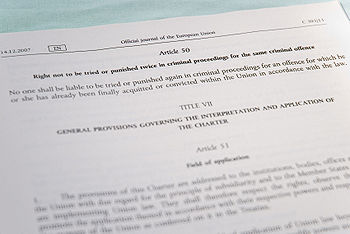 All members of the Council of Europe
(which includes nearly all European countries, and every member of the European Union
) have signed the European Convention on Human Rights
, which protects against double jeopardy. The optional Seventh Protocol to the Convention, Article Four, says:
Member states may, however, implement legislation which allows reopening of a case in the event that new evidence is found or if there was a fundamental defect in the previous proceedings.
This optional protocol has been ratified by all EU states except five (namely Belgium
, Germany
, Spain
, the Netherlands
, and United Kingdom
). In those member states, national rules governing double jeopardy may or may not comply with the provision cited above.
In many European countries the prosecution may appeal an acquittal to a higher court (similar to the provisions of Canadian law) – this is not counted as double jeopardy but as a continuation of the same trial. This is allowed by the European Convention on Human Rights – note the word finally in the above quotation.
. Prosecution for an already judged crime is impossible even though new incriminating evidence has been found. However, a person who has been convicted may request another trial on grounds of new exculpating evidence through a procedure known as révision.
, the Basic Law for the Federal Republic of Germany
does not provide comprehensive protection against double jeopardy.
Based on pre-constitutional case law, the clause is constructed to also protect against double jeopardy in the case of an acquittal. However, both the prosecution210 and defense may appeal against the verdict on questions of law and fact in less serious offences; in more serious offences, appeals are restricted to questions of law.
The rule applies to the whole "historical event, which is usually considered a single historical course of actions the separation of which would seem unnatural". This is true even if new facts occur that indicate other and/or much serious crimes.
The Penal Procedural Code (Strafprozessordnung - StPO) provides some exceptions to the double jeopardy rule:
In the case of an order of summary punishment (Strafbefehl), which can be issued by the court without a trial for lesser misdemeanours (German: Vergehen), there is a further exception:
A felony (German: Verbrechen) is defined as a crime which has a usual minimum sanction of one year of imprisonment.
guaranteed under Article 20 (2) of the Constitution of India
. This states that ""No person shall be prosecuted and punished for the same offence more than once". This provision enshrines the concept of autrefois convict, that no convicted of an offence can be tried or punished a second time. However it does not extend to autrefois acquit, and so if a person is acquitted of a crime he can be retried. In India, protection against autrefois acquit is a statuatory right, not a fundamental right. Such protection is provided by provisions of the Code of Criminal Procedure rather than by the Constitution.
and 166 parties to the International Covenant on Civil and Political Rights
recognise this rule, under Article 14 (7): No one shall be liable to be tried or punished again for an offence for which he has already been finally convicted or acquitted in accordance with the law and penal procedure of each country.
states in Article 39 that
However, in practice, if someone is acquitted in a lower District Court, then the prosecutor can appeal to the High Court, and then to the Supreme Court. Only the acquittal in the Supreme Court is the final acquittal which prevents any further retrial. This process sometimes takes decades.
The above is not considered a violation of the constitution, because of Supreme Court precedent, this process is all considered part of a single jeopardy.
According to Dutch legal experts Crombag, Wagenaar, van Koppen, the Dutch system contravenes the provisions of the European Human Rights convention, in the imbalance between the power of the prosecution service and the defence.
forbids a retrial when there has already been an acquittal or a conviction.
since the Criminal Justice Act 2003
.
from the time of the Norman conquest of England
; they were regarded as essential elements of protection of the liberty of the subject and respect for due process
of law in that there should be finality of proceedings. There were only three exceptions, all relatively recent, to the rules:
In Connelly v DPP
([1964] AC 1254), the Law Lords ruled that a defendant could not be tried for any offence arising out of substantially the same set of facts relied upon in a previous charge of which he had been acquitted, unless there are "special circumstances" proven by the prosecution. There is little case law on the meaning of "special circumstances", but it has been suggested that the emergence of new evidence would suffice.
A defendant who had been convicted of an offence could be given a second trial for an aggravated form of that offence if the facts constituting the aggravation were discovered after the first conviction. By contrast, a person who had been acquitted of a lesser offence could not be tried for an aggravated form even if new evidence became available.
recommended in 2001 that it should be possible to subject an acquitted murder suspect to a second trial. The Parliament of the United Kingdom
implemented these recommendations by passing the Criminal Justice Act 2003
, introduced by then Home Secretary
David Blunkett
. The double jeopardy provisions of the Act came into force in April 2005, but are applicable to crimes committed before then.
Under the 2003 Act, retrials are now allowed if there is "new" and "compelling" evidence for certain serious crimes, including murder
, manslaughter
, kidnapping
, rape
, armed robbery
, and serious drug crimes
. All such retrials must be approved by the Director of Public Prosecutions
, and the Court of Appeal
must agree to quash the original acquittal.
On 11 September 2006, William Dunlop became the first person to be convicted of murder after previously being acquitted. Twice he was tried for the murder of Julie Hogg in Billingham
in 1989, but two juries failed to reach a verdict and he was formally acquitted in 1991. Some years later, he confessed to the crime, and was convicted of perjury. The case was re-investigated in early 2005, when the new law came into effect, and his case was referred to the Court of Appeal in November 2005 for permission for a new trial, which was granted. Dunlop pleaded guilty to murdering Julie Hogg and raping her dead body repeatedly, and was sentenced to life imprisonment, with a recommendation he serve no less than 17 years.
On 13 December 2010, Mark Weston became the first person to be convicted of murder after previously being found not guilty of the same offence, that of the murder of Vikki Thompson at Ascott-under-Wychwood
on 12 August 1995. Weston's first trial was in 1996, when the jury found him not guilty. Following the discovery of compelling new evidence in 2009 – Thompson's blood on Weston's boots – Weston was arrested in 2009 and tried for a second time in December 2010, when he was found guilty of Thompson's murder, and sentenced to life imprisonment to serve a minimum of 13 years.
, although the Scottish government on October 7, 2010 introduced legislation to remove the bar to retrials in cases of murder, rape, serious sexual crimes and culpable homicide. In March 2010 the Scottish Law Commission
recommended revision of the ancient constitutional principle in cases of murder and rape, but the proposed legislation extends the repeal also to cases involving culpable homicide and serious sexual crimes (such as sexual crimes against children). The legislation provides for retroactive application so as to permit the retrial of Angus Sinclair for the World's End murders
of Helen Scott and Christine Eadie.
the Criminal Justice Act of 2003, effective April 18, 2005, makes certain "qualifying offence" (including murder, rape, kidnapping, specified sexual acts with young children, specified drug offences, defined acts of terrorism, as well as in certain cases attempts or conspiracies to commit the foregoing) subject to retrial after acquittal (including acquittals obtained before passage of the Act) if there is a finding by the Court of Appeals that there is "new and compelling evidence."
, the relevant clause of which reads: "[no person shall] be subject for the same offense to be twice put in jeopardy of life or limb".
This clause is intended to limit abuse by the government
in repeated prosecution
for the same offense as a means of harassment or oppression. It is also in harmony with the common law
concept of res judicata
which prevents courts from relitigating issues which have already been the subject of a final judgment.
More specifically, as stated in Ashe v. Swenson
, 397 U.S. 436 (1970): "...when an issue of ultimate fact has once been determined by a valid and final judgment, that issue cannot again be litigated between the same parties in any future lawsuit." Res judicata is a term of general application. Underneath that conceptual umbrella is the concept of collateral estoppel
. As applied to double jeopardy, the court will use collateral estoppel as its basis for forming an opinion.
There are three essential protections included in the double jeopardy principle, which are:
This rule is occasionally referred to as a legal technicality
because it allows defendant
s a defense that does not address whether the crime was actually committed. For example, were police to uncover new evidence conclusively proving the guilt of someone previously acquitted, there is little they can do because the defendant may not be tried again—at least not on the same or a substantially similar charge.
Although the Fifth Amendment initially applied only to the federal government, the U.S. Supreme Court has ruled that the double jeopardy clause applies to the states
as well through incorporation by the Fourteenth Amendment
(Benton v. Maryland
).
Jeopardy attaches in a jury trial
once the jury and alternates are impaneled and sworn in. In a non-jury trial
jeopardy attaches once the first evidence is put on which occurs when the first witness
is sworn.
. Cases dismissed
because of insufficient evidence may constitute a final judgment for these purposes though many state and federal laws allow for substantially limited prosecutorial appeals from these orders. Also, a retrial after a conviction has been set aside following the grant of a motion for new trial
, has been reversed on appeal, or has been vacated in a collateral proceeding (such as habeas corpus), does not violate double jeopardy because the judgment in the first trial has been invalidated. In all of these cases, however, the previous trials do not entirely vanish. Testimony from them may be used in later retrials such as to impeach contradictory testimony given at any subsequent proceeding.
The U.S. Supreme Court has also upheld laws allowing the government to appeal criminal sentences in limited circumstances (such as that of ). The Court ruled that sentences were not accorded the same constitutional finality as jury verdicts under the double jeopardy clause, and giving this right of appeal also did not put the defendant at risk of a succession of prosecutions.
Double jeopardy is also not implicated for separate offenses or in separate jurisdictions arising from the same act. For example, in United States v. Felix
503 U.S. 378 (1992), the U.S. Supreme Court ruled: "a[n]...offense
and a conspiracy
to commit that offense are not the same offense for double jeopardy purposes."
s with plenary power
that have relinquished a number of enumerated powers to the Federal government. Double jeopardy attaches only to prosecutions for the same criminal act by the same sovereign, but as separate sovereigns, both the federal and state governments can bring separate prosecutions for the same act.
As an example, a state might try a defendant for murder, after which the Federal government might try the same defendant for a Federal crime (perhaps a civil rights violation or a kidnapping
) connected to the same act. For example, the officers of the Los Angeles Police Department
who were charged with assault
ing Rodney King
in 1991 were acquitted by a jury
of the Superior Court
, but some were later convicted and sentenced in Federal court for violating King's civil rights. Similar legal processes were used for prosecuting racially-motivated crimes in the Southern United States
in the 1960s during the time of the Civil Rights movement
, when those crimes had not been actively prosecuted, or had resulted in acquittals by juries that were thought to be racist or overly-sympathetic with the accused in local courts.
Federal jurisdiction may apply because the defendant is a member of the armed forces or the victim(s) are armed forces members or dependents. U.S. Army Master Sergeant
Timothy B. Hennis was acquitted in state court in North Carolina
for the murders in 1985 of Kathryn Eastburn (age 31) and her daughters Kara, age five, and Erin, age three, who were stabbed to death in their home near Fort Bragg, North Carolina
. Two decades later, Hennis was recalled to active duty, court-martial
ed by the Army for the crime, and convicted.
Furthermore, the "separate sovereigns" rule allows two states to prosecute for the same criminal act. For example, if a man stood in New York and shot and killed a man standing over the border in Connecticut, both New York and Connecticut could charge the shooter with murder.
Only the states and tribal jurisdictions are recognized as possessing a separate sovereignty, whereas territories, commonwealths (for example, Puerto Rico
), the military and naval forces, and the capital city
of Washington, D.C.
, are exclusively under Federal sovereignty. Acquittal in the court system of any of these entities would therefore preclude a re-trial (or a court-martial) in any court system under Federal jurisdiction.
s must be proven beyond a reasonable doubt
, whereas civil wrongs
need only be proven by preponderance of evidence). Acquittal in a criminal case does not prevent the defendant from being the defendant in a civil suit relating to the same incident (though res judicata
operates within the civil court
system). For example, O.J. Simpson
was acquitted of a double homicide in a California
criminal prosecution, but lost a civil wrongful death claim
brought over the same victims.
If the defendant happened to be on parole
from an earlier offense at the time, the act for which he or she was acquitted may also be the subject of a parole violation hearing, which is not considered to be a criminal trial. Since parolees are usually subject to restrictions not imposed on other citizens, evidence of actions that were not deemed to be criminal by the court may be re-considered by the parole board. This legal board could deem the same evidence to be proof of a parole violation. Most states' parole boards have looser rules of evidence than is found in the courts - for example, hearsay
that had been disallowed in court might be considered by a parole board. Finally, like civil trials parole violation hearings are also subject to a lower standard of proof so it is possible for a parolee to be punished by the parole board for criminal actions that he or she was acquitted of in court.
In the American military or naval courts-martial
are subject to the same law of double jeopardy, since the Uniform Code of Military Justice
has incorporated all of the protections of the U.S. Constitution. The non-criminal proceeding non-judicial punishment
(or NJP) is considered to be akin to a civil case and is subject to lower standards than a court-martial, which is the same as a civilian court of law. NJP proceedings are commonly used to correct or punish minor breaches of military discipline. However if a NJP proceeding fails to produce conclusive evidence, the commanding officer (or ranking official presiding over the NJP) is not allowed to prepare the same charge against the military member in question. In a court-martial, acquittal of the defendant means he is protected permanently from having those charges reinstated.
The most famous American court case invoking the claim of double jeopardy is probably the second murder trial in 1876 of Jack McCall
, killer of Wild Bill Hickok
. McCall was acquitted in his first trial, which Federal authorities later ruled to be illegal because it took place in an illegal town, Deadwood
, then located in South Dakota Indian Territory. At the time Federal law prohibited all except for Native Americans from settling in the Indian Territory. McCall was retried in Federal Indian Territorial court, convicted, and hanged in 1877. He was the first person ever executed by Federal authorities in the Dakota Territory
.
Double jeopardy also does not apply if the defendant was never tried from the start. Charges that were dropped or put on hold for any reason can always be reinstated in the future—if not barred by some statute of limitations
.
Procedural defense
In jurisprudence, procedural defenses are a form of defense, via which a party argues that it should not be held liable for a legal charge or claim brought against it. In common law jurisdictions the term has applications in both criminal law and civil law...
that forbids a defendant
Defendant
A defendant or defender is any party who is required to answer the complaint of a plaintiff or pursuer in a civil lawsuit before a court, or any party who has been formally charged or accused of violating a criminal statute...
from being tried
Trial
A trial is, in the most general sense, a test, usually a test to see whether something does or does not meet a given standard.It may refer to:*Trial , the presentation of information in a formal setting, usually a court...
again on the same, or similar charges following a legitimate acquittal or conviction. At common law
Common law
Common law is law developed by judges through decisions of courts and similar tribunals rather than through legislative statutes or executive branch action...
a defendant may enter a peremptory plea
Peremptory plea
In the common law, the peremptory pleas are pleas that set out special reasons for which a trial cannot go ahead. They are the plea of autrefois convict, the plea of autrefois acquit, and the plea of pardon....
of autrefois acquit or autrefois convict (autrefois means "previously" in French
French language
French is a Romance language spoken as a first language in France, the Romandy region in Switzerland, Wallonia and Brussels in Belgium, Monaco, the regions of Quebec and Acadia in Canada, and by various communities elsewhere. Second-language speakers of French are distributed throughout many parts...
), meaning the defendant has been acquitted or convicted of the same offense.
If this issue is raised, evidence will be placed before the court, which will normally rule as a preliminary matter whether the plea is substantiated, and if it so finds, the projected trial will be prevented from proceeding. In many countries the guarantee against being "twice put in jeopardy" is a constitution
Constitution
A constitution is a set of fundamental principles or established precedents according to which a state or other organization is governed. These rules together make up, i.e. constitute, what the entity is...
al right; these include India
India
India , officially the Republic of India , is a country in South Asia. It is the seventh-largest country by geographical area, the second-most populous country with over 1.2 billion people, and the most populous democracy in the world...
, Mexico
Mexico
The United Mexican States , commonly known as Mexico , is a federal constitutional republic in North America. It is bordered on the north by the United States; on the south and west by the Pacific Ocean; on the southeast by Guatemala, Belize, and the Caribbean Sea; and on the east by the Gulf of...
, and the United States
United States
The United States of America is a federal constitutional republic comprising fifty states and a federal district...
. In other countries, the protection is afforded by statute law
Statutory law
Statutory law or statute law is written law set down by a legislature or by a legislator .Statutes may originate with national, state legislatures or local municipalities...
.
Australia
In contrast to other common law nations, Australian double jeopardy law has been held to extend to the prevention of prosecution for perjuryPerjury
Perjury, also known as forswearing, is the willful act of swearing a false oath or affirmation to tell the truth, whether spoken or in writing, concerning matters material to a judicial proceeding. That is, the witness falsely promises to tell the truth about matters which affect the outcome of the...
following a previous acquittal where a finding of perjury would controvert the previous acquittal. This was confirmed in the case of R v Carroll
R v Carroll
R v Carroll 213 CLR 635; [2002] HCA 55 is a decision of the High Court of Australia which unanimously upheld a Queensland appellate court’s decision to stay an indictment for perjury as the indictment was found to controvert the respondent’s earlier acquittal for murder...
, where the police found new evidence convincingly disproving Carroll's sworn alibi
Alibi
Alibi is a 1929 American crime film directed by Roland West. The screenplay was written by West and C. Gardner Sullivan, who adapted the 1927 Broadway stage play, Nightstick, written by Elaine Sterne Carrington, J.C...
two decades after he had been acquitted of murder charges in the death of Ipswich
Ipswich, Queensland
Ipswich is a city in South-East Queensland, Australia. Situated along the Bremer River Valley approximately 40 kilometres away from the state's capital Brisbane. The suburb by the same name forms the city's Central Business District and administrative centre...
child Deidre Kennedy, and successfully prosecuted him for perjury. Public outcry following the overturning of his conviction (for perjury) by the High Court
High Court of Australia
The High Court of Australia is the supreme court in the Australian court hierarchy and the final court of appeal in Australia. It has both original and appellate jurisdiction, has the power of judicial review over laws passed by the Parliament of Australia and the parliaments of the States, and...
has led to widespread calls for reform of the law along the lines of the UK legislation.
In December 2006, New South Wales Premier
Premiers of New South Wales
The Premier of New South Wales is the head of government in the state of New South Wales, Australia. The Government of New South Wales follows the Westminster system, with a Parliament of New South Wales acting as the legislature...
Morris Iemma
Morris Iemma
Morris Iemma , is a former Australian politician and 40th Premier of New South Wales, succeeding Bob Carr after he resigned on 3 August 2005. Iemma led the Australian Labor Party to victory in the 2007 election before resigning as Premier on 5 September 2008, and as a Member of Parliament on 19...
introduced legislation to scrap substantial parts of the double jeopardy law in that state. Retrials of serious cases with a minimum sentence of 20 years or more are now possible, even when the original trial preceded the 2006 reform. On 17 October 2006, the NSW Parliament passed legislation abolishing the rule against double jeopardy in cases where:
- someone acquitted of a "life sentence offence" (murder, violent gang rapes, large commercial supply or production of illegal drugs) where there is "fresh and compelling" evidence of guilt;
- someone acquitted of a "15 years or more sentence offence" where the acquittal was tainted (by perjury, bribery or perversion of the course of justice); and,
- someone acquitted in a judge-only trialBench trialA bench trial is a trial held before a judge sitting without a jury. The term is chiefly used in common law jurisdictions to describe exceptions from jury trial, as most other legal systems do not use juries to any great extent....
or where a judge directed the juryDirected verdictIn a jury trial, a directed verdict is an order from the presiding judge to the jury to return a particular verdict. Typically, the judge orders a directed verdict after finding that no reasonable jury could reach a decision to the contrary...
to acquit. This largely grew out of the case of Raymond John Carroll.
On 30 July 2008, the South Australia
South Australia
South Australia is a state of Australia in the southern central part of the country. It covers some of the most arid parts of the continent; with a total land area of , it is the fourth largest of Australia's six states and two territories.South Australia shares borders with all of the mainland...
government introduced legislation to scrap parts of its double jeopardy law. Retrials for serious offences, where there is "fresh and compelling" evidence, or if the acquittal was tainted were proposed.
On 8 September 2011, amendments were introduced in the Western Australia
Western Australia
Western Australia is a state of Australia, occupying the entire western third of the Australian continent. It is bounded by the Indian Ocean to the north and west, the Great Australian Bight and Indian Ocean to the south, the Northern Territory to the north-east and South Australia to the south-east...
parliament to reform the state's double jeopardy laws. The proposed amendments would allow retrial if "new and compelling" evidence was found. It would apply to serious offences where the penalty was life imprisonment or imprisonment for 14 years or more. Acquittal because of tainting (threatening of witnesses, jury tampering, or perjury) would also allow retrial.
On 19 August 2008, amendments were introduced in Tasmania
Tasmania
Tasmania is an Australian island and state. It is south of the continent, separated by Bass Strait. The state includes the island of Tasmania—the 26th largest island in the world—and the surrounding islands. The state has a population of 507,626 , of whom almost half reside in the greater Hobart...
to allow retrial in serious cases, if there is "fresh and compelling" evidence.
In June 2011 Victoria
Victoria (Australia)
Victoria is the second most populous state in Australia. Geographically the smallest mainland state, Victoria is bordered by New South Wales, South Australia, and Tasmania on Boundary Islet to the north, west and south respectively....
was considering changing their double jeopardy laws.
On 18 October 2007, Queensland
Queensland
Queensland is a state of Australia, occupying the north-eastern section of the mainland continent. It is bordered by the Northern Territory, South Australia and New South Wales to the west, south-west and south respectively. To the east, Queensland is bordered by the Coral Sea and Pacific Ocean...
modified its double jeopardy laws to allow a retrial where fresh and compelling evidence becomes available after an acquittal for murder or a 'tainted acquittal' for a crime carrying a 25-year or more sentence. A 'tainted acquittal' requires a conviction for an administration of justice offence, such as perjury, that led to the original acquittal. Unlike reforms in the United Kingdom and New South Wales, this law does not have a retrospective effect, which is unpopular with some advocates of the reform.
According to the University of New South Wales
University of New South Wales
The University of New South Wales , is a research-focused university based in Kensington, a suburb in Sydney, New South Wales, Australia...
, the federal government is pushing hard for ‘reform’ of double jeopardy throughout Australia.
Canada
The Canadian Charter of Rights and FreedomsCanadian Charter of Rights and Freedoms
The Canadian Charter of Rights and Freedoms is a bill of rights entrenched in the Constitution of Canada. It forms the first part of the Constitution Act, 1982...
includes provisions such as section 11(h)
Section Eleven of the Canadian Charter of Rights and Freedoms
Section Eleven of the Canadian Charter of Rights and Freedoms is the section of the Canadian Constitution's Charter of Rights that protects a person's legal rights in criminal and penal matters. This includes both criminal as well as regulatory offences, as it provides rights for those accused by...
prohibiting double jeopardy. But often this prohibition applies only after the trial is finally concluded. Canadian law
Law of Canada
The Canadian legal system has its foundation in the British common law system, inherited from being a former colony of the United Kingdom and later a member of the Commonwealth of Nations. Quebec, however, still retains a civil system for issues of private law...
allows the prosecution to appeal from an acquittal. If the acquittal is thrown out, the new trial is not considered to be double jeopardy because the first trial and its judgment would have been annulled. In rare circumstances, a court of appeal might also substitute a conviction for an acquittal. This is not considered to be double jeopardy either - in this case the appeal and subsequent conviction are deemed to be a continuation of the original trial.
For an appeal from an acquittal to be successful, the Supreme Court of Canada
Supreme Court of Canada
The Supreme Court of Canada is the highest court of Canada and is the final court of appeals in the Canadian justice system. The court grants permission to between 40 and 75 litigants each year to appeal decisions rendered by provincial, territorial and federal appellate courts, and its decisions...
requires that the Crown show an error in law was made during the trial and that the error contributed to the verdict. It has been suggested that this test is unfairly beneficial to the prosecution. For instance, Martin L Friedland
Martin Friedland
Martin Lawrence Friedland, is a Canadian lawyer, academic and author.He received a B.Comm. , LL.B. , and honorary LL.D. from the University of Toronto, and a Ph.D. and LL.D from Cambridge University. He was called to the Ontario Bar in 1960...
, in his book My Life in Crime and Other Academic Adventures, contends that the rule should be changed so that a retrial is granted only when the error is shown to be responsible for the verdict, not just one of many factors.
A notable example of this is the case of David Ahenakew
David Ahenakew
David Ahenakew was a Canadian First Nations politician, and former National Chief of the Assembly of First Nations.Ahenakew was born at the Sandy Lake Indian Reserve in Saskatchewan...
or Colby Campbell, who were tried a second time after being acquitted.
European Convention on Human Rights
Council of Europe
The Council of Europe is an international organisation promoting co-operation between all countries of Europe in the areas of legal standards, human rights, democratic development, the rule of law and cultural co-operation...
(which includes nearly all European countries, and every member of the European Union
European Union
The European Union is an economic and political union of 27 independent member states which are located primarily in Europe. The EU traces its origins from the European Coal and Steel Community and the European Economic Community , formed by six countries in 1958...
) have signed the European Convention on Human Rights
European Convention on Human Rights
The Convention for the Protection of Human Rights and Fundamental Freedoms is an international treaty to protect human rights and fundamental freedoms in Europe. Drafted in 1950 by the then newly formed Council of Europe, the convention entered into force on 3 September 1953...
, which protects against double jeopardy. The optional Seventh Protocol to the Convention, Article Four, says:
No one shall be liable to be tried or punished again in criminal proceedings under the jurisdiction of the same State for an offence for which he or she has already been finally acquittedAcquittalIn the common law tradition, an acquittal formally certifies the accused is free from the charge of an offense, as far as the criminal law is concerned. This is so even where the prosecution is abandoned nolle prosequi...
or convictedConvictionIn law, a conviction is the verdict that results when a court of law finds a defendant guilty of a crime.The opposite of a conviction is an acquittal . In Scotland and in the Netherlands, there can also be a verdict of "not proven", which counts as an acquittal...
in accordance with the law and penal procedure of that State.
Member states may, however, implement legislation which allows reopening of a case in the event that new evidence is found or if there was a fundamental defect in the previous proceedings.
The provisions of the preceding paragraph shall not prevent the reopening of the case in accordance with the law and penal procedure of the State concerned, if there is evidence of new or newly discovered facts, or if there has been a fundamental defect in the previous proceedings, which could affect the outcome of the case.
This optional protocol has been ratified by all EU states except five (namely Belgium
Belgium
Belgium , officially the Kingdom of Belgium, is a federal state in Western Europe. It is a founding member of the European Union and hosts the EU's headquarters, and those of several other major international organisations such as NATO.Belgium is also a member of, or affiliated to, many...
, Germany
Germany
Germany , officially the Federal Republic of Germany , is a federal parliamentary republic in Europe. The country consists of 16 states while the capital and largest city is Berlin. Germany covers an area of 357,021 km2 and has a largely temperate seasonal climate...
, Spain
Spain
Spain , officially the Kingdom of Spain languages]] under the European Charter for Regional or Minority Languages. In each of these, Spain's official name is as follows:;;;;;;), is a country and member state of the European Union located in southwestern Europe on the Iberian Peninsula...
, the Netherlands
Netherlands
The Netherlands is a constituent country of the Kingdom of the Netherlands, located mainly in North-West Europe and with several islands in the Caribbean. Mainland Netherlands borders the North Sea to the north and west, Belgium to the south, and Germany to the east, and shares maritime borders...
, and United Kingdom
United Kingdom
The United Kingdom of Great Britain and Northern IrelandIn the United Kingdom and Dependencies, other languages have been officially recognised as legitimate autochthonous languages under the European Charter for Regional or Minority Languages...
). In those member states, national rules governing double jeopardy may or may not comply with the provision cited above.
In many European countries the prosecution may appeal an acquittal to a higher court (similar to the provisions of Canadian law) – this is not counted as double jeopardy but as a continuation of the same trial. This is allowed by the European Convention on Human Rights – note the word finally in the above quotation.
France
Once all appeals have been exhausted on a case, the judgment is final and the action of the prosecution is closed (code of penal procedure, art. 6), except if the final ruling was forgedForgery
Forgery is the process of making, adapting, or imitating objects, statistics, or documents with the intent to deceive. Copies, studio replicas, and reproductions are not considered forgeries, though they may later become forgeries through knowing and willful misrepresentations. Forging money or...
. Prosecution for an already judged crime is impossible even though new incriminating evidence has been found. However, a person who has been convicted may request another trial on grounds of new exculpating evidence through a procedure known as révision.
Germany
In GermanyGermany
Germany , officially the Federal Republic of Germany , is a federal parliamentary republic in Europe. The country consists of 16 states while the capital and largest city is Berlin. Germany covers an area of 357,021 km2 and has a largely temperate seasonal climate...
, the Basic Law for the Federal Republic of Germany
Basic Law for the Federal Republic of Germany
The Basic Law for the Federal Republic of Germany is the constitution of Germany. It was formally approved on 8 May 1949, and, with the signature of the Allies of World War II on 12 May, came into effect on 23 May, as the constitution of those states of West Germany that were initially included...
does not provide comprehensive protection against double jeopardy.
Based on pre-constitutional case law, the clause is constructed to also protect against double jeopardy in the case of an acquittal. However, both the prosecution210 and defense may appeal against the verdict on questions of law and fact in less serious offences; in more serious offences, appeals are restricted to questions of law.
The rule applies to the whole "historical event, which is usually considered a single historical course of actions the separation of which would seem unnatural". This is true even if new facts occur that indicate other and/or much serious crimes.
The Penal Procedural Code (Strafprozessordnung - StPO) provides some exceptions to the double jeopardy rule:
In the case of an order of summary punishment (Strafbefehl), which can be issued by the court without a trial for lesser misdemeanours (German: Vergehen), there is a further exception:
A felony (German: Verbrechen) is defined as a crime which has a usual minimum sanction of one year of imprisonment.
India
A partial protection against double jeopardy is a Fundamental RightFundamental Rights in India
'Part III - Fundamental Rights' is a charter of rights contained in the Constitution of India. It guarantees civil liberties such that all Indians can lead their lives in peace and harmony as citizens of India...
guaranteed under Article 20 (2) of the Constitution of India
Constitution of India
The Constitution of India is the supreme law of India. It lays down the framework defining fundamental political principles, establishes the structure, procedures, powers, and duties of government institutions, and sets out fundamental rights, directive principles, and the duties of citizens...
. This states that ""No person shall be prosecuted and punished for the same offence more than once". This provision enshrines the concept of autrefois convict, that no convicted of an offence can be tried or punished a second time. However it does not extend to autrefois acquit, and so if a person is acquitted of a crime he can be retried. In India, protection against autrefois acquit is a statuatory right, not a fundamental right. Such protection is provided by provisions of the Code of Criminal Procedure rather than by the Constitution.
International Covenant on Civil and Political Rights
The 72 signatoriesSignature
A signature is a handwritten depiction of someone's name, nickname, or even a simple "X" that a person writes on documents as a proof of identity and intent. The writer of a signature is a signatory. Similar to a handwritten signature, a signature work describes the work as readily identifying...
and 166 parties to the International Covenant on Civil and Political Rights
International Covenant on Civil and Political Rights
The International Covenant on Civil and Political Rights is a multilateral treaty adopted by the United Nations General Assembly on December 16, 1966, and in force from March 23, 1976...
recognise this rule, under Article 14 (7): No one shall be liable to be tried or punished again for an offence for which he has already been finally convicted or acquitted in accordance with the law and penal procedure of each country.
Japan
The Constitution of JapanConstitution of Japan
The is the fundamental law of Japan. It was enacted on 3 May, 1947 as a new constitution for postwar Japan.-Outline:The constitution provides for a parliamentary system of government and guarantees certain fundamental rights...
states in Article 39 that
- No person shall be held criminally liable for an act which was lawful at the time it was committed, or of which he has been acquitted, nor shall he be placed in double jeopardy.
However, in practice, if someone is acquitted in a lower District Court, then the prosecutor can appeal to the High Court, and then to the Supreme Court. Only the acquittal in the Supreme Court is the final acquittal which prevents any further retrial. This process sometimes takes decades.
The above is not considered a violation of the constitution, because of Supreme Court precedent, this process is all considered part of a single jeopardy.
Netherlands
In the Netherlands, the state prosecution can appeal against a not-guilty verdict at the bench. New evidence can be brought to bear during a retrial at a district court. Thus one can be tried twice for the same alleged crime. If one is convicted at the district court, the defence can make an appeal on procedural grounds to the supreme court. The supreme court might admit this complaint, and the case will be reopened yet again, at another district court. Again, new evidence might be introduced by the prosecution.According to Dutch legal experts Crombag, Wagenaar, van Koppen, the Dutch system contravenes the provisions of the European Human Rights convention, in the imbalance between the power of the prosecution service and the defence.
Pakistan
Article 13 of the Constitution of Pakistan protects a person from being punished or prosecuted more than once for the same offence.Serbia
This principle is incorporated in to the Constitution of the Republic of Serbia and further elaborated in its Criminal Procedure Act.South Africa
The Bill of Rights in the Constitution of South AfricaConstitution of South Africa
The Constitution of South Africa is the supreme law of the country of South Africa. It provides the legal foundation for the existence of the republic, sets out the rights and duties of its citizens, and defines the structure of the government. The current constitution, the country's fifth, was...
forbids a retrial when there has already been an acquittal or a conviction.
England and Wales
Double jeopardy has been permitted in England and WalesEngland and Wales
England and Wales is a jurisdiction within the United Kingdom. It consists of England and Wales, two of the four countries of the United Kingdom...
since the Criminal Justice Act 2003
Criminal Justice Act 2003
The Criminal Justice Act 2003 is an Act of the Parliament of the United Kingdom. It is a wide ranging measure introduced to modernise many areas of the criminal justice system in England and Wales and, to a lesser extent, in Scotland and Northern Ireland....
.
Pre-2003
The doctrines of autrefois acquit and autrefois convict persisted as part of the common lawCommon law
Common law is law developed by judges through decisions of courts and similar tribunals rather than through legislative statutes or executive branch action...
from the time of the Norman conquest of England
Norman conquest of England
The Norman conquest of England began on 28 September 1066 with the invasion of England by William, Duke of Normandy. William became known as William the Conqueror after his victory at the Battle of Hastings on 14 October 1066, defeating King Harold II of England...
; they were regarded as essential elements of protection of the liberty of the subject and respect for due process
Due process
Due process is the legal code that the state must venerate all of the legal rights that are owed to a person under the principle. Due process balances the power of the state law of the land and thus protects individual persons from it...
of law in that there should be finality of proceedings. There were only three exceptions, all relatively recent, to the rules:
- The prosecution has a right of appeal against acquittal in summary cases if the decision appears to be wrong in law or in excess of jurisdiction.
- A retrial is permissible if the interests of justice so require, following appeal against conviction by a defendant.
- A "tainted acquittal", where there has been an offence of interference with, or intimidation of, a juror or witness, can be challenged in the High Court.
In Connelly v DPP
Connelly v DPP
Connelly v DPP [1964] was a landmark trial in the United Kingdom where the House of Lords passed a ruling regarding double jeopardy in British law. It was ruled that criminal proceedings could be stayed if an "abuse of process" violated the "standards of fairness" and hampered the rights of the...
([1964] AC 1254), the Law Lords ruled that a defendant could not be tried for any offence arising out of substantially the same set of facts relied upon in a previous charge of which he had been acquitted, unless there are "special circumstances" proven by the prosecution. There is little case law on the meaning of "special circumstances", but it has been suggested that the emergence of new evidence would suffice.
A defendant who had been convicted of an offence could be given a second trial for an aggravated form of that offence if the facts constituting the aggravation were discovered after the first conviction. By contrast, a person who had been acquitted of a lesser offence could not be tried for an aggravated form even if new evidence became available.
Post-2003
Following the murder of Stephen Lawrence, the Macpherson Report suggested that double jeopardy should be abrogated where "fresh and viable" new evidence came to light, and the Law CommissionLaw Commission
A Law Commission or Law Reform Commission is an independent body set up by a government to conduct law reform; that is, to consider the state of laws in a jurisdiction and make recommendations or proposals for legal changes or restructuring...
recommended in 2001 that it should be possible to subject an acquitted murder suspect to a second trial. The Parliament of the United Kingdom
Parliament of the United Kingdom
The Parliament of the United Kingdom of Great Britain and Northern Ireland is the supreme legislative body in the United Kingdom, British Crown dependencies and British overseas territories, located in London...
implemented these recommendations by passing the Criminal Justice Act 2003
Criminal Justice Act 2003
The Criminal Justice Act 2003 is an Act of the Parliament of the United Kingdom. It is a wide ranging measure introduced to modernise many areas of the criminal justice system in England and Wales and, to a lesser extent, in Scotland and Northern Ireland....
, introduced by then Home Secretary
Home Secretary
The Secretary of State for the Home Department, commonly known as the Home Secretary, is the minister in charge of the Home Office of the United Kingdom, and one of the country's four Great Offices of State...
David Blunkett
David Blunkett
David Blunkett is a British Labour Party politician and the Member of Parliament for Sheffield Brightside and Hillsborough, having represented Sheffield Brightside from 1987 to 2010...
. The double jeopardy provisions of the Act came into force in April 2005, but are applicable to crimes committed before then.
Under the 2003 Act, retrials are now allowed if there is "new" and "compelling" evidence for certain serious crimes, including murder
Murder
Murder is the unlawful killing, with malice aforethought, of another human being, and generally this state of mind distinguishes murder from other forms of unlawful homicide...
, manslaughter
Manslaughter
Manslaughter is a legal term for the killing of a human being, in a manner considered by law as less culpable than murder. The distinction between murder and manslaughter is said to have first been made by the Ancient Athenian lawmaker Dracon in the 7th century BC.The law generally differentiates...
, kidnapping
Kidnapping
In criminal law, kidnapping is the taking away or transportation of a person against that person's will, usually to hold the person in false imprisonment, a confinement without legal authority...
, rape
Rape
Rape is a type of sexual assault usually involving sexual intercourse, which is initiated by one or more persons against another person without that person's consent. The act may be carried out by physical force, coercion, abuse of authority or with a person who is incapable of valid consent. The...
, armed robbery
Robbery
Robbery is the crime of taking or attempting to take something of value by force or threat of force or by putting the victim in fear. At common law, robbery is defined as taking the property of another, with the intent to permanently deprive the person of that property, by means of force or fear....
, and serious drug crimes
Illegal drug trade
The illegal drug trade is a global black market, dedicated to cultivation, manufacture, distribution and sale of those substances which are subject to drug prohibition laws. Most jurisdictions prohibit trade, except under license, of many types of drugs by drug prohibition laws.A UN report said the...
. All such retrials must be approved by the Director of Public Prosecutions
Director of Public Prosecutions
The Director of Public Prosecutions is the officer charged with the prosecution of criminal offences in several criminal jurisdictions around the world...
, and the Court of Appeal
Court of Appeal of England and Wales
The Court of Appeal of England and Wales is the second most senior court in the English legal system, with only the Supreme Court of the United Kingdom above it...
must agree to quash the original acquittal.
On 11 September 2006, William Dunlop became the first person to be convicted of murder after previously being acquitted. Twice he was tried for the murder of Julie Hogg in Billingham
Billingham
Billingham is a town in the unitary authority of Stockton on Tees, in north east England, with a population of 35,765 . It was founded circa 650 by a group of Saxons known as Billa's people, which is where the name Billingham is thought to have originated...
in 1989, but two juries failed to reach a verdict and he was formally acquitted in 1991. Some years later, he confessed to the crime, and was convicted of perjury. The case was re-investigated in early 2005, when the new law came into effect, and his case was referred to the Court of Appeal in November 2005 for permission for a new trial, which was granted. Dunlop pleaded guilty to murdering Julie Hogg and raping her dead body repeatedly, and was sentenced to life imprisonment, with a recommendation he serve no less than 17 years.
On 13 December 2010, Mark Weston became the first person to be convicted of murder after previously being found not guilty of the same offence, that of the murder of Vikki Thompson at Ascott-under-Wychwood
Ascott-under-Wychwood
Ascott-under-Wychwood is a village and civil parish in the Evenlode valley about south of Chipping Norton, Oxfordshire.-History:The village is one of several named after the historic forest of Wychwood; the others being Shipton-under-Wychwood and Milton-under-Wychwood.Ascot d'Oilly Castle was...
on 12 August 1995. Weston's first trial was in 1996, when the jury found him not guilty. Following the discovery of compelling new evidence in 2009 – Thompson's blood on Weston's boots – Weston was arrested in 2009 and tried for a second time in December 2010, when he was found guilty of Thompson's murder, and sentenced to life imprisonment to serve a minimum of 13 years.
Scotland
The double jeopardy rule still applies in ScotlandScotland
Scotland is a country that is part of the United Kingdom. Occupying the northern third of the island of Great Britain, it shares a border with England to the south and is bounded by the North Sea to the east, the Atlantic Ocean to the north and west, and the North Channel and Irish Sea to the...
, although the Scottish government on October 7, 2010 introduced legislation to remove the bar to retrials in cases of murder, rape, serious sexual crimes and culpable homicide. In March 2010 the Scottish Law Commission
Scottish Law Commission
The Scottish Law Commission is Scottish advisory public body established by Parliament of the United Kingdom in 1965 to keep the law of Scotland under review and recommend necessary reforms to improve, simplify and update Scots law. It plays a leading role in developing the law for the people of...
recommended revision of the ancient constitutional principle in cases of murder and rape, but the proposed legislation extends the repeal also to cases involving culpable homicide and serious sexual crimes (such as sexual crimes against children). The legislation provides for retroactive application so as to permit the retrial of Angus Sinclair for the World's End murders
World's End murders
The World's End Murders were committed in October 1977 and, so named, as the victims were last seen alive leaving the World's End pub in Edinburgh's Old Town...
of Helen Scott and Christine Eadie.
Northern Ireland
In Northern IrelandNorthern Ireland
Northern Ireland is one of the four countries of the United Kingdom. Situated in the north-east of the island of Ireland, it shares a border with the Republic of Ireland to the south and west...
the Criminal Justice Act of 2003, effective April 18, 2005, makes certain "qualifying offence" (including murder, rape, kidnapping, specified sexual acts with young children, specified drug offences, defined acts of terrorism, as well as in certain cases attempts or conspiracies to commit the foregoing) subject to retrial after acquittal (including acquittals obtained before passage of the Act) if there is a finding by the Court of Appeals that there is "new and compelling evidence."
United States
The double jeopardy rule arises from the Fifth Amendment to the United States ConstitutionFifth Amendment to the United States Constitution
The Fifth Amendment to the United States Constitution, which is part of the Bill of Rights, protects against abuse of government authority in a legal procedure. Its guarantees stem from English common law which traces back to the Magna Carta in 1215...
, the relevant clause of which reads: "[no person shall] be subject for the same offense to be twice put in jeopardy of life or limb".
This clause is intended to limit abuse by the government
Government
Government refers to the legislators, administrators, and arbitrators in the administrative bureaucracy who control a state at a given time, and to the system of government by which they are organized...
in repeated prosecution
Prosecutor
The prosecutor is the chief legal representative of the prosecution in countries with either the common law adversarial system, or the civil law inquisitorial system...
for the same offense as a means of harassment or oppression. It is also in harmony with the common law
Common law
Common law is law developed by judges through decisions of courts and similar tribunals rather than through legislative statutes or executive branch action...
concept of res judicata
Res judicata
Res judicata or res iudicata , also known as claim preclusion, is the Latin term for "a matter [already] judged", and may refer to two concepts: in both civil law and common law legal systems, a case in which there has been a final judgment and is no longer subject to appeal; and the legal doctrine...
which prevents courts from relitigating issues which have already been the subject of a final judgment.
More specifically, as stated in Ashe v. Swenson
Ashe v. Swenson
Ashe v. Swenson, 397 U.S. 436 , was a decision by the United States Supreme Court, which held that "when an issue of ultimate fact has once been determined by a valid and final judgment, that issue cannot again be litigated between the same parties in any future lawsuit." The Double Jeopardy Clause...
, 397 U.S. 436 (1970): "...when an issue of ultimate fact has once been determined by a valid and final judgment, that issue cannot again be litigated between the same parties in any future lawsuit." Res judicata is a term of general application. Underneath that conceptual umbrella is the concept of collateral estoppel
Collateral estoppel
Collateral estoppel , known in modern terminology as issue preclusion, is a common law estoppel doctrine that prevents a person from relitigating an issue. One summary is that "once a court has decided an issue of fact or law necessary to its judgment, that decision .....
. As applied to double jeopardy, the court will use collateral estoppel as its basis for forming an opinion.
There are three essential protections included in the double jeopardy principle, which are:
- being tried for the same crime after an acquittal
- retrial after a conviction, unless the conviction has been reversed, vacated or otherwise nullified
- being punished multiple times for the same offense
This rule is occasionally referred to as a legal technicality
Legal technicality
The term legal technicality is a casual or colloquial phrase referring to a technical aspect of law. The phrase is not a term of art in the law; it has no exact meaning, nor does it have a legal definition. It implies that that strict adherence to the letter of the law has prevented the spirit of...
because it allows defendant
Defendant
A defendant or defender is any party who is required to answer the complaint of a plaintiff or pursuer in a civil lawsuit before a court, or any party who has been formally charged or accused of violating a criminal statute...
s a defense that does not address whether the crime was actually committed. For example, were police to uncover new evidence conclusively proving the guilt of someone previously acquitted, there is little they can do because the defendant may not be tried again—at least not on the same or a substantially similar charge.
Although the Fifth Amendment initially applied only to the federal government, the U.S. Supreme Court has ruled that the double jeopardy clause applies to the states
U.S. state
A U.S. state is any one of the 50 federated states of the United States of America that share sovereignty with the federal government. Because of this shared sovereignty, an American is a citizen both of the federal entity and of his or her state of domicile. Four states use the official title of...
as well through incorporation by the Fourteenth Amendment
Fourteenth Amendment to the United States Constitution
The Fourteenth Amendment to the United States Constitution was adopted on July 9, 1868, as one of the Reconstruction Amendments.Its Citizenship Clause provides a broad definition of citizenship that overruled the Dred Scott v...
(Benton v. Maryland
Benton v. Maryland
Benton v. Maryland, , is a Supreme Court of the United States decision concerning double jeopardy. Benton ruled that the Double Jeopardy Clause of the Fifth Amendment does apply to the states. In doing so, Benton expressly overruled Palko v. Connecticut, .-Facts of the case:John Dalmer Benton was...
).
Jeopardy attaches in a jury trial
Jury trial
A jury trial is a legal proceeding in which a jury either makes a decision or makes findings of fact which are then applied by a judge...
once the jury and alternates are impaneled and sworn in. In a non-jury trial
Non-jury trial
In a non-jury trial the fact-finder is one or more professional judges rather than a jury of the defendant's 'peers'.In common law jurisdictions, all trials in equity, of petty criminal offenses and violations, and of small claims at law are non-jury trials, also known as bench trials, held before...
jeopardy attaches once the first evidence is put on which occurs when the first witness
Witness
A witness is someone who has firsthand knowledge about an event, or in the criminal justice systems usually a crime, through his or her senses and can help certify important considerations about the crime or event. A witness who has seen the event first hand is known as an eyewitness...
is sworn.
Non-final judgments
As double jeopardy applies only to charges that were the subject of an earlier final judgment, there are many situations in which it does not apply despite the appearance of a retrial. For example, a second trial held after a mistrial does not violate the double jeopardy clause because a mistrial ends a trial prematurely without a judgment of guilty or not as decided by the U.S. Supreme Court in United States v. Josef PerezUnited States v. Josef Perez
United States v. Josef Perez, is a case of the Supreme Court of the United States. The decision held that when a criminal trial results in a hung jury, the double jeopardy clause of the fifth amendment does not prevent the defendant from being retried....
. Cases dismissed
Involuntary dismissal
Involuntary dismissal is the termination of a court case despite the plaintiff's objection.In United States Federal courts, involuntary dismissal is governed by Federal Rules of Civil Procedure Rule 41....
because of insufficient evidence may constitute a final judgment for these purposes though many state and federal laws allow for substantially limited prosecutorial appeals from these orders. Also, a retrial after a conviction has been set aside following the grant of a motion for new trial
Trial
A trial is, in the most general sense, a test, usually a test to see whether something does or does not meet a given standard.It may refer to:*Trial , the presentation of information in a formal setting, usually a court...
, has been reversed on appeal, or has been vacated in a collateral proceeding (such as habeas corpus), does not violate double jeopardy because the judgment in the first trial has been invalidated. In all of these cases, however, the previous trials do not entirely vanish. Testimony from them may be used in later retrials such as to impeach contradictory testimony given at any subsequent proceeding.
Fraudulent trials
There are two exceptions to the general rule that the prosecution cannot appeal an acquittal:- If the earlier trial is proven to be a fraud or scam, double jeopardy will not prohibit a new trial. In the case of Harry AlemanHarry AlemanHarry "The Hook" Aleman was a Chicago mobster who was one of most feared enforcers for the Chicago Outfit during the 1970s. Aleman got the nickname "Hook" from his boxing career in high school.-Early life:...
an appeals court ruled that a man who bribedBriberyBribery, a form of corruption, is an act implying money or gift giving that alters the behavior of the recipient. Bribery constitutes a crime and is defined by Black's Law Dictionary as the offering, giving, receiving, or soliciting of any item of value to influence the actions of an official or...
his trial judge and was acquitted of murder was allowed to be tried again because his bribe prevented his first trial from actually putting him in jeopardy. - Prosecutors may appeal when a trial judge sets aside a jury verdict for conviction with a judgment notwithstanding verdictJudgment notwithstanding verdictJudgment notwithstanding the verdict, also called judgment non obstante veredicto, or JNOV, is a type of judgment as a matter of law that is ordered at the conclusion of a jury trial....
for the defendant. A successful appeal by the prosecution would simply reinstate the jury verdict and so would not place the defendant at risk of another trial.
The U.S. Supreme Court has also upheld laws allowing the government to appeal criminal sentences in limited circumstances (such as that of ). The Court ruled that sentences were not accorded the same constitutional finality as jury verdicts under the double jeopardy clause, and giving this right of appeal also did not put the defendant at risk of a succession of prosecutions.
Double jeopardy is also not implicated for separate offenses or in separate jurisdictions arising from the same act. For example, in United States v. Felix
United States v. Felix
United States v. Felix, 503 U.S. 378 , was a decision by the United States Supreme Court, which held that “a[n]…offense and a conspiracy to commit that offense are not the same offense for double jeopardy purposes.” The Supreme Court rejected the Tenth Circuit's reversal of Felix's conviction,...
503 U.S. 378 (1992), the U.S. Supreme Court ruled: "a[n]...offense
Crime
Crime is the breach of rules or laws for which some governing authority can ultimately prescribe a conviction...
and a conspiracy
Conspiracy (crime)
In the criminal law, a conspiracy is an agreement between two or more persons to break the law at some time in the future, and, in some cases, with at least one overt act in furtherance of that agreement...
to commit that offense are not the same offense for double jeopardy purposes."
Separate sovereigns
The "separate sovereigns" exception to double jeopardy arises from the dual nature of the American Federal-State system, one in which states are sovereignSovereign
A sovereign is the supreme lawmaking authority within its jurisdiction.Sovereign may also refer to:*Monarch, the sovereign of a monarchy*Sovereign Bank, banking institution in the United States*Sovereign...
s with plenary power
Plenary power
A plenary power or plenary authority is the separate identification, definition, and complete vesting of a power or powers or authority in a governing body or individual, to choose to act on a particular subject matter or area...
that have relinquished a number of enumerated powers to the Federal government. Double jeopardy attaches only to prosecutions for the same criminal act by the same sovereign, but as separate sovereigns, both the federal and state governments can bring separate prosecutions for the same act.
As an example, a state might try a defendant for murder, after which the Federal government might try the same defendant for a Federal crime (perhaps a civil rights violation or a kidnapping
Kidnapping
In criminal law, kidnapping is the taking away or transportation of a person against that person's will, usually to hold the person in false imprisonment, a confinement without legal authority...
) connected to the same act. For example, the officers of the Los Angeles Police Department
Los Angeles Police Department
The Los Angeles Police Department is the police department of the city of Los Angeles, California. With just under 10,000 officers and more than 3,000 civilian staff, covering an area of with a population of more than 4.1 million people, it is the third largest local law enforcement agency in...
who were charged with assault
Assault
In law, assault is a crime causing a victim to fear violence. The term is often confused with battery, which involves physical contact. The specific meaning of assault varies between countries, but can refer to an act that causes another to apprehend immediate and personal violence, or in the more...
ing Rodney King
Rodney King
Rodney Glen King is an American best known for his involvement in a police brutality case involving the Los Angeles Police Department on March 3, 1991...
in 1991 were acquitted by a jury
Jury
A jury is a sworn body of people convened to render an impartial verdict officially submitted to them by a court, or to set a penalty or judgment. Modern juries tend to be found in courts to ascertain the guilt, or lack thereof, in a crime. In Anglophone jurisdictions, the verdict may be guilty,...
of the Superior Court
Superior Courts of California
The Superior Courts of California are the superior courts in the U.S. state of California with general jurisdiction to hear and decide any civil or criminal action which is not specially designated to be heard in some other court or before a government agency...
, but some were later convicted and sentenced in Federal court for violating King's civil rights. Similar legal processes were used for prosecuting racially-motivated crimes in the Southern United States
Southern United States
The Southern United States—commonly referred to as the American South, Dixie, or simply the South—constitutes a large distinctive area in the southeastern and south-central United States...
in the 1960s during the time of the Civil Rights movement
Civil rights movement
The civil rights movement was a worldwide political movement for equality before the law occurring between approximately 1950 and 1980. In many situations it took the form of campaigns of civil resistance aimed at achieving change by nonviolent forms of resistance. In some situations it was...
, when those crimes had not been actively prosecuted, or had resulted in acquittals by juries that were thought to be racist or overly-sympathetic with the accused in local courts.
Federal jurisdiction may apply because the defendant is a member of the armed forces or the victim(s) are armed forces members or dependents. U.S. Army Master Sergeant
Master Sergeant
A master sergeant is the military rank for a senior non-commissioned officer in some armed forces.-Israel Defense Forces:Rav samal rishoninsignia IDF...
Timothy B. Hennis was acquitted in state court in North Carolina
North Carolina
North Carolina is a state located in the southeastern United States. The state borders South Carolina and Georgia to the south, Tennessee to the west and Virginia to the north. North Carolina contains 100 counties. Its capital is Raleigh, and its largest city is Charlotte...
for the murders in 1985 of Kathryn Eastburn (age 31) and her daughters Kara, age five, and Erin, age three, who were stabbed to death in their home near Fort Bragg, North Carolina
Fort Bragg, North Carolina
Fort Bragg is a major United States Army installation, in Cumberland and Hoke counties, North Carolina, U.S., mostly in Fayetteville but also partly in the town of Spring Lake. It was also a census-designated place in the 2010 census and had a population of 39,457. The fort is named for Confederate...
. Two decades later, Hennis was recalled to active duty, court-martial
Court-martial
A court-martial is a military court. A court-martial is empowered to determine the guilt of members of the armed forces subject to military law, and, if the defendant is found guilty, to decide upon punishment.Most militaries maintain a court-martial system to try cases in which a breach of...
ed by the Army for the crime, and convicted.
Furthermore, the "separate sovereigns" rule allows two states to prosecute for the same criminal act. For example, if a man stood in New York and shot and killed a man standing over the border in Connecticut, both New York and Connecticut could charge the shooter with murder.
Only the states and tribal jurisdictions are recognized as possessing a separate sovereignty, whereas territories, commonwealths (for example, Puerto Rico
Puerto Rico
Puerto Rico , officially the Commonwealth of Puerto Rico , is an unincorporated territory of the United States, located in the northeastern Caribbean, east of the Dominican Republic and west of both the United States Virgin Islands and the British Virgin Islands.Puerto Rico comprises an...
), the military and naval forces, and the capital city
Capital City
Capital City was a television show produced by Euston Films which focused on the lives of investment bankers in London living and working on the corporate trading floor for the fictional international bank Shane-Longman....
of Washington, D.C.
Washington, D.C.
Washington, D.C., formally the District of Columbia and commonly referred to as Washington, "the District", or simply D.C., is the capital of the United States. On July 16, 1790, the United States Congress approved the creation of a permanent national capital as permitted by the U.S. Constitution....
, are exclusively under Federal sovereignty. Acquittal in the court system of any of these entities would therefore preclude a re-trial (or a court-martial) in any court system under Federal jurisdiction.
Concerning different legal standards
Double jeopardy also does not apply if the later charge is civil rather than criminal in nature, which involves a different legal standard (crimeCrime
Crime is the breach of rules or laws for which some governing authority can ultimately prescribe a conviction...
s must be proven beyond a reasonable doubt
Reasonable doubt
Proof beyond a reasonable doubt is the standard of evidence required to validate a criminal conviction in most adversarial legal systems . Generally the prosecution bears the burden of proof and is required to prove their version of events to this standard...
, whereas civil wrongs
Tort
A tort, in common law jurisdictions, is a wrong that involves a breach of a civil duty owed to someone else. It is differentiated from a crime, which involves a breach of a duty owed to society in general...
need only be proven by preponderance of evidence). Acquittal in a criminal case does not prevent the defendant from being the defendant in a civil suit relating to the same incident (though res judicata
Res judicata
Res judicata or res iudicata , also known as claim preclusion, is the Latin term for "a matter [already] judged", and may refer to two concepts: in both civil law and common law legal systems, a case in which there has been a final judgment and is no longer subject to appeal; and the legal doctrine...
operates within the civil court
Civil law (common law)
Civil law, as opposed to criminal law, is the branch of law dealing with disputes between individuals or organizations, in which compensation may be awarded to the victim...
system). For example, O.J. Simpson
O. J. Simpson
Orenthal James "O. J." Simpson , nicknamed "The Juice", is a retired American collegiate and professional football player, football broadcaster, and actor...
was acquitted of a double homicide in a California
California
California is a state located on the West Coast of the United States. It is by far the most populous U.S. state, and the third-largest by land area...
criminal prosecution, but lost a civil wrongful death claim
Wrongful death claim
Wrongful death is a claim in common law jurisdictions against a person who can be held liable for a death. The claim is brought in a civil action, usually by close relatives, as enumerated by statute...
brought over the same victims.
If the defendant happened to be on parole
Parole
Parole may have different meanings depending on the field and judiciary system. All of the meanings originated from the French parole . Following its use in late-resurrected Anglo-French chivalric practice, the term became associated with the release of prisoners based on prisoners giving their...
from an earlier offense at the time, the act for which he or she was acquitted may also be the subject of a parole violation hearing, which is not considered to be a criminal trial. Since parolees are usually subject to restrictions not imposed on other citizens, evidence of actions that were not deemed to be criminal by the court may be re-considered by the parole board. This legal board could deem the same evidence to be proof of a parole violation. Most states' parole boards have looser rules of evidence than is found in the courts - for example, hearsay
Hearsay
Hearsay is information gathered by one person from another person concerning some event, condition, or thing of which the first person had no direct experience. When submitted as evidence, such statements are called hearsay evidence. As a legal term, "hearsay" can also have the narrower meaning of...
that had been disallowed in court might be considered by a parole board. Finally, like civil trials parole violation hearings are also subject to a lower standard of proof so it is possible for a parolee to be punished by the parole board for criminal actions that he or she was acquitted of in court.
In the American military or naval courts-martial
Court-martial
A court-martial is a military court. A court-martial is empowered to determine the guilt of members of the armed forces subject to military law, and, if the defendant is found guilty, to decide upon punishment.Most militaries maintain a court-martial system to try cases in which a breach of...
are subject to the same law of double jeopardy, since the Uniform Code of Military Justice
Uniform Code of Military Justice
The Uniform Code of Military Justice , is the foundation of military law in the United States. It is was established by the United States Congress in accordance with the authority given by the United States Constitution in Article I, Section 8, which provides that "The Congress shall have Power . ....
has incorporated all of the protections of the U.S. Constitution. The non-criminal proceeding non-judicial punishment
Nonjudicial punishment
Non-judicial punishment in the United States military, is a form of military justice authorized by Article 15 of the Uniform Code of Military Justice. Non-judicial punishment or "NJP" permits commanders to administratively discipline troops without a court-martial...
(or NJP) is considered to be akin to a civil case and is subject to lower standards than a court-martial, which is the same as a civilian court of law. NJP proceedings are commonly used to correct or punish minor breaches of military discipline. However if a NJP proceeding fails to produce conclusive evidence, the commanding officer (or ranking official presiding over the NJP) is not allowed to prepare the same charge against the military member in question. In a court-martial, acquittal of the defendant means he is protected permanently from having those charges reinstated.
The most famous American court case invoking the claim of double jeopardy is probably the second murder trial in 1876 of Jack McCall
Jack McCall
John "Jack" McCall , known by the nickname "Crooked Nose Jack or Broken Nose Jack, was the killer of James "Wild Bill" Hickok, shooting him from behind, an act that among admirers of Hickok and students of Hickok's history has given rise to the phrase "the coward Jack McCall."-...
, killer of Wild Bill Hickok
Wild Bill Hickok
James Butler Hickok , better known as Wild Bill Hickok, was a folk hero of the American Old West. His skills as a gunfighter and scout, along with his reputation as a lawman, provided the basis for his fame, although some of his exploits are fictionalized.Hickok came to the West as a stagecoach...
. McCall was acquitted in his first trial, which Federal authorities later ruled to be illegal because it took place in an illegal town, Deadwood
Deadwood, South Dakota
Deadwood is a city in South Dakota, United States, and the county seat of Lawrence County. It is named for the dead trees found in its gulch. The population was 1,270 according to a 2010 census...
, then located in South Dakota Indian Territory. At the time Federal law prohibited all except for Native Americans from settling in the Indian Territory. McCall was retried in Federal Indian Territorial court, convicted, and hanged in 1877. He was the first person ever executed by Federal authorities in the Dakota Territory
Dakota Territory
The Territory of Dakota was an organized incorporated territory of the United States that existed from March 2, 1861, until November 2, 1889, when the final extent of the reduced territory was split and admitted to the Union as the states of North and South Dakota.The Dakota Territory consisted of...
.
Double jeopardy also does not apply if the defendant was never tried from the start. Charges that were dropped or put on hold for any reason can always be reinstated in the future—if not barred by some statute of limitations
Statute of limitations
A statute of limitations is an enactment in a common law legal system that sets the maximum time after an event that legal proceedings based on that event may be initiated...
.
See also
- Roman law: Ne bis in idemNe bis in idemNe bis in idem, which translates literally from Latin as "not twice in the same", means that no legal action can be instituted twice for the same cause of action...
- Sam SheppardSam SheppardDr. Samuel Holmes Sheppard was an American osteopathic physician and neurosurgeon, who was involved in an infamous and controversial murder trial. He was convicted of the murder of his pregnant wife, Marilyn Reese Sheppard, in 1954, while residing in the Cleveland, Ohio area. Sheppard served...
- U.S. law: Fifth AmendmentFifth Amendment to the United States ConstitutionThe Fifth Amendment to the United States Constitution, which is part of the Bill of Rights, protects against abuse of government authority in a legal procedure. Its guarantees stem from English common law which traces back to the Magna Carta in 1215...