


Sons of Noah

Encyclopedia
Noah
Noah was, according to the Hebrew Bible, the tenth and last of the antediluvian Patriarchs. The biblical story of Noah is contained in chapters 6–9 of the book of Genesis, where he saves his family and representatives of all animals from the flood by constructing an ark...
appearing in of the Hebrew Bible
Hebrew Bible
The Hebrew Bible is a term used by biblical scholars outside of Judaism to refer to the Tanakh , a canonical collection of Jewish texts, and the common textual antecedent of the several canonical editions of the Christian Old Testament...
, representing an ethnology
Ethnology
Ethnology is the branch of anthropology that compares and analyzes the origins, distribution, technology, religion, language, and social structure of the ethnic, racial, and/or national divisions of humanity.-Scientific discipline:Compared to ethnography, the study of single groups through direct...
from an Iron Age
Iron Age
The Iron Age is the archaeological period generally occurring after the Bronze Age, marked by the prevalent use of iron. The early period of the age is characterized by the widespread use of iron or steel. The adoption of such material coincided with other changes in society, including differing...
Levant
Levant
The Levant or ) is the geographic region and culture zone of the "eastern Mediterranean littoral between Anatolia and Egypt" . The Levant includes most of modern Lebanon, Syria, Jordan, Israel, the Palestinian territories, and sometimes parts of Turkey and Iraq, and corresponds roughly to the...
ine perspective. The significance of Noah in this context is that, according to Genesis, the population of the Earth was completely destroyed during the Flood
Noah's Ark
Noah's Ark is a vessel appearing in the Book of Genesis and the Quran . These narratives describe the construction of the ark by Noah at God's command to save himself, his family, and the world's animals from the worldwide deluge of the Great Flood.In the narrative of the ark, God sees the...
because of the wickedness of the inhabitants, and Noah and his family were the sole eight survivors to continue the human race. The view of history presented by the Bible is thus that all humans on Earth are descended from Noah's family.
Historicity and coverage
A literal interpretation of suggests that the present population of the world was descended from Noah's three sons: ShemShem
Shem was one of the sons of Noah in the Hebrew Bible as well as in Islamic literature. He is most popularly regarded as the eldest son, though some traditions regard him as the second son. Genesis 10:21 refers to relative ages of Shem and his brother Japheth, but with sufficient ambiguity in each...
, Ham
Ham, son of Noah
Ham , according to the Table of Nations in the Book of Genesis, was a son of Noah and the father of Cush, Mizraim, Phut and Canaan.- Hebrew Bible :The story of Ham is related in , King James Version:...
, and Japheth
Japheth
Japheth is one of the sons of Noah in the Abrahamic tradition...
, and their wives
Wives aboard the Ark
Although the Book of Genesis in the Bible does not give any further information about the four women it says were aboard Noah's Ark during the Flood, there exist substantial extra-Biblical traditions regarding these women and their names.-Book of Jubilees:...
. Until the mid-19th century, this was taken by many as historical fact, and still is by many Orthodox Jews, Muslims, and Christian
Christian
A Christian is a person who adheres to Christianity, an Abrahamic, monotheistic religion based on the life and teachings of Jesus of Nazareth as recorded in the Canonical gospels and the letters of the New Testament...
s.
There are disputes about how many of the peoples of the Earth this story was intended to cover, and as to its accuracy. Many Jews, Christians, and Muslims retain the belief that the table applies to the entire population of the earth, while others read it as a guide only to local ethnic groups.
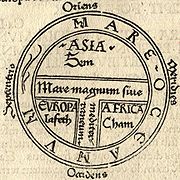
In the Biblical view, the listed children of Japheth, Shem and Ham correspond to various historic nations and peoples. In the typical interpretation, these sons of Noah correspond to three races: European, Semitic, and African. Alternate divisions claim Euro-Asian Japhet, Semitic Shem, and Afro-Asian Ham.
Table of nations
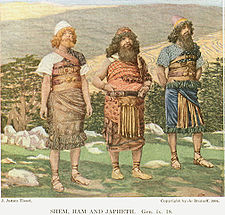
- HamHam, son of NoahHam , according to the Table of Nations in the Book of Genesis, was a son of Noah and the father of Cush, Mizraim, Phut and Canaan.- Hebrew Bible :The story of Ham is related in , King James Version:...
, forefather of the southern peoples (HamiticHamiticHamitic is an historical term for the peoples supposedly descended from Noah's son Ham, paralleling Semitic and Japhetic.It was formerly used for grouping the non-Semitic Afroasiatic languages , but since, unlike the Semitic branch, these have not been shown to form a phylogenetic unity, the term...
) - ShemShemShem was one of the sons of Noah in the Hebrew Bible as well as in Islamic literature. He is most popularly regarded as the eldest son, though some traditions regard him as the second son. Genesis 10:21 refers to relative ages of Shem and his brother Japheth, but with sufficient ambiguity in each...
, forefather of the middle peoples (SemiticSemiticIn linguistics and ethnology, Semitic was first used to refer to a language family of largely Middle Eastern origin, now called the Semitic languages...
) - JaphethJaphethJapheth is one of the sons of Noah in the Abrahamic tradition...
, forefather of the northern peoples (JapheticJapheticJaphetic is a term that refers to the supposed descendants of Japheth, one of the three sons of Noah in the Bible. It corresponds to Semitic and Hamitic...
EurasiaEurasiaEurasia is a continent or supercontinent comprising the traditional continents of Europe and Asia ; covering about 52,990,000 km2 or about 10.6% of the Earth's surface located primarily in the eastern and northern hemispheres...
)
The names of these sons are thought to have significance related to Semitic roots. Ham means "warm". Shem merely means "name" or "renown", "prosperity". Japheth means "open".
It then proceeds to detail their descendants. The identification of several of the first generation is aided by the inclusion of the second, although several of their identifications are less certain. (The copy of the table in the biblical book of 1 Chronicles chapter 1 has occasional variations in the second generation, most likely caused by the similarity of Hebrew letters such as Resh and Daleth). Forms ending in -im are plurals, probably indicating names of peoples, and not intended as the name of a single person.
Japheth's descendants
- Gomer, son of Japheth. Usually identified with the migratory Gimirru (CimmeriansCimmeriansThe Cimmerians or Kimmerians were ancient equestrian nomads of Indo-European origin.According to the Greek historian Herodotus, of the 5th century BC, the Cimmerians inhabited the region north of the Caucasus and the Black Sea during the 8th and 7th centuries BC, in what is now Ukraine and Russia...
) of Assyrian inscriptions, attested from about 720 BC.- AshkenazAshkenazIn the Bible, Ashkenaz is Gomer's first son, brother of Riphath and Togarmah , thereby a Japhetic descendant of Noah. A kingdom of Ashkenaz is called together with Ararat and Minni against Babylon In the Bible, Ashkenaz (Heb. אַשְׁכֲּנָז) is Gomer's first son, brother of Riphath and Togarmah (Gen....
, son of Gomer. It has been conjectured that this name arose from a misprint in Hebrew for "Ashkuz", by reading a nunNun (letter)Nun is the fourteenth letter of many Semitic abjads, including Phoenician, Aramaic, Hebrew and Arabic alphabet . It is the third letter in Thaana , pronounced as "noonu"...
for a vavWaw (letter)Waw is the sixth letter of the Northwest Semitic family of scripts, including Phoenician, Aramaic, Hebrew, Syriac, and Arabic ....
. Ashkuz and Ishkuz were names used for the ScythiaScythiaIn antiquity, Scythian or Scyths were terms used by the Greeks to refer to certain Iranian groups of horse-riding nomadic pastoralists who dwelt on the Pontic-Caspian steppe...
ns, who first appear in Assyrian records in the late 8th century in the Caucasus region, and at times occupied vast areas of Europe and Asia. Additionally, in Medieval Hebrew, Germany is known as Ashkenaz, and is the origin of the term Ashkenazic Jews. - RiphathRiphathRiphath - "a crusher", Gomer's second son , supposed by Josephus to have been the ancestor of the Paphlagonia. Pliny calls Riphath "Riphaci", and mentions a group of mountains named after him, the Riphaean range. Melo calls him "Riphaces", and Solinus "Piphlataci".Some Irish traditions say Riphath...
(Diphath in Chronicles), son of Gomer. Identification with Paphlagonians of later antiquity has been proposed, but this is uncertain. - TogarmahTogarmahTogarmah third son of Gomer, and grandson of Japheth, brother of Ashkenaz and Riphat...
, son of Gomer. Some ArmeniaArmeniaArmenia , officially the Republic of Armenia , is a landlocked mountainous country in the Caucasus region of Eurasia...
n and GeorgianGeorgia (country)Georgia is a sovereign state in the Caucasus region of Eurasia. Located at the crossroads of Western Asia and Eastern Europe, it is bounded to the west by the Black Sea, to the north by Russia, to the southwest by Turkey, to the south by Armenia, and to the southeast by Azerbaijan. The capital of...
traditions have claimed descent from Togarmah; other authors have attempted to connect them with Turkic peoplesTurkic peoplesThe Turkic peoples are peoples residing in northern, central and western Asia, southern Siberia and northwestern China and parts of eastern Europe. They speak languages belonging to the Turkic language family. They share, to varying degrees, certain cultural traits and historical backgrounds...
.
- Ashkenaz
- MagogMagog (Bible)Magog, Hebrew מגוג, Greek Μαγωγ, [ ma'gog ], is the second of the seven sons of Japheth mentioned in the Table of Nations in Genesis 10. It may represent Hebrew for "from Gog", though this is far from certain....
, son of Japheth. This name appears in the Assyrian texts as mat gugu, The Land of Gugu, and means LydiaLydiaLydia was an Iron Age kingdom of western Asia Minor located generally east of ancient Ionia in the modern Turkish provinces of Manisa and inland İzmir. Its population spoke an Anatolian language known as Lydian....
. Gugu is known in Greek texts as Gyges of LydiaGyges of LydiaGyges was the founder of the third or Mermnad dynasty of Lydian kings and reigned from 716 BC to 678 BC . He was succeeded by his son Ardys II.-Allegorical accounts of Gyges' rise to power:...
, a historical king of Lydia and the founder of the Mermnad dynasty (ruled c.716-678 BCE). Is claimed as an ancestor in both Irish and Hungarian medieval traditions. Flavius JosephusJosephusTitus Flavius Josephus , also called Joseph ben Matityahu , was a 1st-century Romano-Jewish historian and hagiographer of priestly and royal ancestry who recorded Jewish history, with special emphasis on the 1st century AD and the First Jewish–Roman War, which resulted in the Destruction of...
, followed by JeromeJeromeSaint Jerome was a Roman Christian priest, confessor, theologian and historian, and who became a Doctor of the Church. He was the son of Eusebius, of the city of Stridon, which was on the border of Dalmatia and Pannonia...
and NenniusNenniusNennius was a Welsh monk of the 9th century.He has traditionally been attributed with the authorship of the Historia Brittonum, based on the prologue affixed to that work, This attribution is widely considered a secondary tradition....
, makes him ancestor of the ScythiaScythiaIn antiquity, Scythian or Scyths were terms used by the Greeks to refer to certain Iranian groups of horse-riding nomadic pastoralists who dwelt on the Pontic-Caspian steppe...
ns who dwelt north of the Black SeaBlack SeaThe Black Sea is bounded by Europe, Anatolia and the Caucasus and is ultimately connected to the Atlantic Ocean via the Mediterranean and the Aegean seas and various straits. The Bosphorus strait connects it to the Sea of Marmara, and the strait of the Dardanelles connects that sea to the Aegean...
. - MadaiMadaiMadai is a son of Japheth and one of the 16 grandsons of Noah in the Book of Genesis of the Hebrew Bible. Biblical scholars have identified Madai with various nations, from the Mitanni of early records, to the Iranian Medes of much later records...
, son of Japheth. The MedesMedesThe MedesThe Medes...
of Northwest IranIranIran , officially the Islamic Republic of Iran , is a country in Southern and Western Asia. The name "Iran" has been in use natively since the Sassanian era and came into use internationally in 1935, before which the country was known to the Western world as Persia...
first appear in Assyrian inscriptions as Amadai in about 844 BC. - JavanJavanJavan was the fourth son of Noah's son Japheth according to the "Table of Nations" in the Hebrew Bible...
, son of Japheth. This name is said to be connected with the IoniansIoniansThe Ionians were one of the four major tribes into which the Classical Greeks considered the population of Hellenes to have been divided...
, one of the original Greek tribes.- ElishahElishahElishah was the son of Javan according to the Book of Genesis as well as the mediaeval, rabbinic Book of Jasher; he is said in Jasher to have been the ancestor of the "Almanim", possibly a reference to Germanic tribes . An older and more common traditions refers to him as a settler of Greece ,...
, son of Javan. Identifications have been proposed with various Aegean peoples such as ElisElisElis, or Eleia is an ancient district that corresponds with the modern Elis peripheral unit...
of northwestern Peloponnesos, or Ellis of PhthiaPhthiaPhthia , Phthíē ) in ancient Greece was the southernmost region of ancient Thessaly, on both sides of Othrys Mountain. It was the homeland of the Myrmidones tribe, who took part in the Trojan War under Achilles....
. - TarshishTarshishTarshish תַּרְשִׁישׁ occurs in the Hebrew Bible with several uncertain meanings:*One of the sons of Javan .* In the Bible Solomon set up a trade with Tarshish and received ivory, apes, and peacocks from Tarshish which are all native to the jungles in India. India's state bird for example is the...
(Tarshishah in Chronicles), son of Javan. Has been variously connected with TarsusTarsus (city)Tarsus is a historic city in south-central Turkey, 20 km inland from the Mediterranean Sea. It is part of the Adana-Mersin Metropolitan Area, the fourth-largest metropolitan area in Turkey with a population of 2.75 million...
in Anatolia, or Tartessus in southern SpainSpainSpain , officially the Kingdom of Spain languages]] under the European Charter for Regional or Minority Languages. In each of these, Spain's official name is as follows:;;;;;;), is a country and member state of the European Union located in southwestern Europe on the Iberian Peninsula...
. - KittimKittimKittim in the genealogy of Genesis 10 in the Hebrew Bible, is the son of Javan, the grandson of Japheth, and Noah's great-grandson....
, offspring of Javan. Usually connected with KitionLarnacaLarnaca, is the third largest city on the southern coast of Cyprus after Nicosia and Limassol. It has a population of 72,000 and is the island's second largest commercial port and an important tourist resort...
in Cyprus, but name appears in other texts with a variety of interpretations. - DodanimDodanimDodanim or Rodanim, , was, in the Book of Genesis, a son of Javan . He is usually associated with the people of the island of Rhodes as their progenitor. "-im" is a plural suffix in Hebrew, and the inhabitants of Rhodes were also called Rodanim or Dodanim...
(Rodanim in Chronicles), offspring of Javan. Usually connected with large Aegean island of RhodesRhodesRhodes is an island in Greece, located in the eastern Aegean Sea. It is the largest of the Dodecanese islands in terms of both land area and population, with a population of 117,007, and also the island group's historical capital. Administratively the island forms a separate municipality within...
near the coast of Asia Minor.
- Elishah
Note: the Greek Septuagint (LXX) of Genesis includes an additional son of Japheth, "Elisa", in between Javan and Tubal; however, as this name is found in no other ancient source, nor in I Chronicles, he is almost universally agreed to be a duplicate of Elisha, son of Javan. Nevertheless, the presence of Elisa (as well as that of Cainan son of Arpachshad, below) in the Greek Bible accounts for the traditional enumeration among early Christian sources of 72 families and languages, from the 72 names in this chapter, as opposed to the 70 names, families and languages usually found in Jewish sources.
- TubalTubalTubal, תובל or תבל , in Genesis 10 , was the name of a son of Japheth, son of Noah.Many authors, following the Jewish historian Flavius Josephus , related the name to Iber- Caucasian Iberia...
, son of Japheth. He is connected with TabalTabalTabal was a Luwian speaking Neo-Hittite kingdom of South Central Anatolia. According to archaeologist Kurt Bittel, the kingdom of Tabal first appeared after the collapse of the Hittite Empire....
, an Anatolian kingdom, and by way of the ancient tribe of the TibareniTibareniThe Tibareni were a people referred to in Herodotus, Xenophon, Strabo and other classical authors. In classical times, they and other related tribes, the Chalybes and the Mossynoeci, were considered the founders of metallurgy...
both with the Iberians of the Caucasus and those of the Iberian peninsulaIberian PeninsulaThe Iberian Peninsula , sometimes called Iberia, is located in the extreme southwest of Europe and includes the modern-day sovereign states of Spain, Portugal and Andorra, as well as the British Overseas Territory of Gibraltar...
(modern SpainSpainSpain , officially the Kingdom of Spain languages]] under the European Charter for Regional or Minority Languages. In each of these, Spain's official name is as follows:;;;;;;), is a country and member state of the European Union located in southwestern Europe on the Iberian Peninsula...
and PortugalPortugalPortugal , officially the Portuguese Republic is a country situated in southwestern Europe on the Iberian Peninsula. Portugal is the westernmost country of Europe, and is bordered by the Atlantic Ocean to the West and South and by Spain to the North and East. The Atlantic archipelagos of the...
). Sometimes he is also seen as the ancestor of the Illyrians and Italics. In the book of JubileesJubileesThe Book of Jubilees , sometimes called Lesser Genesis , is an ancient Jewish religious work, considered one of the pseudepigrapha by Protestant, Roman Catholic, and Eastern Orthodox Churches...
he was bequeathed the three 'tongues' of Europe. - MeshechMeshechIn the Bible, Meshech is named as a son of Japheth in Genesis 10:2 and 1 Chronicles 1:5.Another Meshech is named as a son of Aram in 1 Chronicles 1:17 .-Interpretations:...
, son of Japheth. He is regarded as the eponym of the MushkiMushkiThe Mushki were an Iron Age people of Anatolia, known from Assyrian sources. They do not appear in Hittite records. Several authors have connected them with the Moschoi of Greek sources and the Georgian tribe of the Meskhi. Josephus Flavius identified the Moschoi with the Biblical Meshech...
tribe of Anatolia. The Mushki are sometimes considered one of the ancestors of the Georgians, but also became connected with the Sea PeoplesSea PeoplesThe Sea Peoples were a confederacy of seafaring raiders of the second millennium BC who sailed into the eastern Mediterranean, caused political unrest, and attempted to enter or control Egyptian territory during the late 19th dynasty and especially during year 8 of Ramesses III of the 20th Dynasty...
who roved the Mediterranean Sea. - TirasTirasTiras was, according to and Chronicles 1, the last-named son of Japheth who is otherwise unmentioned in the Hebrew Bible. According to the Book of Jubilees, the inheritance of Tiras consisted of four large islands in the ocean....
, son of Japheth. This name is usually connected with that of ThraciansThraciansThe ancient Thracians were a group of Indo-European tribes inhabiting areas including Thrace in Southeastern Europe. They spoke the Thracian language – a scarcely attested branch of the Indo-European language family...
, an ancient nation first appearing in written records around 700 BC. It has also been associated with some of the Sea PeoplesSea PeoplesThe Sea Peoples were a confederacy of seafaring raiders of the second millennium BC who sailed into the eastern Mediterranean, caused political unrest, and attempted to enter or control Egyptian territory during the late 19th dynasty and especially during year 8 of Ramesses III of the 20th Dynasty...
such as Tursha and TyrsenoiTyrrheniansThe Tyrrhenians or Tyrsenians is an exonym used by Greek authors to refer to a non-Greek people.- Earliest references :...
, with the river TirasDniesterThe Dniester is a river in Eastern Europe. It runs through Ukraine and Moldova and separates most of Moldova's territory from the breakaway de facto state of Transnistria.-Names:...
(Dniester), and sometimes with the Anatolian region of Troas, dating to the later 13th century BC. In tractate YomaYomaYoma is the fifth tractate of Seder Moed of the Mishnah and of the Talmud. It is concerned mainly with the laws of the Jewish holiday Yom Kippur, on which Jews atone for their sins from the previous year...
, of the TalmudTalmudThe Talmud is a central text of mainstream Judaism. It takes the form of a record of rabbinic discussions pertaining to Jewish law, ethics, philosophy, customs and history....
, it states that Tiras is Persia.
Japheth is traditionally seen as the ancestor of Europeans, as well as some more eastern nations; thus Japhetic has been used as a synonym for Caucasians
Caucasian race
The term Caucasian race has been used to denote the general physical type of some or all of the populations of Europe, North Africa, the Horn of Africa, Western Asia , Central Asia and South Asia...
. Caucasian itself derives in part from the assumption that the tribe of Japheth developed its distinctive racial characteristics in the Caucasus
Caucasus
The Caucasus, also Caucas or Caucasia , is a geopolitical region at the border of Europe and Asia, and situated between the Black and the Caspian sea...
, where Mount Ararat
Mount Ararat
Mount Ararat is a snow-capped, dormant volcanic cone in Turkey. It has two peaks: Greater Ararat and Lesser Ararat .The Ararat massif is about in diameter...
is located. The term Japhetic was also applied by the early linguist
Linguistics
Linguistics is the scientific study of human language. Linguistics can be broadly broken into three categories or subfields of study: language form, language meaning, and language in context....
s (brothers Grimm
Brothers Grimm
The Brothers Grimm , Jacob Grimm and Wilhelm Grimm , were German academics, linguists, cultural researchers, and authors who collected folklore and published several collections of it as Grimm's Fairy Tales, which became very popular...
, William Jones
William Jones (philologist)
Sir William Jones was an English philologist and scholar of ancient India, particularly known for his proposition of the existence of a relationship among Indo-European languages...
, Rasmus C. Rask and others) to what later became known as the Indo-European
Indo-European languages
The Indo-European languages are a family of several hundred related languages and dialects, including most major current languages of Europe, the Iranian plateau, and South Asia and also historically predominant in Anatolia...
language group, on the assumption that, if descended from Japheth, the principal languages of Europe would have a common origin, which apart from Uralic
Uralic languages
The Uralic languages constitute a language family of some three dozen languages spoken by approximately 25 million people. The healthiest Uralic languages in terms of the number of native speakers are Hungarian, Finnish, Estonian, Mari and Udmurt...
, Kartvelian, Pontic
Northwest Caucasian languages
The Northwest Caucasian languages, also called Abkhazo-Adyghean, or sometimes Pontic as opposed to Caspian for the Northeast Caucasian languages, are a group of languages spoken in the Caucasus region, chiefly in Russia , the disputed territory of Abkhazia, and Turkey, with smaller communities...
, Dagestanian
Northeast Caucasian languages
The Northeast Caucasian languages constitute a language family spoken in the Russian republics of Dagestan, Chechnya, Ingushetia, northern Azerbaijan, and in northeastern Georgia, as well as in diaspora populations in Russia, Turkey, and the Middle East...
, and Basque
Basque language
Basque is the ancestral language of the Basque people, who inhabit the Basque Country, a region spanning an area in northeastern Spain and southwestern France. It is spoken by 25.7% of Basques in all territories...
, appears to be the case. In a conflicting sense, the term was also used by the Soviet linguist Nikolai Marr in his Japhetic theory
Japhetic theory (linguistics)
Japhetic theory is a term used to describe a linguistic theory developed by the Soviet linguist Nikolay Yakovlevich Marr . In linguistics it was compared by critics to Lysenkoism in biology: a theory that was promoted and supported for ideological rather than scientific reasons, because it was...
intended to demonstrate that the languages of the Caucasus formed part of a once-widespread pre-Indo-European language group.
Ham's descendants
- CushBiblical CushCush was the eldest son of Ham, brother of Mizraim , Canaan and the father of Nimrod, and Raamah, mentioned in the "Table of Nations" in the Genesis 10:6 and I Chronicles 1:8...
, son of Ham. The Empire of KushKingdom of KushThe native name of the Kingdom was likely kaš, recorded in Egyptian as .The name Kash is probably connected to Cush in the Hebrew Bible , son of Ham ....
to the south of EgyptEgyptEgypt , officially the Arab Republic of Egypt, Arabic: , is a country mainly in North Africa, with the Sinai Peninsula forming a land bridge in Southwest Asia. Egypt is thus a transcontinental country, and a major power in Africa, the Mediterranean Basin, the Middle East and the Muslim world...
is known from at least 1970 BC, but this name has also been associated by some with the KassitesKassitesThe Kassites were an ancient Near Eastern people who gained control of Babylonia after the fall of the Old Babylonian Empire after ca. 1531 BC to ca. 1155 BC...
who inhabited the Zagros area of Mesopotamia, the Sumerian city of KishKish (Sumer)Kish is modern Tell al-Uhaymir , and was an ancient city of Sumer. Kish is located some 12 km east of Babylon, and 80 km south of Baghdad ....
.- SebaSebaSebastian Ahrenberg, better known as Seba is a drum and bass producer and DJ hailing originally from Ingarö, an island just outside of Stockholm, Sweden. Seba is also the owner of Secret Operations, a drum and bass record label.-Musical career:...
, son of Cush. Has been connected with both YemenYemenThe Republic of Yemen , commonly known as Yemen , is a country located in the Middle East, occupying the southwestern to southern end of the Arabian Peninsula. It is bordered by Saudi Arabia to the north, the Red Sea to the west, and Oman to the east....
and EthiopiaEthiopiaEthiopia , officially known as the Federal Democratic Republic of Ethiopia, is a country located in the Horn of Africa. It is the second-most populous nation in Africa, with over 82 million inhabitants, and the tenth-largest by area, occupying 1,100,000 km2...
, with much confusion with Sheba below. (The ShibbolethShibbolethA shibboleth is a custom, principle, or belief distinguishing a particular class or group of people, especially a long-standing one regarded as outmoded or no longer important...
-like division amongst the Sabaeans into Sheba and Seba is acknowledged elsewhere, for example in Psalm 72, leading scholars to suspect that this is not a mistaken duplication of the same name, but a genuine historical division. The significance of this division is not yet completely understood, though it may simply reflect which side of the sea each was on.) - HavilahHavilahHavilah is in several books of the Bible referring to both land and people.The story of the Garden of Eden in Genesis 2:11: "And a river went out of Eden to water the garden; and from thence it was parted, and became into four heads...
, son of Cush. Usually considered to be a part of the Arabian peninsulaArabian PeninsulaThe Arabian Peninsula is a land mass situated north-east of Africa. Also known as Arabia or the Arabian subcontinent, it is the world's largest peninsula and covers 3,237,500 km2...
near the Red Sea. - Sabtah, son of Cush. Sometimes connected with HadhramisHadhramautHadhramaut, Hadhramout, Hadramawt or Ḥaḍramūt is the formerly independent Qu'aiti state and sultanate encompassing a historical region of the south Arabian Peninsula along the Gulf of Aden in the Arabian Sea, extending eastwards from Yemen to the borders of the Dhofar region of Oman...
(their ancient capital being Saubatha) in eastern Yemen. - RaamahRaamahRaamah or Rama is a name found in the Bible , means "lofty, exalted, that also may mean "thunder".The name is first mentioned as the fourth son of Cush, who is the son of Ham, who is the son of Noah in Gen. 10:7, and later appears as a country that traded with the Phoenician city-state of Tyre, in...
, son of Cush. Has been connected with Rhammanitae mentioned by Strabo in the southwest Arabian peninsula, and with an Arabian city of Regmah at the head of Persian Gulf.- ShebaShebaSheba was a kingdom mentioned in the Jewish scriptures and the Qur'an...
, son of Raamah. Has been connected with SabaeansSabaeansThe Sabaeans or Sabeans were an ancient people speaking an Old South Arabian language who lived in what is today Yemen, in the south west of the Arabian Peninsula.Some scholars suggest a link between the Sabaeans and the Biblical land of Sheba....
and peoples on either side of the narrowest part of the Red SeaRed SeaThe Red Sea is a seawater inlet of the Indian Ocean, lying between Africa and Asia. The connection to the ocean is in the south through the Bab el Mandeb strait and the Gulf of Aden. In the north, there is the Sinai Peninsula, the Gulf of Aqaba, and the Gulf of Suez...
, in both YemenYemenThe Republic of Yemen , commonly known as Yemen , is a country located in the Middle East, occupying the southwestern to southern end of the Arabian Peninsula. It is bordered by Saudi Arabia to the north, the Red Sea to the west, and Oman to the east....
/South Arabia, and EritreaEritreaEritrea , officially the State of Eritrea, is a country in the Horn of Africa. Eritrea derives it's name from the Greek word Erethria, meaning 'red land'. The capital is Asmara. It is bordered by Sudan in the west, Ethiopia in the south, and Djibouti in the southeast...
/EthiopiaEthiopiaEthiopia , officially known as the Federal Democratic Republic of Ethiopia, is a country located in the Horn of Africa. It is the second-most populous nation in Africa, with over 82 million inhabitants, and the tenth-largest by area, occupying 1,100,000 km2...
/SomaliaSomaliaSomalia , officially the Somali Republic and formerly known as the Somali Democratic Republic under Socialist rule, is a country located in the Horn of Africa. Since the outbreak of the Somali Civil War in 1991 there has been no central government control over most of the country's territory...
. - DedanDedanThe word Dedan means "low ground". The people are called Dedanim or Dedanites.In the Bible, it can refer to either:* A son of Raamah . His descendants are mentioned in Isaiah 21:13, Ezekiel 25:13 and Ezekiel 27:15...
, son of Raamah. Apparently a region of the Tabuk Province of Saudi ArabiaSaudi ArabiaThe Kingdom of Saudi Arabia , commonly known in British English as Saudi Arabia and in Arabic as as-Sa‘ūdiyyah , is the largest state in Western Asia by land area, constituting the bulk of the Arabian Peninsula, and the second-largest in the Arab World...
.
- Sheba
- Sabtechah, son of Cush. Possibly Sabaiticum Ostium, Sabaeans living around a specific harbour in Eritrea.
- NimrodNimrod (king)Nimrod is, according to the Book of Genesis and Books of Chronicles, the son of Cush and great-grandson of Noah and the king of Shinar. He is depicted in the Tanakh as a man of power in the earth, and a mighty hunter. Extra-Biblical traditions associating him with the Tower of Babel led to his...
, son of Cush, also identified as a mighty hunter before God, and the founder of ancient BabelBabylonBabylon was an Akkadian city-state of ancient Mesopotamia, the remains of which are found in present-day Al Hillah, Babil Province, Iraq, about 85 kilometers south of Baghdad...
, AkkadAkkadThe Akkadian Empire was an empire centered in the city of Akkad and its surrounding region in Mesopotamia....
, Sumer, and possibly cities in Assyria. The Hebrew wording of Genesis 10:11 has led to some ambiguity as to whether Asshur here is the son of Shem or a city built by Nimrod; either interpretation can be found in various modern versions.
- Seba
- MizraimMizraimMizraim is the Hebrew name for the land of Egypt, with the dual suffix -āyim, perhaps referring to the "two Egypts": Upper Egypt and Lower Egypt....
, son of Ham. Mizraim is a name for Upper and Lower EgyptUpper and Lower EgyptAncient Egypt was divided into two regions, namely Upper Egypt and Lower Egypt. To the north was Lower Egypt where the Nile stretched out with its several branches to form the Nile Delta. To the south was Upper Egypt, stretching to Syene. The two kingdoms of Upper and Lower Egypt were united c....
and literally translates as Ta-Wy in Ancient Egyptian ("The Two Lands"). The -aim in Mizraim represents dual number. Arabic-speaking modern Egyptians refer to their country as Miṣr.- LudimLudimLudim is the Hebrew term for Lydia used in Jeremiah and Ezekiel. In the Biblical Table of Nations Genesis 10:13 they were descended from Mizraim...
, offspring of Mizraim. Sometimes considered a scribal error for Lubim, a reference to the Lebou of Eastern Libya. - AnamimAnamimAnamim is, according to the Bible, either a son of Ham's son Mizraim or the name of a people descending from him.The name should perhaps be attached to a people in northern Africa, probably in the surrounding area of Egypt. A text from Assyria, dating from the time of Sargon II, apparently calls...
, offspring of Mizraim. There is a reference in an Assyrian inscription from Sargon IISargon IISargon II was an Assyrian king. Sargon II became co-regent with Shalmaneser V in 722 BC, and became the sole ruler of the kingdom of Assyria in 722 BC after the death of Shalmaneser V. It is not clear whether he was the son of Tiglath-Pileser III or a usurper unrelated to the royal family...
's time to Anami, a tribe located in Cyrene, LibyaCyrene, LibyaCyrene was an ancient Greek colony and then a Roman city in present-day Shahhat, Libya, the oldest and most important of the five Greek cities in the region. It gave eastern Libya the classical name Cyrenaica that it has retained to modern times.Cyrene lies in a lush valley in the Jebel Akhdar...
. - Lehabim, offspring of Mizraim. Identification uncertain, possibly Libya.
- Naphtuhim, offspring of Mizraim. Has been connected with Na-PtahNophNoph or Moph was the Hebrew name for the ancient Egyptian city of Memphis, which stood on the Nile near the site of modern-day Cairo. It is mentioned several times in the Hebrew Bible ....
, the Egyptian form of MemphisMemphis, EgyptMemphis was the ancient capital of Aneb-Hetch, the first nome of Lower Egypt. Its ruins are located near the town of Helwan, south of Cairo.According to legend related by Manetho, the city was founded by the pharaoh Menes around 3000 BC. Capital of Egypt during the Old Kingdom, it remained an...
. - PathrusimPathrusimPathrusim were descendants of Mizraim, according to the genealogies in Genesis. According to some scholars, this was in southern Egypt around Thebes, since Pa-to-ris means "southerners" in Ancient Egyptian....
, offspring of Mizraim. Possibly connected with Egyptian word Pa-To-Ris meaning southerners. - CasluhimCasluhimThe Casluhim or Casluhites were an ancient Egyptian people mentioned in the Bible and related literature. According to and , they were descendants of Mizraim son of Ham, out of whom originated the Philistines....
("out of whom came PhilistimPhilistinesPhilistines , Pleshet or Peleset, were a people who occupied the southern coast of Canaan at the beginning of the Iron Age . According to the Bible, they ruled the five city-states of Gaza, Askelon, Ashdod, Ekron and Gath, from the Wadi Gaza in the south to the Yarqon River in the north, but with...
"). - Caphtorim, offspring of Mizraim, associated with CaphtorCaphtorCaphtor is a locality mentioned in the Bible and related literature. The people of Caphtor are called Caphtorites and are named as a division of the ancient Egyptians. Caphtor is also mentioned in ancient inscriptions from Egypt, Mari and Ugarit. Traditional Hebrew sources place Caphtor in the...
in northeast Egypt near Philistia.
- Ludim
- PhutPhutPhut or Put is the third son of Ham , in the biblical Table of Nations .Put is associated with Ancient Libya by many early writers...
, son of Ham. Ancient authorities are fairly universal in identifying Phut with the LibyansAncient LibyaThe Latin name Libya referred to the region west of the Nile Valley, generally corresponding to modern Northwest Africa. Climate changes affected the locations of the settlements....
(Lebu and Pitu), the earliest neighbors of Egypt to the west. (Although more recent theories have tried to connect Phut with PhoeniciaPhoeniciaPhoenicia , was an ancient civilization in Canaan which covered most of the western, coastal part of the Fertile Crescent. Several major Phoenician cities were built on the coastline of the Mediterranean. It was an enterprising maritime trading culture that spread across the Mediterranean from 1550...
, or the currently unidentified Land of PuntLand of PuntThe Land of Punt, also called Pwenet, or Pwene by the ancient Egyptians, was a trading partner known for producing and exporting gold, aromatic resins, African blackwood, ebony, ivory, slaves and wild animals...
.) - CanaanCanaanCanaan is a historical region roughly corresponding to modern-day Israel, Palestine, Lebanon, and the western parts of Jordan...
, son of Ham. This is known to be the name of a nation and people who settled the Eastern shore of the Mediterranean in what is now called IsraelIsraelThe State of Israel is a parliamentary republic located in the Middle East, along the eastern shore of the Mediterranean Sea...
and LebanonLebanonLebanon , officially the Republic of LebanonRepublic of Lebanon is the most common term used by Lebanese government agencies. The term Lebanese Republic, a literal translation of the official Arabic and French names that is not used in today's world. Arabic is the most common language spoken among...
and SyriaSyriaSyria , officially the Syrian Arab Republic , is a country in Western Asia, bordering Lebanon and the Mediterranean Sea to the West, Turkey to the north, Iraq to the east, Jordan to the south, and Israel to the southwest....
.- SidonSidonSidon or Saïda is the third-largest city in Lebanon. It is located in the South Governorate of Lebanon, on the Mediterranean coast, about 40 km north of Tyre and 40 km south of the capital Beirut. In Genesis, Sidon is the son of Canaan the grandson of Noah...
, firstborn son of Canaan, and name one of the oldest city-states on the PhoeniciaPhoeniciaPhoenicia , was an ancient civilization in Canaan which covered most of the western, coastal part of the Fertile Crescent. Several major Phoenician cities were built on the coastline of the Mediterranean. It was an enterprising maritime trading culture that spread across the Mediterranean from 1550...
n coast. - HethBiblical HittitesThe Hittites and children of Heth are a people or peoples mentioned in the Hebrew Bible. They are listed in Book of Genesis as second of the twelve Canaanite nations, descended from one Heth...
, son of Canaan, considered ancestor of "HittitesBiblical HittitesThe Hittites and children of Heth are a people or peoples mentioned in the Hebrew Bible. They are listed in Book of Genesis as second of the twelve Canaanite nations, descended from one Heth...
", a people of Canaan, possibly connected with HattiHattiansThe Hattians were an ancient people who inhabited the land of Hatti in present-day central part of Anatolia, Turkey, noted at least as early as the empire of Sargon of Akkad , until they were gradually displaced and absorbed ca...
, a powerful entity in Anatolia. - "the JebusiteJebusiteAccording to the Hebrew Bible, the Jebusites were a Canaanite tribe who inhabited and built Jerusalem prior to its conquest by King David; the Books of Kings state that Jerusalem was known as Jebus prior to this event...
", offspring of Canaan, a tribe that lived around Jerusalem, that was formerly known as Jebus according to the Books of KingsBooks of KingsThe Book of Kings presents a narrative history of ancient Israel and Judah from the death of David to the release of his successor Jehoiachin from imprisonment in Babylon, a period of some 400 years...
. - "the AmoriteAmoriteAmorite refers to an ancient Semitic people who occupied large parts of Mesopotamia from the 21st Century BC...
", offspring of Canaan, a people living between the Jordan and Euphrates rivers by at least 2000 BC, known as Amurru to the Akkadians and Egyptians. - "the Girgasites", offspring of Canaan
- "the HiviteHivitesThe Hivites were one group of descendants of Canaan, son of Ham, according to the Table of Nations in .- History : does not list the Hivites as being in the land that was promised to the descendants of Abraham...
", offspring of Canaan - "the Arkite", offspring of Canaan, probably city-state of ArqaArqaArqa is a village near Miniara in Akkar District of the North Governorate in Lebanon, 22 km northeast of Tripoli, near the coast...
in Phoenicia. - "the SiniteCanaanCanaan is a historical region roughly corresponding to modern-day Israel, Palestine, Lebanon, and the western parts of Jordan...
", offspring of Canaan, possibly connected with the Wilderness of SinWilderness of SinThe Wilderness of Sin/Desert of Sin is a geographic area mentioned by the Bible as lying between Elim and Mount Sinai. Sin does not refer to sinfulness, but is an untranslated word that would translate as the moon; biblical scholars suspect that the name Sin here refers to the semitic moon-deity...
, or the Sinn river in Syria. - "the Arvadite", offspring of Canaan, refers to the Phoenician city-state of ArwadArwadArwad – formerly known as Arado , Arados , Arvad, Arpad, Arphad, and Antiochia in Pieria , also called Ruad Island – located in the Mediterranean Sea, is the only inhabited island in Syria. The town of Arwad takes up the entire island...
, now; inhabited island in Syria. - "the Zemarite", offspring of Canaan, refers to the Phoenician city-state of ZemarZemarZemar was a Phoenician city in what is now Syria. Zemar was a major trade center....
. - "the Hamathite", offspring of Canaan, refers to Syrian city of Hamath.
- Sidon
Africans were thus anciently understood to be the sons of Ham, particularly his descendant Cush, as Cushites are referred to throughout scripture as being the inhabitants of East Africa
East Africa
East Africa or Eastern Africa is the easterly region of the African continent, variably defined by geography or geopolitics. In the UN scheme of geographic regions, 19 territories constitute Eastern Africa:...
, and they and the Yoruba
Yoruba people
The Yoruba people are one of the largest ethnic groups in West Africa. The majority of the Yoruba speak the Yoruba language...
still trace their ancestry through Ham today. Beginning in the 9th century with the Jewish grammarian Judah ibn Quraysh, a relationship between the Semitic
Semitic languages
The Semitic languages are a group of related languages whose living representatives are spoken by more than 270 million people across much of the Middle East, North Africa and the Horn of Africa...
and Cushitic languages
Cushitic languages
The Cushitic languages are a branch of the Afroasiatic language family spoken in the Horn of Africa, Tanzania, Kenya, Sudan and Egypt. They are named after the Biblical character Cush, who was identified as an ancestor of the speakers of these specific languages as early as AD 947...
was seen; modern linguists group these two families, along with the Egyptian, Berber
Berber languages
The Berber languages are a family of languages indigenous to North Africa, spoken from Siwa Oasis in Egypt to Morocco , and south to the countries of the Sahara Desert...
, Chadic
Chadic languages
The Chadic languages constitute a language family of perhaps 200 languages spoken across northern Nigeria, Niger, Chad, Central African Republic and Cameroon, belonging to the Afroasiatic phylum...
, and Omotic
Omotic languages
The Omotic languages are a branch of the Afroasiatic family spoken in southwestern Ethiopia. The Ge'ez alphabet is used to write some Omotic languages, the Roman alphabet for some others. They are fairly agglutinative, and have complex tonal systems .-Language list:The North and South Omotic...
language groups into the larger Afro-Asiatic
Afro-Asiatic languages
The Afroasiatic languages , also known as Hamito-Semitic, constitute one of the world's largest language families, with about 375 living languages...
language family. In addition, languages in the southern half of Africa are now seen as belonging to several distinct families independent of the Afro-Asiatic group. Some now discarded Hamitic
Hamitic
Hamitic is an historical term for the peoples supposedly descended from Noah's son Ham, paralleling Semitic and Japhetic.It was formerly used for grouping the non-Semitic Afroasiatic languages , but since, unlike the Semitic branch, these have not been shown to form a phylogenetic unity, the term...
theories have become viewed as racist; in particular a theory proposed in the 19th century by Speke, that the Tutsi
Tutsi
The Tutsi , or Abatutsi, are an ethnic group in Central Africa. Historically they were often referred to as the Watussi or Watusi. They are the second largest caste in Rwanda and Burundi, the other two being the Hutu and the Twa ....
were supposedly Hamitic and thus inherently superior.
The 17th-century Jesuit, Athanasius Kircher
Athanasius Kircher
Athanasius Kircher was a 17th century German Jesuit scholar who published around 40 works, most notably in the fields of oriental studies, geology, and medicine...
, thought that the Chinese had also descended from Ham, via Egyptians.
Shem's descendants
Shem is traditionally held to be the ancestor of the SemiticSemitic
In linguistics and ethnology, Semitic was first used to refer to a language family of largely Middle Eastern origin, now called the Semitic languages...
people;
Religious Jews and Arabs consider themselves sons of Shem through Arpachshad (thus, Semites).
In the view of some 17th century European scholars (e.g., John Webb), the people of China and India descended from him as well.
- ElamElam (Hebrew Bible)Elam in the Hebrew Bible is said to be the oldest son of Shem, the son of Noah. It is also used , for the ancient country of Elam in what is now southern Iran, whose people the Hebrews believed to be the offspring of Elam, son of Shem...
, son of Shem. The Elamites called themselves the Haltamti and had an empire (capital SusaSusaSusa was an ancient city of the Elamite, Persian and Parthian empires of Iran. It is located in the lower Zagros Mountains about east of the Tigris River, between the Karkheh and Dez Rivers....
) in what is now Khuzistan, modern IranIranIran , officially the Islamic Republic of Iran , is a country in Southern and Western Asia. The name "Iran" has been in use natively since the Sassanian era and came into use internationally in 1935, before which the country was known to the Western world as Persia...
. ElamiteElamite languageElamite is an extinct language spoken by the ancient Elamites. Elamite was the primary language in present day Iran from 2800–550 BCE. The last written records in Elamite appear about the time of the conquest of the Persian Empire by Alexander the Great....
, however, is a non-SemiticSemitic languagesThe Semitic languages are a group of related languages whose living representatives are spoken by more than 270 million people across much of the Middle East, North Africa and the Horn of Africa...
language. It has been controversially grouped with the modern Dravidian languages, into "Elamo-Dravidian". - AshurAshurAshur |Shin]]) in the Masoretic text, which doubles the 'ש'), was the second son of Shem, the son of Noah. Ashur's brothers were Elam, Arphaxad, Lud, and Aram....
, son of Shem. The AssyriaAssyriaAssyria was a Semitic Akkadian kingdom, extant as a nation state from the mid–23rd century BC to 608 BC centred on the Upper Tigris river, in northern Mesopotamia , that came to rule regional empires a number of times through history. It was named for its original capital, the ancient city of Assur...
ns traced themselves to the god-ancestor AshurAshur (god)Ashur is the head of the Assyrian pantheon....
and the city he founded by that name on the TigrisTigrisThe Tigris River is the eastern member of the two great rivers that define Mesopotamia, the other being the Euphrates. The river flows south from the mountains of southeastern Turkey through Iraq.-Geography:...
. - ArpachshadArpachshadArpachshad or Arphaxad or Arphacsad was one of the five sons of Shem, the son of Noah . His brothers were Elam, Asshur, Lud and Aram; he is an ancestor of Abraham. He is said by Gen...
, (also transcribed Arphaxad) son of Shem. He or his immediate descendants are credited in Jewish tradition with founding the city of Ur of the ChaldeesUr KasdimUr Kaśdim or Ur of the Chaldees is a biblical place mentioned in the Book of Genesis that refers to a location that the Patriarch Abraham may have been from...
, possibly Urfa modern southeastern Turkey, although it has also been identified by some (following the archaeologist WooleyLeonard WoolleySir Charles Leonard Woolley was a British archaeologist best known for his excavations at Ur in Mesopotamia...
) with the Sumerian city of UrUrUr was an important city-state in ancient Sumer located at the site of modern Tell el-Muqayyar in Iraq's Dhi Qar Governorate...
on the south bank of the EuphratesEuphratesThe Euphrates is the longest and one of the most historically important rivers of Western Asia. Together with the Tigris, it is one of the two defining rivers of Mesopotamia...
. - LudLud son of ShemLud was a son of Shem and grandson of Noah, according to Genesis 10 . Lud should not be confused with the Ludim, said there to be descended from Mizraim....
, son of Shem. Most ancient authorities assign this name to the LydiaLydiaLydia was an Iron Age kingdom of western Asia Minor located generally east of ancient Ionia in the modern Turkish provinces of Manisa and inland İzmir. Its population spoke an Anatolian language known as Lydian....
ns of Eastern Anatolia (Luddu in Assyrian inscriptions from ca. 700 BC). This name may also be connected with the earlier Luwians who lived in approximately the same area. - AramAram, son of ShemAram is a son of Shem, according to the Table of Nations in Genesis 10 of the Hebrew Bible, and the father of Uz, Hul, Gether and Mash. The Book of Chronicles confirms Aram as one of Shem's sons, confirming Uz, Hul, Gether and Mash, as also on the list of Shem's descendants. Aram son of Shem is ...
, son of Shem. There are references to a campaign against 'Aram' as early as 2300 BC in the inscriptions of Naram-Sin of Akkad. His descendants settled in the city of HaranHaranHaran or Aran is a figure in Book of Genesis in the Hebrew Bible. Haran was born in Ur Kaśdim , the son of Terah and thus a descendant of Shem. Haran's brothers were Abram/Abraham and Nahor...
. There were a number of places named AramAram (Biblical region)Aram is the name of a region mentioned in the Bible located in central Syria, including where the city of Aleppo now stands.-Etymology:The etymology is uncertain. One standard explanation is an original meaning of "highlands"...
including one in DamascusDamascusDamascus , commonly known in Syria as Al Sham , and as the City of Jasmine , is the capital and the second largest city of Syria after Aleppo, both are part of the country's 14 governorates. In addition to being one of the oldest continuously inhabited cities in the world, Damascus is a major...
and another called Aram-NaharaimAram-NaharaimAram-Naharaim is a region that is mentioned five times in the Hebrew Bible. It is commonly identified with Nahrima mentioned in three tablets of the Amarna correspondence as a geographical description of the kingdom of Mitanni...
or Aram of two Rivers since it was situated between the Tigris and Euphrates rivers. There is also Aram-Tzova which is mentioned in Psalms 60.- UzUz (son of Aram)According to the Table of nations of Genesis 10 in the Hebrew Bible, Uz is one of the sons of Aram, son of Shem. This makes him the great-grandson of Noah....
, son of Aram. Possibly the ancestors of the NabataeansNabataeansThamudi3.jpgThe Nabataeans, also Nabateans , were ancient peoples of southern Canaan and the northern part of Arabia, whose oasis settlements in the time of Josephus , gave the name of Nabatene to the borderland between Syria and Arabia, from the Euphrates to the Red Sea...
, extending from Southern JordanJordanJordan , officially the Hashemite Kingdom of Jordan , Al-Mamlaka al-Urduniyya al-Hashemiyya) is a kingdom on the East Bank of the River Jordan. The country borders Saudi Arabia to the east and south-east, Iraq to the north-east, Syria to the north and the West Bank and Israel to the west, sharing...
to Northwestern Saudi ArabiaSaudi ArabiaThe Kingdom of Saudi Arabia , commonly known in British English as Saudi Arabia and in Arabic as as-Sa‘ūdiyyah , is the largest state in Western Asia by land area, constituting the bulk of the Arabian Peninsula, and the second-largest in the Arab World...
; also mentioned in JobBook of JobThe Book of Job , commonly referred to simply as Job, is one of the books of the Hebrew Bible. It relates the story of Job, his trials at the hands of Satan, his discussions with friends on the origins and nature of his suffering, his challenge to God, and finally a response from God. The book is a...
. - HulHulIn the Book of Genesis, Hul is the son of Aram, son of Shem. According to the 1st century Jewish historian Flavius Josephus it was he who founded Armenia....
, son of Aram. Unknown; possible connection with Lake known in Aramaic as HulataHulah ValleyThe Hula Valley is an agricultural region in northern Israel with abundant fresh water. It is a major stopover for birds migrating along the Syrian-African Rift Valley between Africa, Europe, and Asia. The marshland around Lake Hula, a breeding grounds for malaria, was drained in the 1950s...
. - GetherGetherAccording to the Table of Nations in the Book of Genesis in the Hebrew Bible Gether was the third son of Aram, son of Shem.In Arabic traditions, he became the father of Thamud, whose brother the Qur'an calls Salih....
, son of Aram. Father of ThamudThamudThe Thamūd were a people of ancient Arabia who were known from the 1st millennium BC to near the time of Muhammad. Although they are thought to have originated in southern Arabia, Arabic tradition has them moving north to settle on the slopes of Mount Athlab near Mada'in Saleh...
in Arabic tradition. - MashMash-Military:* Mobile Army Surgical Hospital, a United States Army medical unit serving in a combat area of operations-Entertainment:* MASH: A Novel About Three Army Doctors, by Richard Hooker** MASH , a 1970 dark comedy based on the novel...
, son of Aram (1 Chronicles has Meshech). Unknown; suggestions include MashuMashuMashu, as described in the Epic of Gilgamesh of Mesopotamian mythology, is a great cedar mountain through which the hero-king Gilgamesh passes via a tunnel on his journey to Dilmun after leaving the Cedar Forest, a forest of ten thousand leagues span. The corresponding location in reality has been...
, an unknown region of cedars mentioned in the Epic of GilgameshEpic of GilgameshEpic of Gilgamesh is an epic poem from Mesopotamia and is among the earliest known works of literature. Scholars believe that it originated as a series of Sumerian legends and poems about the protagonist of the story, Gilgamesh king of Uruk, which were fashioned into a longer Akkadian epic much...
(possibly Lebanon), and E-Mash-Mash, the main temple at Ninevah in Assyria.
- Uz
Arpachshad's family (genealogy of Abraham) and the Line of Joktan
The genealogy at this point lists several generations of Arpachshad's descendants, on account of their connection with the Hebrew nation and the rest of Genesis:- CainanCainanCainan can refer to either:*A variant of the name Kenan in the generations of Adam, the lists of antediluvian patriarchs given in the Torah;*Cainan, the son of the Arpachshad mentioned in most manuscripts of the Gospel of Luke 3:36...
is listed as the son of Arpachshad and father of Shelah in some ancient sources. The name is omitted in the Hebrew Masoretic textMasoretic TextThe Masoretic Text is the authoritative Hebrew text of the Jewish Bible and is regarded as Judaism's official version of the Tanakh. While the Masoretic Text defines the books of the Jewish canon, it also defines the precise letter-text of these biblical books, with their vocalization and...
of the Hebrew BibleHebrew BibleThe Hebrew Bible is a term used by biblical scholars outside of Judaism to refer to the Tanakh , a canonical collection of Jewish texts, and the common textual antecedent of the several canonical editions of the Christian Old Testament...
, but the Greek Septuagint and genealogy of JesusJesusJesus of Nazareth , commonly referred to as Jesus Christ or simply as Jesus or Christ, is the central figure of Christianity...
in St. Luke 3:36 include the name. - ShelahSalah (Biblical figure)Salah is an ancestor of the Israelites according to the Table of Nations in . He is thus one of the table's "seventy names". He is called Shelah in and Sala in the Septuagint and ....
(also transcribed Salah) son of Arpachshad (or Cainan).- EberEberEber is an ancestor of the Israelites, according to the "Table of Nations" in and . He was a great-grandson of Noah's son Shem and the father of Peleg born when Eber was 34 years old, and of Joktan. He was the son of Shelah a distant ancestor of Abraham...
son of Shelah, implicitly indicated as the eponymEponymAn eponym is the name of a person or thing, whether real or fictitious, after which a particular place, tribe, era, discovery, or other item is named or thought to be named...
ous ancestor of the HebrewsHebrewsHebrews is an ethnonym used in the Hebrew Bible...
.- PelegPeleg__notoc__Peleg is mentioned in the Hebrew Bible as one of the two sons of Eber, an ancestor of the Israelites, according to the "Table of Nations" in and . Peleg's son was Reu, born when Peleg was thirty, and he had other sons and daughters. According to the Hebrew Bible, Peleg lived to the age...
, son of Eber. Sometimes connected to Phalgu, an ancient town located where the EuphratesEuphratesThe Euphrates is the longest and one of the most historically important rivers of Western Asia. Together with the Tigris, it is one of the two defining rivers of Mesopotamia...
and ChaborasKhabur RiverThe Khabur River , , , ) is the largest perennial tributary to the Euphrates in Syrian territory. Although the Khabur originates in Turkey, the karstic springs around Ra's al-'Ayn are the river's main source of water. Several important wadis join the Khabur north of Al-Hasakah, together creating...
meet. In the table, it is said that the Earth was divided in the days of Peleg. A threefold division among Ham, Shem and Japheth preceding the Tower of BabelTower of BabelThe Tower of Babel , according to the Book of Genesis, was an enormous tower built in the plain of Shinar .According to the biblical account, a united humanity of the generations following the Great Flood, speaking a single language and migrating from the east, came to the land of Shinar, where...
incident, is elaborated on in some ancient sources; others assume the 'division' occurred immediately following it, with the scattering of the nations. - JoktanJoktanJoktan or Yoktan was the second of the two sons of Eber mentioned in the Hebrew Bible. His name means "small" or "smallness"....
, son of Eber.
- Peleg
- Eber
Joktan's Sons
-
-
-
- AlmodadAlmodadAlmodad was a descendant of Noah and the first named son of Joktan in and . While the Bible has no further history regarding Almodad, this patriarch is considered to be the founder of an Arabian tribe in "Arabia Felix"...
, son of Joktan. According to Easton's Bible DictionaryEaston's Bible Dictionary (1897)Easton's Bible Dictionary generally refers to the Illustrated Bible Dictionary, Third Edition, by Matthew George Easton, M.A., D.D. , published in 1897 by Thomas Nelson. Because of its age, it is now a public domain resource. It contains nearly 4,000 entries relating to the Bible, from a 19th...
"Almodad" means "immeasurable", however it has also been translated as "not measured", "measurer", "measure of God", "the beloved," or, "God is beloved", "God is love", and "God is a friend".
- Almodad
-
-
-
-
-
- ShelephShelephSheleph was a son of Joktan, of the family of Shem. . Sheleph means "drawing out" or "who draws out" ....
, son of Joktan. Sheleph means "drawing out" or "who draws out" (Hitchcock's Bible Dictionary). - HazarmavethHazarmavethHazarmaveth is the third of thirteen sons of Joktan, who was a son of Eber, son of Shem in the table of the Sons of Noah in Genesis chapter 10 and 1 Chronicles chapter 1 in the Bible...
, son of Joktan. Hazarmaveth, also transcribed Hazarmaueth, means "dwelling of death" (Hitchcock's Bible Dictionary). - Jerah, son of Joktan.
- HadoramHadoramHadoram is the son of Joktan mentioned in the Book of Genesis of the Hebrew Bible. Noah had three sons: Shem, Ham, and Japheth. One of Shem's sons was Arpachshad. One of Arpachshad's sons was Eber...
, son of Joktan. According to Rabbi Aryeh Kaplan's footnotes: "Hadarom: Some interpret this as denoting 'the south.' - UzalUzalUzal, in the Hebrew Bible, is a descendant of Joktan whose clan supposedly settled in Yemen. He was believed to be the founder of an Arabian tribe. Joktan became the father of Almodad and Sheleph and Hazarmaveth and Jerah and Hadoram and Uzal and Diklah...
, son of Joktan. - Diklah son of Joktan.
- Obal, son of Joktan.
- Abimael, son of Joktan. Abimael means my father is God.
- ShebaShebaSheba was a kingdom mentioned in the Jewish scriptures and the Qur'an...
, son of Joktan. - OphirOphirOphir is a port or region mentioned in the Bible, famous for its wealth. King Solomon is supposed to have received a cargo of gold, silver, sandalwood, precious stones, ivory, apes and peacocks from Ophir, every three years.- Citations :...
, son of Joktan. Ophir means Gold - HavilahHavilahHavilah is in several books of the Bible referring to both land and people.The story of the Garden of Eden in Genesis 2:11: "And a river went out of Eden to water the garden; and from thence it was parted, and became into four heads...
, son of Joktan. Literally meaning "Stretch of Sand" - Jobab, son of Joktan.
- Sheleph
-
-
In Flavius Josephus
Antiquities of the Jews
Antiquities of the Jews is a twenty volume historiographical work composed by the Jewish historian Flavius Josephus in the thirteenth year of the reign of Roman emperor Flavius Domitian which was around 93 or 94 AD. Antiquities of the Jews contains an account of history of the Jewish people,...
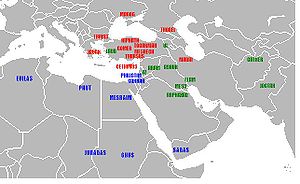
Book 1, chapter 6, was among the first of many who attempted to assign known ethnicities to some of the names listed in Genesis chapter 10. His assignments became the basis for most later authors, and were as follows:
- Gomer: "those whom the Greeks now call GalatiaGalatiaAncient Galatia was an area in the highlands of central Anatolia in modern Turkey. Galatia was named for the immigrant Gauls from Thrace , who settled here and became its ruling caste in the 3rd century BC, following the Gallic invasion of the Balkans in 279 BC. It has been called the "Gallia" of...
ns, [Galls,] but were then called Gomerites".- Aschanax (Ashkenaz): "Aschanaxians, who are now called by the Greeks Rheginians".
- Riphath: "Ripheans, now called PaphlagoniaPaphlagoniaPaphlagonia was an ancient area on the Black Sea coast of north central Anatolia, situated between Bithynia to the west and Pontus to the east, and separated from Phrygia by a prolongation to the east of the Bithynian Olympus...
ns". - Thrugramma (Togarmah): "Thrugrammeans, who, as the Greeks resolved, were named PhrygiaPhrygiaIn antiquity, Phrygia was a kingdom in the west central part of Anatolia, in what is now modern-day Turkey. The Phrygians initially lived in the southern Balkans; according to Herodotus, under the name of Bryges , changing it to Phruges after their final migration to Anatolia, via the...
ns".
- Magog: "Magogites, but who are by the Greeks called Scythians".
- Madai: "the Madeans, who are called Medes, by the Greeks".
- Javan: "Ionia, and all the Grecians".
- Elisa: "Eliseans... they are now the AeoliansAeoliansThe Aeolians were one of the four major ancient Greek tribes comprising Ancient Greeks. Their name derives from Aeolus, the mythical ancestor of the Aeolic branch and son of Hellen, the mythical patriarch of the Greek nation...
". - Tharsus (Tarshish): "Tharsians, for so was CiliciaCiliciaIn antiquity, Cilicia was the south coastal region of Asia Minor, south of the central Anatolian plateau. It existed as a political entity from Hittite times into the Byzantine empire...
of old called". He also derives the name of their city Tarsus from Tharsus. - Cethimus (Kittim): "The island Cethima: it is now called Cyprus". He also derives the Greek name of their city, which he spells Citius, from Cethimus.
- Elisa: "Eliseans... they are now the Aeolians
- Thobel (Tubal): "Thobelites, who are now called Iberes".
- Mosoch (Meshech): "Mosocheni... now they are CappadociaCappadociaCappadocia is a historical region in Central Anatolia, largely in Nevşehir Province.In the time of Herodotus, the Cappadocians were reported as occupying the whole region from Mount Taurus to the vicinity of the Euxine...
ns." He also derives the name of their capital Mazaca from Mosoch. - Thiras (Tiras): "Thirasians; but the Greeks changed the name into Thracians".
- Chus (Cush): "Ethiopians... even at this day, both by themselves and by all men in Asia, called Chusites".
- Sabas (Seba): Sabeans
- Evilas (Havilah): "Evileans, who are called Getuli".
- Sabathes (Sabta): "Sabathens, they are now called by the Greeks Astaborans".
- Sabactas (Sabteca): Sabactens
- Ragmus (Raamah): Ragmeans
- Judadas (Dedan): "Judadeans, a nation of the western Ethiopians".
- Sabas (Sheba): Sabeans
- Mesraim (Misraim): Egypt, which he says is called Mestre in his country.
- "Now all the children of Mesraim, being eight in number, possessed the country from Gaza to Egypt, though it retained the name of one only, the Philistim; for the Greeks call part of that country Palestine. As for the rest, Ludieim, and Enemim, and Labim, who alone inhabited in Libya, and called the country from himself, Nedim, and Phethrosim, and Chesloim, and Cephthorim, we know nothing of them besides their names; for the Ethiopic war which we shall describe hereafter, was the cause that those cities were overthrown."
- Phut: Libya. He states that a river and region "in the country of Moors" was still called Phut by the Greeks, but that it had been renamed "from one of the sons of Mesraim, who was called Lybyos".
- Canaan: Judea, which he called "from his own name Canaan".
- Sidonius (Sidon): The city of Sidonius, "called by the Greeks Sidon".
- Amathus (Hamathite): "Amathine, which is even now called Amathe by the inhabitants, although the Macedonians named it Epiphania, from one of his posterity."
- Arudeus (Arvadite): "the island Aradus".
- Arucas (Arkite): "Arce, which is in Libanus".
- "But for the seven others [sons of Canaan], Chetteus, Jebuseus, Amorreus, Gergesus, Eudeus, Sineus, Samareus, we have nothing in the sacred books but their names, for the Hebrews overthrew their cities".
- Elam: "Elamites, the ancestors of the Persians".
- Ashur: Assyrians, and their city Niniveh built by Ashur.
- Arphaxad: "Arphaxadites, who are now called ChaldeaChaldeaChaldea or Chaldaea , from Greek , Chaldaia; Akkadian ; Hebrew כשדים, Kaśdim; Aramaic: ܟܐܠܕܘ, Kaldo) was a marshy land located in modern-day southern Iraq which came to briefly rule Babylon...
ns".- Sala
- Heber (Eber): "from whom they originally called the Jews Hebrews".
- Phaleg (Peleg): He notes that he was so named "because he was born at the dispersion of the nations to their several countries; for Phaleg among the Hebrews signifies division".
- Joctan
- "Elmodad, Saleph, Asermoth, Jera, Adoram, Aizel, Decla, Ebal, Abimael, Sabeus, Ophir, Euilat, and Jobab. These inhabited from Cophen, an Indian river, and in part of Asia adjoining to it."
- Heber (Eber): "from whom they originally called the Jews Hebrews".
- Sala
- Aram: "Aramites, which the Greeks called Syrians".
- Uz: "Uz founded TrachonitisTrachonitisTrachonitis was a region that once formed part of Herod Philip's tetrarchy. It now lies within the boundaries of modern Syria.It appears in the Bible only in the phrase tes Itouraias kai Trachbnitidos choras, literally, "of the Iturean and Trachonian region"...
and DamascusDamascusDamascus , commonly known in Syria as Al Sham , and as the City of Jasmine , is the capital and the second largest city of Syria after Aleppo, both are part of the country's 14 governorates. In addition to being one of the oldest continuously inhabited cities in the world, Damascus is a major...
: this country lies between Palestine and Celesyria". - Ul (Hul): Armenia
- Gather (Gether): BactriaBactriaBactria and also appears in the Zend Avesta as Bukhdi. It is the ancient name of a historical region located between south of the Amu Darya and west of the Indus River...
ns - Mesa (Mesh): "Mesaneans; it is now called Charax Spasini".
- Uz: "Uz founded Trachonitis
- Laud (Lud): "Laudites, which are now called Lydians".
In Hippolytus
The chronicle of Hippolytus of Rome (c. 234), existing in numerous Latin and Greek copies, make another attempt to assign ethnicities to the names in Genesis 10, in some cases similar to those of Josephus, but with many differences, which are:- Gomer – Cappadocians
- Ashkenaz – Sarmatians
- Riphath – Sauromatians
- Togarmah – Armenians
- Magog – Galatians, Celts
- Javan
- Elishah – Siculi (Chron Pasc: Trojans and Phrygians)
- Tarshish – Iberians, Tyrrhenians
- Kittim – Macedonians, Romans, Latins
- Tubal – "Hettali" (?)
- Meshech – Illyrians
- Misraim
- Ludim – Lydians
- Anamim – PamphyliaPamphyliaIn ancient geography, Pamphylia was the region in the south of Asia Minor, between Lycia and Cilicia, extending from the Mediterranean to Mount Taurus . It was bounded on the north by Pisidia and was therefore a country of small extent, having a coast-line of only about 75 miles with a breadth of...
ns - Pathrusim – LyciaLyciaLycia Lycian: Trm̃mis; ) was a region in Anatolia in what are now the provinces of Antalya and Muğla on the southern coast of Turkey. It was a federation of ancient cities in the region and later a province of the Roman Empire...
ns (var.: Cretans) - Caphtorim – Cilicians
- Put – TroglodytesTroglodytaeThe Troglodytae or Troglodyti , were a people mentioned in various locations by many ancient Greek and Roman geographers and historians including Agatharcides, Strabo, Diodorus Siculus, Pliny, Tacitus, Josephus, etc....
- Canaan – AfriAfriAfri was a Latin name for the Carthaginians. It was received by the Romans from the Carthaginians, as a native term for their country....
and Phoenicians- Arkite – TripolitaniaTripolitaniaTripolitania or Tripolitana is a historic region and former province of Libya.Tripolitania was a separate Italian colony from 1927 to 1934...
ns
- Arkite – Tripolitania
- Lud – HalizonesHalizonesThe Halizones are an obscure people that appear in Homer's Iliad as allies of Troy during the Trojan War. Their leaders were Odius and Epistrophus, said by Apollodorus to be sons of a man named Mecisteus...
- Arpachshad
- Cainan – "those east of the Sarmatians" (one variant)
- Joktan
- Elmodad – Indians
- Saleph – Bactrians
- Hazamaveth, Sheba – Arabs
- Adoram – CarmaniaCarmania (satrapy)Carmania was a satrapy of the Achaemenid Empire as well as, later on, the Sassanid Empire. The region is approximately equal to that of modern day Kermān Province in Iran. Little is known about the exact boundaries of ancient Carmania, which may have fluctuated...
ns - Uzal – Arians (var.: Parthians)
- Abimael – Hyrcanians
- Obal – Scythians
- Ophir – Armenians
- Deklah – GedrosiaGedrosiaGedrosia from Pashto Gwadar-khua is the hellenized name of an area that corresponds to today's Balochistan. Eastern Balochistan is southwestern province of Pakistan and parts of southwestern and south-central Afghanistan and western Balochistan is divided between Iranian provinces of Hormozgan and...
ns
- Joktan
- Cainan – "those east of the Sarmatians" (one variant)
- Aram – "Etes" ?
- Hul – Lydians (var: Colchians)
- Gether – "Gaspeni" ?
- Mash – MossynoeciMossynoeciMossynoeci is a name that the Greeks of the Euxine Sea applied to the peoples of Pontus, the northern Anatolian coast west of Trebizond.-Herodotus:...
(var: Mosocheni)
The Chronicle of 354, the Panarion
Panarion
In early Christian heresiology, the Panarion , to which 16th-century Latin translations gave the name Adversus Haereses , is the most important of the works of Epiphanius of Salamis...
by Epiphanius of Salamis
Epiphanius of Salamis
Epiphanius of Salamis was bishop of Salamis at the end of the 4th century. He is considered a saint and a Church Father by both the Eastern Orthodox and Catholic Churches. He gained a reputation as a strong defender of orthodoxy...
(c. 375), the Chronicon Paschale
Chronicon Paschale
Chronicon Paschale is the conventional name of a 7th-century Greek Christian chronicle of the world...
(c. 627), the History of Albania by the Georgian historian Movses Kaghankatvatsi
Movses Kaghankatvatsi
Movses Kaghankatvatsi , or Movses Daskhurantsi , is the reputed author of a 10th-century Old Armenian historiographical work on Caucasian Albania, known as The History of the Country of Albania .- Authorship :...
(7th century), and the Synopsis of Histories by John Skylitzes
John Skylitzes
John Skylitzes, latinized as Ioannes Scylitzes was a Greek historian of the late 11th century. He was born in the beginning of 1040's and died after 1101.- Life :Very little is known about his life...
(c. 1057) follow the identifications of Hippolytus.
In Jerome
JeromeJerome
Saint Jerome was a Roman Christian priest, confessor, theologian and historian, and who became a Doctor of the Church. He was the son of Eusebius, of the city of Stridon, which was on the border of Dalmatia and Pannonia...
, writing ca. 390, provided an 'updated' version of Josephus' identifications in his Hebrew Questions on Genesis. His list is substantially identical to that of Josephus in almost all respects, but with the following notable differences:
- Thubal, son of Japheth: "Iberians, who are also the Spaniards from whom derive the CeltiberiansCeltiberiansThe Celtiberians were Celtic-speaking people of the Iberian Peninsula in the final centuries BC. The group used the Celtic Celtiberian language.Archaeologically, the Celtiberians participated in the Hallstatt culture in what is now north-central Spain...
, although certain people suppose them to be the Italians." - Gether, son of Aram: "AcarnaniiAcarnaniaAcarnania is a region of west-central Greece that lies along the Ionian Sea, west of Aetolia, with the Achelous River for a boundary, and north of the gulf of Calydon, which is the entrance to the Gulf of Corinth. Today it forms the western part of the prefecture of Aetolia-Acarnania. The capital...
or CariaCariaCaria was a region of western Anatolia extending along the coast from mid-Ionia south to Lycia and east to Phrygia. The Ionian and Dorian Greeks colonized the west of it and joined the Carian population in forming Greek-dominated states there...
ns" - Mash, son of Aram: Maeones
In Isidore of Seville and later authors
The scholar Isidore of SevilleIsidore of Seville
Saint Isidore of Seville served as Archbishop of Seville for more than three decades and is considered, as the historian Montalembert put it in an oft-quoted phrase, "le dernier savant du monde ancien"...
, in his Etymologiae
Etymologiae
Etymologiae is an encyclopedia compiled by Isidore of Seville towards the end of his life. It forms a bridge between a condensed epitome of classical learning at the close of Late Antiquity and the inheritance received, in large part through Isidore's work, by the early Middle Ages...
(ca. 600), repeats all of Jerome's identifications, but with these minor changes :
- Joktan, son of Eber: Indians
- Saleph, son of Joktan: Bactrians
- Magog, son of Japheth: "Scythians and Goths"
- Ashkenaz, son of Gomer: "SarmatiansSarmatiansThe Iron Age Sarmatians were an Iranian people in Classical Antiquity, flourishing from about the 5th century BC to the 4th century AD....
, whom the Greeks call Rheginians".
Isidore's identifications for Japheth's sons were repeated in the Historia Britonum
Historia Britonum
The Historia Brittonum, or The History of the Britons, is a historical work that was first composed around 830, and exists in several recensions of varying difference. It purports to relate the history of the Brittonic inhabitants of Britain from earliest times, and this text has been used to write...
attributed to Nennius
Nennius
Nennius was a Welsh monk of the 9th century.He has traditionally been attributed with the authorship of the Historia Brittonum, based on the prologue affixed to that work, This attribution is widely considered a secondary tradition....
. Isidore's identifications also became the basis for numerous later mediaeval scholars, remaining so until the Age of Discovery
Age of Discovery
The Age of Discovery, also known as the Age of Exploration and the Great Navigations , was a period in history starting in the early 15th century and continuing into the early 17th century during which Europeans engaged in intensive exploration of the world, establishing direct contacts with...
prompted newer theories, such as that of Benito Arias Montano
Benito Arias Montano
Benito Arias Montano , Spanish orientalist and editor of the Antwerp Polyglot, was born at Fregenal de la Sierra, in Extremadura, in 1527. After studying at the universities of Seville and Alcalá, he took orders about the year 1559. He became a clerical member of the Military Order of St...
(1571), who proposed connecting Meshech with Moscow
Moscow
Moscow is the capital, the most populous city, and the most populous federal subject of Russia. The city is a major political, economic, cultural, scientific, religious, financial, educational, and transportation centre of Russia and the continent...
, and Ophir with Peru
Peru
Peru , officially the Republic of Peru , is a country in western South America. It is bordered on the north by Ecuador and Colombia, on the east by Brazil, on the southeast by Bolivia, on the south by Chile, and on the west by the Pacific Ocean....
.
Shem as the Father of the Far East

Noah
Noah was, according to the Hebrew Bible, the tenth and last of the antediluvian Patriarchs. The biblical story of Noah is contained in chapters 6–9 of the book of Genesis, where he saves his family and representatives of all animals from the flood by constructing an ark...
himself.
Extrabiblical sons of Noah
There exist various traditions in post-biblical sources claiming that Noah had children other than Shem, Ham, and Japheth — born variously before, during, or after the Deluge.According to the Quran (Hud
Hud (sura)
Sura Hud is the 11th chapter of the Qur'an with 123 verses. It is a Makkan sura.-Contents and themes:...
v. 42–43), Noah had another unnamed son who refused to come aboard the Ark, instead preferring to climb a mountain, where he drowned. Some later Islamic commentators give his name as either Yam or Kan'an.
According to Irish mythology
Irish mythology
The mythology of pre-Christian Ireland did not entirely survive the conversion to Christianity, but much of it was preserved, shorn of its religious meanings, in medieval Irish literature, which represents the most extensive and best preserved of all the branch and the Historical Cycle. There are...
, as found in the Annals of the Four Masters
Annals of the Four Masters
The Annals of the Kingdom of Ireland or the Annals of the Four Masters are a chronicle of medieval Irish history...
and elsewhere, Noah had another son named Bith, who was not allowed aboard the Ark, and who attempted to colonise Ireland with 54 persons, only to be wiped out in the Deluge.
Some 9th century manuscripts of the Anglo-Saxon Chronicles assert that Sceafa was the fourth son of Noah, born aboard the Ark, from whom the House of Wessex
Wessex
The Kingdom of Wessex or Kingdom of the West Saxons was an Anglo-Saxon kingdom of the West Saxons, in South West England, from the 6th century, until the emergence of a united English state in the 10th century, under the Wessex dynasty. It was to be an earldom after Canute the Great's conquest...
traced their ancestry; in William of Malmesbury
William of Malmesbury
William of Malmesbury was the foremost English historian of the 12th century. C. Warren Hollister so ranks him among the most talented generation of writers of history since Bede, "a gifted historical scholar and an omnivorous reader, impressively well versed in the literature of classical,...
's version of this genealogy (c. 1120), Sceaf is instead made a descendant of Strephius, the fourth son born aboard the Ark (Gesta Regnum Anglorum).
An early Arabic work known as Kitab al-Magall or the Book of Rolls (part of Clementine literature
Clementine literature
Clementine literature is the name given to the religious romance which purports to contain a record made by one Clement of discourses...
) mentions Bouniter, the fourth son of Noah, born after the flood, who allegedly invented astronomy and instructed Nimrod. Variants of this story with often similar names for Noah's fourth son are also found in the ca. 5th century Ge'ez work Conflict of Adam and Eve with Satan
Conflict of Adam and Eve with Satan
The Conflict of Adam and Eve with Satan is a Christian pseudepigraphical work found in Ge'ez, translated from an Arabic original and thought to date from the 5th or 6th century AD....
(Barvin), the ca. 6th century Syriac book Cave of Treasures
Cave of Treasures
The Cave of Treasures, sometimes referred to simply as The Treasure, is a book of the New Testament apocrypha.-Origin:This text is attributed to Ephrem Syrus, who was born at Nisibis soon after AD 306 and died in 373, but it is now generally believed that its current form is 6th century or...
(Yonton), the 7th century Apocalypse of Pseudo-Methodius
Apocalypse of Pseudo-Methodius
The Apocalypse of Pseudo-Methodius is a 7th-century apocalypse that shaped the eschatological imagination of Christendom throughout the Middle Ages. The work was written in Syriac in the late 7th century, in reaction to the Islamic conquest of the Near East, and is falsely attributed to the...
(Ionitus), the Syriac Book of the Bee
Book of the Bee
The Book of the Bee is an historical/theological compilation containing numerous bible legends. It was written by Syrian Nestorian Solomon, Bishop of Bassora . It was written in Syriac.-Book:...
1221 (Yônatôn), the Hebrew Chronicles of Jerahmeel
Chronicles of Jerahmeel
The Chronicles of Jerahmeel is a voluminous work that draws largely on Pseudo-Philo's earlier history of Biblical events and is of special interest because it includes Hebrew and Aramaic versions of certain deuterocanonical books in the Septuagint....
, ca. 12th–14th cent. (Jonithes), and throughout Armenian apocryphal literature, where he is usually referred to as Maniton; as well as in works by Petrus Comestor
Petrus Comestor
-Biography:Born in Troyes, he was first attached to the Church of Notre-Dame in that city and habitually signed himself as "Presbyter Trecensis". Before 1148 he became dean of the chapter and received a benefice in 1148. About 1160 he formed one of the Chapter of Notre-Dame at Paris, and about the...
c. 1160 (Jonithus), Godfrey of Viterbo
Godfrey of Viterbo
Godfrey of Viterbo was a Roman Catholic chronicler, either Italian or German.-Biography:He was probably an Italian by birth, although some authorities assert that he was a Saxon German like his imperial patrons...
1185 (Ihonitus), Michael the Syrian
Michael the Syrian
Michael the Syrian , also known as Michael the Great or Michael Syrus or Michael the Elder, to distinguish him from his nephew, was a patriarch of the Syriac Orthodox Church from 1166 to 1199. He is best known today as the author of the largest medieval Chronicle, which he composed in Syriac...
1196 (Maniton), Abu Salih the Armenian c. 1208 (Abu Naiţur); Jacob van Maerlant
Jacob van Maerlant
Jacob van Maerlant was the greatest Flemish poet of the thirteenth century and one of the most important Middle Dutch authors during the Middle Ages.-Biography:...
c. 1270 (Jonitus), and Abraham Zacuto
Abraham Zacuto
Abraham Zacuto was a Sephardi Jewish astronomer, astrologer, mathematician and historian who served as Royal Astronomer in the 15th century to King John II of Portugal. The crater Zagut on the Moon is named after him....
1504 (Yoniko).
Martin of Opava
Martin of Opava
Martin of Opava, also known as Martin of Poland, was a 13th century chronicler.Known in Latin as Frater Martinus Ordinis Praedicatorum , he is believed to have been born, at an unknown date, in the Silesian town of Opava , thus sometimes called Martinus Oppaviensis, or also Martinus Polonus...
(c. 1250), later versions of the Mirabilia Urbis Romae
Mirabilia Urbis Romae
Mirabilia Urbis Romae is a much-copied medieval Latin text that served generations of pilgrims and tourists as a guide to the city of Rome. The original, which was written by a canon of St Peter's, dates from the 1140s...
, and the Chronicon Bohemorum of Giovanni di Marignola (1355) make Janus
Janus (mythology)
In ancient Roman religion and mythology, Janus is the god of beginnings and transitions, thence also of gates, doors, doorways, endings and time. He is usually a two-faced god since he looks to the future and the past...
(i.e., the Roman deity) the fourth son of Noah, who moved to Italy, invented astrology
Astrology
Astrology consists of a number of belief systems which hold that there is a relationship between astronomical phenomena and events in the human world...
, and instructed Nimrod.
According to the monk Annio da Viterbo (1498), the Hellenistic Babylonian writer Berossus
Berossus
Berossus was a Hellenistic-era Babylonian writer, a priest of Bel Marduk and astronomer writing in Greek, who was active at the beginning of the 3rd century BC...
had mentioned 30 children born to Noah after the Deluge, including sons named Tuiscon, Prometheus
Prometheus
In Greek mythology, Prometheus is a Titan, the son of Iapetus and Themis, and brother to Atlas, Epimetheus and Menoetius. He was a champion of mankind, known for his wily intelligence, who stole fire from Zeus and gave it to mortals...
, Iapetus
Iapetus (mythology)
In Greek mythology, Iapetus , also Iapetos or Japetus , was a Titan, the son of Uranus and Gaia, and father of Atlas, Prometheus, Epimetheus, and Menoetius and through Prometheus, Epimetheus and Atlas an ancestor of the human race...
, Macrus, "16 titan
Titan (mythology)
In Greek mythology, the Titans were a race of powerful deities, descendants of Gaia and Uranus, that ruled during the legendary Golden Age....
s", Cranus, Granaus, Oceanus
Oceanus
Oceanus ; , Ōkeanós) was a pseudo-geographical feature in classical antiquity, believed by the ancient Greeks and Romans to be the world-ocean, an enormous river encircling the world....
, and Tipheus. Also mentioned are daughters of Noah named Araxa "the Great", Regina, Pandora
Pandora
In Greek mythology, Pandora was the first woman. As Hesiod related it, each god helped create her by giving her unique gifts...
, Crana, and Thetis
Thetis
Silver-footed Thetis , disposer or "placer" , is encountered in Greek mythology mostly as a sea nymph or known as the goddess of water, one of the fifty Nereids, daughters of the ancient one of the seas with shape-shifting abilities who survives in the historical vestiges of most later Greek myths...
. However, Annio's manuscript is widely regarded today as having been a forgery.
See also
- AggadahAggadahAggadah refers to the homiletic and non-legalistic exegetical texts in the classical rabbinic literature of Judaism, particularly as recorded in the Talmud and Midrash...
- Ancient EgyptAncient EgyptAncient Egypt was an ancient civilization of Northeastern Africa, concentrated along the lower reaches of the Nile River in what is now the modern country of Egypt. Egyptian civilization coalesced around 3150 BC with the political unification of Upper and Lower Egypt under the first pharaoh...
- AntediluvianAntediluvianThe antediluvian period meaning "before the deluge" is the period referred to in the Bible between the Creation of the Earth and the Deluge . The narrative takes up chapters 1-6 of Genesis...
- Comparative linguisticsComparative linguisticsComparative linguistics is a branch of historical linguistics that is concerned with comparing languages to establish their historical relatedness....
- Continuity thesisContinuity thesisIn the history of ideas, the continuity thesis is the hypothesis that there was no radical discontinuity between the intellectual development of the Middle Ages and the developments in the Renaissance and early modern period. Thus the idea of an intellectual or scientific revolution following the...
- EthnographyEthnographyEthnography is a qualitative method aimed to learn and understand cultural phenomena which reflect the knowledge and system of meanings guiding the life of a cultural group...
- Fertile crescentFertile CrescentThe Fertile Crescent, nicknamed "The Cradle of Civilization" for the fact the first civilizations started there, is a crescent-shaped region containing the comparatively moist and fertile land of otherwise arid and semi-arid Western Asia. The term was first used by University of Chicago...
- Garden of EdenGarden of EdenThe Garden of Eden is in the Bible's Book of Genesis as being the place where the first man, Adam, and his wife, Eve, lived after they were created by God. Literally, the Bible speaks about a garden in Eden...
- GenealogyGenealogyGenealogy is the study of families and the tracing of their lineages and history. Genealogists use oral traditions, historical records, genetic analysis, and other records to obtain information about a family and to demonstrate kinship and pedigrees of its members...
- Human history
- MesopotamiaMesopotamiaMesopotamia is a toponym for the area of the Tigris–Euphrates river system, largely corresponding to modern-day Iraq, northeastern Syria, southeastern Turkey and southwestern Iran.Widely considered to be the cradle of civilization, Bronze Age Mesopotamia included Sumer and the...
- NuwaubianismNuwaubianismThe Nuwaubian Nation or Nuwaubian movement led by Malachi York,...
- Noah's ArkNoah's ArkNoah's Ark is a vessel appearing in the Book of Genesis and the Quran . These narratives describe the construction of the ark by Noah at God's command to save himself, his family, and the world's animals from the worldwide deluge of the Great Flood.In the narrative of the ark, God sees the...
- Wives aboard the ArkWives aboard the ArkAlthough the Book of Genesis in the Bible does not give any further information about the four women it says were aboard Noah's Ark during the Flood, there exist substantial extra-Biblical traditions regarding these women and their names.-Book of Jubilees:...
External links
- Latin Vulgate and English Douay-Rheims
- English Septuagint
- King James Version and Revised Standard Version
- Jewish Encyclopedia: Entry for "Genealogy" - a 1901/6 view (the early days of comparative linguistics and the documentary hypothesis).
- The connection of modern nations to the table according to a creationist source (with Europe as descended from the tribes of Israel, and the UK and USA from Joseph (but by different sons)).
- Custance, Arthur C., The Roots of the Nations. A more standard creationist account that associates Japheth with Europe.