

Mushki

Encyclopedia
The Mushki were an Iron Age
people of Anatolia
, known from Assyria
n sources. They do not appear in Hittite
records. Several authors have connected them with the Moschoi (Μόσχοι) of Greek sources and the Georgian tribe of the Meskhi
. Josephus Flavius identified the Moschoi with the Biblical Meshech
. Two different groups are called Muški in the Assyrian sources (Diakonoff
1984:115), one from the 12th to 9th centuries, located near the confluence of the Arsanias and the Euphrates
("Eastern Mushki"), and the other in the 8th to 7th centuries, located in Cappadocia
and Cilicia
("Western Mushki"). Assyrian sources identify the Western Mushki with the Phrygians, while Greek sources clearly distinguish between Phrygians and Moschoi.
Identification of the Eastern with the Western Mushki is uncertain, but it is of course possible to assume a migration of at least part of the Eastern Mushki to Cilicia in the course of the 10th to 8th centuries, and this possibility has been repeatedly suggested, variously identifying the Mushki as speakers of a Georgian
, Armenian
or Anatolian idiom. The Encyclopedia of Indo-European Culture
notes that "the Armenians according to Diakonoff, are then an amalgam of the Hurrian (and Urartians), Luvians and the Proto-Armenian Mushki (or Armeno-Phrygian
s) who carried their IE language eastwards across Anatolia."
. They established themselves in a post-Hittite
kingdom in Cappadocia
.
Whether they moved into the core Hittite areas from the east or west has been a matter of some discussion by historians. Some speculate that they may have originally occupied a territory in the area of Urartu
; alternatively, ancient accounts suggest that they first arrived from a homeland in the west (as part of the Armeno-Phrygian
migration), from the region of Troy, or even from as far as Macedonia, as the Bryges
.
Together with the Hurrians
and Kaskas
, they invaded the Assyrian provinces of Alzi and Puruhuzzi in about 1160, but they were pushed back and defeated, along with the Kaskas, by Tiglath-Pileser I
in 1115 BC, who until 1110 advanced as far as Milid
.
became the most influential of the post-Hittite polities, and the Mushki under Mita entered an anti-Assyrian alliance with Tabal and Carchemish
. The alliance was soon defeated by Sargon of Assyria
, who captured Carchemish and drove back Mita to his own province. Ambaris of Tabal was diplomatically married to an Assyrian princess, and received the province of Hilakku
, but in 713 BC, Ambaris was deposed and Tabal became an Assyrian province.
In 709, the Mushki re-emerged as allies of Assyria, Sargon naming Mita as his friend. It appears that Mita had captured and handed over to the Assyrians emissaries of Urikki, king of Que
, who were sent to negotiate an anti-Assyrian contract with Urartu, as they passed through his territory.
According to Assyrian military intelligence reports to Sargon
recorded on clay tablets found in the Royal Archives of Nineveh by Sir Henry Layard
, the Cimmerians invaded Urartu from Mannai in 714. From there they turned west along the coast of the Black Sea as far as Sinope
, and then headed south towards Tabal, in 705 defeating an Assyrian army in central Anatolia, resulting in the death of Sargon. Macqueen (1986:157) and others have speculated that the Mushki under Mita may have participated in the Assyrian campaign and were forced to flee to western Anatolia, disappearing from Assyrian accounts, but entering the periphery of Greek historiography as king Midas
of Phrygia
.
Rusas II of Urartu
in the 7th century fought the Mushki-ni to his west, before he entered an alliance with them against Assyria.
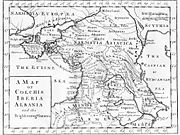 Hecataeus of Miletus (c. 550 - 476 BCE) speaks of the Moschi as "Colchians
" (perhaps, Georgian
speaking), situated next to the Matieni (Hurrians
).
According to Herodotus
, the equipment of the Moschoi was similar to that of the Tibareni
, Macrones
, Mossynoeci
and Mardae, with wooden caps upon their heads, and shields and small spears, on which long points were set. All these tribes formed the 19th satrapy of the Achaemenid empire, extending along the southeast of the Euxine, or the Black Sea
, and bounded on the south by the lofty chain of the Armenian mountains
.
Strabo
locates the Moschoi in two places. The first location is somewhere in modern Abkhazia
(Georgia
) on the eastern shore of the Black Sea, in agreement with Stephan of Byzantium quoting Hellanicus. The second location Moschice (Moschikê) – in which was a temple of Leucothea
, once famous for its wealth, but plundered by Pharnaces
and Mithridates
– was divided between the Colchians, Armenia
ns, and Iberians
(cf. Mela
, III. 5.4; Pliny
VI.4.). These latter Moschoi were obviously the Georgian Meskhi or Mesx’i
(where Greek
χ, chi
, is Georgian
ხ, x). Procopius
calls them Meschoi and says that they were subject to the Iberians (i.e., Georgians), and had embraced Christianity
, the religion of their masters. According to Professor James R. Russell
of Harvard University
, the Georgian designation for Armenians Somekhi, preserves the old name of the Mushki.
Pliny in the 1st century AD mentions the Moscheni in southern Armenia ("Armenia" at the time stretching south and west to the Mediterranean, bordering on Cappadocia). In Byzantine
historiography, Moschoi was a name equivalent to or considered as the ancestors of "Cappadocians" (Eusebius) with their capital at Mazaca (later Caesarea Mazaca, modern Kayseri
).
n Moschoi with the Biblical Japhetic
tribe descended from Meshech
in his writings on the Genealogy of the Nations in Genesis 10, while Hippolytus of Rome connected Meshech with Illyria
ns. Meshech is named with Tubal
as a principality of the prince of Gog and Magog
in Ezekiel
38:2 and 39:1.
, near Tbilisi, is believed by Georgian experts to be the former capital of the Mushki state. According to the medieval Georgian Chronicles, the city was built by the legendary patriarch Mtskhetos, one of five sons of Kartlos, the legendary patriarch of the Georgian nation (who was in turn said to be a son of Torgom, the Georgian spelling of Biblical Togar Mah, son of Gomer, son of Japheth, son of Noah). According to the Chronicles, during Mtskhetos' lifetime the descendants of Torgom (including Georgians, Armenians and other South Caucasian nations) were united and successfully resisted the attacks of the "Nimrodians", which Georgian experts interpret as a reference to ancient conflict between the Mushki and Assyria. Excavations in Mtskheta have confirmed the town dates back at least as far as 1000 BC.
The Chronicles, the older Conversion of Kartli
, and the older still Armenian chronicles of Moses of Chorene all give conflicting accounts of Mtskheta's history prior to and during the conquests of Alexander the Great. According to the Conversion, Mtskheta remained the chief city of "Kartli", the medieval native name for Georgia, up until Alexander's arrival, who changed the ruling dynasty in Mtskheta by installing Azo
, said to be a prince from Arian Kartli. According to the Chronicles, after Mtskhetos' death, Kartli broke up into several smaller, warring regions, until unity was restored by Azo, said to be one of Alexander's Macedonian generals, who was in turn expelled by the (half-Persian) local prince Parnawaz, and it was Parnawaz who founded the new ruling dynasty of Kartli. Moses of Chorene says that Alexander installed a Persian satrap named Mithridates in Mtskheta.
While Georgian experts disagree over the details of their interpretations of these accounts, they generally agree that they reflect a decline of the Mushki state and rise of Persian influence before the arrival of Alexander, who, perhaps more as a side-effect than by any effort on his part, ushered in a new era of unity in much of the Mushki state's former territories under a new dynasty, who preferred the name Kartli over Mushki. Mtskheta remained the capital of the Kartli state, which became known in most languages as Iberia
, until the 5th century AD.
. They speak a dialect of Georgian called Meskhuri, which among Georgia's regional dialects is relatively close to official Georgian. The town of Mtskheta is not in today's Meskheti region, but lies about 100km to its northeast, in the Kartli region.
is another name for the Mushki, in contradiction to prevailing opinion which places the Massagetae in Central Asia. They base their argument on statements by Herodotus
that the Massagetae lived "beyond the Araxes" (1.201) and that "after crossing the Araxes, Cyrus was sleeping on the territory of the Massagetae" (1.209), while rejecting as a mistake a third statement by Herodotus that "on the west the Caspian is bounded by the Caucasus; eastwards lies an immense tract of flat country ... the greater part of this region is occupied by the Massagetae" (1.204). Georgian historians also point to the similarity of the names Massagetae, Mtskheta and Meskheti, and to the lack of archeological evidence for a Massagetae state in Central Asia.
Iron Age
The Iron Age is the archaeological period generally occurring after the Bronze Age, marked by the prevalent use of iron. The early period of the age is characterized by the widespread use of iron or steel. The adoption of such material coincided with other changes in society, including differing...
people of Anatolia
Anatolia
Anatolia is a geographic and historical term denoting the westernmost protrusion of Asia, comprising the majority of the Republic of Turkey...
, known from Assyria
Assyria
Assyria was a Semitic Akkadian kingdom, extant as a nation state from the mid–23rd century BC to 608 BC centred on the Upper Tigris river, in northern Mesopotamia , that came to rule regional empires a number of times through history. It was named for its original capital, the ancient city of Assur...
n sources. They do not appear in Hittite
Hittites
The Hittites were a Bronze Age people of Anatolia.They established a kingdom centered at Hattusa in north-central Anatolia c. the 18th century BC. The Hittite empire reached its height c...
records. Several authors have connected them with the Moschoi (Μόσχοι) of Greek sources and the Georgian tribe of the Meskhi
Meskhetians
Meskhetian Turks, also known as Ahıska Turks are the former Turkish inhabitants of Meskheti , along the border with Turkey. They were deported to Central Asia during November 15–25, 1944 by Joseph Stalin and settled within Kazakhstan, Kyrgyzstan, and Uzbekistan. Of the 120,000 forcibly deported...
. Josephus Flavius identified the Moschoi with the Biblical Meshech
Meshech
In the Bible, Meshech is named as a son of Japheth in Genesis 10:2 and 1 Chronicles 1:5.Another Meshech is named as a son of Aram in 1 Chronicles 1:17 .-Interpretations:...
. Two different groups are called Muški in the Assyrian sources (Diakonoff
Igor Diakonov
Igor Mikhailovich Diakonov was a Russian historian, linguist, and translator and a renowned expert in the Ancient Near East and its languages....
1984:115), one from the 12th to 9th centuries, located near the confluence of the Arsanias and the Euphrates
Euphrates
The Euphrates is the longest and one of the most historically important rivers of Western Asia. Together with the Tigris, it is one of the two defining rivers of Mesopotamia...
("Eastern Mushki"), and the other in the 8th to 7th centuries, located in Cappadocia
Cappadocia
Cappadocia is a historical region in Central Anatolia, largely in Nevşehir Province.In the time of Herodotus, the Cappadocians were reported as occupying the whole region from Mount Taurus to the vicinity of the Euxine...
and Cilicia
Cilicia
In antiquity, Cilicia was the south coastal region of Asia Minor, south of the central Anatolian plateau. It existed as a political entity from Hittite times into the Byzantine empire...
("Western Mushki"). Assyrian sources identify the Western Mushki with the Phrygians, while Greek sources clearly distinguish between Phrygians and Moschoi.
Identification of the Eastern with the Western Mushki is uncertain, but it is of course possible to assume a migration of at least part of the Eastern Mushki to Cilicia in the course of the 10th to 8th centuries, and this possibility has been repeatedly suggested, variously identifying the Mushki as speakers of a Georgian
Georgian language
Georgian is the native language of the Georgians and the official language of Georgia, a country in the Caucasus.Georgian is the primary language of about 4 million people in Georgia itself, and of another 500,000 abroad...
, Armenian
Armenian language
The Armenian language is an Indo-European language spoken by the Armenian people. It is the official language of the Republic of Armenia as well as in the region of Nagorno-Karabakh. The language is also widely spoken by Armenian communities in the Armenian diaspora...
or Anatolian idiom. The Encyclopedia of Indo-European Culture
Encyclopedia of Indo-European Culture
The Encyclopedia of Indo-European Culture is an encyclopedia of Indo-European studies and the Proto-Indo-Europeans. The encyclopedia was edited by J. P. Mallory and Douglas Q. Adams and published in 1997 by Fitzroy Dearborn...
notes that "the Armenians according to Diakonoff, are then an amalgam of the Hurrian (and Urartians), Luvians and the Proto-Armenian Mushki (or Armeno-Phrygian
Armeno-Phrygian
Armeno-Phrygian is a term for a hypothetical people who are thought to have migrated from the Balkans to Anatolia as a group and then have separated to form the Phrygians, the Mushki of Cappadocia, and the Armenians. It is also used for the language they are assumed to have spoken...
s) who carried their IE language eastwards across Anatolia."
Eastern Muški
The Eastern Muski appear to have moved into Hatti in the 12th century, completing the downfall of the collapsing Hittite state, along with various Sea PeoplesSea Peoples
The Sea Peoples were a confederacy of seafaring raiders of the second millennium BC who sailed into the eastern Mediterranean, caused political unrest, and attempted to enter or control Egyptian territory during the late 19th dynasty and especially during year 8 of Ramesses III of the 20th Dynasty...
. They established themselves in a post-Hittite
Neo-Hittite
The states that are called Neo-Hittite, or more recently Syro-Hittite, were Luwian, Aramaic and Phoenician-speaking political entities of the Iron Age northern Syria and southern Anatolia that arose following the collapse of the Hittite Empire around 1180 BC and lasted until roughly 700 BC...
kingdom in Cappadocia
Cappadocia
Cappadocia is a historical region in Central Anatolia, largely in Nevşehir Province.In the time of Herodotus, the Cappadocians were reported as occupying the whole region from Mount Taurus to the vicinity of the Euxine...
.
Whether they moved into the core Hittite areas from the east or west has been a matter of some discussion by historians. Some speculate that they may have originally occupied a territory in the area of Urartu
Urartu
Urartu , corresponding to Ararat or Kingdom of Van was an Iron Age kingdom centered around Lake Van in the Armenian Highland....
; alternatively, ancient accounts suggest that they first arrived from a homeland in the west (as part of the Armeno-Phrygian
Armeno-Phrygian
Armeno-Phrygian is a term for a hypothetical people who are thought to have migrated from the Balkans to Anatolia as a group and then have separated to form the Phrygians, the Mushki of Cappadocia, and the Armenians. It is also used for the language they are assumed to have spoken...
migration), from the region of Troy, or even from as far as Macedonia, as the Bryges
Bryges
Bryges or Briges is the historical name given to a people of the ancient Balkans. They are generally considered to have been related to the Phrygians, who during classical antiquity lived in western Anatolia. Both names, Bryges and Phrygians, are assumed to be variants of the same root. Based on...
.
Together with the Hurrians
Hurrians
The Hurrians were a people of the Ancient Near East who lived in Northern Mesopotamia and adjacent regions during the Bronze Age.The largest and most influential Hurrian nation was the kingdom of Mitanni. The population of the Hittite Empire in Anatolia to a large part consisted of Hurrians, and...
and Kaskas
Kaskas
The Kaska were a loosely-affiliated Bronze Age non-Indo-European tribal people of mountainous Pontic Anatolia, known from Hittite sources...
, they invaded the Assyrian provinces of Alzi and Puruhuzzi in about 1160, but they were pushed back and defeated, along with the Kaskas, by Tiglath-Pileser I
Tiglath-Pileser I
Tiglath-Pileser I was a king of Assyria during the Middle Assyrian period . According to Georges Roux, Tiglath-Pileser was "one of the two or three great Assyrian monarchs since the days of Shamshi-Adad I"...
in 1115 BC, who until 1110 advanced as far as Milid
Milid
Melid was an ancient city on the Tohma River, a tributary of the upper Euphrates rising in the Taurus Mountains...
.
Western Muški
In the 8th century, TabalTabal
Tabal was a Luwian speaking Neo-Hittite kingdom of South Central Anatolia. According to archaeologist Kurt Bittel, the kingdom of Tabal first appeared after the collapse of the Hittite Empire....
became the most influential of the post-Hittite polities, and the Mushki under Mita entered an anti-Assyrian alliance with Tabal and Carchemish
Carchemish
Carchemish or Kargamış was an important ancient city of the Mitanni, Hittite and Neo Assyrian Empires, now on the frontier between Turkey and Syria. It was the location of an important battle between the Babylonians and Egyptians, mentioned in the Bible...
. The alliance was soon defeated by Sargon of Assyria
Sargon II
Sargon II was an Assyrian king. Sargon II became co-regent with Shalmaneser V in 722 BC, and became the sole ruler of the kingdom of Assyria in 722 BC after the death of Shalmaneser V. It is not clear whether he was the son of Tiglath-Pileser III or a usurper unrelated to the royal family...
, who captured Carchemish and drove back Mita to his own province. Ambaris of Tabal was diplomatically married to an Assyrian princess, and received the province of Hilakku
Cilicia
In antiquity, Cilicia was the south coastal region of Asia Minor, south of the central Anatolian plateau. It existed as a political entity from Hittite times into the Byzantine empire...
, but in 713 BC, Ambaris was deposed and Tabal became an Assyrian province.
In 709, the Mushki re-emerged as allies of Assyria, Sargon naming Mita as his friend. It appears that Mita had captured and handed over to the Assyrians emissaries of Urikki, king of Que
Quwê
Quwê – also spelled Que, Kue, Qeve, Coa, Kuê and Keveh – was a "Neo-Hittite" Assyrian vassal state or province at various times from the 9th century BCE to shortly after the death of Ashurbanipal around 627 BCE in the lowlands of eastern Cilicia, and the name of its capital city,...
, who were sent to negotiate an anti-Assyrian contract with Urartu, as they passed through his territory.
According to Assyrian military intelligence reports to Sargon
Sargon II
Sargon II was an Assyrian king. Sargon II became co-regent with Shalmaneser V in 722 BC, and became the sole ruler of the kingdom of Assyria in 722 BC after the death of Shalmaneser V. It is not clear whether he was the son of Tiglath-Pileser III or a usurper unrelated to the royal family...
recorded on clay tablets found in the Royal Archives of Nineveh by Sir Henry Layard
Austen Henry Layard
Sir Austen Henry Layard GCB, PC was a British traveller, archaeologist, cuneiformist, art historian, draughtsman, collector, author, politician and diplomat, best known as the excavator of Nimrud.-Family:...
, the Cimmerians invaded Urartu from Mannai in 714. From there they turned west along the coast of the Black Sea as far as Sinope
Sinope
Sinope may refer to:*Sinop, Turkey, a city on the Black Sea, historically known as Sinope** Battle of Sinop, 1853 naval battle in the Sinop port*Sinope , in Greek mythology, daughter of Asopus*Sinope , a moon of the planet Jupiter...
, and then headed south towards Tabal, in 705 defeating an Assyrian army in central Anatolia, resulting in the death of Sargon. Macqueen (1986:157) and others have speculated that the Mushki under Mita may have participated in the Assyrian campaign and were forced to flee to western Anatolia, disappearing from Assyrian accounts, but entering the periphery of Greek historiography as king Midas
Midas
For the legend of Gordias, a person who was taken by the people and made King, in obedience to the command of the oracle, see Gordias.Midas or King Midas is popularly remembered in Greek mythology for his ability to turn everything he touched into gold. This was called the Golden touch, or the...
of Phrygia
Phrygia
In antiquity, Phrygia was a kingdom in the west central part of Anatolia, in what is now modern-day Turkey. The Phrygians initially lived in the southern Balkans; according to Herodotus, under the name of Bryges , changing it to Phruges after their final migration to Anatolia, via the...
.
Rusas II of Urartu
Urartu
Urartu , corresponding to Ararat or Kingdom of Van was an Iron Age kingdom centered around Lake Van in the Armenian Highland....
in the 7th century fought the Mushki-ni to his west, before he entered an alliance with them against Assyria.
Moschoi
Colchis
In ancient geography, Colchis or Kolkhis was an ancient Georgian state kingdom and region in Western Georgia, which played an important role in the ethnic and cultural formation of the Georgian nation.The Kingdom of Colchis contributed significantly to the development of medieval Georgian...
" (perhaps, Georgian
Georgian language
Georgian is the native language of the Georgians and the official language of Georgia, a country in the Caucasus.Georgian is the primary language of about 4 million people in Georgia itself, and of another 500,000 abroad...
speaking), situated next to the Matieni (Hurrians
Hurrians
The Hurrians were a people of the Ancient Near East who lived in Northern Mesopotamia and adjacent regions during the Bronze Age.The largest and most influential Hurrian nation was the kingdom of Mitanni. The population of the Hittite Empire in Anatolia to a large part consisted of Hurrians, and...
).
According to Herodotus
Herodotus
Herodotus was an ancient Greek historian who was born in Halicarnassus, Caria and lived in the 5th century BC . He has been called the "Father of History", and was the first historian known to collect his materials systematically, test their accuracy to a certain extent and arrange them in a...
, the equipment of the Moschoi was similar to that of the Tibareni
Tabal
Tabal was a Luwian speaking Neo-Hittite kingdom of South Central Anatolia. According to archaeologist Kurt Bittel, the kingdom of Tabal first appeared after the collapse of the Hittite Empire....
, Macrones
Macrones
The Macrones were an ancient Colchian tribe in the east of Pontus, about the Moschici Mountains .The Macrones are first mentioned by Herodotus , who relates that they, along with Moschi, Tabal, Mossynoeci, and Mares, formed the nineteenth satrapy within the Achaemenid Persian Empire and fought...
, Mossynoeci
Mossynoeci
Mossynoeci is a name that the Greeks of the Euxine Sea applied to the peoples of Pontus, the northern Anatolian coast west of Trebizond.-Herodotus:...
and Mardae, with wooden caps upon their heads, and shields and small spears, on which long points were set. All these tribes formed the 19th satrapy of the Achaemenid empire, extending along the southeast of the Euxine, or the Black Sea
Black Sea
The Black Sea is bounded by Europe, Anatolia and the Caucasus and is ultimately connected to the Atlantic Ocean via the Mediterranean and the Aegean seas and various straits. The Bosphorus strait connects it to the Sea of Marmara, and the strait of the Dardanelles connects that sea to the Aegean...
, and bounded on the south by the lofty chain of the Armenian mountains
Armenian Highland
The Armenian Highland is the central-most and highest of three land-locked plateaus that together form the northern sector of the Middle East...
.
Strabo
Strabo
Strabo, also written Strabon was a Greek historian, geographer and philosopher.-Life:Strabo was born to an affluent family from Amaseia in Pontus , a city which he said was situated the approximate equivalent of 75 km from the Black Sea...
locates the Moschoi in two places. The first location is somewhere in modern Abkhazia
Abkhazia
Abkhazia is a disputed political entity on the eastern coast of the Black Sea and the south-western flank of the Caucasus.Abkhazia considers itself an independent state, called the Republic of Abkhazia or Apsny...
(Georgia
Georgia (country)
Georgia is a sovereign state in the Caucasus region of Eurasia. Located at the crossroads of Western Asia and Eastern Europe, it is bounded to the west by the Black Sea, to the north by Russia, to the southwest by Turkey, to the south by Armenia, and to the southeast by Azerbaijan. The capital of...
) on the eastern shore of the Black Sea, in agreement with Stephan of Byzantium quoting Hellanicus. The second location Moschice (Moschikê) – in which was a temple of Leucothea
Leucothea
In Greek mythology, Leucothea , "white goddess") was one of the aspects under which an ancient sea goddess was recognized, in this case as a transformed nymph....
, once famous for its wealth, but plundered by Pharnaces
Pharnaces II of Pontus
Pharnaces II of Pontus, also known as Pharnaces II was a prince, then King of Pontus and the Bosporan until his death. He was a monarch of Persian and Greek Macedonian ancestry. Pharnaces II was the youngest son and child born to King Mithridates VI of Pontus from his first wife, his sister Queen...
and Mithridates
Mithridates VI of Pontus
Mithridates VI or Mithradates VI Mithradates , from Old Persian Mithradatha, "gift of Mithra"; 134 BC – 63 BC, also known as Mithradates the Great and Eupator Dionysius, was king of Pontus and Armenia Minor in northern Anatolia from about 120 BC to 63 BC...
– was divided between the Colchians, Armenia
Armenia
Armenia , officially the Republic of Armenia , is a landlocked mountainous country in the Caucasus region of Eurasia...
ns, and Iberians
Caucasian Iberia
Iberia , also known as Iveria , was a name given by the ancient Greeks and Romans to the ancient Georgian kingdom of Kartli , corresponding roughly to the eastern and southern parts of the present day Georgia...
(cf. Mela
Pomponius Mela
Pomponius Mela, who wrote around AD 43, was the earliest Roman geographer. He was born in Tingentera and died c. AD 45.His short work occupies less than one hundred pages of ordinary print. It is laconic in style and deficient in method, but of pure Latinity, and occasionally relieved by pleasing...
, III. 5.4; Pliny
Pliny the Elder
Gaius Plinius Secundus , better known as Pliny the Elder, was a Roman author, naturalist, and natural philosopher, as well as naval and army commander of the early Roman Empire, and personal friend of the emperor Vespasian...
VI.4.). These latter Moschoi were obviously the Georgian Meskhi or Mesx’i
Meskheti
Meskheti is in a mountainous area of Moschia and is a former province in southwestern Georgia. The ancient Georgian tribes of Meskhi and Mosiniks were the indigenous population of this region. A majority of the modern Georgian population of Meskheti are descendants of these ancient tribes...
(where Greek
Greek alphabet
The Greek alphabet is the script that has been used to write the Greek language since at least 730 BC . The alphabet in its classical and modern form consists of 24 letters ordered in sequence from alpha to omega...
χ, chi
Chi (letter)
Chi is the 22nd letter of the Greek alphabet, pronounced as in English.-Greek:-Ancient Greek:Its value in Ancient Greek was an aspirated velar stop .-Koine Greek:...
, is Georgian
Georgian alphabet
The Georgian alphabet is the writing system used to write the Georgian language and other Kartvelian languages , and occasionally other languages of the Caucasus such as Ossetic and Abkhaz during the 1940s...
ხ, x). Procopius
Procopius
Procopius of Caesarea was a prominent Byzantine scholar from Palestine. Accompanying the general Belisarius in the wars of the Emperor Justinian I, he became the principal historian of the 6th century, writing the Wars of Justinian, the Buildings of Justinian and the celebrated Secret History...
calls them Meschoi and says that they were subject to the Iberians (i.e., Georgians), and had embraced Christianity
Christianity
Christianity is a monotheistic religion based on the life and teachings of Jesus as presented in canonical gospels and other New Testament writings...
, the religion of their masters. According to Professor James R. Russell
James R. Russell
James Robert Russell is a scholar and professor in Ancient Near Eastern, Iranian and Armenian Studies. He has published extensively in journals, and has written several books....
of Harvard University
Harvard University
Harvard University is a private Ivy League university located in Cambridge, Massachusetts, United States, established in 1636 by the Massachusetts legislature. Harvard is the oldest institution of higher learning in the United States and the first corporation chartered in the country...
, the Georgian designation for Armenians Somekhi, preserves the old name of the Mushki.
Pliny in the 1st century AD mentions the Moscheni in southern Armenia ("Armenia" at the time stretching south and west to the Mediterranean, bordering on Cappadocia). In Byzantine
Byzantine Empire
The Byzantine Empire was the Eastern Roman Empire during the periods of Late Antiquity and the Middle Ages, centred on the capital of Constantinople. Known simply as the Roman Empire or Romania to its inhabitants and neighbours, the Empire was the direct continuation of the Ancient Roman State...
historiography, Moschoi was a name equivalent to or considered as the ancestors of "Cappadocians" (Eusebius) with their capital at Mazaca (later Caesarea Mazaca, modern Kayseri
Kayseri
Kayseri is a large and industrialized city in Central Anatolia, Turkey. It is the seat of Kayseri Province. The city of Kayseri, as defined by the boundaries of Kayseri Metropolitan Municipality, is structurally composed of five metropolitan districts, the two core districts of Kocasinan and...
).
Biblical Meshech
Josephus Flavius identified the CappadociaCappadocia
Cappadocia is a historical region in Central Anatolia, largely in Nevşehir Province.In the time of Herodotus, the Cappadocians were reported as occupying the whole region from Mount Taurus to the vicinity of the Euxine...
n Moschoi with the Biblical Japhetic
Japhetic
Japhetic is a term that refers to the supposed descendants of Japheth, one of the three sons of Noah in the Bible. It corresponds to Semitic and Hamitic...
tribe descended from Meshech
Meshech
In the Bible, Meshech is named as a son of Japheth in Genesis 10:2 and 1 Chronicles 1:5.Another Meshech is named as a son of Aram in 1 Chronicles 1:17 .-Interpretations:...
in his writings on the Genealogy of the Nations in Genesis 10, while Hippolytus of Rome connected Meshech with Illyria
Illyria
In classical antiquity, Illyria was a region in the western part of the Balkan Peninsula inhabited by the Illyrians....
ns. Meshech is named with Tubal
Tubal
Tubal, תובל or תבל , in Genesis 10 , was the name of a son of Japheth, son of Noah.Many authors, following the Jewish historian Flavius Josephus , related the name to Iber- Caucasian Iberia...
as a principality of the prince of Gog and Magog
Gog and Magog
Gog and Magog are names that appear primarily in various Jewish, Christian and Muslim scriptures, as well as numerous subsequent references in other works. Their context can be either genealogical or eschatological and apocalyptic, as in Ezekiel and Revelation...
in Ezekiel
Ezekiel
Ezekiel , "God will strengthen" , is the central protagonist of the Book of Ezekiel in the Hebrew Bible. In Judaism, Christianity and Islam, Ezekiel is acknowledged as a Hebrew prophet...
38:2 and 39:1.
Mtskhetos and Mtskheta
The ancient city of MtskhetaMtskheta
Mtskheta , one of the oldest cities of the country of Georgia , is located approximately 20 kilometers north of Tbilisi at the confluence of the Aragvi and Kura rivers. The city is now the administrative centre of the Mtskheta-Mtianeti region...
, near Tbilisi, is believed by Georgian experts to be the former capital of the Mushki state. According to the medieval Georgian Chronicles, the city was built by the legendary patriarch Mtskhetos, one of five sons of Kartlos, the legendary patriarch of the Georgian nation (who was in turn said to be a son of Torgom, the Georgian spelling of Biblical Togar Mah, son of Gomer, son of Japheth, son of Noah). According to the Chronicles, during Mtskhetos' lifetime the descendants of Torgom (including Georgians, Armenians and other South Caucasian nations) were united and successfully resisted the attacks of the "Nimrodians", which Georgian experts interpret as a reference to ancient conflict between the Mushki and Assyria. Excavations in Mtskheta have confirmed the town dates back at least as far as 1000 BC.
The Chronicles, the older Conversion of Kartli
Conversion of Kartli
The Conversion of Kartli is the earliest surviving medieval Georgian historical compendium, independent from The Georgian Chronicles, the major corpus historicum of medieval Georgia...
, and the older still Armenian chronicles of Moses of Chorene all give conflicting accounts of Mtskheta's history prior to and during the conquests of Alexander the Great. According to the Conversion, Mtskheta remained the chief city of "Kartli", the medieval native name for Georgia, up until Alexander's arrival, who changed the ruling dynasty in Mtskheta by installing Azo
Azo
Azo may refer to:* Azo compound, chemistry functional group and class of compounds, also used for CDs and DVDs* A urinary tract analgesic also known as phenazopyridine* the medieval Italian jurist, see Azo of Bologna...
, said to be a prince from Arian Kartli. According to the Chronicles, after Mtskhetos' death, Kartli broke up into several smaller, warring regions, until unity was restored by Azo, said to be one of Alexander's Macedonian generals, who was in turn expelled by the (half-Persian) local prince Parnawaz, and it was Parnawaz who founded the new ruling dynasty of Kartli. Moses of Chorene says that Alexander installed a Persian satrap named Mithridates in Mtskheta.
While Georgian experts disagree over the details of their interpretations of these accounts, they generally agree that they reflect a decline of the Mushki state and rise of Persian influence before the arrival of Alexander, who, perhaps more as a side-effect than by any effort on his part, ushered in a new era of unity in much of the Mushki state's former territories under a new dynasty, who preferred the name Kartli over Mushki. Mtskheta remained the capital of the Kartli state, which became known in most languages as Iberia
Caucasian Iberia
Iberia , also known as Iveria , was a name given by the ancient Greeks and Romans to the ancient Georgian kingdom of Kartli , corresponding roughly to the eastern and southern parts of the present day Georgia...
, until the 5th century AD.
Meskheti and the Meskhs
People in what is now a south-central Georgian region continued to favor a variant of the old Mushki name, and today call themselves Meskhs and their region MeskhetiMeskheti
Meskheti is in a mountainous area of Moschia and is a former province in southwestern Georgia. The ancient Georgian tribes of Meskhi and Mosiniks were the indigenous population of this region. A majority of the modern Georgian population of Meskheti are descendants of these ancient tribes...
. They speak a dialect of Georgian called Meskhuri, which among Georgia's regional dialects is relatively close to official Georgian. The town of Mtskheta is not in today's Meskheti region, but lies about 100km to its northeast, in the Kartli region.
Massagetae
Georgian historians believe the MassagetaeMassagetae
The Massageteans or Massagetaeans were an Iranian nomadic confederation in antiquity known primarily from the writings of Herodotus. Their name was probably akin to Thyssagetae.-Name:...
is another name for the Mushki, in contradiction to prevailing opinion which places the Massagetae in Central Asia. They base their argument on statements by Herodotus
Herodotus
Herodotus was an ancient Greek historian who was born in Halicarnassus, Caria and lived in the 5th century BC . He has been called the "Father of History", and was the first historian known to collect his materials systematically, test their accuracy to a certain extent and arrange them in a...
that the Massagetae lived "beyond the Araxes" (1.201) and that "after crossing the Araxes, Cyrus was sleeping on the territory of the Massagetae" (1.209), while rejecting as a mistake a third statement by Herodotus that "on the west the Caspian is bounded by the Caucasus; eastwards lies an immense tract of flat country ... the greater part of this region is occupied by the Massagetae" (1.204). Georgian historians also point to the similarity of the names Massagetae, Mtskheta and Meskheti, and to the lack of archeological evidence for a Massagetae state in Central Asia.
External links
- A History of Armenia by Vahan M. Kurkjian (1958)
- Midas and the Mushki by Miltiades E. Bolaris (2010)