

Sea Peoples

Encyclopedia
The Sea Peoples were a confederacy of seafaring raiders of the second millennium BC who sailed into the eastern Mediterranean, caused political unrest, and attempted to enter or control Egypt
ian territory during the late 19th dynasty
and especially during year 8 of Ramesses III
of the 20th Dynasty
. The Egyptian Pharaoh Merneptah
explicitly refers to them by the term "the foreign-countries (or 'peoples') of the sea" (Egyptian
) in his Great Karnak Inscription
. Although some scholars believe that they invaded Cyprus
, Hatti
and the Levant
, this hypothesis is disputed.
was characterized by the raiding of migratory peoples and their subsequent resettlement. The identity of the Sea Peoples has remained enigmatic to modern scholars, who have only the scattered records of ancient civilizations and archaeological analysis to inform them. Evidence shows that the identities and motives of these peoples were not unknown to the Egyptians. In fact, many had been subordinate to the Egyptians or in a diplomatic relationship with them for at least as long as the few centuries covered by the records.
Some groups were not included in the Egyptian list of Sea Peoples, as they operated primarily on land. Among them were the 'prw (Habiru
) of Egyptian inscriptions, or 'apiru of cuneiform ("bandits"). Sandars uses the analogous name "land peoples." Some people, such as the Lukka
, were included in both categories. It has been suggested that one of the groups of Habiru were the Hebrews
., but the modern scholarly conclusion is that "the plethora of attempts to relate apiru (Habiru) to the gentilic (i.e. biblical word) ibri are all nothing but wishful thinking." Select groups, or members of groups, were used as mercenaries by the Egyptians.
 The earliest ethnic group
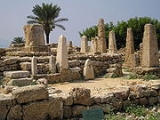
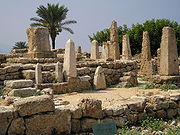
later considered among the Sea Peoples is believed to be attested in Egyptian hieroglyphics on the Byblos obelisk found in the Obelisk Temple at Byblos
in modern day Lebanon. The inscription mentions kwkwn son of rwqq-( or kukun son of luqq), transliterated as Kukunnis, son of Lukka, "the Lycia
n". The date is given variously as 2000 or 1700 BC.
appear much later and also the Sherden in the Amarna Letters
, perhaps of Amenhotep III
or his son Akhenaten
, around the mid-14th century BC. A Sherden man is an apparent renegade mercenary, and three more are slain by an Egyptian overseer. The Danuna
are mentioned in another letter but only in a passing reference to the death of their king. The Lukka are being accused of attacking the Egyptians in conjunction with the Alashiya
ns, or Cypriotes
, with the latter having stated that the Lukka were seizing their villages.
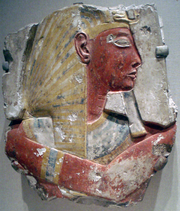 Records or possible records of sea peoples generally or in particular date to two campaigns of Ramesses II
, a pharaoh of the militant 19th Dynasty: operations in or near the delta in Year 2 of his reign and the major confrontation with the Hittite
Empire and allies at the Battle of Kadesh
in his Year 5. The dates of this long-lived pharaoh's reign are not known for certain, but they must have comprised nearly all of the first half of the 13th century BC.
In his Second Year, an attack of the Sherden, or Shardana, on the Nile Delta was repulsed and defeated by Ramesses, who captured some of the pirates. The event is recorded on Tanis Stele II. An inscription by Ramesses II on the stela from Tanis
which recorded the Sherden raider's raid and subsequent capture speaks of the continuous threat they posed to Egypt's Mediterranean coasts:
The Sherden prisoners were subsequently incorporated into the Egyptian army for service on the Hittite
frontier by Ramesses. Another stele usually cited in conjunction with this one is the "Aswan Stele" (there were other stelae at Aswan
), which mentions the king's operations to defeat a number of peoples including those of the "Great Green". It is plausible to assume that the Tanis and Aswan Stelae refer to the same event, in which case they reinforce each other.
The Battle of Kadesh
was the outcome of a campaign against the Syrians and allies in the Levant
in the pharaoh's Year 5. The imminent collision of the Egyptian and Hittite empires became obvious to both, and they both prepared campaigns against the strategic mid-point of Kadesh for the next year. Ramesses divided his Egyptian forces, which were then ambushed piecemeal by the Hittite army and nearly defeated. However, some Egyptian forces made it through to Kadesh, and the arrival of the last of the Egyptians provided enough military cover to allow the pharaoh to escape and his army to withdraw in defeat; leaving Kadesh in Hittite hands.
At home, Ramesses had his scribes formulate an official description, which has been called "the Bulletin" because it was widely published by inscription. Ten copies survive today on the temples at Abydos
, Karnak
, Luxor
and Abu Simbel
, with reliefs depicting the battle. A poem, the "Poem of Pentaur", describing the battle survives also.
The poem relates that the previously captured Sherden were not only working for his majesty, but were also formulating a plan of battle for him; i.e., it was their idea to divide Egyptian forces into four columns. There is no evidence of any collaboration with the Hittites or malicious intent on their part, and if Ramesses considered it, he never left any record of that consideration.
The poem lists the peoples which went to Kadesh as allies of the Hittites. Amongst them are some of the sea peoples spoken of in the Egyptian inscriptions previously mentioned, and many of the peoples who would later take part in the great migrations of the 12th century BC.
(1213 BC–1203 BC), 4th king of the 19th Dynasty, was his battle against a confederacy termed "the Nine Bows" at Perire in the western delta in the 5th and 6th years of his reign. Depredations of this confederacy had been so severe that the region was "forsaken as pasturage for cattle, it was left waste from the time of the ancestors."
The pharaoh's action against them is attested in four inscriptions: the Great Karnak Inscription
, describing the battle, the Cairo Column, the Athribis Stele (the last two of which are shorter versions of the Great Karnak), and a stele found at Thebes, called variously the Hymn of Victory, the Merneptah Stele
or the Israel Stele. It describes the reign of peace resulting from the victory.
The Nine Bows were acting under the leadership of the king of Libya
and an associated near-concurrent revolt in Canaan
involving Gaza
, Ashkelon
, Yenoam and Israel. Exactly which peoples were consistently in the Nine Bows is not clear, but present at the battle were the Libyans, some neighboring Meshwesh
, and possibly a separate revolt in the following year involving peoples from the eastern Mediterranean, including the Kheta (or Hittites), or Syrians, and (in the Israel Stele) for the first time in history, the Israelites. In addition to them, the first lines of the Karnak inscription include some sea peoples, which must have arrived in the Western Delta or from Cyrene
by ship:
Later in the inscription Merneptah receives news of the attack:
 "His majesty was enraged at their report, like a lion," assembled his court and gave a rousing speech. Later, he dreamed he saw Ptah
handing him a sword and saying, "Take thou (it) and banish thou the fearful heart from thee." When the bowmen went forth, says the inscription, "Amun
was with them as a shield." After six hours, the surviving Nine Bows threw down their weapons, abandoned their baggage and dependents, and ran for their lives. Merneptah states that he defeated the invasion, killing 6,000 soldiers and taking 9,000 prisoners. To be sure of the numbers, among other things, he took the penises of all uncircumcised enemy dead and the hands of all the circumcised, from which history learns that the Ekwesh were circumcised, a fact causing some to doubt they were Greek.
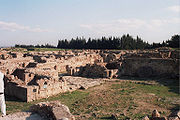 Some Sea Peoples appear in four letters found at Ugarit
, the last three of which seem to foreshadow the destruction of the city around 1180 BC. The letters are therefore dated to the early twelfth century. The last king of Ugarit
was Ammurapi
, or Hammurabi (c. 1191–1182 BC), who, throughout this correspondence, is quite a young man.
The earliest is letter RS 34.129, found on the south side of the city, from "the Great King", presumably Suppiluliuma II
of the Hittites
, to the prefect of the city. He says that he ordered the king of Ugarit to send him Ibnadushu for questioning, but the king was too immature to respond. He therefore wants the prefect to send the man, whom he promises to return.
What this language implies about the relationship of the Hittite empire to Ugarit is a matter for interpretation. Ibnadushu had been kidnapped by and had resided among a people of Shikala, probably the Shekelesh, "who lived on ships." The letter is generally interpreted as an interest in military intelligence by the king.
The last three letters, RS L 1, RS 20.238 and RS 20.18, are a set from the Rap'anu Archive between a slightly older Ammurapi, now handling his own affairs, and Eshuwara, the grand supervisor of Alasiya. Evidently, Ammurapi had informed Eshuwara, that an enemy fleet of 20 ships had been spotted at sea.
Eshuwara wrote back and inquired about the location of Ammurapi's own forces. Eshuwara also noted that he would like to know where the enemy fleet of 20 ships are now located. Unfortunately for both Ugarit and Alasiya, neither kingdom was able to fend off the Sea People's onslaught, and both were ultimately destroyed. A letter by Amurapi (RS 18.147) to the king of Alasiya—which was in fact a response to an appeal for assistance by the latter—has been found by archaeologists. In it, Ammurapi describes the desperate plight facing Ugarit:
Ammurapi, in turn, appealed for aid from the viceroy of Carchemish—a state which actually survived the Sea People's onslaught—but its viceroy could only offer some words of advice for Ammurapi:
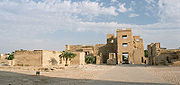 Pharaoh Ramesses III
, the second king of the 20th Dynasty, who reigned for most of the first half of the 12th century BC, was forced to deal with a later wave of invasions of the Sea Peoples—the best recorded in his eighth year. The pharaoh records the Sea People's activities in several long inscriptions from his Medinet Habu
mortuary temple:
s around 1175 BC have instigated a theory that the Sea Peoples may have caused the collapse of the Hittite
, Mycenaean
and Mitanni
kingdoms. The American Hittitologist
, Gary Beckman
, writes on page 23 of Akkadica 120 (2000):
Ramesses' comments about the scale of the Sea Peoples' onslaught in the eastern Mediterranean are confirmed by the destruction of the states of Hatti
, Ugarit
, Ashkelon
and Hazor around this time. As the Hittitologist Trevor Bryce observes:
This situation is confirmed by the Medinet Habu
temple reliefs of Ramesses III which show that:
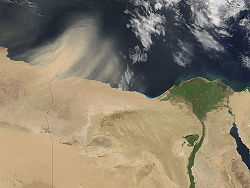 The inscriptions of Ramesses III
at his Medinet Habu
mortuary temple in Thebes
record three victorious campaigns against the Sea Peoples considered bona fide, in Years 5, 8 and 12, as well as three considered spurious, against the Nubia
ns and Libya
ns in Year 5 and the Libyans with Asiatics in Year 11. During Year 8 some Hittites
were operating with the Sea Peoples.
The inner west wall of the second court describes the invasion of Year 5. Only the Peleset and Tjeker
are mentioned, but the list is lost in a lacuna
. The attack was two-pronged, one by sea and one by land; that is, the Sea Peoples divided their forces. His majesty was waiting in the Nile
mouths and trapped the enemy fleet there. The land forces were defeated separately.
The Sea Peoples did not learn any lessons from this defeat, as they repeated their mistake in Year 8 with a similar result. The campaign is recorded more extensively on the inner northwest panel of the first court. It is possible, but not generally believed, that the dates are only those of the inscriptions and both refer to the same campaign.
In Ramesses' Year 8, the Nine Bows appear again as a "conspiracy in their isles". This time, they are revealed unquestionably as Sea Peoples: the Peleset, Tjeker
, Shekelesh, Denyen
and Weshesh, which are classified as "foreign countries" in the inscription. They camped in Amor and sent a fleet to the Nile.
The pharaoh was once more waiting for them. He had built a fleet especially for the occasion, hid it in the Nile mouths and posted coast watchers. The enemy fleet was ambushed there, their ships overturned, and the men dragged up on shore and executed ad hoc.
The land army was also routed within Egyptian controlled territory. Additional information is given in the relief on the outer side of the east wall. The land battle occurred in the vicinity of Zahi against "the northern countries". When it was over, several chiefs were captive: of Hatti
, Amor and Shasu
among the "land peoples" and the Tjeker
, "Sherden of the sea", "Teresh of the sea" and Peleset (ancient Greek name for sea people; Pelasgians
).
The campaign of Year 12 is attested by the Südstele found on the south side of the temple. It mentions the Tjeker
, Peleset, Denyen
, Weshesh and Shekelesh.
Papyrus Harris I
of the period, found behind the temple, suggests a wider campaign against the Sea Peoples but does not mention the date. In it, the persona of Ramses III says, "I slew the Denyen (D'-yn-yw-n) in their isles" and "burned" the Tjeker and Peleset, implying a maritime raid of his own. He also captured some Sherden and Weshesh "of the sea" and settled them in Egypt. As he is called the "Ruler of Nine Bows
" in the relief of the east side, these events probably happened in Year 8; i.e., his majesty would have used the victorious fleet for some punitive expeditions elsewhere in the Mediterranean.
The Onomasticon of Amenope, or Amenemipit (amen-em-apt), gives a slight credence to the idea that the Ramesside kings settled the Sea Peoples in Canaan. Dated to about 1100 BC, at the end of the 21st dynasty (which had numerous short-reigned pharaohs), this document simply lists names. After six place names, four of which were in Philistia, the scribe lists the Sherden (Line 268), the Tjeker (Line 269) and the Peleset (Line 270), who might be presumed to occupy those cities. The Story of Wenamun
on a papyrus of the same cache also places the Tjeker in Dor
at that time.
and Sidon
, survived the Sea Peoples' migrations. Despite Ramesses III's pessimism, Carchemish
also survived the Sea Peoples' onslaught. King Kuzi-Teshub
I, who was the son of Talmi-Teshub
—a direct contemporary of the last ruling Hittite king, Suppiluliuma II
—is attested in power there. Kuzi-Tesup and his successors ruled a mini-empire from Carchemish which stretched from "Southeast Asia Minor, North Syria...[to] the west bend of the Euphrates" from c. 1175 BC to 990 BC.
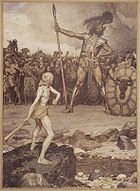 The archaeological evidence from the southern coastal plain of ancient Palestine
, termed Philistia in the Hebrew Bible
, indicates a disruption of the Canaan
ite culture that existed during the Late Bronze Age and its replacement (with some integration) by a culture with a possibly foreign (mainly Aegean
) origin. This includes distinct pottery, which at first belongs to the Mycenaean IIIC tradition (albeit of local manufacture) and gradually transforms into a uniquely Philistine pottery. Mazar says:
Sandars, however, does not take this point of view, but says:
Artifacts of the Philistine culture are found at numerous sites, in particular in the excavations of the five main cities of the Philistines
: the Pentapolis
of Ashkelon
, Ashdod, Ekron
, Gath, and Gaza
. Some scholars (e.g. S. Sherratt, Drews, etc.) have challenged the theory that the Philistine culture is an immigrant culture, claiming instead that they are an in situ development of the Canaanite culture, but others argue for the immigrant hypothesis; for example, T. Dothan and Barako.
had traditions that may connect them to Crete
: the Tjeker
and the Peleset (Philistines). The Tjeker may have left Crete to settle in Anatolia
, and left there to settle Dor
. According to the Old Testament
, the Israelite God brought the Philistines out of Caphtor
. The mainstream of Biblical and classical scholarship accepts Caphtor to refer to Crete, but there are alternative minority theories. Crete at the time was populated by peoples speaking many languages, among which were Mycenaean Greek and Eteocretan, the descendant of the language of the Minoans. It is possible, but by no means certain, that these two peoples spoke Eteocretan.
Recent examinations of the eruption of the Santorini volcano suggest that it occurred very close (estimated between 1660-1613 BC) to the first appearances of the Sea People in Egypt. The eruption and its aftermath (fires, tsunami, weather changes and famines) would have had wide-ranging effects across the Mediterranean, the Levant and particularly Greece, and could have provided the impetus for invasions of other regions of the Mediterranean.
with the Greek Danaans and Ekwesh with the Greek Achaeans are long-standing issues in Bronze Age scholarship, whether Greek, Hittite or Biblical, especially as they lived "in the isles". If the Greeks do appear as Sea Peoples, what were they doing? Michael Wood gives a good summary of the question and the hypothetical role of the Greeks (who have already been proposed as the identity of the Philistines above):
Wood would also include the Sherden and Shekelesh, pointing out that "there were migrations of Greek-speaking peoples to the same place [Sardinia and Sicily] at this time." He is careful to point out that the Greeks must only have been an element among the peoples, and that their numbers must have been relatively small. His major hypothesis, however, is that the Trojan War
was fought against Troy VI and that Troy VIIa, the candidate of Carl Blegen
, was sacked by essentially Greek Sea Peoples. He suggests that Odysseus' assumed identity of a wandering Cretan coming home from the Trojan War who fights in Egypt and serves there after being captured "remembers" the campaign of Year 8 of Ramses III, described above. He points out also that places destroyed on Cyprus
at the time (such as Kition) were rebuilt by a new Greek-speaking population.
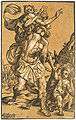
, believed to be an Etruscan
-related culture, and on the other with Taruissa, a Hittite name possibly referring to Troy, had been considered by the ancient Romans. The Roman poet Virgil
refers to this belief when he depicts Aeneas
as escaping the fall of Troy by coming to Latium
to found a line descending to Romulus
, first king of Rome
. Considering that Anatolia
n connections have been identified for other Sea Peoples, such as the Tjeker
and the Lukka
, Eberhard Zangger
puts together an Anatolian hypothesis: Recent genetic sequencing of Tuscan cattle suggests their closest link is with the cattle of north west Anatolia, in confirmation of this hypothesis
, who destroyed each other in a disastrous series of conflicts lasting several decades. There would have been few or no external invaders and just a few excursions outside the Greek-speaking part of the Aegean civilization
.
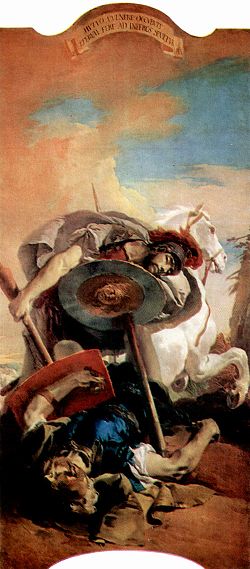 Archaeological evidence indicates that many fortified sites of the Greek domain were destroyed in the late 13th and early 12th century BC, which was understood in the mid 20th century to have been simultaneous or nearly so and was attributed to the Dorian Invasion
championed by Carl Blegen
of the University of Cincinnati
. He believed Mycenaean Pylos
was burned during an amphibious raid by warriors from the north (Dorians).
Subsequent critical analysis focused on the facts that the destructions were not simultaneous and all the evidence of Dorians came from later times. John Chadwick
championed a Sea Peoples hypothesis, which asserted that as the Pylians had retreated to the northeast, the attack must have come from the southwest, the Sea Peoples being, in his view, the most likely candidates. He states that they were based in Anatolia
and, although doubting that Mycenaeans called themselves "Achaeans", speculates that "... it is very tempting to bring them into connexion." He does not assign the Greek identity to all of the Sea Peoples.
Considering the turbulence between and within the great families of the Mycenaean city-states in Greek mythology, the hypothesis that the Mycenaeans destroyed themselves is long-standing and finds support by the reputable Greek historian Thucydides
, who theorized:
The connection of these predations to the fall of Mycenaean Greece and, more widely, to the Sea Peoples is a logical outcome. Although some advocates of the Philistine or Greek migration hypotheses (above) identify all the Mycenaeans or Sea Peoples as ethnically Greek, the cautious Chadwick (founder, with Michael Ventris
, of Linear B
studies) rather adopts the multiple ethnicity view.
, Shekelesh to Sicily
, and Teresh to Tyrrhenians
, even though long-standing, are based mainly on onomastic
similarities.
The Sardinian architecture produced by the Nuragic civilization
was the most advanced of any civilization in the western Mediterranean during the Sea Peoples epoch, including those in the regions of Magna Graecia
.
The pre-Roman Sicels
are known from a number of locations, including Sicily
, presumed named after them. The Tyrrhenian Sea
gives some credence to the story of Tyrrhenus mentioned above.
No evidence has been uncovered yet to settle the enigmatic connections of these Sea Peoples. The self-name of the Etruscans, Rasna, does not lend itself to the Tyrrhenian derivation, although linguist Glen Glordon has suggested an earlier form T'Rasena or even T'Lasena which would explain Greek and later Roman names. He has further suggested that T'Lasena contains the pre-Greek Thalassa (Sea) etymology. Assertions in various articles and books that the Sherdens definitely were or were not from Sardis
or some ancestor state have no foundation in the evidence. The Etruscan civilization
has been studied, and the language partly deciphered. It has variants and representatives in Aegean inscriptions, but these may well be from travellers or colonists of Etruscans during their seafaring period before Rome
destroyed their power. The entire Etruscan civilization can scarcely be explained by a few ships of Teresh or even a whole fleet.
Archaeology is equally enigmatic. About all that can be said for certain is that Mycenaean
pottery was widespread around the Mediterranean and its introduction at various places, including Sardinia, is often associated with cultural change, violent or gradual. These circumstances appear to be enough for archaeological theorizers. The prevalent speculation is that the Sherden and Shekelesh brought those names with them to Sardinia and Sicily, "perhaps not operating from those great islands but moving toward them." More recent genetic evidence indicates that the populations in those regions are more related to the people of Anatolia than to anywhere else, but this evidence is not event- or period-specific.
portrays the wandering and migration of Lydia
ns from Anatolia
because of famine:
Connections to the Teresh of the Merneptah Stele
, which also mentions shipments of grain to the Hittite Empire to relieve famine, are logically unavoidable. Many have made them, generally proposing a coalition of seagoing migrants from Anatolia and the islands seeking relief from scarcity. Tablet RS 18.38 from Ugarit
also mentions grain to the Hittites, suggesting a long period of famine, connected further, in the full theory, to drought. Barry Weiss, using the Palmer Drought Index
for 35 Greek, Turkish, and Middle Eastern weather stations, showed that a drought of the kinds that persisted from January 1972 would have affected all of the sites associated with the Late Bronze Age collapse. Drought could have easily precipitated or hastened socio-economic problems and led to wars. More recently, Brian Fagan
has shown how mid-winter storms from the Atlantic were diverted to travel north of the Pyrenees and the Alps, bringing wetter conditions to Central Europe, but drought to the Eastern Mediterranean.
: "There was a gigantic series of migratory waves, extending all the way from the Danube
valley to the plains of China
."
Such a comprehensive movement is associated with more than one people or culture; instead, a "disturbance" happens, according to Finley:
If different times are allowed on the Danube, they are not in the Aegean: "all this destruction must be dated to the same period about 1200."
The following movements are compressed by Finley into the 1200 BC window: the Dorian Invasion
, the attacks of the Sea Peoples, the formation of Philistine kingdoms in the Levant
and the fall of the Hittite
Empire, when in fact, those events required at least a few hundred years.
The archaeological evidence is treated in the same way. Robert Drews presents a map showing the destruction sites of 47 fortified major settlements, which he terms "Major Sites Destroyed in the Catastrophe". They are concentrated in the Levant
, with some in Greece
and Anatolia
. The questions of dates and agents of destruction remain for the most part unanswered in detail, without which no single catastrophe or related catastrophes can be postulated beyond the level of pure speculation.
The invaders, that is, the replacement cultures at those sites, apparently made no attempt to retain the cities' wealth but instead built new settlements of a materially simpler cultural and less complex economic level atop the ruins. For example, no one appropriated the palace and rich stores at Pylos
, but all were burned up, and the successors (whomever they were) moved in over the ruins with plain pottery and simple goods. This demonstrates a cultural discontinuity.
Whether all the discontinuities were sufficiently contemporaneous to warrant a theory of great waves of invasion another question. Ethnic identities from the Danube
and beyond are in short supply in the records.
applied to the lake of Serbonis (Sirbonis or Serbon) in Egypt
relates to the Sea Peoples. When sand blew onto it, the Serbonian Bog appeared to be solid land, but was in fact a bog
. The term is now applied metaphorically to any situation in which one is entangled from which extrication is difficult.
The Serbonian Bog has been identified as Sabkhat al Bardawil, one of the string of "Bitter Lakes" to the east of the Nile
's right branch. It was described in ancient times as a quagmire
, in which armies were fabled to be swallowed up and lost.
The term Serbonian came from the name of the Sherden (also known as Serden or Shardana) sea pirates, one of several groups of Sea Peoples who appear in fragmentary Egypt
ian records in the 2nd millennium BC.
Egypt
Egypt , officially the Arab Republic of Egypt, Arabic: , is a country mainly in North Africa, with the Sinai Peninsula forming a land bridge in Southwest Asia. Egypt is thus a transcontinental country, and a major power in Africa, the Mediterranean Basin, the Middle East and the Muslim world...
ian territory during the late 19th dynasty
Nineteenth dynasty of Egypt
The Nineteenth Dynasty of ancient Egypt was one of the periods of the Egyptian New Kingdom. Founded by Vizier Ramesses I, whom Pharaoh Horemheb chose as his successor to the throne, this dynasty is best known for its military conquests in Palestine, Lebanon, and Syria.The warrior kings of the...
and especially during year 8 of Ramesses III
Ramesses III
Usimare Ramesses III was the second Pharaoh of the Twentieth Dynasty and is considered to be the last great New Kingdom king to wield any substantial authority over Egypt. He was the son of Setnakhte and Queen Tiy-Merenese. Ramesses III is believed to have reigned from March 1186 to April 1155 BCE...
of the 20th Dynasty
Twentieth dynasty of Egypt
The Eighteenth, Nineteenth, and Twentieth Dynasties of ancient Egypt are often combined under the group title, New Kingdom. This dynasty is considered to be the last one of the New Kingdom of Egypt, and was followed by the Third Intermediate Period....
. The Egyptian Pharaoh Merneptah
Merneptah
Merneptah was the fourth ruler of the Nineteenth Dynasty of Ancient Egypt. He ruled Egypt for almost ten years between late July or early August 1213 and May 2, 1203 BC, according to contemporary historical records...
explicitly refers to them by the term "the foreign-countries (or 'peoples') of the sea" (Egyptian
Egyptian language
Egyptian is the oldest known indigenous language of Egypt and a branch of the Afroasiatic language family. Written records of the Egyptian language have been dated from about 3400 BC, making it one of the oldest recorded languages known. Egyptian was spoken until the late 17th century AD in the...
) in his Great Karnak Inscription
Great Karnak Inscription
Located on the wall of the Cachette Court, in the Precinct of Amun-Re of the Karnak temple complex, in modern Luxor, the Great Karnak Inscription of Merneptah is a record of the campaigns of this king against the Sea Peoples....
. Although some scholars believe that they invaded Cyprus
Cyprus
Cyprus , officially the Republic of Cyprus , is a Eurasian island country, member of the European Union, in the Eastern Mediterranean, east of Greece, south of Turkey, west of Syria and north of Egypt. It is the third largest island in the Mediterranean Sea.The earliest known human activity on the...
, Hatti
Hattians
The Hattians were an ancient people who inhabited the land of Hatti in present-day central part of Anatolia, Turkey, noted at least as early as the empire of Sargon of Akkad , until they were gradually displaced and absorbed ca...
and the Levant
Levant
The Levant or ) is the geographic region and culture zone of the "eastern Mediterranean littoral between Anatolia and Egypt" . The Levant includes most of modern Lebanon, Syria, Jordan, Israel, the Palestinian territories, and sometimes parts of Turkey and Iraq, and corresponds roughly to the...
, this hypothesis is disputed.
Historical context
The Late Bronze Age in the AegeanAegean Sea
The Aegean Sea[p] is an elongated embayment of the Mediterranean Sea located between the southern Balkan and Anatolian peninsulas, i.e., between the mainlands of Greece and Turkey. In the north, it is connected to the Marmara Sea and Black Sea by the Dardanelles and Bosporus...
was characterized by the raiding of migratory peoples and their subsequent resettlement. The identity of the Sea Peoples has remained enigmatic to modern scholars, who have only the scattered records of ancient civilizations and archaeological analysis to inform them. Evidence shows that the identities and motives of these peoples were not unknown to the Egyptians. In fact, many had been subordinate to the Egyptians or in a diplomatic relationship with them for at least as long as the few centuries covered by the records.
Some groups were not included in the Egyptian list of Sea Peoples, as they operated primarily on land. Among them were the 'prw (Habiru
Habiru
Habiru or Apiru or ˁpr.w was the name given by various Sumerian, Egyptian, Akkadian, Hittite, Mitanni, and Ugaritic sources to a group of people living as nomadic invaders in areas of the Fertile Crescent from Northeastern Mesopotamia and Iran to the borders of Egypt in Canaan...
) of Egyptian inscriptions, or 'apiru of cuneiform ("bandits"). Sandars uses the analogous name "land peoples." Some people, such as the Lukka
Lukka
The Lukka lands are often mentioned in Hittite texts from the second millennium BC. It denotes a region in the southwestern part of Anatolia. The Lukka lands were never put under permanent Hittite control and were viewed as hostile by the Hittites....
, were included in both categories. It has been suggested that one of the groups of Habiru were the Hebrews
Hebrews
Hebrews is an ethnonym used in the Hebrew Bible...
., but the modern scholarly conclusion is that "the plethora of attempts to relate apiru (Habiru) to the gentilic (i.e. biblical word) ibri are all nothing but wishful thinking." Select groups, or members of groups, were used as mercenaries by the Egyptians.
Byblos obelisk
Ethnic group
An ethnic group is a group of people whose members identify with each other, through a common heritage, often consisting of a common language, a common culture and/or an ideology that stresses common ancestry or endogamy...
later considered among the Sea Peoples is believed to be attested in Egyptian hieroglyphics on the Byblos obelisk found in the Obelisk Temple at Byblos
Byblos
Byblos is the Greek name of the Phoenician city Gebal . It is a Mediterranean city in the Mount Lebanon Governorate of present-day Lebanon under the current Arabic name of Jubayl and was also referred to as Gibelet during the Crusades...
in modern day Lebanon. The inscription mentions kwkwn son of rwqq-( or kukun son of luqq), transliterated as Kukunnis, son of Lukka, "the Lycia
Lycia
Lycia Lycian: Trm̃mis; ) was a region in Anatolia in what are now the provinces of Antalya and Muğla on the southern coast of Turkey. It was a federation of ancient cities in the region and later a province of the Roman Empire...
n". The date is given variously as 2000 or 1700 BC.
Early Amarna age
The LukkaLukka
The Lukka lands are often mentioned in Hittite texts from the second millennium BC. It denotes a region in the southwestern part of Anatolia. The Lukka lands were never put under permanent Hittite control and were viewed as hostile by the Hittites....
appear much later and also the Sherden in the Amarna Letters
Amarna letters
The Amarna letters are an archive of correspondence on clay tablets, mostly diplomatic, between the Egyptian administration and its representatives in Canaan and Amurru during the New Kingdom...
, perhaps of Amenhotep III
Amenhotep III
Amenhotep III also known as Amenhotep the Magnificent was the ninth pharaoh of the Eighteenth dynasty. According to different authors, he ruled Egypt from June 1386 to 1349 BC or June 1388 BC to December 1351 BC/1350 BC after his father Thutmose IV died...
or his son Akhenaten
Akhenaten
Akhenaten also spelled Echnaton,Ikhnaton,and Khuenaten;meaning "living spirit of Aten") known before the fifth year of his reign as Amenhotep IV , was a Pharaoh of the Eighteenth dynasty of Egypt who ruled for 17 years and died perhaps in 1336 BC or 1334 BC...
, around the mid-14th century BC. A Sherden man is an apparent renegade mercenary, and three more are slain by an Egyptian overseer. The Danuna
Denyen
The Denyen are one of the groups constituting the Sea Peoples, who were of Indo-European origin.-Origin:Archeologists have described them as being of Indo-European origin....
are mentioned in another letter but only in a passing reference to the death of their king. The Lukka are being accused of attacking the Egyptians in conjunction with the Alashiya
Alashiya
Alashiya or Alasiya was a state which existed in the Middle and Late Bronze Ages, and was situated somewhere in the Eastern Mediterranean. It was a major source of goods, especially copper, for Ancient Egypt and other states in the Ancient Near East. It is referred to in a number of the surviving...
ns, or Cypriotes
Cyprus
Cyprus , officially the Republic of Cyprus , is a Eurasian island country, member of the European Union, in the Eastern Mediterranean, east of Greece, south of Turkey, west of Syria and north of Egypt. It is the third largest island in the Mediterranean Sea.The earliest known human activity on the...
, with the latter having stated that the Lukka were seizing their villages.
Reign of Ramesses II
Ramesses II
Ramesses II , referred to as Ramesses the Great, was the third Egyptian pharaoh of the Nineteenth dynasty. He is often regarded as the greatest, most celebrated, and most powerful pharaoh of the Egyptian Empire...
, a pharaoh of the militant 19th Dynasty: operations in or near the delta in Year 2 of his reign and the major confrontation with the Hittite
Hittites
The Hittites were a Bronze Age people of Anatolia.They established a kingdom centered at Hattusa in north-central Anatolia c. the 18th century BC. The Hittite empire reached its height c...
Empire and allies at the Battle of Kadesh
Battle of Kadesh
The Battle of Kadesh took place between the forces of the Egyptian Empire under Ramesses II and the Hittite Empire under Muwatalli II at the city of Kadesh on the Orontes River, in what is now the Syrian Arab Republic....
in his Year 5. The dates of this long-lived pharaoh's reign are not known for certain, but they must have comprised nearly all of the first half of the 13th century BC.
In his Second Year, an attack of the Sherden, or Shardana, on the Nile Delta was repulsed and defeated by Ramesses, who captured some of the pirates. The event is recorded on Tanis Stele II. An inscription by Ramesses II on the stela from Tanis
Tanis
Tanis was the capital of the 21st and 22nd dynasties of ancient Egypt, and is now an archaeological temple site. The word Tanis can also refer to:*Tanis, a little girl mummy in Scooby-Doo and the Ghoul School...
which recorded the Sherden raider's raid and subsequent capture speaks of the continuous threat they posed to Egypt's Mediterranean coasts:
- "the unruly Sherden whom no one had ever known how to combat, they came boldly sailing in their warships from the midst of the sea, none being able to withstand them."
The Sherden prisoners were subsequently incorporated into the Egyptian army for service on the Hittite
Hittites
The Hittites were a Bronze Age people of Anatolia.They established a kingdom centered at Hattusa in north-central Anatolia c. the 18th century BC. The Hittite empire reached its height c...
frontier by Ramesses. Another stele usually cited in conjunction with this one is the "Aswan Stele" (there were other stelae at Aswan
Aswan
Aswan , formerly spelled Assuan, is a city in the south of Egypt, the capital of the Aswan Governorate.It stands on the east bank of the Nile at the first cataract and is a busy market and tourist centre...
), which mentions the king's operations to defeat a number of peoples including those of the "Great Green". It is plausible to assume that the Tanis and Aswan Stelae refer to the same event, in which case they reinforce each other.
The Battle of Kadesh
Battle of Kadesh
The Battle of Kadesh took place between the forces of the Egyptian Empire under Ramesses II and the Hittite Empire under Muwatalli II at the city of Kadesh on the Orontes River, in what is now the Syrian Arab Republic....
was the outcome of a campaign against the Syrians and allies in the Levant
Levant
The Levant or ) is the geographic region and culture zone of the "eastern Mediterranean littoral between Anatolia and Egypt" . The Levant includes most of modern Lebanon, Syria, Jordan, Israel, the Palestinian territories, and sometimes parts of Turkey and Iraq, and corresponds roughly to the...
in the pharaoh's Year 5. The imminent collision of the Egyptian and Hittite empires became obvious to both, and they both prepared campaigns against the strategic mid-point of Kadesh for the next year. Ramesses divided his Egyptian forces, which were then ambushed piecemeal by the Hittite army and nearly defeated. However, some Egyptian forces made it through to Kadesh, and the arrival of the last of the Egyptians provided enough military cover to allow the pharaoh to escape and his army to withdraw in defeat; leaving Kadesh in Hittite hands.
At home, Ramesses had his scribes formulate an official description, which has been called "the Bulletin" because it was widely published by inscription. Ten copies survive today on the temples at Abydos
Abydos, Egypt
Abydos is one of the most ancient cities of Upper Egypt, and also of the eight Upper Nome, of which it was the capital city. It is located about 11 kilometres west of the Nile at latitude 26° 10' N, near the modern Egyptian towns of el-'Araba el Madfuna and al-Balyana...
, Karnak
Karnak
The Karnak Temple Complex—usually called Karnak—comprises a vast mix of decayed temples, chapels, pylons, and other buildings, notably the Great Temple of Amun and a massive structure begun by Pharaoh Ramses II . Sacred Lake is part of the site as well. It is located near Luxor, some...
, Luxor
Thebes, Egypt
Thebes is the Greek name for a city in Ancient Egypt located about 800 km south of the Mediterranean, on the east bank of the river Nile within the modern city of Luxor. The Theban Necropolis is situated nearby on the west bank of the Nile.-History:...
and Abu Simbel
Abu Simbel
Abu Simbel temples refers to two massive rock temples in Abu Simbel in Nubia, southern Egypt on the western bank of Lake Nasser about 230 km southwest of Aswan...
, with reliefs depicting the battle. A poem, the "Poem of Pentaur", describing the battle survives also.
The poem relates that the previously captured Sherden were not only working for his majesty, but were also formulating a plan of battle for him; i.e., it was their idea to divide Egyptian forces into four columns. There is no evidence of any collaboration with the Hittites or malicious intent on their part, and if Ramesses considered it, he never left any record of that consideration.
The poem lists the peoples which went to Kadesh as allies of the Hittites. Amongst them are some of the sea peoples spoken of in the Egyptian inscriptions previously mentioned, and many of the peoples who would later take part in the great migrations of the 12th century BC.
Reign of Merneptah
The major event of the reign of the Pharaoh MerneptahMerneptah
Merneptah was the fourth ruler of the Nineteenth Dynasty of Ancient Egypt. He ruled Egypt for almost ten years between late July or early August 1213 and May 2, 1203 BC, according to contemporary historical records...
(1213 BC–1203 BC), 4th king of the 19th Dynasty, was his battle against a confederacy termed "the Nine Bows" at Perire in the western delta in the 5th and 6th years of his reign. Depredations of this confederacy had been so severe that the region was "forsaken as pasturage for cattle, it was left waste from the time of the ancestors."
The pharaoh's action against them is attested in four inscriptions: the Great Karnak Inscription
Great Karnak Inscription
Located on the wall of the Cachette Court, in the Precinct of Amun-Re of the Karnak temple complex, in modern Luxor, the Great Karnak Inscription of Merneptah is a record of the campaigns of this king against the Sea Peoples....
, describing the battle, the Cairo Column, the Athribis Stele (the last two of which are shorter versions of the Great Karnak), and a stele found at Thebes, called variously the Hymn of Victory, the Merneptah Stele
Merneptah Stele
The Merneptah Stele — also known as the Israel Stele or Victory Stele of Merneptah — is an inscription by the Ancient Egyptian king Merneptah , which appears on the reverse side of a granite stele erected by the king Amenhotep III...
or the Israel Stele. It describes the reign of peace resulting from the victory.
The Nine Bows were acting under the leadership of the king of Libya
Libya
Libya is an African country in the Maghreb region of North Africa bordered by the Mediterranean Sea to the north, Egypt to the east, Sudan to the southeast, Chad and Niger to the south, and Algeria and Tunisia to the west....
and an associated near-concurrent revolt in Canaan
Canaan
Canaan is a historical region roughly corresponding to modern-day Israel, Palestine, Lebanon, and the western parts of Jordan...
involving Gaza
Gaza
Gaza , also referred to as Gaza City, is a Palestinian city in the Gaza Strip, with a population of about 450,000, making it the largest city in the Palestinian territories.Inhabited since at least the 15th century BC,...
, Ashkelon
Ashkelon
Ashkelon is a coastal city in the South District of Israel on the Mediterranean coast, south of Tel Aviv, and north of the border with the Gaza Strip. The ancient seaport of Ashkelon dates back to the Neolithic Age...
, Yenoam and Israel. Exactly which peoples were consistently in the Nine Bows is not clear, but present at the battle were the Libyans, some neighboring Meshwesh
Meshwesh
The Meshwesh were an ancient Libyan tribe from beyond Cyrenaica where the Libu and Tehenu lived according to Egyptian references and who were probably of Central Berber ethnicity. Herodotus placed them in Tunisia and said of them to be sedentary farmers living in settled permanent houses as the...
, and possibly a separate revolt in the following year involving peoples from the eastern Mediterranean, including the Kheta (or Hittites), or Syrians, and (in the Israel Stele) for the first time in history, the Israelites. In addition to them, the first lines of the Karnak inscription include some sea peoples, which must have arrived in the Western Delta or from Cyrene
Cyrene, Libya
Cyrene was an ancient Greek colony and then a Roman city in present-day Shahhat, Libya, the oldest and most important of the five Greek cities in the region. It gave eastern Libya the classical name Cyrenaica that it has retained to modern times.Cyrene lies in a lush valley in the Jebel Akhdar...
by ship:
Later in the inscription Merneptah receives news of the attack:
Ptah
In Ancient Egyptian Religion, Ptah was the deification of the primordial mound in the Ennead cosmogony, which was more literally referred to as Ta-tenen , meaning risen land, or as Tanen, meaning submerged land, though Tatenen was a god in his...
handing him a sword and saying, "Take thou (it) and banish thou the fearful heart from thee." When the bowmen went forth, says the inscription, "Amun
Amun
Amun, reconstructed Egyptian Yamānu , was a god in Egyptian mythology who in the form of Amun-Ra became the focus of the most complex system of theology in Ancient Egypt...
was with them as a shield." After six hours, the surviving Nine Bows threw down their weapons, abandoned their baggage and dependents, and ran for their lives. Merneptah states that he defeated the invasion, killing 6,000 soldiers and taking 9,000 prisoners. To be sure of the numbers, among other things, he took the penises of all uncircumcised enemy dead and the hands of all the circumcised, from which history learns that the Ekwesh were circumcised, a fact causing some to doubt they were Greek.
Letters at Ugarit
Ugarit
Ugarit was an ancient port city in the eastern Mediterranean at the Ras Shamra headland near Latakia, Syria. It is located near Minet el-Beida in northern Syria. It is some seven miles north of Laodicea ad Mare and approximately fifty miles east of Cyprus...
, the last three of which seem to foreshadow the destruction of the city around 1180 BC. The letters are therefore dated to the early twelfth century. The last king of Ugarit
Ugarit
Ugarit was an ancient port city in the eastern Mediterranean at the Ras Shamra headland near Latakia, Syria. It is located near Minet el-Beida in northern Syria. It is some seven miles north of Laodicea ad Mare and approximately fifty miles east of Cyprus...
was Ammurapi
Ammurapi
Ammurapi was the last Bronze Age ruler and king of the Ancient Syrian city of Ugarit, from ca. 1215 to 1180 BC. Ammurapi was a contemporary of the Hittite King Suppiluliuma II. He wrote a vivid letter in response to a plea for assistance from the king of Alashiya which has been preserved...
, or Hammurabi (c. 1191–1182 BC), who, throughout this correspondence, is quite a young man.
The earliest is letter RS 34.129, found on the south side of the city, from "the Great King", presumably Suppiluliuma II
Suppiluliuma II
Suppiluliuma II, the son of Tudhaliya IV, was the last known king of the New Kingdom of the Hittite Empire, ruling ca. 1207–1178 BC , contemporary with Tukulti-Ninurta I of Assyria....
of the Hittites
Hittites
The Hittites were a Bronze Age people of Anatolia.They established a kingdom centered at Hattusa in north-central Anatolia c. the 18th century BC. The Hittite empire reached its height c...
, to the prefect of the city. He says that he ordered the king of Ugarit to send him Ibnadushu for questioning, but the king was too immature to respond. He therefore wants the prefect to send the man, whom he promises to return.
What this language implies about the relationship of the Hittite empire to Ugarit is a matter for interpretation. Ibnadushu had been kidnapped by and had resided among a people of Shikala, probably the Shekelesh, "who lived on ships." The letter is generally interpreted as an interest in military intelligence by the king.
The last three letters, RS L 1, RS 20.238 and RS 20.18, are a set from the Rap'anu Archive between a slightly older Ammurapi, now handling his own affairs, and Eshuwara, the grand supervisor of Alasiya. Evidently, Ammurapi had informed Eshuwara, that an enemy fleet of 20 ships had been spotted at sea.
Eshuwara wrote back and inquired about the location of Ammurapi's own forces. Eshuwara also noted that he would like to know where the enemy fleet of 20 ships are now located. Unfortunately for both Ugarit and Alasiya, neither kingdom was able to fend off the Sea People's onslaught, and both were ultimately destroyed. A letter by Amurapi (RS 18.147) to the king of Alasiya—which was in fact a response to an appeal for assistance by the latter—has been found by archaeologists. In it, Ammurapi describes the desperate plight facing Ugarit:
Ammurapi, in turn, appealed for aid from the viceroy of Carchemish—a state which actually survived the Sea People's onslaught—but its viceroy could only offer some words of advice for Ammurapi:
Reign of Ramesses III
Ramesses III
Usimare Ramesses III was the second Pharaoh of the Twentieth Dynasty and is considered to be the last great New Kingdom king to wield any substantial authority over Egypt. He was the son of Setnakhte and Queen Tiy-Merenese. Ramesses III is believed to have reigned from March 1186 to April 1155 BCE...
, the second king of the 20th Dynasty, who reigned for most of the first half of the 12th century BC, was forced to deal with a later wave of invasions of the Sea Peoples—the best recorded in his eighth year. The pharaoh records the Sea People's activities in several long inscriptions from his Medinet Habu
Medinet Habu (temple)
Medinet Habu is the name commonly given to the Mortuary Temple of Ramesses III, an important New Kingdom period structure in the location of the same name on the West Bank of Luxor in Egypt...
mortuary temple:
No land could stand before their arms
The ends of several civilizationCivilization
Civilization is a sometimes controversial term that has been used in several related ways. Primarily, the term has been used to refer to the material and instrumental side of human cultures that are complex in terms of technology, science, and division of labor. Such civilizations are generally...
s around 1175 BC have instigated a theory that the Sea Peoples may have caused the collapse of the Hittite
Hittites
The Hittites were a Bronze Age people of Anatolia.They established a kingdom centered at Hattusa in north-central Anatolia c. the 18th century BC. The Hittite empire reached its height c...
, Mycenaean
Mycenaean Greece
Mycenaean Greece was a cultural period of Bronze Age Greece taking its name from the archaeological site of Mycenae in northeastern Argolis, in the Peloponnese of southern Greece. Athens, Pylos, Thebes, and Tiryns are also important Mycenaean sites...
and Mitanni
Mitanni
Mitanni or Hanigalbat was a loosely organized Hurrian-speaking state in northern Syria and south-east Anatolia from ca. 1500 BC–1300 BC...
kingdoms. The American Hittitologist
Hittitologist
A Hittitologist is an archaeologist, historian, linguist, or art historian who specialises in the study of the Ancient Hittites and their Near Eastern Empire which was based in Hattusa in modern day Anatolia.A partial list of notable Hittite scholars includes:...
, Gary Beckman
Gary Beckman
Professor Gary Beckman is a noted Hittitologist and Professor of Hittite and Mesopotamian Studies from the University of Michigan. He has written several books on the Ancient Hittites: his publication 'Hittite Diplomatic Texts' and 'Hittite Myths' were both republished twice—in 1991 and 1999...
, writes on page 23 of Akkadica 120 (2000):
Ramesses' comments about the scale of the Sea Peoples' onslaught in the eastern Mediterranean are confirmed by the destruction of the states of Hatti
Hittites
The Hittites were a Bronze Age people of Anatolia.They established a kingdom centered at Hattusa in north-central Anatolia c. the 18th century BC. The Hittite empire reached its height c...
, Ugarit
Ugarit
Ugarit was an ancient port city in the eastern Mediterranean at the Ras Shamra headland near Latakia, Syria. It is located near Minet el-Beida in northern Syria. It is some seven miles north of Laodicea ad Mare and approximately fifty miles east of Cyprus...
, Ashkelon
Ashkelon
Ashkelon is a coastal city in the South District of Israel on the Mediterranean coast, south of Tel Aviv, and north of the border with the Gaza Strip. The ancient seaport of Ashkelon dates back to the Neolithic Age...
and Hazor around this time. As the Hittitologist Trevor Bryce observes:
This situation is confirmed by the Medinet Habu
Medinet Habu (temple)
Medinet Habu is the name commonly given to the Mortuary Temple of Ramesses III, an important New Kingdom period structure in the location of the same name on the West Bank of Luxor in Egypt...
temple reliefs of Ramesses III which show that:
Checking the onslaught
Ramesses III
Usimare Ramesses III was the second Pharaoh of the Twentieth Dynasty and is considered to be the last great New Kingdom king to wield any substantial authority over Egypt. He was the son of Setnakhte and Queen Tiy-Merenese. Ramesses III is believed to have reigned from March 1186 to April 1155 BCE...
at his Medinet Habu
Medinet Habu (temple)
Medinet Habu is the name commonly given to the Mortuary Temple of Ramesses III, an important New Kingdom period structure in the location of the same name on the West Bank of Luxor in Egypt...
mortuary temple in Thebes
Thebes, Egypt
Thebes is the Greek name for a city in Ancient Egypt located about 800 km south of the Mediterranean, on the east bank of the river Nile within the modern city of Luxor. The Theban Necropolis is situated nearby on the west bank of the Nile.-History:...
record three victorious campaigns against the Sea Peoples considered bona fide, in Years 5, 8 and 12, as well as three considered spurious, against the Nubia
Nubia
Nubia is a region along the Nile river, which is located in northern Sudan and southern Egypt.There were a number of small Nubian kingdoms throughout the Middle Ages, the last of which collapsed in 1504, when Nubia became divided between Egypt and the Sennar sultanate resulting in the Arabization...
ns and Libya
Libya
Libya is an African country in the Maghreb region of North Africa bordered by the Mediterranean Sea to the north, Egypt to the east, Sudan to the southeast, Chad and Niger to the south, and Algeria and Tunisia to the west....
ns in Year 5 and the Libyans with Asiatics in Year 11. During Year 8 some Hittites
Hittites
The Hittites were a Bronze Age people of Anatolia.They established a kingdom centered at Hattusa in north-central Anatolia c. the 18th century BC. The Hittite empire reached its height c...
were operating with the Sea Peoples.
The inner west wall of the second court describes the invasion of Year 5. Only the Peleset and Tjeker
Tjeker
The Tjekker or Tjeker were one of the Sea Peoples and are known mainly from the Story of Wenamun. The name tkr/skl has been transliterated variously as Tjekru, Tjekker, skl, Sikil, Djekker, etc. and they are thought to be the people who developed the port of Dor during the 12th century BCE from a...
are mentioned, but the list is lost in a lacuna
Lacuna (manuscripts)
A lacunaPlural lacunae. From Latin lacūna , diminutive form of lacus . is a gap in a manuscript, inscription, text, painting, or a musical work...
. The attack was two-pronged, one by sea and one by land; that is, the Sea Peoples divided their forces. His majesty was waiting in the Nile
Nile
The Nile is a major north-flowing river in North Africa, generally regarded as the longest river in the world. It is long. It runs through the ten countries of Sudan, South Sudan, Burundi, Rwanda, Democratic Republic of the Congo, Tanzania, Kenya, Ethiopia, Uganda and Egypt.The Nile has two major...
mouths and trapped the enemy fleet there. The land forces were defeated separately.
The Sea Peoples did not learn any lessons from this defeat, as they repeated their mistake in Year 8 with a similar result. The campaign is recorded more extensively on the inner northwest panel of the first court. It is possible, but not generally believed, that the dates are only those of the inscriptions and both refer to the same campaign.
In Ramesses' Year 8, the Nine Bows appear again as a "conspiracy in their isles". This time, they are revealed unquestionably as Sea Peoples: the Peleset, Tjeker
Tjeker
The Tjekker or Tjeker were one of the Sea Peoples and are known mainly from the Story of Wenamun. The name tkr/skl has been transliterated variously as Tjekru, Tjekker, skl, Sikil, Djekker, etc. and they are thought to be the people who developed the port of Dor during the 12th century BCE from a...
, Shekelesh, Denyen
Denyen
The Denyen are one of the groups constituting the Sea Peoples, who were of Indo-European origin.-Origin:Archeologists have described them as being of Indo-European origin....
and Weshesh, which are classified as "foreign countries" in the inscription. They camped in Amor and sent a fleet to the Nile.
The pharaoh was once more waiting for them. He had built a fleet especially for the occasion, hid it in the Nile mouths and posted coast watchers. The enemy fleet was ambushed there, their ships overturned, and the men dragged up on shore and executed ad hoc.
The land army was also routed within Egyptian controlled territory. Additional information is given in the relief on the outer side of the east wall. The land battle occurred in the vicinity of Zahi against "the northern countries". When it was over, several chiefs were captive: of Hatti
Hittites
The Hittites were a Bronze Age people of Anatolia.They established a kingdom centered at Hattusa in north-central Anatolia c. the 18th century BC. The Hittite empire reached its height c...
, Amor and Shasu
Shasu
Shasu is an Egyptian word for pastoral nomads who appeared in the Levant and Arabia from the fifteenth century BCE all the way to the Third Intermediate Period. The name evolved from a transliteration of the Egyptian word š3sw, meaning "those who move on foot", into the term for Bedouin-type...
among the "land peoples" and the Tjeker
Tjeker
The Tjekker or Tjeker were one of the Sea Peoples and are known mainly from the Story of Wenamun. The name tkr/skl has been transliterated variously as Tjekru, Tjekker, skl, Sikil, Djekker, etc. and they are thought to be the people who developed the port of Dor during the 12th century BCE from a...
, "Sherden of the sea", "Teresh of the sea" and Peleset (ancient Greek name for sea people; Pelasgians
Pelasgians
The name Pelasgians was used by some ancient Greek writers to refer to populations that were either the ancestors of the Greeks or who preceded the Greeks in Greece, "a hold-all term for any ancient, primitive and presumably indigenous people in the Greek world." In general, "Pelasgian" has come...
).
The campaign of Year 12 is attested by the Südstele found on the south side of the temple. It mentions the Tjeker
Tjeker
The Tjekker or Tjeker were one of the Sea Peoples and are known mainly from the Story of Wenamun. The name tkr/skl has been transliterated variously as Tjekru, Tjekker, skl, Sikil, Djekker, etc. and they are thought to be the people who developed the port of Dor during the 12th century BCE from a...
, Peleset, Denyen
Denyen
The Denyen are one of the groups constituting the Sea Peoples, who were of Indo-European origin.-Origin:Archeologists have described them as being of Indo-European origin....
, Weshesh and Shekelesh.
Papyrus Harris I
Papyrus Harris I
Papyrus Harris I is also known as the Great Harris Papyrus and simply the Harris Papyrus . Its technical designation is Papyrus British Museum 9999...
of the period, found behind the temple, suggests a wider campaign against the Sea Peoples but does not mention the date. In it, the persona of Ramses III says, "I slew the Denyen (D'-yn-yw-n) in their isles" and "burned" the Tjeker and Peleset, implying a maritime raid of his own. He also captured some Sherden and Weshesh "of the sea" and settled them in Egypt. As he is called the "Ruler of Nine Bows
Nine bows
The nine bows is a term used in Ancient Egypt to represent the traditional enemies of Egypt. The peoples covered by this term changed over time, as enemies changed, and there is no true list of the nine bows...
" in the relief of the east side, these events probably happened in Year 8; i.e., his majesty would have used the victorious fleet for some punitive expeditions elsewhere in the Mediterranean.
The Onomasticon of Amenope, or Amenemipit (amen-em-apt), gives a slight credence to the idea that the Ramesside kings settled the Sea Peoples in Canaan. Dated to about 1100 BC, at the end of the 21st dynasty (which had numerous short-reigned pharaohs), this document simply lists names. After six place names, four of which were in Philistia, the scribe lists the Sherden (Line 268), the Tjeker (Line 269) and the Peleset (Line 270), who might be presumed to occupy those cities. The Story of Wenamun
Story of Wenamun
The Story of Wenamun is a literary text written in hieratic in the Late Egyptian language...
on a papyrus of the same cache also places the Tjeker in Dor
Dor
Tel Dor , is an archeological site located on Israel's Mediterranean coast, about 30 km south of Haifa. Lying on a small headland at the north side of a protected inlet, it is identified with D-jr of Egyptian sources, Biblical Dor, and with Dor/Dora of Greek and Roman sources...
at that time.
Survivors
A few states, such as ByblosByblos
Byblos is the Greek name of the Phoenician city Gebal . It is a Mediterranean city in the Mount Lebanon Governorate of present-day Lebanon under the current Arabic name of Jubayl and was also referred to as Gibelet during the Crusades...
and Sidon
Sidon
Sidon or Saïda is the third-largest city in Lebanon. It is located in the South Governorate of Lebanon, on the Mediterranean coast, about 40 km north of Tyre and 40 km south of the capital Beirut. In Genesis, Sidon is the son of Canaan the grandson of Noah...
, survived the Sea Peoples' migrations. Despite Ramesses III's pessimism, Carchemish
Carchemish
Carchemish or Kargamış was an important ancient city of the Mitanni, Hittite and Neo Assyrian Empires, now on the frontier between Turkey and Syria. It was the location of an important battle between the Babylonians and Egyptians, mentioned in the Bible...
also survived the Sea Peoples' onslaught. King Kuzi-Teshub
Kuzi-Teshub
Kuzi-Teshub was the son of Talmi-Teshub who was both the last viceroy of the Hittite Empire at Carchemish under Suppiluliuma II, and a direct descendant of Suppiluliuma I. He succeeded his father in office according to royal seal impressions found at Lidar Höyük in 1985 on the east bank of the...
I, who was the son of Talmi-Teshub
Talmi-Teshub
Talmi-Teshub was "the great-great-great-grandson of Suppiluliuma I" and a viceroy at Carchemish in Syria under Suppiluliuma II. According to royal seal impressions found at Lidar Höyük found in 1985 on the east bank of the Euphrates river, Talmi-Teshub was succeeded by his own son, Kuzi-Teshub....
—a direct contemporary of the last ruling Hittite king, Suppiluliuma II
Suppiluliuma II
Suppiluliuma II, the son of Tudhaliya IV, was the last known king of the New Kingdom of the Hittite Empire, ruling ca. 1207–1178 BC , contemporary with Tukulti-Ninurta I of Assyria....
—is attested in power there. Kuzi-Tesup and his successors ruled a mini-empire from Carchemish which stretched from "Southeast Asia Minor, North Syria...[to] the west bend of the Euphrates" from c. 1175 BC to 990 BC.
Hypotheses about the Sea Peoples
A number of hypotheses concerning the identities and motives of the Sea Peoples described in the records have been formulated. They are not necessarily alternative or contradictory hypotheses; any or all might be mainly or partly true.Philistine hypothesis
Palestine
Palestine is a conventional name, among others, used to describe the geographic region between the Mediterranean Sea and the Jordan River, and various adjoining lands....
, termed Philistia in the Hebrew Bible
Hebrew Bible
The Hebrew Bible is a term used by biblical scholars outside of Judaism to refer to the Tanakh , a canonical collection of Jewish texts, and the common textual antecedent of the several canonical editions of the Christian Old Testament...
, indicates a disruption of the Canaan
Canaan
Canaan is a historical region roughly corresponding to modern-day Israel, Palestine, Lebanon, and the western parts of Jordan...
ite culture that existed during the Late Bronze Age and its replacement (with some integration) by a culture with a possibly foreign (mainly Aegean
Aegean civilization
Aegean civilization is a general term for the Bronze Age civilizations of Greece around the Aegean Sea. There are three distinct but communicating and interacting geographic regions covered by this term: Crete, the Cyclades and the Greek mainland. Crete is associated with the Minoan civilization...
) origin. This includes distinct pottery, which at first belongs to the Mycenaean IIIC tradition (albeit of local manufacture) and gradually transforms into a uniquely Philistine pottery. Mazar says:
Sandars, however, does not take this point of view, but says:
Artifacts of the Philistine culture are found at numerous sites, in particular in the excavations of the five main cities of the Philistines
Philistines
Philistines , Pleshet or Peleset, were a people who occupied the southern coast of Canaan at the beginning of the Iron Age . According to the Bible, they ruled the five city-states of Gaza, Askelon, Ashdod, Ekron and Gath, from the Wadi Gaza in the south to the Yarqon River in the north, but with...
: the Pentapolis
Pentapolis
A pentapolis, from the Greek words , "five" and , "city" is a geographic and/or institutional grouping of five cities...
of Ashkelon
Ashkelon
Ashkelon is a coastal city in the South District of Israel on the Mediterranean coast, south of Tel Aviv, and north of the border with the Gaza Strip. The ancient seaport of Ashkelon dates back to the Neolithic Age...
, Ashdod, Ekron
Ekron
The city of Ekron , was one of the five cities of the famed Philistine pentapolis, located in southwestern Canaan. Ekron lies 35 kilometers west of Jerusalem, and 18 kilometers north of ancient Gath, on the eastern edge of Israel's coastal plain.-History:...
, Gath, and Gaza
Gaza
Gaza , also referred to as Gaza City, is a Palestinian city in the Gaza Strip, with a population of about 450,000, making it the largest city in the Palestinian territories.Inhabited since at least the 15th century BC,...
. Some scholars (e.g. S. Sherratt, Drews, etc.) have challenged the theory that the Philistine culture is an immigrant culture, claiming instead that they are an in situ development of the Canaanite culture, but others argue for the immigrant hypothesis; for example, T. Dothan and Barako.
Minoan hypothesis
Two of the peoples who settled in the LevantLevant
The Levant or ) is the geographic region and culture zone of the "eastern Mediterranean littoral between Anatolia and Egypt" . The Levant includes most of modern Lebanon, Syria, Jordan, Israel, the Palestinian territories, and sometimes parts of Turkey and Iraq, and corresponds roughly to the...
had traditions that may connect them to Crete
Crete
Crete is the largest and most populous of the Greek islands, the fifth largest island in the Mediterranean Sea, and one of the thirteen administrative regions of Greece. It forms a significant part of the economy and cultural heritage of Greece while retaining its own local cultural traits...
: the Tjeker
Tjeker
The Tjekker or Tjeker were one of the Sea Peoples and are known mainly from the Story of Wenamun. The name tkr/skl has been transliterated variously as Tjekru, Tjekker, skl, Sikil, Djekker, etc. and they are thought to be the people who developed the port of Dor during the 12th century BCE from a...
and the Peleset (Philistines). The Tjeker may have left Crete to settle in Anatolia
Anatolia
Anatolia is a geographic and historical term denoting the westernmost protrusion of Asia, comprising the majority of the Republic of Turkey...
, and left there to settle Dor
Dor
Tel Dor , is an archeological site located on Israel's Mediterranean coast, about 30 km south of Haifa. Lying on a small headland at the north side of a protected inlet, it is identified with D-jr of Egyptian sources, Biblical Dor, and with Dor/Dora of Greek and Roman sources...
. According to the Old Testament
Old Testament
The Old Testament, of which Christians hold different views, is a Christian term for the religious writings of ancient Israel held sacred and inspired by Christians which overlaps with the 24-book canon of the Masoretic Text of Judaism...
, the Israelite God brought the Philistines out of Caphtor
Caphtor
Caphtor is a locality mentioned in the Bible and related literature. The people of Caphtor are called Caphtorites and are named as a division of the ancient Egyptians. Caphtor is also mentioned in ancient inscriptions from Egypt, Mari and Ugarit. Traditional Hebrew sources place Caphtor in the...
. The mainstream of Biblical and classical scholarship accepts Caphtor to refer to Crete, but there are alternative minority theories. Crete at the time was populated by peoples speaking many languages, among which were Mycenaean Greek and Eteocretan, the descendant of the language of the Minoans. It is possible, but by no means certain, that these two peoples spoke Eteocretan.
Recent examinations of the eruption of the Santorini volcano suggest that it occurred very close (estimated between 1660-1613 BC) to the first appearances of the Sea People in Egypt. The eruption and its aftermath (fires, tsunami, weather changes and famines) would have had wide-ranging effects across the Mediterranean, the Levant and particularly Greece, and could have provided the impetus for invasions of other regions of the Mediterranean.
Greek migrational hypothesis
The identifications of DenyenDenyen
The Denyen are one of the groups constituting the Sea Peoples, who were of Indo-European origin.-Origin:Archeologists have described them as being of Indo-European origin....
with the Greek Danaans and Ekwesh with the Greek Achaeans are long-standing issues in Bronze Age scholarship, whether Greek, Hittite or Biblical, especially as they lived "in the isles". If the Greeks do appear as Sea Peoples, what were they doing? Michael Wood gives a good summary of the question and the hypothetical role of the Greeks (who have already been proposed as the identity of the Philistines above):
Wood would also include the Sherden and Shekelesh, pointing out that "there were migrations of Greek-speaking peoples to the same place [Sardinia and Sicily] at this time." He is careful to point out that the Greeks must only have been an element among the peoples, and that their numbers must have been relatively small. His major hypothesis, however, is that the Trojan War
Trojan War
In Greek mythology, the Trojan War was waged against the city of Troy by the Achaeans after Paris of Troy took Helen from her husband Menelaus, the king of Sparta. The war is among the most important events in Greek mythology and was narrated in many works of Greek literature, including the Iliad...
was fought against Troy VI and that Troy VIIa, the candidate of Carl Blegen
Carl Blegen
Carl William Blegen was an American archaeologist famous for his work on the site of Pylos in modern day Greece and Troy in modern day Turkey...
, was sacked by essentially Greek Sea Peoples. He suggests that Odysseus' assumed identity of a wandering Cretan coming home from the Trojan War who fights in Egypt and serves there after being captured "remembers" the campaign of Year 8 of Ramses III, described above. He points out also that places destroyed on Cyprus
Cyprus
Cyprus , officially the Republic of Cyprus , is a Eurasian island country, member of the European Union, in the Eastern Mediterranean, east of Greece, south of Turkey, west of Syria and north of Egypt. It is the third largest island in the Mediterranean Sea.The earliest known human activity on the...
at the time (such as Kition) were rebuilt by a new Greek-speaking population.
Trojan hypothesis
The possibility that the Teresh were connected on the one hand with the TyrrheniansTyrrhenians
The Tyrrhenians or Tyrsenians is an exonym used by Greek authors to refer to a non-Greek people.- Earliest references :...
, believed to be an Etruscan
Etruscan civilization
Etruscan civilization is the modern English name given to a civilization of ancient Italy in the area corresponding roughly to Tuscany. The ancient Romans called its creators the Tusci or Etrusci...
-related culture, and on the other with Taruissa, a Hittite name possibly referring to Troy, had been considered by the ancient Romans. The Roman poet Virgil
Virgil
Publius Vergilius Maro, usually called Virgil or Vergil in English , was an ancient Roman poet of the Augustan period. He is known for three major works of Latin literature, the Eclogues , the Georgics, and the epic Aeneid...
refers to this belief when he depicts Aeneas
Aeneas
Aeneas , in Greco-Roman mythology, was a Trojan hero, the son of the prince Anchises and the goddess Aphrodite. His father was the second cousin of King Priam of Troy, making Aeneas Priam's second cousin, once removed. The journey of Aeneas from Troy , which led to the founding a hamlet south of...
as escaping the fall of Troy by coming to Latium
Latium
Lazio is one of the 20 administrative regions of Italy, situated in the central peninsular section of the country. With about 5.7 million residents and a GDP of more than 170 billion euros, Lazio is the third most populated and the second richest region of Italy...
to found a line descending to Romulus
Romulus
- People:* Romulus and Remus, the mythical founders of Rome* Romulus Augustulus, the last Western Roman Emperor* Valerius Romulus , deified son of the Roman emperor Maxentius* Romulus , son of the Western Roman emperor Anthemius...
, first king of Rome
Rome
Rome is the capital of Italy and the country's largest and most populated city and comune, with over 2.7 million residents in . The city is located in the central-western portion of the Italian Peninsula, on the Tiber River within the Lazio region of Italy.Rome's history spans two and a half...
. Considering that Anatolia
Anatolia
Anatolia is a geographic and historical term denoting the westernmost protrusion of Asia, comprising the majority of the Republic of Turkey...
n connections have been identified for other Sea Peoples, such as the Tjeker
Tjeker
The Tjekker or Tjeker were one of the Sea Peoples and are known mainly from the Story of Wenamun. The name tkr/skl has been transliterated variously as Tjekru, Tjekker, skl, Sikil, Djekker, etc. and they are thought to be the people who developed the port of Dor during the 12th century BCE from a...
and the Lukka
Lukka
The Lukka lands are often mentioned in Hittite texts from the second millennium BC. It denotes a region in the southwestern part of Anatolia. The Lukka lands were never put under permanent Hittite control and were viewed as hostile by the Hittites....
, Eberhard Zangger
Eberhard Zangger
Eberhard Zangger, , a senior research associate in the Department of Earth Sciences at the University of Cambridge , is a German writer on geoarchaeology investigating the global interrelations between man and environment, especially in the prehistoric and protohistoric Aegean...
puts together an Anatolian hypothesis: Recent genetic sequencing of Tuscan cattle suggests their closest link is with the cattle of north west Anatolia, in confirmation of this hypothesis
Mycenaean warfare hypothesis
This theory suggests that the Sea Peoples were populations from the city states of the Greek Mycenaean civilizationMycenaean Greece
Mycenaean Greece was a cultural period of Bronze Age Greece taking its name from the archaeological site of Mycenae in northeastern Argolis, in the Peloponnese of southern Greece. Athens, Pylos, Thebes, and Tiryns are also important Mycenaean sites...
, who destroyed each other in a disastrous series of conflicts lasting several decades. There would have been few or no external invaders and just a few excursions outside the Greek-speaking part of the Aegean civilization
Aegean civilization
Aegean civilization is a general term for the Bronze Age civilizations of Greece around the Aegean Sea. There are three distinct but communicating and interacting geographic regions covered by this term: Crete, the Cyclades and the Greek mainland. Crete is associated with the Minoan civilization...
.
Dorian invasion
The Dorian invasion is a concept devised by historians of Ancient Greece to explain the replacement of pre-classical dialects and traditions in southern Greece by the ones that prevailed in Classical Greece...
championed by Carl Blegen
Carl Blegen
Carl William Blegen was an American archaeologist famous for his work on the site of Pylos in modern day Greece and Troy in modern day Turkey...
of the University of Cincinnati
University of Cincinnati
The University of Cincinnati is a comprehensive public research university in Cincinnati, Ohio, and a part of the University System of Ohio....
. He believed Mycenaean Pylos
Pylos
Pylos , historically known under its Italian name Navarino, is a town and a former municipality in Messenia, Peloponnese, Greece. Since the 2011 local government reform it is part of the municipality Pylos-Nestoras, of which it is the seat and a municipal unit. It was the capital of the former...
was burned during an amphibious raid by warriors from the north (Dorians).
Subsequent critical analysis focused on the facts that the destructions were not simultaneous and all the evidence of Dorians came from later times. John Chadwick
John Chadwick
John Chadwick was an English linguist and classical scholar most famous for his role in deciphering Linear B, along with Michael Ventris.-Early life and education:...
championed a Sea Peoples hypothesis, which asserted that as the Pylians had retreated to the northeast, the attack must have come from the southwest, the Sea Peoples being, in his view, the most likely candidates. He states that they were based in Anatolia
Anatolia
Anatolia is a geographic and historical term denoting the westernmost protrusion of Asia, comprising the majority of the Republic of Turkey...
and, although doubting that Mycenaeans called themselves "Achaeans", speculates that "... it is very tempting to bring them into connexion." He does not assign the Greek identity to all of the Sea Peoples.
Considering the turbulence between and within the great families of the Mycenaean city-states in Greek mythology, the hypothesis that the Mycenaeans destroyed themselves is long-standing and finds support by the reputable Greek historian Thucydides
Thucydides
Thucydides was a Greek historian and author from Alimos. His History of the Peloponnesian War recounts the 5th century BC war between Sparta and Athens to the year 411 BC...
, who theorized:
The connection of these predations to the fall of Mycenaean Greece and, more widely, to the Sea Peoples is a logical outcome. Although some advocates of the Philistine or Greek migration hypotheses (above) identify all the Mycenaeans or Sea Peoples as ethnically Greek, the cautious Chadwick (founder, with Michael Ventris
Michael Ventris
Michael George Francis Ventris, OBE was an English architect and classical scholar who, along with John Chadwick, was responsible for the decipherment of Linear B.Ventris was educated in Switzerland and at Stowe School...
, of Linear B
Linear B
Linear B is a syllabic script that was used for writing Mycenaean Greek, an early form of Greek. It pre-dated the Greek alphabet by several centuries and seems to have died out with the fall of Mycenaean civilization...
studies) rather adopts the multiple ethnicity view.
Sardinian, Sicilian and Tyrrhenian peoples hypotheses
Theories of the possible connections between the Sherden to SardiniaSardinia
Sardinia is the second-largest island in the Mediterranean Sea . It is an autonomous region of Italy, and the nearest land masses are the French island of Corsica, the Italian Peninsula, Sicily, Tunisia and the Spanish Balearic Islands.The name Sardinia is from the pre-Roman noun *sard[],...
, Shekelesh to Sicily
Sicily
Sicily is a region of Italy, and is the largest island in the Mediterranean Sea. Along with the surrounding minor islands, it constitutes an autonomous region of Italy, the Regione Autonoma Siciliana Sicily has a rich and unique culture, especially with regard to the arts, music, literature,...
, and Teresh to Tyrrhenians
Tyrrhenians
The Tyrrhenians or Tyrsenians is an exonym used by Greek authors to refer to a non-Greek people.- Earliest references :...
, even though long-standing, are based mainly on onomastic
Onomastics
Onomastics or onomatology is the study of proper names of all kinds and the origins of names. The words are from the Greek: "ὀνομαστικός" , "of or belonging to naming" and "ὀνοματολογία" , from "ὄνομα" "name". Toponymy or toponomastics, the study of place names, is one of the principal branches of...
similarities.
The Sardinian architecture produced by the Nuragic civilization
Nuragic civilization
The Nuragic civilization was a civilization of Sardinia, lasting from the Bronze Age to the 2nd century AD. The name derives from its most characteristic monuments, the nuraghe. They consist of tower-fortresses, built starting from about 1800 BC...
was the most advanced of any civilization in the western Mediterranean during the Sea Peoples epoch, including those in the regions of Magna Graecia
Magna Graecia
Magna Græcia is the name of the coastal areas of Southern Italy on the Tarentine Gulf that were extensively colonized by Greek settlers; particularly the Achaean colonies of Tarentum, Crotone, and Sybaris, but also, more loosely, the cities of Cumae and Neapolis to the north...
.
The pre-Roman Sicels
Sicels
The Sicels were an Italic people who inhabited ancient Sicily. The Sicels gave Sicily the name it has held since antiquity, but they rapidly fused into the culture of Magna Graecia.-History:...
are known from a number of locations, including Sicily
Sicily
Sicily is a region of Italy, and is the largest island in the Mediterranean Sea. Along with the surrounding minor islands, it constitutes an autonomous region of Italy, the Regione Autonoma Siciliana Sicily has a rich and unique culture, especially with regard to the arts, music, literature,...
, presumed named after them. The Tyrrhenian Sea
Tyrrhenian Sea
The Tyrrhenian Sea is part of the Mediterranean Sea off the western coast of Italy.-Geography:The sea is bounded by Corsica and Sardinia , Tuscany, Lazio, Campania, Basilicata and Calabria and Sicily ....
gives some credence to the story of Tyrrhenus mentioned above.
No evidence has been uncovered yet to settle the enigmatic connections of these Sea Peoples. The self-name of the Etruscans, Rasna, does not lend itself to the Tyrrhenian derivation, although linguist Glen Glordon has suggested an earlier form T'Rasena or even T'Lasena which would explain Greek and later Roman names. He has further suggested that T'Lasena contains the pre-Greek Thalassa (Sea) etymology. Assertions in various articles and books that the Sherdens definitely were or were not from Sardis
Sardis
Sardis or Sardes was an ancient city at the location of modern Sart in Turkey's Manisa Province...
or some ancestor state have no foundation in the evidence. The Etruscan civilization
Etruscan civilization
Etruscan civilization is the modern English name given to a civilization of ancient Italy in the area corresponding roughly to Tuscany. The ancient Romans called its creators the Tusci or Etrusci...
has been studied, and the language partly deciphered. It has variants and representatives in Aegean inscriptions, but these may well be from travellers or colonists of Etruscans during their seafaring period before Rome
Rome
Rome is the capital of Italy and the country's largest and most populated city and comune, with over 2.7 million residents in . The city is located in the central-western portion of the Italian Peninsula, on the Tiber River within the Lazio region of Italy.Rome's history spans two and a half...
destroyed their power. The entire Etruscan civilization can scarcely be explained by a few ships of Teresh or even a whole fleet.
Archaeology is equally enigmatic. About all that can be said for certain is that Mycenaean
Helladic period
Helladic is a modern archaeological term meant to identify a sequence of periods characterizing the culture of mainland ancient Greece during the Bronze Age. The term is commonly used in archaeology and art history...
pottery was widespread around the Mediterranean and its introduction at various places, including Sardinia, is often associated with cultural change, violent or gradual. These circumstances appear to be enough for archaeological theorizers. The prevalent speculation is that the Sherden and Shekelesh brought those names with them to Sardinia and Sicily, "perhaps not operating from those great islands but moving toward them." More recent genetic evidence indicates that the populations in those regions are more related to the people of Anatolia than to anywhere else, but this evidence is not event- or period-specific.
Anatolian famine hypothesis
A famous passage from HerodotusHerodotus
Herodotus was an ancient Greek historian who was born in Halicarnassus, Caria and lived in the 5th century BC . He has been called the "Father of History", and was the first historian known to collect his materials systematically, test their accuracy to a certain extent and arrange them in a...
portrays the wandering and migration of Lydia
Lydia
Lydia was an Iron Age kingdom of western Asia Minor located generally east of ancient Ionia in the modern Turkish provinces of Manisa and inland İzmir. Its population spoke an Anatolian language known as Lydian....
ns from Anatolia
Anatolia
Anatolia is a geographic and historical term denoting the westernmost protrusion of Asia, comprising the majority of the Republic of Turkey...
because of famine:
Connections to the Teresh of the Merneptah Stele
Merneptah Stele
The Merneptah Stele — also known as the Israel Stele or Victory Stele of Merneptah — is an inscription by the Ancient Egyptian king Merneptah , which appears on the reverse side of a granite stele erected by the king Amenhotep III...
, which also mentions shipments of grain to the Hittite Empire to relieve famine, are logically unavoidable. Many have made them, generally proposing a coalition of seagoing migrants from Anatolia and the islands seeking relief from scarcity. Tablet RS 18.38 from Ugarit
Ugarit
Ugarit was an ancient port city in the eastern Mediterranean at the Ras Shamra headland near Latakia, Syria. It is located near Minet el-Beida in northern Syria. It is some seven miles north of Laodicea ad Mare and approximately fifty miles east of Cyprus...
also mentions grain to the Hittites, suggesting a long period of famine, connected further, in the full theory, to drought. Barry Weiss, using the Palmer Drought Index
Palmer Drought Index
The Palmer Drought Index, sometimes called the Palmer Drought Severity Index and often abbreviated PDSI, is a measurement of dryness based on recent precipitation and temperature. It was developed by meteorologist Wayne Palmer, who first published his method in the 1965 paper Meteorological Drought...
for 35 Greek, Turkish, and Middle Eastern weather stations, showed that a drought of the kinds that persisted from January 1972 would have affected all of the sites associated with the Late Bronze Age collapse. Drought could have easily precipitated or hastened socio-economic problems and led to wars. More recently, Brian Fagan
Brian Fagan
Brian Murray Fagan is a prolific author of popular archaeology books and a professor emeritus of Anthropology at the University of California, Santa Barbara, California, USA.-Biography:...
has shown how mid-winter storms from the Atlantic were diverted to travel north of the Pyrenees and the Alps, bringing wetter conditions to Central Europe, but drought to the Eastern Mediterranean.
Invader hypothesis
The term invasion is used generally in the literature concerning the period to mean the documented attacks implying a local or unspecified origin. An origin outside the Aegean also has been proposed, as in this example by Michael GrantMichael Grant (author)
Michael Grant was an English classicist, numismatist, and author of numerous popular books on ancient history. His 1956 translation of Tacitus’s Annals of Imperial Rome remains a standard of the work. Having studied and held a number of academic posts in the United Kingdom and the Middle East, he...
: "There was a gigantic series of migratory waves, extending all the way from the Danube
Danube
The Danube is a river in the Central Europe and the Europe's second longest river after the Volga. It is classified as an international waterway....
valley to the plains of China
China
Chinese civilization may refer to:* China for more general discussion of the country.* Chinese culture* Greater China, the transnational community of ethnic Chinese.* History of China* Sinosphere, the area historically affected by Chinese culture...
."
Such a comprehensive movement is associated with more than one people or culture; instead, a "disturbance" happens, according to Finley:
If different times are allowed on the Danube, they are not in the Aegean: "all this destruction must be dated to the same period about 1200."
The following movements are compressed by Finley into the 1200 BC window: the Dorian Invasion
Dorian invasion
The Dorian invasion is a concept devised by historians of Ancient Greece to explain the replacement of pre-classical dialects and traditions in southern Greece by the ones that prevailed in Classical Greece...
, the attacks of the Sea Peoples, the formation of Philistine kingdoms in the Levant
Levant
The Levant or ) is the geographic region and culture zone of the "eastern Mediterranean littoral between Anatolia and Egypt" . The Levant includes most of modern Lebanon, Syria, Jordan, Israel, the Palestinian territories, and sometimes parts of Turkey and Iraq, and corresponds roughly to the...
and the fall of the Hittite
Hittites
The Hittites were a Bronze Age people of Anatolia.They established a kingdom centered at Hattusa in north-central Anatolia c. the 18th century BC. The Hittite empire reached its height c...
Empire, when in fact, those events required at least a few hundred years.
The archaeological evidence is treated in the same way. Robert Drews presents a map showing the destruction sites of 47 fortified major settlements, which he terms "Major Sites Destroyed in the Catastrophe". They are concentrated in the Levant
Levant
The Levant or ) is the geographic region and culture zone of the "eastern Mediterranean littoral between Anatolia and Egypt" . The Levant includes most of modern Lebanon, Syria, Jordan, Israel, the Palestinian territories, and sometimes parts of Turkey and Iraq, and corresponds roughly to the...
, with some in Greece
Greece
Greece , officially the Hellenic Republic , and historically Hellas or the Republic of Greece in English, is a country in southeastern Europe....
and Anatolia
Anatolia
Anatolia is a geographic and historical term denoting the westernmost protrusion of Asia, comprising the majority of the Republic of Turkey...
. The questions of dates and agents of destruction remain for the most part unanswered in detail, without which no single catastrophe or related catastrophes can be postulated beyond the level of pure speculation.
The invaders, that is, the replacement cultures at those sites, apparently made no attempt to retain the cities' wealth but instead built new settlements of a materially simpler cultural and less complex economic level atop the ruins. For example, no one appropriated the palace and rich stores at Pylos
Pylos
Pylos , historically known under its Italian name Navarino, is a town and a former municipality in Messenia, Peloponnese, Greece. Since the 2011 local government reform it is part of the municipality Pylos-Nestoras, of which it is the seat and a municipal unit. It was the capital of the former...
, but all were burned up, and the successors (whomever they were) moved in over the ruins with plain pottery and simple goods. This demonstrates a cultural discontinuity.
Whether all the discontinuities were sufficiently contemporaneous to warrant a theory of great waves of invasion another question. Ethnic identities from the Danube
Danube
The Danube is a river in the Central Europe and the Europe's second longest river after the Volga. It is classified as an international waterway....
and beyond are in short supply in the records.
Serbonian Bog
The name of the Serbonian BogSerbonian Bog
Serbonian Bog relates to the lake of Serbonis in Egypt. Because sand blew onto it, the Serbonian Bog had a deceptive appearance of being solid land, but was a bog...
applied to the lake of Serbonis (Sirbonis or Serbon) in Egypt
Egypt
Egypt , officially the Arab Republic of Egypt, Arabic: , is a country mainly in North Africa, with the Sinai Peninsula forming a land bridge in Southwest Asia. Egypt is thus a transcontinental country, and a major power in Africa, the Mediterranean Basin, the Middle East and the Muslim world...
relates to the Sea Peoples. When sand blew onto it, the Serbonian Bog appeared to be solid land, but was in fact a bog
Bog
A bog, quagmire or mire is a wetland that accumulates acidic peat, a deposit of dead plant material—often mosses or, in Arctic climates, lichens....
. The term is now applied metaphorically to any situation in which one is entangled from which extrication is difficult.
The Serbonian Bog has been identified as Sabkhat al Bardawil, one of the string of "Bitter Lakes" to the east of the Nile
Nile
The Nile is a major north-flowing river in North Africa, generally regarded as the longest river in the world. It is long. It runs through the ten countries of Sudan, South Sudan, Burundi, Rwanda, Democratic Republic of the Congo, Tanzania, Kenya, Ethiopia, Uganda and Egypt.The Nile has two major...
's right branch. It was described in ancient times as a quagmire
Bog
A bog, quagmire or mire is a wetland that accumulates acidic peat, a deposit of dead plant material—often mosses or, in Arctic climates, lichens....
, in which armies were fabled to be swallowed up and lost.
The term Serbonian came from the name of the Sherden (also known as Serden or Shardana) sea pirates, one of several groups of Sea Peoples who appear in fragmentary Egypt
Egypt
Egypt , officially the Arab Republic of Egypt, Arabic: , is a country mainly in North Africa, with the Sinai Peninsula forming a land bridge in Southwest Asia. Egypt is thus a transcontinental country, and a major power in Africa, the Mediterranean Basin, the Middle East and the Muslim world...
ian records in the 2nd millennium BC.
External links
- Philistine Kin Found in Early Israel, Adam Zertal, BAR 28:03, May/Jun 2002.
- The Sea Peoples and the Philistines: a course at Penn State
- Egyptians, Canaanites, and Philistines in the Period of the Emergence of Early Israel, paper by Itamar Singer at the UCLA Near Eastern Languages & Culture site
- "Who Were the Sea People?", article by Eberhard Zangger in Saudi Aramco World, Volume 46, Number 3, May/June 1995
- PlosOne dating the Sea People destruction of the Levant to 1192-90 BC
- The Origins of the Sea Peoples, undergraduate paper by Joseph Morris published by Florida State University Classic Department
- The Sea Peoples and Annales: A Contextual Study of the Late Bronze Age, Master's Thesis of Daniel Jacobus Krüger, published at the University of South Africa site
- "The Battle of the Nile - Circa 1190 B.C.", article by I Cornelius in Military History Journal, Vol. 7., No. 4 of the South African Military History Society