
In Depth
See Also

Talmud

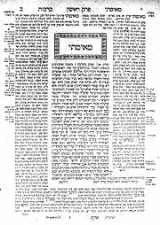
The Talmud is a record of rabbinic discussions pertaining to Jewish law, ethics, customs and history. The Talmud has two components: the Mishnah, which is the first written compendium of Judaism's Oral Law; and the Gemara, a discussion of the Mishnah and related Tannaitic writings that often ventures onto other subjects and expounds broadly on the Tanakh Tanakh

Tanakh [????] , is an acronym [i] that identifies the Hebrew Bible [i]. ... 

. The terms Talmud and Gemara are often used interchangeably. The Gemara is the basis for all codes of rabbinic law and is much quoted in other rabbinic literature.

Discussions

  Discussion Features

   Ask a question about 'Talmud'

   Start a new discussion about 'Talmud'

   Answer questions about 'Talmud'

   'Talmud' discussion forum

Timeline

20   Died

200   Jew Jew

Jews are followers of Judaism [i] or, more generally, members of the Jewish people , an ethno [i] ... 

ish Eretz Yisrael Land of Israel

The Land of Israel is a historical term and concept in Jewish [i] and Christian [i] ... 

i scholar Judah ha-Nasi Judah haNasi

Rabbi Judah haNasi, was a key leader of the Jewish [i] community of Judea [i] toward the end of the 2nd century [i] ... 

 compiles tracts of the Mishnah, beginning the creation of Talmudic law.

375   The Talmud of Babylon Talmud

The Talmud is a record of rabbi [i]nic discussions pertaining to Jewish law [i], ethics [i] ... 

 written by Rav Ashi. This commentary on the Mishnah contains approximately 2.5 million words on 5,894 pages.

475   Completion of the compilation of the Babylonian talmud Talmud

The Talmud is a record of rabbi [i]nic discussions pertaining to Jewish law [i], ethics [i] ... 

, the source of the majority of Jewish Jew

Jews are followers of Judaism [i] or, more generally, members of the Jewish people , an ethno [i] ... 

 Halakha

550   The main redaction of Babylonian Talmud is completed under Rabbis Ravina and Ashi (approximate date).

1263   Nahmanides, chief rabbi of Catalonia Catalonia

The Autonomous Community of Catalonia , known throughout history simply as Catalonia, is today one... 

, defends the Talmud in an important disputation Disputation

In the scholastic [i] system of education of the Middle Ages [i], disputations offered a f ... 

 against Pablo Christiani before King James I of Aragon James I of Aragon

James I of Aragon surnamed the Conqueror, was the king of Aragon [i], count of Barcelona [i] ... 

.

1264   In Barcelona Barcelona

Barcelona – Greek [i]: ; Latin [i]: Barcino, Barcelo , and Barceno' ... 

, a commission of Dominicans Dominican Order

The Order of Preachers , more commonly known as the Dominican Order [i], or Dominicans ... 

 censors portions of the Talmud for the first time by ordering the cancellation of passages found reprehensible from a Christian Christianity

Christianity is a monotheistic [i] religion [i] centered on Jesus of Nazareth [i] ... 

 point of view.

1275   The era of the ''tosafot'', Medieval commentators on the Talmud, ends (began 1100).

1415   Antipope Antipope

An antipope is a person who makes a widely accepted claim to be the lawful Pope [i], in opposition to th ... 

 Benedict XIII Pope Benedict XIII

Pope Benedict XIII, O.P. [i] , born Pietro Francesco Orsini, later Vincenzo Maria Orsini' ... 

 orders all Talmuds to be delivered to diocese Diocese

In some Christian churches, the diocese is an administrative territorial unit administrated by a bishop [i] ... 

 and held until further notice


Encyclopedia


The Talmud is a record of rabbinic discussions pertaining to Jewish law, ethics, customs and history. The Talmud has two components: the Mishnah, which is the first written compendium of Judaism's Oral Law; and the Gemara, a discussion of the Mishnah and related Tannaitic writings that often ventures onto other subjects and expounds broadly on the Tanakh Tanakh

Tanakh [????] , is an acronym [i] that identifies the Hebrew Bible [i]. ... 

. The terms Talmud and Gemara are often used interchangeably. The Gemara is the basis for all codes of rabbinic law and is much quoted in other rabbinic literature. The whole Talmud is traditionally also referred to as Shas .

Origins of the Talmud

Originally Jewish scholarship was oral. Rabbis expounded and debated the law and discussed the bible without the benefit of written works This situation changed drastically, however, mainly as the result of the destruction of the Jewish commonwealth in the year 70 C.E. and the consequent upheaval of Jewish social and legal norms.

As the Rabbis were required to face a new reality—mainly Judaism without a Temple and Judea with no autonomy—there was a flurry of legal discourse and the old system of oral scholarship could not be maintained. It is during this period that Rabbinic discourse began to be recorded in writing.

About the year 200 C.E., Rabbi Judah haNasi Judah haNasi

Rabbi Judah haNasi, was a key leader of the Jewish [i] community of Judea [i] toward the end of the 2nd century [i] ... 

 redacted these rabbinic discussions into the Mishnah . The name means “redaction,” from the verb shanah ???, to repeat or review. This name hints at the original oral memorization method of studying rabbinic discourse.

Mishna


The Mishna was compiled about the year 200 C.E. and is a compilation of legal opinions and debates. The Mishna is on the whole a legal work that records unqualified rulings and major debates of Jewish law. Statements in the Mishnah are usually short, recording only terse opinions of the various rabbis debating a subject or the consensus view. The rabbis of the Mishnah are known as Tannaim ; many teachings in the Mishnah are reported in the name of a particular Tanna. Sometimes statements are made without attribution to a particular Rabbi, usually indicating that the statement represented the majority view.

According to tradition, the Mishna was compiled by Rabbi Judah haNasi Judah haNasi

Rabbi Judah haNasi, was a key leader of the Jewish [i] community of Judea [i] toward the end of the 2nd century [i] ... 

 about the year 200 CE. He collected a large body of rabbinic teachings and edited and organized them according to a topical structure.

Structure and content


The Mishna consists of six orders . Each of the six orders contains between 7 and 12 tractates, called masechtot . Each masechet is divided into chapters composed of smaller units called mishnayot . Not every tractate in the Mishnah has a corresponding Gemara. Furthermore, the order of the tractates in the Talmud differs in some cases from that in the Mishnah; see the discussion on each Seder.

  • First Order: Zeraim . 11 tractates. It deals with prayer and blessings, tithes, and agricultural laws.
  • Second Order: Moed . 12 tractates. This pertains to the laws of the Sabbath and the Festivals.
  • Third Order: Nashim . 7 tractates. Concerns marriage and divorce, some forms of oaths and the laws of the nazirite.
  • Fourth Order: Nezikin . 10 tractates. Deals with civil and criminal law, the functioning of the courts and oaths.
  • Fifth Order: Kodashim . 11 tractates. This involves sacrificial rites, the Temple Temple in Jerusalem

    The Temple in Jerusalem or the Holy Temple was built in ancient Jerusalem [i] in the 10th century BCE [i] ... 

    , and the dietary laws.
  • Sixth Order: Tohorot . 12 tractates. This pertains to the laws of ritual purity.


In addition to the Mishnah, other tannaitic works were created at about the same time or shortly thereafter. The Midrashim such as the Sifra, Sifri and Mekhilta, are exegetical or allegorical rabbinic statements organized according to their relevance to particular biblical passages. The Tosefta is a collection of tannaitic material independent of the Mishna. The Gemara frequently refers to these Tannaitic statements in order to compare them to those contained in the Mishna. These non-Mishnaic statements are usually referred to as Baraitot.

Gemara

Over the next three centuries rabbis throughout Palestine and Babylonia analyzed, debated and discussed the Mishnah. These discussions form the Gemara . The Gemara mainly focuses on elucidating and elaborating the opinions of the Tannaim. The rabbis of the Gemara are known as Amoraim . Gemara means “completion,” from gamar ??? : Hebrew Hebrew language

Hebrew is a Semitic language [i] of the Afro-Asiatic language family [i] ... 

 to complete; Aramaic Aramaic language

Aramaic is a Semitic language [i] with a 3,000-year history [i]. ... 

 to study.

Two major works of Talmud were created. The older compilation is called the Palestinian Talmud or the Talmud Yerushalmi. It was compliled sometime during the fourth century in Palestine. The Babylonian Talmud was compiled about the year 500 C.E., although it continued to be edited later. The word "Talmud", when used without qualification, usually refers to the Babylonian Talmud.

Talmud Yerushalmi


The Gemara here is a synopsis of almost 200 years of analysis of the Mishna in the Academies in Israel Due to the location of the Academies, the agricultural laws of the Land of Israel are discussed in great detail. Traditionally, it was redacted in the year 350 C.E. by Rav Muna and Rav Yossi in Israel. It is referred to traditionally as the Talmud Yerushalmi however, the name is a misnomer, as it was not written in Jerusalem. As such it is also known more accurately as the The Talmud of the land of Israel.

It is written in both Hebrew Hebrew language

Hebrew is a Semitic language [i] of the Afro-Asiatic language family [i] ... 

 and a western Aramaic Aramaic language

Aramaic is a Semitic language [i] with a 3,000-year history [i]. ... 

 dialect that differs from its Babylonian counterpart.

Talmud Bavli


Talmud Bavli is comprised of the Mishnah and the Babylonian Gemara. This Gemara is a synopsis of more than 300 years of analysis of the Mishna in the Babylonian Academies. Tradition ascribes the initial editing of the Babylonian Talmud to two Babylonian sages, Rav Ashi and Ravina. But the question as to when the Gemara was finally put into its present form is not settled among modern scholars. Some of the text did not reach its final form until around 700. Traditionally, the rabbis who edited the talmud after the end of the Amoraic period are called the Saboraim or Rabanan Saborai. Modern scholars, also use the term Stammaim for the authors of unattributed statements in the Gemara.

Comparison of style and subject matter


There are significant differences between the two Talmud compilations. The language of the Palestinian Talmud is a western Aramaic dialect which differs from that of the Babylonian. The Talmud Yerushalmi is often fragmentary and difficult to read, even for experienced Talmudists. The redaction of the Talmud Bavli, on the other hand, is more careful and precise.
In the Bavli, however, gemara exists only for 37 out of the 63 tractates of the Mishna: most laws from the Orders Zeraim and Toharot had little practical relevance in Babylonia and were therefore not included. The Yerushalmi, though, covers a number of these tractates.

The influence of the Babylonian Talmud has been far greater than that of the Yerushalmi. In the main, this is because the influence and prestige of the Jewish community of Israel steadily declined in contrast with the Babylonian community in the years after the redaction of the Talmud and continuing until the Gaonic era. Furthermore, the editing of the Babylonian talmud was superior to that of the Palestinian version, making it more accessible and readily usable.

Halakha and Aggadah

The Talmud contains a vast amount of material and touches on a great many subjects. Traditionally talmudic statements can be classified into two broad categories, Halakhic and Agaddic statements. Halakhic statements are those which directly relate to questions of Jewish law and practice. Aggadic statements are those which are not legally related, but rather are exegetical, homiletical, ethical or historical in nature. See Aggada for further discussion.

Talmudic methodology

Much of the Talmud consists of legal analysis. The starting point for the analysis is usually a legal statement found in a Mishna. The statement is then analyzed and compared with other statements in a dialectical exchange between two disputants, termed the makshan and tartzan . These exchanges form the "building-blocks" of the gemara; the name for a passage of gemara is a sugya . A sugya will typically comprise a detailed proof-based elaboration of a mishnaic statement.

In a given sugya, scriptural, Tannaitic and Amoraic statements are brought to support the various opinions. In so doing, the gemara will bring semantic disagreements between Tannaim and Amoraim , and compare the Mishnaic views with passages from the Tosefta  and the Halakhic Midrash . All such non-Mishnaic Tannaitic sources are termed beraitot . Rarely are debates formally closed; in many instances, the final word determines the practical law, although there are many exceptions to this principle. See Gemara for further discussion.

Printing of the Talmud


The first complete edition of the Babylonian Talmud was printed Printing

Printing is a process for production of text [i]s and , typically with ink [i] on paper [i] using a printing press [i] ... 

 in Italy by Daniel Bomberg during the 16th century. In addition to the Mishna and Gemara, Bomberg's edition contained the commentaries of Rashi Rashi

Rashi ??"? is a Hebrew [i] acronym [i] for ??? ???? ????? , or ??? ???? ???? , author ... 

 and Tosafot. Almost all printings since Bomberg have followed the same pagination. In 1835, a new edition of the Talmud was printed by the Menachem Romm of Vilna. Known as the Vilna Shas, this edition have become an unofficial standard for Talmud editions.

A page number in the Talmud refers to a double-sided page, known as a daf; each daf has two amudim labelled ? and ?, sides A and B. The referencing by daf is relatively recent and dates from the early Talmud printings of the 17th century 17th century

As a means of recording the passage of time [i], the 17th century was that century [i] which lasted from ... 

. Earlier rabbinic literature generally only refers to the tractate or chapters within a tractate. Nowadays, reference is made in format [Tractate daf a/b] . In the Vilna edition of the Talmud there are 5,894 folio pages.

Talmud commentary and study


The Talmud contains a great wealth of Jewish knowledge and from the time of its completion it became an essential and authoritative addition to Jewish literature. It quickly became an integral part of the curriculum of Jewish schools throughout Babylonia and beyond. In this section we will briefly outline some of the major areas of Talmudic scholarship and study.

The earliest talmud commentaries were written by the Gaonim . Although some direct commentaries on particular treatises are extant, our main knowledge of Gaonic era talmud scholarship comes from statements embedded in Geonic responsa which shed light on talmudic passages. After the death of Hai Gaon, however, the center of Talmud scholarship shifts to Europe and North Africa.

Halachic and Aggadic extractions


One area of talmudic scholarship developed out of the need to ascertain the Halacha. Early commentators such as Rabbi Isaac Alfasi  attempted to extract and determine the binding legal opinions from the vast corpus of the talmud. Alfasi's work was highly influential and later served as a basis for the creation of halachic codes. Another influential medieval Halakhic commentary was that of Rabbi Asher b. Jehiel .

A fifteenth century Spanish Rabbi, Jacob ibn Habib , composed the En Yaaqob. En Yaaqob extracts nearly all the aggadic material from the talmud. It was intended to familiarize the public with the ethical parts of the Talmud and to dispute many of the accusations surrounding the contents of the Talmud.

Understanding the Talmud


The talmud is often cryptic and difficult to understand. Its language contains many Greek and Persian words which over time became obscure. A major area of Talmudic scholarship developed in order to explain these passages and words. Some early commentators such as Rabbenu Gershom of Mainz and Rabbenu Hannanel produced running commentaries to various tractates. These commentaries could be read with the text of the Talmud and would help explain the meaning of the text. Using a different style, Rabbi Nathan b. Jechiel created a lexicon called the Arukh in the 11th century in order to translate difficult words.

By far the most well known commentary on the Babylonian Talmud is that of Rashi Rashi

Rashi ??"? is a Hebrew [i] acronym [i] for ??? ???? ????? , or ??? ???? ???? , author ... 

 . The commentary is comprehensive, covering almost the entire Talmud. Written as a running commentary, it provides a full explanation of the words, and explains the logical structure of each Talmudic passage. It is considered indespensible to students of the Talmud.

Medieval Ashkenazic Jewry produced another major commentary known as Tosafot . The tosafot are collected commentaries by various medieval Ashkenazic Rabbis on the Talmud. One of the main goals of the Tosafot is to explain and interpret contradictory statements in the talmud. Unlike Rashi, the Tosafot is not a running commentary, but rather comments on selected matters. Often the explanations of Tosafot differ from those of Rashi.

Over time, many other commentaries have been produced. Some of the more widely known are those of "Maharshal" , "Maharam" and "Maharsha"

Pilpul

Beginning in the sixteenth century a genre of talmud commentary was created in which very discreet or minor points of contradiction within the talmud were explained by using complicated logical explanations. Such commentaries were often praised more for their artistry and logical skill than for their explanations of the text. This genre became known as pilpul . Pilpul is considered a highly developed art form of talmud study. The term Pilpul itself is somewhat derogatory. The new genre drew both admirers and critics. In response to pilpul, Talmud commentaries that did not use complicated logical arguments were referred to as being al derekh haPeshat .

Brisker method

In the late nineteenth century another trend in Talmud study arose. Rabbi Hayyim Soloveitchik  of Brisk developed and refined this style of study. Brisker method involves the analysis of rabbinic arguments within the talmud or among the rishonim and explaining the differing opinions by placing them within a categorical structure. The brisker method is highly analytical and is often criticized as being a modern day version of Pilpul. Nevertheless, the influence of the Brisker method is great. Most modern day Yeshivot study the Talmud using the Brisker method in some form. And it is through this method that Maimonides' Mishne Torah was transformed from being solely a halachic work to one of talmudic interpretation as well.

Historical method


The Text of the Talmud has been subject to some level of critical scrutiny throughout its history. However, traditionally, the text of the Talmud has been viewed as static and as having a semi-canonical status. Traditional commentaries usually shied away from textual emendation of Talumudic passages. As a result of emancipation from the ghetto , Judaism underwent enormous upheaval and transformation during the Nineteenth century. The Talmud like the rest of Judaism was scrutinized and questioned. As a result modern critical study of the Talmud was born.

Leaders of the Reform movement, such as Abraham Geiger and Samuel Holdheim, subjected the Talmud to severe scrutiny as part of an effort to break with traditional rabbinic Judaism. In reaction Orthodox leaders such as Moses Sofer Moses Sofer

Rabbi Moses ben Samuel Sofer or Schreiber, also known by his main work Hatam Sofer or the ... 

 became severely sensitive to any change and would reject any critical analysis of Talmud. Talmud study was cought up in the great debate between Reformers and Orthodoxy. Somewhere in between these two diametrically opposed views arose a new method. The Historical-Critical method of Talmud study. These scholars and rabbis believed that Jewish Law was a product of a long development and that tampering with this process should be avoided. On the other hand, they believed that traditional Jewish sources, such as the Talmud, should be subject to academic inquiry and critical analysis. The founders this viewpoint were Zecharias Frankel, Leopold Zunz Leopold Zunz

Leopold Zunz was the founder of what has been termed the "Science of Judaism" , the critical [i] invest... 

 and Solomon Judah Leib Rappaport.

In general, it may be said that advocates of the critical method of talmud study were willing to apply modern academic and scientific methods of research to Talmud study. Significantly, advocates of the historical method are willing to emmend the text of the talmud in order to answer difficulties in the text.

Because modern method of historical study has its origins in the era of religious reform it was immedietly controversial within the Orthodox world. Still, many severe critics of Refrom and strictly orthodox Rabbis of the nineteenth century utilized this new scientific method .

Talmud scholarship today


In Orthodox yeshivot the critical study of Talmud is still mostly avoided. However, the historical method has become the basis of all modern academic study. Some trends within contemporary academic talmud scholarship are listed below.

  • Some scholars hold that there has been extensive editorial reshaping of the stories and statements within the Talmud. Lacking outside confirming texts, they hold that we cannot confirm the origin or date of most statements and laws, and that we can say little for certain about their authorship. In this view, the questions above are impossible to answer. See, for example, the works of Louis Jacobs Louis Jacobs

    * The Times [i], July 4 [i], 2006 [i]

... 

 and Shaye J.D. Cohen.

  • Some scholars hold that the Talmud has been extensively shaped by later editorial redaction, but that it contains sources which we can identify and describe with some level of reliability. In this view, sources can be identified by tracing the history and analyzing the geographical regions of origin. See, for example, the works of Lee I. Levine and David C. Kraemer.


  • Some scholars hold that many or most the statements and events described in the Talmud usually occurred more or less as described, and that they can be used as serious sources of historical study. In this view, historians do their best to tease out later editorial additions and skeptically view accounts of miracles, leaving behind a reliable historical text. See, for example, the works of Saul Lieberman, David Weiss Halivni, and Avraham Goldberg.

Role of the Talmud in Judaism


The Talmud is the written record of an oral tradition. It became the basis for many rabbinic legal codes and customs. Not all Jews have accepted the Talmud as having religious authority. This section briefly outlines such movements.

Sadducees

The Sadducees were a Jewish sect which flourished during the second temple period. One of their main arguments with the Pharisees  was their rejection of an Oral Law.

Karaism

Another movement which rejected the oral law was Karaism Karaite Judaism

Karaite Judaism or Karaism is a Jewish denomination [i] characterized by the ... 

. It arose within two centuries of the completion of the Talmud. Karaism developed as a reaction against the Talmudic Judaism of Babylonia. The central concept of Karaism is the rejection of the Oral Law, as embodied in the Talmud, in favor of a strict adherence to the Written Law only. This opposes the fundamental Rabbinic concept that the Oral Law was given to Moses Moses

Moses or Moshe is a legend [i]ary Hebrew [i] liberator, leader, lawgiver, prophet [i], an ... 

 on Mount Sinai Mount Sinai

Mount Sinai , also known as Mount Horeb, Mount Musa, Gebel Musa or Jabal Musa b... 

 together with the Written Law. Karaism has virtually disappeared, declining from a high of nearly 10% of the Jewish population to a current estimated .002%.

Reform Judaism

With the rise of Reform Judaism Reform Judaism

Reform Judaism can refer to the largest denomination of Judaism in America [i] and its sib ... 

 during the nineteenth century the authority of the Talmud was again questioned. The talmud was seen as being a product of late antiquity and of having relevance merely as a historical document.

The Talmud in modern-day Judaism

See also How Halakha is viewed today; The Halakhic process.


Orthodox Judaism continues to regard the Talmud as the repository of the Oral Law and the primary document through which Judaism in general, and Halakha in particular, is to be understood. Orthodox Jews view Talmud study as a lifelong pursuit, formal instruction begins at a young age and daily study is usual for all men . At the same time Orthodoxy rarely uses Talmudic legal methodology to alter Jewish law as codified in later compendia. In practice Orthodox scholars generally rely on the codes. The reason for this is that the Orthodox community feels that the correct possibilities were mostly exhausted by rishonim; therefore, they defer to them. Rare individuals that are seen by the Orthodox community to have the rishonim's level of piety and knowledge are exceptions . In addition, although it is theoretically possible in Orthodoxy to change or inactivate rabbinic decrees, this must be done by a body of law equal to that which made the decree. According to Orthodox opinion, it will become possible to inactivate rabbinic decrees once a Sanhedrin is gathered again, during the Messianic Era. Orthodox Jews will also study the Talmud for its own sake; this is considered a great mitzvah, Talmud Torah . Most Orthodox Jews consider the logic of the Talmudic argument holy by itself, since it is an argument within Divinity . From a cultural standpoint, study of Talmudic argument reveals to a student concentrated wisdom of centuries of Jewish culture and tradition. See also: Orthodox beliefs about Jewish law and tradition.

Conservative Judaism also considers Halakha as binding, but does not consider the Oral Law to have been verbally revealed to Moses. This results in viewing Talmud study as a historical source for Halakha and Jewish wisdom, but not as the unalterable repository of the spirit of Judaism. In addition, decisions of modern legal codes are not considered binding. The Conservative approach to legal decision-making emphasizes placing classic texts and prior decisions in historical and cultural context, and examining the historical development of halakha. The Conservative community also regards the Rabbinical Assembly's halakhic arm as empowered to overturn earlier rabbinical decrees and issue decrees of its own. These approaches generally result in greater practical flexibility and a greater degree of change. See also: The Conservative Jewish view of the Halakha.

Reform Reform Judaism

Reform Judaism can refer to the largest denomination of Judaism in America [i] and its sib ... 

 and Reconstructionist Jews usually do not teach much Talmud in their Hebrew schools, but they do teach it in their rabbinical seminaries; the world view of liberal Judaism rejects the idea of binding Jewish law, and uses the Talmud as a source of inspiration and moral instruction. Most liberal scholars of Talmud do not study the Talmud at such an in-depth level as would be found in the Orthodox or Conservative movements. See also: The Reform Jewish view of the Halakha Reform Judaism

Reform Judaism can refer to the largest denomination of Judaism in America [i] and its sib ... 

and view of the Talmud Reform Judaism

Reform Judaism can refer to the largest denomination of Judaism in America [i] and its sib ... 

.


External attacks on the Talmud

The history of the Talmud reflects in part the history of Judaism persisting in a world of hostility and persecution. Almost at the very time that the Babylonian savoraim put the finishing touches to the redaction of the Talmud, the emperor Justinian Justinian I

Justinian I was Eastern Roman Emperor [i] from August 1 [i], 527 [i] until h ... 

 issued his edict against the abolition of the Greek translation of the Bible in the service of the Synagogue. This edict, dictated by Christian zeal and anti-Jewish feeling, was the prelude to attacks on the Talmud, conceived in the same spirit, and beginning in the thirteenth century 13th century

As a means of recording the passage of time [i], the 13th century was that century [i] which lasted from ... 

 in France France

France, officially the French Republic, is a country [i] whose metropolitan territory [i] ... 

, where Talmudic study was then flourishing.

The charge against the Talmud brought by the convert Nicholas Donin led to the first public disputation between Jews and Christians and to the first burning of copies of the work . The Talmud was likewise the subject of a disputation at Barcelona Barcelona

Barcelona – Greek [i]: ; Latin [i]: Barcino, Barcelo , and Barceno' ... 

 in 1263 between Nahmanides  and Pablo Christiani. This same Pablo Christiani made an attack on the Talmud which resulted in a papal bull Papal bull

A Papal bull is a special kind of patent [i] or charter issued by a pope [i] and named fo ... 

 against it and in the first censorship, which was undertaken at Barcelona by a commission of Dominican Dominican Order

The Order of Preachers , more commonly known as the Dominican Order [i], or Dominicans ... 

s, who ordered the cancellation of passages reprehensible from a Christian perspective .

At the disputation of Tortosa Tortosa

Tortosa is the capital of the comarca [i] of Baix Ebre [i], in the province of ... 

 in 1413, Geronimo de Santa Fé brought forward a number of accusations, including the fateful assertion that the condemnations of pagans and apostates found in the Talmud referred in reality to Christians. Two years later, Pope Martin V Pope Martin V

Pope Martin V , born Oddone Colonna , Pope [i] from 1417 [i] to 1431 [i], was elected on St. Martin's Day [i] ... 

, who had convened this disputation, issued a bull forbidding the Jews to read the Talmud, and ordering the destruction of all copies of it. Far more important were the charges made in the early part of the sixteenth century 16th century

As a means of recording the passage of time [i], the 16th century was that century [i] which lasted from ... 

 by the convert Johannes Pfefferkorn, the agent of the Dominicans. The result of these accusations was a struggle in which the emperor and the pope acted as judges, the advocate of the Jews being Johann Reuchlin Johann Reuchlin

Johann Reuchlin was a German [i] humanist [i] and Hebrew [i] scholar. ... 

, who was opposed by the obscurantists and the humanists; and this controversy, which was carried on for the most part by means of pamphlets, became the precursor of the Reformation Protestant Reformation

The Protestant Reformation, also referred to as the Protestant Revolution, was a movement in the 1... 

 .

An unexpected result of this affair was the complete printed edition of the Babylonian Talmud issued in 1520 by Daniel Bomberg at Venice Venice

Venice is the capital [i] of the region [i] of Veneto [i] and the province of the same name [i] ... 

, under the protection of a papal privilege. Three years later, in 1523, Bomberg published the first edition of the Palestinian Talmud. After thirty years the Vatican, which had first permitted the Talmud to appear in print, undertook a campaign of destruction against it. On New-Year's Day the copies of the Talmud which had been confiscated in compliance with a decree of the Inquisition Inquisition

The term Inquisition refers broadly to a number of historical movements orchestrated by the Roman Catholic Church [i] ... 

 were burned at Rome Rome

Rome is the capital [i] of Italy [i] and of its region, called Latium [i]. ... 

; and similar burnings took place in other Italian cities, as at Cremona Cremona

Cremona is a city [i] in Northern Italy [i], situated in Lombardy [i], on the left shore of the Po [i] ... 

 in 1559. The Censorship of the Talmud and other Hebrew works was introduced by a papal bull issued in 1554; five years later the Talmud was included in the first Index Expurgatorius Index Librorum Prohibitorum

The Index Librorum Prohibitorum is a list of publications which the Catholic Church [i] ... 

; and Pope Pius IV Pope Pius IV

Pope Pius IV , born Giovanni Angelo Medici, was Pope [i] from 1559 [i] to 1565 [i]. ... 

 commanded, in 1565, that the Talmud be deprived of its very name.

The first edition of the expurgated Talmud, on which most subsequent editions were based, appeared at Basel Basel

Basel is Switzerland [i]'s third most populous city .
... 

  with the omission of the entire treatise of 'Abodah Zarah and of passages considered inimical to Christianity, together with modifications of certain phrases. A fresh attack on the Talmud was decreed by Pope Gregory XIII Pope Gregory XIII

Pope Gregory XIII , born Ugo Boncompagni, was Pope [i] from 1572 to 1585. ... 

 , and in 1593 Clement VIII Pope Clement VIII

Pope Clement VIII , born Ippolito Aldobrandini, was Pope [i] from January 30 [i], 1592 [i] to March 3 [i] ... 

 renewed the old interdiction against reading or owning it. The increasing study of the Talmud in Poland led to the issue of a complete edition , with a restoration of the original text; an edition containing, so far as known, only two treatises had previously been published at Lublin Lublin

Lublin is the biggest city in eastern Poland [i] and the capital of Lublin Voivodeship [i] with a popula ... 

 . In 1707 some copies of the Talmud were confiscated in the province of Brandenburg Brandenburg

Brandenburg is one of Germany [i]'s sixteen Bundeslnder [i] . ... 

, but were restored to their owners by command of Frederick, the first king of Prussia Frederick I of Prussia

Frederick I of Prussia of the Hohenzollern [i] dynasty was Elector [i] of Brandenburg [i]... 

. The last attack on the Talmud took place in Poland in 1757, when Bishop Dembowski, at the instigation of the Frankists Jacob Frank

*Judaism and Christianity [i]
... 

, convened a public disputation at Kamenetz-Podolsk, and ordered all copies of the work found in his bishopric to be confiscated and burned by the hangman.

The external history of the Talmud includes also the literary attacks made upon it by Christian theologians after the Reformation, since these onslaughts on Judaism were directed primarily against that work, even though it was made a subject of study by the Christian theologians of the seventeenth and eighteenth centuries. In 1830, during a debate in the French Chamber of Peers regarding state recognition of the Jewish faith, Admiral Verhuell declared himself unable to forgive the Jews whom he had met during his travels throughout the world either for their refusal to recognize Jesus Jesus

Jesus,Some of the historians and Biblical scholars who place the birth and death of Jesus within this ra... 

 as the Messiah or for their possession of the Talmud. In the same year the Abbé Chiarini published at Paris a voluminous work entitled "Théorie du Judaïsme," in which he announced a translation of the Talmud, advocating for the first time a version which should make the work generally accessible, and thus serve for attacks on Judaism. In a like spirit modern anti-Semitic agitators have urged that a translation be made; and this demand has even been brought before legislative bodies, as in Vienna. The Talmud and the "Talmud Jew" thus became objects of anti-Semitic attacks, although, on the other hand, they were defended by many Christian students of the Talmud.

Despite the numerous mentions of Edom Edom

Edom, a Hebrew [i] word meaning "red [i]", is a name given to Esau [i] in the Hebrew Bible [i] ... 

 which may refer to Christendom, the Talmud makes little mention of Jesus directly or the early Christians. There are a number of quotes about individuals named Yeshu Yeshu

Yeshu, or and slight variations such as Jeshu (Bible English transliteration) or Yeishu ... 

 that once existed in editions of the Talmud; these quotes were long ago removed from the main text due to accusations that they referred to Jesus, and are no longer used in Talmud study. However, these removed quotes were preserved through rare printings of lists of errata, known as Hashmatot Hashass . Some modern editions of the Talmud contain some or all of this material, either at the back of the book, in the margin, or in alternate print. These passages do not necessarily refer to a single individual and many of the stories are far removed from anything written in the New Testament New Testament

The New Testament , sometimes called the Greek Testament or Greek Scriptures, and sometimes ... 

. Many scholars are convinced that these people cannot be identified as the Christian Jesus.

Charges of racism


Some groups and individuals consider that passages in the Talmud show that Judaism Judaism

Judaism is the religion [i] of the Jew [i]ish people. ... 

 is inherently racist. Critics of these charges argue that the passages in question do not indicate inherent racism on the part of the Talmud , but rather mistranslation, falsification, and selective choice of quotes out of context, on the part of those making the charges. The Anti-Defamation League Anti-Defamation League

The Anti-Defamation League is an organization founded by B'nai B'rith [i] in the United States whose st ... 

's report on this topic states:

By selectively citing various passages from the Talmud and Midrash, polemicists have sought to demonstrate that Judaism espouses hatred for non-Jews , and promotes obscenity, sexual perversion, and other immoral behavior. To make these passages serve their purposes, these polemicists frequently mistranslate them or cite them out of context ...

In distorting the normative meanings of rabbinic texts, anti-Talmud writers frequently remove passages from their textual and historical contexts. Even when they present their citations accurately, they judge the passages based on contemporary moral standards, ignoring the fact that the majority of these passages were composed close to two thousand years ago by people living in cultures radically different from our own. They are thus able to ignore Judaism's long history of social progress and paint it instead as a primitive and parochial religion.

Those who attack the Talmud frequently cite ancient rabbinic sources without noting subsequent developments in Jewish thought, and without making a good-faith effort to consult with contemporary Jewish authorities who can explain the role of these sources in normative Jewish thought and practice.


Rabbi Gil Student, a prolific author on the internet, exposes anti-Talmud accusations and writes:
Anti-Talmud accusations have a long history dating back to the 13th century when the associates of the Inquisition attempted to defame Jews and their religion [see Yitzchak Baer, A History of Jews in Christian Spain, vol. I pp. 150-185]. The early material compiled by hateful preachers like Raymond Martini and Nicholas Donin remain the basis of all subsequent accusations against the Talmud. Some are true, most are false and based on quotations taken out of context, and some are total fabrications [see Baer, ch. 4 f. 54, 82 that it has been proven that Raymond Martini forged quotations]. On the Internet today we can find many of these old accusations being rehashed...

The Daf Yomi

Thousands of Jews worldwide participate in Daf Yomi - literally the daily page - as part of a monumental program. Daf Yomi was initiated by Rabbi Meir Shapiro in 1923 at the First World Congress of Agudath Israel in Vienna Vienna

Vienna is the capital [i] of Austria [i], and also one of the nine States of Austria [i]. ... 

. With 2711 folios in the Talmud, one cycle takes about 7.5 years. Daf Yomi started its 12th cycle of study on March 2, 2005.

Translations


Translations of Talmud Bavli

There are four contemporary translations of the Talmud into English:
  • The Soncino Hebrew-English Talmud Isidore Epstein, Soncino Press. In this translation, each English page faces the Aramaic/Hebrew page. Notes on each page provide additional background material. See also: .
  • The Talmud of Babylonia. An American Translation, Jacob Neusner, Tzvee Zahavy, others. Atlanta: 1984-1995: Scholars Press for Brown Judaic Studies. Complete.
  • The Schottenstein Edition of the Talmud, Mesorah Publications ArtScroll

    ArtScroll is an imprint [i] of translations, books and commentaries from an Orthodox Jewish [i]... 

    . In this translation, each English page faces the Aramaic/Hebrew page. The English pages are elucidated and heavily annotated; each Aramaic/Hebrew page of Talmud typically requires three English pages of translation. See also: .
  • The Talmud: The Steinsaltz Edition Adin Steinsaltz Adin Steinsaltz

    Rabbi Adin Steinsaltz or Adin Even Yisrael is a rabbi [i] who claims to have received Semicha [i] ... 

    , Random House . This work is in fact a translation of Rabbi Steinsaltz' Hebrew language Hebrew language

    Hebrew is a Semitic language [i] of the Afro-Asiatic language family [i] ... 

     translation of and commentary on the entire Talmud. See also: .

Translations of Talmud Yerushalmi

Talmud of the Land of Israel: A Preliminary Translation and Explanation Jacob Neusner, Tzvee Zahavy, others. University of Chicago Press. This translation uses a form-analytical presentation which makes the logical units of discourse easier to identify and follow.

This work has received many positive reviews. However, some consider Neusner's translation methodology idiosyncratic. One volume was negatively reviewed by Saul Lieberman of the Jewish Theological Seminary.

Schottenstein Edition of the Yerushalmi Talmud Mesorah/Artscroll. This translation is the counterpart to Mesorah/Artscroll's Schottenstein Edition of the Talmud .

See also

  • Jerusalem Talmud
  • Mishnah
  • Minor Tractates
  • Tosefta
  • Beraita
  • Gemara
  • Ein Yaakov
  • Rabbinic literature
  • The Kallah Month
  • Yeshiva

References


General

  • Maimonides Maimonides

    Maimonides was a Jew [i]ish rabbi [i], physician [i], and philosopher [i] in Spain [i] and Egypt [i] du ... 

     Introduction to the Mishneh Torah Mishneh Torah

    ## De'ot: general proper behavior

... 


  • Maimonides Maimonides

    Maimonides was a Jew [i]ish rabbi [i], physician [i], and philosopher [i] in Spain [i] and Egypt [i] du ... 

     Introduction to the Commentary on the Mishnah Maimonides

    Maimonides was a Jew [i]ish rabbi [i], physician [i], and philosopher [i] in Spain [i] and Egypt [i] du ... 

    , transl. Zvi Lampel . ISBN 1-880582-28-7
  • Adin Steinsaltz Adin Steinsaltz

    Rabbi Adin Steinsaltz or Adin Even Yisrael is a rabbi [i] who claims to have received Semicha [i] ... 

     The Talmud: A Reference Guide . ISBN 0-679-77367-3
  • Adin Steinsaltz Adin Steinsaltz

    Rabbi Adin Steinsaltz or Adin Even Yisrael is a rabbi [i] who claims to have received Semicha [i] ... 

     The Essential Talmud . ISBN 0-465-02063-1; see also
  • Zvi Hirsch Chajes "Mevo Hatalmud", transl. Jacob Shachter: The Students' Guide Through The Talmud . ISBN 1-933143-05-3
  • Shmuel Hanaggid Introduction to the Talmud, in Aryeh Carmell Aiding Talmud Study . ISBN 0-87306-428-3
  • Nathan T. Lopes Cardozo The Infinite Chain : Torah, Masorah, and Man . ISBN 0-944070-15-9
  • D. Landesman A Practical Guide to Torah Learning . ISBN 1-56821-320-4
  • Aaron Parry The Complete Idiot's Guide to The Talmud . ISBN 1-59257-202-2
  • R. Travers Herford Christianity in Talmud and Midrash . ISBN 0-87068-483-3

Historical study

  • Shalom Carmy Modern Scholarship in the Study of Torah: Contributions and Limitations Jason Aronson, Inc.
  • Louis Jacobs Louis Jacobs

    * The Times [i], July 4 [i], 2006 [i]

... 

, "How Much of the Babylonian Talmud is Pseudepigraphic?" Journal of Jewish Studies 28, No. 1 , pp. 46-59
  • Richard Kalmin Sages, Stories, Authors and Editors in Rabbinic Babylonia Brown Judaic Studies
  • David C. Kraemer, On the Reliability of Attributions in the Babylonian Talmud, Hebrew Union College Annual 60 , pp. 175-90
  • Lee Levine, Ma'amad ha-Hakhamim be-Erez Yisrael ,
  • Saul Lieberman Hellenism in Jewish Palestine
  • Jacob Neusner Sources and Traditions: Types of Compositions in the Talmud of Babylonia .
  • David Weiss Halivni Mekorot u-Mesorot: Eruvin-Pesahim
  • David Bigman, ,

External links


General

  • , jewishencyclopedia.com
  • , jewishencyclopedia.com
  • , aish.com
  • , jewishvirtuallibrary.org
  • , University of Miami University of Miami

    The University of Miami, sometimes called UM or The U [i], is a private university [i], foun ... 

     Law Library
  • , Ohr Somayach

Full text resources

  • .
  • .


Talmudic layout

  • image map from Prof. Eliezer Segal
  • , upenn.edu
  • from the World Union of Jewish Students


Pertaining to the "Daf Yomi" program


Refutation of anti-Semitic allegations concerning the Talmud


Audio

  • , mp3shiur.com