


Japhetic

Encyclopedia
Japhetic is a term that refers to the supposed descendants of Japheth
, one of the three sons of Noah
in the Bible
. It corresponds to Semitic
(descendants of Shem
) and Hamitic
(descendants of Ham
). Variations of the term include Japhetite and Japhethitic.
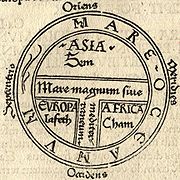 Traditionally, Japheth has been believed by some to be the progenitor of the peoples of Europe. Thus "Japhetic" came to be used as a synonym for Europeans, as well as Asians. In medieval Europe, the world was believed to have been divided into three large-scale racial groupings. In addition to the Japhetic peoples of Europe, the Semitic peoples were equated with all Middle-easterners, Arabs and Israelites, and Hamitic peoples with Africans.
The link between Japheth and the Europeans is reflected in Genesis 10:5, which states that the sons of Japheth moved to the "isles of the Gentile
s" — commonly believed to be the Greek isles.
In the Bible, Japheth is ascribed seven sons and seven grandsons:
The intended ethnic identity of these 'descendants of Japheth' is not certain; however, over history, they have been identified by Biblical scholars with various historical nations who were deemed to be descendants of Japheth and his sons — a practice dating back at least to the classical encounters of Jew with Hellene, for example in Josephus
's Antiquities of the Jews, I.VI.122 (Whiston). Josephus wrote:
Josephus subsequently detailed the nations supposed to have descended from the seven sons of Japheth.
Among the nations that various later writers (including Jerome
and Isidore of Seville
, as well as other traditional accounts) have attempted to assign to them, are as follows:
and thought to have been originally written ca. 70 AD, contains an expanded genealogy that is seemingly garbled from that of Genesis, and also quite different from the much later one found in Jasher:
", a midrash
(elaboration of the biblical text) first published in 1625, provides some new names for Japheth's grandchildren. Additions, not seen in the Bible or any other source:
"complete" (sons were Ashkenaz, Riphath
and Togarmah
) - also Gamir, Gommer, Gomeri, Gomeria, Gomery, Goth, Guth, Gutar, Götar, Gadelas, Galic, Gallic, Galicia, Galica, Galatia, Gael, Getae, Galatae, Galatoi, Gaul, Galls, Goar, Celt, Celtae, Celticae, Kelt, Keltoi, Gimmer, Gimmerai, Gimirra, Gimirrai, Gimirraya, Kimmer, Kimmeroi, Kimirraa, Kumri, Umbri, Cimmer, Cimmeria, Cimbri, Cimbris, Crimea, Chomari, Cymric, Cymry, Cymru, Cymbry, Cumber
In Western tradition Gomer lineage is associated with Caledonians
, Picts
, Milesians
, Umbrians, Helvetians, Celts, Galatia
ns, Ostrogoths, Visigoths, Goths
, Vandals
, Scandinavians
, Jutes
, Teutons
, Franks
, Burgundians
, Alemanni, Armenians
, Germans, Belgians
, Dutch
, Luxembourgers
, Liechtenstein
ers, Austrians
, Swiss, Angles
, Saxons
, Britons, English
, Cornish
, Irish
, Welsh
, Scottish
, and other related groups);
In alternate Caucasian and Asiatic genealogies Gomer is also ancestor of Turks
, Bulgars
, Tartars, Cossacks, Circassians, Bashkirs
, Chuvashes, Khazars
, Azerbaijanis, Kazakhs
, Turkmen
, Uzbeks
, Tajiks, Kyrgyz, Phrygians, Bithynians, Carpathians
, and Paphlagonians.
"land of Gog" (sons were Elichanaf and Lubal) - also Gog, Gogh, Magug, Magogae, Mugogh, Mat Gugi, Gugu, Gyges, Bedwig, Moghef, Magogian, Massagetae, Dacae, Sacae, Scyth, Scythi, Scythia, Scythae, Sythia, Scythes, Skuthai, Skythai, Scythia, Skythia, Scynthia, Scynthius, Sclaveni, Sarmatian, Scoloti, Skodiai, Scotti, Skoloti, Skoth-ai, Skoth, Skuthes, Skuth-a, Askuza, Askuasa, Alani, Alans, Alanic, Ulan, Uhlan also Rasapu, Rashu, Rukhs, Rukhs-As, Rhos, Ros, Rosh, Rox, Roxolani, Rhoxolani, Ruskolan, Rosichi, Rhossi, Rusichi, Rus, Ruska, Rossiya, Russian (Russians
, Belarusians
, Ukrainians
); also Mas-ar, Mas-gar, Masgar, Mazar, Madj, Madjar, Makr-on, Makar, Makaroi, Merkar, Magor, Magar, Magyar, Mohgur (Hungarians - also Hungar, Hunugur, Hurri, Gurri, Onogur, Ugor, Ungar, Uhor, Venger); Siberia
ns, Yugoslavians, Croatians, Bosnians
, Montenegrins, Serbians
, Slovenes, Slovakians, Bulgarians
, Poles
, Czechs, and other related groups);
Also Turks
, Hungarians, Huns
, Voguls, Finns, Lapps, Estonians
, Mordvins, Karelians
, Komi-Zyrians, Udmurts, Izhorians
, Livonians, and Siberians.
"middle land" (sons were Achon, Zeelo, Chazoni and Lot) - Medes
, Persians, Caspians
, Achaemenians, Manneans, Iranians, Afghans.
"miry" (sons were Elishah
, Tarshish
, Kittim
and Dodanim
) - also Jevanim, Iewanim, Iawan, Iawon, Iamanu, Iones, Ionians, Ellas, Ellines, El-li-ness, Hellas, Hellenes, Yavan, Yavanas, Yawan, Yuban, Yauna, Uinivu, Xuthus (Greeks
, Fomorians
, Sparta
ns, Dorians, Britons, Aeolians
, Achaeans
, Myceneans, Ancient Macedonians
, Carthaginians, Cypriots
, Cretans;
Also Anatolians
, Cilicians, Ionians
, Tartessians, and the aboriginal inhabitants of the British Isles such as the Irish Travellers.
"brought" (sons were Ariphi, Kesed and Taari) - also Tabal, Tabali, Tubalu, T'bilisi, Tibarenoi, Tibareni, Tibar, Tibor, Sabir, Sapir, Sabarda, Subar, Subartu, Thobal, Thobel, Circassians, Georgians
, Dagestan
is, Chechens, and other related groups);
Also Avars
, Basques, Colchians.
"drawing out" (sons were Dedon, Zaron and Shebashni) - Me'shech, Mes'ek, Meshekh, Meskhi, Mushch, Muschki, Mushki, Mishi, Muski, Mushku, Musku, Muskeva, Muska, Muskaa, Muskai, Maskali, Machar, Maskouci, Mazakha, Mazaca, Massagatae, Mtskhetos, Modar-es, Moskhi, Moshkhi, Mosher, Moshch, Moschis, Mosoch, Moschi, Moschian, Mo'skhoi, Moschoi, Mosochenu, Mosochean, Mossynes, Mosynoeci, and other related groups);
Also Moschi
, Georgians
, and Cappadocians.
"desire" (sons were Benib, Gera, Lupirion and Gilak) - also Tiracian, Thracian, Thirasian, Thuras, Troas, Tros, Troia, Troi, Troy, Trajan, Trojan, Taunrus, Tyrsen, Tyrrhena, Rasenna, Tursha, Tusci, Tuscany
, Etruscan
, Eturscan (Thracians
, Pelasgians
, Phrygians, Leleges
and Etruscans.
as a racial label for Europeans derives in part from the assumption that the tribe of Japheth developed its distinctive racial characteristics in the Caucasus area, having migrated there from Mount Ararat
before populating Europe. In the same vein, Georgia
n nationalist histories associated Japheth's sons with certain ancient tribes of the Caucasus area, called Tubal
s (Tabal
s, Tibarenoi in Greek) and Meshech
s (Meshekhs/Mosokhs, Moschoi in Greek), who they claimed represented ancient pre-Indo-European
and non-Semitic, possibly "Proto-Iberian
", tribes of Asia Minor
of the 3rd
-1st millennias BC
. This theory influenced the use of the term Japhetic in the linguistic theories of Nikolai Marr (see below).
During the eighteenth and nineteenth century the Biblical statement that "God shall enlarge Japheth" (Genesis 9:27) was used by some Christians as a justification for the "enlargement" of European territories through Imperialism
, which was interpreted as part of God's plan for the world. The subjugation of Africans was likewise justified by the curse of Ham
.
, Rasmus C. Rask and other pre-Darwinian linguists
to what later became known as the Indo-European
language group, on the assumption that the principal languages of Europe would have originated with the tribe of Japheth.
In a conflicting sense, it was also used by the Soviet linguist Nikolai Marr in his Japhetic theory
, which was intended to demonstrate that the languages of the Caucasus formed part of a once-widespread pre-Indo-European language group, and also to apply Marxist notions of class consciousness
and class struggle
to language.
Japheth
Japheth is one of the sons of Noah in the Abrahamic tradition...
, one of the three sons of Noah
Sons of Noah
The Seventy Nations or Sons of Noah is an extensive list of descendants of Noah appearing in of the Hebrew Bible, representing an ethnology from an Iron Age Levantine perspective...
in the Bible
Bible
The Bible refers to any one of the collections of the primary religious texts of Judaism and Christianity. There is no common version of the Bible, as the individual books , their contents and their order vary among denominations...
. It corresponds to Semitic
Semitic
In linguistics and ethnology, Semitic was first used to refer to a language family of largely Middle Eastern origin, now called the Semitic languages...
(descendants of Shem
Shem
Shem was one of the sons of Noah in the Hebrew Bible as well as in Islamic literature. He is most popularly regarded as the eldest son, though some traditions regard him as the second son. Genesis 10:21 refers to relative ages of Shem and his brother Japheth, but with sufficient ambiguity in each...
) and Hamitic
Hamitic
Hamitic is an historical term for the peoples supposedly descended from Noah's son Ham, paralleling Semitic and Japhetic.It was formerly used for grouping the non-Semitic Afroasiatic languages , but since, unlike the Semitic branch, these have not been shown to form a phylogenetic unity, the term...
(descendants of Ham
Ham, son of Noah
Ham , according to the Table of Nations in the Book of Genesis, was a son of Noah and the father of Cush, Mizraim, Phut and Canaan.- Hebrew Bible :The story of Ham is related in , King James Version:...
). Variations of the term include Japhetite and Japhethitic.
Japhetic geography and race
The link between Japheth and the Europeans is reflected in Genesis 10:5, which states that the sons of Japheth moved to the "isles of the Gentile
Gentile
The term Gentile refers to non-Israelite peoples or nations in English translations of the Bible....
s" — commonly believed to be the Greek isles.
In the Bible, Japheth is ascribed seven sons and seven grandsons:
- GomerGomer (Bible)Gomer was the eldest son of Japheth , and father of Ashkenaz, Riphath, and Togarmah, according to the "Table of Nations" in the Hebrew Bible, ....
- AshkenazAshkenazIn the Bible, Ashkenaz is Gomer's first son, brother of Riphath and Togarmah , thereby a Japhetic descendant of Noah. A kingdom of Ashkenaz is called together with Ararat and Minni against Babylon In the Bible, Ashkenaz (Heb. אַשְׁכֲּנָז) is Gomer's first son, brother of Riphath and Togarmah (Gen....
- RiphathRiphathRiphath - "a crusher", Gomer's second son , supposed by Josephus to have been the ancestor of the Paphlagonia. Pliny calls Riphath "Riphaci", and mentions a group of mountains named after him, the Riphaean range. Melo calls him "Riphaces", and Solinus "Piphlataci".Some Irish traditions say Riphath...
- TogarmahTogarmahTogarmah third son of Gomer, and grandson of Japheth, brother of Ashkenaz and Riphat...
- Ashkenaz
- MagogMagog (Bible)Magog, Hebrew מגוג, Greek Μαγωγ, [ ma'gog ], is the second of the seven sons of Japheth mentioned in the Table of Nations in Genesis 10. It may represent Hebrew for "from Gog", though this is far from certain....
- MadaiMadaiMadai is a son of Japheth and one of the 16 grandsons of Noah in the Book of Genesis of the Hebrew Bible. Biblical scholars have identified Madai with various nations, from the Mitanni of early records, to the Iranian Medes of much later records...
- JavanJavanJavan was the fourth son of Noah's son Japheth according to the "Table of Nations" in the Hebrew Bible...
- ElishahElishahElishah was the son of Javan according to the Book of Genesis as well as the mediaeval, rabbinic Book of Jasher; he is said in Jasher to have been the ancestor of the "Almanim", possibly a reference to Germanic tribes . An older and more common traditions refers to him as a settler of Greece ,...
- TarshishTarshishTarshish תַּרְשִׁישׁ occurs in the Hebrew Bible with several uncertain meanings:*One of the sons of Javan .* In the Bible Solomon set up a trade with Tarshish and received ivory, apes, and peacocks from Tarshish which are all native to the jungles in India. India's state bird for example is the...
- KittimKittimKittim in the genealogy of Genesis 10 in the Hebrew Bible, is the son of Javan, the grandson of Japheth, and Noah's great-grandson....
- DodanimDodanimDodanim or Rodanim, , was, in the Book of Genesis, a son of Javan . He is usually associated with the people of the island of Rhodes as their progenitor. "-im" is a plural suffix in Hebrew, and the inhabitants of Rhodes were also called Rodanim or Dodanim...
- Elishah
- TubalTubalTubal, תובל or תבל , in Genesis 10 , was the name of a son of Japheth, son of Noah.Many authors, following the Jewish historian Flavius Josephus , related the name to Iber- Caucasian Iberia...
- MeshechMeshechIn the Bible, Meshech is named as a son of Japheth in Genesis 10:2 and 1 Chronicles 1:5.Another Meshech is named as a son of Aram in 1 Chronicles 1:17 .-Interpretations:...
- TirasTirasTiras was, according to and Chronicles 1, the last-named son of Japheth who is otherwise unmentioned in the Hebrew Bible. According to the Book of Jubilees, the inheritance of Tiras consisted of four large islands in the ocean....
The intended ethnic identity of these 'descendants of Japheth' is not certain; however, over history, they have been identified by Biblical scholars with various historical nations who were deemed to be descendants of Japheth and his sons — a practice dating back at least to the classical encounters of Jew with Hellene, for example in Josephus
Josephus
Titus Flavius Josephus , also called Joseph ben Matityahu , was a 1st-century Romano-Jewish historian and hagiographer of priestly and royal ancestry who recorded Jewish history, with special emphasis on the 1st century AD and the First Jewish–Roman War, which resulted in the Destruction of...
's Antiquities of the Jews, I.VI.122 (Whiston). Josephus wrote:
- Japhet, the son of Noah, had seven sons: they inhabited so, that, beginning at the mountains Taurus and Amanus, they proceeded along Asia, as far as the river Tanais (Don), and along Europe to Cadiz; and settling themselves on the lands which they light upon, which none had inhabited before, they called the nations by their own names.
Josephus subsequently detailed the nations supposed to have descended from the seven sons of Japheth.
Among the nations that various later writers (including Jerome
Jerome
Saint Jerome was a Roman Christian priest, confessor, theologian and historian, and who became a Doctor of the Church. He was the son of Eusebius, of the city of Stridon, which was on the border of Dalmatia and Pannonia...
and Isidore of Seville
Isidore of Seville
Saint Isidore of Seville served as Archbishop of Seville for more than three decades and is considered, as the historian Montalembert put it in an oft-quoted phrase, "le dernier savant du monde ancien"...
, as well as other traditional accounts) have attempted to assign to them, are as follows:
- GomerGomerGomer was the son of Japheth in the Hebrew Bible.Gomer may also refer to:*Gomer *GOMER , in medical slang, an undesirable patient*Gomer Press, a printing and publishing company in Wales...
: Scythians, TurksTurkic peoplesThe Turkic peoples are peoples residing in northern, central and western Asia, southern Siberia and northwestern China and parts of eastern Europe. They speak languages belonging to the Turkic language family. They share, to varying degrees, certain cultural traits and historical backgrounds...
, SerbsSerbsThe Serbs are a South Slavic ethnic group of the Balkans and southern Central Europe. Serbs are located mainly in Serbia, Montenegro and Bosnia and Herzegovina, and form a sizable minority in Croatia, the Republic of Macedonia and Slovenia. Likewise, Serbs are an officially recognized minority in...
, CroatsCroatsCroats are a South Slavic ethnic group mostly living in Croatia, Bosnia and Herzegovina and nearby countries. There are around 4 million Croats living inside Croatia and up to 4.5 million throughout the rest of the world. Responding to political, social and economic pressure, many Croats have...
, ArmeniansArmeniansArmenian people or Armenians are a nation and ethnic group native to the Armenian Highland.The largest concentration is in Armenia having a nearly-homogeneous population with 97.9% or 3,145,354 being ethnic Armenian....
, WelshWelsh peopleThe Welsh people are an ethnic group and nation associated with Wales and the Welsh language.John Davies argues that the origin of the "Welsh nation" can be traced to the late 4th and early 5th centuries, following the Roman departure from Britain, although Brythonic Celtic languages seem to have...
, PictsPictsThe Picts were a group of Late Iron Age and Early Mediaeval people living in what is now eastern and northern Scotland. There is an association with the distribution of brochs, place names beginning 'Pit-', for instance Pitlochry, and Pictish stones. They are recorded from before the Roman conquest...
, IrishIrish peopleThe Irish people are an ethnic group who originate in Ireland, an island in northwestern Europe. Ireland has been populated for around 9,000 years , with the Irish people's earliest ancestors recorded having legends of being descended from groups such as the Nemedians, Fomorians, Fir Bolg, Tuatha...
, Germans (Teutons); - MagogMagog (Bible)Magog, Hebrew מגוג, Greek Μαγωγ, [ ma'gog ], is the second of the seven sons of Japheth mentioned in the Table of Nations in Genesis 10. It may represent Hebrew for "from Gog", though this is far from certain....
: Scythians, Slavs, Magyars (Hungarians), IrishIrish peopleThe Irish people are an ethnic group who originate in Ireland, an island in northwestern Europe. Ireland has been populated for around 9,000 years , with the Irish people's earliest ancestors recorded having legends of being descended from groups such as the Nemedians, Fomorians, Fir Bolg, Tuatha...
; - MadaiMadaiMadai is a son of Japheth and one of the 16 grandsons of Noah in the Book of Genesis of the Hebrew Bible. Biblical scholars have identified Madai with various nations, from the Mitanni of early records, to the Iranian Medes of much later records...
: MitanniMitanniMitanni or Hanigalbat was a loosely organized Hurrian-speaking state in northern Syria and south-east Anatolia from ca. 1500 BC–1300 BC...
, Mannai, Medes, more generally PersianPersian peopleThe Persian people are part of the Iranian peoples who speak the modern Persian language and closely akin Iranian dialects and languages. The origin of the ethnic Iranian/Persian peoples are traced to the Ancient Iranian peoples, who were part of the ancient Indo-Iranians and themselves part of...
s, or even more generally Indo-AryansIndo-AryansIndo-Aryan is an ethno-linguistic term referring to the wide collection of peoples united as native speakers of the Indo-Aryan branch of the Indo-Iranian family of Indo-European languages...
; - JavanJavanJavan was the fourth son of Noah's son Japheth according to the "Table of Nations" in the Hebrew Bible...
: IoniaIoniaIonia is an ancient region of central coastal Anatolia in present-day Turkey, the region nearest İzmir, which was historically Smyrna. It consisted of the northernmost territories of the Ionian League of Greek settlements...
ns (GreeksGreeksThe Greeks, also known as the Hellenes , are a nation and ethnic group native to Greece, Cyprus and neighboring regions. They also form a significant diaspora, with Greek communities established around the world....
) - TubalTubalTubal, תובל or תבל , in Genesis 10 , was the name of a son of Japheth, son of Noah.Many authors, following the Jewish historian Flavius Josephus , related the name to Iber- Caucasian Iberia...
: TabalTabalTabal was a Luwian speaking Neo-Hittite kingdom of South Central Anatolia. According to archaeologist Kurt Bittel, the kingdom of Tabal first appeared after the collapse of the Hittite Empire....
i, Circassians, GeorgiansGeorgiansThe Georgians are an ethnic group that have originated in Georgia, where they constitute a majority of the population. Large Georgian communities are also present throughout Russia, European Union, United States, and South America....
, ItalicAncient Italic peoplesAncient people of Italy are all those people that lived in Italy before the Roman domination.Not all of these various people are linguistically or ethnically closely related...
s, IberiansIberiansThe Iberians were a set of peoples that Greek and Roman sources identified with that name in the eastern and southern coasts of the Iberian peninsula at least from the 6th century BC...
, BasquesBasque peopleThe Basques as an ethnic group, primarily inhabit an area traditionally known as the Basque Country , a region that is located around the western end of the Pyrenees on the coast of the Bay of Biscay and straddles parts of north-central Spain and south-western France.The Basques are known in the...
; - MeshechMeshechIn the Bible, Meshech is named as a son of Japheth in Genesis 10:2 and 1 Chronicles 1:5.Another Meshech is named as a son of Aram in 1 Chronicles 1:17 .-Interpretations:...
: PhrygiaPhrygiaIn antiquity, Phrygia was a kingdom in the west central part of Anatolia, in what is now modern-day Turkey. The Phrygians initially lived in the southern Balkans; according to Herodotus, under the name of Bryges , changing it to Phruges after their final migration to Anatolia, via the...
ns, MeskhetiMeskhetiMeskheti is in a mountainous area of Moschia and is a former province in southwestern Georgia. The ancient Georgian tribes of Meskhi and Mosiniks were the indigenous population of this region. A majority of the modern Georgian population of Meskheti are descendants of these ancient tribes...
, MoschoiMushkiThe Mushki were an Iron Age people of Anatolia, known from Assyrian sources. They do not appear in Hittite records. Several authors have connected them with the Moschoi of Greek sources and the Georgian tribe of the Meskhi. Josephus Flavius identified the Moschoi with the Biblical Meshech...
, IllyriansIllyriansThe Illyrians were a group of tribes who inhabited part of the western Balkans in antiquity and the south-eastern coasts of the Italian peninsula...
; - TirasTirasTiras was, according to and Chronicles 1, the last-named son of Japheth who is otherwise unmentioned in the Hebrew Bible. According to the Book of Jubilees, the inheritance of Tiras consisted of four large islands in the ocean....
: ThraciansThraciansThe ancient Thracians were a group of Indo-European tribes inhabiting areas including Thrace in Southeastern Europe. They spoke the Thracian language – a scarcely attested branch of the Indo-European language family...
, Etruscans, GothsGothsThe Goths were an East Germanic tribe of Scandinavian origin whose two branches, the Visigoths and the Ostrogoths, played an important role in the fall of the Roman Empire and the emergence of Medieval Europe....
, JutesJutesThe Jutes, Iuti, or Iutæ were a Germanic people who, according to Bede, were one of the three most powerful Germanic peoples of their time, the other two being the Saxons and the Angles...
, Teutons (Germans).
Pseudo-Philo
An ancient, relatively obscure text known as Pseudo-PhiloPseudo-Philo
Pseudo-Philo is the name commonly used for a Jewish pseudepigraphical work in Latin, so called because it was transmitted along with Latin translations of the works of Philo of Alexandria but is very obviously not written by Philo...
and thought to have been originally written ca. 70 AD, contains an expanded genealogy that is seemingly garbled from that of Genesis, and also quite different from the much later one found in Jasher:
- Sons of Japheth: "Gomer, Magog, and Madai, Nidiazech, Tubal, Mocteras, Cenez, Riphath, and Thogorma, Elisa, Dessin, Cethin, Tudant."
- Sons of Gomer: Thelez, Lud, Deberlet.
- Sons of Magog: Cesse, Thipha, Pharuta, Ammiel, Phimei, Goloza, Samanach.
- Sons of Duden: Sallus, Phelucta Phallita.
- Sons of Tubal: Phanatonova, Eteva.
- Sons of Tyras: Maac, Tabel, Ballana, Samplameac, Elaz.
- Sons of Mellech: Amboradat, Urach, Bosara.
- Sons of Ascenez: Jubal, Zaraddana, Anac.
- Sons of Heri: Phuddet, Doad, Dephadzeat, Enoc.
- Sons of Togorma: Abiud, Saphath, Asapli, Zepthir.
- Sons of Elisa: Etzaac, Zenez, Mastisa, Rira.
- Sons of Zepti: Macziel, Temna, Aela, Phinon.
- Sons of Tessis: Meccul, Loon, Zelataban.
- Sons of Duodennin: Itheb, Beath, Phenech.
Jasher
The "Book of JasherSefer haYashar (midrash)
The Sefer haYashar is a Hebrew midrash also known as the Toledot Adam and Dibre ha-Yamim be-'Aruk. It is known in English translation mostly as The Book of Jasher...
", a midrash
Midrash
The Hebrew term Midrash is a homiletic method of biblical exegesis. The term also refers to the whole compilation of homiletic teachings on the Bible....
(elaboration of the biblical text) first published in 1625, provides some new names for Japheth's grandchildren. Additions, not seen in the Bible or any other source:
Gomer lineage
GomerGomer
Gomer was the son of Japheth in the Hebrew Bible.Gomer may also refer to:*Gomer *GOMER , in medical slang, an undesirable patient*Gomer Press, a printing and publishing company in Wales...
"complete" (sons were Ashkenaz, Riphath
Riphath
Riphath - "a crusher", Gomer's second son , supposed by Josephus to have been the ancestor of the Paphlagonia. Pliny calls Riphath "Riphaci", and mentions a group of mountains named after him, the Riphaean range. Melo calls him "Riphaces", and Solinus "Piphlataci".Some Irish traditions say Riphath...
and Togarmah
Togarmah
Togarmah third son of Gomer, and grandson of Japheth, brother of Ashkenaz and Riphat...
) - also Gamir, Gommer, Gomeri, Gomeria, Gomery, Goth, Guth, Gutar, Götar, Gadelas, Galic, Gallic, Galicia, Galica, Galatia, Gael, Getae, Galatae, Galatoi, Gaul, Galls, Goar, Celt, Celtae, Celticae, Kelt, Keltoi, Gimmer, Gimmerai, Gimirra, Gimirrai, Gimirraya, Kimmer, Kimmeroi, Kimirraa, Kumri, Umbri, Cimmer, Cimmeria, Cimbri, Cimbris, Crimea, Chomari, Cymric, Cymry, Cymru, Cymbry, Cumber
In Western tradition Gomer lineage is associated with Caledonians
Caledonians
The Caledonians , or Caledonian Confederacy, is a name given by historians to a group of indigenous peoples of what is now Scotland during the Iron Age and Roman eras. The Romans referred to their territory as Caledonia and initially included them as Britons, but later distinguished as the Picts...
, Picts
Picts
The Picts were a group of Late Iron Age and Early Mediaeval people living in what is now eastern and northern Scotland. There is an association with the distribution of brochs, place names beginning 'Pit-', for instance Pitlochry, and Pictish stones. They are recorded from before the Roman conquest...
, Milesians
Milesians (Irish)
Milesians are a people figuring in Irish mythology. The descendants of Míl Espáine, they were the final inhabitants of Ireland, and were believed to represent the Goidelic Celts.-Myth:...
, Umbrians, Helvetians, Celts, Galatia
Galatia
Ancient Galatia was an area in the highlands of central Anatolia in modern Turkey. Galatia was named for the immigrant Gauls from Thrace , who settled here and became its ruling caste in the 3rd century BC, following the Gallic invasion of the Balkans in 279 BC. It has been called the "Gallia" of...
ns, Ostrogoths, Visigoths, Goths
Goths
The Goths were an East Germanic tribe of Scandinavian origin whose two branches, the Visigoths and the Ostrogoths, played an important role in the fall of the Roman Empire and the emergence of Medieval Europe....
, Vandals
Vandals
The Vandals were an East Germanic tribe that entered the late Roman Empire during the 5th century. The Vandals under king Genseric entered Africa in 429 and by 439 established a kingdom which included the Roman Africa province, besides the islands of Sicily, Corsica, Sardinia and the Balearics....
, Scandinavians
Scandinavians
Scandinavians are a group of Germanic peoples, inhabiting Scandinavia and to a lesser extent countries associated with Scandinavia, and speaking Scandinavian languages. The group includes Danes, Norwegians and Swedes, and additionally the descendants of Scandinavian settlers such as the Icelandic...
, Jutes
Jutes
The Jutes, Iuti, or Iutæ were a Germanic people who, according to Bede, were one of the three most powerful Germanic peoples of their time, the other two being the Saxons and the Angles...
, Teutons
Teutons
The Teutons or Teutones were mentioned as a Germanic tribe by Greek and Roman authors, notably Strabo and Marcus Velleius Paterculus and normally in close connection with the Cimbri, whose ethnicity is contested between Gauls and Germani...
, Franks
Franks
The Franks were a confederation of Germanic tribes first attested in the third century AD as living north and east of the Lower Rhine River. From the third to fifth centuries some Franks raided Roman territory while other Franks joined the Roman troops in Gaul. Only the Salian Franks formed a...
, Burgundians
Burgundians
The Burgundians were an East Germanic tribe which may have emigrated from mainland Scandinavia to the island of Bornholm, whose old form in Old Norse still was Burgundarholmr , and from there to mainland Europe...
, Alemanni, Armenians
Armenians
Armenian people or Armenians are a nation and ethnic group native to the Armenian Highland.The largest concentration is in Armenia having a nearly-homogeneous population with 97.9% or 3,145,354 being ethnic Armenian....
, Germans, Belgians
Belgians
Belgians are people originating from the Kingdom of Belgium, a federal state in Western Europe.-Etymology:Belgians are a relatively "new" people...
, Dutch
Dutch people
The Dutch people are an ethnic group native to the Netherlands. They share a common culture and speak the Dutch language. Dutch people and their descendants are found in migrant communities worldwide, notably in Suriname, Chile, Brazil, Canada, Australia, South Africa, New Zealand, and the United...
, Luxembourgers
Luxembourgers
Luxembourgers are an ethnic group native to Luxembourg sharing Luxembourgian culture and being of Luxembourgian descent.-Location:Most ethnic Luxembourgers live in the Grand-Duchy of Luxembourg, a small country located in Europe between Germany, France and Belgium and are a mixture of Latin and...
, Liechtenstein
Liechtenstein
The Principality of Liechtenstein is a doubly landlocked alpine country in Central Europe, bordered by Switzerland to the west and south and by Austria to the east. Its area is just over , and it has an estimated population of 35,000. Its capital is Vaduz. The biggest town is Schaan...
ers, Austrians
Austrians
Austrians are a nation and ethnic group, consisting of the population of the Republic of Austria and its historical predecessor states who share a common Austrian culture and Austrian descent....
, Swiss, Angles
Angles
The Angles is a modern English term for a Germanic people who took their name from the ancestral cultural region of Angeln, a district located in Schleswig-Holstein, Germany...
, Saxons
Saxons
The Saxons were a confederation of Germanic tribes originating on the North German plain. The Saxons earliest known area of settlement is Northern Albingia, an area approximately that of modern Holstein...
, Britons, English
English people
The English are a nation and ethnic group native to England, who speak English. The English identity is of early mediaeval origin, when they were known in Old English as the Anglecynn. England is now a country of the United Kingdom, and the majority of English people in England are British Citizens...
, Cornish
Cornish people
The Cornish are a people associated with Cornwall, a county and Duchy in the south-west of the United Kingdom that is seen in some respects as distinct from England, having more in common with the other Celtic parts of the United Kingdom such as Wales, as well as with other Celtic nations in Europe...
, Irish
Irish people
The Irish people are an ethnic group who originate in Ireland, an island in northwestern Europe. Ireland has been populated for around 9,000 years , with the Irish people's earliest ancestors recorded having legends of being descended from groups such as the Nemedians, Fomorians, Fir Bolg, Tuatha...
, Welsh
Welsh people
The Welsh people are an ethnic group and nation associated with Wales and the Welsh language.John Davies argues that the origin of the "Welsh nation" can be traced to the late 4th and early 5th centuries, following the Roman departure from Britain, although Brythonic Celtic languages seem to have...
, Scottish
Scottish people
The Scottish people , or Scots, are a nation and ethnic group native to Scotland. Historically they emerged from an amalgamation of the Picts and Gaels, incorporating neighbouring Britons to the south as well as invading Germanic peoples such as the Anglo-Saxons and the Norse.In modern use,...
, and other related groups);
In alternate Caucasian and Asiatic genealogies Gomer is also ancestor of Turks
Turkish people
Turkish people, also known as the "Turks" , are an ethnic group primarily living in Turkey and in the former lands of the Ottoman Empire where Turkish minorities had been established in Bulgaria, Cyprus, Bosnia and Herzegovina, Georgia, Greece, Kosovo, Macedonia, and Romania...
, Bulgars
Bulgars
The Bulgars were a semi-nomadic who flourished in the Pontic Steppe and the Volga basin in the 7th century.The Bulgars emerge after the collapse of the Hunnic Empire in the 5th century....
, Tartars, Cossacks, Circassians, Bashkirs
Bashkirs
The Bashkirs are a Turkic people indigenous to Bashkortostan extending on both parts of the Ural mountains, on the place where Europe meets Asia. Groups of Bashkirs also live in the republic of Tatarstan, Perm Krai, Chelyabinsk, Orenburg, Tyumen, Sverdlovsk, Kurgan, Samara and Saratov Oblasts of...
, Chuvashes, Khazars
Khazars
The Khazars were semi-nomadic Turkic people who established one of the largest polities of medieval Eurasia, with the capital of Atil and territory comprising much of modern-day European Russia, western Kazakhstan, eastern Ukraine, Azerbaijan, large portions of the northern Caucasus , parts of...
, Azerbaijanis, Kazakhs
Kazakhs
The Kazakhs are a Turkic people of the northern parts of Central Asia ....
, Turkmen
Turkmen people
The Turkmen are a Turkic people located primarily in the Central Asian states of Turkmenistan, Afghanistan, and northeastern Iran. They speak the Turkmen language, which is classified as a part of the Western Oghuz branch of the Turkic languages family together with Turkish, Azerbaijani, Qashqai,...
, Uzbeks
Uzbeks
The Uzbeks are a Turkic ethnic group in Central Asia. They comprise the majority population of Uzbekistan, and large populations can also be found in Afghanistan, Tajikstan, Kyrgyzstan, Turkmenistan, Kazakhstan, Russia, Pakistan, Mongolia and the Xinjiang Uyghur Autonomous Region of China...
, Tajiks, Kyrgyz, Phrygians, Bithynians, Carpathians
Carpathian Mountains
The Carpathian Mountains or Carpathians are a range of mountains forming an arc roughly long across Central and Eastern Europe, making them the second-longest mountain range in Europe...
, and Paphlagonians.
Magog lineage
MagogMagog (Bible)
Magog, Hebrew מגוג, Greek Μαγωγ, [ ma'gog ], is the second of the seven sons of Japheth mentioned in the Table of Nations in Genesis 10. It may represent Hebrew for "from Gog", though this is far from certain....
"land of Gog" (sons were Elichanaf and Lubal) - also Gog, Gogh, Magug, Magogae, Mugogh, Mat Gugi, Gugu, Gyges, Bedwig, Moghef, Magogian, Massagetae, Dacae, Sacae, Scyth, Scythi, Scythia, Scythae, Sythia, Scythes, Skuthai, Skythai, Scythia, Skythia, Scynthia, Scynthius, Sclaveni, Sarmatian, Scoloti, Skodiai, Scotti, Skoloti, Skoth-ai, Skoth, Skuthes, Skuth-a, Askuza, Askuasa, Alani, Alans, Alanic, Ulan, Uhlan also Rasapu, Rashu, Rukhs, Rukhs-As, Rhos, Ros, Rosh, Rox, Roxolani, Rhoxolani, Ruskolan, Rosichi, Rhossi, Rusichi, Rus, Ruska, Rossiya, Russian (Russians
Russians
The Russian people are an East Slavic ethnic group native to Russia, speaking the Russian language and primarily living in Russia and neighboring countries....
, Belarusians
Belarusians
Belarusians ; are an East Slavic ethnic group who populate the majority of the Republic of Belarus. Introduced to the world as a new state in the early 1990s, the Republic of Belarus brought with it the notion of a re-emerging Belarusian ethnicity, drawn upon the lines of the Old Belarusian...
, Ukrainians
Ukrainians
Ukrainians are an East Slavic ethnic group native to Ukraine, which is the sixth-largest nation in Europe. The Constitution of Ukraine applies the term 'Ukrainians' to all its citizens...
); also Mas-ar, Mas-gar, Masgar, Mazar, Madj, Madjar, Makr-on, Makar, Makaroi, Merkar, Magor, Magar, Magyar, Mohgur (Hungarians - also Hungar, Hunugur, Hurri, Gurri, Onogur, Ugor, Ungar, Uhor, Venger); Siberia
Siberia
Siberia is an extensive region constituting almost all of Northern Asia. Comprising the central and eastern portion of the Russian Federation, it was part of the Soviet Union from its beginning, as its predecessor states, the Tsardom of Russia and the Russian Empire, conquered it during the 16th...
ns, Yugoslavians, Croatians, Bosnians
Bosnians
Bosnians are people who reside in, or come from, Bosnia and Herzegovina. By the modern state definition a Bosnian can be anyone who holds citizenship of the state. This includes, but is not limited to, members of the constituent ethnic groups of Bosnia and Herzegovina: Bosniaks, Bosnian Serbs and...
, Montenegrins, Serbians
Serbs
The Serbs are a South Slavic ethnic group of the Balkans and southern Central Europe. Serbs are located mainly in Serbia, Montenegro and Bosnia and Herzegovina, and form a sizable minority in Croatia, the Republic of Macedonia and Slovenia. Likewise, Serbs are an officially recognized minority in...
, Slovenes, Slovakians, Bulgarians
Bulgarians
The Bulgarians are a South Slavic nation and ethnic group native to Bulgaria and neighbouring regions. Emigration has resulted in immigrant communities in a number of other countries.-History and ethnogenesis:...
, Poles
Poles
thumb|right|180px|The state flag of [[Poland]] as used by Polish government and diplomatic authoritiesThe Polish people, or Poles , are a nation indigenous to Poland. They are united by the Polish language, which belongs to the historical Lechitic subgroup of West Slavic languages of Central Europe...
, Czechs, and other related groups);
Also Turks
Turkish people
Turkish people, also known as the "Turks" , are an ethnic group primarily living in Turkey and in the former lands of the Ottoman Empire where Turkish minorities had been established in Bulgaria, Cyprus, Bosnia and Herzegovina, Georgia, Greece, Kosovo, Macedonia, and Romania...
, Hungarians, Huns
Huns
The Huns were a group of nomadic people who, appearing from east of the Volga River, migrated into Europe c. AD 370 and established the vast Hunnic Empire there. Since de Guignes linked them with the Xiongnu, who had been northern neighbours of China 300 years prior to the emergence of the Huns,...
, Voguls, Finns, Lapps, Estonians
Estonians
Estonians are a Finnic people closely related to the Finns and inhabiting, primarily, the country of Estonia. They speak a Finnic language known as Estonian...
, Mordvins, Karelians
Karelians
The Karelians are a Baltic-Finnic ethnic group living mostly in the Republic of Karelia and in other north-western parts of the Russian Federation. The historic homeland of Karelians includes also parts of present-day Eastern Finland and the formerly Finnish territory of Ladoga Karelia...
, Komi-Zyrians, Udmurts, Izhorians
Izhorians
The Izhorians , along with the Votes are an indigenous people of Ingria. Small numbers can still be found in the Western part of Ingria, between the Narva and Neva rivers in northwestern Russia.- History :The history of the Izhorians is bound to the history of Ingria...
, Livonians, and Siberians.
Madai lineage
MadaiMadai
Madai is a son of Japheth and one of the 16 grandsons of Noah in the Book of Genesis of the Hebrew Bible. Biblical scholars have identified Madai with various nations, from the Mitanni of early records, to the Iranian Medes of much later records...
"middle land" (sons were Achon, Zeelo, Chazoni and Lot) - Medes
Medes
The MedesThe Medes...
, Persians, Caspians
Caspians
Caspians is the English version of a Greek ethnonym mentioned twice by Herodotus among the satrapies of Darius and applied by Strabo to the ancient people dwelling along the southern and southwestern shores of the Caspian Sea, in the region which was called Caspiane after them...
, Achaemenians, Manneans, Iranians, Afghans.
Javan lineage
JavanJavan
Javan was the fourth son of Noah's son Japheth according to the "Table of Nations" in the Hebrew Bible...
"miry" (sons were Elishah
Elishah
Elishah was the son of Javan according to the Book of Genesis as well as the mediaeval, rabbinic Book of Jasher; he is said in Jasher to have been the ancestor of the "Almanim", possibly a reference to Germanic tribes . An older and more common traditions refers to him as a settler of Greece ,...
, Tarshish
Tarshish
Tarshish תַּרְשִׁישׁ occurs in the Hebrew Bible with several uncertain meanings:*One of the sons of Javan .* In the Bible Solomon set up a trade with Tarshish and received ivory, apes, and peacocks from Tarshish which are all native to the jungles in India. India's state bird for example is the...
, Kittim
Kittim
Kittim in the genealogy of Genesis 10 in the Hebrew Bible, is the son of Javan, the grandson of Japheth, and Noah's great-grandson....
and Dodanim
Dodanim
Dodanim or Rodanim, , was, in the Book of Genesis, a son of Javan . He is usually associated with the people of the island of Rhodes as their progenitor. "-im" is a plural suffix in Hebrew, and the inhabitants of Rhodes were also called Rodanim or Dodanim...
) - also Jevanim, Iewanim, Iawan, Iawon, Iamanu, Iones, Ionians, Ellas, Ellines, El-li-ness, Hellas, Hellenes, Yavan, Yavanas, Yawan, Yuban, Yauna, Uinivu, Xuthus (Greeks
Greeks
The Greeks, also known as the Hellenes , are a nation and ethnic group native to Greece, Cyprus and neighboring regions. They also form a significant diaspora, with Greek communities established around the world....
, Fomorians
Fomorians
In Irish mythology, the Fomoire are a semi-divine race said to have inhabited Ireland in ancient times. They may have once been believed to be the beings who preceded the gods, similar to the Greek Titans. It has been suggested that they represent the gods of chaos and wild nature, as opposed to...
, Sparta
Sparta
Sparta or Lacedaemon, was a prominent city-state in ancient Greece, situated on the banks of the River Eurotas in Laconia, in south-eastern Peloponnese. It emerged as a political entity around the 10th century BC, when the invading Dorians subjugated the local, non-Dorian population. From c...
ns, Dorians, Britons, Aeolians
Aeolians
The Aeolians were one of the four major ancient Greek tribes comprising Ancient Greeks. Their name derives from Aeolus, the mythical ancestor of the Aeolic branch and son of Hellen, the mythical patriarch of the Greek nation...
, Achaeans
Achaeans (tribe)
The Achaeans were one of the four major tribes into which the people of Classical Greece divided themselves. According to the foundation myth formalized by Hesiod, their name comes from Achaeus, the mythical founder of the Achaean tribe, who was supposedly one of the sons of Xuthus, and brother of...
, Myceneans, Ancient Macedonians
Ancient Macedonians
The Macedonians originated from inhabitants of the northeastern part of the Greek peninsula, in the alluvial plain around the rivers Haliacmon and lower Axios...
, Carthaginians, Cypriots
Cyprus
Cyprus , officially the Republic of Cyprus , is a Eurasian island country, member of the European Union, in the Eastern Mediterranean, east of Greece, south of Turkey, west of Syria and north of Egypt. It is the third largest island in the Mediterranean Sea.The earliest known human activity on the...
, Cretans;
Also Anatolians
Anatolians
Anatolian peoples were a group of distinct ethnic groups which spoke related languages. They shared cultural traits and traditional religion. The Anatolian languages were one branch of the larger Indo-European language family.-Extinction:...
, Cilicians, Ionians
Ionians
The Ionians were one of the four major tribes into which the Classical Greeks considered the population of Hellenes to have been divided...
, Tartessians, and the aboriginal inhabitants of the British Isles such as the Irish Travellers.
Tubal lineage
TubalTubal
Tubal, תובל or תבל , in Genesis 10 , was the name of a son of Japheth, son of Noah.Many authors, following the Jewish historian Flavius Josephus , related the name to Iber- Caucasian Iberia...
"brought" (sons were Ariphi, Kesed and Taari) - also Tabal, Tabali, Tubalu, T'bilisi, Tibarenoi, Tibareni, Tibar, Tibor, Sabir, Sapir, Sabarda, Subar, Subartu, Thobal, Thobel, Circassians, Georgians
Georgians
The Georgians are an ethnic group that have originated in Georgia, where they constitute a majority of the population. Large Georgian communities are also present throughout Russia, European Union, United States, and South America....
, Dagestan
Dagestan
The Republic of Dagestan is a federal subject of Russia, located in the North Caucasus region. Its capital and the largest city is Makhachkala, located at the center of Dagestan on the Caspian Sea...
is, Chechens, and other related groups);
Also Avars
Eurasian Avars
The Eurasian Avars or Ancient Avars were a highly organized nomadic confederacy of mixed origins. They were ruled by a khagan, who was surrounded by a tight-knit entourage of nomad warriors, an organization characteristic of Turko-Mongol groups...
, Basques, Colchians.
Meshech lineage
MeshechMeshech
In the Bible, Meshech is named as a son of Japheth in Genesis 10:2 and 1 Chronicles 1:5.Another Meshech is named as a son of Aram in 1 Chronicles 1:17 .-Interpretations:...
"drawing out" (sons were Dedon, Zaron and Shebashni) - Me'shech, Mes'ek, Meshekh, Meskhi, Mushch, Muschki, Mushki, Mishi, Muski, Mushku, Musku, Muskeva, Muska, Muskaa, Muskai, Maskali, Machar, Maskouci, Mazakha, Mazaca, Massagatae, Mtskhetos, Modar-es, Moskhi, Moshkhi, Mosher, Moshch, Moschis, Mosoch, Moschi, Moschian, Mo'skhoi, Moschoi, Mosochenu, Mosochean, Mossynes, Mosynoeci, and other related groups);
Also Moschi
Mushki
The Mushki were an Iron Age people of Anatolia, known from Assyrian sources. They do not appear in Hittite records. Several authors have connected them with the Moschoi of Greek sources and the Georgian tribe of the Meskhi. Josephus Flavius identified the Moschoi with the Biblical Meshech...
, Georgians
Georgians
The Georgians are an ethnic group that have originated in Georgia, where they constitute a majority of the population. Large Georgian communities are also present throughout Russia, European Union, United States, and South America....
, and Cappadocians.
Tiras lineage
TirasTiras
Tiras was, according to and Chronicles 1, the last-named son of Japheth who is otherwise unmentioned in the Hebrew Bible. According to the Book of Jubilees, the inheritance of Tiras consisted of four large islands in the ocean....
"desire" (sons were Benib, Gera, Lupirion and Gilak) - also Tiracian, Thracian, Thirasian, Thuras, Troas, Tros, Troia, Troi, Troy, Trajan, Trojan, Taunrus, Tyrsen, Tyrrhena, Rasenna, Tursha, Tusci, Tuscany
Tuscany
Tuscany is a region in Italy. It has an area of about 23,000 square kilometres and a population of about 3.75 million inhabitants. The regional capital is Florence ....
, Etruscan
Etruscan civilization
Etruscan civilization is the modern English name given to a civilization of ancient Italy in the area corresponding roughly to Tuscany. The ancient Romans called its creators the Tusci or Etrusci...
, Eturscan (Thracians
Thracians
The ancient Thracians were a group of Indo-European tribes inhabiting areas including Thrace in Southeastern Europe. They spoke the Thracian language – a scarcely attested branch of the Indo-European language family...
, Pelasgians
Pelasgians
The name Pelasgians was used by some ancient Greek writers to refer to populations that were either the ancestors of the Greeks or who preceded the Greeks in Greece, "a hold-all term for any ancient, primitive and presumably indigenous people in the Greek world." In general, "Pelasgian" has come...
, Phrygians, Leleges
Leleges
The Leleges were one of the aboriginal peoples of southwest Anatolia , who were already there when the Indo-European Hellenes emerged. The distinction between the Leleges and the Carians is unclear. According to Homer the Leleges were a distinct Anatolian tribe Homer...
and Etruscans.
Japhetic and Caucasian
The term CaucasianCaucasian race
The term Caucasian race has been used to denote the general physical type of some or all of the populations of Europe, North Africa, the Horn of Africa, Western Asia , Central Asia and South Asia...
as a racial label for Europeans derives in part from the assumption that the tribe of Japheth developed its distinctive racial characteristics in the Caucasus area, having migrated there from Mount Ararat
Mount Ararat
Mount Ararat is a snow-capped, dormant volcanic cone in Turkey. It has two peaks: Greater Ararat and Lesser Ararat .The Ararat massif is about in diameter...
before populating Europe. In the same vein, Georgia
Georgia (country)
Georgia is a sovereign state in the Caucasus region of Eurasia. Located at the crossroads of Western Asia and Eastern Europe, it is bounded to the west by the Black Sea, to the north by Russia, to the southwest by Turkey, to the south by Armenia, and to the southeast by Azerbaijan. The capital of...
n nationalist histories associated Japheth's sons with certain ancient tribes of the Caucasus area, called Tubal
Tubal
Tubal, תובל or תבל , in Genesis 10 , was the name of a son of Japheth, son of Noah.Many authors, following the Jewish historian Flavius Josephus , related the name to Iber- Caucasian Iberia...
s (Tabal
Tabal
Tabal was a Luwian speaking Neo-Hittite kingdom of South Central Anatolia. According to archaeologist Kurt Bittel, the kingdom of Tabal first appeared after the collapse of the Hittite Empire....
s, Tibarenoi in Greek) and Meshech
Meshech
In the Bible, Meshech is named as a son of Japheth in Genesis 10:2 and 1 Chronicles 1:5.Another Meshech is named as a son of Aram in 1 Chronicles 1:17 .-Interpretations:...
s (Meshekhs/Mosokhs, Moschoi in Greek), who they claimed represented ancient pre-Indo-European
Proto-Indo-Europeans
The Proto-Indo-Europeans were the speakers of the Proto-Indo-European language , a reconstructed prehistoric language of Eurasia.Knowledge of them comes chiefly from the linguistic reconstruction, along with material evidence from archaeology and archaeogenetics...
and non-Semitic, possibly "Proto-Iberian
Caucasian Iberia
Iberia , also known as Iveria , was a name given by the ancient Greeks and Romans to the ancient Georgian kingdom of Kartli , corresponding roughly to the eastern and southern parts of the present day Georgia...
", tribes of Asia Minor
Asia Minor
Asia Minor is a geographical location at the westernmost protrusion of Asia, also called Anatolia, and corresponds to the western two thirds of the Asian part of Turkey...
of the 3rd
3rd millennium BC
The 3rd millennium BC spans the Early to Middle Bronze Age.It represents a period of time in which imperialism, or the desire to conquer, grew to prominence, in the city states of the Middle East, but also throughout Eurasia, with Indo-European expansion to Anatolia, Europe and Central Asia. The...
-1st millennias BC
1st millennium BC
The 1st millennium BC encompasses the Iron Age and sees the rise of many successive empires, and spanned from 1000 BC to 1 BC.The Neo-Assyrian Empire, followed by the Achaemenids. In Greece, Classical Antiquity begins with the colonization of Magna Graecia and peaks with the rise of Hellenism. The...
. This theory influenced the use of the term Japhetic in the linguistic theories of Nikolai Marr (see below).
During the eighteenth and nineteenth century the Biblical statement that "God shall enlarge Japheth" (Genesis 9:27) was used by some Christians as a justification for the "enlargement" of European territories through Imperialism
Imperialism
Imperialism, as defined by Dictionary of Human Geography, is "the creation and/or maintenance of an unequal economic, cultural, and territorial relationships, usually between states and often in the form of an empire, based on domination and subordination." The imperialism of the last 500 years,...
, which was interpreted as part of God's plan for the world. The subjugation of Africans was likewise justified by the curse of Ham
Curse of Ham
The Curse of Ham is a possible misnomer, for the Curse of Canaan. The curse refers to Noah cursing Ham's offspring Canaan, for Ham's own transgression against his father, according to Genesis in the Hebrew Bible. The debate regarding upon whom the curse fell has raged for at least two thousand...
.
Linguistics
The term Japhetic was also applied by William JonesWilliam Jones (philologist)
Sir William Jones was an English philologist and scholar of ancient India, particularly known for his proposition of the existence of a relationship among Indo-European languages...
, Rasmus C. Rask and other pre-Darwinian linguists
Linguistics
Linguistics is the scientific study of human language. Linguistics can be broadly broken into three categories or subfields of study: language form, language meaning, and language in context....
to what later became known as the Indo-European
Indo-European languages
The Indo-European languages are a family of several hundred related languages and dialects, including most major current languages of Europe, the Iranian plateau, and South Asia and also historically predominant in Anatolia...
language group, on the assumption that the principal languages of Europe would have originated with the tribe of Japheth.
In a conflicting sense, it was also used by the Soviet linguist Nikolai Marr in his Japhetic theory
Japhetic theory (linguistics)
Japhetic theory is a term used to describe a linguistic theory developed by the Soviet linguist Nikolay Yakovlevich Marr . In linguistics it was compared by critics to Lysenkoism in biology: a theory that was promoted and supported for ideological rather than scientific reasons, because it was...
, which was intended to demonstrate that the languages of the Caucasus formed part of a once-widespread pre-Indo-European language group, and also to apply Marxist notions of class consciousness
Class consciousness
Class consciousness is consciousness of one's social class or economic rank in society. From the perspective of Marxist theory, it refers to the self-awareness, or lack thereof, of a particular class; its capacity to act in its own rational interests; or its awareness of the historical tasks...
and class struggle
Class struggle
Class struggle is the active expression of a class conflict looked at from any kind of socialist perspective. Karl Marx and Friedrich Engels wrote "The [written] history of all hitherto existing society is the history of class struggle"....
to language.
See also
- AryanAryanAryan is an English language loanword derived from Sanskrit ārya and denoting variously*In scholarly usage:**Indo-Iranian languages *in dated usage:**the Indo-European languages more generally and their speakers...
- Confusion of tonguesConfusion of tonguesThe confusion of tongues is the initial fragmentation of human languages described in the Book of Genesis 11:1–9, as a result of the construction of the Tower of Babel....
- Garden of EdenGarden of EdenThe Garden of Eden is in the Bible's Book of Genesis as being the place where the first man, Adam, and his wife, Eve, lived after they were created by God. Literally, the Bible speaks about a garden in Eden...
- Gog and MagogGog and MagogGog and Magog are names that appear primarily in various Jewish, Christian and Muslim scriptures, as well as numerous subsequent references in other works. Their context can be either genealogical or eschatological and apocalyptic, as in Ezekiel and Revelation...
- HephthaliteHephthaliteThe Hephthalites or Hephthalite is a pre-Islamic Greek term for local Abdali Afghans, who's famous ruler was Nazak Abdali . Hephthalites were a Central Asian nomadic confederation of the AD 5th-6th centuries whose precise origins and composition remain obscure...
s - Indo-ScythiansIndo-ScythiansIndo-Scythians is a term used to refer to Sakas , who migrated into Bactria, Sogdiana, Arachosia, Gandhara, Kashmir, Punjab, Haryana, Uttar Pradesh, Gujarat, Maharashtra and Rajasthan, from the middle of the 2nd century BCE to the 4th century CE....
- JaphethJaphethJapheth is one of the sons of Noah in the Abrahamic tradition...
- Japhetic theoryJaphetic theory (linguistics)Japhetic theory is a term used to describe a linguistic theory developed by the Soviet linguist Nikolay Yakovlevich Marr . In linguistics it was compared by critics to Lysenkoism in biology: a theory that was promoted and supported for ideological rather than scientific reasons, because it was...
- Proto-Indo-EuropeansProto-Indo-EuropeansThe Proto-Indo-Europeans were the speakers of the Proto-Indo-European language , a reconstructed prehistoric language of Eurasia.Knowledge of them comes chiefly from the linguistic reconstruction, along with material evidence from archaeology and archaeogenetics...
- Tower of BabelTower of BabelThe Tower of Babel , according to the Book of Genesis, was an enormous tower built in the plain of Shinar .According to the biblical account, a united humanity of the generations following the Great Flood, speaking a single language and migrating from the east, came to the land of Shinar, where...
- Whites
External links
- Easton Bible dictionary about Japheth
- Smith's Bible Dictionary about Japheth
- International Standard Bible Encyclopedia: Japheth
- Japheth in the Jewish EncyclopediaJewish EncyclopediaThe Jewish Encyclopedia is an encyclopedia originally published in New York between 1901 and 1906 by Funk and Wagnalls. It contained over 15,000 articles in 12 volumes on the history and then-current state of Judaism and the Jews as of 1901...