


Martin of Opava

Encyclopedia
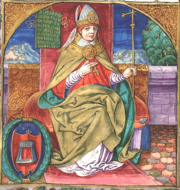
Known in Latin
Latin
Latin is an Italic language originally spoken in Latium and Ancient Rome. It, along with most European languages, is a descendant of the ancient Proto-Indo-European language. Although it is considered a dead language, a number of scholars and members of the Christian clergy speak it fluently, and...
as Frater Martinus Ordinis Praedicatorum (Brother Martin of the Dominican order
Dominican Order
The Order of Preachers , after the 15th century more commonly known as the Dominican Order or Dominicans, is a Catholic religious order founded by Saint Dominic and approved by Pope Honorius III on 22 December 1216 in France...
), he is believed to have been born, at an unknown date, in the Silesia
Czech Silesia
Czech Silesia is an unofficial name of one of the three Czech lands and a section of the Silesian historical region. It is located in the north-east of the Czech Republic, predominantly in the Moravian-Silesian Region, with a section in the northern Olomouc Region...
n town of Opava
Opava
Opava is a city in the northern Czech Republic on the river Opava, located to the north-west of Ostrava. The historical capital of Czech Silesia, Opava is now in the Moravian-Silesian Region and has a population of 59,843 as of January 1, 2005....
(German: Troppau), thus sometimes called Martinus Oppaviensis, or also Martinus Polonus
Polonus
Polonus means "Pole" or Polish in Latin. In Polish it refers to a Pole living outside of Poland, a member of Polonia, the Polish diaspora. Regarding persons, Polonus was attributed to-Persons:*Alexius Sylvius Polonus*Martin of Opava*Benedykt Polak...
. In German
German language
German is a West Germanic language, related to and classified alongside English and Dutch. With an estimated 90 – 98 million native speakers, German is one of the world's major languages and is the most widely-spoken first language in the European Union....
he appears as Martin von Troppau and in Czech
Czech language
Czech is a West Slavic language with about 12 million native speakers; it is the majority language in the Czech Republic and spoken by Czechs worldwide. The language was known as Bohemian in English until the late 19th century...
as Martin z Opavy.
From the middle of the 13th century, he was active in Rome
Rome
Rome is the capital of Italy and the country's largest and most populated city and comune, with over 2.7 million residents in . The city is located in the central-western portion of the Italian Peninsula, on the Tiber River within the Lazio region of Italy.Rome's history spans two and a half...
, as penitentiary
Penitentiary
Penitentiary may refer to:* Prison or penitentiary, a correctional facility* Apostolic Penitentiary, a tribunal of mercy, responsible for issues relating to the forgiveness of sins in the Roman Catholic Church* Penitentiary...
and capellanus
Capellanus
Capellanus may refer to 12/13th century figures:* Andreas Capellanus* Walter Capellanus* Robert Capellanus* John Capellanus...
for Pope Alexander IV
Pope Alexander IV
Pope Alexander IV was Pope from 1254 until his death.Born as Rinaldo di Jenne, in Jenne , he was, on his mother's side, a member of the de' Conti di Segni family, the counts of Segni, like Pope Innocent III and Pope Gregory IX...
and his successors, Pope Urban IV
Pope Urban IV
Pope Urban IV , born Jacques Pantaléon, was Pope, from 1261 to 1264. He was not a cardinal, and there have been several Popes since him who have not been Cardinals, including Urban V and Urban VI.-Biography:...
, Pope Clement IV
Pope Clement IV
Pope Clement IV , born Gui Faucoi called in later life le Gros , was elected Pope February 5, 1265, in a conclave held at Perugia that took four months, while cardinals argued over whether to call in Charles of Anjou, the youngest brother of Louis IX of France...
, Pope Gregory
Pope Gregory
Pope Gregory has been the name of sixteen Roman Catholic Popes and two Antipopes:#Pope Gregory I, also called Gregory the Great#Pope Gregory II#Pope Gregory III#Pope Gregory IV#Pope Gregory V#Pope Gregory VI#*Antipope Gregory VI...
, Pope Innocent V
Pope Innocent V
Pope Blessed Innocent V , born Pierre de Tarentaise, was Pope from January 21 to June 22, 1276.He was born around 1225 near Moûtiers in the Tarentaise region of the County of Savoy, then part of the Kingdom of Arles in the Holy Roman Empire, but now in southeastern France...
, Pope Adrian V
Pope Adrian V
Pope Adrian V , born Ottobuono de' Fieschi, was pope in 1276.-Biography:Ottobuono belonged to a feudal family of Liguria, the Fieschi, Counts of Lavagna....
and Pope John XXI
Pope John XXI
Pope John XXI, , born Pedro Julião Pope John XXI, , born Pedro Julião Pope John XXI, , born Pedro Julião (Latin, Petrus Iulianus (c. 1215 – May 20, 1277), a Portuguese also called Pedro Hispano (Latin, Petrus Hispanus; English, Peter of Spain), was Pope from 1276 until his death about eight...
(d. 1277), the last pope to appear in his chronicles. On 22 June 1278, Pope Nicholas III
Pope Nicholas III
Pope Nicholas III , born Giovanni Gaetano Orsini, Pope from November 25, 1277 to his death in 1280, was a Roman nobleman who had served under eight Popes, been made cardinal-deacon of St...
, while in Viterbo
Viterbo
See also Viterbo, Texas and Viterbo UniversityViterbo is an ancient city and comune in the Lazio region of central Italy, the capital of the province of Viterbo. It is approximately 80 driving / 80 walking kilometers north of GRA on the Via Cassia, and it is surrounded by the Monti Cimini and...
, appointed him Archbishop of Gniezno. While travelling to his see in the same year, Martinus died in Bologna
Bologna
Bologna is the capital city of Emilia-Romagna, in the Po Valley of Northern Italy. The city lies between the Po River and the Apennine Mountains, more specifically, between the Reno River and the Savena River. Bologna is a lively and cosmopolitan Italian college city, with spectacular history,...
, where he was buried in St. Dominic's church.
Martin's Latin chronicle, the Chronicon pontificum et imperatorum, was intended for the school-room. It is mostly derivative in content and is therefore of limited value to modern historians. However, its importance is in the way the material is presented, which is a quantum leap forward in didactic method. The genius lies in its layout; each double page covers fifty years with fifty lines per page. The left-hand pages give the history of the papacy, with one line per year, and the right-hand pages give the history of emperor
Emperor
An emperor is a monarch, usually the sovereign ruler of an empire or another type of imperial realm. Empress, the female equivalent, may indicate an emperor's wife or a woman who rules in her own right...
s, the two accounts being kept strictly parallel. This was a revolutionary approach in graphic design
Graphic design
Graphic design is a creative process – most often involving a client and a designer and usually completed in conjunction with producers of form – undertaken in order to convey a specific message to a targeted audience...
, which was not appreciated by all his contemporaries: many manuscripts simply copy the text without retaining the page layout, which results in a rather chaotic chronology. The chronicle was enormously influential; over 400 manuscripts are known, and the influence on many dozens of later chroniclers is palpable. Translations were made into many medieval vernaculars, including Middle English, as well as an Old French translation by Sébastien Mamerot. Martin's Chronicon is the most influential source for the legend of "Pope Joan
Pope Joan
Pope Joan is a legendary female Pope who, it is purported, reigned for a few years some time in the Middle Ages. The story first appeared in the writings of 13th-century chroniclers, and subsequently spread through Europe...
", which was only added in the latest edition, probably after his death.
Other works include the Promptuarium Exemplorum.
Literature
- Anna-Dorothee von den Brincken: Studien zur Überlieferung der Chronik des Martin von Troppau (Erfahrungen mit einem massenhaft überlieferten historischen Text). In. DA 41 (1985), S. 460–531.
- Wolfgang-Valentin Ikas: Martinus Polonus' Chronicle of the Popes and Emperors. A Medieval Best-seller and its Neglected Influence on English Medieval Chroniclers. In: The English Historical Review 116 (2001), S. 327-341 (also ISBN 3895003131)
- Wolfgang-Valentin Ikas: Neue Handschriftenfunde zum Chronicon pontificum et imperatorum des Martin von Troppau. In: Deutsches Archiv für Erforschung des Mittelalters 58 (2002), S. 521-537
- Wolfgang-Valentin Ikas: Martin von Troppau (Martinus Polonus), O.P. (gest. 1278) in England. Überlieferungs- und wirkungsgeschichtliche Studien zu dessen Papst- und Kaiserchronik. (Wissensliteratur im Mittelalter 40) Wiesbaden: Verlag Dr. Ludwig Reichert 2002. ISBN 3-89500-313-1 Review article
- Ludwig Weiland (Hg.): Martini Oppaviensis chronicon pontificum et imperatorum. MGH SS 22 (1872), S. 377–475 Faksimile bei Gallica
- H. Daniel Embree (Hg.): The Chronicles of Rome. An Edition of the Middle English 'The Chronicle of Popes and Emperors' and 'The Lollard Chronicle'. Woodbridge 1999.