


Nabataeans

Encyclopedia

People
People is a plurality of human beings or other beings possessing enough qualities constituting personhood. It has two usages:* as the plural of person or a group of people People is a plurality of human beings or other beings possessing enough qualities constituting personhood. It has two usages:*...
of southern Canaan
Canaan
Canaan is a historical region roughly corresponding to modern-day Israel, Palestine, Lebanon, and the western parts of Jordan...
and the northern part of Arabia, whose oasis settlements in the time of Josephus
Josephus
Titus Flavius Josephus , also called Joseph ben Matityahu , was a 1st-century Romano-Jewish historian and hagiographer of priestly and royal ancestry who recorded Jewish history, with special emphasis on the 1st century AD and the First Jewish–Roman War, which resulted in the Destruction of...
(AD 37 – c. 100), gave the name of Nabatene to the borderland between Syria
Syria
Syria , officially the Syrian Arab Republic , is a country in Western Asia, bordering Lebanon and the Mediterranean Sea to the West, Turkey to the north, Iraq to the east, Jordan to the south, and Israel to the southwest....
and Arabia, from the Euphrates
Euphrates
The Euphrates is the longest and one of the most historically important rivers of Western Asia. Together with the Tigris, it is one of the two defining rivers of Mesopotamia...
to the Red Sea
Red Sea
The Red Sea is a seawater inlet of the Indian Ocean, lying between Africa and Asia. The connection to the ocean is in the south through the Bab el Mandeb strait and the Gulf of Aden. In the north, there is the Sinai Peninsula, the Gulf of Aqaba, and the Gulf of Suez...
. Their loosely-controlled trading network, which centered on strings of oases that they controlled, where agriculture was intensively practiced in limited areas, and on the routes that linked them, had no securely defined boundaries in the surrounding desert. Trajan
Trajan
Trajan , was Roman Emperor from 98 to 117 AD. Born into a non-patrician family in the province of Hispania Baetica, in Spain Trajan rose to prominence during the reign of emperor Domitian. Serving as a legatus legionis in Hispania Tarraconensis, in Spain, in 89 Trajan supported the emperor against...
conquered the Nabataean kingdom
Nabataean kingdom
The Nabataean kingdom, also named Nabatea , was a political state of the Nabataeans which existed during Classical antiquity and was annexed by the Roman Empire in AD 106.-Geography:...
, annexing it to the Roman Empire
Roman Empire
The Roman Empire was the post-Republican period of the ancient Roman civilization, characterised by an autocratic form of government and large territorial holdings in Europe and around the Mediterranean....
, where their individual culture, easily identified by their characteristic finely-potted painted ceramics, became dispersed in the general Greco-Roman culture and was eventually lost.
Culture
Many examples of graffiti and inscriptions—largely of names and greetings—document the area of Nabatean culture, which extended as far north as the north end of the Dead SeaDead Sea
The Dead Sea , also called the Salt Sea, is a salt lake bordering Jordan to the east and Israel and the West Bank to the west. Its surface and shores are below sea level, the lowest elevation on the Earth's surface. The Dead Sea is deep, the deepest hypersaline lake in the world...
, and testify to widespread literacy; but no Nabatean literature has survived, nor was any noted in antiquity, and the temples bear no inscriptions. Onomastic analysis has suggested that the Nabatean culture may have embraced multiple ethnicities. Classical references to the Nabateans begin with Diodorus Siculus
Diodorus Siculus
Diodorus Siculus was a Greek historian who flourished between 60 and 30 BC. According to Diodorus' own work, he was born at Agyrium in Sicily . With one exception, antiquity affords no further information about Diodorus' life and doings beyond what is to be found in his own work, Bibliotheca...
; they suggest that the Nabateans' trade routes and the origins of their goods were regarded as trade secrets, and disguised in tales that should have strained outsiders' credulity. Diodorus Siculus
Diodorus Siculus
Diodorus Siculus was a Greek historian who flourished between 60 and 30 BC. According to Diodorus' own work, he was born at Agyrium in Sicily . With one exception, antiquity affords no further information about Diodorus' life and doings beyond what is to be found in his own work, Bibliotheca...
(book ii) described them as a strong tribe of some 10,000 warriors, pre-eminent among the nomads of Arabia, eschewing agriculture, fixed houses, and the use of wine, but adding to pastoral pursuits a profitable trade with the seaports in frankincense
Frankincense
Frankincense, also called olibanum , is an aromatic resin obtained from trees of the genus Boswellia, particularly Boswellia sacra, B. carteri, B. thurifera, B. frereana, and B. bhaw-dajiana...
and myrrh
Myrrh
Myrrh is the aromatic oleoresin of a number of small, thorny tree species of the genus Commiphora, which grow in dry, stony soil. An oleoresin is a natural blend of an essential oil and a resin. Myrrh resin is a natural gum....
and spices from Arabia Felix (today's Yemen
Yemen
The Republic of Yemen , commonly known as Yemen , is a country located in the Middle East, occupying the southwestern to southern end of the Arabian Peninsula. It is bordered by Saudi Arabia to the north, the Red Sea to the west, and Oman to the east....
), as well as a trade with Egypt
Egypt
Egypt , officially the Arab Republic of Egypt, Arabic: , is a country mainly in North Africa, with the Sinai Peninsula forming a land bridge in Southwest Asia. Egypt is thus a transcontinental country, and a major power in Africa, the Mediterranean Basin, the Middle East and the Muslim world...
in bitumen from the Dead Sea
Dead Sea
The Dead Sea , also called the Salt Sea, is a salt lake bordering Jordan to the east and Israel and the West Bank to the west. Its surface and shores are below sea level, the lowest elevation on the Earth's surface. The Dead Sea is deep, the deepest hypersaline lake in the world...
. Their arid country was their best safeguard, for the bottle-shaped cisterns for rain-water which they excavated in the rocky or clay-rich soil were carefully concealed from invaders.
The extent of Nabatean trade resulted in cross-cultural influences that reached as far as the Red Sea
Red Sea
The Red Sea is a seawater inlet of the Indian Ocean, lying between Africa and Asia. The connection to the ocean is in the south through the Bab el Mandeb strait and the Gulf of Aden. In the north, there is the Sinai Peninsula, the Gulf of Aqaba, and the Gulf of Suez...
coast of southern Arabia. The gods worshipped at Petra were headed by Dushara
Dushara
Dushara , also transliterated as Dusares, was an aniconic deity in the ancient Middle East worshipped by the Nabataeans at Petra and Madain Saleh . He was mothered by Manat the goddess of fate. In Greek times, he was associated with Zeus because he was the chief of the Nabataean pantheon as well as...
and al-‘Uzzá.
Origins
The brief Babylonian captivityBabylonian captivity
The Babylonian captivity was the period in Jewish history during which the Jews of the ancient Kingdom of Judah were captives in Babylon—conventionally 587–538 BCE....
of the Hebrews that began in 586 BC opened a minor power vacuum in Judah
Kingdom of Judah
The Kingdom of Judah was a Jewish state established in the Southern Levant during the Iron Age. It is often referred to as the "Southern Kingdom" to distinguish it from the northern Kingdom of Israel....
(prior to the Israelites' return under the Persian King, Cyrus), and as Edom
Edom
Edom or Idumea was a historical region of the Southern Levant located south of Judea and the Dead Sea. It is mentioned in biblical records as a 1st millennium BC Iron Age kingdom of Edom, and in classical antiquity the cognate name Idumea was used to refer to a smaller area in the same region...
ites moved into open Judaean
Judea
Judea or Judæa was the name of the mountainous southern part of the historic Land of Israel from the 8th century BCE to the 2nd century CE, when Roman Judea was renamed Syria Palaestina following the Jewish Bar Kokhba revolt.-Etymology:The...
grazing lands, Nabatean inscriptions began to be left in Edomite territory. The first definite appearance was in 312/311 BC, when they were attacked at Sela or perhaps Petra
Petra
Petra is a historical and archaeological city in the Jordanian governorate of Ma'an that is famous for its rock cut architecture and water conduits system. Established sometime around the 6th century BC as the capital city of the Nabataeans, it is a symbol of Jordan as well as its most visited...
without success by Antigonus I's officer Athenaeus as part of the Third War of the Diadochi; at that time Hieronymus of Cardia
Hieronymus of Cardia
Hieronymus of Cardia, Greek general and historian from Cardia in Thrace, was a contemporary of Alexander the Great .After the death of Alexander he followed the fortunes of his friend and fellow-countryman Eumenes. He was wounded and taken prisoner by Antigonus, who pardoned him and appointed him...
, a Seleucid officer, mentioned the Nabateans in a battle report. About 50 BC, the Greek historian Diodorus Siculus
Diodorus Siculus
Diodorus Siculus was a Greek historian who flourished between 60 and 30 BC. According to Diodorus' own work, he was born at Agyrium in Sicily . With one exception, antiquity affords no further information about Diodorus' life and doings beyond what is to be found in his own work, Bibliotheca...
cited Hieronymus in his report, and added the following: "Just as the Seleucids had tried to subdue them, so the Romans made several attempts to get their hands on that lucrative trade."
Sela was the ancient capital of Edom
Edom
Edom or Idumea was a historical region of the Southern Levant located south of Judea and the Dead Sea. It is mentioned in biblical records as a 1st millennium BC Iron Age kingdom of Edom, and in classical antiquity the cognate name Idumea was used to refer to a smaller area in the same region...
; the Nabateans must have occupied the old Edomite country, and succeeded to its commerce, after the Edomites took advantage of the Babylonian captivity to press forward into southern Judaea
Judea
Judea or Judæa was the name of the mountainous southern part of the historic Land of Israel from the 8th century BCE to the 2nd century CE, when Roman Judea was renamed Syria Palaestina following the Jewish Bar Kokhba revolt.-Etymology:The...
. This migration, the date of which cannot be determined, also made them masters of the shores of the Gulf of Aqaba
Gulf of Aqaba
The Gulf of Aqaba is a large gulf located at the northern tip of the Red Sea. In pre twentieth-century and modern sources it is often named the Gulf of Eilat, as Eilat is its predominant Israeli city ....
and the important harbor of Elath. Here, according to Agatharchides
Agatharchides
Agatharchides of Cnidus was a Greek historian and geographer .-Life:He is believed to have been born at Cnidus, hence his appellation. As Stanley M...
, they were for a time very troublesome, as wreckers and pirates, to the reopened commerce between Egypt and the East, until they were chastised by the Ptolemaic rulers of Alexandria
Ptolemaic dynasty
The Ptolemaic dynasty, was a Macedonian Greek royal family which ruled the Ptolemaic Empire in Egypt during the Hellenistic period. Their rule lasted for 275 years, from 305 BC to 30 BC...
.
The Nabateans had already some tincture of foreign culture when they first appear in history. That culture was Aramaic; they wrote a letter to Antigonus in Syriac letters, and Aramaic continued to be the language of their coins and inscriptions when the tribe grew into a kingdom, and profited by the decay of the Seleucids to extend its borders northward over the more fertile country east of the Jordan
Jordan
Jordan , officially the Hashemite Kingdom of Jordan , Al-Mamlaka al-Urduniyya al-Hashemiyya) is a kingdom on the East Bank of the River Jordan. The country borders Saudi Arabia to the east and south-east, Iraq to the north-east, Syria to the north and the West Bank and Israel to the west, sharing...
. They occupied Hauran
Hauran
Hauran, , also spelled Hawran or Houran, is a volcanic plateau, a geographic area and a people located in southwestern Syria and extending into the northwestern corner of Jordan. It gets its name from the Aramaic Hawran, meaning "cave land." In geographic and geomorphic terms, its boundaries...
, and in about 85 BC
85 BC
Year 85 BC was a year of the pre-Julian Roman calendar. At the time it was known as the Year of the Consulship of Cinna and Carbo...
their king Aretas III
Aretas III
Aretas III was king of the Nabataean kingdom from 87 to 62 BCE. Aretas ascended to the throne upon the death of his brother, Obodas I, in 87 BCE. During his reign, he extended his kingdom to cover what now forms the northern area of Jordan, the south of Syria, and part of Saudi Arabia...
became lord of Damascus
Damascus
Damascus , commonly known in Syria as Al Sham , and as the City of Jasmine , is the capital and the second largest city of Syria after Aleppo, both are part of the country's 14 governorates. In addition to being one of the oldest continuously inhabited cities in the world, Damascus is a major...
and Coele-Syria
Coele-Syria
Coele-Syria , or Cœle-Syria or Celesyria, traditionally given the meaning 'hollow' Syria, was the region of southern Syria disputed between the Seleucid dynasty and the Ptolemaic dynasty. Rather than limiting the Greek term to the Beqaa Valley of Lebanon, it is often used to cover the entire area...
. Nabateans became the Arabic name for Aramaeans
Aramaeans
The Aramaeans, also Arameans , were a Northwest Semitic semi-nomadic and pastoralist people who originated in what is now modern Syria during the Late Bronze Age and the Iron Age...
, whether in Syria
Syria
Syria , officially the Syrian Arab Republic , is a country in Western Asia, bordering Lebanon and the Mediterranean Sea to the West, Turkey to the north, Iraq to the east, Jordan to the south, and Israel to the southwest....
or Iraq
Iraq
Iraq ; officially the Republic of Iraq is a country in Western Asia spanning most of the northwestern end of the Zagros mountain range, the eastern part of the Syrian Desert and the northern part of the Arabian Desert....
, a fact which has been incorrectly held to prove that the Nabateans were originally Aramaean immigrants from Babylonia
Babylonia
Babylonia was an ancient cultural region in central-southern Mesopotamia , with Babylon as its capital. Babylonia emerged as a major power when Hammurabi Babylonia was an ancient cultural region in central-southern Mesopotamia (present-day Iraq), with Babylon as its capital. Babylonia emerged as...
. Proper names on their inscriptions suggest that they were true Arab
Arab
Arab people, also known as Arabs , are a panethnicity primarily living in the Arab world, which is located in Western Asia and North Africa. They are identified as such on one or more of genealogical, linguistic, or cultural grounds, with tribal affiliations, and intra-tribal relationships playing...
s who had come under Aramaic influence. Starcky identifies the Nabatu of southern Arabia (Pre-Khalan migration) as their ancestors. However different groups amongst the Nabateans wrote their names in slightly different ways, consequently archeologists are reluctant to say that they were all the same tribe, or that any one group is the original Nabateans.
Language
The language of the Nabatean inscriptions, attested from the 2nd century BCE, shows a local development of the Aramaic languageAramaic language
Aramaic is a group of languages belonging to the Afroasiatic language phylum. The name of the language is based on the name of Aram, an ancient region in central Syria. Within this family, Aramaic belongs to the Semitic family, and more specifically, is a part of the Northwest Semitic subfamily,...
, which had ceased to have super-regional importance after the collapse of the Achaemenid Empire
Achaemenid Empire
The Achaemenid Empire , sometimes known as First Persian Empire and/or Persian Empire, was founded in the 6th century BCE by Cyrus the Great who overthrew the Median confederation...
(330 BC
330 BC
Year 330 BC was a year of the pre-Julian Roman calendar. At the time, it was known as the Year of the Consulship of Crassus and Venno...
). The Nabataean alphabet itself also developed out of the Aramaic alphabet
Aramaic alphabet
The Aramaic alphabet is adapted from the Phoenician alphabet and became distinctive from it by the 8th century BC. The letters all represent consonants, some of which are matres lectionis, which also indicate long vowels....
.
This Aramaic dialect was increasingly affected by the Arabic
Ancient North Arabian
Ancient North Arabian is a language known from fragmentary inscriptions in modern day Iraq, Jordan, Syria and Saudi Arabia, dating to between roughly the 6th century BC and the 6th century AD, all written in scripts derived from Epigraphic South Arabian...
dialect of the local population. From the 4th century AD, the Arabic influence becomes overwhelming, in a way that it may be said the Nabatean language shifted seamlessly from Aramaic to Arabic. The Arabic alphabet
Arabic alphabet
The Arabic alphabet or Arabic abjad is the Arabic script as it is codified for writing the Arabic language. It is written from right to left, in a cursive style, and includes 28 letters. Because letters usually stand for consonants, it is classified as an abjad.-Consonants:The Arabic alphabet has...
itself developed out of cursive variants of the Nabatean script in the 5th century.
Ibn Wahshiyya
Ibn Wahshiyya
Ibn Wahshiyya was an Iraqi alchemist, agriculturalist, farm toxicologist, egyptologist and historian born at Qusayn near Kufa in Iraq.Ibn Wahshiyya was one of the first historians to be able to at least partly decipher what was written in the ancient Egyptian hieroglyphs, by relating them to the...
claimed to have translated from this language in his Nabataean corpus.
Agriculture
Although not as dry as at present, the area occupied by the Nabateans was still a desert and required special systems for agriculture. One system was to contour an area of land into a shallow funnel and to plant a single fruit tree in the middle. Before the 'rainy season' which could easily consist of only one or two rain events, the area around the tree was broken up. When the rain came, all the water which collected in the funnel would flow down toward the fruit tree and sink into the ground. The ground, which was largely loessLoess
Loess is an aeolian sediment formed by the accumulation of wind-blown silt, typically in the 20–50 micrometre size range, twenty percent or less clay and the balance equal parts sand and silt that are loosely cemented by calcium carbonate...
, would seal up when it got wet and retain the water.
In the mid-1950s, a research team headed by M. Evenari set up a research station near Avdat (Evenari, Shenan and Tadmor 1971). He focused on the relevance of runoff rainwater management in explaining the mechanism of the ancient agricultural features, such as: terraced wadis, channels for collecting runoff rainwater, and the enigmatic phenomenon of "Tuleilat el-Anab". Evenari showed that the runoff rainwater collection systems concentrate water from an area that is five times larger than the area in which the water actually drains.
Another study was conducted by Y. Kedar in 1957, which also focused on the mechanism of the agriculture systems, but he studied soil management, and claimed that the ancient agriculture systems were intended to increase the accumulation of loess
Loess
Loess is an aeolian sediment formed by the accumulation of wind-blown silt, typically in the 20–50 micrometre size range, twenty percent or less clay and the balance equal parts sand and silt that are loosely cemented by calcium carbonate...
in wadis and create an infrastructure for agricultural activity. This theory has also been explored by Prof. E. Mazor, of the Weizmann Institute of Science
Weizmann Institute of Science
The Weizmann Institute of Science , known as Machon Weizmann, is a university and research institute in Rehovot, Israel. It differs from other Israeli universities in that it offers only graduate and post-graduate studies in the sciences....
.
The Hellenistic and Roman periods

Petra
Petra
Petra is a historical and archaeological city in the Jordanian governorate of Ma'an that is famous for its rock cut architecture and water conduits system. Established sometime around the 6th century BC as the capital city of the Nabataeans, it is a symbol of Jordan as well as its most visited...
was rapidly built in the first century BC in Hellenistic splendor, and developed a population estimated at 20,000.
The Nabataeans were allies of the first Hasmoneans in their struggles against the Seleucid monarchs. They then became rivals of the Judaean dynasty in the period of its splendor, and a chief element in the disorders which invited Pompey
Pompey
Gnaeus Pompeius Magnus, also known as Pompey or Pompey the Great , was a military and political leader of the late Roman Republic...
's intervention in Judea
Judea
Judea or Judæa was the name of the mountainous southern part of the historic Land of Israel from the 8th century BCE to the 2nd century CE, when Roman Judea was renamed Syria Palaestina following the Jewish Bar Kokhba revolt.-Etymology:The...
. Many Nabataeans were forcefully converted to Judaism by the Hasmonean
Hasmonean
The Hasmonean dynasty , was the ruling dynasty of Judea and surrounding regions during classical antiquity. Between c. 140 and c. 116 BCE, the dynasty ruled semi-autonomously from the Seleucids in the region of Judea...
king Alexander Jannaeus. It was this King who after putting down a local rebellion invaded and occupied the Nabatean towns of Moab
Moab
Moab is the historical name for a mountainous strip of land in Jordan. The land lies alongside much of the eastern shore of the Dead Sea. The existence of the Kingdom of Moab is attested to by numerous archeological findings, most notably the Mesha Stele, which describes the Moabite victory over...
and Gilead
Gilead
In the Bible "Gilead" means hill of testimony or mound of witness, , a mountainous region east of the Jordan River, situated in the Hashemite Kingdom of Jordan. It is also referred to by the Aramaic name Yegar-Sahadutha, which carries the same meaning as the Hebrew . From its mountainous character...
and imposed a tribute of an unspecified amount. Obodas I
Obodas I
Obodas I was King of the Nabateans from 96 BC to 85 BC. He was the successor of Aretas II, from whom he inherited the war with the Hasmonean kingdom. He defeated them around 93 BC on the Golan Heights....
knew that Alexander would attack, so was able to ambush Alexander's forces near Gaulane destroying the Judean army (90 BC).
The Roman military was not very successful in their campaigns against the Nabataeans. In 62 BC
62 BC
Year 62 BC was a year of the pre-Julian Roman calendar. At the time it was known as the Year of the Consulship of Silanus and Murena...
, Marcus Aemilius Scaurus
Marcus Aemilius Scaurus (praetor 56 BC)
Marcus Aemilius Scaurus was a Roman politician of the 1st century BC and son of Marcus Aemilius Scaurus and Caecilia Metella Dalmatica.Scaurus lost his father when he was very young, but his education was insured by several other family friends...
accepted a bribe of 300 talents to lift the siege of Petra, partly because of the difficult terrain and the fact Scaurus had run out of food provisions. Hyrcanus who was a friend of Aretas was dispached by Scaurus to the King to buy peace. In so obtaining peace King Aretas retained his whole possessions, including Damascus and became a Roman vassal.
During the King Malichus II reign, in 32 BC Herod the Great
Herod the Great
Herod , also known as Herod the Great , was a Roman client king of Judea. His epithet of "the Great" is widely disputed as he is described as "a madman who murdered his own family and a great many rabbis." He is also known for his colossal building projects in Jerusalem and elsewhere, including his...
started a war against Nabatea, with the support of Cleopatra. The war started with Herod's army plundering Nabataea and with a large cavalry force, and the occupation of Dium
Dion, Jordan
Dion is the name of an ancient city, which was a member of the Decapolis. The exact location of the city is still disputed, but is thought to be a site site near Al Hisn currently known as Aydoun, around the city of Irbid in Jordan.-External links:*...
. After this defeat the Nabatean forces amassed near Canatha
Canatha
Qanawat , the ancient Roman city of Canatha , is a village in Syria, located 7 km north-east of As Suwayda. It stands at a height of about 1,200 m, near a river and surrounded by woods.-History:...
in Syria
Syria
Syria , officially the Syrian Arab Republic , is a country in Western Asia, bordering Lebanon and the Mediterranean Sea to the West, Turkey to the north, Iraq to the east, Jordan to the south, and Israel to the southwest....
, but were attacked and routed. Athenio (Cleopatra's General) sent Canathans to the aid of the Nabateans, and this force crushed Herod's army which then fled to Ormiza. One year later, Herod's army overran Nabataea.

Amman
Amman is the capital of Jordan. It is the country's political, cultural and commercial centre and one of the oldest continuously inhabited cities in the world. The Greater Amman area has a population of 2,842,629 as of 2010. The population of Amman is expected to jump from 2.8 million to almost...
) and both sides set up camp. The Nabateans under Elthemus refused to give battle, so Herod forced the issue when he attacked their camp
Palisade
A palisade is a steel or wooden fence or wall of variable height, usually used as a defensive structure.- Typical construction :Typical construction consisted of small or mid sized tree trunks aligned vertically, with no spacing in between. The trunks were sharpened or pointed at the top, and were...
. A confused mass of Nabateans gave battle but were defeated. Once the defeated had retreated to their defences, Herod laid siege to the camp and over time some of the defenders surrendered. The remaining Nabatean forces offered 500 talents for peace but this was rejected. Lacking water, the Nabateans were forced out of their camp for battle, but were defeated in this last battle.
An ally of the Roman Empire
Roman Empire
The Roman Empire was the post-Republican period of the ancient Roman civilization, characterised by an autocratic form of government and large territorial holdings in Europe and around the Mediterranean....
, the Nabataean kingdom
Nabataean kingdom
The Nabataean kingdom, also named Nabatea , was a political state of the Nabataeans which existed during Classical antiquity and was annexed by the Roman Empire in AD 106.-Geography:...
continued to flourish throughout the first century. Its power extended far into Arabia along the Red Sea
Red Sea
The Red Sea is a seawater inlet of the Indian Ocean, lying between Africa and Asia. The connection to the ocean is in the south through the Bab el Mandeb strait and the Gulf of Aden. In the north, there is the Sinai Peninsula, the Gulf of Aqaba, and the Gulf of Suez...
to Yemen
Yemen
The Republic of Yemen , commonly known as Yemen , is a country located in the Middle East, occupying the southwestern to southern end of the Arabian Peninsula. It is bordered by Saudi Arabia to the north, the Red Sea to the west, and Oman to the east....
, and Petra
Petra
Petra is a historical and archaeological city in the Jordanian governorate of Ma'an that is famous for its rock cut architecture and water conduits system. Established sometime around the 6th century BC as the capital city of the Nabataeans, it is a symbol of Jordan as well as its most visited...
was a cosmopolitan marketplace, though its commerce was diminished by the rise of the Eastern trade-route from Myoshormus to Coptos on the Nile
Nile
The Nile is a major north-flowing river in North Africa, generally regarded as the longest river in the world. It is long. It runs through the ten countries of Sudan, South Sudan, Burundi, Rwanda, Democratic Republic of the Congo, Tanzania, Kenya, Ethiopia, Uganda and Egypt.The Nile has two major...
. Under the Pax Romana
Pax Romana
Pax Romana was the long period of relative peace and minimal expansion by military force experienced by the Roman Empire in the 1st and 2nd centuries AD. Since it was established by Caesar Augustus it is sometimes called Pax Augusta...
they lost their warlike and nomadic habits, and were a sober, acquisitive, orderly people, wholly intent on trade and agriculture.
The kingdom was a bulwark between Rome and the wild hordes of the desert but for Trajan
Trajan
Trajan , was Roman Emperor from 98 to 117 AD. Born into a non-patrician family in the province of Hispania Baetica, in Spain Trajan rose to prominence during the reign of emperor Domitian. Serving as a legatus legionis in Hispania Tarraconensis, in Spain, in 89 Trajan supported the emperor against...
, who reduced Petra
Petra
Petra is a historical and archaeological city in the Jordanian governorate of Ma'an that is famous for its rock cut architecture and water conduits system. Established sometime around the 6th century BC as the capital city of the Nabataeans, it is a symbol of Jordan as well as its most visited...
and broke up the Nabataean nationality as the short-lived Roman province of Arabia Petraea
Arabia Petraea
Arabia Petraea, also called Provincia Arabia or simply Arabia, was a frontier province of the Roman Empire beginning in the 2nd century; it consisted of the former Nabataean kingdom in modern Jordan, southern modern Syria, the Sinai Peninsula and northwestern Saudi Arabia. Its capital was Petra...
.
By the third century, the Nabateans had stopped writing in Aramaic and begun writing in Greek instead, and by the fourth century they had converted to Christianity. The new Arab invaders who soon pressed forward into their seats found the remnants of the Nabataeans transformed into-- peasant
Peasant
A peasant is an agricultural worker who generally tend to be poor and homeless-Etymology:The word is derived from 15th century French païsant meaning one from the pays, or countryside, ultimately from the Latin pagus, or outlying administrative district.- Position in society :Peasants typically...
s. Their lands were divided between the new Qahtanite
Qahtanite
The terms Qahtanite and Qahtani refer to Semitic peoples either originating in, or claiming genealogical descent from the southern extent of the Arabian Peninsula, especially from Yemen....
Arab tribal kingdoms of the Byzantine
Byzantine
Byzantine usually refers to the Roman Empire during the Middle Ages.Byzantine may also refer to:* A citizen of the Byzantine Empire, or native Greek during the Middle Ages...
vassals the Ghassanid Arabs and the Himyarite vassals the Kindah
Kindah
The kingdom of Kindah was a vassal kingdom which ruled from Qaryah dhat Kahl in Nejd, Central Arabia . The kingdom controlled much of the northern Arabian peninsula in the 4th and 5th centuries AD.-Origin:...
Arab Kingdom in North Arabia.
The city of Petra was brought to the attention of Westerners by the Swiss explorer Johann Ludwig Burckhardt
Johann Ludwig Burckhardt
Johann Ludwig Burckhardt was a Swiss traveller and orientalist. He wrote his letters in French and signed Louis...
in 1812.
Archeological sites
- PetraPetraPetra is a historical and archaeological city in the Jordanian governorate of Ma'an that is famous for its rock cut architecture and water conduits system. Established sometime around the 6th century BC as the capital city of the Nabataeans, it is a symbol of Jordan as well as its most visited...
in Jordan - BosraBosraBosra , also known as Bostra, Busrana, Bozrah, Bozra, Busra Eski Şam, Busra ash-Sham, and Nova Trajana Bostra, is an ancient city administratively belonging to the Daraa Governorate in southern Syria...
in Syria - Mada'in Saleh in northwest Saudi Arabia.
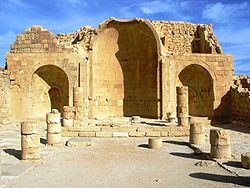
- ShivtaShivtaShivta or Sobota or Subeitah or Subaytah , is an archaeological site in the Negev Desert of Israel, east of Nitzana. It is close to the Israeli Artillery Corps main training facility....
in Negev Desert of Israel; disputed as a Nabataean precursor to a Byzantine colony. - AvdatAvdatAvdat , also known as Ovdat or Obodat was the most important historic city on the Incense Route after Petra between the 7th and the 1st centuries BCE. It was inhabited by Nabataeans, Romans and Byzantines. It was a seasonal camping ground for Nabataean caravans travelling along the early Petra -...
in Negev Desert of Israel
External links
- Hecht Museum - Catalogues | The Nabateans in the Negev
- Hecht Museum - Exhibitions | The Nabateans in the Negev
- The Bulletin of Nabataean Studies online—links on Petra and the Nabataeans
- NABATÆANS in the Jewish Encyclopedia
- Cincinnati Art Museum—the only collection of ancient Nabataean art outside of Jordan
- Archaeological Studies—Ancient Desert Agriculture Systems Revived (ADASR)
- Petra: Lost City of Stone Exhibition—Canadian Museum of Civilization
- "Solving the Enigma of Petra and the Nabataeans", Biblical Archaeology Review
- Nabataeans a nation civilization—Petra Crown