

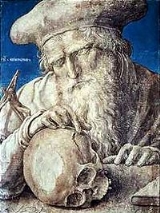
Jerome

Encyclopedia
Saint Jerome (formerly Saint Hierom) was a Roman
Christian
priest, confessor, theologian and historian, and who became a Doctor of the Church. He was the son of Eusebius, of the city of Stridon
, which was on the border of Dalmatia
and Pannonia
. He is best known for his translation of the Bible
into Latin
(the Vulgate
), and his list of writings is extensive.
He is recognized by the Catholic Church as a saint
and Doctor of the Church
, and the Vulgate is still an important text in Catholicism. He is also recognized as a saint by the Eastern Orthodox Church
, where he is known as St. Jerome of Stridonium or Blessed Jerome.
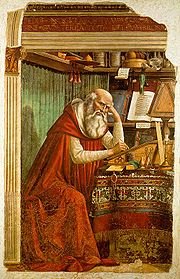 Sophronius Eusebius Hieronymus , was born at Stridon
around 347,. He was not baptized
until about 360 or 366, when he had gone to Rome
with his friend Bonosus
(who may or may not have been the same Bonosus whom Jerome identifies as his friend who went to live as a hermit on an island in the Adriatic) to pursue rhetoric
al and philosophical
studies. He studied under the grammarian Aelius Donatus
. There Jerome learned Latin
and at least some Greek
, though probably not the familiarity with Greek literature he would later claim to have acquired as a schoolboy.
As a student in Rome, he engaged in the superficial activities of students there, which he indulged in quite casually but suffered terrible bouts of repentance afterwards. To appease his conscience
, he would visit on Sundays the sepulchers of the martyr
s and the Apostle
s in the catacombs. This experience would remind him of the terrors of hell
:
Jerome used a quote from Vergil — “The horror and the silences terrified their souls” — to describe the horror of hell. Jerome initially used classical authors to describe Christian concepts such as hell that indicated both his classical education and his deep shame of their associated practices, such as pederasty
. Although initially skeptical of Christianity, he was eventually converted
.
After several years in Rome, he travelled with Bonosus to Gaul
and settled in Trier
where he seems to have first taken up theological studies, and where he copied, for his friend Tyrannius Rufinus
, Hilary of Poitiers
' commentary on the Psalms and the treatise De synodis. Next came a stay of at least several months, or possibly years, with Rufinus at Aquileia
, where he made many Christian friends.
Some of these accompanied him when he set out about 373 on a journey through Thrace
and Asia Minor
into northern Syria
. At Antioch
, where he stayed the longest, two of his companions died and he himself was seriously ill more than once. During one of these illnesses (about the winter of 373–374), he had a vision that led him to lay aside his secular studies and devote himself to God. He seems to have abstained for a considerable time from the study of the classics and to have plunged deeply into that of the Bible
, under the impulse of Apollinaris of Laodicea
, then teaching in Antioch
and not yet suspected of heresy
.
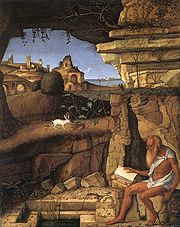 Seized with a desire for a life of ascetic penance, he went for a time to the desert of Chalcis
, to the southwest of Antioch
, known as the Syrian Thebaid, from the number of hermits inhabiting it. During this period, he seems to have found time for study and writing. He made his first attempt to learn Hebrew under the guidance of a converted Jew; and he seems to have been in correspondence with Jewish Christians
in Antioch. Around this time he had copied for him a Hebrew Gospel, of which fragments are preserved in his notes are known today as the Gospel of the Hebrews
, and which the Nazarene
s considered was the true Gospel of Matthew
. Jerome translated parts of this Hebrew Gospel into Greek.
Returning to Antioch in 378 or 379, he was ordained by Bishop Paulinus
, apparently unwillingly and on condition that he continue his ascetic life. Soon afterward, he went to Constantinople
to pursue a study of Scripture under Gregory Nazianzen. He seems to have spent two years there; the next three (382-385) he was in Rome again, attached to Pope Damasus I
and the leading Roman Christians. Invited originally for the synod
of 382, held to end the schism
of Antioch, he made himself indispensable to the pope, and took a prominent place in his councils.
Among his other duties, he undertook a revision of the Latin Bible
, to be based on the Greek
New Testament
. He also updated the Psalter then at use in Rome based on the Septuagint. Though he did not realize it yet, translating much of what became the Latin Vulgate
Bible would take many years, and be his most important achievement (see Writings- Translations section below).
In Rome he was surrounded by a circle of well-born and well-educated women, including some from the noblest patrician families, such as the widows Lea
, Marcella
and Paula
, with their daughters Blaesilla
and Eustochium
. The resulting inclination of these women to the monastic life, and his unsparing criticism of the secular clergy
, brought a growing hostility against him among the clergy and their supporters. Soon after the death of his patron Damasus
(10 December 384), Jerome was forced to leave his position at Rome after an inquiry by the Roman clergy into allegations that he had an improper relationship with the widow Paula.
Additionally, his condemnation of Blaesilla's hedonistic lifestyle had led her to adopt aescetic practices, but worsened her physical weakness to the point that she died just four months after starting to follow his instructions; much of the Roman populace were outraged at Jerome for causing the premature death of such a lively young woman, and his insistence to Paula that Blaesilla should not be mourned, and complaints that her grief was excessive, were seen as heartless, polarising Roman opinion against him.
In August 385, he returned to Antioch, accompanied by his brother Paulinianus and several friends, and followed a little later by Paula and Eustochium, who had resolved to end their days in the Holy Land
. In the winter of 385, Jerome acted as their spiritual adviser. The pilgrims, joined by Bishop Paulinus of Antioch, visited Jerusalem, Bethlehem
, and the holy places of Galilee
, and then went to Egypt
, the home of the great heroes of the ascetic life.
At the Catechetical School of Alexandria
, Jerome listened to the catechist
Didymus the Blind
expounding the prophet Hosea
and telling his reminiscences of Anthony the Great
, who had died 30 years before; he spent some time in Nitria, admiring the disciplined community life of the numerous inhabitants of that "city of the Lord," but detecting even there "concealed serpents," i.e., the influence of Origen of Alexandria. Late in the summer of 388 he was back in Israel, and spent the remainder of his life in a hermit's cell near Bethlehem, surrounded by a few friends, both men and women (including Paula and Eustochium), to whom he acted as priestly guide and teacher.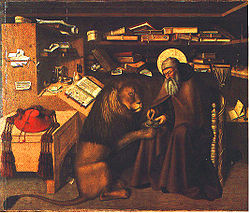 Amply provided by Paula with the means of livelihood and of increasing his collection of books, he led a life of incessant activity in literary production. To these last 34 years of his career belong the most important of his works; his version of the Old Testament from the original Hebrew text, the best of his scriptural commentaries, his catalogue of Christian authors, and the dialogue against the Pelagians
, the literary perfection of which even an opponent recognized. To this period also belong most of his polemic
s, which distinguished him among the orthodox Fathers, including the treatises against the Origenism of Bishop John II of Jerusalem
and his early friend Rufinus. As a result of his writings against Pelagianism, a body of excited partisans broke into the monastic buildings, set them on fire, attacked the inmates and killed a deacon
, forcing Jerome to seek safety in a neighboring fortress (416).
Jerome died near Bethlehem
on 30 September 420. The date of his death is given by the Chronicon of Prosper of Aquitaine
. His remains, originally buried at Bethlehem
, are said to have been later transferred to the basilica of Santa Maria Maggiore in Rome, though other places in the West claim some relics — the cathedral at Nepi
boasting possession of his head, which, according to another tradition, is in the Escorial.
 Jerome was a scholar at a time when that statement implied a fluency in Greek. He knew some Hebrew when he started his translation project, but moved to Jerusalem to strengthen his grip on Jewish scripture commentary. A wealthy Roman aristocrat, Paula, funded his stay in a monastery in Bethlehem and he completed his translation there. He began in 382 by correcting the existing Latin language version of the New Testament, commonly referred to as the Vetus Latina
. By 390 he turned to the Hebrew Bible
, having previously translated portions from the Septuagint. He completed this work by 405. Prior to Jerome's Vulgate, all Latin translations of the Old Testament
were based on the Septuagint. Jerome's decision to use a Hebrew text instead of the Septuagint went against the advice of most other Christians, including Augustine
, who considered the Septuagint inspired. Modern scholarship, however, has cast doubts on the actual quality of Jerome's Hebrew knowledge; the Greek Hexapla
is now considered as still the main source also for Jerome's "iuxta Hebraeos" translation of the Old Testament.
For the next 15 years, until he died, Jerome produced a number of commentaries on Scripture, often explaining his translation choices. His patristic
commentaries align closely with Jewish tradition, and he indulges in allegorical and mystical subtleties after the manner of Philo
and the Alexandrian school. Unlike his contemporaries, he emphasizes the difference between the Hebrew Bible "apocrypha" and the Hebraica veritas of the protocanonical books
. Evidence of this can be found in his introductions to the Solomon
ic writings, the Book of Tobit
, and the Book of Judith. Most notable, however, is the statement from his introduction to the Books of Samuel
:
Jerome's commentaries fall into three groups:
The works of Hippolytus of Rome and Irenaeus
greatly influenced Jerome's interpretation of prophecy. He noted the distinction between the original Septuagint and Theodotion's later substitution.
Jerome warned that those substituting false interpretations for the actual meaning of Scripture belonged to the “synagogue of the Antichrist”. “He that is not of Christ is of Antichrist,” he wrote to Pope Damasus I
. He believed that “the mystery of iniquity” written about by Paul in 2 Thessalonians 2:7 was already in action when “every one chatters about his views.” To Jerome, the power restraining this mystery of iniquity was the Roman Empire, but as it fell this restraining force was removed. He warned a noble woman of Gaul
:
His Commentary on Daniel was expressly written to offset the criticisms of Porphyry
, who taught that Daniel related entirely to the time of Antiochus IV Epiphanes
and was written by an unknown individual living in the 2nd century BC. Against Porphyry, Jerome identified Rome as the fourth kingdom of chapters two and seven, but his view of chapters eight and 11 was more complex. Jerome held that chapter eight describes the activity of Antiochus Epiphanes, who is understood as a "type" of a future antichrist; 11:24 onwards applies primarily to a future antichrist but was partially fulfilled by Antiochus. Instead, he advocated that the “little horn” was the Antichrist:
In his Commentary on Daniel, he noted, “Let us not follow the opinion of some commentators and suppose him to be either the Devil or some demon, but rather, one of the human race, in whom Satan will wholly take up his residence in bodily form.” In interpreting 2 Thessalonians's claim that the Antichrist will sit in God's temple, Jerome preferred the view that the "temple" should be interpreted as the Church, not as the Temple in Jerusalem.
Jerome identified the four prophetic kingdoms symbolized in Daniel 2 as the Neo-Babylonian Empire
, the Medes and Persians, Macedon
, and Rome. Jerome identified the stone cut out without hands as "namely, the Lord and Savior".
Jerome refuted Porphyry's application of the little horn of chapter seven to Antiochus. He expected that at the end of the world, Rome would be destroyed, and partitioned among ten kingdoms before the little horn appeared.
Jerome believed that Cyrus of Persia is the higher of the two horns of the Medo-Persian ram of Daniel 8:3. The he-goat is Greece smiting Persia. Alexander is the great horn, which is then succeeded by Alexander's half brother Philip and three of his generals.
or Temporum liber), composed ca. 380 in Constantinople; this is a translation into Latin of the chronological tables which compose the second part of the Chronicon
of Eusebius, with a supplement covering the period from 325 to 379. Despite numerous errors taken over from Eusebius, and some of his own, Jerome produced a valuable work, if only for the impulse which it gave to such later chroniclers as Prosper
, Cassiodorus
, and Victor of Tunnuna
to continue his annals.
Important also is De viris illustribus
, written at Bethlehem
in 392, the title and arrangement of which are borrowed from Suetonius
. It contains short biographical and literary notes on 135 Christian authors, from Saint Peter
down to Jerome himself. For the first seventy-eight authors Eusebius (Historia ecclesiastica
) is the main source; in the second section, beginning with Arnobius
and Lactantius
, he includes a good deal of independent information, especially as to western writers.
Four works of a hagiographic
nature are:
The so-called Martyrologium Hieronymianum
is spurious; it was apparently composed by a western monk toward the end of the 6th or beginning of the 7th century, with reference to an expression of Jerome's in the opening chapter of the Vita Malchi, where he speaks of intending to write a history of the saints and martyrs from the apostolic times.
s, both by the great variety of their subjects and by their qualities of style, form an important portion of his literary remains. Whether he is discussing problems of scholarship, or reasoning on cases of conscience, comforting the afflicted, or saying pleasant things to his friends, scourging the vices and corruptions of the time, exhorting to the ascetic life
and renunciation of the world
, or breaking a lance with his theological opponents, he gives a vivid picture not only of his own mind, but of the age and its peculiar characteristics.
The letters most frequently reprinted or referred to are of a hortatory nature, such as Ep. 14, Ad Heliodorum de laude vitae solitariae; Ep. 22, Ad Eustochium de custodia virginitatis; Ep. 52, Ad Nepotianum de vita clericorum et monachorum, a sort of epitome
of pastoral theology
from the ascetic standpoint; Ep. 53, Ad Paulinum de studio scripturarum; Ep. 57, to the same, De institutione monachi; Ep. 70, Ad Magnum de scriptoribus ecclesiasticis; and Ep. 107, Ad Laetam de institutione filiae.
have a more or less vehemently polemic
al character, and are directed against assailants of the orthodox doctrines. Even the translation of the treatise of Didymus the Blind
on the Holy Spirit
into Latin (begun in Rome 384, completed at Bethlehem) shows an apologetic tendency against the Arians
and Pneumatomachoi. The same is true of his version of Origen's De principiis (ca. 399), intended to supersede the inaccurate translation by Rufinus. The more strictly polemical writings cover every period of his life. During the sojourns at Antioch and Constantinople he was mainly occupied with the Arian controversy, and especially with the schisms centering around Meletius of Antioch
and Lucifer Calaritanus. Two letters to Pope Damasus (15 and 16) complain of the conduct of both parties at Antioch, the Meletians and Paulinians, who had tried to draw him into their controversy over the application of the terms ousia and hypostasis to the Trinity
. At the same time or a little later (379) he composed his Liber Contra Luciferianos, in which he cleverly uses the dialogue form to combat the tenets of that faction, particularly their rejection of baptism
by heretics.
In Rome (ca. 383) he wrote a passionate counterblast against the teaching of Helvidius
, in defense of the doctrine of the perpetual virginity of Mary
and of the superiority of the single over the married state. An opponent of a somewhat similar nature was Jovinianus, with whom he came into conflict in 392 (Adversus Jovinianum, Against Jovinianus
) and the defense of this work addressed to his friend Pammachius, numbered 48 in the letters). Once more he defended the ordinary Catholic practices of piety
and his own ascetic ethics
in 406 against the Gallic presbyter
Vigilantius
, who opposed the cult
us of martyrs and relics, the vow of poverty, and clerical celibacy. Meanwhile the controversy with John II of Jerusalem and Rufinus concerning the orthodoxy of Origen occurred. To this period belong some of his most passionate and most comprehensive polemical works: the Contra Joannem Hierosolymitanum (398 or 399); the two closely connected Apologiae contra Rufinum (402); and the "last word" written a few months later, the Liber tertius seu ultima responsio adversus scripta Rufini. The last of his polemical works is the skilfully composed Dialogus contra Pelagianos (415).
) in ancient Latin Christianity. In the Roman Catholic Church
, he is recognized as the patron saint
of translators, librarian
s and encyclopedists.
He acquired a knowledge of Hebrew by studying with a Jew
who converted to Christianity, and took the unusual position (for that time) that the Hebrew, and not the Septuagint, was the inspired text of the Old Testament. The traditional view is that he used this knowledge to translate what became known as the Vulgate, and his translation was slowly but eventually accepted in the Catholic Church. The later resurgence of Hebrew studies within Christianity owes much to him.
He showed more zeal and interest in the ascetic ideal than in abstract speculation. It was this strict asceticism that made Martin Luther
judge him so severely. In fact, Protestant readers are not generally inclined to accept his writings as authoritative. The tendency to recognize a superior comes out in his correspondence with Augustine
(cf. Jerome's letters numbered 56, 67, 102-105, 110-112, 115-116; and 28, 39, 40, 67-68, 71-75, 81-82 in Augustine's).
Despite the criticisms already mentioned, Jerome has retained a rank among the western Fathers. This would be his due, if for nothing else, on account of the great influence exercised by his Latin version of the Bible upon the subsequent ecclesiastical and theological development.
doctors of the Church along with Augustine of Hippo
, Ambrose
, and Pope Gregory I
. As a prominent member of the Roman clergy, he has often been portrayed anachronistically in the garb of a cardinal
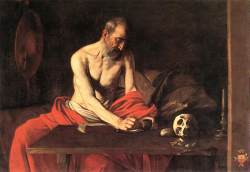
. Even when he is depicted as a half-clad anchorite
, with cross, skull and Bible for the only furniture of his cell, the red hat or some other indication of his rank as cardinal is as a rule introduced somewhere in the picture.
He is also often depicted with a lion
, "a figment" found in the twelfth-century Golden Legend
by Jacobus de Voragine
, and less often with an owl
, the symbol of wisdom and scholarship. Hagiographies of Jerome talk of his having spent a lot of his years in the Syrian desert, and multiple artists have titled their works "St Jerome in the wilderness"; some of them include Pietro Perugino and Lambert Sustris. Writing material
s and the trumpet of final judgment are also part of his iconography
. He is commemorated on 30 September with a memorial.
Roman Empire
The Roman Empire was the post-Republican period of the ancient Roman civilization, characterised by an autocratic form of government and large territorial holdings in Europe and around the Mediterranean....
Christian
Christian
A Christian is a person who adheres to Christianity, an Abrahamic, monotheistic religion based on the life and teachings of Jesus of Nazareth as recorded in the Canonical gospels and the letters of the New Testament...
priest, confessor, theologian and historian, and who became a Doctor of the Church. He was the son of Eusebius, of the city of Stridon
Stridon
Stridon was a town in the Roman province of Dalmatia. The town is located near modern Ljubljana but the exact location is unknown. The town is especially known as the birthplace of Saint Jerome. From Stridon also came Domnus of Stridon, a bishop who took part in the First Council of Nicaea, and...
, which was on the border of Dalmatia
Dalmatia (Roman province)
Dalmatia was an ancient Roman province. Its name is probably derived from the name of an Illyrian tribe called the Dalmatae which lived in the area of the eastern Adriatic coast in Classical antiquity....
and Pannonia
Pannonia
Pannonia was an ancient province of the Roman Empire bounded north and east by the Danube, coterminous westward with Noricum and upper Italy, and southward with Dalmatia and upper Moesia....
. He is best known for his translation of the Bible
Bible
The Bible refers to any one of the collections of the primary religious texts of Judaism and Christianity. There is no common version of the Bible, as the individual books , their contents and their order vary among denominations...
into Latin
Latin
Latin is an Italic language originally spoken in Latium and Ancient Rome. It, along with most European languages, is a descendant of the ancient Proto-Indo-European language. Although it is considered a dead language, a number of scholars and members of the Christian clergy speak it fluently, and...
(the Vulgate
Vulgate
The Vulgate is a late 4th-century Latin translation of the Bible. It was largely the work of St. Jerome, who was commissioned by Pope Damasus I in 382 to make a revision of the old Latin translations...
), and his list of writings is extensive.
He is recognized by the Catholic Church as a saint
Saint
A saint is a holy person. In various religions, saints are people who are believed to have exceptional holiness.In Christian usage, "saint" refers to any believer who is "in Christ", and in whom Christ dwells, whether in heaven or in earth...
and Doctor of the Church
Doctor of the Church
Doctor of the Church is a title given by a variety of Christian churches to individuals whom they recognize as having been of particular importance, particularly regarding their contribution to theology or doctrine.-Catholic Church:In the Catholic Church, this name is given to a saint from whose...
, and the Vulgate is still an important text in Catholicism. He is also recognized as a saint by the Eastern Orthodox Church
Eastern Orthodox Church
The Orthodox Church, officially called the Orthodox Catholic Church and commonly referred to as the Eastern Orthodox Church, is the second largest Christian denomination in the world, with an estimated 300 million adherents mainly in the countries of Belarus, Bulgaria, Cyprus, Georgia, Greece,...
, where he is known as St. Jerome of Stridonium or Blessed Jerome.
Life
Stridon
Stridon was a town in the Roman province of Dalmatia. The town is located near modern Ljubljana but the exact location is unknown. The town is especially known as the birthplace of Saint Jerome. From Stridon also came Domnus of Stridon, a bishop who took part in the First Council of Nicaea, and...
around 347,. He was not baptized
Baptism
In Christianity, baptism is for the majority the rite of admission , almost invariably with the use of water, into the Christian Church generally and also membership of a particular church tradition...
until about 360 or 366, when he had gone to Rome
Rome
Rome is the capital of Italy and the country's largest and most populated city and comune, with over 2.7 million residents in . The city is located in the central-western portion of the Italian Peninsula, on the Tiber River within the Lazio region of Italy.Rome's history spans two and a half...
with his friend Bonosus
Bonosus (bishop)
Bonusus was a Bishop of Sardica in the latter part of the fourth century, founder of the heresy, known after him as Bonosians.-History:Against the common teaching of the Catholic Church he held that, after Jesus, Mary had several other children...
(who may or may not have been the same Bonosus whom Jerome identifies as his friend who went to live as a hermit on an island in the Adriatic) to pursue rhetoric
Rhetoric
Rhetoric is the art of discourse, an art that aims to improve the facility of speakers or writers who attempt to inform, persuade, or motivate particular audiences in specific situations. As a subject of formal study and a productive civic practice, rhetoric has played a central role in the Western...
al and philosophical
Philosophy
Philosophy is the study of general and fundamental problems, such as those connected with existence, knowledge, values, reason, mind, and language. Philosophy is distinguished from other ways of addressing such problems by its critical, generally systematic approach and its reliance on rational...
studies. He studied under the grammarian Aelius Donatus
Aelius Donatus
Aelius Donatus was a Roman grammarian and teacher of rhetoric. The only fact known regarding his life is that he was the tutor of St...
. There Jerome learned Latin
Latin
Latin is an Italic language originally spoken in Latium and Ancient Rome. It, along with most European languages, is a descendant of the ancient Proto-Indo-European language. Although it is considered a dead language, a number of scholars and members of the Christian clergy speak it fluently, and...
and at least some Greek
Greek language
Greek is an independent branch of the Indo-European family of languages. Native to the southern Balkans, it has the longest documented history of any Indo-European language, spanning 34 centuries of written records. Its writing system has been the Greek alphabet for the majority of its history;...
, though probably not the familiarity with Greek literature he would later claim to have acquired as a schoolboy.
As a student in Rome, he engaged in the superficial activities of students there, which he indulged in quite casually but suffered terrible bouts of repentance afterwards. To appease his conscience
Conscience
Conscience is an aptitude, faculty, intuition or judgment of the intellect that distinguishes right from wrong. Moral judgement may derive from values or norms...
, he would visit on Sundays the sepulchers of the martyr
Martyr
A martyr is somebody who suffers persecution and death for refusing to renounce, or accept, a belief or cause, usually religious.-Meaning:...
s and the Apostle
Apostle (Christian)
The term apostle is derived from Classical Greek ἀπόστολος , meaning one who is sent away, from στέλλω + από . The literal meaning in English is therefore an "emissary", from the Latin mitto + ex...
s in the catacombs. This experience would remind him of the terrors of hell
Hell
In many religious traditions, a hell is a place of suffering and punishment in the afterlife. Religions with a linear divine history often depict hells as endless. Religions with a cyclic history often depict a hell as an intermediary period between incarnations...
:
Jerome used a quote from Vergil — “The horror and the silences terrified their souls” — to describe the horror of hell. Jerome initially used classical authors to describe Christian concepts such as hell that indicated both his classical education and his deep shame of their associated practices, such as pederasty
Pederasty
Pederasty or paederasty is an intimate relationship between an adult and an adolescent boy outside his immediate family. The word pederasty derives from Greek "love of boys", a compound derived from "child, boy" and "lover".Historically, pederasty has existed as a variety of customs and...
. Although initially skeptical of Christianity, he was eventually converted
Religious conversion
Religious conversion is the adoption of a new religion that differs from the convert's previous religion. Changing from one denomination to another within the same religion is usually described as reaffiliation rather than conversion.People convert to a different religion for various reasons,...
.
After several years in Rome, he travelled with Bonosus to Gaul
Gaul
Gaul was a region of Western Europe during the Iron Age and Roman era, encompassing present day France, Luxembourg and Belgium, most of Switzerland, the western part of Northern Italy, as well as the parts of the Netherlands and Germany on the left bank of the Rhine. The Gauls were the speakers of...
and settled in Trier
Trier
Trier, historically called in English Treves is a city in Germany on the banks of the Moselle. It is the oldest city in Germany, founded in or before 16 BC....
where he seems to have first taken up theological studies, and where he copied, for his friend Tyrannius Rufinus
Tyrannius Rufinus
Tyrannius Rufinus or Rufinus of Aquileia was a monk, historian, and theologian. He is most known as a translator of Greek patristic material into Latin—especially the work of Origen.-Life:...
, Hilary of Poitiers
Hilary of Poitiers
Hilary of Poitiers was Bishop of Poitiers and is a Doctor of the Church. He was sometimes referred to as the "Hammer of the Arians" and the "Athanasius of the West." His name comes from the Latin word for happy or cheerful. His optional memorial in the Roman Catholic calendar of saints is 13...
' commentary on the Psalms and the treatise De synodis. Next came a stay of at least several months, or possibly years, with Rufinus at Aquileia
Aquileia
Aquileia is an ancient Roman city in what is now Italy, at the head of the Adriatic at the edge of the lagoons, about 10 km from the sea, on the river Natiso , the course of which has changed somewhat since Roman times...
, where he made many Christian friends.
Some of these accompanied him when he set out about 373 on a journey through Thrace
Thrace
Thrace is a historical and geographic area in southeast Europe. As a geographical concept, Thrace designates a region bounded by the Balkan Mountains on the north, Rhodope Mountains and the Aegean Sea on the south, and by the Black Sea and the Sea of Marmara on the east...
and Asia Minor
Asia Minor
Asia Minor is a geographical location at the westernmost protrusion of Asia, also called Anatolia, and corresponds to the western two thirds of the Asian part of Turkey...
into northern Syria
Syria
Syria , officially the Syrian Arab Republic , is a country in Western Asia, bordering Lebanon and the Mediterranean Sea to the West, Turkey to the north, Iraq to the east, Jordan to the south, and Israel to the southwest....
. At Antioch
Antioch
Antioch on the Orontes was an ancient city on the eastern side of the Orontes River. It is near the modern city of Antakya, Turkey.Founded near the end of the 4th century BC by Seleucus I Nicator, one of Alexander the Great's generals, Antioch eventually rivaled Alexandria as the chief city of the...
, where he stayed the longest, two of his companions died and he himself was seriously ill more than once. During one of these illnesses (about the winter of 373–374), he had a vision that led him to lay aside his secular studies and devote himself to God. He seems to have abstained for a considerable time from the study of the classics and to have plunged deeply into that of the Bible
Bible
The Bible refers to any one of the collections of the primary religious texts of Judaism and Christianity. There is no common version of the Bible, as the individual books , their contents and their order vary among denominations...
, under the impulse of Apollinaris of Laodicea
Apollinaris of Laodicea
Apollinaris "the Younger" was a bishop of Laodicea in Syria. He collaborated with his father Apollinaris the Elder in reproducing the Old Testament in the form of Homeric and Pindaric poetry, and the New Testament after the fashion of Platonic dialogues, when the emperor Julian had forbidden...
, then teaching in Antioch
Antioch
Antioch on the Orontes was an ancient city on the eastern side of the Orontes River. It is near the modern city of Antakya, Turkey.Founded near the end of the 4th century BC by Seleucus I Nicator, one of Alexander the Great's generals, Antioch eventually rivaled Alexandria as the chief city of the...
and not yet suspected of heresy
Christian heresy
Christian heresy refers to non-orthodox practices and beliefs that were deemed to be heretical by one or more of the Christian churches. In Western Christianity, the term "heresy" most commonly refers to those beliefs which were declared to be anathema by the Catholic Church prior to the schism of...
.
Chalcis, Syria
Chalcis was an ancient city in Syria. Syrian Chalcis was the birthplace of 3rd century Neoplatonist philosopher Iamblichus.It is thought to be the site of the modern town of Qinnasrin, though Anjar in Lebanon has also been suggested as the site of ancient Chalcis....
, to the southwest of Antioch
Antioch
Antioch on the Orontes was an ancient city on the eastern side of the Orontes River. It is near the modern city of Antakya, Turkey.Founded near the end of the 4th century BC by Seleucus I Nicator, one of Alexander the Great's generals, Antioch eventually rivaled Alexandria as the chief city of the...
, known as the Syrian Thebaid, from the number of hermits inhabiting it. During this period, he seems to have found time for study and writing. He made his first attempt to learn Hebrew under the guidance of a converted Jew; and he seems to have been in correspondence with Jewish Christians
Jewish Christians
Jewish Christians is a term which appears in historical texts contrasting Christians of Jewish origin with Gentile Christians, both in discussion of the New Testament church and the second and following centuries....
in Antioch. Around this time he had copied for him a Hebrew Gospel, of which fragments are preserved in his notes are known today as the Gospel of the Hebrews
Gospel of the Hebrews
The Gospel of the Hebrews , commonly shortened from the Gospel according to the Hebrews or simply called the Hebrew Gospel, is a hypothesised lost gospel preserved in fragments within the writings of the Church Fathers....
, and which the Nazarene
Nazarene (sect)
The Nazarene sect is used in two contexts:* Firstly of the New Testament early church where in Acts 24:5 Paul is accused before Felix at Caesarea by Tertullus of being "a ringleader of the sect of the Nazarenes."...
s considered was the true Gospel of Matthew
Gospel of Matthew
The Gospel According to Matthew is one of the four canonical gospels, one of the three synoptic gospels, and the first book of the New Testament. It tells of the life, ministry, death, and resurrection of Jesus of Nazareth...
. Jerome translated parts of this Hebrew Gospel into Greek.
Returning to Antioch in 378 or 379, he was ordained by Bishop Paulinus
Paulinus, Bishop of Antioch
Paulinus was a claimant to the See of Antioch from 362 to 388. He was supported by members of the Eustathian party, and was a rival to Meletius of Antioch. The Eustathians objected to Miletius having been consecrated by Arians, and had begun to meet separately...
, apparently unwillingly and on condition that he continue his ascetic life. Soon afterward, he went to Constantinople
Constantinople
Constantinople was the capital of the Roman, Eastern Roman, Byzantine, Latin, and Ottoman Empires. Throughout most of the Middle Ages, Constantinople was Europe's largest and wealthiest city.-Names:...
to pursue a study of Scripture under Gregory Nazianzen. He seems to have spent two years there; the next three (382-385) he was in Rome again, attached to Pope Damasus I
Pope Damasus I
Pope Saint Damasus I was the bishop of Rome from 366 to 384.He was born around 305, probably near the city of Idanha-a-Velha , in what is present-day Portugal, then part of the Western Roman Empire...
and the leading Roman Christians. Invited originally for the synod
Synod
A synod historically is a council of a church, usually convened to decide an issue of doctrine, administration or application. In modern usage, the word often refers to the governing body of a particular church, whether its members are meeting or not...
of 382, held to end the schism
Schism (religion)
A schism , from Greek σχίσμα, skhísma , is a division between people, usually belonging to an organization or movement religious denomination. The word is most frequently applied to a break of communion between two sections of Christianity that were previously a single body, or to a division within...
of Antioch, he made himself indispensable to the pope, and took a prominent place in his councils.
Among his other duties, he undertook a revision of the Latin Bible
Vetus Latina
Vetus Latina is a collective name given to the Biblical texts in Latin that were translated before St Jerome's Vulgate Bible became the standard Bible for Latin-speaking Western Christians. The phrase Vetus Latina is Latin for Old Latin, and the Vetus Latina is sometimes known as the Old Latin Bible...
, to be based on the Greek
Greek language
Greek is an independent branch of the Indo-European family of languages. Native to the southern Balkans, it has the longest documented history of any Indo-European language, spanning 34 centuries of written records. Its writing system has been the Greek alphabet for the majority of its history;...
New Testament
New Testament
The New Testament is the second major division of the Christian biblical canon, the first such division being the much longer Old Testament....
. He also updated the Psalter then at use in Rome based on the Septuagint. Though he did not realize it yet, translating much of what became the Latin Vulgate
Vulgate
The Vulgate is a late 4th-century Latin translation of the Bible. It was largely the work of St. Jerome, who was commissioned by Pope Damasus I in 382 to make a revision of the old Latin translations...
Bible would take many years, and be his most important achievement (see Writings- Translations section below).
In Rome he was surrounded by a circle of well-born and well-educated women, including some from the noblest patrician families, such as the widows Lea
Saint Lea
Saint Lea is a third century saint in the Roman Catholic Church on the authority of Jerome about whom little is definitively known. The church father Saint Jerome, in a letter to Saint Marcella, said that she was a widow who retired to a Roman convent of consecrated virgins, where she became the...
, Marcella
Saint Marcella
Marcella is a saint in the Roman Catholic Church. She was a Christian ascetic in ancient Rome. Growing up in Rome, she was influenced by her pious mother, Albina, an educated woman of wealth and benevolence. Childhood memories centered around piety, and one in particular related to Athanasius,...
and Paula
Saint Paula
Saint Paula was an ancient Roman saint and early Desert Mother. A member of one of the richest "senatorial" families which frivolously claimed descent from Agamemnon, Paula was the daughter of Blesilla and Rogatus, from the great clan of the Furii Camilli...
, with their daughters Blaesilla
Blaesilla
Blaesilla was the daughter of Paula, and sister of Eustochium, from one of the Senatorial families of Ancient Rome. Blaesilla died young, under the influence of Jerome. She, and her sister and mother , are accorded Sainthood by the Roman Catholic church.Blaesilla, as a young girl, showed a strong...
and Eustochium
Eustochium
Saint Eustochium . Born Eustochium Julia at Rome, she was the daughter of Saint Paula and is also venerated as a saint and was an early Desert Mother. She was the third of four daughters of the Roman Senator Toxotius, for whom Jerome made a lot of fanciful claims of ancestry. After the death of...
. The resulting inclination of these women to the monastic life, and his unsparing criticism of the secular clergy
Secular clergy
The term secular clergy refers to deacons and priests who are not monastics or members of a religious order.-Catholic Church:In the Catholic Church, the secular clergy are ministers, such as deacons and priests, who do not belong to a religious order...
, brought a growing hostility against him among the clergy and their supporters. Soon after the death of his patron Damasus
Pope Damasus I
Pope Saint Damasus I was the bishop of Rome from 366 to 384.He was born around 305, probably near the city of Idanha-a-Velha , in what is present-day Portugal, then part of the Western Roman Empire...
(10 December 384), Jerome was forced to leave his position at Rome after an inquiry by the Roman clergy into allegations that he had an improper relationship with the widow Paula.
Additionally, his condemnation of Blaesilla's hedonistic lifestyle had led her to adopt aescetic practices, but worsened her physical weakness to the point that she died just four months after starting to follow his instructions; much of the Roman populace were outraged at Jerome for causing the premature death of such a lively young woman, and his insistence to Paula that Blaesilla should not be mourned, and complaints that her grief was excessive, were seen as heartless, polarising Roman opinion against him.
In August 385, he returned to Antioch, accompanied by his brother Paulinianus and several friends, and followed a little later by Paula and Eustochium, who had resolved to end their days in the Holy Land
Holy Land
The Holy Land is a term which in Judaism refers to the Kingdom of Israel as defined in the Tanakh. For Jews, the Land's identifiction of being Holy is defined in Judaism by its differentiation from other lands by virtue of the practice of Judaism often possible only in the Land of Israel...
. In the winter of 385, Jerome acted as their spiritual adviser. The pilgrims, joined by Bishop Paulinus of Antioch, visited Jerusalem, Bethlehem
Bethlehem
Bethlehem is a Palestinian city in the central West Bank of the Jordan River, near Israel and approximately south of Jerusalem, with a population of about 30,000 people. It is the capital of the Bethlehem Governorate of the Palestinian National Authority and a hub of Palestinian culture and tourism...
, and the holy places of Galilee
Galilee
Galilee , is a large region in northern Israel which overlaps with much of the administrative North District of the country. Traditionally divided into Upper Galilee , Lower Galilee , and Western Galilee , extending from Dan to the north, at the base of Mount Hermon, along Mount Lebanon to the...
, and then went to Egypt
Ancient Egypt
Ancient Egypt was an ancient civilization of Northeastern Africa, concentrated along the lower reaches of the Nile River in what is now the modern country of Egypt. Egyptian civilization coalesced around 3150 BC with the political unification of Upper and Lower Egypt under the first pharaoh...
, the home of the great heroes of the ascetic life.
At the Catechetical School of Alexandria
Catechetical School of Alexandria
The Catechetical School of Alexandria was and is a place for the training of Christian theologians and priests in Alexandria. The teachers and students of the school were influential in many of the early theological controversies of the Christian church.The earliest recorded instructor at the...
, Jerome listened to the catechist
Catechism
A catechism , i.e. to indoctrinate) is a summary or exposition of doctrine, traditionally used in Christian religious teaching from New Testament times to the present...
Didymus the Blind
Didymus the Blind
Didymus the Blind was a Coptic Church theologian of Alexandria, whose famous Catechetical School he led for about half a century. He became blind at a very young age, and therefore ignorant of the rudiments of learning...
expounding the prophet Hosea
Hosea
Hosea was the son of Beeri and a prophet in Israel in the 8th century BC. He is one of the Twelve Prophets of the Jewish Hebrew Bible, also known as the Minor Prophets of the Christian Old Testament. Hosea is often seen as a "prophet of doom", but underneath his message of destruction is a promise...
and telling his reminiscences of Anthony the Great
Anthony the Great
Anthony the Great or Antony the Great , , also known as Saint Anthony, Anthony the Abbot, Anthony of Egypt, Anthony of the Desert, Anthony the Anchorite, Abba Antonius , and Father of All Monks, was a Christian saint from Egypt, a prominent leader among the Desert Fathers...
, who had died 30 years before; he spent some time in Nitria, admiring the disciplined community life of the numerous inhabitants of that "city of the Lord," but detecting even there "concealed serpents," i.e., the influence of Origen of Alexandria. Late in the summer of 388 he was back in Israel, and spent the remainder of his life in a hermit's cell near Bethlehem, surrounded by a few friends, both men and women (including Paula and Eustochium), to whom he acted as priestly guide and teacher.
Pelagianism
Pelagianism is a theological theory named after Pelagius , although he denied, at least at some point in his life, many of the doctrines associated with his name. It is the belief that original sin did not taint human nature and that mortal will is still capable of choosing good or evil without...
, the literary perfection of which even an opponent recognized. To this period also belong most of his polemic
Polemic
A polemic is a variety of arguments or controversies made against one opinion, doctrine, or person. Other variations of argument are debate and discussion...
s, which distinguished him among the orthodox Fathers, including the treatises against the Origenism of Bishop John II of Jerusalem
Bishop John II of Jerusalem
John II was bishop of Jerusalem from AD 387 to AD 417. John II succeeded to the episcopal throne of Jerusalem on the death of Saint Cyril in 386...
and his early friend Rufinus. As a result of his writings against Pelagianism, a body of excited partisans broke into the monastic buildings, set them on fire, attacked the inmates and killed a deacon
Deacon
Deacon is a ministry in the Christian Church that is generally associated with service of some kind, but which varies among theological and denominational traditions...
, forcing Jerome to seek safety in a neighboring fortress (416).
Jerome died near Bethlehem
Bethlehem
Bethlehem is a Palestinian city in the central West Bank of the Jordan River, near Israel and approximately south of Jerusalem, with a population of about 30,000 people. It is the capital of the Bethlehem Governorate of the Palestinian National Authority and a hub of Palestinian culture and tourism...
on 30 September 420. The date of his death is given by the Chronicon of Prosper of Aquitaine
Prosper of Aquitaine
Saint Prosper of Aquitaine , a Christian writer and disciple of Saint Augustine of Hippo, was the first continuator of Jerome's Universal Chronicle.- Life :...
. His remains, originally buried at Bethlehem
Bethlehem
Bethlehem is a Palestinian city in the central West Bank of the Jordan River, near Israel and approximately south of Jerusalem, with a population of about 30,000 people. It is the capital of the Bethlehem Governorate of the Palestinian National Authority and a hub of Palestinian culture and tourism...
, are said to have been later transferred to the basilica of Santa Maria Maggiore in Rome, though other places in the West claim some relics — the cathedral at Nepi
Nepi
Nepi is a town and comune in Italy in the province of Viterbo, region of Lazio. The town lies 30 km southeast of the city of Viterbo and about 13 km southwest from Civita Castellana....
boasting possession of his head, which, according to another tradition, is in the Escorial.
Translations and commentaries
Vetus Latina
Vetus Latina is a collective name given to the Biblical texts in Latin that were translated before St Jerome's Vulgate Bible became the standard Bible for Latin-speaking Western Christians. The phrase Vetus Latina is Latin for Old Latin, and the Vetus Latina is sometimes known as the Old Latin Bible...
. By 390 he turned to the Hebrew Bible
Hebrew Bible
The Hebrew Bible is a term used by biblical scholars outside of Judaism to refer to the Tanakh , a canonical collection of Jewish texts, and the common textual antecedent of the several canonical editions of the Christian Old Testament...
, having previously translated portions from the Septuagint. He completed this work by 405. Prior to Jerome's Vulgate, all Latin translations of the Old Testament
Old Testament
The Old Testament, of which Christians hold different views, is a Christian term for the religious writings of ancient Israel held sacred and inspired by Christians which overlaps with the 24-book canon of the Masoretic Text of Judaism...
were based on the Septuagint. Jerome's decision to use a Hebrew text instead of the Septuagint went against the advice of most other Christians, including Augustine
St. Augustine
-People:* Augustine of Hippo or Augustine of Hippo , father of the Latin church* Augustine of Canterbury , first Archbishop of Canterbury* Augustine Webster, an English Catholic martyr.-Places:*St. Augustine, Florida, United States...
, who considered the Septuagint inspired. Modern scholarship, however, has cast doubts on the actual quality of Jerome's Hebrew knowledge; the Greek Hexapla
Hexapla
Hexapla is the term for an edition of the Bible in six versions. Especially it applies to the edition of the Old Testament compiled by Origen of Alexandria, which placed side by side:#Hebrew...
is now considered as still the main source also for Jerome's "iuxta Hebraeos" translation of the Old Testament.
For the next 15 years, until he died, Jerome produced a number of commentaries on Scripture, often explaining his translation choices. His patristic
Patristics
Patristics or Patrology is the study of Early Christian writers, known as the Church Fathers. The names derive from the Latin pater . The period is generally considered to run from the end of New Testament times or end of the Apostolic Age Patristics or Patrology is the study of Early Christian...
commentaries align closely with Jewish tradition, and he indulges in allegorical and mystical subtleties after the manner of Philo
Philo
Philo , known also as Philo of Alexandria , Philo Judaeus, Philo Judaeus of Alexandria, Yedidia, "Philon", and Philo the Jew, was a Hellenistic Jewish Biblical philosopher born in Alexandria....
and the Alexandrian school. Unlike his contemporaries, he emphasizes the difference between the Hebrew Bible "apocrypha" and the Hebraica veritas of the protocanonical books
Protocanonical books
The protocanonical books are those books of the Old Testament which are also included in the Hebrew Bible and which have always been considered canonical by almost all Christians throughout history...
. Evidence of this can be found in his introductions to the Solomon
Solomon
Solomon , according to the Book of Kings and the Book of Chronicles, a King of Israel and according to the Talmud one of the 48 prophets, is identified as the son of David, also called Jedidiah in 2 Samuel 12:25, and is described as the third king of the United Monarchy, and the final king before...
ic writings, the Book of Tobit
Book of Tobit
The Book of Tobit is a book of scripture that is part of the Catholic and Orthodox biblical canon, pronounced canonical by the Council of Carthage of 397 and confirmed for Roman Catholics by the Council of Trent...
, and the Book of Judith. Most notable, however, is the statement from his introduction to the Books of Samuel
Books of Samuel
The Books of Samuel in the Jewish bible are part of the Former Prophets, , a theological history of the Israelites affirming and explaining the Torah under the guidance of the prophets.Samuel begins by telling how the prophet Samuel is chosen by...
:
This preface to the Scriptures may serve as a helmeted [i.e. defensive] introduction to all the books which we turn from Hebrew into Latin, so that we may be assured that what is outside of them must be placed aside among the Apocryphal writings.
Jerome's commentaries fall into three groups:
- His translations or recastings of Greek predecessors, including fourteen homilies on the Book of JeremiahBook of JeremiahThe Book of Jeremiah is the second of the Latter Prophets in the Hebrew Bible, following the book of Isaiah and preceding Ezekiel and the Book of the Twelve....
and the same number on the Book of EzekielBook of EzekielThe Book of Ezekiel is the third of the Latter Prophets in the Hebrew Bible, following the books of Isaiah and Jeremiah and preceding the Book of the Twelve....
by Origen (translated ca. 380 in Constantinople); two homilies of Origen of Alexandria on the Song of Solomon (in Rome, ca. 383); and thirty-nine on the Gospel of LukeGospel of LukeThe Gospel According to Luke , commonly shortened to the Gospel of Luke or simply Luke, is the third and longest of the four canonical Gospels. This synoptic gospel is an account of the life and ministry of Jesus of Nazareth. It details his story from the events of his birth to his Ascension.The...
(ca. 389, in Bethlehem). The nine homilies of Origen on the Book of IsaiahBook of IsaiahThe Book of Isaiah is the first of the Latter Prophets in the Hebrew Bible, preceding the books of Ezekiel, Jeremiah and the Book of the Twelve...
included among his works were not done by him. Here should be mentioned, as an important contribution to the topography of Israel, his book De situ et nominibus locorum Hebraeorum, a translation with additions and some regrettable omissions of the Onomasticon of Eusebius. To the same period (ca. 390) belongs the Liber interpretationis nominum Hebraicorum, based on a work supposed to go back to PhiloPhiloPhilo , known also as Philo of Alexandria , Philo Judaeus, Philo Judaeus of Alexandria, Yedidia, "Philon", and Philo the Jew, was a Hellenistic Jewish Biblical philosopher born in Alexandria....
and expanded by Origen. - Original commentaries on the Old Testament. To the period before his settlement at Bethlehem and the following five years belong a series of short Old Testament studies: De seraphim, De voce Osanna, De tribus quaestionibus veteris legis (usually included among the letters as 18, 20, and 36); Quaestiones hebraicae in Genesim; Commentarius in Ecclesiasten; Tractatus septem in Psalmos 10-16 (lost); Explanationes in Michaeam, Sophoniam, Nahum, Habacuc, Aggaeum. After 395 he composed a series of longer commentaries, though in rather a desultory fashion: first on Jonah and Obadiah (396), then on Isaiah (ca. 395-ca. 400), on Zechariah, Malachi, Hoseah, Joel, Amos (from 406), on the Book of DanielBook of DanielThe Book of Daniel is a book in the Hebrew Bible. The book tells of how Daniel, and his Judean companions, were inducted into Babylon during Jewish exile, and how their positions elevated in the court of Nebuchadnezzar. The court tales span events that occur during the reigns of Nebuchadnezzar,...
(ca. 407), on Ezekiel (between 410 and 415), and on Jeremiah (after 415, left unfinished). - New Testament commentaries. These include only PhilemonEpistle to PhilemonPaul's Epistle to Philemon, usually referred to simply as Philemon, is a prison letter to Philemon from Paul of Tarsus. Philemon was a leader in the Colossian church. This letter, which is one of the books of the New Testament, deals with forgiveness.Philemon was a wealthy Christian of the house...
, Galatians, Ephesians, and TitusEpistle to TitusThe Epistle of Paul to Titus, usually referred to simply as Titus, is one of the three Pastoral Epistles , traditionally attributed to Saint Paul, and is part of the New Testament...
(hastily composed 387-388); MatthewGospel of MatthewThe Gospel According to Matthew is one of the four canonical gospels, one of the three synoptic gospels, and the first book of the New Testament. It tells of the life, ministry, death, and resurrection of Jesus of Nazareth...
(dictated in a fortnight, 398); MarkGospel of MarkThe Gospel According to Mark , commonly shortened to the Gospel of Mark or simply Mark, is the second book of the New Testament. This canonical account of the life of Jesus of Nazareth is one of the three synoptic gospels. It was thought to be an epitome, which accounts for its place as the second...
, selected passages in LukeGospel of LukeThe Gospel According to Luke , commonly shortened to the Gospel of Luke or simply Luke, is the third and longest of the four canonical Gospels. This synoptic gospel is an account of the life and ministry of Jesus of Nazareth. It details his story from the events of his birth to his Ascension.The...
, RevelationRevelationIn religion and theology, revelation is the revealing or disclosing, through active or passive communication with a supernatural or a divine entity...
, and the prologue to the Gospel of JohnGospel of JohnThe Gospel According to John , commonly referred to as the Gospel of John or simply John, and often referred to in New Testament scholarship as the Fourth Gospel, is an account of the public ministry of Jesus...
. Treating Revelation in his cursory fashion, he made use of an excerpt from the commentary of the North AfricaNorth AfricaNorth Africa or Northern Africa is the northernmost region of the African continent, linked by the Sahara to Sub-Saharan Africa. Geopolitically, the United Nations definition of Northern Africa includes eight countries or territories; Algeria, Egypt, Libya, Morocco, South Sudan, Sudan, Tunisia, and...
n Tichonius, which is preserved as a sort of argument at the beginning of the more extended work of the Spanish presbyter Beatus of LiébanaBeatus of LiébanaSaint Beatus of Liébana was a monk, theologian and geographer from the Kingdom of Asturias, in modern northern Spain, who worked and lived in the Picos de Europa mountains of the region of Liébana, in what is now Cantabria and his feast day is February 19.-Biography:He created an important...
. But before this he had already devoted to the Revelation another treatment, a rather arbitrary recasting of the commentary of Saint Victorinus, with whose chiliastic views he was not in accord, substituting for the chiliastic conclusion a spiritualizing exposition of his own, supplying an introduction, and making certain changes in the text.
The works of Hippolytus of Rome and Irenaeus
Irenaeus
Saint Irenaeus , was Bishop of Lugdunum in Gaul, then a part of the Roman Empire . He was an early church father and apologist, and his writings were formative in the early development of Christian theology...
greatly influenced Jerome's interpretation of prophecy. He noted the distinction between the original Septuagint and Theodotion's later substitution.
Jerome warned that those substituting false interpretations for the actual meaning of Scripture belonged to the “synagogue of the Antichrist”. “He that is not of Christ is of Antichrist,” he wrote to Pope Damasus I
Pope Damasus I
Pope Saint Damasus I was the bishop of Rome from 366 to 384.He was born around 305, probably near the city of Idanha-a-Velha , in what is present-day Portugal, then part of the Western Roman Empire...
. He believed that “the mystery of iniquity” written about by Paul in 2 Thessalonians 2:7 was already in action when “every one chatters about his views.” To Jerome, the power restraining this mystery of iniquity was the Roman Empire, but as it fell this restraining force was removed. He warned a noble woman of Gaul
Gaul
Gaul was a region of Western Europe during the Iron Age and Roman era, encompassing present day France, Luxembourg and Belgium, most of Switzerland, the western part of Northern Italy, as well as the parts of the Netherlands and Germany on the left bank of the Rhine. The Gauls were the speakers of...
:
“He that letteth is taken out of the way, and yet we do not realize that Antichrist is near. Yes, Antichrist is near whom the Lord Jesus Christ “shall consume with the spirit of his mouth.” “Woe unto them,” he cries, “that are with child, and to them that give suck in those days.”... Savage tribes in countless numbers have overrun all parts of Gaul. The whole country between the Alps and the Pyrenees, between the Rhine and the Ocean, has been laid waste by hordes of QuadiQuadiThe Quadi were a smaller Germanic tribe, about which little is definitively known. We only know the Germanic tribe the Romans called the 'Quadi' through reports of the Romans themselves...
, VandalsVandalsThe Vandals were an East Germanic tribe that entered the late Roman Empire during the 5th century. The Vandals under king Genseric entered Africa in 429 and by 439 established a kingdom which included the Roman Africa province, besides the islands of Sicily, Corsica, Sardinia and the Balearics....
, SarmatiansSarmatiansThe Iron Age Sarmatians were an Iranian people in Classical Antiquity, flourishing from about the 5th century BC to the 4th century AD....
, AlansAlansThe Alans, or the Alani, occasionally termed Alauni or Halani, were a group of Sarmatian tribes, nomadic pastoralists of the 1st millennium AD who spoke an Eastern Iranian language which derived from Scytho-Sarmatian and which in turn evolved into modern Ossetian.-Name:The various forms of Alan —...
, Gepids, Herules, SaxonsSaxonsThe Saxons were a confederation of Germanic tribes originating on the North German plain. The Saxons earliest known area of settlement is Northern Albingia, an area approximately that of modern Holstein...
, BurgundiansBurgundiansThe Burgundians were an East Germanic tribe which may have emigrated from mainland Scandinavia to the island of Bornholm, whose old form in Old Norse still was Burgundarholmr , and from there to mainland Europe...
, Allemanni, and—alas! for the commonweal!-- even Pannonians.
His Commentary on Daniel was expressly written to offset the criticisms of Porphyry
Porphyry (philosopher)
Porphyry of Tyre , Porphyrios, AD 234–c. 305) was a Neoplatonic philosopher who was born in Tyre. He edited and published the Enneads, the only collection of the work of his teacher Plotinus. He also wrote many works himself on a wide variety of topics...
, who taught that Daniel related entirely to the time of Antiochus IV Epiphanes
Antiochus IV Epiphanes
Antiochus IV Epiphanes ruled the Seleucid Empire from 175 BC until his death in 164 BC. He was a son of King Antiochus III the Great. His original name was Mithridates; he assumed the name Antiochus after he ascended the throne....
and was written by an unknown individual living in the 2nd century BC. Against Porphyry, Jerome identified Rome as the fourth kingdom of chapters two and seven, but his view of chapters eight and 11 was more complex. Jerome held that chapter eight describes the activity of Antiochus Epiphanes, who is understood as a "type" of a future antichrist; 11:24 onwards applies primarily to a future antichrist but was partially fulfilled by Antiochus. Instead, he advocated that the “little horn” was the Antichrist:
We should therefore concur with the traditional interpretation of all the commentators of the Christian Church, that at the end of the world, when the Roman Empire is to be destroyed, there shall be ten kings who will partition the Roman world amongst themselves. Then an insignificant eleventh king will arise, who will overcome three of the ten kings... after they have been slain, the seven other kings also will bow their necks to the victor.
In his Commentary on Daniel, he noted, “Let us not follow the opinion of some commentators and suppose him to be either the Devil or some demon, but rather, one of the human race, in whom Satan will wholly take up his residence in bodily form.” In interpreting 2 Thessalonians's claim that the Antichrist will sit in God's temple, Jerome preferred the view that the "temple" should be interpreted as the Church, not as the Temple in Jerusalem.
Jerome identified the four prophetic kingdoms symbolized in Daniel 2 as the Neo-Babylonian Empire
Neo-Babylonian Empire
The Neo-Babylonian Empire or Second Babylonian Empire was a period of Mesopotamian history which began in 626 BC and ended in 539 BC. During the preceding three centuries, Babylonia had been ruled by their fellow Akkadian speakers and northern neighbours, Assyria. Throughout that time Babylonia...
, the Medes and Persians, Macedon
Macedon
Macedonia or Macedon was an ancient kingdom, centered in the northeastern part of the Greek peninsula, bordered by Epirus to the west, Paeonia to the north, the region of Thrace to the east and Thessaly to the south....
, and Rome. Jerome identified the stone cut out without hands as "namely, the Lord and Savior".
Jerome refuted Porphyry's application of the little horn of chapter seven to Antiochus. He expected that at the end of the world, Rome would be destroyed, and partitioned among ten kingdoms before the little horn appeared.
Jerome believed that Cyrus of Persia is the higher of the two horns of the Medo-Persian ram of Daniel 8:3. The he-goat is Greece smiting Persia. Alexander is the great horn, which is then succeeded by Alexander's half brother Philip and three of his generals.
Historical and hagiographic writings
Jerome is also known as a historian. One of his earliest historical works was his Chronicle (or ChroniconChronicon (Jerome)
The Chronicle was a universal chronicle, one of Jerome's earliest attempts in the department of history...
or Temporum liber), composed ca. 380 in Constantinople; this is a translation into Latin of the chronological tables which compose the second part of the Chronicon
Chronicon (Eusebius)
The Chronicon or Chronicle was a work in two books by Eusebius of Caesarea. It seems to have been compiled in the early 4th century. It contained a world chronicle from Abraham until the vicennalia of Constantine I in 325 AD...
of Eusebius, with a supplement covering the period from 325 to 379. Despite numerous errors taken over from Eusebius, and some of his own, Jerome produced a valuable work, if only for the impulse which it gave to such later chroniclers as Prosper
Prosper of Aquitaine
Saint Prosper of Aquitaine , a Christian writer and disciple of Saint Augustine of Hippo, was the first continuator of Jerome's Universal Chronicle.- Life :...
, Cassiodorus
Cassiodorus
Flavius Magnus Aurelius Cassiodorus Senator , commonly known as Cassiodorus, was a Roman statesman and writer, serving in the administration of Theodoric the Great, king of the Ostrogoths. Senator was part of his surname, not his rank.- Life :Cassiodorus was born at Scylletium, near Catanzaro in...
, and Victor of Tunnuna
Victor of Tunnuna
Victor of Tunnuna was bishop of the North African town of Tunnuna and a chronicler from Late Antiquity....
to continue his annals.
Important also is De viris illustribus
De Viris Illustribus (Jerome)
De viris illustribus is a collection of short biographies of 135 authors, written in Latin, by the 4th century Latin Church Father Jerome. He completed this work at Bethlehem in 392-3 CE. The work consists of a prologue plus 135 chapters, each consisting of a brief biography. Jerome himself is...
, written at Bethlehem
Bethlehem
Bethlehem is a Palestinian city in the central West Bank of the Jordan River, near Israel and approximately south of Jerusalem, with a population of about 30,000 people. It is the capital of the Bethlehem Governorate of the Palestinian National Authority and a hub of Palestinian culture and tourism...
in 392, the title and arrangement of which are borrowed from Suetonius
Lives of the Twelve Caesars
De vita Caesarum commonly known as The Twelve Caesars, is a set of twelve biographies of Julius Caesar and the first 11 emperors of the Roman Empire written by Gaius Suetonius Tranquillus.The work, written in AD 121 during the reign of the emperor Hadrian, was the most popular work of Suetonius,...
. It contains short biographical and literary notes on 135 Christian authors, from Saint Peter
Saint Peter
Saint Peter or Simon Peter was an early Christian leader, who is featured prominently in the New Testament Gospels and the Acts of the Apostles. The son of John or of Jonah and from the village of Bethsaida in the province of Galilee, his brother Andrew was also an apostle...
down to Jerome himself. For the first seventy-eight authors Eusebius (Historia ecclesiastica
Church History (Eusebius)
The Church History of Eusebius, the bishop of Caesarea was a 4th-century pioneer work giving a chronological account of the development of Early Christianity from the 1st century to the 4th century. It was written in Koine Greek, and survives also in Latin, Syriac and Armenian manuscripts...
) is the main source; in the second section, beginning with Arnobius
Arnobius
Arnobius of Sicca was an Early Christian apologist, during the reign of Diocletian . According to Jerome's Chronicle, Arnobius, before his conversion, was a distinguished Numidian rhetorician at Sicca Veneria , a major Christian center in Proconsular Africa, and owed his conversion to a...
and Lactantius
Lactantius
Lucius Caecilius Firmianus Lactantius was an early Christian author who became an advisor to the first Christian Roman emperor, Constantine I, guiding his religious policy as it developed, and tutor to his son.-Biography:...
, he includes a good deal of independent information, especially as to western writers.
Four works of a hagiographic
Hagiography
Hagiography is the study of saints.From the Greek and , it refers literally to writings on the subject of such holy people, and specifically to the biographies of saints and ecclesiastical leaders. The term hagiology, the study of hagiography, is also current in English, though less common...
nature are:
- the Vita Pauli monachi, written during his first sojourn at AntiochAntiochAntioch on the Orontes was an ancient city on the eastern side of the Orontes River. It is near the modern city of Antakya, Turkey.Founded near the end of the 4th century BC by Seleucus I Nicator, one of Alexander the Great's generals, Antioch eventually rivaled Alexandria as the chief city of the...
(ca. 376), the legendary material of which is derived from Egyptian monastic tradition; - the Vitae Patrum (Vita Pauli primi eremitae), a biography of Saint Paul of Thebes;
- the Vita Malchi monachi captivi (ca. 391), probably based on an earlier work, although it purports to be derived from the oral communications of the aged ascetic MalchusMalchusIn the Gospel of John in the New Testament of the Bible, Malchus is the servant of the Jewish High Priest, Caiaphas, who participated in the arrest of Jesus...
originally made to him in the desert of Chalcis; - the Vita Hilarionis, of the same date, containing more trustworthy historical matter than the other two, and based partly on the biography of EpiphaniusEpiphanius of SalamisEpiphanius of Salamis was bishop of Salamis at the end of the 4th century. He is considered a saint and a Church Father by both the Eastern Orthodox and Catholic Churches. He gained a reputation as a strong defender of orthodoxy...
and partly on oral traditionOral traditionOral tradition and oral lore is cultural material and traditions transmitted orally from one generation to another. The messages or testimony are verbally transmitted in speech or song and may take the form, for example, of folktales, sayings, ballads, songs, or chants...
.
The so-called Martyrologium Hieronymianum
Martyrologium Hieronymianum
The Martyrologium Hieronymianum was a medieval list of martyrs, one of the most used and influential of the Middle Ages...
is spurious; it was apparently composed by a western monk toward the end of the 6th or beginning of the 7th century, with reference to an expression of Jerome's in the opening chapter of the Vita Malchi, where he speaks of intending to write a history of the saints and martyrs from the apostolic times.
Letters
Jerome's letters or epistleEpistle
An epistle is a writing directed or sent to a person or group of people, usually an elegant and formal didactic letter. The epistle genre of letter-writing was common in ancient Egypt as part of the scribal-school writing curriculum. The letters in the New Testament from Apostles to Christians...
s, both by the great variety of their subjects and by their qualities of style, form an important portion of his literary remains. Whether he is discussing problems of scholarship, or reasoning on cases of conscience, comforting the afflicted, or saying pleasant things to his friends, scourging the vices and corruptions of the time, exhorting to the ascetic life
Asceticism
Asceticism describes a lifestyle characterized by abstinence from various sorts of worldly pleasures often with the aim of pursuing religious and spiritual goals...
and renunciation of the world
World (theology)
-Christian views on the World:In Christianity, the concept connotes the fallen and corrupt world order of human society. The world is frequently cited alongside the flesh and the Devil as a source of temptation that Christians should flee...
, or breaking a lance with his theological opponents, he gives a vivid picture not only of his own mind, but of the age and its peculiar characteristics.
The letters most frequently reprinted or referred to are of a hortatory nature, such as Ep. 14, Ad Heliodorum de laude vitae solitariae; Ep. 22, Ad Eustochium de custodia virginitatis; Ep. 52, Ad Nepotianum de vita clericorum et monachorum, a sort of epitome
Epitome
An epitome is a summary or miniature form; an instance that represents a larger reality, also used as a synonym for embodiment....
of pastoral theology
Pastoral theology
Pastoral theology is the branch of practical theology concerned with the application of the study of religion in the context of regular church ministry. This approach to theology seeks to give practical expression to theology...
from the ascetic standpoint; Ep. 53, Ad Paulinum de studio scripturarum; Ep. 57, to the same, De institutione monachi; Ep. 70, Ad Magnum de scriptoribus ecclesiasticis; and Ep. 107, Ad Laetam de institutione filiae.
Theological writings
Practically all of Jerome's productions in the field of dogmaDogma
Dogma is the established belief or doctrine held by a religion, or a particular group or organization. It is authoritative and not to be disputed, doubted, or diverged from, by the practitioners or believers...
have a more or less vehemently polemic
Polemic
A polemic is a variety of arguments or controversies made against one opinion, doctrine, or person. Other variations of argument are debate and discussion...
al character, and are directed against assailants of the orthodox doctrines. Even the translation of the treatise of Didymus the Blind
Didymus the Blind
Didymus the Blind was a Coptic Church theologian of Alexandria, whose famous Catechetical School he led for about half a century. He became blind at a very young age, and therefore ignorant of the rudiments of learning...
on the Holy Spirit
Holy Spirit
Holy Spirit is a term introduced in English translations of the Hebrew Bible, but understood differently in the main Abrahamic religions.While the general concept of a "Spirit" that permeates the cosmos has been used in various religions Holy Spirit is a term introduced in English translations of...
into Latin (begun in Rome 384, completed at Bethlehem) shows an apologetic tendency against the Arians
Arianism
Arianism is the theological teaching attributed to Arius , a Christian presbyter from Alexandria, Egypt, concerning the relationship of the entities of the Trinity and the precise nature of the Son of God as being a subordinate entity to God the Father...
and Pneumatomachoi. The same is true of his version of Origen's De principiis (ca. 399), intended to supersede the inaccurate translation by Rufinus. The more strictly polemical writings cover every period of his life. During the sojourns at Antioch and Constantinople he was mainly occupied with the Arian controversy, and especially with the schisms centering around Meletius of Antioch
Meletius of Antioch
Saint Meletius of Antioch was a Christian bishop, or Patriarch of Antioch, from 360 until his death. There were contrasting view about his theological position: on the one hand, he was exiled three times under Arian emperors; on the other, he was strongly opposed by those faithful to the memory...
and Lucifer Calaritanus. Two letters to Pope Damasus (15 and 16) complain of the conduct of both parties at Antioch, the Meletians and Paulinians, who had tried to draw him into their controversy over the application of the terms ousia and hypostasis to the Trinity
Trinity
The Christian doctrine of the Trinity defines God as three divine persons : the Father, the Son , and the Holy Spirit. The three persons are distinct yet coexist in unity, and are co-equal, co-eternal and consubstantial . Put another way, the three persons of the Trinity are of one being...
. At the same time or a little later (379) he composed his Liber Contra Luciferianos, in which he cleverly uses the dialogue form to combat the tenets of that faction, particularly their rejection of baptism
Baptism
In Christianity, baptism is for the majority the rite of admission , almost invariably with the use of water, into the Christian Church generally and also membership of a particular church tradition...
by heretics.
In Rome (ca. 383) he wrote a passionate counterblast against the teaching of Helvidius
Helvidius
Helvidius was the author of a work written before 383 against the belief in the perpetual virginity of Mary.Helvidius maintained that the mention in the Gospels of the "sisters" and "brethren" of our Lord was proof that the Blessed Virgin had subsequent issue, and he supported his opinion by the...
, in defense of the doctrine of the perpetual virginity of Mary
Perpetual virginity of Mary
The doctrine of the perpetual virginity of Mary, expresses the Virgin Mary's "real and perpetual virginity even in the act of giving birth to Jesus the Son of God made Man"...
and of the superiority of the single over the married state. An opponent of a somewhat similar nature was Jovinianus, with whom he came into conflict in 392 (Adversus Jovinianum, Against Jovinianus
Against Jovinianus
Against Jovinianus is a two-volume treatise by the Church Father Saint Jerome.-Jovinianus' propositions:Jovinianus, about whom little more is known than what is to be found in Jerome's treatise, published a Latin treatise outlining several opinions:...
) and the defense of this work addressed to his friend Pammachius, numbered 48 in the letters). Once more he defended the ordinary Catholic practices of piety
Piety
In spiritual terminology, piety is a virtue that can mean religious devotion, spirituality, or a combination of both. A common element in most conceptions of piety is humility.- Etymology :...
and his own ascetic ethics
Ethics
Ethics, also known as moral philosophy, is a branch of philosophy that addresses questions about morality—that is, concepts such as good and evil, right and wrong, virtue and vice, justice and crime, etc.Major branches of ethics include:...
in 406 against the Gallic presbyter
Presbyter
Presbyter in the New Testament refers to a leader in local Christian congregations, then a synonym of episkopos...
Vigilantius
Vigilantius
Vigilantius, , the presbyter, celebrated as the author of a work, no longer extant, against a number of Catholic practices, which called forth one of the most violent of St Jerome's polemical treatises.-Life and legacy:...
, who opposed the cult
Cult
The word cult in current popular usage usually refers to a group whose beliefs or practices are considered abnormal or bizarre. The word originally denoted a system of ritual practices...
us of martyrs and relics, the vow of poverty, and clerical celibacy. Meanwhile the controversy with John II of Jerusalem and Rufinus concerning the orthodoxy of Origen occurred. To this period belong some of his most passionate and most comprehensive polemical works: the Contra Joannem Hierosolymitanum (398 or 399); the two closely connected Apologiae contra Rufinum (402); and the "last word" written a few months later, the Liber tertius seu ultima responsio adversus scripta Rufini. The last of his polemical works is the skilfully composed Dialogus contra Pelagianos (415).
Reception by later Christianity
Jerome is the second most voluminous writer (after St. AugustineSt. Augustine
-People:* Augustine of Hippo or Augustine of Hippo , father of the Latin church* Augustine of Canterbury , first Archbishop of Canterbury* Augustine Webster, an English Catholic martyr.-Places:*St. Augustine, Florida, United States...
) in ancient Latin Christianity. In the Roman Catholic Church
Roman Catholic Church
The Catholic Church, also known as the Roman Catholic Church, is the world's largest Christian church, with over a billion members. Led by the Pope, it defines its mission as spreading the gospel of Jesus Christ, administering the sacraments and exercising charity...
, he is recognized as the patron saint
Patron saint
A patron saint is a saint who is regarded as the intercessor and advocate in heaven of a nation, place, craft, activity, class, clan, family, or person...
of translators, librarian
Librarian
A librarian is an information professional trained in library and information science, which is the organization and management of information services or materials for those with information needs...
s and encyclopedists.
He acquired a knowledge of Hebrew by studying with a Jew
Jews
The Jews , also known as the Jewish people, are a nation and ethnoreligious group originating in the Israelites or Hebrews of the Ancient Near East. The Jewish ethnicity, nationality, and religion are strongly interrelated, as Judaism is the traditional faith of the Jewish nation...
who converted to Christianity, and took the unusual position (for that time) that the Hebrew, and not the Septuagint, was the inspired text of the Old Testament. The traditional view is that he used this knowledge to translate what became known as the Vulgate, and his translation was slowly but eventually accepted in the Catholic Church. The later resurgence of Hebrew studies within Christianity owes much to him.
He showed more zeal and interest in the ascetic ideal than in abstract speculation. It was this strict asceticism that made Martin Luther
Martin Luther
Martin Luther was a German priest, professor of theology and iconic figure of the Protestant Reformation. He strongly disputed the claim that freedom from God's punishment for sin could be purchased with money. He confronted indulgence salesman Johann Tetzel with his Ninety-Five Theses in 1517...
judge him so severely. In fact, Protestant readers are not generally inclined to accept his writings as authoritative. The tendency to recognize a superior comes out in his correspondence with Augustine
Augustine of Hippo
Augustine of Hippo , also known as Augustine, St. Augustine, St. Austin, St. Augoustinos, Blessed Augustine, or St. Augustine the Blessed, was Bishop of Hippo Regius . He was a Latin-speaking philosopher and theologian who lived in the Roman Africa Province...
(cf. Jerome's letters numbered 56, 67, 102-105, 110-112, 115-116; and 28, 39, 40, 67-68, 71-75, 81-82 in Augustine's).
Despite the criticisms already mentioned, Jerome has retained a rank among the western Fathers. This would be his due, if for nothing else, on account of the great influence exercised by his Latin version of the Bible upon the subsequent ecclesiastical and theological development.
In art
In art, he is often represented as one of the four LatinLatin
Latin is an Italic language originally spoken in Latium and Ancient Rome. It, along with most European languages, is a descendant of the ancient Proto-Indo-European language. Although it is considered a dead language, a number of scholars and members of the Christian clergy speak it fluently, and...
doctors of the Church along with Augustine of Hippo
Augustine of Hippo
Augustine of Hippo , also known as Augustine, St. Augustine, St. Austin, St. Augoustinos, Blessed Augustine, or St. Augustine the Blessed, was Bishop of Hippo Regius . He was a Latin-speaking philosopher and theologian who lived in the Roman Africa Province...
, Ambrose
Ambrose
Aurelius Ambrosius, better known in English as Saint Ambrose , was a bishop of Milan who became one of the most influential ecclesiastical figures of the 4th century. He was one of the four original doctors of the Church.-Political career:Ambrose was born into a Roman Christian family between about...
, and Pope Gregory I
Pope Gregory I
Pope Gregory I , better known in English as Gregory the Great, was pope from 3 September 590 until his death...
. As a prominent member of the Roman clergy, he has often been portrayed anachronistically in the garb of a cardinal
Cardinal (Catholicism)
A cardinal is a senior ecclesiastical official, usually an ordained bishop, and ecclesiastical prince of the Catholic Church. They are collectively known as the College of Cardinals, which as a body elects a new pope. The duties of the cardinals include attending the meetings of the College and...
. Even when he is depicted as a half-clad anchorite
Anchorite
Anchorite denotes someone who, for religious reasons, withdraws from secular society so as to be able to lead an intensely prayer-oriented, ascetic, and—circumstances permitting—Eucharist-focused life...
, with cross, skull and Bible for the only furniture of his cell, the red hat or some other indication of his rank as cardinal is as a rule introduced somewhere in the picture.
He is also often depicted with a lion
Lion
The lion is one of the four big cats in the genus Panthera, and a member of the family Felidae. With some males exceeding 250 kg in weight, it is the second-largest living cat after the tiger...
, "a figment" found in the twelfth-century Golden Legend
Golden Legend
The Golden Legend is a collection of hagiographies by Jacobus de Voragine that became a late medieval bestseller. More than a thousand manuscripts of the text have survived, compared to twenty or so of its nearest rivals...
by Jacobus de Voragine
Jacobus de Voragine
Blessed Jacobus de Varagine or Voragine was an Italian chronicler and archbishop of Genoa. He was the author, or more accurately the compiler, of Legenda Aurea, the Golden Legend, a collection of the legendary lives of the greater saints of the medieval church that was one of the most popular...
, and less often with an owl
Owl
Owls are a group of birds that belong to the order Strigiformes, constituting 200 bird of prey species. Most are solitary and nocturnal, with some exceptions . Owls hunt mostly small mammals, insects, and other birds, although a few species specialize in hunting fish...
, the symbol of wisdom and scholarship. Hagiographies of Jerome talk of his having spent a lot of his years in the Syrian desert, and multiple artists have titled their works "St Jerome in the wilderness"; some of them include Pietro Perugino and Lambert Sustris. Writing material
Writing material
Writing material refers to the materials that provide the surfaces on which humans use writing instruments to inscribe writings. The same materials can also be used for symbolic or representational drawings. Building material on which writings or drawings are produced are not included...
s and the trumpet of final judgment are also part of his iconography
Iconography
Iconography is the branch of art history which studies the identification, description, and the interpretation of the content of images. The word iconography literally means "image writing", and comes from the Greek "image" and "to write". A secondary meaning is the painting of icons in the...
. He is commemorated on 30 September with a memorial.
See also
- Church FathersChurch FathersThe Church Fathers, Early Church Fathers, Christian Fathers, or Fathers of the Church were early and influential theologians, eminent Christian teachers and great bishops. Their scholarly works were used as a precedent for centuries to come...
- Bible translationsBible translationsThe Bible has been translated into many languages from the biblical languages of Hebrew, Aramaic and Greek. Indeed, the full Bible has been translated into over 450 languages, although sections of the Bible have been translated into over 2,000 languages....
- Order of St. JeromeHieronymitesHieronymites, or the Order of St. Jerome , is a common name for several congregations of hermits living according to the Rule of St. Augustine, with supplementary regulations taken from the writings of the 5th-century monk and scholar, St Jerome. The principal group with this name was founded in...
- Genesius of ArlesGenesius of ArlesSaint Genesius of Arles was a notary martyred under Maximianus in 303 or 308. His Feast day is celebrated on August 25. He is honoured as the patron saint of notaries and secretaries, and invoked against chilblains and scurf...
- Letter of Jerome to Pope DamasusLetter of Jerome to Pope DamasusThe Epistle of Jerome to Pope Damasus I , written in 376 or 377 AD, is a response of Jerome to a epistle from Damasus, who urged him to make a new translational work of the Holy Scripture. The letter was written before Jerome started his translational work .Jerome agreed that Old-Latin translation...
- Ferdinand CavalleraFerdinand CavalleraFerdinand Cavallera was an Italian biblical scholar, textual critic, publisher of some Patristic works, and Jesuit.In 1909 he finished the Catholic Intitute in Toulouse. He examined Latin manuscripts of the Vulgate...
External links
- St. Jerome (pdf) from Fr. Alban ButlerAlban ButlerAlban Butler , English Roman Catholic priest and hagiographer, was born at Appletree, Northamptonshire.He was educated at the English College, Douai, where on his ordination to the priesthood in 1735 he held successively the chairs of philosophy and divinity...
's Lives of the Saints - The Life of St. Jerome, Priest, Confessor and Doctor of the Church
- Jewish Encyclopedia: Jerome
- St. Jerome – Catholic Online
- St Jerome (Hieronymus) of Stridonium Orthodox synaxarion
- Early Church Fathers. Jerome: Great Translator
- Further reading of depictions of Saint Jerome in art
Latin texts
- Chronological list of Jerome's Works with modern editions and translations cited
- Opera Omnia (Complete Works) from Migne edition (Patrologia Latina, 1844-1855) with analytical indexes, almost complete online edition
Facsimiles
- Migne volume 23 part 1 (1883 edition)
- Migne volume 23 part 2 (1883 edition)
- Migne volume 24 (1845 edition)
- Migne volume 25 part 1 (1884 edition)
- Migne volume 25 part 2 (1884 edition)
- Migne volume 28 (1890 edition?)
- Migne volume 30 (1865 edition)
English translations
- English translations of Biblical Prefaces, Commentary on Daniel, Chronicle, and Letter 120 (tertullian.org)
- Jerome's Letter to Pope Damasus: Preface to the Gospels
- English translation of Jerome's De Viris Illustribus
- The Perpetual Virginity of Blessed Mary
- Lives of Famous Men (CCEL)
- Apology Against Rufinus (CCEL)
- Letters, The Life of Paulus the First Hermit, The Life of S. Hilarion, The Life of Malchus, the Captive Monk, The Dialogue Against the Luciferians, The Perpetual Virginity of Blessed Mary, Against Jovinianus, Against Vigilantius, To Pammachius against John of Jerusalem, Against the Pelagians, Prefaces (CCEL)