

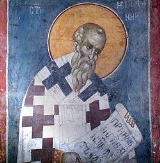
Epiphanius of Salamis

Encyclopedia
Epiphanius of Salamis was bishop of Salamis
at the end of the 4th century
. He is considered a saint
and a Church Father by both the Eastern Orthodox and Catholic Churches. He gained a reputation as a strong defender of orthodoxy
. He is best known for composing a very large compendium
of the heresies
up to his own time, full of quotations that are often the only surviving fragments of suppressed texts, and for instigating, with Tychon (Bishop
of Amathus
), a persecution against the non-Christians living on Cyprus, and the destruction of most of their temples.
family in the small settlement of Besanduk, which is near Eleutheropolis
, Palestine
, and lived as a monk
in Egypt
, where he was educated and came into contact with Valentinian groups. He returned to Palestine
around 333, when he was still a young man, and he founded a monastery at Ad nearby
which is often mentioned in the polemics of Jerome
with Rufinus
and John, Bishop of Jerusalem
. He was ordained a priest
, and lived and studied as superior of the monastery in Ad that he founded for thirty years and gained much skill and knowledge in that position. In that position he gained the ability to speak in several tongues including Hebrew
, Syriac
, Egyptian
, Greek, and Latin
and was called by Jerome on that account Pentaglossis ("Five tongued").
His reputation for learning prompted his nomination and consecration
as Bishop
of Salamis, Cyprus
in 367. He was also the Metropolitan
of the Church of Cyprus. He served as bishop for nearly forty years, as well as traveling widely to combat unorthodox beliefs. He was present at a synod in Antioch
(376) where the Trinitarian questions were debated against the heresy of Apollinarianism
. He upheld the position of Bishop Paulinus
, who had the support of Rome
, over that of Meletius of Antioch
, who was supported by the Eastern Churches. In 382 he was present at the Council of Rome
, again upholding the cause of Paulinus.
During a visit to Palestine in 394 he attacked Origen
's followers and urged the Bishop of Jerusalem, John II, to condemn his writings. Origen's writings were eventually condemned at the Second Council of Constantinople
in 553. When Epiphanius was nearly 80, in 402, at the behest of Bishop Theophilus of Alexandria, the saint went to Constantinople
to support Theophilus in his campaign against Saint John Chrysostom, and the four "Tall Brothers." When he realized he was being used as a tool by Theophilus against Saint John Chrysostom, who had given refuge to the monks persecuted by Theophilus and who were appealing to the emperor, Epiphanius started back to Salamis, only to die on the way home in 403.
and the teachings of Origen
.
His best-known book is the Panarion
which means "medicine-chest" (also known as Adversus Haereses, "Against Heresies"), presented as a book of antidotes for those bitten by the serpent of heresy. Written between 374 and 377, it forms a handbook for dealing with the arguments of heretics.
It lists 80 heresies, some of which are not described in any other surviving documents from the time. While Epiphanius often let his zeal come before facts - he admits on one occasion that he writes against the Origenists based only on hearsay (Panarion, Epiphanius 71) - the Panarion is a valuable source of information on the Christian church of the fourth century. It is also an important source regarding the early Jewish gospels such as the Gospel according to the Hebrews
circulating among the Ebionites
and the Nazarenes
, as well as the followers of Cerinthus
and Merinthus.
The Panarion was only recently (1987 and 1990) translated into English.
Aside from the polemics by which he is known, Epiphanius wrote a work of biblical antiquarian
ism, called, for one of its sections, On Measures and Weights (περί μέτρων καί στάθμων). It was composed in Constantinople for a Persian priest, in 392. The first section discusses the canon of the Old Testament
and its versions, the second of measures and weights, and the third, the geography of Palestine
. The texts appear not to have been given a polish but consist of rough notes and sketches, his modern editor, Allen A. Shaw, concluded; nevertheless Epiphanius' work on metrology
was important in the History of measurement
.
The collection of homilies
traditionally ascribed to a "Saint Epiphanius, bishop" are dated in the late fifth or sixth century and are not connected with Epiphanius of Salamis by modern scholars.
Salamis, Cyprus
Salamis was an ancient Greek city-state on the east coast of Cyprus, at the mouth of the river Pedieos, 6 km north of modern Famagusta. According to tradition the founder of Salamis was Teucer, son of Telamon, who could not return home after the Trojan war because he had failed to avenge his...
at the end of the 4th century
Christianity in the 4th century
Christianity in the 4th century was dominated by Constantine the Great, and the First Council of Nicea of 325, which was the beginning of the period of the First seven Ecumenical Councils and the attempt to reach an orthodox consensus and to establish a unified Christendom as the State church of...
. He is considered a saint
Saint
A saint is a holy person. In various religions, saints are people who are believed to have exceptional holiness.In Christian usage, "saint" refers to any believer who is "in Christ", and in whom Christ dwells, whether in heaven or in earth...
and a Church Father by both the Eastern Orthodox and Catholic Churches. He gained a reputation as a strong defender of orthodoxy
Orthodoxy
The word orthodox, from Greek orthos + doxa , is generally used to mean the adherence to accepted norms, more specifically to creeds, especially in religion...
. He is best known for composing a very large compendium
Compendium
A compendium is a concise, yet comprehensive compilation of a body of knowledge. A compendium may summarize a larger work. In most cases the body of knowledge will concern some delimited field of human interest or endeavour , while a "universal" encyclopedia can be referred to as a compendium of...
of the heresies
Heresy
Heresy is a controversial or novel change to a system of beliefs, especially a religion, that conflicts with established dogma. It is distinct from apostasy, which is the formal denunciation of one's religion, principles or cause, and blasphemy, which is irreverence toward religion...
up to his own time, full of quotations that are often the only surviving fragments of suppressed texts, and for instigating, with Tychon (Bishop
Bishop
A bishop is an ordained or consecrated member of the Christian clergy who is generally entrusted with a position of authority and oversight. Within the Catholic Church, Eastern Orthodox, Oriental Orthodox Churches, in the Assyrian Church of the East, in the Independent Catholic Churches, and in the...
of Amathus
Amathus
Amathus was one of the most ancient royal cities of Cyprus, on the southern coast in front of Agios Tychonas, about 24 miles west of Larnaca and 6 miles east of Limassol...
), a persecution against the non-Christians living on Cyprus, and the destruction of most of their temples.
Ecclesiastical Life
He was born into a ChristianChristian
A Christian is a person who adheres to Christianity, an Abrahamic, monotheistic religion based on the life and teachings of Jesus of Nazareth as recorded in the Canonical gospels and the letters of the New Testament...
family in the small settlement of Besanduk, which is near Eleutheropolis
Eleutheropolis
Eleutheropolis was the Greek name of a Roman city in Israel, some 53 km southwest of Jerusalem. Its remains still straddle the ancient road to Gaza. The site— already rendered as Baitogabra in Ptolemy's Geography— was called Beit Guvrin and Bet Gubrin in the Talmud...
, Palestine
Palestine
Palestine is a conventional name, among others, used to describe the geographic region between the Mediterranean Sea and the Jordan River, and various adjoining lands....
, and lived as a monk
Monk
A monk is a person who practices religious asceticism, living either alone or with any number of monks, while always maintaining some degree of physical separation from those not sharing the same purpose...
in Egypt
Egypt
Egypt , officially the Arab Republic of Egypt, Arabic: , is a country mainly in North Africa, with the Sinai Peninsula forming a land bridge in Southwest Asia. Egypt is thus a transcontinental country, and a major power in Africa, the Mediterranean Basin, the Middle East and the Muslim world...
, where he was educated and came into contact with Valentinian groups. He returned to Palestine
Palestine
Palestine is a conventional name, among others, used to describe the geographic region between the Mediterranean Sea and the Jordan River, and various adjoining lands....
around 333, when he was still a young man, and he founded a monastery at Ad nearby
which is often mentioned in the polemics of Jerome
Jerome
Saint Jerome was a Roman Christian priest, confessor, theologian and historian, and who became a Doctor of the Church. He was the son of Eusebius, of the city of Stridon, which was on the border of Dalmatia and Pannonia...
with Rufinus
Tyrannius Rufinus
Tyrannius Rufinus or Rufinus of Aquileia was a monk, historian, and theologian. He is most known as a translator of Greek patristic material into Latin—especially the work of Origen.-Life:...
and John, Bishop of Jerusalem
Bishop John II of Jerusalem
John II was bishop of Jerusalem from AD 387 to AD 417. John II succeeded to the episcopal throne of Jerusalem on the death of Saint Cyril in 386...
. He was ordained a priest
Priest
A priest is a person authorized to perform the sacred rites of a religion, especially as a mediatory agent between humans and deities. They also have the authority or power to administer religious rites; in particular, rites of sacrifice to, and propitiation of, a deity or deities...
, and lived and studied as superior of the monastery in Ad that he founded for thirty years and gained much skill and knowledge in that position. In that position he gained the ability to speak in several tongues including Hebrew
Hebrew language
Hebrew is a Semitic language of the Afroasiatic language family. Culturally, is it considered by Jews and other religious groups as the language of the Jewish people, though other Jewish languages had originated among diaspora Jews, and the Hebrew language is also used by non-Jewish groups, such...
, Syriac
Syriac language
Syriac is a dialect of Middle Aramaic that was once spoken across much of the Fertile Crescent. Having first appeared as a script in the 1st century AD after being spoken as an unwritten language for five centuries, Classical Syriac became a major literary language throughout the Middle East from...
, Egyptian
Egyptian language
Egyptian is the oldest known indigenous language of Egypt and a branch of the Afroasiatic language family. Written records of the Egyptian language have been dated from about 3400 BC, making it one of the oldest recorded languages known. Egyptian was spoken until the late 17th century AD in the...
, Greek, and Latin
Latin
Latin is an Italic language originally spoken in Latium and Ancient Rome. It, along with most European languages, is a descendant of the ancient Proto-Indo-European language. Although it is considered a dead language, a number of scholars and members of the Christian clergy speak it fluently, and...
and was called by Jerome on that account Pentaglossis ("Five tongued").
His reputation for learning prompted his nomination and consecration
Consecration
Consecration is the solemn dedication to a special purpose or service, usually religious. The word "consecration" literally means "to associate with the sacred". Persons, places, or things can be consecrated, and the term is used in various ways by different groups...
as Bishop
Bishop
A bishop is an ordained or consecrated member of the Christian clergy who is generally entrusted with a position of authority and oversight. Within the Catholic Church, Eastern Orthodox, Oriental Orthodox Churches, in the Assyrian Church of the East, in the Independent Catholic Churches, and in the...
of Salamis, Cyprus
Salamis, Cyprus
Salamis was an ancient Greek city-state on the east coast of Cyprus, at the mouth of the river Pedieos, 6 km north of modern Famagusta. According to tradition the founder of Salamis was Teucer, son of Telamon, who could not return home after the Trojan war because he had failed to avenge his...
in 367. He was also the Metropolitan
Metropolitan bishop
In Christian churches with episcopal polity, the rank of metropolitan bishop, or simply metropolitan, pertains to the diocesan bishop or archbishop of a metropolis; that is, the chief city of a historical Roman province, ecclesiastical province, or regional capital.Before the establishment of...
of the Church of Cyprus. He served as bishop for nearly forty years, as well as traveling widely to combat unorthodox beliefs. He was present at a synod in Antioch
Antioch
Antioch on the Orontes was an ancient city on the eastern side of the Orontes River. It is near the modern city of Antakya, Turkey.Founded near the end of the 4th century BC by Seleucus I Nicator, one of Alexander the Great's generals, Antioch eventually rivaled Alexandria as the chief city of the...
(376) where the Trinitarian questions were debated against the heresy of Apollinarianism
Apollinarism
Apollinarism or Apollinarianism was a view proposed by Apollinaris of Laodicea that Jesus could not have had a human mind; rather, that Jesus had a human body and lower soul but a divine mind....
. He upheld the position of Bishop Paulinus
Paulinus, Bishop of Antioch
Paulinus was a claimant to the See of Antioch from 362 to 388. He was supported by members of the Eustathian party, and was a rival to Meletius of Antioch. The Eustathians objected to Miletius having been consecrated by Arians, and had begun to meet separately...
, who had the support of Rome
Rome
Rome is the capital of Italy and the country's largest and most populated city and comune, with over 2.7 million residents in . The city is located in the central-western portion of the Italian Peninsula, on the Tiber River within the Lazio region of Italy.Rome's history spans two and a half...
, over that of Meletius of Antioch
Meletius of Antioch
Saint Meletius of Antioch was a Christian bishop, or Patriarch of Antioch, from 360 until his death. There were contrasting view about his theological position: on the one hand, he was exiled three times under Arian emperors; on the other, he was strongly opposed by those faithful to the memory...
, who was supported by the Eastern Churches. In 382 he was present at the Council of Rome
Council of Rome
The Council of Rome was a meeting of Christian Church officials and theologians which took place in 382 under the authority of the bishop of Rome, Damasus I. The previous year, the Emperor Theodosius I had appointed the "dark horse" candidate Nectarius Archbishop of Constantinople...
, again upholding the cause of Paulinus.
During a visit to Palestine in 394 he attacked Origen
Origen
Origen , or Origen Adamantius, 184/5–253/4, was an early Christian Alexandrian scholar and theologian, and one of the most distinguished writers of the early Church. As early as the fourth century, his orthodoxy was suspect, in part because he believed in the pre-existence of souls...
's followers and urged the Bishop of Jerusalem, John II, to condemn his writings. Origen's writings were eventually condemned at the Second Council of Constantinople
Second Council of Constantinople
The Second Council of Constantinople is recognized as the Fifth Ecumenical Council by the Eastern Orthodox, Roman Catholics, Old Catholics, and a number of other Western Christian groups. It was held from May 5 to June 2, 553, having been called by the Byzantine Emperor Justinian...
in 553. When Epiphanius was nearly 80, in 402, at the behest of Bishop Theophilus of Alexandria, the saint went to Constantinople
Constantinople
Constantinople was the capital of the Roman, Eastern Roman, Byzantine, Latin, and Ottoman Empires. Throughout most of the Middle Ages, Constantinople was Europe's largest and wealthiest city.-Names:...
to support Theophilus in his campaign against Saint John Chrysostom, and the four "Tall Brothers." When he realized he was being used as a tool by Theophilus against Saint John Chrysostom, who had given refuge to the monks persecuted by Theophilus and who were appealing to the emperor, Epiphanius started back to Salamis, only to die on the way home in 403.
Writings
His earliest known work is the Ancoratus (the well anchored man), which includes arguments against ArianismArianism
Arianism is the theological teaching attributed to Arius , a Christian presbyter from Alexandria, Egypt, concerning the relationship of the entities of the Trinity and the precise nature of the Son of God as being a subordinate entity to God the Father...
and the teachings of Origen
Origen
Origen , or Origen Adamantius, 184/5–253/4, was an early Christian Alexandrian scholar and theologian, and one of the most distinguished writers of the early Church. As early as the fourth century, his orthodoxy was suspect, in part because he believed in the pre-existence of souls...
.
His best-known book is the Panarion
Panarion
In early Christian heresiology, the Panarion , to which 16th-century Latin translations gave the name Adversus Haereses , is the most important of the works of Epiphanius of Salamis...
which means "medicine-chest" (also known as Adversus Haereses, "Against Heresies"), presented as a book of antidotes for those bitten by the serpent of heresy. Written between 374 and 377, it forms a handbook for dealing with the arguments of heretics.
It lists 80 heresies, some of which are not described in any other surviving documents from the time. While Epiphanius often let his zeal come before facts - he admits on one occasion that he writes against the Origenists based only on hearsay (Panarion, Epiphanius 71) - the Panarion is a valuable source of information on the Christian church of the fourth century. It is also an important source regarding the early Jewish gospels such as the Gospel according to the Hebrews
Gospel of the Hebrews
The Gospel of the Hebrews , commonly shortened from the Gospel according to the Hebrews or simply called the Hebrew Gospel, is a hypothesised lost gospel preserved in fragments within the writings of the Church Fathers....
circulating among the Ebionites
Ebionites
Ebionites, or Ebionaioi, , is a patristic term referring to a Jewish Christian sect or sects that existed during the first centuries of the Christian Era. They regarded Jesus as the Messiah and insisted on the necessity of following Jewish religious law and rites...
and the Nazarenes
Nazarene (sect)
The Nazarene sect is used in two contexts:* Firstly of the New Testament early church where in Acts 24:5 Paul is accused before Felix at Caesarea by Tertullus of being "a ringleader of the sect of the Nazarenes."...
, as well as the followers of Cerinthus
Cerinthus
Cerinthus was a gnostic and to some, an early Christian, who was prominent as a "heresiarch" in the view of the early Church Fathers. Contrary to proto-orthodox Christianity, Cerinthus's school followed the Jewish law, used the Gospel according to the Hebrews, denied that the Supreme God had made...
and Merinthus.
The Panarion was only recently (1987 and 1990) translated into English.
Aside from the polemics by which he is known, Epiphanius wrote a work of biblical antiquarian
Antiquarian
An antiquarian or antiquary is an aficionado or student of antiquities or things of the past. More specifically, the term is used for those who study history with particular attention to ancient objects of art or science, archaeological and historic sites, or historic archives and manuscripts...
ism, called, for one of its sections, On Measures and Weights (περί μέτρων καί στάθμων). It was composed in Constantinople for a Persian priest, in 392. The first section discusses the canon of the Old Testament
Old Testament
The Old Testament, of which Christians hold different views, is a Christian term for the religious writings of ancient Israel held sacred and inspired by Christians which overlaps with the 24-book canon of the Masoretic Text of Judaism...
and its versions, the second of measures and weights, and the third, the geography of Palestine
Palestine
Palestine is a conventional name, among others, used to describe the geographic region between the Mediterranean Sea and the Jordan River, and various adjoining lands....
. The texts appear not to have been given a polish but consist of rough notes and sketches, his modern editor, Allen A. Shaw, concluded; nevertheless Epiphanius' work on metrology
Metrology
Metrology is the science of measurement. Metrology includes all theoretical and practical aspects of measurement. The word comes from Greek μέτρον , "measure" + "λόγος" , amongst others meaning "speech, oration, discourse, quote, study, calculation, reason"...
was important in the History of measurement
History of measurement
Units of measurement were among the earliest tools invented by humans. Primitive societies needed rudimentary measures for numerous tasks such as: constructing dwellings of an appropriate size and shape, fashioning clothing, or bartering food or raw materials....
.
The collection of homilies
Homily
A homily is a commentary that follows a reading of scripture. In Catholic, Anglican, Lutheran, and Eastern Orthodox Churches, a homily is usually given during Mass at the end of the Liturgy of the Word...
traditionally ascribed to a "Saint Epiphanius, bishop" are dated in the late fifth or sixth century and are not connected with Epiphanius of Salamis by modern scholars.
Works
- The Panarion of Epiphanius of Salamis, Book I (Sects 1-46) Frank Williams, translator, 1987 (E.J. Brill, Leiden) ISBN 90-04-07926-2
- The Panarion of Epiphanius of Salamis, Book II and III (Sects 47-80, De Fide) Frank Williams, translator, 1993 (E.J. Brill, Leiden) ISBN 90-04-09898-4
- The Panarion of St. Epiphanius, Bishop of Salamis Philip R. Amidon, translator, 1990 (Oxford University Press, New York) ISBN 0-19-506291-4
External links
- St Epiphanius of Salamis Orthodox Icon and Synaxarion
- Epiphanius, On Biblical Weights and Measures English translation of a Syriac text
- Some excerpts from the Panarion
- (Further excerpts from the Panarion) – Currently dead.
- Letter from Epiphianus, Bishop of Salamis, in Cyprus, to John, Bishop of Jerusalem
- Opera Omnia by Migne Patrologia Graeca with analytical indexes