
All Topics  
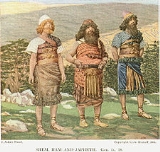
Shem


   Email Print
   Bookmark   Link


Shem


Shem ( ; ; Arabic: ; Ge'ez
Ge'ez language

Ge'ez is an ancient South Semitic language that developed in the current region of Eritrea and northern Ethiopia in the Horn of Africa. It later became the official language of the Kingdom of Aksum and Ethiopian imperial court....
: ??, Sem; "renown; prosperity; name") was one of the sons of Noah
Sons of Noah

The Table of Nations or Sons of Noah is an extensive list of descendants of Noah appearing within the Torah at Genesis 10, representing an ethnology from an Iron Age Levantine perspective and its reflections in the medieval and modern history and genealogy researches....
 in the Bible
Bible

The Bible is the central religious text of Judaism and Christianity. The exact Books of the Bible is dependent on the religious traditions of specific denominations....
. He is most popularly regarded as the eldest son, though some traditions regard him as the second son. Genesis 10:21 refers to relative ages of Shem and his brother Japheth
Japheth

Japheth is one of the sons of Noah in the Bible. In Arabic language citations, his name is normally given as Yafeth ibn Nuh ....
, but with sufficient ambiguity in each to have yielded different translations. The verse is translated in the KJV as "Unto Shem also, the father of all the children of Eber
Eber

Eber or Heber, is a person from the Hebrew Bible and Muslim Qur'an. He was a great-grandson of Noah's son Shem and the father of Peleg and Joktan....
, the brother of Japheth the elder, even to him were children born.".


Discussion
Ask a question about 'Shem'
Start a new discussion about 'Shem'
Answer questions from other users
Full Discussion Forum


Recent Posts


Encyclopedia


Shem ( ; ; Arabic: ; Ge'ez
Ge'ez language

Ge'ez is an ancient South Semitic language that developed in the current region of Eritrea and northern Ethiopia in the Horn of Africa. It later became the official language of the Kingdom of Aksum and Ethiopian imperial court....
: ??, Sem; "renown; prosperity; name") was one of the sons of Noah
Sons of Noah

The Table of Nations or Sons of Noah is an extensive list of descendants of Noah appearing within the Torah at Genesis 10, representing an ethnology from an Iron Age Levantine perspective and its reflections in the medieval and modern history and genealogy researches....
 in the Bible
Bible

The Bible is the central religious text of Judaism and Christianity. The exact Books of the Bible is dependent on the religious traditions of specific denominations....
. He is most popularly regarded as the eldest son, though some traditions regard him as the second son. Genesis 10:21 refers to relative ages of Shem and his brother Japheth
Japheth

Japheth is one of the sons of Noah in the Bible. In Arabic language citations, his name is normally given as Yafeth ibn Nuh ....
, but with sufficient ambiguity in each to have yielded different translations. The verse is translated in the KJV as "Unto Shem also, the father of all the children of Eber
Eber

Eber or Heber, is a person from the Hebrew Bible and Muslim Qur'an. He was a great-grandson of Noah's son Shem and the father of Peleg and Joktan....
, the brother of Japheth the elder, even to him were children born.". However, the New American Standard Bible
New American Standard Bible

The New American Standard Bible is an English language translation of the Bible.The New Testament was first published in 1963. The complete Bible was published in 1971....
 gives, "Also to Shem, the father of all the children of Eber, and the older brother of Japheth, children were born."

Genesis 11:10 records that Shem was 100 years old at the birth of Arpachshad two years after the flood, making him 98 at the time of the flood; and that he lived for another 500 years after this, making his age at death 600 years.

The children of Shem were Elam
Elam (Hebrew Bible)

Elam in the Hebrew Bible is said to be the oldest son of Shem, the son of Noah. It is also used , for the country of Elam in what is now southern Iran, that the Hebrews believed to be the offspring of Elam, son of Shem....
, Asshur, Aram
Aram, son of Shem

According to the Table of Nations in Book of Genesis 10 of the Hebrew Bible, Aram was a son of Shem, and the father of Uz , Hul, Gether and Mash....
, Arpachshad
Arpachshad

Arpachshad or Arphaxad or Arphacsad was one of the five sons of Shem, the son of Noah . His brothers were Elam, Asshur, Lud son of Shem and Aram; he is an ancestor of Abraham....
 and Lud
Lud son of Shem

Lud was a son of Shem and grandson of Noah, according to Genesis 10 . Lud should not be confused with the Ludim, said there to be descended from Mizraim....
, in addition to daughters. Abraham
Abraham

Abraham is a man featured in the Book of Genesis and an important figure in several monotheistic religions. Judaism, Christianity and Islam traditions regard him as the founding Patriarchs of the Israelites, Ishmaelites and Edomite peoples....
, the patriarch of the Hebrews and Arabs, was one of the descendants of Arpachshad.

The 1st century historian Flavius Josephus, among many others, recounted the tradition that these five sons were the progenitors of the nations of Elam
Elam

Elam was an ancient civilization located in what is now southwest Iran.Elam was centered in the far west and southwest of modern-day Iran, stretching from the lowlands of Khuzestan and Ilam Province , as far as Jiroft in Kerman province and Burned City in Zabol, as well as a small part of southern Iraq....
, Assyria
Assyria

Assyria was a political state centered on the Upper Tigris river, in Mesopotamia , that came to rule regional empires a number of times in history....
, Syria
Syria

Syria , officially the Syrian Arab Republic , is an Arab-majority country in Southwest Asia, bordering Lebanon and the Mediterranean Sea to the west, Israel to the southwest, Jordan to the south, Iraq to the east, and Turkey to the north....
, Chaldea
Chaldea

Chaldea , "the Chaldees" of the King James Version of the Bible Old Testament, was a Hellenistic designation for a part of Babylonia, mainly around Sumerian Ur, which became an independent kingdom under the Chaldees....
 (from whom descended the Hebrews and Arabs), and Lydia
Lydia

Lydia was an Iron Age kingdom of western Asia Minor located generally east of ancient Ionia in the modern Turkey provinces of Manisa Province and inland Izmir Province....
, respectively.

Terms like "Semite" and "Hamite" are less common now, and may sometimes even be perceived as offensive, because of their "racial" connotations. The adjectival forms "Semitic
Semitic

In linguistics and ethnology, Semitic was first used to refer to a language family of largely Middle Eastern origin, now called the Semitic languages....
" and "Hamitic
Hamitic

Hamitic is a historical term for the peoples supposedly descended from Noah's son Ham, son of Noah, paralleling Semitic and Japhetic.It used to be used for grouping the non-Semitic Afro-Asiatic languages , but since, unlike the Semitic branch, these have not been shown to form a phylogenetic unity, the term is obsolete in this sense....
" are more common, though the vague term 'Hamitic' dropped out of mainstream academic use in the 1960s. Semitic is still a commonly used term for the Semitic languages
Semitic languages

File:Amarna Akkadian letter.pngThe Semitic languages are a group of related languages whose living representatives are spoken by more than 467 million people across much of the Middle East, North Africa and the Horn of Africa....
, as a subset of the Afro-Asiatic languages
Afro-Asiatic languages

The Afro-Asiatic languages constitute a language family with about 375 living languages and more than 300 million speakers spread throughout North Africa, the Horn of Africa, and Southwest Asia ....
, denoting the common linguistic heritage of Arabic
Arabic language

Arabic is a Central Semitic language, thus related to and classified alongside other Semitic languages languages such as Hebrew language and Aramaic language....
, Aramaic
Aramaic language

Aramaic is a Semitic languages with a 3,000-year history. It has been the language of administration of empires and the language of divine worship....
, Akkadian
Akkadian language

Akkadian or Assyrian-Babylonian is a Semitic language that was spoken in ancient Mesopotamia. The earliest attested Semitic language, it used the cuneiform writing system derived ultimately from ancient Sumerian language, an unrelated language isolate....
, Ethiopic, Hebrew
Hebrew language

Hebrew is a Semitic languages of the Afro-Asiatic languages. Modern Hebrew is spoken by more than seven million people in Israel and Classical Hebrew is used for prayer or study in Jews communities around the world....
 and Phoenician languages.

'Semitic' also appears in the phrase "anti-Semitic" to refer to racial, ethnic or cultural prejudice aimed exclusively at Jew
Jew

A Jew is a member of the Jewish people, an ethnoreligious group that traces its ancestry to the Israelites or Hebrews of the Ancient Near East....
s.

According to some Jewish traditions (e.g., B. Talmud
Talmud

The Talmud is a record of rabbinic discussions pertaining to Halakha, Jewish ethics, customs, and history. It is a central text of mainstream Judaism....
 Nedarim 32b; Genesis Rabba
Genesis Rabba

Genesis Rabba is a religious text from Judaism's classical period. It is a midrash comprising a collection of ancient rabbi homiletical interpretations of the book of Genesis ....
h 46:7; Genesis Rabbah 56:10; Leviticus Rabbah
Leviticus Rabbah

Leviticus Rabbah, Vayikrah Rabbah, or Wayikra Rabbah is a homiletic midrash to the Biblical book of Leviticus . It is referred to by Nathan ben Jehiel in his Aruk as well as by Rashi in his commentaries on and elsewhere....
 25:6; Numbers Rabbah 4:8.), Shem is believed to have been Melchizedek
Melchizedek

Melchizedek is an enigmatic figure twice mentioned in the Tanakh, also known as the Old Testament. Melchizedek seems to be the King of Salem, and priest of the Most High, in the time of the biblical patriarch Abram....
, King of Salem whom Abraham is recorded to have met after the battle of the four kings. Other legends say that he opened a religious academy, and, due to his long life, even his very-distant descendents who kept the belief in God, like Jacob
Jacob

According to the Hebrew Bible, Jacob , also known as Israel , was the third Biblical patriarchs and the ancestor of the twelve Israelites....
, were able to attend it.

In a few of the many extra-biblical sources that describe him, Shem is also credited with killing Nimrod
Nimrod

Nimrod means "Hunter"; was a Biblical Mesopotamian king mentioned in the Table of Nations. The term Nimrod when vague or general is applied to the means of hunter, normally to a person....
, son of Cush.

Shem is mentioned in Genesis
Genesis

Genesis or Breishit is the first book of the Bible used by Judaism and Christianity, and the first of five books of the Pentateuch or Torah....
 5:32, 6:10; 7:13; 9:18,23,26-27; 10; 11:10; also in 1 Chronicles 1:4.

Genealogies according to "Book of Jasher"


A rabbinic document that surfaced in the 1600s, claiming to be the lost "Book of Jasher
Sefer haYashar (midrash)

Sefer haYashar , a Hebrew language midrash known in English translation mostly as The Book of Jasher. The book is named after the Sefer HaYashar mentioned in Book of Joshua and 2 books of Samuel....
" provides some names not found in any other source. Some have reconstructed more complete genealogies based on this information as follows:

Shem. Also Sem. Literal meanings are named or renown (father of the Semitic races - Shemites). The sons of Shem were:

  • Elam "eternity" (sons were Shushan, Machul and Harmon) - (Elamites, Khuzestanis)


  • Asshur "a step" or "strong" (sons were Mirus and Mokil) - (Assyrians
    Assyrians

    Assyrians or Assyrian people may refer to :*the Ancient Assyrians*the modern Assyrian/Chaldean/Syriac peopleSee also*Assyrian ...


  • Arphaxad (sons were Shelach, Anar and Ashcol) - Hebrews (Israelites, Moabites, Ammonites, Edomites, and related groups)


  • Lud "strife" (sons were Pethor and Bizayon) - (Ludim, Lubim, Ludians, Ludu, Lydians
    Lydians

    Lydians were the inhabitants of Lydia, a region in western Anatolia.Their capital was at Sardis.Their governmental system included kings,as their rulers....
    , and other related groups in Asia Minor.


  • Aram "exalted" (sons were Uz, Chul, Gather and Mash) - (Aramaeans
    Aramaeans

    The Aramaeans were a West Semitic semi-nomadic and pastoralist people who lived in upper Mesopotamia and Aram . Aramaeans never had a unified empire; they were divided into independent kingdoms all across the Near East....
    .


Other proposed lineages from Shem


Europeans

Some believe that from Shem descend the whole of the European peoples. Ernest L. Martin writes, "...[The] Shemite tribes (people who were descendants of Shem and including some peoples who came from Abraham) later colonized the whole of southern Europe and replaced the people of JAVAN and his four descendants. JAVAN'S people were pushed mainly into the northern areas of Europe where in turn they migrated farther east into Asia (along with GOMER the firstborn son of JAPHETH and his descendants). Indeed, in prophecies dealing also with the End-Time, we find the people of JAVAN no longer in Europe, but they are now associated with TUBAL [Ezekiel 38: & 39 end time prophecy] (another son of JAPHETH) who became an eastern Mongolian type of people...though the name JAVAN still retained its geographical hold on the southern region of Europe, particularly in Greece)...It is not uncommon for people to give a name to a region and then the original people move on to other areas (or are killed off) and the original geographical name becomes associated with completely different people"

Germanic
Some scholars have claimed that the Anglo-Saxons are the descendants of Shem. "Alfred, king of the Anglo-Saxons [b. 849 A.D.] was... the son [descendant] of Sem [Shem]" (Church Historians of England, vol. 2, p. 443). Proponents of this theory also claim that Alfred the Great
Alfred the Great

Alfred the Great , also spelled ?lfred, was king of the southern Anglo-Saxons kingdom of Wessex from 871 to 899. Alfred is noted for his defence of the kingdom against the Danish people Vikings, becoming the only English people king to be awarded the epithet "the Great"....
 was a descendant of Shem because he claimed to descend from Sceafa, a marooned man who came to Britain on a boat after a flood.

Le Petit, a writer in 1601 mentioned King Adel, said to be descendant of Shem, ruler of Britain having 3 children that migrated to India.

Further, it is said that Tuitsch a German patriarch is none other than Shem himself (see Assyrian-German theory).

Hellenistic (Greek)
A text from Islam claims that the Greeks derived from Shem: Tabari II:11 “Shem, the son of Noah was the father of the Arabs, the Persians, and the Greeks;...

In Serge A. Zenkovsky's, Medieval Russia's Epics, Chronicles, and Tales, "To the lot of Shem fell the Orient, and his share extended lengthwise as far as India and breadthwise (from east to south) as far as Phinocorura, including Persia and Bactria, as well as Syria, Media (which lies beside the Euphrates River), Babylon, Cordyna, Assyria, Mesopotamia, Arabia the Ancient, Elymais, India, Arabia the Mighty, Coelesyria, Commagene, and all Phoenicia."

Indo-Iranians
According to Abulgazi, Shem's original land was Iran while Japheth's was the country called "Kuttup Shamach," said to be the name of the regions between the Caspian Sea and India.

According to Armenian tradition, Dr. Hales is quoted saying, "To the sons of Shem was alloted the middle region of the earth viz., Palestine, Syria, Assyria, Samaria (Shinar?) Babel (or Babylonia), Persia and Hedjaz (Arabia).

In Mystery of the Ages, by Dr. James Modlish, it is said that India is inhabited by Shemites.

Hisham Ibn al-Kalbi
Hisham Ibn Al-Kalbi

Hisham Ibn Al-Kalbi, full name Abu al-Mundhir Hisham b. Muhammed b. al-Sa'ib b. Bishr al-Kalbi was an Arab historian.Al-Kalbi was born in Kufa, but spent much of his life in Baghdad....
, a 19th century Arab historian, states that al-Hind and al-Sind [India] are of Ophir
Ophir

Ophir is a port or region mentioned in the Bible, famous for its wealth. King Solomon is supposed to have received a cargo of gold, silver, sandalwood, precious stones, ivory, apes and peacocks from Ophir, every three years....
, the son of Joktan
Joktan

Joktan or Yoktan was the second of the two sons of Eber mentioned in the Hebrew Bible. His name means "small" or "smallness".In the Book of Genesis 10:25 it reads: "And unto Eber were born two sons: the name of one was Peleg; for in his days was the earth divided; and his brother's name was Joktan."...
. Isidore of Seville
Isidore of Seville

Saint Isidore of Seville was Archbishop of Seville for more than three decades and has the reputation of being one of the greatest scholars of the early Middle Ages....
 (c. 635) had also made Joktan the ancestor of Indians; his material was based on earlier enumerations made by Jerome and Josephus, who had stated that Joktan's descendants "inhabited from Cophen, an Indian river, and in part of Asia adjoining to it."

African
In Genesis, while Sheba
Sheba

Sheba was a southern kingdom mentioned in the Tanakh and the Qur'an. The actual location of the historical kingdom is disputed between southern Arabia and the Horn of Africa; the kingdom may have been situated in either present-day Ethiopia or present-day Yemen, or both....
 and Seba
Seba

Sebastian Ahrenberg, better known as Seba is a drum and bass Record producer and DJ hailing originally from Ingar?, an island just outside of Stockholm, Sweden....
 are listed among descendants of Cush son of Ham in 10:7, another Sheba is listed as a son of Joktan, son of Eber in 10:28. These names are associated with Semitic tribes on both sides of the Red Sea in Yemen
Yemen

Yemen , officially the Republic of Yemen is an Arab country located on the Arabian Peninsula in Southwest Asia. Yemen has an estimated population of more than 23 million people and is bordered by Saudi Arabia to the North, the Red Sea to the West, the Arabian Sea and Gulf of Aden to the South, and Oman to the east....
 and Eritrea
Eritrea

Eritrea , officially the Country of Eritrea, is a country in Northeast Africa. It is bordered by Sudan in the west, Ethiopia in the south, and Djibouti in the southeast....
 (See Sabaeans
Sabaeans

The Sabaeans or Sab?ans were an ancient people speaking an Old South Arabian language who lived in what is today Yemen, in south west Arabian Peninsula; from 2000 BC to the 8th century BC....
). This situation may reflect a combined Hamito-Semitic ancestry postulated for Ethiopian peoples.

Racial connotations


Tawny of Brown

In the modern times, many people including scholars associate the 3 patriarchs of human cultures with distinct racial features in each of the three. That is, Shem, the oldest son of Noah is said to be yellow-brown; Japheth, white; and Ham, black.

Also, according to The History of the Church of God:
"The world was to some extent divided between Noah’s three sons, so that we may in general reckon Asia to Shem, Africa to Ham, and Europe to Japheth[9] — though, of course, there was some crossing of these lines by each."


The Jewish text Pirqei R. Eliezer, depicts God as dividing the earth among Noah‘s sons, Shem, Ham, and Japhet, and attributing different skin colors to them (literally, —blessing“ them with different skin colors): light colored skin for the Japhetites, medium dark or brown for the Semites, and very dark or black for the Hamites.

This passage again from Pirqei R. Eliezer, a writing which was composed in Israel after the Islamic conquest, is strikingly paralleled in an Arabic text of approximately the same period. The historian abari (d. 923) quotes Ibn Abbas (d. 686-8) as saying:
Born to Noah were Shem, whose descendants were tawny-white (baya wa-adma); Ham, whose descendants were black with hardly any whiteness (sawad wa-baya qalil); and Japheth, whose descendants were reddish-white (al-luqra
wal- umra.)

From the same author also comes his commentary of Gen 5:32:
" 'And Noah begat Shem and Ham and Japheth.' That is Shem is the father of the swarthy, and Ham of the blacks, and Japheth of the whites." Then on the commentary on Gen 10:32, "...the red [smqry'] sons of Japheth,... the black sons of Ham,... and the swarthy sons of Shem."


The tradition is repeated in the 13th century by the Christian Ibn al- Ibri (Bar Hebraeus), known for the —fidelity with which he reproduces earlier writers. Again in another work, Bar Hebraeus speaks of Noah dividing the world among his three sons, with Ham getting the Land of the Blacks (sudan), Shem the Land of the Browns (sumra), and Japheth the Land of the Reds (luqra).

"According to ISBE, Shem means "dusky", and Japheth means "fair." (McKissick, Beyond Roots. P. 108).

According to Armenian tradition, Shem had the region of the tawny.

Red

Josiah Preist (1788–1851) believed that Shem, because he was a descendant in the Adamic line, and because "Adam" means reddish in Hebrew, that Shem too was of the "reddish
Red hair

Red hair varies from a deep orange-red through orange #Burnt orange to bright copper . It is characterized by high levels of the reddish pigment Melanin#Melanin in humans and relatively low levels of the dark pigment Melanin#Melanin in humans....
 race". Further, he believe that because Christ was a descendant in the line of Shem, that Christ was of "copper-colored stock".

White

Discussing the backgrounds of the Magi
Magi

File:Adoracao_dos_magos_de_Vicente_Gil.jpgMagi is a term, used since at least the 4th century BCE, to denote a follower of Zoroaster, or rather, a follower of what the Hellenistic civilization associated Zoroaster with, which was – in the main – the ability to read the stars, and manipulate the fate that the stars foretold....
 Three Wise Men, Benjamin Walker writes:
"Balthasar belonged to the white race of Shem and brought the infant gold, symbol of the incarnation. Melchior belonged to the black race of Ham, and brought frankincense, symbol of the crucifixion. Caspar belonged to the yellow race of Japheth, and brought myrrh, symbol of the resurrection."


See also

  • Wives aboard the Ark
    Wives aboard the Ark

    Although the Book of Genesis in the Bible does not give any further information about the four women it says were aboard Noah's Ark during the Deluge , there exist substantial extra-Biblical traditions regarding these women and their names....
  • Subarians
    Subarians

    The land of Subar or Subartu was situated at the Tigris, north of Babylonia. The name also appears in the Amarna letters, and, in the form ?br, in Ugarit....
  • Finnegans Wake
    Finnegans Wake

    Finnegans Wake is a work of Comic novel by Irish literature James Joyce, which is recognised for its difficulty for the reader and its experimental style....


Further reading


External links