

English people

Encyclopedia
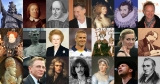
The English are a nation and ethnic group
native to England, who speak English
. The English identity is of early mediaeval
origin, when they were known in Old English as the Anglecynn. England is now a country of the United Kingdom
, and the majority of English people in England are British Citizens
. Their ethnonym
is derived from the Angles
, a Germanic people originally from Northern Germany
who migrated to Britain.
Historically, the English population is descended from several genetically
similar peoples—the earlier Britons (or Brythons)
, the Germanic tribes that settled in the area, including Angles
, Saxons
, and Jutes
, collectively known as the Anglo-Saxons
, who founded what was to become England (from the Old English Englaland), and the later Danes
, Normans
and other groups. Following the Act of Union
in 1707, in which the Kingdom of England
became part of the Kingdom of Great Britain
, English customs and identity became closely aligned with British customs and identity.
Today, some English people have recent forbears from other parts of the United Kingdom, while some are also descended from more recent immigrants from other European countries and from the Commonwealth
. Through their position at the centre of the former British Empire
, the English are the source of the English language, the parliamentary system
, common law systems of many countries
and a variety of the globe's most popular sports.
within the United Kingdom, the English may still be regarded as a "nation" according to the Oxford English Dictionary
s definition: a group united by factors that include "language, culture, history, or occupation of the same territory".
The concept of an "English nation" is far older than that of the "British nation", and the 1990s witnessed a revival in English self-consciousness. This is linked to the expressions of national self-awareness of the other British nations of Wales and Scotland – which take their most solid form in the new devolved
political arrangements within the United Kingdom – and the waning of a shared British national identity with the growing distance between the end of the British Empire
and the present.
While prescriptions of English national identity can involve beliefs in common descent, most political English nationalists
do not consider Englishness to be dependent upon kinship
.
Many recent migrants to England have assumed a solely British identity, while others have developed dual or hyphenated identities. Use of the word "English" to describe Britons from ethnic minorities in England is complicated by most non-white people in England identifying as British rather than English. In their 2004 Annual Population Survey, the Office of National Statistics compared the ethnic identities of British people with their perceived national identity. They found that while 58% of white people described their nationality as "English", the vast majority of non-white people called themselves "British".
for 'Irish'
and for 'Scottish'
, there were none for 'English', or 'Welsh'
, who were subsumed into the general heading 'White British'. Following complaints about this, the 2011 census will "allow respondents to record their English, Welsh, Scottish, Northern Irish, Irish or other identity." Another complication in defining the English is a common tendency for the words "English" and "British" to be used interchangeably, especially overseas. In his study of English identity, Krishan Kumar
describes a common slip of the tongue in which people say "English, I mean British". He notes that this slip is normally made only by the English themselves and by foreigners: "Non-English members of the United Kingdom rarely say 'British' when they mean 'English'". Kumar suggests that although this blurring is a sign of England's dominant position with the UK, it is also "problematic for the English [...] when it comes to conceiving of their national identity. It tells of the difficulty that most English people have of distinguishing themselves, in a collective way, from the other inhabitants of the British Isles".
In 1965, the historian A. J. P. Taylor
wrote,
However, although Taylor believed this blurring effect was dying out, in his book The Isles (1999), Norman Davies
lists numerous examples in history books of "British" still being used to mean "English" and vice versa.
In December 2010, Matthew Parris
of The Spectator
, analysing the use of “English” over “British”, argued that English identity, rather than growing, had existed all along but has recently been unmasked from behind a veneer of Britishness.
, Germanic
tribes that migrated to Great Britain following the end of the Roman occupation of Britain, with assimilation of later migrants such as the Vikings and Normans
. This version of history is considered by some historians and geneticists as simplistic or even incorrect. Recently, historians have questioned the assumption that the English are primarily descended from Anglo-Saxons. Based on a re-estimation of the number of settlers, there is a view that it is highly unlikely that the existing British Celtic population was substantially displaced by the Anglo-Saxons, and the latter were merely a ruling elite who imposed their culture on the local populations. However, many historians, while making allowance for British survival, still hold to the view that there was significant displacement of the indigenous population.
In any event, the Celts, particularly in their use of Brythonic languages
such as Cornish
, Cumbric
, and Welsh
, held on for several centuries in parts of England such as Cornwall
, Devon, Cumbria
and a part of Lancashire
. However, the notion of the Anglo-Saxon English has traditionally been important in defining English identity and distinguishing the English from their Celtic neighbours, such as the Scots
, Welsh
, Cornish
and Irish. Historian Catherine Hills describes what she calls the "national origin myth" of the English:
A popular interest in English identity is evident in the recent reporting of scientific and sociological investigations of the English, in which complex results are heavily simplified. In 2002, the BBC
used the headline "English and Welsh are races apart" to report a genetic survey of test subjects from market town
s in England and Wales, while in September 2006, The Sunday Times
reported that a survey of first names and surnames in the UK had identified Ripley
in Derbyshire as "the 'most English' place in England with 88.58% of residents having an English ethnic background". The Daily Mail
printed an article with the headline "We're all Germans! (and we have been for 1,600 years)". In all these cases, the language of race is employed by the journalists.
In addition, several recent books by Stephen Oppenheimer
and Bryan Sykes
, have argued that the recent genetic studies in fact do not show a clear dividing line between the English and their 'Celtic' neighbours, but that there is a gradual clinal
change from west coast Britain to east coast Britain. They suggest that the majority of the ancestors of British peoples were the original palaeolithic settlers of Great Britain, and that the differences that exist between the east and west coasts of Great Britain though not large, are deep in prehistory, mostly originating in the upper palaeolithic and Mesolithic (15,000–7,000 years ago). Furthermore, Oppenheimer states that genetic testing has proven that "75% of British and Irish ancestors arrive[d] between 15,000 and 7,500 years ago" (that is, long before the arrival of the Anglo-Saxons).
Oppenheimer also claims that Celtic
split from Indo-European earlier than previously suspected, some 6000 years ago, while English split from Germanic
before the Roman period. Oppenheimer believes that a Germanic language that became English was spoken by the tribes of what is now England long before the arrival of the Anglo-Saxon and also discounts the view that the people of the area were ever Celtic.
s, Celt
ic Britons
, and Roman
colonists. This is because up to and during the Roman occupation of Britain, the region now called England was not a distinct country; all the native inhabitants of Britain spoke Brythonic languages
and were regarded as Britons (or Brythons) divided into many tribe
s. The word "English" refers to a heritage that began with the arrival of the Anglo-Saxons
in the 5th century, who settled lands already inhabited by Romano-British tribes. That heritage then comes to include later arrivals, including Scandinavians, Normans
, as well as those Romano-Britons who still lived in England.
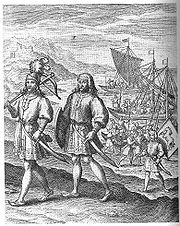 The first people to be called 'English' were the Anglo-Saxons
, a group of closely related Germanic
tribes that began migrating to eastern and southern Great Britain, from southern Denmark
and northern Germany, in the 5th century AD, after the Romans had withdrawn from Britain. The Anglo-Saxons gave their name to England (Engla land, meaning "Land of the Angles") and to the English.
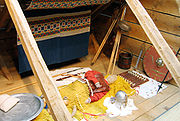 The Anglo-Saxons arrived in a land that was already populated by people commonly referred to as the 'Romano-British
'—the descendants of the native Brythonic-speaking population that lived in the area of Britain under Roman rule during the 1st–5th centuries AD. The multi-ethnic nature of the Roman Empire meant that small numbers of other peoples may have also been present in England before the Anglo-Saxons arrived. There is archaeological evidence, for example, of an early North African presence in a Roman garrison at Aballava, now Burgh-by-Sands, in Cumbria; a fourth-century inscription says that the Roman military unit Numerus Maurorum Aurelianorum ("unit of Aurelian Moors") from Muretania (Morocco) was stationed there.
The exact nature of the arrival of the Anglo-Saxons
and their relationship with the Romano-British is a matter of debate. Traditionally, it was believed that a mass invasion by various Anglo-Saxon tribes largely displaced the indigenous British population in southern and eastern Great Britain (modern day England with the exception of Cornwall
). This was supported by the writings of Gildas
, the only contemporary historical account of the period, describing slaughter and starvation of native Britons by invading tribes (aduentus Saxonum).
Added to this was the fact that the English language contains no more than a handful of words borrowed from Brythonic
sources (although the names of some towns, cities, rivers etc. do have Brythonic or pre-Brythonic origins, becoming more frequent towards the west of Britain). However, this view has been re-evaluated by some archaeologists and historians since the 1960s, and more recently supported by genetic studies, who see only minimal evidence for mass displacement. Archaeologist Francis Pryor
has stated that he "can't see any evidence for bona fide mass migrations after the Neolithic
."
While the historian Malcolm Todd writes "It is much more likely that a large proportion of the British population remained in place and was progressively dominated by a Germanic aristocracy, in some cases marrying into it and leaving Celtic names in the, admittedly very dubious, early lists of Anglo-Saxon dynasties. But how we identify the surviving Britons in areas of predominantly Anglo-Saxon settlement, either archaeologically or linguistically, is still one of the deepest problems of early English history."
In a survey of the genes of British and Irish men, even those British regions that were most genetically similar to (Germanic speaking) continental regions were still more genetically British than continental: "When included in the PC analysis, the Frisians were more 'Continental' than any of the British samples, although they were somewhat closer to the British ones than the North German/Denmark sample. For example, the part of mainland Britain that has the most Continental input is Central England, but even here the AMH+1
frequency, not below 44% (Southwell), is higher than the 35% observed in the Frisians. These results demonstrate that even with the choice of Frisians as a source for the Anglo-Saxons, there is a clear indication of a continuing indigenous component in the English paternal genetic makeup."
assaults on the coastlines of the British Isles
were gradually followed by a succession of Danish settlers in England. At first, the Vikings were very much considered a separate people from the English. This separation was enshrined when Alfred the Great
signed the Treaty of Alfred and Guthrum
to establish the Danelaw
, a division of England between English and Danish rule, with the Danes occupying northern and eastern England.
However, Alfred's successors subsequently won military victories against the Danes, incorporating much of the Danelaw into the nascent kingdom of England. Danish invasions continued into the 11th century, and there were both English and Danish kings in the period following the unification of England (for example, Æthelred II
(978–1013 and 1014–1016) was English but Cnut (1016–1035) was Danish).
Gradually, the Danes in England came to be seen as 'English'. They had a noticeable impact on the English language: many English words, such as anger, ball, egg, got, knife, take, and they, are of Old Norse origin, and place names that end in -thwaite and -by are Scandinavian in origin.
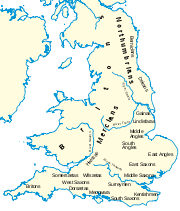 The English population was not politically unified until the 10th century. Before then, it consisted of a number of petty kingdom
s which gradually coalesced into a Heptarchy
of seven powerful states, the most powerful of which were Mercia
and Wessex
. The English nation state began to form when the Anglo-Saxon kingdoms united against Danish Viking invasions, which began around 800 AD. Over the following century and a half England was for the most part a politically unified entity, and remained permanently so after 959.
The nation of England was formed in 937 by Athelstan of Wessex
after the Battle of Brunanburh
, as Wessex grew from a relatively small kingdom in the South West to become the founder of the Kingdom of the English, incorporating all Anglo-Saxon
kingdoms and the Danelaw
.
 The Norman conquest of England
during 1066 brought Anglo-Saxon and Danish rule of England to an end, as the new Norman
elite almost universally replaced the Anglo-Saxon aristocracy and church leaders. After the conquest, "English" normally included all natives of England, whether they were of Anglo-Saxon, Scandinavian or Celtic ancestry, to distinguish them from the Norman invaders, who were regarded as "Norman" even if born in England, for a generation or two after the Conquest. The Norman dynasty ruled England for 87 years until the death of King Stephen
in 1154, when the succession passed to Henry II
, House of Plantagenet
(based in France), and England became part of the Angevin Empire
until 1399.
Various contemporary sources suggest that within fifty years of the invasion most of the Normans outside the royal court had switched to English, with Anglo-Norman
remaining the prestige language of government and law largely out of social inertia. For example, Orderic Vitalis, a historian born in 1075 and the son of a Norman knight, said that he learned French only as a second language. Anglo-Norman continued to be used by the Plantagenet kings until Edward I
came to the throne. Over time the English language became more important even in the court, and the Normans were gradually assimilated, until, by the 14th century, both rulers and subjects regarded themselves as English and spoke the English language.
Despite the assimilation of the Normans, the distinction between 'English' and 'French' survived in official documents long after it had fallen out of common use, in particular in the legal phrase Presentment of Englishry (a rule by which a hundred had to prove an unidentified murdered body found on their soil to be that of an Englishman, rather than a Norman, if they wanted to avoid a fine). This law was abolished in 1340.
, which today is called the United Kingdom. Wales
was annexed
by England by the Laws in Wales Acts 1535–1542, which incorporated Wales into the English state. A new British identity was subsequently developed when James VI of Scotland became James I of England
as well, and expressed the desire to be known as the monarch of Britain.
In 1707, England formed a union with Scotland
by passing an Act of Union
in March 1707 that ratified the Treaty of Union
. The Parliament of Scotland
had previously passed its own Act of Union, so the Kingdom of Great Britain
was born on 1 May 1707. In 1801, another Act of Union
formed a union between the Kingdom of Great Britain and the Kingdom of Ireland
, creating the United Kingdom of Great Britain and Ireland
. In 1922, about two thirds of the Irish population (those who lived in twenty-six of the thirty-two counties of Ireland), left the United Kingdom to form the Irish Free State
. The remainder became
the United Kingdom of Great Britain and Northern Ireland, although this name was not introduced until 1927, after some years in which the term "United Kingdom" had been little used.
Throughout the history of the UK, the English have been dominant in population and in political weight. As a consequence, notions of 'Englishness' and 'Britishness' are often very similar. At the same time, after the Union of 1707, the English, along with the other peoples of the British Isles, have been encouraged to think of themselves as British rather than to identify themselves with the constituent nations.
and intermarried
with the English. Since Oliver Cromwell
's resettlement of the Jews
in 1656, there have been waves of Jewish immigration from Russia
in the nineteenth century and from Germany in the twentieth.
After the French king Louis XIV
declared Protestantism illegal in 1685 with the Edict of Fontainebleau
, an estimated 50,000 Protestant Huguenot
s fled to England. Due to sustained and sometimes mass emigration from Ireland, current estimates indicate that around 6 million people in the UK have at least one grandparent born in Ireland.
There has been a black
presence in England since at least the 16th century due to the slave trade and an Indian presence since the mid 19th century because of the British Raj
. Black
and Asian
proportions have grown in England as immigration from the British Empire and the subsequent Commonwealth of Nations
was encouraged due to labour shortages during post-war rebuilding.
However, these groups are often still considered to be ethnic minorities and research has shown that black and Asian people in the UK are more likely to identify as British rather than with one of the state's four constituent nations, including England.
was previously more commonly flown by fans.
This perceived rise in English self-consciousness has generally been attributed to the devolution
in the late 1990s of some powers to the Scottish Parliament
and National Assembly for Wales
. In policy areas for which the devolved administrations in Scotland, Wales and Northern Ireland
have responsibility, the UK Parliament votes on laws that consequently only apply to England. Because the Westminster Parliament is composed of MPs from throughout the UK, this has given rise to the "West Lothian question
", a reference to the situation in which MPs representing constituencies outside England can vote on matters affecting only England, but MPs cannot vote on the same matters in relation to the other parts of the UK. Consequently, groups such as the Campaign for an English Parliament
have called for the creation of a devolved English Parliament
, claiming that there is now a discriminatory democratic deficit against the English. The establishment of an English parliament has also been backed by a number of Scottish and Welsh nationalists. Writer Paul Johnson has suggested that like most dominant groups, the English have only demonstrated interest in their ethnic self-definition when they were feeling oppressed.
John Curtice
argues that "In the early years of devolution...there was little sign" of an English backlash against devolution for Scotland and Wales, but that more recently survey data shows tentative signs of "a form of English nationalism...beginning to emerge among the general public". Michael Kenny, Richard English
and Richard Hayton, meanwhile, argue that the resurgence in English nationalism predates devolution, being observable in the early 1990s, but that this resurgence does not necessarily have negative implications for the perception of the UK as a political union. Others question whether devolution has led to a rise in English national identity at all, arguing that survey data fails to portray the complex nature of national identities, with many people considering themselves both English and British.
Recent surveys of public opinion on the establishment of an English parliament have given widely varying conclusions. In the first five years of devolution for Scotland and Wales, support in England for the establishment of an English parliament was low at between 16 and 19 per cent, according to successive British Social Attitudes Survey
s. A report, also based on the British Social Attitudes Survey, published in December 2010 suggests that only 29 per cent of people in England support the establishment of an English parliament, though this figure had risen from 17 per cent in 2007.
One 2007 poll carried out for BBC Newsnight
, however, found that 61 per cent would support such a parliament being established. Krishan Kumar notes that support for measures to ensure that only English MPs can vote on legislation that applies only to England is generally higher than that for the establishment of an English parliament, although support for both varies depending on the timing of the opinion poll and the wording of the question. Electoral support for English nationalist parties is also low, even though there is public support for many of the policies they espouse. The English Democrats gained just 64,826 votes in the 2010 UK general election, accounting for 0.3 per cent of all votes cast in England. Kumar argued in 2010 that "despite devolution and occasional bursts of English nationalism – more an expression of exasperation with the Scots or Northern Irish – the English remain on the whole satisfied with current constitutional arrangements".
and 20% of the Welsh population were born in England. Similarly, the census of the Republic of Ireland does not collect information on ethnicity, but it does record that there are over 200,000 people living in Ireland who were born in England and Wales
.
English emigrant and ethnic descent communities are found across the world, and in some places, settled in significant numbers. Substantial populations descended from English colonists and immigrants exist in the United States, Canada, Australia, South Africa and New Zealand.
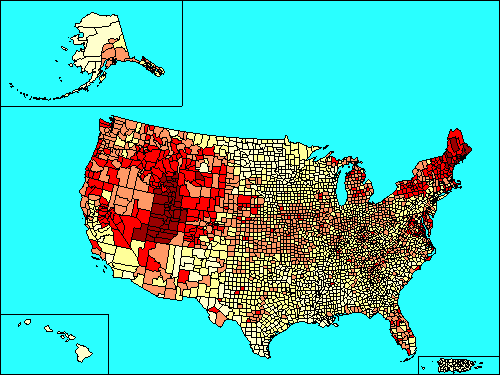
in 2009 data, Americans
reporting English ancestry made up an estimated 9.0% of the total U.S. population, and form the third largest European ancestry group after German Americans and Irish Americans.
However, demographers
regard this as an undercount, as the index of inconsistency is high, and many, if not most, people from English stock have a tendency to identify simply as Americans
or, if of mixed European ancestry, nominate a more recent and differentiated ethnic group.
Throughout the nineteenth century, England was the largest investor in American land development, railroads, mining, cattle ranching, and heavy industry. Perhaps because English settlers gained easy acceptance, they founded few organizations dedicated to preserving the traditions of their homeland.
In the 2000 United States Census, 24,509,692 Americans described their ancestry as wholly or partly English. In addition, 1,035,133 recorded British ancestry.
In the 1980 United States Census
, over 49 million (49,598,035) Americans claimed English ancestry, at the time around 26.34% of the total population and largest reported group which, even today, would make them the largest ethnic group in the United States.
also live in Scotland
and Wales
, as well as in Ireland, Chile, Argentina
, New Zealand, and South Africa. Most of the Britons in Pakistan
are in fact British Pakistanis from England who have returned to their ancestral country.
Since the 1980s there have been increasingly large numbers of English people, estimated at over 3 million, permanently or semi-permanently living in Spain and France, drawn there by the climate and cheaper house prices.
and, on the other hand, given the extent to which other cultures have influenced life in England.
Diaspora:
Ethnic group
An ethnic group is a group of people whose members identify with each other, through a common heritage, often consisting of a common language, a common culture and/or an ideology that stresses common ancestry or endogamy...
native to England, who speak English
English language in England
The English language in England refers to the English language as spoken in England. These forms of English are a subsection of British English, as spoken throughout Great Britain. Other terms used to refer to the English language as spoken in England include:...
. The English identity is of early mediaeval
Early Middle Ages
The Early Middle Ages was the period of European history lasting from the 5th century to approximately 1000. The Early Middle Ages followed the decline of the Western Roman Empire and preceded the High Middle Ages...
origin, when they were known in Old English as the Anglecynn. England is now a country of the United Kingdom
Countries of the United Kingdom
Countries of the United Kingdom is a term used to describe England, Northern Ireland, Scotland and Wales. These four countries together form the sovereign state of the United Kingdom of Great Britain and Northern Ireland, which is also described as a country. The alternative terms, constituent...
, and the majority of English people in England are British Citizens
British nationality law
British nationality law is the law of the United Kingdom that concerns citizenship and other categories of British nationality. The law is complex because of the United Kingdom's former status as an imperial power.-History:...
. Their ethnonym
Ethnonym
An ethnonym is the name applied to a given ethnic group. Ethnonyms can be divided into two categories: exonyms and autonyms or endonyms .As an example, the ethnonym for...
is derived from the Angles
Angles
The Angles is a modern English term for a Germanic people who took their name from the ancestral cultural region of Angeln, a district located in Schleswig-Holstein, Germany...
, a Germanic people originally from Northern Germany
Northern Germany
- Geography :The key terrain features of North Germany are the marshes along the coastline of the North Sea and Baltic Sea, and the geest and heaths inland. Also prominent are the low hills of the Baltic Uplands, the ground moraines, end moraines, sandur, glacial valleys, bogs, and Luch...
who migrated to Britain.
Historically, the English population is descended from several genetically
Genetic history of the British Isles
The genetic history of the British Isles is the subject of research within the larger field of human population genetics. It has developed in parallel with DNA testing technologies capable of identifying genetic similarities and differences between populations...
similar peoples—the earlier Britons (or Brythons)
Britons (historical)
The Britons were the Celtic people culturally dominating Great Britain from the Iron Age through the Early Middle Ages. They spoke the Insular Celtic language known as British or Brythonic...
, the Germanic tribes that settled in the area, including Angles
Angles
The Angles is a modern English term for a Germanic people who took their name from the ancestral cultural region of Angeln, a district located in Schleswig-Holstein, Germany...
, Saxons
Saxons
The Saxons were a confederation of Germanic tribes originating on the North German plain. The Saxons earliest known area of settlement is Northern Albingia, an area approximately that of modern Holstein...
, and Jutes
Jutes
The Jutes, Iuti, or Iutæ were a Germanic people who, according to Bede, were one of the three most powerful Germanic peoples of their time, the other two being the Saxons and the Angles...
, collectively known as the Anglo-Saxons
Anglo-Saxons
Anglo-Saxon is a term used by historians to designate the Germanic tribes who invaded and settled the south and east of Great Britain beginning in the early 5th century AD, and the period from their creation of the English nation to the Norman conquest. The Anglo-Saxon Era denotes the period of...
, who founded what was to become England (from the Old English Englaland), and the later Danes
Danelaw
The Danelaw, as recorded in the Anglo-Saxon Chronicle , is a historical name given to the part of England in which the laws of the "Danes" held sway and dominated those of the Anglo-Saxons. It is contrasted with "West Saxon law" and "Mercian law". The term has been extended by modern historians to...
, Normans
Normans
The Normans were the people who gave their name to Normandy, a region in northern France. They were descended from Norse Viking conquerors of the territory and the native population of Frankish and Gallo-Roman stock...
and other groups. Following the Act of Union
Acts of Union 1707
The Acts of Union were two Parliamentary Acts - the Union with Scotland Act passed in 1706 by the Parliament of England, and the Union with England Act passed in 1707 by the Parliament of Scotland - which put into effect the terms of the Treaty of Union that had been agreed on 22 July 1706,...
in 1707, in which the Kingdom of England
Kingdom of England
The Kingdom of England was, from 927 to 1707, a sovereign state to the northwest of continental Europe. At its height, the Kingdom of England spanned the southern two-thirds of the island of Great Britain and several smaller outlying islands; what today comprises the legal jurisdiction of England...
became part of the Kingdom of Great Britain
Kingdom of Great Britain
The former Kingdom of Great Britain, sometimes described as the 'United Kingdom of Great Britain', That the Two Kingdoms of Scotland and England, shall upon the 1st May next ensuing the date hereof, and forever after, be United into One Kingdom by the Name of GREAT BRITAIN. was a sovereign...
, English customs and identity became closely aligned with British customs and identity.
Today, some English people have recent forbears from other parts of the United Kingdom, while some are also descended from more recent immigrants from other European countries and from the Commonwealth
Commonwealth of Nations
The Commonwealth of Nations, normally referred to as the Commonwealth and formerly known as the British Commonwealth, is an intergovernmental organisation of fifty-four independent member states...
. Through their position at the centre of the former British Empire
British Empire
The British Empire comprised the dominions, colonies, protectorates, mandates and other territories ruled or administered by the United Kingdom. It originated with the overseas colonies and trading posts established by England in the late 16th and early 17th centuries. At its height, it was the...
, the English are the source of the English language, the parliamentary system
Westminster System
The Westminster system is a democratic parliamentary system of government modelled after the politics of the United Kingdom. This term comes from the Palace of Westminster, the seat of the Parliament of the United Kingdom....
, common law systems of many countries
English law
English law is the legal system of England and Wales, and is the basis of common law legal systems used in most Commonwealth countries and the United States except Louisiana...
and a variety of the globe's most popular sports.
English nationality
Although England is no longer an independent nation state, but rather a constituent countryConstituent country
Constituent country is a phrase sometimes used in contexts in which a country makes up a part of a larger entity. The term constituent country does not have any defined legal meaning, and is used simply to refer to a country which is a part Constituent country is a phrase sometimes used in contexts...
within the United Kingdom, the English may still be regarded as a "nation" according to the Oxford English Dictionary
Oxford English Dictionary
The Oxford English Dictionary , published by the Oxford University Press, is the self-styled premier dictionary of the English language. Two fully bound print editions of the OED have been published under its current name, in 1928 and 1989. The first edition was published in twelve volumes , and...
s definition: a group united by factors that include "language, culture, history, or occupation of the same territory".
The concept of an "English nation" is far older than that of the "British nation", and the 1990s witnessed a revival in English self-consciousness. This is linked to the expressions of national self-awareness of the other British nations of Wales and Scotland – which take their most solid form in the new devolved
Devolution
Devolution is the statutory granting of powers from the central government of a sovereign state to government at a subnational level, such as a regional, local, or state level. Devolution can be mainly financial, e.g. giving areas a budget which was formerly administered by central government...
political arrangements within the United Kingdom – and the waning of a shared British national identity with the growing distance between the end of the British Empire
British Empire
The British Empire comprised the dominions, colonies, protectorates, mandates and other territories ruled or administered by the United Kingdom. It originated with the overseas colonies and trading posts established by England in the late 16th and early 17th centuries. At its height, it was the...
and the present.
While prescriptions of English national identity can involve beliefs in common descent, most political English nationalists
English nationalism
English nationalism refers to a nationalist outlook or political stance applied to England. In a general sense, it comprises political and social movements and sentiment inspired by a love for English culture, language and history, and a sense of pride in England and the English people...
do not consider Englishness to be dependent upon kinship
Kinship
Kinship is a relationship between any entities that share a genealogical origin, through either biological, cultural, or historical descent. And descent groups, lineages, etc. are treated in their own subsections....
.
Many recent migrants to England have assumed a solely British identity, while others have developed dual or hyphenated identities. Use of the word "English" to describe Britons from ethnic minorities in England is complicated by most non-white people in England identifying as British rather than English. In their 2004 Annual Population Survey, the Office of National Statistics compared the ethnic identities of British people with their perceived national identity. They found that while 58% of white people described their nationality as "English", the vast majority of non-white people called themselves "British".
Relationship to Britishness
It is unclear how many British people consider themselves English. In the 2001 UK census, respondents were invited to state their ethnicity, but while there were tick boxesTick (checkmark)
A tick is a mark used to indicate the concept "yes", for example "yes; this has been verified", "yes; that is the correct answer" or "yes; this [item or option] applies to me"...
for 'Irish'
Irish people
The Irish people are an ethnic group who originate in Ireland, an island in northwestern Europe. Ireland has been populated for around 9,000 years , with the Irish people's earliest ancestors recorded having legends of being descended from groups such as the Nemedians, Fomorians, Fir Bolg, Tuatha...
and for 'Scottish'
Scottish people
The Scottish people , or Scots, are a nation and ethnic group native to Scotland. Historically they emerged from an amalgamation of the Picts and Gaels, incorporating neighbouring Britons to the south as well as invading Germanic peoples such as the Anglo-Saxons and the Norse.In modern use,...
, there were none for 'English', or 'Welsh'
Welsh people
The Welsh people are an ethnic group and nation associated with Wales and the Welsh language.John Davies argues that the origin of the "Welsh nation" can be traced to the late 4th and early 5th centuries, following the Roman departure from Britain, although Brythonic Celtic languages seem to have...
, who were subsumed into the general heading 'White British'. Following complaints about this, the 2011 census will "allow respondents to record their English, Welsh, Scottish, Northern Irish, Irish or other identity." Another complication in defining the English is a common tendency for the words "English" and "British" to be used interchangeably, especially overseas. In his study of English identity, Krishan Kumar
Krishan Kumar
Krishan Kumar is an Indian sociologist who is currently Chair of the Department of Sociology at the University of Virginia, where he holds the titles University Professor and William R...
describes a common slip of the tongue in which people say "English, I mean British". He notes that this slip is normally made only by the English themselves and by foreigners: "Non-English members of the United Kingdom rarely say 'British' when they mean 'English'". Kumar suggests that although this blurring is a sign of England's dominant position with the UK, it is also "problematic for the English [...] when it comes to conceiving of their national identity. It tells of the difficulty that most English people have of distinguishing themselves, in a collective way, from the other inhabitants of the British Isles".
In 1965, the historian A. J. P. Taylor
A. J. P. Taylor
Alan John Percivale Taylor, FBA was a British historian of the 20th century and renowned academic who became well known to millions through his popular television lectures.-Early life:...
wrote,
- "When the Oxford History of EnglandOxford History of EnglandThe Oxford History of England is one of the most prominent and acclaimed modern history series, written by many of the then-leading historians of each period....
was launched a generation ago, "England" was still an all-embracing word. It meant indiscriminately England and Wales; Great Britain; the United Kingdom; and even the British Empire. Foreigners used it as the name of a Great PowerGreat powerA great power is a nation or state that has the ability to exert its influence on a global scale. Great powers characteristically possess military and economic strength and diplomatic and cultural influence which may cause small powers to consider the opinions of great powers before taking actions...
and indeed continue to do so. Bonar Law, by origin a Scotch CanadianScottish CanadianScottish Canadians are people of Scottish descent or heritage living in Canada. As the third-largest ethnic group in Canada and among the first to settle in Canada, Scottish people have made a large impact on Canadian culture since colonial times...
, was not ashamed to describe himself as "Prime Minister of England" [...] Now terms have become more rigorous. The use of "England" except for a geographic area brings protests, especially from the ScotchScottish peopleThe Scottish people , or Scots, are a nation and ethnic group native to Scotland. Historically they emerged from an amalgamation of the Picts and Gaels, incorporating neighbouring Britons to the south as well as invading Germanic peoples such as the Anglo-Saxons and the Norse.In modern use,...
."
However, although Taylor believed this blurring effect was dying out, in his book The Isles (1999), Norman Davies
Norman Davies
Professor Ivor Norman Richard Davies FBA, FRHistS is a leading English historian of Welsh descent, noted for his publications on the history of Europe, Poland, and the United Kingdom.- Academic career :...
lists numerous examples in history books of "British" still being used to mean "English" and vice versa.
In December 2010, Matthew Parris
Matthew Parris
Matthew Francis Parris is a UK-based journalist and former Conservative politician.-Early life and family:...
of The Spectator
The Spectator
The Spectator is a weekly British magazine first published on 6 July 1828. It is currently owned by David and Frederick Barclay, who also owns The Daily Telegraph. Its principal subject areas are politics and culture...
, analysing the use of “English” over “British”, argued that English identity, rather than growing, had existed all along but has recently been unmasked from behind a veneer of Britishness.
English ethnicity
The conventional view of English origins is that the English are primarily descended from the Anglo-SaxonsAnglo-Saxons
Anglo-Saxon is a term used by historians to designate the Germanic tribes who invaded and settled the south and east of Great Britain beginning in the early 5th century AD, and the period from their creation of the English nation to the Norman conquest. The Anglo-Saxon Era denotes the period of...
, Germanic
Germanic peoples
The Germanic peoples are an Indo-European ethno-linguistic group of Northern European origin, identified by their use of the Indo-European Germanic languages which diversified out of Proto-Germanic during the Pre-Roman Iron Age.Originating about 1800 BCE from the Corded Ware Culture on the North...
tribes that migrated to Great Britain following the end of the Roman occupation of Britain, with assimilation of later migrants such as the Vikings and Normans
Normans
The Normans were the people who gave their name to Normandy, a region in northern France. They were descended from Norse Viking conquerors of the territory and the native population of Frankish and Gallo-Roman stock...
. This version of history is considered by some historians and geneticists as simplistic or even incorrect. Recently, historians have questioned the assumption that the English are primarily descended from Anglo-Saxons. Based on a re-estimation of the number of settlers, there is a view that it is highly unlikely that the existing British Celtic population was substantially displaced by the Anglo-Saxons, and the latter were merely a ruling elite who imposed their culture on the local populations. However, many historians, while making allowance for British survival, still hold to the view that there was significant displacement of the indigenous population.
In any event, the Celts, particularly in their use of Brythonic languages
Brythonic languages
The Brythonic or Brittonic languages form one of the two branches of the Insular Celtic language family, the other being Goidelic. The name Brythonic was derived by Welsh Celticist John Rhys from the Welsh word Brython, meaning an indigenous Briton as opposed to an Anglo-Saxon or Gael...
such as Cornish
Cornish language
Cornish is a Brythonic Celtic language and a recognised minority language of the United Kingdom. Along with Welsh and Breton, it is directly descended from the ancient British language spoken throughout much of Britain before the English language came to dominate...
, Cumbric
Cumbric language
Cumbric was a variety of the Celtic British language spoken during the Early Middle Ages in the Hen Ogledd or "Old North", or what is now northern England and southern Lowland Scotland, the area anciently known as Cumbria. It was closely related to Old Welsh and the other Brythonic languages...
, and Welsh
Welsh language
Welsh is a member of the Brythonic branch of the Celtic languages spoken natively in Wales, by some along the Welsh border in England, and in Y Wladfa...
, held on for several centuries in parts of England such as Cornwall
Cornwall
Cornwall is a unitary authority and ceremonial county of England, within the United Kingdom. It is bordered to the north and west by the Celtic Sea, to the south by the English Channel, and to the east by the county of Devon, over the River Tamar. Cornwall has a population of , and covers an area of...
, Devon, Cumbria
Cumbria
Cumbria , is a non-metropolitan county in North West England. The county and Cumbria County Council, its local authority, came into existence in 1974 after the passage of the Local Government Act 1972. Cumbria's largest settlement and county town is Carlisle. It consists of six districts, and in...
and a part of Lancashire
Lancashire
Lancashire is a non-metropolitan county of historic origin in the North West of England. It takes its name from the city of Lancaster, and is sometimes known as the County of Lancaster. Although Lancaster is still considered to be the county town, Lancashire County Council is based in Preston...
. However, the notion of the Anglo-Saxon English has traditionally been important in defining English identity and distinguishing the English from their Celtic neighbours, such as the Scots
Scottish people
The Scottish people , or Scots, are a nation and ethnic group native to Scotland. Historically they emerged from an amalgamation of the Picts and Gaels, incorporating neighbouring Britons to the south as well as invading Germanic peoples such as the Anglo-Saxons and the Norse.In modern use,...
, Welsh
Welsh people
The Welsh people are an ethnic group and nation associated with Wales and the Welsh language.John Davies argues that the origin of the "Welsh nation" can be traced to the late 4th and early 5th centuries, following the Roman departure from Britain, although Brythonic Celtic languages seem to have...
, Cornish
Cornish people
The Cornish are a people associated with Cornwall, a county and Duchy in the south-west of the United Kingdom that is seen in some respects as distinct from England, having more in common with the other Celtic parts of the United Kingdom such as Wales, as well as with other Celtic nations in Europe...
and Irish. Historian Catherine Hills describes what she calls the "national origin myth" of the English:
- The arrival of the Anglo-Saxons ... is still perceived as an important and interesting event because it is believed to have been a key factor in the identity of the present inhabitants of the British Isles, involving migration on such a scale as to permanently change the population of south-east Britain, and making the English a distinct and different people from the CeltCeltThe Celts were a diverse group of tribal societies in Iron Age and Roman-era Europe who spoke Celtic languages.The earliest archaeological culture commonly accepted as Celtic, or rather Proto-Celtic, was the central European Hallstatt culture , named for the rich grave finds in Hallstatt, Austria....
ic Irish, WelshWelsh peopleThe Welsh people are an ethnic group and nation associated with Wales and the Welsh language.John Davies argues that the origin of the "Welsh nation" can be traced to the late 4th and early 5th centuries, following the Roman departure from Britain, although Brythonic Celtic languages seem to have...
and ScotsScottish peopleThe Scottish people , or Scots, are a nation and ethnic group native to Scotland. Historically they emerged from an amalgamation of the Picts and Gaels, incorporating neighbouring Britons to the south as well as invading Germanic peoples such as the Anglo-Saxons and the Norse.In modern use,...
....this is an example of a national origin myth ... and shows why there are seldom simple answers to questions about origins.
A popular interest in English identity is evident in the recent reporting of scientific and sociological investigations of the English, in which complex results are heavily simplified. In 2002, the BBC
BBC
The British Broadcasting Corporation is a British public service broadcaster. Its headquarters is at Broadcasting House in the City of Westminster, London. It is the largest broadcaster in the world, with about 23,000 staff...
used the headline "English and Welsh are races apart" to report a genetic survey of test subjects from market town
Market town
Market town or market right is a legal term, originating in the medieval period, for a European settlement that has the right to host markets, distinguishing it from a village and city...
s in England and Wales, while in September 2006, The Sunday Times
The Sunday Times
The Sunday Times is a British Sunday newspaper.The Sunday Times may also refer to:*The Sunday Times *The Sunday Times *The Sunday Times *The Sunday Times...
reported that a survey of first names and surnames in the UK had identified Ripley
Ripley, Derbyshire
Ripley is a town in the Amber Valley area of Derbyshire in England.- Earliest history :Not much information is available as to when Ripley was founded, but it existed at the time of the Domesday Book, when it was held by a man called Levenot....
in Derbyshire as "the 'most English' place in England with 88.58% of residents having an English ethnic background". The Daily Mail
Daily Mail
The Daily Mail is a British daily middle-market tabloid newspaper owned by the Daily Mail and General Trust. First published in 1896 by Lord Northcliffe, it is the United Kingdom's second biggest-selling daily newspaper after The Sun. Its sister paper The Mail on Sunday was launched in 1982...
printed an article with the headline "We're all Germans! (and we have been for 1,600 years)". In all these cases, the language of race is employed by the journalists.
In addition, several recent books by Stephen Oppenheimer
Stephen Oppenheimer
Stephen Oppenheimer is a British paediatrician, geneticist, and writer. He is a member of Green Templeton College, Oxford and an honorary fellow of Liverpool School of Tropical Medicine, and carries out and publishes research in the fields of genetics and human prehistory.-Career:Oppenheimer...
and Bryan Sykes
Bryan Sykes
Bryan Sykes is a former Professor of Human Genetics at the University of Oxford and a current Fellow of Wolfson College.Sykes published the first report on retrieving DNA from ancient bone...
, have argued that the recent genetic studies in fact do not show a clear dividing line between the English and their 'Celtic' neighbours, but that there is a gradual clinal
Cline (population genetics)
In biology, an ecocline or simply cline describes an ecotone in which a series of biocommunities display continuous gradient...
change from west coast Britain to east coast Britain. They suggest that the majority of the ancestors of British peoples were the original palaeolithic settlers of Great Britain, and that the differences that exist between the east and west coasts of Great Britain though not large, are deep in prehistory, mostly originating in the upper palaeolithic and Mesolithic (15,000–7,000 years ago). Furthermore, Oppenheimer states that genetic testing has proven that "75% of British and Irish ancestors arrive[d] between 15,000 and 7,500 years ago" (that is, long before the arrival of the Anglo-Saxons).
Oppenheimer also claims that Celtic
Celtic languages
The Celtic languages are descended from Proto-Celtic, or "Common Celtic"; a branch of the greater Indo-European language family...
split from Indo-European earlier than previously suspected, some 6000 years ago, while English split from Germanic
Germanic languages
The Germanic languages constitute a sub-branch of the Indo-European language family. The common ancestor of all of the languages in this branch is called Proto-Germanic , which was spoken in approximately the mid-1st millennium BC in Iron Age northern Europe...
before the Roman period. Oppenheimer believes that a Germanic language that became English was spoken by the tribes of what is now England long before the arrival of the Anglo-Saxon and also discounts the view that the people of the area were ever Celtic.
Antiquity
The term "English" is not used to refer to the earliest inhabitants of the area that would become England: Palaeolithic hunter-gathererHunter-gatherer
A hunter-gatherer or forage society is one in which most or all food is obtained from wild plants and animals, in contrast to agricultural societies which rely mainly on domesticated species. Hunting and gathering was the ancestral subsistence mode of Homo, and all modern humans were...
s, Celt
Celt
The Celts were a diverse group of tribal societies in Iron Age and Roman-era Europe who spoke Celtic languages.The earliest archaeological culture commonly accepted as Celtic, or rather Proto-Celtic, was the central European Hallstatt culture , named for the rich grave finds in Hallstatt, Austria....
ic Britons
Brython
The Britons were the Celtic people culturally dominating Great Britain from the Iron Age through the Early Middle Ages. They spoke the Insular Celtic language known as British or Brythonic...
, and Roman
Roman Empire
The Roman Empire was the post-Republican period of the ancient Roman civilization, characterised by an autocratic form of government and large territorial holdings in Europe and around the Mediterranean....
colonists. This is because up to and during the Roman occupation of Britain, the region now called England was not a distinct country; all the native inhabitants of Britain spoke Brythonic languages
Brythonic languages
The Brythonic or Brittonic languages form one of the two branches of the Insular Celtic language family, the other being Goidelic. The name Brythonic was derived by Welsh Celticist John Rhys from the Welsh word Brython, meaning an indigenous Briton as opposed to an Anglo-Saxon or Gael...
and were regarded as Britons (or Brythons) divided into many tribe
Tribe
A tribe, viewed historically or developmentally, consists of a social group existing before the development of, or outside of, states.Many anthropologists use the term tribal society to refer to societies organized largely on the basis of kinship, especially corporate descent groups .Some theorists...
s. The word "English" refers to a heritage that began with the arrival of the Anglo-Saxons
Anglo-Saxons
Anglo-Saxon is a term used by historians to designate the Germanic tribes who invaded and settled the south and east of Great Britain beginning in the early 5th century AD, and the period from their creation of the English nation to the Norman conquest. The Anglo-Saxon Era denotes the period of...
in the 5th century, who settled lands already inhabited by Romano-British tribes. That heritage then comes to include later arrivals, including Scandinavians, Normans
Normans
The Normans were the people who gave their name to Normandy, a region in northern France. They were descended from Norse Viking conquerors of the territory and the native population of Frankish and Gallo-Roman stock...
, as well as those Romano-Britons who still lived in England.
Early Middle Ages
Anglo-Saxons
Anglo-Saxon is a term used by historians to designate the Germanic tribes who invaded and settled the south and east of Great Britain beginning in the early 5th century AD, and the period from their creation of the English nation to the Norman conquest. The Anglo-Saxon Era denotes the period of...
, a group of closely related Germanic
Germanic peoples
The Germanic peoples are an Indo-European ethno-linguistic group of Northern European origin, identified by their use of the Indo-European Germanic languages which diversified out of Proto-Germanic during the Pre-Roman Iron Age.Originating about 1800 BCE from the Corded Ware Culture on the North...
tribes that began migrating to eastern and southern Great Britain, from southern Denmark
Denmark
Denmark is a Scandinavian country in Northern Europe. The countries of Denmark and Greenland, as well as the Faroe Islands, constitute the Kingdom of Denmark . It is the southernmost of the Nordic countries, southwest of Sweden and south of Norway, and bordered to the south by Germany. Denmark...
and northern Germany, in the 5th century AD, after the Romans had withdrawn from Britain. The Anglo-Saxons gave their name to England (Engla land, meaning "Land of the Angles") and to the English.
Romano-British
Romano-British culture describes the culture that arose in Britain under the Roman Empire following the Roman conquest of AD 43 and the creation of the province of Britannia. It arose as a fusion of the imported Roman culture with that of the indigenous Britons, a people of Celtic language and...
'—the descendants of the native Brythonic-speaking population that lived in the area of Britain under Roman rule during the 1st–5th centuries AD. The multi-ethnic nature of the Roman Empire meant that small numbers of other peoples may have also been present in England before the Anglo-Saxons arrived. There is archaeological evidence, for example, of an early North African presence in a Roman garrison at Aballava, now Burgh-by-Sands, in Cumbria; a fourth-century inscription says that the Roman military unit Numerus Maurorum Aurelianorum ("unit of Aurelian Moors") from Muretania (Morocco) was stationed there.
The exact nature of the arrival of the Anglo-Saxons
Anglo-Saxon settlement of Britain
The Anglo-Saxon settlement of Britain was the invasion and migration of Germanic peoples from continental Europe to Great Britain during the Early Middle Ages, specifically the arrival of the Anglo-Saxons in Britain after the demise of Roman rule in the 5th century.The stimulus, progression and...
and their relationship with the Romano-British is a matter of debate. Traditionally, it was believed that a mass invasion by various Anglo-Saxon tribes largely displaced the indigenous British population in southern and eastern Great Britain (modern day England with the exception of Cornwall
Cornwall
Cornwall is a unitary authority and ceremonial county of England, within the United Kingdom. It is bordered to the north and west by the Celtic Sea, to the south by the English Channel, and to the east by the county of Devon, over the River Tamar. Cornwall has a population of , and covers an area of...
). This was supported by the writings of Gildas
Gildas
Gildas was a 6th-century British cleric. He is one of the best-documented figures of the Christian church in the British Isles during this period. His renowned learning and literary style earned him the designation Gildas Sapiens...
, the only contemporary historical account of the period, describing slaughter and starvation of native Britons by invading tribes (aduentus Saxonum).
Added to this was the fact that the English language contains no more than a handful of words borrowed from Brythonic
Brythonic languages
The Brythonic or Brittonic languages form one of the two branches of the Insular Celtic language family, the other being Goidelic. The name Brythonic was derived by Welsh Celticist John Rhys from the Welsh word Brython, meaning an indigenous Briton as opposed to an Anglo-Saxon or Gael...
sources (although the names of some towns, cities, rivers etc. do have Brythonic or pre-Brythonic origins, becoming more frequent towards the west of Britain). However, this view has been re-evaluated by some archaeologists and historians since the 1960s, and more recently supported by genetic studies, who see only minimal evidence for mass displacement. Archaeologist Francis Pryor
Francis Pryor
thumb|180px|Francis Pryor discusses the excavation during the filming of a 2007 dig for [[Time Team]] with series editor Michael Douglas ....
has stated that he "can't see any evidence for bona fide mass migrations after the Neolithic
Neolithic
The Neolithic Age, Era, or Period, or New Stone Age, was a period in the development of human technology, beginning about 9500 BC in some parts of the Middle East, and later in other parts of the world. It is traditionally considered as the last part of the Stone Age...
."
While the historian Malcolm Todd writes "It is much more likely that a large proportion of the British population remained in place and was progressively dominated by a Germanic aristocracy, in some cases marrying into it and leaving Celtic names in the, admittedly very dubious, early lists of Anglo-Saxon dynasties. But how we identify the surviving Britons in areas of predominantly Anglo-Saxon settlement, either archaeologically or linguistically, is still one of the deepest problems of early English history."
In a survey of the genes of British and Irish men, even those British regions that were most genetically similar to (Germanic speaking) continental regions were still more genetically British than continental: "When included in the PC analysis, the Frisians were more 'Continental' than any of the British samples, although they were somewhat closer to the British ones than the North German/Denmark sample. For example, the part of mainland Britain that has the most Continental input is Central England, but even here the AMH+1
Atlantic Modal Haplotype
In human genetics, the Atlantic Modal Haplotype or haplotype 15 is a Y chromosome haplotype of Y-STR microsatellite variations, associated with the Haplogroup R1b. It was discovered prior to many of the SNPs now used to identify subclades of R1b and references to it can be found in some of the...
frequency, not below 44% (Southwell), is higher than the 35% observed in the Frisians. These results demonstrate that even with the choice of Frisians as a source for the Anglo-Saxons, there is a clear indication of a continuing indigenous component in the English paternal genetic makeup."
Vikings and the Danelaw
From about AD 800 waves of Danish VikingViking
The term Viking is customarily used to refer to the Norse explorers, warriors, merchants, and pirates who raided, traded, explored and settled in wide areas of Europe, Asia and the North Atlantic islands from the late 8th to the mid-11th century.These Norsemen used their famed longships to...
assaults on the coastlines of the British Isles
British Isles
The British Isles are a group of islands off the northwest coast of continental Europe that include the islands of Great Britain and Ireland and over six thousand smaller isles. There are two sovereign states located on the islands: the United Kingdom of Great Britain and Northern Ireland and...
were gradually followed by a succession of Danish settlers in England. At first, the Vikings were very much considered a separate people from the English. This separation was enshrined when Alfred the Great
Alfred the Great
Alfred the Great was King of Wessex from 871 to 899.Alfred is noted for his defence of the Anglo-Saxon kingdoms of southern England against the Vikings, becoming the only English monarch still to be accorded the epithet "the Great". Alfred was the first King of the West Saxons to style himself...
signed the Treaty of Alfred and Guthrum
Treaty of Alfred and Guthrum
The Treaty of Alfred and Guthrum is an agreement between Alfred of Wessex and Guthrum, the Viking ruler of East Anglia. Its date is uncertain, but must have been between 878 and 890. The treaty is one of the few existing documents of Alfred's reign; it survives in Old English in Corpus Christi...
to establish the Danelaw
Danelaw
The Danelaw, as recorded in the Anglo-Saxon Chronicle , is a historical name given to the part of England in which the laws of the "Danes" held sway and dominated those of the Anglo-Saxons. It is contrasted with "West Saxon law" and "Mercian law". The term has been extended by modern historians to...
, a division of England between English and Danish rule, with the Danes occupying northern and eastern England.
However, Alfred's successors subsequently won military victories against the Danes, incorporating much of the Danelaw into the nascent kingdom of England. Danish invasions continued into the 11th century, and there were both English and Danish kings in the period following the unification of England (for example, Æthelred II
Ethelred the Unready
Æthelred the Unready, or Æthelred II , was king of England . He was son of King Edgar and Queen Ælfthryth. Æthelred was only about 10 when his half-brother Edward was murdered...
(978–1013 and 1014–1016) was English but Cnut (1016–1035) was Danish).
Gradually, the Danes in England came to be seen as 'English'. They had a noticeable impact on the English language: many English words, such as anger, ball, egg, got, knife, take, and they, are of Old Norse origin, and place names that end in -thwaite and -by are Scandinavian in origin.
English unification
Petty kingdom
A petty kingdom is one of a number of small kingdoms, described as minor or "petty" by contrast to an empire or unified kingdom that either preceded or succeeded it...
s which gradually coalesced into a Heptarchy
Heptarchy
The Heptarchy is a collective name applied to the Anglo-Saxon kingdoms of south, east, and central Great Britain during late antiquity and the early Middle Ages, conventionally identified as seven: Northumbria, Mercia, East Anglia, Essex, Kent, Sussex and Wessex...
of seven powerful states, the most powerful of which were Mercia
Mercia
Mercia was one of the kingdoms of the Anglo-Saxon Heptarchy. It was centred on the valley of the River Trent and its tributaries in the region now known as the English Midlands...
and Wessex
Wessex
The Kingdom of Wessex or Kingdom of the West Saxons was an Anglo-Saxon kingdom of the West Saxons, in South West England, from the 6th century, until the emergence of a united English state in the 10th century, under the Wessex dynasty. It was to be an earldom after Canute the Great's conquest...
. The English nation state began to form when the Anglo-Saxon kingdoms united against Danish Viking invasions, which began around 800 AD. Over the following century and a half England was for the most part a politically unified entity, and remained permanently so after 959.
The nation of England was formed in 937 by Athelstan of Wessex
Wessex
The Kingdom of Wessex or Kingdom of the West Saxons was an Anglo-Saxon kingdom of the West Saxons, in South West England, from the 6th century, until the emergence of a united English state in the 10th century, under the Wessex dynasty. It was to be an earldom after Canute the Great's conquest...
after the Battle of Brunanburh
Battle of Brunanburh
The Battle of Brunanburh was an English victory in 937 by the army of Æthelstan, King of England, and his brother Edmund over the combined armies of Olaf III Guthfrithson, the Norse-Gael King of Dublin, Constantine II, King of Scots, and Owen I, King of Strathclyde...
, as Wessex grew from a relatively small kingdom in the South West to become the founder of the Kingdom of the English, incorporating all Anglo-Saxon
Anglo-Saxons
Anglo-Saxon is a term used by historians to designate the Germanic tribes who invaded and settled the south and east of Great Britain beginning in the early 5th century AD, and the period from their creation of the English nation to the Norman conquest. The Anglo-Saxon Era denotes the period of...
kingdoms and the Danelaw
Danelaw
The Danelaw, as recorded in the Anglo-Saxon Chronicle , is a historical name given to the part of England in which the laws of the "Danes" held sway and dominated those of the Anglo-Saxons. It is contrasted with "West Saxon law" and "Mercian law". The term has been extended by modern historians to...
.
Norman and Angevin rule
Norman conquest of England
The Norman conquest of England began on 28 September 1066 with the invasion of England by William, Duke of Normandy. William became known as William the Conqueror after his victory at the Battle of Hastings on 14 October 1066, defeating King Harold II of England...
during 1066 brought Anglo-Saxon and Danish rule of England to an end, as the new Norman
Normans
The Normans were the people who gave their name to Normandy, a region in northern France. They were descended from Norse Viking conquerors of the territory and the native population of Frankish and Gallo-Roman stock...
elite almost universally replaced the Anglo-Saxon aristocracy and church leaders. After the conquest, "English" normally included all natives of England, whether they were of Anglo-Saxon, Scandinavian or Celtic ancestry, to distinguish them from the Norman invaders, who were regarded as "Norman" even if born in England, for a generation or two after the Conquest. The Norman dynasty ruled England for 87 years until the death of King Stephen
Stephen of England
Stephen , often referred to as Stephen of Blois , was a grandson of William the Conqueror. He was King of England from 1135 to his death, and also the Count of Boulogne by right of his wife. Stephen's reign was marked by the Anarchy, a civil war with his cousin and rival, the Empress Matilda...
in 1154, when the succession passed to Henry II
Henry II of England
Henry II ruled as King of England , Count of Anjou, Count of Maine, Duke of Normandy, Duke of Aquitaine, Duke of Gascony, Count of Nantes, Lord of Ireland and, at various times, controlled parts of Wales, Scotland and western France. Henry, the great-grandson of William the Conqueror, was the...
, House of Plantagenet
House of Plantagenet
The House of Plantagenet , a branch of the Angevins, was a royal house founded by Geoffrey V of Anjou, father of Henry II of England. Plantagenet kings first ruled the Kingdom of England in the 12th century. Their paternal ancestors originated in the French province of Gâtinais and gained the...
(based in France), and England became part of the Angevin Empire
Angevin Empire
The term Angevin Empire is a modern term describing the collection of states once ruled by the Angevin Plantagenet dynasty.The Plantagenets ruled over an area stretching from the Pyrenees to Ireland during the 12th and early 13th centuries, located north of Moorish Iberia. This "empire" extended...
until 1399.
Various contemporary sources suggest that within fifty years of the invasion most of the Normans outside the royal court had switched to English, with Anglo-Norman
Anglo-Norman language
Anglo-Norman is the name traditionally given to the kind of Old Norman used in England and to some extent elsewhere in the British Isles during the Anglo-Norman period....
remaining the prestige language of government and law largely out of social inertia. For example, Orderic Vitalis, a historian born in 1075 and the son of a Norman knight, said that he learned French only as a second language. Anglo-Norman continued to be used by the Plantagenet kings until Edward I
Edward I of England
Edward I , also known as Edward Longshanks and the Hammer of the Scots, was King of England from 1272 to 1307. The first son of Henry III, Edward was involved early in the political intrigues of his father's reign, which included an outright rebellion by the English barons...
came to the throne. Over time the English language became more important even in the court, and the Normans were gradually assimilated, until, by the 14th century, both rulers and subjects regarded themselves as English and spoke the English language.
Despite the assimilation of the Normans, the distinction between 'English' and 'French' survived in official documents long after it had fallen out of common use, in particular in the legal phrase Presentment of Englishry (a rule by which a hundred had to prove an unidentified murdered body found on their soil to be that of an Englishman, rather than a Norman, if they wanted to avoid a fine). This law was abolished in 1340.
In the United Kingdom
Since the 18th century, England has been one part of a wider political entity covering all or part of the British IslesBritish Isles
The British Isles are a group of islands off the northwest coast of continental Europe that include the islands of Great Britain and Ireland and over six thousand smaller isles. There are two sovereign states located on the islands: the United Kingdom of Great Britain and Northern Ireland and...
, which today is called the United Kingdom. Wales
Wales
Wales is a country that is part of the United Kingdom and the island of Great Britain, bordered by England to its east and the Atlantic Ocean and Irish Sea to its west. It has a population of three million, and a total area of 20,779 km²...
was annexed
Annexation
Annexation is the de jure incorporation of some territory into another geo-political entity . Usually, it is implied that the territory and population being annexed is the smaller, more peripheral, and weaker of the two merging entities, barring physical size...
by England by the Laws in Wales Acts 1535–1542, which incorporated Wales into the English state. A new British identity was subsequently developed when James VI of Scotland became James I of England
James I of England
James VI and I was King of Scots as James VI from 24 July 1567 and King of England and Ireland as James I from the union of the English and Scottish crowns on 24 March 1603...
as well, and expressed the desire to be known as the monarch of Britain.
In 1707, England formed a union with Scotland
Kingdom of Scotland
The Kingdom of Scotland was a Sovereign state in North-West Europe that existed from 843 until 1707. It occupied the northern third of the island of Great Britain and shared a land border to the south with the Kingdom of England...
by passing an Act of Union
Acts of Union 1707
The Acts of Union were two Parliamentary Acts - the Union with Scotland Act passed in 1706 by the Parliament of England, and the Union with England Act passed in 1707 by the Parliament of Scotland - which put into effect the terms of the Treaty of Union that had been agreed on 22 July 1706,...
in March 1707 that ratified the Treaty of Union
Treaty of Union
The Treaty of Union is the name given to the agreement that led to the creation of the united kingdom of Great Britain, the political union of the Kingdom of England and the Kingdom of Scotland, which took effect on 1 May 1707...
. The Parliament of Scotland
Parliament of Scotland
The Parliament of Scotland, officially the Estates of Parliament, was the legislature of the Kingdom of Scotland. The unicameral parliament of Scotland is first found on record during the early 13th century, with the first meeting for which a primary source survives at...
had previously passed its own Act of Union, so the Kingdom of Great Britain
Kingdom of Great Britain
The former Kingdom of Great Britain, sometimes described as the 'United Kingdom of Great Britain', That the Two Kingdoms of Scotland and England, shall upon the 1st May next ensuing the date hereof, and forever after, be United into One Kingdom by the Name of GREAT BRITAIN. was a sovereign...
was born on 1 May 1707. In 1801, another Act of Union
Act of Union 1800
The Acts of Union 1800 describe two complementary Acts, namely:* the Union with Ireland Act 1800 , an Act of the Parliament of Great Britain, and...
formed a union between the Kingdom of Great Britain and the Kingdom of Ireland
Kingdom of Ireland
The Kingdom of Ireland refers to the country of Ireland in the period between the proclamation of Henry VIII as King of Ireland by the Crown of Ireland Act 1542 and the Act of Union in 1800. It replaced the Lordship of Ireland, which had been created in 1171...
, creating the United Kingdom of Great Britain and Ireland
United Kingdom of Great Britain and Ireland
The United Kingdom of Great Britain and Ireland was the formal name of the United Kingdom during the period when what is now the Republic of Ireland formed a part of it....
. In 1922, about two thirds of the Irish population (those who lived in twenty-six of the thirty-two counties of Ireland), left the United Kingdom to form the Irish Free State
Irish Free State
The Irish Free State was the state established as a Dominion on 6 December 1922 under the Anglo-Irish Treaty, signed by the British government and Irish representatives exactly twelve months beforehand...
. The remainder became
the United Kingdom of Great Britain and Northern Ireland, although this name was not introduced until 1927, after some years in which the term "United Kingdom" had been little used.
Throughout the history of the UK, the English have been dominant in population and in political weight. As a consequence, notions of 'Englishness' and 'Britishness' are often very similar. At the same time, after the Union of 1707, the English, along with the other peoples of the British Isles, have been encouraged to think of themselves as British rather than to identify themselves with the constituent nations.
Immigration and assimilation
Although England has not been conquered since the Norman conquest nor extensively settled since, it has been the destination of varied numbers of migrants at different periods from the seventeenth century. While some members of these groups maintain a separate ethnic identity, others have assimilatedCultural assimilation
Cultural assimilation is a socio-political response to demographic multi-ethnicity that supports or promotes the assimilation of ethnic minorities into the dominant culture. The term assimilation is often used with regard to immigrants and various ethnic groups who have settled in a new land. New...
and intermarried
Interracial marriage
Interracial marriage occurs when two people of differing racial groups marry. This is a form of exogamy and can be seen in the broader context of miscegenation .-Legality of interracial marriage:In the Western world certain jurisdictions have had regulations...
with the English. Since Oliver Cromwell
Oliver Cromwell
Oliver Cromwell was an English military and political leader who overthrew the English monarchy and temporarily turned England into a republican Commonwealth, and served as Lord Protector of England, Scotland, and Ireland....
's resettlement of the Jews
Resettlement of the Jews in England
The resettlement of the Jews in England was a historic commercial policy dealing with Jews in England in the 17th century, and forms a prominent part of the history of the Jews in England.-Background:...
in 1656, there have been waves of Jewish immigration from Russia
Russian Empire
The Russian Empire was a state that existed from 1721 until the Russian Revolution of 1917. It was the successor to the Tsardom of Russia and the predecessor of the Soviet Union...
in the nineteenth century and from Germany in the twentieth.
After the French king Louis XIV
Louis XIV of France
Louis XIV , known as Louis the Great or the Sun King , was a Bourbon monarch who ruled as King of France and Navarre. His reign, from 1643 to his death in 1715, began at the age of four and lasted seventy-two years, three months, and eighteen days...
declared Protestantism illegal in 1685 with the Edict of Fontainebleau
Edict of Fontainebleau
The Edict of Fontainebleau was an edict issued by Louis XIV of France, also known as the Revocation of the Edict of Nantes. The Edict of Nantes of 1598, had granted the Huguenots the right to practice their religion without persecution from the state...
, an estimated 50,000 Protestant Huguenot
Huguenot
The Huguenots were members of the Protestant Reformed Church of France during the 16th and 17th centuries. Since the 17th century, people who formerly would have been called Huguenots have instead simply been called French Protestants, a title suggested by their German co-religionists, the...
s fled to England. Due to sustained and sometimes mass emigration from Ireland, current estimates indicate that around 6 million people in the UK have at least one grandparent born in Ireland.
There has been a black
Black people
The term black people is used in systems of racial classification for humans of a dark skinned phenotype, relative to other racial groups.Different societies apply different criteria regarding who is classified as "black", and often social variables such as class, socio-economic status also plays a...
presence in England since at least the 16th century due to the slave trade and an Indian presence since the mid 19th century because of the British Raj
British Raj
British Raj was the British rule in the Indian subcontinent between 1858 and 1947; The term can also refer to the period of dominion...
. Black
Black British
Black British is a term used to describe British people of Black African descent, especially those of Afro-Caribbean background. The term has been used from the 1950s to refer to Black people from former British colonies in the West Indies and Africa, who are residents of the United Kingdom and...
and Asian
British Asian
British Asian is a term used to describe British citizens who descended from mainly South Asia, also known as South Asians in the United Kingdom...
proportions have grown in England as immigration from the British Empire and the subsequent Commonwealth of Nations
Commonwealth of Nations
The Commonwealth of Nations, normally referred to as the Commonwealth and formerly known as the British Commonwealth, is an intergovernmental organisation of fifty-four independent member states...
was encouraged due to labour shortages during post-war rebuilding.
However, these groups are often still considered to be ethnic minorities and research has shown that black and Asian people in the UK are more likely to identify as British rather than with one of the state's four constituent nations, including England.
Current national and political identity
The 1990s witnessed a resurgence of English national identity. Survey data shows a rise in the number of people in England describing their national identity as English and a fall in the number describing themselves as British. Scholars and journalists have noted a rise in English self-consciousness, with increased use of the English flag, particularly at football matches where the Union flagUnion Flag
The Union Flag, also known as the Union Jack, is the flag of the United Kingdom. It retains an official or semi-official status in some Commonwealth Realms; for example, it is known as the Royal Union Flag in Canada. It is also used as an official flag in some of the smaller British overseas...
was previously more commonly flown by fans.
This perceived rise in English self-consciousness has generally been attributed to the devolution
Devolution
Devolution is the statutory granting of powers from the central government of a sovereign state to government at a subnational level, such as a regional, local, or state level. Devolution can be mainly financial, e.g. giving areas a budget which was formerly administered by central government...
in the late 1990s of some powers to the Scottish Parliament
Scottish Parliament
The Scottish Parliament is the devolved national, unicameral legislature of Scotland, located in the Holyrood area of the capital, Edinburgh. The Parliament, informally referred to as "Holyrood", is a democratically elected body comprising 129 members known as Members of the Scottish Parliament...
and National Assembly for Wales
National Assembly for Wales
The National Assembly for Wales is a devolved assembly with power to make legislation in Wales. The Assembly comprises 60 members, who are known as Assembly Members, or AMs...
. In policy areas for which the devolved administrations in Scotland, Wales and Northern Ireland
Northern Ireland
Northern Ireland is one of the four countries of the United Kingdom. Situated in the north-east of the island of Ireland, it shares a border with the Republic of Ireland to the south and west...
have responsibility, the UK Parliament votes on laws that consequently only apply to England. Because the Westminster Parliament is composed of MPs from throughout the UK, this has given rise to the "West Lothian question
West Lothian question
The West Lothian question refers to issues concerning the ability of Members of Parliament from constituencies in Northern Ireland, Scotland and Wales to vote on matters that only affect people living in England...
", a reference to the situation in which MPs representing constituencies outside England can vote on matters affecting only England, but MPs cannot vote on the same matters in relation to the other parts of the UK. Consequently, groups such as the Campaign for an English Parliament
Campaign for an English Parliament
The Campaign for an English Parliament is a pressure group which seeks the establishment of a devolved English parliament. Some members of the CEP were instrumental in the formation of the English Democrats Party in 2002.-Establishment:...
have called for the creation of a devolved English Parliament
Devolved English parliament
A devolved English parliament or assembly, giving separate decision-making powers to representatives for voters in England similar to the representation given by the National Assembly for Wales, Scottish Parliament and the Northern Ireland Assembly, is currently a growing issue in the politics of...
, claiming that there is now a discriminatory democratic deficit against the English. The establishment of an English parliament has also been backed by a number of Scottish and Welsh nationalists. Writer Paul Johnson has suggested that like most dominant groups, the English have only demonstrated interest in their ethnic self-definition when they were feeling oppressed.
John Curtice
John Curtice
John Curtice is an academic who is currently Professor of Politics at the University of Strathclyde. He is particularly interested in electoral behaviour, researching political and social attitudes, and is an acknowledged expert on the call for Scottish independence.- External links :*...
argues that "In the early years of devolution...there was little sign" of an English backlash against devolution for Scotland and Wales, but that more recently survey data shows tentative signs of "a form of English nationalism...beginning to emerge among the general public". Michael Kenny, Richard English
Richard English
Richard English is a historian from Northern Ireland. He was born in Belfast in 1963. His father, Donald English was a prominent Methodist preacher. He studied as an undergraduate at Keble College, Oxford, and subsequently at Keele University, where he was awarded a PhD in History...
and Richard Hayton, meanwhile, argue that the resurgence in English nationalism predates devolution, being observable in the early 1990s, but that this resurgence does not necessarily have negative implications for the perception of the UK as a political union. Others question whether devolution has led to a rise in English national identity at all, arguing that survey data fails to portray the complex nature of national identities, with many people considering themselves both English and British.
Recent surveys of public opinion on the establishment of an English parliament have given widely varying conclusions. In the first five years of devolution for Scotland and Wales, support in England for the establishment of an English parliament was low at between 16 and 19 per cent, according to successive British Social Attitudes Survey
British Social Attitudes Survey
The British Social Attitudes Survey is an annual statistical survey conducted in Great Britain by the since 1983. The BSA involves in-depth interviews with over 3,000 respondents, selected using random probability sampling, focused on topics including newspaper readership, political parties and...
s. A report, also based on the British Social Attitudes Survey, published in December 2010 suggests that only 29 per cent of people in England support the establishment of an English parliament, though this figure had risen from 17 per cent in 2007.
One 2007 poll carried out for BBC Newsnight
Newsnight
Newsnight is a BBC Television current affairs programme noted for its in-depth analysis and often robust cross-examination of senior politicians. Jeremy Paxman has been its main presenter for over two decades....
, however, found that 61 per cent would support such a parliament being established. Krishan Kumar notes that support for measures to ensure that only English MPs can vote on legislation that applies only to England is generally higher than that for the establishment of an English parliament, although support for both varies depending on the timing of the opinion poll and the wording of the question. Electoral support for English nationalist parties is also low, even though there is public support for many of the policies they espouse. The English Democrats gained just 64,826 votes in the 2010 UK general election, accounting for 0.3 per cent of all votes cast in England. Kumar argued in 2010 that "despite devolution and occasional bursts of English nationalism – more an expression of exasperation with the Scots or Northern Irish – the English remain on the whole satisfied with current constitutional arrangements".
English diaspora
From the earliest times English people have left England to settle in other parts of Great Britain and Northern Ireland, but it is not possible to identify their numbers, as British censuses have historically not invited respondents to identify themselves as English. However, the census does record place of birth, revealing that 8.08% of Scotland's population, 3.66% of the population of Northern IrelandNorthern Ireland
Northern Ireland is one of the four countries of the United Kingdom. Situated in the north-east of the island of Ireland, it shares a border with the Republic of Ireland to the south and west...
and 20% of the Welsh population were born in England. Similarly, the census of the Republic of Ireland does not collect information on ethnicity, but it does record that there are over 200,000 people living in Ireland who were born in England and Wales
England and Wales
England and Wales is a jurisdiction within the United Kingdom. It consists of England and Wales, two of the four countries of the United Kingdom...
.
English emigrant and ethnic descent communities are found across the world, and in some places, settled in significant numbers. Substantial populations descended from English colonists and immigrants exist in the United States, Canada, Australia, South Africa and New Zealand.
United States
According to the American Community SurveyAmerican Community Survey
The American Community Survey is an ongoing statistical survey by the U.S. Census Bureau, sent to approximately 250,000 addresses monthly . It regularly gathers information previously contained only in the long form of the decennial census...
in 2009 data, Americans
Americans
The people of the United States, also known as simply Americans or American people, are the inhabitants or citizens of the United States. The United States is a multi-ethnic nation, home to people of different ethnic and national backgrounds...
reporting English ancestry made up an estimated 9.0% of the total U.S. population, and form the third largest European ancestry group after German Americans and Irish Americans.
However, demographers
Demography
Demography is the statistical study of human population. It can be a very general science that can be applied to any kind of dynamic human population, that is, one that changes over time or space...
regard this as an undercount, as the index of inconsistency is high, and many, if not most, people from English stock have a tendency to identify simply as Americans
American ethnicity
American ethnicity differs from United States nationality. An individual's nationality is American if he or she is a national of the United States of America. The circumstances under which a person is ethnically American are less clear....
or, if of mixed European ancestry, nominate a more recent and differentiated ethnic group.
Throughout the nineteenth century, England was the largest investor in American land development, railroads, mining, cattle ranching, and heavy industry. Perhaps because English settlers gained easy acceptance, they founded few organizations dedicated to preserving the traditions of their homeland.
In the 2000 United States Census, 24,509,692 Americans described their ancestry as wholly or partly English. In addition, 1,035,133 recorded British ancestry.
In the 1980 United States Census
United States Census, 1980
The Twentieth United States Census, conducted by the Census Bureau, determined the resident population of the United States to be 226,545,805, an increase of 11.4 percent over the 203,184,772 persons enumerated during the 1970 Census.-Census questions:...
, over 49 million (49,598,035) Americans claimed English ancestry, at the time around 26.34% of the total population and largest reported group which, even today, would make them the largest ethnic group in the United States.
Canada
In the 2006 Canadian Census, 'English' was the most common ethnic origin (ethnic origin refers to the ethnic or cultural group(s) to which the respondent's ancestors belong) recorded by respondents; 6,570,015 people described themselves as wholly or partly English, 16% of the population. On the other hand people identifying as Canadian but not English may have previously identified as English before the option of identifying as Canadian was available.Australia
In Australia, the 2006 Australian Census recorded 6,298,945 people who described their ancestry, but not ethnicity, as 'English'. 1,425,559 of these people recorded that both their parents were born overseas.Other communities
Significant numbers of people with at least some English ancestryAncestor
An ancestor is a parent or the parent of an ancestor ....
also live in Scotland
Scotland
Scotland is a country that is part of the United Kingdom. Occupying the northern third of the island of Great Britain, it shares a border with England to the south and is bounded by the North Sea to the east, the Atlantic Ocean to the north and west, and the North Channel and Irish Sea to the...
and Wales
Wales
Wales is a country that is part of the United Kingdom and the island of Great Britain, bordered by England to its east and the Atlantic Ocean and Irish Sea to its west. It has a population of three million, and a total area of 20,779 km²...
, as well as in Ireland, Chile, Argentina
Argentina
Argentina , officially the Argentine Republic , is the second largest country in South America by land area, after Brazil. It is constituted as a federation of 23 provinces and an autonomous city, Buenos Aires...
, New Zealand, and South Africa. Most of the Britons in Pakistan
Britons in Pakistan
Britons in Pakistan consist of British people and their descendants who emigrated from the United Kingdom. A sizeable number of Britons in Pakistan are British Pakistanis, descendants of Pakistani immigrants to the UK prior to their return...
are in fact British Pakistanis from England who have returned to their ancestral country.
Since the 1980s there have been increasingly large numbers of English people, estimated at over 3 million, permanently or semi-permanently living in Spain and France, drawn there by the climate and cheaper house prices.
Culture
The culture of England is sometimes difficult to separate clearly from the culture of the United Kingdom, so influential has English culture been on the cultures of the British IslesBritish Isles
The British Isles are a group of islands off the northwest coast of continental Europe that include the islands of Great Britain and Ireland and over six thousand smaller isles. There are two sovereign states located on the islands: the United Kingdom of Great Britain and Northern Ireland and...
and, on the other hand, given the extent to which other cultures have influenced life in England.
See also
Language:- AnglicisationAnglicisationAnglicisation, or anglicization , is the process of converting verbal or written elements of any other language into a form that is more comprehensible to an English speaker, or, more generally, of altering something such that it becomes English in form or character.The term most often refers to...
- AnglosphereAnglosphereAnglosphere is a neologism which refers to those nations with English as the most common language. The term can be used more specifically to refer to those nations which share certain characteristics within their cultures based on a linguistic heritage, through being former British colonies...
- English languageEnglish languageEnglish is a West Germanic language that arose in the Anglo-Saxon kingdoms of England and spread into what was to become south-east Scotland under the influence of the Anglian medieval kingdom of Northumbria...
- Old English languageOld English languageOld English or Anglo-Saxon is an early form of the English language that was spoken and written by the Anglo-Saxons and their descendants in parts of what are now England and southeastern Scotland between at least the mid-5th century and the mid-12th century...
- Cumbric languageCumbric languageCumbric was a variety of the Celtic British language spoken during the Early Middle Ages in the Hen Ogledd or "Old North", or what is now northern England and southern Lowland Scotland, the area anciently known as Cumbria. It was closely related to Old Welsh and the other Brythonic languages...
Diaspora:
- Anglo-Scot
- Anglo-IrishAnglo-IrishAnglo-Irish was a term used primarily in the 19th and early 20th centuries to identify a privileged social class in Ireland, whose members were the descendants and successors of the Protestant Ascendancy, mostly belonging to the Church of Ireland, which was the established church of Ireland until...
- English AmericanEnglish AmericanEnglish Americans are citizens or residents of the United States whose ancestry originates wholly or partly in England....
- English AustralianEnglish AustralianEnglish Australians, also known as Anglo-Australians are Australians of English descent, are the single largest ethnic group in Australia and the largest 'ancestry' identity in the Australia Census after "Australian"...
- Anglo ArgentinesEnglish settlement in ArgentinaEnglish Argentines are citizens of Argentina who can claim ancestry originating in England. The English settlement in Argentina , took place in the period after Argentina's independence from Spain through the 19th century...
- English ChileanEnglish ChileanEnglish Chileans English descendants in Chile are estimated to number between 350,000 and 420,000 people, although over 700,000 Chileans may have British origin ....
- English CanadianEnglish CanadianAn English Canadian is a Canadian of English ancestry; it is used primarily in contrast with French Canadian. Canada is an officially bilingual state, with English and French official language communities. Immigrant cultural groups ostensibly integrate into one or both of these communities, but...
- List of Anglo-Indians
- English BrazilianEnglish BrazilianEnglish Brazilian is a Brazilian person of full, partial, or predominantly English ancestry, or an English-born person residing in Brazil.-Notable English Brazilians:*Alice Dayrell Caldeira Brant*Berta Lutz*Charles William Miller*Gérard Moss...
- New Zealand EuropeanNew Zealand EuropeanThe term New Zealand European refers to New Zealanders of European descent who identify as New Zealand Europeans rather than some other ethnic group...
- Anglo-IndianAnglo-IndianAnglo-Indians are people who have mixed Indian and British ancestry, or people of British descent born or living in India, now mainly historical in the latter sense. British residents in India used the term "Eurasians" for people of mixed European and Indian descent...
- Anglo-BurmeseAnglo-BurmeseThe Anglo-Burmese, also known as the Anglo-Burmans, are a community of Eurasians of Burmese and European descent, and emerged as a distinct community through mixed relations between the British and other European settlers and the indigenous peoples of Burma from 1826 until 1948 when Burma gained...
- Anglo-AfricanAnglo-AfricanAnglo-Africans are primarily White African people of largely British descent who live or come from Sub-Saharan Africa and are Anglophone. A large majority live in South Africa...
- Metis peopleAnglo-MétisA 19th-century community of the Métis people of Canada, the Anglo-Métis, more commonly known as Countryborn, were children of fur traders; they typically had Orcadian, Scottish, or English fathers and Aboriginal mothers. Their first languages were generally those of their mothers: Cree, Saulteaux,...
Further reading
- BBC Nations Articles on England and the English
- The British Isles Information on England
- Mercator's Atlas Map of England ("Anglia") circa 1564.
- Viking blood still flowing; BBC; 3 December 2001.
- UK 2001 Census showing 49,138,831 people from all ethnic groups living in England.
- Tory MP leads English protest over census; The Telegraph; 23 April 2001.
- On St. George's Day, What's Become Of England?; CNSNews.com; 23 April 2001.
- Watching the English – an anthropologist's look at the hidden rules of English behaviour.
- The True-Born Englishman, by Daniel DefoeDaniel DefoeDaniel Defoe , born Daniel Foe, was an English trader, writer, journalist, and pamphleteer, who gained fame for his novel Robinson Crusoe. Defoe is notable for being one of the earliest proponents of the novel, as he helped to popularise the form in Britain and along with others such as Richardson,...
. - The Effect of 1066 on the English Language Geoff Boxell
- BBC "English and Welsh are races apart"
- New York Times, When English Eyes Are Smiling Article on the common English and Irish ethnicity
- Y Chromosome Evidence for Anglo-Saxon Mass Migration
- Origins of Britons – Bryan Sykes