


Indigenous peoples in Brazil

Encyclopedia
The Indigenous peoples in Brazil comprise a large number of distinct ethnic groups who inhabited the country prior to the Europe
an invasion around 1500. Unlike Christopher Columbus
, who thought he had reached the East Indies
, the Portuguese
, most notably Vasco da Gama
, had already reached India
via the Indian Ocean route when they reached Brazil
.
Nevertheless the word índios ("Indians") was by then established to designate the people of the New World and stuck being used today in the Portuguese language to designate these peoples, while the people of India, Asia are called indianos in order to distinguish the two people.
At the time of European discovery, some of the indigenous peoples
were traditionally mostly semi-nomadic tribes who subsisted on hunting
, fishing
, gathering
, and migrant agriculture
. Many of the estimated 2,000 nations and tribes which existed in the 16th century died out as a consequence of the European settlement, and many were assimilated into the Brazilian population
.
The Indigenous population was largely killed off by the Spanish
, declining from a pre-Columbian high of millions to some 300,000 (1997), grouped into some 200 tribes. However, the number could be much higher if the urban Indigenous populations are counted in all the Brazilian cities today. A somewhat dated linguistic survey found 188 living indigenous languages
with 155,000 total speakers.
On 18 January 2007, FUNAI
reported that it had confirmed the presence of 67 different uncontacted tribes in Brazil
, up from 40 in 2005. With this addition Brazil has now overpassed New Guinea
as the country having the largest number of uncontacted peoples
.
Brazilian Indigenous people have made substantial and pervasive contributions to the world's medicine with knowledge used today by pharmaceutical corporations, material and cultural development—such as the domestication of cassava
and other natural foods.
In the last IBGE census (2006), 519,000 Brazilians classified themselves as indigenous
, even though millions of Brazilians have Amerindian ancestry.
 Questions about the original settlement the Americas has produced a number of hypotheses and models. The origins of these indigenous peoples are still a matter of dispute among archaeologists
. The traditional view, which traces them to Siberia
n migration to America at the end of the last ice age
, has been increasingly challenged by South America
n archaeologists. Theories to explain evidence of pre-Columbian trans-oceanic contact
with the Americas by Asian, African, or Oceanic peoples is generally the topic of significant debate. Demonstrations
such as Kon-Tiki
and the Kantuta Expeditions
demonstrated the ability to travel westward with the Humboldt Current
from South America to Polynesia
.
and genetic
evidence indicates that most Native American peoples descended from migrant peoples from North Asia
(Siberia
) who entered America across the Bering Strait
or along the western coast of North America in at least three separate waves. In Brazil, particularly, most native tribes who were living in the land by 1500 are thought to be descended from the first Siberian wave of migrants, who are believed to have crossed the Bering Land Bridge
at the end of the last Ice Age, between 13,000 and 17,000 years before the present. A migrant wave would have taken some time after initial entry to reach present-day Brazil, probably entering the Amazon River
basin from the Northwest. (The second and third migratory waves from Siberia, which are thought to have generated the Athabaskan and Eskimo
peoples, apparently did not reach farther than the southern United States
and Canada
, respectively).
An analysis of Amerindian Y-chromosome DNA indicates specific clustering of much of the South American population. The micro-satellite diversity and distributions of the Y lineage specific to South America indicates that certain Amerindian populations have been isolated since the initial colonization of the region.
in Lagoa Santa
, Minas Gerais
, Brazil analyzed by University of São Paulo
, Professor Walter Neves
) are claimed to be morphologically distinct from the Asian phenotype
and are more similar to Australian Aborigines. These Americans would have been later displaced or absorbed by the Siberian immigrants. The distinctive natives of Tierra del Fuego
, the southernmost tip of the American continent, may have been the last remains of those Aboriginal populations.
These early immigrants would have either crossed the ocean on raft
s or boats, or traveled North along the Asian coast and entered America through the Bering Strait area, well before the Siberian waves. This theory is still resisted by many scientists chiefly because of the apparent difficulty of the trip. Some proposed theories involve a southward migration from or through Australia
and Tasmania
, hopping Subantarctic islands and then proceeding along the coast of Antarctica and/or southern ice sheet
s to the tip of South America
at the time of the last glacial maximum
.
and the western Andes
, did not keep written records or erect stone monuments, and the humid climate and acidic soil have destroyed almost all traces of their material culture, including wood
and bone
s. Therefore, what is known about the region's history before 1500 has been inferred and reconstructed from small-scale archaeological evidence, such as pottery
and stone arrowhead
s.
The most conspicuous remains of these societies are very large mounds of discarded shellfish
(sambaquis) found in some coastal sites which were continuously inhabited for over 5,000 years; and the substantial "black earth" (terra preta
) deposits in several places along the Amazon, which are believed to be ancient garbage dumps (midden
s). Recent excavations of such deposits in the middle and upper course of the Amazon have uncovered remains of some very large settlements, containing tens of thousands of homes, indicating a complex social and economical structure.
Although the Tupi were broken down into sub-tribes, they were culturally and linguistically homogeneous. The fact that the Portuguese encountered practically the same people and language all along the Brazilian coast made interaction rather easy.
The names by which the different Tupi tribes were called and recorded by Portuguese and French authors of the 16th C. are poorly understood. Most do not seem to be proper names, but descriptions of relationship, usually familial - e.g. tupi means "first father", tupinambá means "relatives of the ancestors", tupiniquim means "side-neighbors", tamoio means "grandfather", temiminó means "grandson", "tabajara" means "in-laws" and so on. Some etymologists believe these names reflect the ordering of the migration waves of Tupi peoples to the coast, e.g. first Tupi wave to reach the coast being the "grandfathers" (Tamoio), soon joined by the "relatives of the ancients" (Tupinamba), by which it could mean relatives of the Tamoio, or a Tamoio term to refer to relatives of the old Tupi back in the Amazon basin. The "grandsons" (Temiminó) might be a a splinter. The "side-neighbors" (Tupiniquim) meant perhaps recent arrivals, still trying to jostle their way in.
Coastal Sequence (north to south):
With the exception of the Goitacases, the coastal tribes were primarily agriculturalists. The subtropical Guarani cultivated maize
, tropical Tupi cultivated manioc (cassava
), highland Jês cultivated peanut
, as the staple of their diet. Supplementary crops included bean
s, sweet potato
es, cará (yam
), jerimum (pumpkin
) and cumari (capsicum
pepper).
 When the Portuguese
explorers first arrived in Brazil in April 1500, they found, to their astonishment, a wide coastline rich in resources, teeming with hundreds of thousands of Indigenous people living in a "paradise" of natural riches. Pêro Vaz de Caminha
, the official scribe of Pedro Álvares Cabral
, the commander of the discovery fleet which landed in the present state of Bahia
, wrote a letter to the King of Portugal describing in glowing terms the beauty of the land.
At the time of European arrival, the territory of current day Brazil had as many as 2,000 nations and tribes. The indigenous peoples were traditionally mostly semi-nomadic tribes who subsisted on hunting, fishing, gathering, and migrant agriculture. For hundreds of years, the indigenous people of Brazil lived a semi-nomadic life, managing the forests to meet their needs. When the Portuguese arrived in 1500, the Indians were living mainly on the coast and along the banks of major rivers. Initially, the Europeans saw the natives as noble savages, and miscegenation
of the population began right away. Portugues claims of tribal warfare, cannibalism
, and the pursuit of Amazonian brazilwood
for its treasured red dye convinced the Portuguese that they should "civilize" the Indians (originally, Colonists called Brazil Terra de Santa Cruz, until later it acquired its name (see List of meanings of countries' names) from brazilwood
). But the Portuguese, like the Spanish in their North America territories, had brought diseases with them against which many Indians were helpless due to lack of immunity. Measles
, smallpox
, tuberculosis
, and influenza
killed tens of thousands. The diseases spread quickly along the indigenous trade routes, and whole tribes were likely annihilated without ever coming in direct contact with Europeans.
The Portuguese colonists, all males, started to have children with female Indians, creating a new generation of mixed-race people who spoke Indian languages (a Tupi language called Nheengatu
). The children of these Portuguese men and Indian women formed the majority of the population. Groups of fierce pathfinders organized expeditions called "bandeiras
" (flags) into the backlands to claim it for the Portuguese crown and to look for gold
and precious stones.
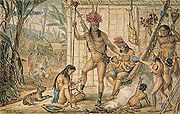 Intending to profit from sugar trade, the Portuguese decided to plant sugar cane in Brazil, and use indigenous slaves as the workforce, as the Spanish
colonies were successfully doing. But the indigenous people were hard to capture and soon infected by diseases brought by the Europeans against which they had no natural immunity
, began dying in great numbers. This, coupled with the prospects of increased profits from the African slave trade
(at the time almost monopolized by Portugal and supplying the labour needs of both Spanish and Portuguese settlers in the New World
), encouraged Portuguese settlers and traders to start importing slaves from Africa
. Although in 1570 King Sebastian I
ordered that the Brazilian Indians should not be used for slavery and ordered the release of those held in captivity it was only in 1755 that the slavery of Indians was finally abolished.
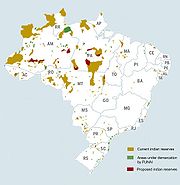 The Jesuit
priests, who had come with the first Governor General to provide for religious assistance to the colonists, but mainly to convert the "pagan" peoples to Catholicism
, took the side of the Indians and extracted a Papal bull
stating that they were human and should be protected.
Jesuit priests such as fathers José de Anchieta
and Manuel da Nóbrega
studied and recorded their language and founded mixed settlements, such as São Paulo dos Campos de Piratininga
, where colonists and Indians lived side by side, speaking the same Língua Geral
(common language) and freely interbred. They began also to establish more remote villages peopled only by "civilized" Indians, called Missions, or reductions (see the article on the Guarani people for more details).
By the middle of the 16th century, Catholic Jesuit priests, at the behest of Portugal's monarchy, had established missions throughout the country's colonies. They became protectors of the Indians and worked to both Europeanize them and convert them to Catholicism
. The Jesuits provided a period of relative stability for the Indians.
In the mid-1770s, when the power of the Catholic Church began to wane in Europe, the Indians' fragile co-existence with the colonists was again threatened. Because of a complex diplomatic web between Portugal
, Spain
and the Vatican
, the Jesuits were expelled from Brazil and the missions confiscated and sold.
By 1800, the population of Brazil had reached approximately 3.25 million, of which only 250,000 were indigenous
. And for the next four decades, the Indians were largely left alone.
 A number of wars between several tribes, such as the Tamoio Confederation, and the Portuguese ensued, sometimes with the Indians siding with enemies of Portugal, such as the French
, in the famous episode of France Antarctique
in Rio de Janeiro
, sometimes allying themselves to Portugal in their fight against other tribes. At approximately the same period, a German soldier, Hans Staden
, was captured by the Tupinambá and released after a while. He described it in a famous book.
There are various documented accounts of smallpox
being knowingly used as a biological weapon by New Brazilian villagers that wanted to get rid of nearby Indian tribes (not always aggressive ones). The most "classical", according to Anthropologist, Mércio Pereira Gomes, happened in Caxias, in south Maranhão, where local farmers, wanting more land to extend their cattle farms, gave clothing owned by ill villagers (that normally would be burned to prevent further infection) to the Timbira. The clothing infected the entire tribe, and they had neither immunity nor cure. Similar things happened in other villages throughout South America.
. The process for vulcanizing
rubber
was developed, and worldwide demand for the product skyrocketed. The best rubber trees in the world grew in the Amazon, and thousands of rubber tappers began to work the plantations. When the Indians proved to be a difficult labor force, peasants from surrounding areas were brought into the region. In a dynamic that continues to this day, the indigenous population was at constant odds with the peasants, who the Indians felt had invaded their lands in search of treasure.
 In the 20th century, the Brazilian Government adopted a more humanitarian attitude and offered official protection to the indigenous people, including the establishment of the first indigenous reserves. Fortune brightened for the Indians around the turn of the 20th century when Cândido Rondon
, a man of both Portuguese
and Bororo
ancestry, and an explorer and progressive officer in the Brazilian army, began working to gain the Indians' trust and establish peace. Rondon, who had been assigned to help bring telegraph communications into the Amazon, was a curious and natural explorer. In 1910, he helped found the Serviço de Proteção aos Índios - SPI (Indian Protection Service, today the FUNAI, or Fundação Nacional do Índio
, National Foundation for Indians). SPI was the first federal agency charged with protecting Indians and preserving their culture. In 1914, Rondon accompanied Theodore Roosevelt
on Roosevelt's famous expedition to map the Amazon and discover new species. During these travels, Rondon was appalled to see how settlers and developers treated the indigenes, and he became their lifelong friend and protector. In 1952, as a final legacy, he established Xingu National Park
, in the state of Mato Grosso
, the first Indian reservation in Brazil.
Rondon, who died in 1956, is a national hero in Brazil. The Brazilian state of Rondônia
is named after him.
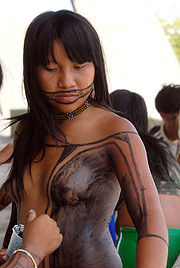 After Rondon's pioneering work, the SPI was turned over to bureaucrats and military officers and its work declined after 1957. The new officials did not share Rondon's deep commitment to the Indians. SPI sought to address tribal issues by transforming the tribes into mainstream Brazilian society. The lure of reservation riches enticed cattle ranchers and settlers to continue their assault on Indians lands – and the SPI eased the way. Between 1900 and 1967, an estimated 98 indigenous
tribes were wiped out.
During the social and political upheaval in the 1960s, reports of mistreatment of Indians increasingly reached Brazil
's urban center
s and began to affect Brazilian thinking. In 1967, following the publication of the Figueiredo report, commissioned by the Ministry of the Interior, the military government launched an investigation into SPI. It soon came to light that the SPI was corrupt and failing to protect Indians, their lands, and, culture. The 5,000 page report catalogued atrocities including slavery, sexual abuse, torture, and mass murder.
It has been charged that agency officials, in collaboration with land speculators, were systematically slaughtering the Indians by intentionally circulating disease-laced clothes. Criminal prosecutions followed, and the SPI was disbanded. The same year the government established Fundação Nacional do Índio (National Indian Foundation), known as FUNAI which is responsible for protecting the interests, cultures, and rights of the Brazilian indigenous populations.
Some tribes have become significantly integrated into Brazilian society. The unacculturated tribes which have been contacted by FUNAI, are supposed to be protected and accommodated within Brazilian society in varying degrees. By 1987 it was recognized that unessential contact with the tribes was causing illness and social disintegration. The uncontacted tribes are now supposed to be protected from intrusion and interference in their life style and territory.
However, the exploitation of rubber
and other Amazonic natural resources has led to a new cycle of invasion, expulsion, massacres and death, which continues to this day.
and to open up the region to more trade. With funding from World Bank, thousands of square miles of forest were cleared without regard for reservation status. After the highway projects came giant hydroelectric projects, then swaths of forest were cleared for cattle ranches. As a result, reservation lands suffered massive deforestation and flooding. The public works projects attracted very few migrants, but those few – and largely poor - settlers brought new diseases that further devastated the Indians population.
recognises indigenous peoples' right to pursue their traditional ways of life and to the permanent and exclusive possession of their "traditional lands", which are demarcated as Indigenous Territories
. In practice, however, Brazil's indigenous people are still face a number of external threats and challenges to their continued existence and cultural heritage. The process of demarcation is slow—often involving protracted legal battles—and FUNAI
do not have sufficient resources to enforce the legal protection on indigenous land. Since the 1980s there has been a boom in the exploitation of the Amazon Rainforest for mining, logging and cattle ranching, posing a severe threat to the region's indigenous population. Settlers illegally encroaching on indigenous land continue to destroy the environment necessary for indigenous peoples' traditional ways of life, provoke violent confrontations and spread disease. Peoples such as the Akuntsu
and Kanoê
have been brought to the brink of extinction within the last three decades.
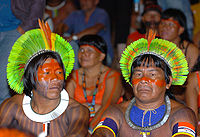
Europe
Europe is, by convention, one of the world's seven continents. Comprising the westernmost peninsula of Eurasia, Europe is generally 'divided' from Asia to its east by the watershed divides of the Ural and Caucasus Mountains, the Ural River, the Caspian and Black Seas, and the waterways connecting...
an invasion around 1500. Unlike Christopher Columbus
Christopher Columbus
Christopher Columbus was an explorer, colonizer, and navigator, born in the Republic of Genoa, in northwestern Italy. Under the auspices of the Catholic Monarchs of Spain, he completed four voyages across the Atlantic Ocean that led to general European awareness of the American continents in the...
, who thought he had reached the East Indies
East Indies
East Indies is a term used by Europeans from the 16th century onwards to identify what is now known as Indian subcontinent or South Asia, Southeastern Asia, and the islands of Oceania, including the Malay Archipelago and the Philippines...
, the Portuguese
Portugal
Portugal , officially the Portuguese Republic is a country situated in southwestern Europe on the Iberian Peninsula. Portugal is the westernmost country of Europe, and is bordered by the Atlantic Ocean to the West and South and by Spain to the North and East. The Atlantic archipelagos of the...
, most notably Vasco da Gama
Vasco da Gama
Vasco da Gama, 1st Count of Vidigueira was a Portuguese explorer, one of the most successful in the Age of Discovery and the commander of the first ships to sail directly from Europe to India...
, had already reached India
India
India , officially the Republic of India , is a country in South Asia. It is the seventh-largest country by geographical area, the second-most populous country with over 1.2 billion people, and the most populous democracy in the world...
via the Indian Ocean route when they reached Brazil
Brazil
Brazil , officially the Federative Republic of Brazil , is the largest country in South America. It is the world's fifth largest country, both by geographical area and by population with over 192 million people...
.
Nevertheless the word índios ("Indians") was by then established to designate the people of the New World and stuck being used today in the Portuguese language to designate these peoples, while the people of India, Asia are called indianos in order to distinguish the two people.
At the time of European discovery, some of the indigenous peoples
Indigenous peoples
Indigenous peoples are ethnic groups that are defined as indigenous according to one of the various definitions of the term, there is no universally accepted definition but most of which carry connotations of being the "original inhabitants" of a territory....
were traditionally mostly semi-nomadic tribes who subsisted on hunting
Hunting
Hunting is the practice of pursuing any living thing, usually wildlife, for food, recreation, or trade. In present-day use, the term refers to lawful hunting, as distinguished from poaching, which is the killing, trapping or capture of the hunted species contrary to applicable law...
, fishing
Fishing
Fishing is the activity of trying to catch wild fish. Fish are normally caught in the wild. Techniques for catching fish include hand gathering, spearing, netting, angling and trapping....
, gathering
Hunter-gatherer
A hunter-gatherer or forage society is one in which most or all food is obtained from wild plants and animals, in contrast to agricultural societies which rely mainly on domesticated species. Hunting and gathering was the ancestral subsistence mode of Homo, and all modern humans were...
, and migrant agriculture
Agriculture
Agriculture is the cultivation of animals, plants, fungi and other life forms for food, fiber, and other products used to sustain life. Agriculture was the key implement in the rise of sedentary human civilization, whereby farming of domesticated species created food surpluses that nurtured the...
. Many of the estimated 2,000 nations and tribes which existed in the 16th century died out as a consequence of the European settlement, and many were assimilated into the Brazilian population
Population
A population is all the organisms that both belong to the same group or species and live in the same geographical area. The area that is used to define a sexual population is such that inter-breeding is possible between any pair within the area and more probable than cross-breeding with individuals...
.
The Indigenous population was largely killed off by the Spanish
Spain
Spain , officially the Kingdom of Spain languages]] under the European Charter for Regional or Minority Languages. In each of these, Spain's official name is as follows:;;;;;;), is a country and member state of the European Union located in southwestern Europe on the Iberian Peninsula...
, declining from a pre-Columbian high of millions to some 300,000 (1997), grouped into some 200 tribes. However, the number could be much higher if the urban Indigenous populations are counted in all the Brazilian cities today. A somewhat dated linguistic survey found 188 living indigenous languages
Languages of Brazil
Portuguese is the official language of Brazil, and is spoken by more than 99% of the population. Minority languages include indigenous languages, and languages of more recent European and Asian immigrants. The population speaks or signs approximately 210 languages, of which 80 are...
with 155,000 total speakers.
On 18 January 2007, FUNAI
Fundação Nacional do Índio
Fundação Nacional do Índio or FUNAI is a Brazilian governmental protection agency for Indian interests and their culture.It was originally called the SPI and was founded by the Brazilian Marshal Cândido Rondon in 1910, who also created the agency's motto, "Die if necessary, but never kill." The...
reported that it had confirmed the presence of 67 different uncontacted tribes in Brazil
Brazil
Brazil , officially the Federative Republic of Brazil , is the largest country in South America. It is the world's fifth largest country, both by geographical area and by population with over 192 million people...
, up from 40 in 2005. With this addition Brazil has now overpassed New Guinea
New Guinea
New Guinea is the world's second largest island, after Greenland, covering a land area of 786,000 km2. Located in the southwest Pacific Ocean, it lies geographically to the east of the Malay Archipelago, with which it is sometimes included as part of a greater Indo-Australian Archipelago...
as the country having the largest number of uncontacted peoples
Uncontacted peoples
Uncontacted people, also referred to as isolated people or lost tribes, are communities who live, or have lived, either by choice or by circumstance, without significant contact with globalized civilisation....
.
Brazilian Indigenous people have made substantial and pervasive contributions to the world's medicine with knowledge used today by pharmaceutical corporations, material and cultural development—such as the domestication of cassava
Cassava
Cassava , also called yuca or manioc, a woody shrub of the Euphorbiaceae native to South America, is extensively cultivated as an annual crop in tropical and subtropical regions for its edible starchy tuberous root, a major source of carbohydrates...
and other natural foods.
In the last IBGE census (2006), 519,000 Brazilians classified themselves as indigenous
Indigenous peoples
Indigenous peoples are ethnic groups that are defined as indigenous according to one of the various definitions of the term, there is no universally accepted definition but most of which carry connotations of being the "original inhabitants" of a territory....
, even though millions of Brazilians have Amerindian ancestry.
Origins
Archaeology
Archaeology, or archeology , is the study of human society, primarily through the recovery and analysis of the material culture and environmental data that they have left behind, which includes artifacts, architecture, biofacts and cultural landscapes...
. The traditional view, which traces them to Siberia
Siberia
Siberia is an extensive region constituting almost all of Northern Asia. Comprising the central and eastern portion of the Russian Federation, it was part of the Soviet Union from its beginning, as its predecessor states, the Tsardom of Russia and the Russian Empire, conquered it during the 16th...
n migration to America at the end of the last ice age
Wisconsin glaciation
The last glacial period was the most recent glacial period within the current ice age occurring during the last years of the Pleistocene, from approximately 110,000 to 10,000 years ago....
, has been increasingly challenged by South America
South America
South America is a continent situated in the Western Hemisphere, mostly in the Southern Hemisphere, with a relatively small portion in the Northern Hemisphere. The continent is also considered a subcontinent of the Americas. It is bordered on the west by the Pacific Ocean and on the north and east...
n archaeologists. Theories to explain evidence of pre-Columbian trans-oceanic contact
Pre-Columbian trans-oceanic contact
Theories of Pre-Columbian trans-oceanic contact are those theories that propose interaction between indigenous peoples of the Americas who settled the Americas before 10,000 BC, and peoples of other continents , which occurred before the arrival of Christopher Columbus in the Caribbean in 1492.Many...
with the Americas by Asian, African, or Oceanic peoples is generally the topic of significant debate. Demonstrations
Experimental archaeology
Experimental archaeology employs a number of different methods, techniques, analyses, and approaches in order to generate and test hypotheses, based upon archaeological source material, like ancient structures or artifacts. It should not be confused with primitive technology which is not concerned...
such as Kon-Tiki
Kon-Tiki
Kon-Tiki was the raft used by Norwegian explorer and writer Thor Heyerdahl in his 1947 expedition across the Pacific Ocean from South America to the Polynesian islands. It was named after the Inca sun god, Viracocha, for whom "Kon-Tiki" was said to be an old name...
and the Kantuta Expeditions
Kantuta Expeditions
The Kantuta Expeditions were two separate expeditions on balsa rafts led by the Czech explorer and adventurer Eduard Ingris.The voyages were inspired by the Thor Heyerdahl's Kon-Tiki expeditions...
demonstrated the ability to travel westward with the Humboldt Current
Humboldt Current
The Humboldt Current , also known as the Peru Current, is a cold, low-salinity ocean current that flows north-westward along the west coast of South America from the southern tip of Chile to northern Peru. It is an eastern boundary current flowing in the direction of the equator, and can extend...
from South America to Polynesia
Polynesia
Polynesia is a subregion of Oceania, made up of over 1,000 islands scattered over the central and southern Pacific Ocean. The indigenous people who inhabit the islands of Polynesia are termed Polynesians and they share many similar traits including language, culture and beliefs...
.
The Siberian Ice Age hypothesis
AnthropologicalAnthropology
Anthropology is the study of humanity. It has origins in the humanities, the natural sciences, and the social sciences. The term "anthropology" is from the Greek anthrōpos , "man", understood to mean mankind or humanity, and -logia , "discourse" or "study", and was first used in 1501 by German...
and genetic
Genetics
Genetics , a discipline of biology, is the science of genes, heredity, and variation in living organisms....
evidence indicates that most Native American peoples descended from migrant peoples from North Asia
North Asia
North Asia or Northern Asia is a subregion of Asia, consisting of the Asian portion of Russia.The Phillips Illustrated Atlas of the World 1988 defines it as being most of the former USSR, the part that is to the east of the Ural Mountains...
(Siberia
Siberia
Siberia is an extensive region constituting almost all of Northern Asia. Comprising the central and eastern portion of the Russian Federation, it was part of the Soviet Union from its beginning, as its predecessor states, the Tsardom of Russia and the Russian Empire, conquered it during the 16th...
) who entered America across the Bering Strait
Bering Strait
The Bering Strait , known to natives as Imakpik, is a sea strait between Cape Dezhnev, Chukotka Autonomous Okrug, Russia, the easternmost point of the Asian continent and Cape Prince of Wales, Alaska, USA, the westernmost point of the North American continent, with latitude of about 65°40'N,...
or along the western coast of North America in at least three separate waves. In Brazil, particularly, most native tribes who were living in the land by 1500 are thought to be descended from the first Siberian wave of migrants, who are believed to have crossed the Bering Land Bridge
Bering land bridge
The Bering land bridge was a land bridge roughly 1,000 miles wide at its greatest extent, which joined present-day Alaska and eastern Siberia at various times during the Pleistocene ice ages. Like most of Siberia and all of Manchuria, Beringia was not glaciated because snowfall was extremely light...
at the end of the last Ice Age, between 13,000 and 17,000 years before the present. A migrant wave would have taken some time after initial entry to reach present-day Brazil, probably entering the Amazon River
Amazon River
The Amazon of South America is the second longest river in the world and by far the largest by waterflow with an average discharge greater than the next seven largest rivers combined...
basin from the Northwest. (The second and third migratory waves from Siberia, which are thought to have generated the Athabaskan and Eskimo
Eskimo
Eskimos or Inuit–Yupik peoples are indigenous peoples who have traditionally inhabited the circumpolar region from eastern Siberia , across Alaska , Canada, and Greenland....
peoples, apparently did not reach farther than the southern United States
United States
The United States of America is a federal constitutional republic comprising fifty states and a federal district...
and Canada
Canada
Canada is a North American country consisting of ten provinces and three territories. Located in the northern part of the continent, it extends from the Atlantic Ocean in the east to the Pacific Ocean in the west, and northward into the Arctic Ocean...
, respectively).
An analysis of Amerindian Y-chromosome DNA indicates specific clustering of much of the South American population. The micro-satellite diversity and distributions of the Y lineage specific to South America indicates that certain Amerindian populations have been isolated since the initial colonization of the region.
The Australian Aborigines hypothesis
The traditional view above has recently been challenged by findings of human remains in South America, which are claimed to be too old to fit this scenario—perhaps even 20,000 years old. Some recent finds (notably the Luzia skeletonLuzia Woman
right|thumb|250px|Reconstruction of her faceLuzia Woman is the name for the skeleton of a woman found in a cave in Brazil, South America. Some archaeologists believe the young woman may have been part of the first wave of immigrants to South America...
in Lagoa Santa
Lagoa Santa
For Lagoa Santa, a municipality in Goiás see Lagoa Santa, GoiásLagoa Santa is a municipality and region in the state of Minas Gerais, Brazil...
, Minas Gerais
Minas Gerais
Minas Gerais is one of the 26 states of Brazil, of which it is the second most populous, the third richest, and the fourth largest in area. Minas Gerais is the Brazilian state with the largest number of Presidents of Brazil, the current one, Dilma Rousseff, being one of them. The capital is the...
, Brazil analyzed by University of São Paulo
University of São Paulo
Universidade de São Paulo is a public university in the Brazilian state of São Paulo. It is the largest Brazilian university and one of the country's most prestigious...
, Professor Walter Neves
Walter Neves
Walter Neves is a Brazilian anthropologist, archaeologist and biologist from the University of São Paulo , Brazil. He is best known for his analysis of the morphological characteristics of early human remains in South America....
) are claimed to be morphologically distinct from the Asian phenotype
Phenotype
A phenotype is an organism's observable characteristics or traits: such as its morphology, development, biochemical or physiological properties, behavior, and products of behavior...
and are more similar to Australian Aborigines. These Americans would have been later displaced or absorbed by the Siberian immigrants. The distinctive natives of Tierra del Fuego
Fuegians
Fuegians are the indigenous inhabitants of Tierra del Fuego, at the southern tip of South America. In English, the term originally referred to the Yaghan people of Tierra del Fuego...
, the southernmost tip of the American continent, may have been the last remains of those Aboriginal populations.
These early immigrants would have either crossed the ocean on raft
Raft
A raft is any flat structure for support or transportation over water. It is the most basic of boat design, characterized by the absence of a hull...
s or boats, or traveled North along the Asian coast and entered America through the Bering Strait area, well before the Siberian waves. This theory is still resisted by many scientists chiefly because of the apparent difficulty of the trip. Some proposed theories involve a southward migration from or through Australia
Australia
Australia , officially the Commonwealth of Australia, is a country in the Southern Hemisphere comprising the mainland of the Australian continent, the island of Tasmania, and numerous smaller islands in the Indian and Pacific Oceans. It is the world's sixth-largest country by total area...
and Tasmania
Tasmania
Tasmania is an Australian island and state. It is south of the continent, separated by Bass Strait. The state includes the island of Tasmania—the 26th largest island in the world—and the surrounding islands. The state has a population of 507,626 , of whom almost half reside in the greater Hobart...
, hopping Subantarctic islands and then proceeding along the coast of Antarctica and/or southern ice sheet
Ice sheet
An ice sheet is a mass of glacier ice that covers surrounding terrain and is greater than 50,000 km² , thus also known as continental glacier...
s to the tip of South America
South America
South America is a continent situated in the Western Hemisphere, mostly in the Southern Hemisphere, with a relatively small portion in the Northern Hemisphere. The continent is also considered a subcontinent of the Americas. It is bordered on the west by the Pacific Ocean and on the north and east...
at the time of the last glacial maximum
Last Glacial Maximum
The Last Glacial Maximum refers to a period in the Earth's climate history when ice sheets were at their maximum extension, between 26,500 and 19,000–20,000 years ago, marking the peak of the last glacial period. During this time, vast ice sheets covered much of North America, northern Europe and...
.
Archaeological remains
Brazilian natives, unlike those in MesoamericaMesoamerica
Mesoamerica is a region and culture area in the Americas, extending approximately from central Mexico to Belize, Guatemala, El Salvador, Honduras, Nicaragua, and Costa Rica, within which a number of pre-Columbian societies flourished before the Spanish colonization of the Americas in the 15th and...
and the western Andes
Andes
The Andes is the world's longest continental mountain range. It is a continual range of highlands along the western coast of South America. This range is about long, about to wide , and of an average height of about .Along its length, the Andes is split into several ranges, which are separated...
, did not keep written records or erect stone monuments, and the humid climate and acidic soil have destroyed almost all traces of their material culture, including wood
Wood
Wood is a hard, fibrous tissue found in many trees. It has been used for hundreds of thousands of years for both fuel and as a construction material. It is an organic material, a natural composite of cellulose fibers embedded in a matrix of lignin which resists compression...
and bone
Bone
Bones are rigid organs that constitute part of the endoskeleton of vertebrates. They support, and protect the various organs of the body, produce red and white blood cells and store minerals. Bone tissue is a type of dense connective tissue...
s. Therefore, what is known about the region's history before 1500 has been inferred and reconstructed from small-scale archaeological evidence, such as pottery
Pottery
Pottery is the material from which the potteryware is made, of which major types include earthenware, stoneware and porcelain. The place where such wares are made is also called a pottery . Pottery also refers to the art or craft of the potter or the manufacture of pottery...
and stone arrowhead
Arrowhead
An arrowhead is a tip, usually sharpened, added to an arrow to make it more deadly or to fulfill some special purpose. Historically arrowheads were made of stone and of organic materials; as human civilization progressed other materials were used...
s.
The most conspicuous remains of these societies are very large mounds of discarded shellfish
Shellfish
Shellfish is a culinary and fisheries term for exoskeleton-bearing aquatic invertebrates used as food, including various species of molluscs, crustaceans, and echinoderms. Although most kinds of shellfish are harvested from saltwater environments, some kinds are found only in freshwater...
(sambaquis) found in some coastal sites which were continuously inhabited for over 5,000 years; and the substantial "black earth" (terra preta
Terra preta
Terra preta is a type of very dark, fertile anthropogenic soil found in the Amazon Basin. Terra preta owes its name to its very high charcoal content, and was indeed made by adding a mixture of charcoal, bone, and manure to the otherwise relatively infertile Amazonian soil, and stays there for...
) deposits in several places along the Amazon, which are believed to be ancient garbage dumps (midden
Midden
A midden, is an old dump for domestic waste which may consist of animal bone, human excrement, botanical material, vermin, shells, sherds, lithics , and other artifacts and ecofacts associated with past human occupation...
s). Recent excavations of such deposits in the middle and upper course of the Amazon have uncovered remains of some very large settlements, containing tens of thousands of homes, indicating a complex social and economical structure.
The natives after the European colonization
On the eve of the Portuguese arrival in 1500, Brazil's coastal areas had two major mega-groups - the Tupi (speakers of Tupi–Guarani languages), who inhabited practically the entire Brazilian coast, and the Tapuia (a catch-all term for non-Tupis, usually Jê language peoples), who resided in the interior. The Portuguese arrived in the final days of a long struggle between the Tupis and Tapuias, which had resulted in the defeat and expulsion of the Tapuias from the coastal areas.Although the Tupi were broken down into sub-tribes, they were culturally and linguistically homogeneous. The fact that the Portuguese encountered practically the same people and language all along the Brazilian coast made interaction rather easy.
The names by which the different Tupi tribes were called and recorded by Portuguese and French authors of the 16th C. are poorly understood. Most do not seem to be proper names, but descriptions of relationship, usually familial - e.g. tupi means "first father", tupinambá means "relatives of the ancestors", tupiniquim means "side-neighbors", tamoio means "grandfather", temiminó means "grandson", "tabajara" means "in-laws" and so on. Some etymologists believe these names reflect the ordering of the migration waves of Tupi peoples to the coast, e.g. first Tupi wave to reach the coast being the "grandfathers" (Tamoio), soon joined by the "relatives of the ancients" (Tupinamba), by which it could mean relatives of the Tamoio, or a Tamoio term to refer to relatives of the old Tupi back in the Amazon basin. The "grandsons" (Temiminó) might be a a splinter. The "side-neighbors" (Tupiniquim) meant perhaps recent arrivals, still trying to jostle their way in.
Coastal Sequence (north to south):
- Tupinambá (Tupi, from the Amazon delta to MaranhãoMaranhãoMaranhão is a northeastern state of Brazil. To the north lies the Atlantic Ocean. Maranhão is neighbored by the states of Piauí, Tocantins and Pará. The people of Maranhão have a distinctive accent...
) - TremembéTremembé peoplethumb|200px|1629 map of [[Ceará]] coast, highlighting the dominions of the TremembéThe Tremembé or Teremembé people are an indigenous people in the state of Ceará in Brazil....
(Tapuia (non-Tupi), coastal tribe, ranged from São Luis IslandSão Luís IslandSão Luís Island is an island in Brazil with an area of 1,410 km² , located between the Baía de São Marcos and the Baía de São José in Maranhão state. There are 4 cities located in the island: São Luís, after which the island is named, São José de Ribamar, Paço do Lumiar, and Raposa. São Luís is the...
(south Maranhão) to the mouth of the Acaraú RiverAcaraú River-References:*...
in north CearáCearáCeará is one of the 27 states of Brazil, located in the northeastern part of the country, on the Atlantic coast. It is currently the 8th largest Brazilian State by population and the 17th by area. It is also one of the main touristic destinations in Brazil. The state capital is the city of...
; French interlopers cultivated an alliance with them) - Potiguara (Tupi, literally "shrimp-eaters"; they had a reputation as great canoeists and aggressively expansionist, inhabited a great coastal stretch from Acaraú river to ItamaracáItamaracáItamaracá is an island and a city in Pernambuco, Brazil, in the Atlantic Ocean. The name means "stone shaker" in Tupi, from the words itá and mbara'ká . Itamaracá has a total area of 65.41 square kilometers and had an estimated population of 18,658 inhabitants in 2009 according with IBGE...
, covering the modern states of souther Ceará, Rio Grande do Norte and Paraíba.) - TabajaraTabajaraTabajara is a nation of indigenous people, who had lived in interior of the Ceará, specially in Serra da Ibiapaba. This name means lord of village from taba village, and jara lord; according to José de Alencar....
(tiny Tupi tribe between Itamaracá island and Paraiba RiverParaíba do Norte RiverThe Paraíba do Norte River, also known simply as the Paraíba River, is a river in Paraíba state of northeastern Brazil. The river originates in the Borborema Plateau, and it flows northeast to empty into the Atlantic Ocean north of João Pessoa, the state capital....
; frequent victims of the Potiguara) - Caeté (Tupi group in Pernambuco, ranged from Paraiba River to the São Francisco RiverSão Francisco RiverThe São Francisco is a river in Brazil. With a length of , it is the longest river that runs entirely in Brazilian territory, and the fourth longest in South America and overall in Brazil...
; after killing and eating a Portuguese bishop, they were subjected to Portuguese extermination raids and the remnant pushed into the Pará interior) - Tupinambá again (Tupi par excellence, ranged from the São Francisco River to the Bay of All Saints, population estimated as high as 100,000; hosted Portuguese castaway CaramuruCaramuruDiogo Álvares Correia , called Caramuru by the Tupinambá, was a Portuguese settler born in Viana do Castelo. He departed for Brazil in 1509, and his ship wrecked in the coast of Bahia, Diogo Álvares found himself among the Tupinamba Indians...
) - TupiniquimTupiniquimTupiniquim is the name of an Amerindian tribe who now only live in three reservations . All three are located in the municipality of Aracruz in northern Espírito Santo state, southeastern Brazil. As of 1997 their population was 1,386...
(Tupi, covered Bahian discovery coast, from Camumu to Rio São Mateus; these were the first people encountered by the Portuguese in 1500) - Aimoré (non-Tupi (Jê) tribe; concentrated on a sliver of coast in modern Espirito Santo)
- GoitacáGoitacá peopleThe Goitacá people are an indigenous people of Brazil, currently considered extinct....
(Tapuia (non-Tupi) tribe; once dominated the coast from São Mateus RiverSão Mateus River-References:*...
(in Espírito SantoEspírito SantoEspírito Santo is one of the states of southeastern Brazil, often referred to by the abbreviation "ES". Its capital is Vitória and the largest city is Vila Velha. The name of the state means literally "holy spirit" after the Holy Ghost of Christianity...
state) down to the Paraíba do SulParaíba do SulthumbThe Paraíba do Sul , or simply termed Paraíba, is a river in the south-east of Brazil. It flows 1,137 kilometres west to northeast from its farthest source at the source of the river Paraitinga to the sea near Campos...
river (in Rio de JaneiroRio de Janeiro (state)Rio de Janeiro is one of the 27 states of Brazil.Rio de Janeiro has the second largest economy of Brazil behind only São Paulo state.The state of Rio de Janeiro is located within the Brazilian geopolitical region classified as the Southeast...
state); hunter-gatherers and fishermen, they were a shy people that avoided all contact with foreigners; estimated at 12,000; they had a fearsome reputation and were eventually annihilated by European colonists) - Temiminó (small Tupi tribe, centered on Governador island in Guanabara bay; frequently at war with the Tamoio around them)
- Tamoio (old branch of the Tupinambá, ranged from the western edge of Guanabara bay to Ilha Grande)
- Tupinamba again (Tupi, indistinct from the Tamoio. Inhabited the Paulist coast, from Ilha Grande to Santos; main enemies of the Tupiniquim to their west Numbered around 6 to 10,000).
- TupiniquimTupiniquimTupiniquim is the name of an Amerindian tribe who now only live in three reservations . All three are located in the municipality of Aracruz in northern Espírito Santo state, southeastern Brazil. As of 1997 their population was 1,386...
again (Tupi, on the Paulist coast from Santos/Bertioga down to Cananeia; aggressively expansionist, they were recent arrivals imposing themselves on the coast at the expense of their neighbors; first formal allies of the Portuguese colonists of the 1530s) - Carijó (Guarani tribe, from Cananeia down to Lago dos Patos; victims of the Tupiniquim and early European slavers; hosted mysterious degredadoDegredadoA degredado is the traditionalPortuguese term for a convict exile, esp. in 15th-18th C.The term degredado is a traditional Portuguese legal term used to refer to anyone who was subject to legal restrictions on their movement, speech or labor. Exile is only one of several forms of legal impairment...
known as the Bachelor of Cananeia) - CharrúaCharruaThe Charrúa were an indigenous people of southern South America in the area today known as Uruguay and southern Brazil. They were a nomadic people that sustained themselves through fishing and foraging...
(non-Tupi (Jê) tribe in modern Uruguay coast, with an aggressive reputation against intruders; killed Juan Dias de Solis)
With the exception of the Goitacases, the coastal tribes were primarily agriculturalists. The subtropical Guarani cultivated maize
Maize
Maize known in many English-speaking countries as corn or mielie/mealie, is a grain domesticated by indigenous peoples in Mesoamerica in prehistoric times. The leafy stalk produces ears which contain seeds called kernels. Though technically a grain, maize kernels are used in cooking as a vegetable...
, tropical Tupi cultivated manioc (cassava
Cassava
Cassava , also called yuca or manioc, a woody shrub of the Euphorbiaceae native to South America, is extensively cultivated as an annual crop in tropical and subtropical regions for its edible starchy tuberous root, a major source of carbohydrates...
), highland Jês cultivated peanut
Peanut
The peanut, or groundnut , is a species in the legume or "bean" family , so it is not a nut. The peanut was probably first cultivated in the valleys of Peru. It is an annual herbaceous plant growing tall...
, as the staple of their diet. Supplementary crops included bean
Bean
Bean is a common name for large plant seeds of several genera of the family Fabaceae used for human food or animal feed....
s, sweet potato
Sweet potato
The sweet potato is a dicotyledonous plant that belongs to the family Convolvulaceae. Its large, starchy, sweet-tasting, tuberous roots are an important root vegetable. The young leaves and shoots are sometimes eaten as greens. Of the approximately 50 genera and more than 1,000 species of...
es, cará (yam
Yam (vegetable)
Yam is the common name for some species in the genus Dioscorea . These are perennial herbaceous vines cultivated for the consumption of their starchy tubers in Africa, Asia, Latin America and Oceania...
), jerimum (pumpkin
Pumpkin
A pumpkin is a gourd-like squash of the genus Cucurbita and the family Cucurbitaceae . It commonly refers to cultivars of any one of the species Cucurbita pepo, Cucurbita mixta, Cucurbita maxima, and Cucurbita moschata, and is native to North America...
) and cumari (capsicum
Capsicum
Capsicum is a genus of flowering plants in the nightshade family, Solanaceae. Its species are native to the Americas where they have been cultivated for thousands of years, but they are now also cultivated worldwide, used as spices, vegetables, and medicines - and have become are a key element in...
pepper).
First contacts
Portuguese people
The Portuguese are a nation and ethnic group native to the country of Portugal, in the west of the Iberian peninsula of south-west Europe. Their language is Portuguese, and Roman Catholicism is the predominant religion....
explorers first arrived in Brazil in April 1500, they found, to their astonishment, a wide coastline rich in resources, teeming with hundreds of thousands of Indigenous people living in a "paradise" of natural riches. Pêro Vaz de Caminha
Pêro Vaz de Caminha
Pêro Vaz de Caminha , was a Portuguese knight that accompanied Pedro Álvares Cabral to India in 1500, as a secretary to the royal factory. Caminha wrote the detailed official report of the April 1500 discovery of Brazil by Cabral's fleet...
, the official scribe of Pedro Álvares Cabral
Pedro Álvares Cabral
Pedro Álvares Cabral was a Portuguese noble, military commander, navigator and explorer regarded as the discoverer of Brazil. Cabral conducted the first substantial exploration of the northeast coast of South America and claimed it for Portugal. While details of Cabral's early life are sketchy, it...
, the commander of the discovery fleet which landed in the present state of Bahia
Bahia
Bahia is one of the 26 states of Brazil, and is located in the northeastern part of the country on the Atlantic coast. It is the fourth most populous Brazilian state after São Paulo, Minas Gerais and Rio de Janeiro, and the fifth-largest in size...
, wrote a letter to the King of Portugal describing in glowing terms the beauty of the land.
At the time of European arrival, the territory of current day Brazil had as many as 2,000 nations and tribes. The indigenous peoples were traditionally mostly semi-nomadic tribes who subsisted on hunting, fishing, gathering, and migrant agriculture. For hundreds of years, the indigenous people of Brazil lived a semi-nomadic life, managing the forests to meet their needs. When the Portuguese arrived in 1500, the Indians were living mainly on the coast and along the banks of major rivers. Initially, the Europeans saw the natives as noble savages, and miscegenation
Miscegenation
Miscegenation is the mixing of different racial groups through marriage, cohabitation, sexual relations, and procreation....
of the population began right away. Portugues claims of tribal warfare, cannibalism
Cannibalism
Cannibalism is the act or practice of humans eating the flesh of other human beings. It is also called anthropophagy...
, and the pursuit of Amazonian brazilwood
Brazilwood
Caesalpinia echinata is a species of Brazilian timber tree in the pea family, Fabaceae. Common names include Brazilwood, Pau-Brasil, Pau de Pernambuco and Ibirapitanga . This plant has a dense, orange-red heartwood that takes a high shine, and it is the premier wood used for making bows for...
for its treasured red dye convinced the Portuguese that they should "civilize" the Indians (originally, Colonists called Brazil Terra de Santa Cruz, until later it acquired its name (see List of meanings of countries' names) from brazilwood
Brazilwood
Caesalpinia echinata is a species of Brazilian timber tree in the pea family, Fabaceae. Common names include Brazilwood, Pau-Brasil, Pau de Pernambuco and Ibirapitanga . This plant has a dense, orange-red heartwood that takes a high shine, and it is the premier wood used for making bows for...
). But the Portuguese, like the Spanish in their North America territories, had brought diseases with them against which many Indians were helpless due to lack of immunity. Measles
Measles
Measles, also known as rubeola or morbilli, is an infection of the respiratory system caused by a virus, specifically a paramyxovirus of the genus Morbillivirus. Morbilliviruses, like other paramyxoviruses, are enveloped, single-stranded, negative-sense RNA viruses...
, smallpox
Smallpox
Smallpox was an infectious disease unique to humans, caused by either of two virus variants, Variola major and Variola minor. The disease is also known by the Latin names Variola or Variola vera, which is a derivative of the Latin varius, meaning "spotted", or varus, meaning "pimple"...
, tuberculosis
Tuberculosis
Tuberculosis, MTB, or TB is a common, and in many cases lethal, infectious disease caused by various strains of mycobacteria, usually Mycobacterium tuberculosis. Tuberculosis usually attacks the lungs but can also affect other parts of the body...
, and influenza
Influenza
Influenza, commonly referred to as the flu, is an infectious disease caused by RNA viruses of the family Orthomyxoviridae , that affects birds and mammals...
killed tens of thousands. The diseases spread quickly along the indigenous trade routes, and whole tribes were likely annihilated without ever coming in direct contact with Europeans.
Slavery and the Bandeiras
The mutual feeling of wonderment and good relationship was to end in the succeeding years.The Portuguese colonists, all males, started to have children with female Indians, creating a new generation of mixed-race people who spoke Indian languages (a Tupi language called Nheengatu
Nheengatu
The Nheengatu language , often spelled Nhengatu, is an Amerindian language of a Tupi–Guarani family. It is also known by the Portuguese names língua geral da Amazônia and língua geral amazônica, both meaning "Amazonian General Language," or even by the Latin lingua brasilica...
). The children of these Portuguese men and Indian women formed the majority of the population. Groups of fierce pathfinders organized expeditions called "bandeiras
Bandeirantes
The bandeirantes were composed of Indians , caboclos , and some whites who were the captains of the Bandeiras. Members of the 16th–18th century South American slave-hunting expeditions called bandeiras...
" (flags) into the backlands to claim it for the Portuguese crown and to look for gold
Gold
Gold is a chemical element with the symbol Au and an atomic number of 79. Gold is a dense, soft, shiny, malleable and ductile metal. Pure gold has a bright yellow color and luster traditionally considered attractive, which it maintains without oxidizing in air or water. Chemically, gold is a...
and precious stones.
Spain
Spain , officially the Kingdom of Spain languages]] under the European Charter for Regional or Minority Languages. In each of these, Spain's official name is as follows:;;;;;;), is a country and member state of the European Union located in southwestern Europe on the Iberian Peninsula...
colonies were successfully doing. But the indigenous people were hard to capture and soon infected by diseases brought by the Europeans against which they had no natural immunity
Immune system
An immune system is a system of biological structures and processes within an organism that protects against disease by identifying and killing pathogens and tumor cells. It detects a wide variety of agents, from viruses to parasitic worms, and needs to distinguish them from the organism's own...
, began dying in great numbers. This, coupled with the prospects of increased profits from the African slave trade
African slave trade
Systems of servitude and slavery were common in many parts of Africa, as they were in much of the ancient world. In some African societies, the enslaved people were also indentured servants and fully integrated; in others, they were treated much worse...
(at the time almost monopolized by Portugal and supplying the labour needs of both Spanish and Portuguese settlers in the New World
New World
The New World is one of the names used for the Western Hemisphere, specifically America and sometimes Oceania . The term originated in the late 15th century, when America had been recently discovered by European explorers, expanding the geographical horizon of the people of the European middle...
), encouraged Portuguese settlers and traders to start importing slaves from Africa
Africa
Africa is the world's second largest and second most populous continent, after Asia. At about 30.2 million km² including adjacent islands, it covers 6% of the Earth's total surface area and 20.4% of the total land area...
. Although in 1570 King Sebastian I
Sebastian of Portugal
Sebastian "the Desired" was the 16th king of Portugal and the Algarves. He was the son of Prince John of Portugal and his wife, Joan of Spain...
ordered that the Brazilian Indians should not be used for slavery and ordered the release of those held in captivity it was only in 1755 that the slavery of Indians was finally abolished.
The Jesuits: Protectors of the Indians
Society of Jesus
The Society of Jesus is a Catholic male religious order that follows the teachings of the Catholic Church. The members are called Jesuits, and are also known colloquially as "God's Army" and as "The Company," these being references to founder Ignatius of Loyola's military background and a...
priests, who had come with the first Governor General to provide for religious assistance to the colonists, but mainly to convert the "pagan" peoples to Catholicism
Roman Catholic Church
The Catholic Church, also known as the Roman Catholic Church, is the world's largest Christian church, with over a billion members. Led by the Pope, it defines its mission as spreading the gospel of Jesus Christ, administering the sacraments and exercising charity...
, took the side of the Indians and extracted a Papal bull
Papal bull
A Papal bull is a particular type of letters patent or charter issued by a Pope of the Catholic Church. It is named after the bulla that was appended to the end in order to authenticate it....
stating that they were human and should be protected.
Jesuit priests such as fathers José de Anchieta
José de Anchieta
José de Anchieta was a Canarian Jesuit missionary to Brazil in the second half of the 16th century. A highly influential figure in Brazil's history in the 1st century after its discovery on April 22, 1500 by a Portuguese fleet commanded by Pedro Álvares Cabral, Anchieta was one of the founders of...
and Manuel da Nóbrega
Manuel da Nóbrega
Manuel da Nóbrega was a Portuguese Jesuit priest and first Provincial of the Society of Jesus in colonial Brazil...
studied and recorded their language and founded mixed settlements, such as São Paulo dos Campos de Piratininga
São Paulo dos Campos de Piratininga
São Paulo dos Campos de Piratininga was the village that grew into São Paulo, Brazil in the region known as Campos de Piratininga...
, where colonists and Indians lived side by side, speaking the same Língua Geral
Língua Geral
Língua Geral is the name of two distinct linguae francae spoken in Brazil, the língua geral paulista , now extinct; and the língua geral amazônica , whose modern descendant is Nheengatu....
(common language) and freely interbred. They began also to establish more remote villages peopled only by "civilized" Indians, called Missions, or reductions (see the article on the Guarani people for more details).
By the middle of the 16th century, Catholic Jesuit priests, at the behest of Portugal's monarchy, had established missions throughout the country's colonies. They became protectors of the Indians and worked to both Europeanize them and convert them to Catholicism
Catholicism
Catholicism is a broad term for the body of the Catholic faith, its theologies and doctrines, its liturgical, ethical, spiritual, and behavioral characteristics, as well as a religious people as a whole....
. The Jesuits provided a period of relative stability for the Indians.
In the mid-1770s, when the power of the Catholic Church began to wane in Europe, the Indians' fragile co-existence with the colonists was again threatened. Because of a complex diplomatic web between Portugal
Portugal
Portugal , officially the Portuguese Republic is a country situated in southwestern Europe on the Iberian Peninsula. Portugal is the westernmost country of Europe, and is bordered by the Atlantic Ocean to the West and South and by Spain to the North and East. The Atlantic archipelagos of the...
, Spain
Spain
Spain , officially the Kingdom of Spain languages]] under the European Charter for Regional or Minority Languages. In each of these, Spain's official name is as follows:;;;;;;), is a country and member state of the European Union located in southwestern Europe on the Iberian Peninsula...
and the Vatican
Vatican City
Vatican City , or Vatican City State, in Italian officially Stato della Città del Vaticano , which translates literally as State of the City of the Vatican, is a landlocked sovereign city-state whose territory consists of a walled enclave within the city of Rome, Italy. It has an area of...
, the Jesuits were expelled from Brazil and the missions confiscated and sold.
By 1800, the population of Brazil had reached approximately 3.25 million, of which only 250,000 were indigenous
Indigenous peoples
Indigenous peoples are ethnic groups that are defined as indigenous according to one of the various definitions of the term, there is no universally accepted definition but most of which carry connotations of being the "original inhabitants" of a territory....
. And for the next four decades, the Indians were largely left alone.
Wars
France
The French Republic , The French Republic , The French Republic , (commonly known as France , is a unitary semi-presidential republic in Western Europe with several overseas territories and islands located on other continents and in the Indian, Pacific, and Atlantic oceans. Metropolitan France...
, in the famous episode of France Antarctique
France Antarctique
France Antarctique was a French colony south of the Equator, in Rio de Janeiro, Brazil, which existed between 1555 and 1567, and had control over the coast from Rio de Janeiro to Cabo Frio...
in Rio de Janeiro
Rio de Janeiro
Rio de Janeiro , commonly referred to simply as Rio, is the capital city of the State of Rio de Janeiro, the second largest city of Brazil, and the third largest metropolitan area and agglomeration in South America, boasting approximately 6.3 million people within the city proper, making it the 6th...
, sometimes allying themselves to Portugal in their fight against other tribes. At approximately the same period, a German soldier, Hans Staden
Hans Staden
Hans Staden was a German soldier and mariner who voyaged to South America. On one voyage, he was captured by the Tupinambá people of Brazil whom he claimed practiced cannibalism...
, was captured by the Tupinambá and released after a while. He described it in a famous book.
There are various documented accounts of smallpox
Smallpox
Smallpox was an infectious disease unique to humans, caused by either of two virus variants, Variola major and Variola minor. The disease is also known by the Latin names Variola or Variola vera, which is a derivative of the Latin varius, meaning "spotted", or varus, meaning "pimple"...
being knowingly used as a biological weapon by New Brazilian villagers that wanted to get rid of nearby Indian tribes (not always aggressive ones). The most "classical", according to Anthropologist, Mércio Pereira Gomes, happened in Caxias, in south Maranhão, where local farmers, wanting more land to extend their cattle farms, gave clothing owned by ill villagers (that normally would be burned to prevent further infection) to the Timbira. The clothing infected the entire tribe, and they had neither immunity nor cure. Similar things happened in other villages throughout South America.
The rubber trade
The 1840s brought trade and wealth to the AmazonAmazon Basin
The Amazon Basin is the part of South America drained by the Amazon River and its tributaries that drains an area of about , or roughly 40 percent of South America. The basin is located in the countries of Bolivia, Brazil, Colombia, Ecuador, Guyana, Peru, and Venezuela...
. The process for vulcanizing
Vulcanization
Vulcanization or vulcanisation is a chemical process for converting rubber or related polymers into more durable materials via the addition of sulfur or other equivalent "curatives." These additives modify the polymer by forming crosslinks between individual polymer chains. Vulcanized material is...
rubber
Rubber
Natural rubber, also called India rubber or caoutchouc, is an elastomer that was originally derived from latex, a milky colloid produced by some plants. The plants would be ‘tapped’, that is, an incision made into the bark of the tree and the sticky, milk colored latex sap collected and refined...
was developed, and worldwide demand for the product skyrocketed. The best rubber trees in the world grew in the Amazon, and thousands of rubber tappers began to work the plantations. When the Indians proved to be a difficult labor force, peasants from surrounding areas were brought into the region. In a dynamic that continues to this day, the indigenous population was at constant odds with the peasants, who the Indians felt had invaded their lands in search of treasure.
The legacy of Cândido Rondon
Cândido Rondon
Cândido Mariano da Silva Rondon, or Marechal Rondon was a Brazilian military officer who is most famous for his exploration of Mato Grosso and the Western Amazon Basin, and his lifelong support of Brazilian indigenous populations...
, a man of both Portuguese
Portuguese people
The Portuguese are a nation and ethnic group native to the country of Portugal, in the west of the Iberian peninsula of south-west Europe. Their language is Portuguese, and Roman Catholicism is the predominant religion....
and Bororo
Bororo people
The Bororo or Bororo-Boe people live in the Mato Grosso region of Brazil; they also extended into Bolivia and the Brazilian state of Goiás. The Western Bororo, now extinct, lived around the Jauru and Cabaçal rivers...
ancestry, and an explorer and progressive officer in the Brazilian army, began working to gain the Indians' trust and establish peace. Rondon, who had been assigned to help bring telegraph communications into the Amazon, was a curious and natural explorer. In 1910, he helped found the Serviço de Proteção aos Índios - SPI (Indian Protection Service, today the FUNAI, or Fundação Nacional do Índio
Fundação Nacional do Índio
Fundação Nacional do Índio or FUNAI is a Brazilian governmental protection agency for Indian interests and their culture.It was originally called the SPI and was founded by the Brazilian Marshal Cândido Rondon in 1910, who also created the agency's motto, "Die if necessary, but never kill." The...
, National Foundation for Indians). SPI was the first federal agency charged with protecting Indians and preserving their culture. In 1914, Rondon accompanied Theodore Roosevelt
Theodore Roosevelt
Theodore "Teddy" Roosevelt was the 26th President of the United States . He is noted for his exuberant personality, range of interests and achievements, and his leadership of the Progressive Movement, as well as his "cowboy" persona and robust masculinity...
on Roosevelt's famous expedition to map the Amazon and discover new species. During these travels, Rondon was appalled to see how settlers and developers treated the indigenes, and he became their lifelong friend and protector. In 1952, as a final legacy, he established Xingu National Park
Xingu National Park
The Parque Nacional Xingu is located in the state of Mato Grosso, Brazil and was created on April 14, 1961, signed by President Jânio Quadros. The area of the park is 2,642,003 ha., and it is contained in the municipalities of Mato Grosso; Canarana, Paranatinga, São Félix do Araguaia, São José do...
, in the state of Mato Grosso
Mato Grosso
Mato Grosso is one of the states of Brazil, the third largest in area, located in the western part of the country.Neighboring states are Rondônia, Amazonas, Pará, Tocantins, Goiás and Mato Grosso do Sul. It also borders Bolivia to the southwest...
, the first Indian reservation in Brazil.
Rondon, who died in 1956, is a national hero in Brazil. The Brazilian state of Rondônia
Rondônia
Rondônia is a state in Brazil, located in the north-western part of the country. To the west is a short border with the state of Acre, to the north is the state of Amazonas, in the east is Mato Grosso, and in the south is Bolivia. Its capital is Porto Velho. The state was named after Candido Rondon...
is named after him.
SPI failure and FUNAI
Indigenous peoples
Indigenous peoples are ethnic groups that are defined as indigenous according to one of the various definitions of the term, there is no universally accepted definition but most of which carry connotations of being the "original inhabitants" of a territory....
tribes were wiped out.
During the social and political upheaval in the 1960s, reports of mistreatment of Indians increasingly reached Brazil
Brazil
Brazil , officially the Federative Republic of Brazil , is the largest country in South America. It is the world's fifth largest country, both by geographical area and by population with over 192 million people...
's urban center
Urban Center
The Urban Center is a gallery on Madison Avenue in New York City , which is run by the Municipal Art Society . The gallery serves to champion the fields of urban planning and design in New York, and is also the site of MAS' community development workshops, seminars, lectures, and other educational...
s and began to affect Brazilian thinking. In 1967, following the publication of the Figueiredo report, commissioned by the Ministry of the Interior, the military government launched an investigation into SPI. It soon came to light that the SPI was corrupt and failing to protect Indians, their lands, and, culture. The 5,000 page report catalogued atrocities including slavery, sexual abuse, torture, and mass murder.
It has been charged that agency officials, in collaboration with land speculators, were systematically slaughtering the Indians by intentionally circulating disease-laced clothes. Criminal prosecutions followed, and the SPI was disbanded. The same year the government established Fundação Nacional do Índio (National Indian Foundation), known as FUNAI which is responsible for protecting the interests, cultures, and rights of the Brazilian indigenous populations.
Some tribes have become significantly integrated into Brazilian society. The unacculturated tribes which have been contacted by FUNAI, are supposed to be protected and accommodated within Brazilian society in varying degrees. By 1987 it was recognized that unessential contact with the tribes was causing illness and social disintegration. The uncontacted tribes are now supposed to be protected from intrusion and interference in their life style and territory.
However, the exploitation of rubber
Rubber
Natural rubber, also called India rubber or caoutchouc, is an elastomer that was originally derived from latex, a milky colloid produced by some plants. The plants would be ‘tapped’, that is, an incision made into the bark of the tree and the sticky, milk colored latex sap collected and refined...
and other Amazonic natural resources has led to a new cycle of invasion, expulsion, massacres and death, which continues to this day.
The military government
Also in 1964, in a seismic political shift, the Brazilian military took control of the government and abolished all existing political parties, creating a two-party system. For the next two decades, Brazil was ruled by a series of generals. The country's mantra was "Brazil, the Country of the Future," which the military government used as justification for a giant push into the Amazon to exploit its resources, thereby beginning to transform Brazil into one of the leading economies of the world. Construction began on a transcontinental highway across the Amazon basin, aimed to encourage migration to the AmazonAmazon Rainforest
The Amazon Rainforest , also known in English as Amazonia or the Amazon Jungle, is a moist broadleaf forest that covers most of the Amazon Basin of South America...
and to open up the region to more trade. With funding from World Bank, thousands of square miles of forest were cleared without regard for reservation status. After the highway projects came giant hydroelectric projects, then swaths of forest were cleared for cattle ranches. As a result, reservation lands suffered massive deforestation and flooding. The public works projects attracted very few migrants, but those few – and largely poor - settlers brought new diseases that further devastated the Indians population.
Contemporary situation
The 1988 Brazilian ConstitutionConstitution
A constitution is a set of fundamental principles or established precedents according to which a state or other organization is governed. These rules together make up, i.e. constitute, what the entity is...
recognises indigenous peoples' right to pursue their traditional ways of life and to the permanent and exclusive possession of their "traditional lands", which are demarcated as Indigenous Territories
Indigenous Territory
In Brazil, Indigenous Territories or Indigenous Lands are areas inhabited and exclusively possessed by indigenous people. The Brazilian Constitution recognises the inalienable right of indigenous peoples to lands they "traditionally occupy"Further defined as those lands "on which they live on a...
. In practice, however, Brazil's indigenous people are still face a number of external threats and challenges to their continued existence and cultural heritage. The process of demarcation is slow—often involving protracted legal battles—and FUNAI
Fundação Nacional do Índio
Fundação Nacional do Índio or FUNAI is a Brazilian governmental protection agency for Indian interests and their culture.It was originally called the SPI and was founded by the Brazilian Marshal Cândido Rondon in 1910, who also created the agency's motto, "Die if necessary, but never kill." The...
do not have sufficient resources to enforce the legal protection on indigenous land. Since the 1980s there has been a boom in the exploitation of the Amazon Rainforest for mining, logging and cattle ranching, posing a severe threat to the region's indigenous population. Settlers illegally encroaching on indigenous land continue to destroy the environment necessary for indigenous peoples' traditional ways of life, provoke violent confrontations and spread disease. Peoples such as the Akuntsu
Akuntsu
The Akuntsu are an indigenous people of Rondônia, Brazil. Their land is part of the Rio Omerê Indigenous Territory, a small forest reserve which is also inhabited by a group of Kanoê...
and Kanoê
Kanoê
The Kanoê are an indigenous people of southern Rondônia, Brazil, near the Bolivian border. There are two major groups of Kanoê: one residing in the region of the Guaporé River and another in the Rio Omerê Indigenous Territory...
have been brought to the brink of extinction within the last three decades.
Major ethnic groups
For complete list see List of Indigenous peoples in Brazil- AmanyéAmanyeThe Amanayé are a Native South American nation of Brazil's Amazonia. Sedentary farmers, hunters and gatherers, they speak Tupí. They frequently relocate villages as their soil becomes exhausted, and possibly also to avoid their enemies. The Amanyé were first contacted in 1755, they tended to avoid...
- AwáAwáThe Awá or Guajá are an endangered indigenous group of people living in the eastern Amazon forests of Brazil. Their language is in the Tupi–Guarani family. Originally living in settlements, they adopted a nomadic lifestyle about 1800 to escape incursions by Europeans...
- Baniwa
- BotocudoBotocudoBotocudo , is the foreign name for a tribe of South American Indians of eastern Brazil, also known as the Aimorés, Aimborés, or Krenak people...
- Caingang
- Dowlut
- Enawene NaweEnawene NaweThe Enawene Nawe are a small tribe who live by fishing and gathering in Mato Grosso state, Brazil. They practice agriculture and do not hunt or eat red meat. The Enawene Nawe are a relatively isolated people who were first contacted in 1974 by Vicente Cañas. Today they number over 566...
- Guaraní
- Kamayurá (Kamaiurá)Kamayurá peopleThe Kamayurá are an indigenous tribe in the Amazonian Basin of Brazil. The name is also spelled Kamayura, and Kamaiurá in Portuguese; it means "a raised platform to keep meat, pots and pans." The Kamayurá language belongs to the Tupi–Guarani family...
- Karajá
- KayapoKayapo peopleThe Kayapo people are the Gê-speaking native peoples of the plain lands of the Mato Grosso and Pará in Brazil, south of the Amazon Basin and along Rio Xingu and its tributaries.In 2003, their population was 7,096....
- Kubeo
- Kalias
- KoruboKoruboKorubo or Korubu is the name given to a tribe of indigenous people living in the Javari Valley, in the Western Amazon Basin. The group calls themselves 'Dslala', and in Portuguese they are referred to as caceteiros...
- Marinahas
- MatsésMatsésThe Matsés or Mayoruna are an indigenous tribe of the Peruvian and Brazilian Amazon. The tribe's ancestral lands are currently threatened by illegal logging practices and poaching. These homelands are located between the Javari and Galvez rivers...
- Mayoruna
- MundurukuMundurukuThe Munduruku are an indigenous people of Brazil living in the Amazon River basin. Some Mundurucu communities are part of the Coatá-Laranjal Indigenous Land. They had an estimated population in 2010 of 11,640.-History:...
- NambikwaraNambikwaraThe Nambikwara is an indigenous people of the Brazilan Amazon. Currently ca. 1,200 Nambikwara live in federal reservations in the Brazilian state of Mato Grosso along the Guaporé and Juruena rivers...
- OfayéOfayéThe Ofayé are an indigenous people of Central Brazil. Although their language is listed as extinct by the Ethnologue, it is still spoken by around fifteen individuals. Most Ofayé live in a reservation located in the municipality of Brasilândia, in the Brazilian state of Mato Grosso do Sul....
- PanaráPanaráThe Panará are an Indigenous people of the Pará and Mato Grosso states in the Brazilian Amazon. They were formerly called the Kreen-Akrore. Other names for the Panará include Kreen-Akarore, Krenhakarore, Krenhakore, Krenakore, Krenakarore or Krenacarore, and "Índios Gigantes" – all variants of the...
- PataxóPataxóThe Pataxó are a native tribe in Bahia, Brazil with a population of about 2,790 individuals. They once spoke the Pataxó Hã-Ha-Hãe language, but now speak Portuguese.-External links:*...
- PirahãPirahã peopleThe Pirahã people are an indigenous hunter-gatherer tribe of Amazon natives, a subgroup of the Mura, who mainly live on the banks of the Maici River in Brazil's Amazonas state, in the territory on Humaitá and Manicoré municipality....
- QuilomboloQuilomboloThe Quilombola are an ethnic minority in Brazil. They live in closed communities, called quilombos. They trace back from slaves , brought to Brazil in the seventeenth century....
- SuruíSuruíThe Suruí, also called the Suruí-Paíter, are an indigenous people who live in the Rondônia region of Brazil.First prolonged contact with the modern world came in the late 1960s, the Brazilian government laid the 2,000-mile Trans-Amazon Highway through Rondônia...
- TapirapeTapirapéThe Tapirapé indigenous people is a Brazilian Indian tribe that survived the European conquest and subsequent colonization of the country, keeping with little changes most of their culture and customs...
- TerenaTerenaTerena can refer to:* Terena people, an ethnic group in Brazil* Terêna language, their language* TERENA, Trans-European Research and Education Networking Association* Terena , parish within the municipality Alandroal, Portugal...
- Ticuna
- Tremembé
- Tupi
- TupiniquimTupiniquimTupiniquim is the name of an Amerindian tribe who now only live in three reservations . All three are located in the municipality of Aracruz in northern Espírito Santo state, southeastern Brazil. As of 1997 their population was 1,386...
(Tupinikim) - Waorani
- XavanteXavanteThe Xavante are an indigenous people, comprising some 9,600 individuals within the territory of eastern Mato Grosso state in Brazil...
- Xokó
- XucuruXucuruThe Xucuru are an indigenous people with a population of approximately 8,500, living in the state of Pernambuco, Brazil. They have recently gained governmental recognition of their rights to their indigenous homeland in the Ororubo Mountains, though this has brought them into conflict with the...
- Yanomami
- YawanawaYawanawaThe Yaminawá are an indigenous people who live in Acre , Madre de Dios , and Bolivia. Their homeland is Acre, Brazil.-Name:...
- Zuruaha
- Zemborya
See also
- Amerindians
- Archaeology of the AmericasArchaeology of the AmericasThe archaeology of the Americas is the study of the archaeology of North America , Central America, South America and the Caribbean...
- BandeirantesBandeirantesThe bandeirantes were composed of Indians , caboclos , and some whites who were the captains of the Bandeiras. Members of the 16th–18th century South American slave-hunting expeditions called bandeiras...
- Bering Land BridgeBering land bridgeThe Bering land bridge was a land bridge roughly 1,000 miles wide at its greatest extent, which joined present-day Alaska and eastern Siberia at various times during the Pleistocene ice ages. Like most of Siberia and all of Manchuria, Beringia was not glaciated because snowfall was extremely light...
- COIABCoordination of the Indigenous Organizations of the Brazilian AmazonCoordination of the Indigenous Organizations of the Brazilian Amazon or COIAB is a Brazilian indigenous organization composed by several indigenous rights organizations of the Brazilian Amazon Basin. It was created at a meeting of indigenous leaders in April 1989 and is now composed of 75 member...
- Brazilians
- Fundação Nacional do ÍndioFundação Nacional do ÍndioFundação Nacional do Índio or FUNAI is a Brazilian governmental protection agency for Indian interests and their culture.It was originally called the SPI and was founded by the Brazilian Marshal Cândido Rondon in 1910, who also created the agency's motto, "Die if necessary, but never kill." The...
- Indigenous peoples of the AmericasIndigenous peoples of the AmericasThe indigenous peoples of the Americas are the pre-Columbian inhabitants of North and South America, their descendants and other ethnic groups who are identified with those peoples. Indigenous peoples are known in Canada as Aboriginal peoples, and in the United States as Native Americans...
- Museu do ÍndioMuseu do ÍndioO Museu do Índio is a cultural and scientific agency of the Fundação Nacional do Índio or FUNAI. It was created by Darcy Ribeiro, in the city of Rio De Janeiro, Brazil in 1953...
- Uncontacted peoplesUncontacted peoplesUncontacted people, also referred to as isolated people or lost tribes, are communities who live, or have lived, either by choice or by circumstance, without significant contact with globalized civilisation....
- Percy FawcettPercy FawcettLt. Colonel Percival Harrison Fawcett was a British artillery officer, archaeologist and South American explorer....
- Sydney PossueloSydney PossueloSydney Ferreira Possuelo is a Brazilian explorer, social activist and ethnographer who is considered the leading authority on Brazil's remaining isolated Indigenous Peoples....
- Villas Boas brothersVillas Boas brothersOrlando and his brothers Cláudio and Leonardo Villas-Bôas were Brazilian activists regarding indigenous peoples.-Achievements:...
External links
- Fundação Nacional do Índio, National Foundation of the Native American
- Indigenous Peoples in Brazil. Instituto Socioambiental
- Uncontacted Indian Tribe Found in Brazilian Amazon
- Etnolinguistica.Org: discussion list on South American languages
- Indigenous Peoples Issues and Resources: Brazil
- Ethnologue: Languages of the World, Fifteenth edition. Dallas, Tex.: SIL International
- New photos of Uncontacted Brazilian tribe
- Google Video on Indigenous People of Brazil
- "Tribes" of Brazil
- Children of the Amazon, a documentary on indigenous peoples in Brazil
- Scientists find Evidence Discrediting Theory Amazon was Virtually Unlivable by The Washington PostThe Washington PostThe Washington Post is Washington, D.C.'s largest newspaper and its oldest still-existing paper, founded in 1877. Located in the capital of the United States, The Post has a particular emphasis on national politics. D.C., Maryland, and Virginia editions are printed for daily circulation...