
All Topics  
Human eye


   Email Print
   Bookmark   Link


Human eye


The human eye is a significant human sense organ. It allows humans conscious light perception, vision, which includes color differentiation and the perception of depth. The human eye has a 200° viewing angle and can see 10 million colors.

retina has a static contrast ratio
Contrast ratio

The contrast ratio is a measure of a display system, defined as the ratio of the luminance of the brightest color to that of the darkest color that the system is capable of producing....
 of around 100:1 (about 6 1/2 stops). As soon as the eye
Eye

Eyes are Organ that detect light, and send signals along the optic nerve to the visual system and other areas of the brain. Complex optical systems with resolving power have come in ten fundamentally different forms, and 96% of animal species possess a complex optical system....
 moves (saccades) it re-adjusts its exposure both chemically and by adjusting the iris.


Discussion
Ask a question about 'Human eye'
Start a new discussion about 'Human eye'
Answer questions from other users
Full Discussion Forum


Recent Posts


Encyclopedia


The human eye is a significant human sense organ. It allows humans conscious light perception, vision, which includes color differentiation and the perception of depth. The human eye has a 200° viewing angle and can see 10 million colors.

Dynamic range

The retina has a static contrast ratio
Contrast ratio

The contrast ratio is a measure of a display system, defined as the ratio of the luminance of the brightest color to that of the darkest color that the system is capable of producing....
 of around 100:1 (about 6 1/2 stops). As soon as the eye
Eye

Eyes are Organ that detect light, and send signals along the optic nerve to the visual system and other areas of the brain. Complex optical systems with resolving power have come in ten fundamentally different forms, and 96% of animal species possess a complex optical system....
 moves (saccades) it re-adjusts its exposure both chemically and by adjusting the iris. Initial dark adaptation takes place in approximately four seconds of profound, uninterrupted darkness; full adaptation through adjustments in retinal chemistry (the Purkinje effect
Purkinje effect

The Purkinje effect is the tendency for the peak sensitivity of the rods of the human eye to shift toward the blue end of the color spectrum at low illumination levels....
) are mostly complete in thirty minutes. Hence, a dynamic contrast ratio
Contrast ratio

The contrast ratio is a measure of a display system, defined as the ratio of the luminance of the brightest color to that of the darkest color that the system is capable of producing....
 of about 1,000,000:1 (about 20 stops) is possible. The process is nonlinear and multifaceted, so an interruption by light merely starts the adaptation process over again. Full adaptation is dependent on good blood flow; thus dark adaptation may be hampered by poor circulation, and vasoconstrictors like alcohol or tobacco.

The eye includes a lens not dissimilar to lenses found in optical instruments such as cameras and the same principles can be applied. The pupil
Pupil

The pupil is the sphere that is located in the center of the Iris of the eye and that controls the amount of light that enters the eye. It appears black because most of the light entering the pupil is absorbed by the biological tissue inside the eye....
 of the human eye
Eye

Eyes are Organ that detect light, and send signals along the optic nerve to the visual system and other areas of the brain. Complex optical systems with resolving power have come in ten fundamentally different forms, and 96% of animal species possess a complex optical system....
 is its aperture
Aperture

In optics, an aperture is a hole or an opening through which light is admitted. More specifically, the aperture of an optical system is the opening that determines the cone angle of a bundle of ray that come to a focus in the ....
; the iris is the diaphragm that serves as the aperture stop. Refraction in the cornea
Cornea

The cornea is the transparency front part of the eye that covers the Iris , pupil, and anterior chamber. Together with the cilliary muscles, the cornea reflects light, and as a result helps the eye to dilate, accounting for approximately two-thirds of the eye's total optical power....
 causes the effective aperture (the entrance pupil
Entrance pupil

In an optics system, the entrance pupil is a virtual aperture that defines the area at the entrance of the system that can accept light. Rays that pass through the pupil are able to enter the optical system and pass through it to the exit ....
) to differ slightly from the physical pupil diameter. The entrance pupil is typically about 4 mm in diameter, although it can range from 2 mm in a brightly lit place to 8 mm in the dark.

Eye movement

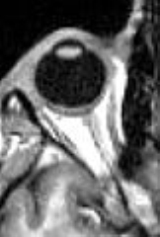
Mri of Human Eye
The visual system in the brain is too slow to process information if the images are slipping across the retina at more than a few degrees per second. Thus, for humans to be able to see while moving, the brain must compensate for the motion of the head by turning the eyes. Another complication for vision in frontal-eyed animals is the development of a small area of the retina with a very high visual acuity. This area is called the fovea, and covers about 2 degrees of visual angle in people. To get a clear view of the world, the brain must turn the eyes so that the image of the object of regard falls on the fovea. Eye movements are thus very important for visual perception, and any failure to make them correctly can lead to serious visual disabilities.

Having two eyes is an added complication, because the brain must point both of them accurately enough that the object of regard falls on corresponding points of the two retinas; otherwise, double vision would occur. The movements of different body parts are controlled by striated muscles acting around joints. The movements of the eye are no exception, but they have special advantages not shared by skeletal muscles and joints, and so are considerably different.

Extraocular muscles


Each eye has six muscle
MUSCLE

MUSCLE is public domain, multiple sequence alignment software for protein and nucleotide sequences.MUSCLE is integrated into UGENE bioinformatics tool as a plugin....
s that control its movements: the lateral rectus
Lateral rectus muscle

The lateral rectus muscle is a muscle in the orbit . It is one of six extraocular muscles that control the eye movements and the only muscle innervation by the abducens nerve, cranial nerve VI....
, the medial rectus
Medial rectus muscle

The medial rectus muscle is a muscle in the orbit .As with most of the muscles of the orbit, it is innervation by the inferior division of the oculomotor nerve ....
, the inferior rectus
Inferior rectus muscle

The inferior rectus muscle is a muscle in the orbit ....
, the superior rectus
Superior rectus muscle

The superior rectus muscle is a muscle in the orbit . It is one of the extraocular muscles.It is innervation by the superior division of the oculomotor nerve ....
, the inferior oblique
Inferior oblique muscle

The Obliquus oculi inferior is a thin, narrow muscle, placed near the anterior margin of the floor of the orbit ....
, and the superior oblique
Superior oblique muscle

For the abdominal muscle see: External oblique muscleThe superior oblique muscle, or obliquus oculi superior, is a fusiform muscle in the upper, medial side of the orbit whose primary action is intorsion and whose secondary actions are to abduction and Depression the eyeball ....
. When the muscles exert different tensions, a torque is exerted on the globe that causes it to turn, in almost pure rotation, with only about one millimeter of translation. Thus, the eye can be considered as undergoing rotations about a single point in the center of the eye.

Rapid eye movement

Rapid eye movement, or REM for short, typically refers to the stage during sleep
Sleep

Sleep is the natural state of bodily rest observed in humans and other animals. It is common to all mammals and birds, and is also seen in many reptiles, amphibians and fish....
 during which the most vivid dreams occur. During this stage, the eyes move rapidly. It is not in itself a unique form of eye movement.

Saccades


Saccades are quick, simultaneous movements of both eyes in the same direction controlled by the frontal lobe of the brain. Some irregular drifts, movements, smaller than a saccade and larger than a microsaccade, subtend up to six minutes of arc.

Microsaccades


Even when looking intently at a single spot, the eyes drift around. This ensures that individual photosensitive cells are continually stimulated in different degrees. Without changing input, these cells would otherwise stop generating output. Microsaccades move the eye no more than a total of 0.2° in adult humans.

Vestibulo-ocular reflex


The vestibulo-ocular reflex
Vestibulo-ocular reflex

The vestibulo-ocular reflex or oculovestibular reflex is a reflex eye movement that stabilizes images on the retina during head movement by producing an eye movement in the direction opposite to head movement, thus preserving the image on the center of the visual field....
 is a
A

The letter A is the first letter in the Latin alphabet. Its name in English language is a ; the plural is aes or, more commonly, a's....
 reflex
ReFLEX

ReFLEX is a wireless protocol developed by Motorola which is used for two-way paging.The Motorola PageWriter released in 1996 was one of the first devices to use the ReFLEX network protocol....
 eye movement
Eye movement

Eye movement may refer to:* Eye movement , the voluntary or involuntary movement of the eyes* Eye movement in reading, the method in which eye movement assimilates written language...
 that stabilizes images on the retina
Retina

The vertebrate retina is a light sensitive tissue lining the inner surface of the eye. The optics of the eye create an image of the visual world on the retina, which serves much the same function as the film in a camera....
 during head movement by producing an eye movement in the direction opposite to head movement, thus preserving the image on the center of the visual field. For example, when the head moves to the right, the eyes move to the left, and vice versa.

Smooth pursuit movement


The eyes can also follow a moving object around. This tracking is less accurate than the vestibulo-ocular reflex, as it requires the brain to process incoming visual information and supply feedback
Feedback

Feedback describes the situation when output from an event or phenomenon in the past will influence the same event/phenomenon in the present or future....
. Following an object moving at constant speed is relatively easy, though the eyes will often make saccadic jerks to keep up. The smooth pursuit movement can move the eye at up to 100°/s in adult humans.

It is more difficult to visually estimate speed in low light conditions or while moving, unless there is another point of reference for determining speed.

Optokinetic reflex

The optokinetic reflex is a combination of a saccade and smooth pursuit movement. When, for example, looking out of the window at a moving train, the eyes can focus on a 'moving' train for a short moment (through smooth pursuit), until the train moves out of the field of vision. At this point, the optokinetic reflex kicks in, and moves the eye back to the point where it first saw the train (through a saccade).

Vergence movement


Stereogram Tut Eye Convergence
When a creature with binocular vision looks at an object, the eyes must rotate around a vertical axis so that the projection of the image is in the centre of the retina in both eyes. To look at an object closer by, the eyes rotate 'towards each other' (convergence
Convergence (eye)

In ophthalmology, convergence is the simultaneous inward movement of both eyes toward each other, usually in an effort to maintain single binocular vision when viewing an object....
), while for an object farther away they rotate 'away from each other' (divergence
Divergence (eye)

In ophthalmology, divergence is the simultaneous outward movement of both eyes away from each other, usually in an effort to maintain single binocular vision when viewing an object....
). Exaggerated convergence is called cross eyed viewing (focusing on the nose for example) . When looking into the distance, or when 'staring into nothingness', the eyes neither converge nor diverge.

Vergence movements are closely connected to accommodation of the eye. Under normal conditions, changing the focus of the eyes to look at an object at a different distance will automatically cause vergence and accommodation.

There are many diseases, disorders, and age-related changes that may affect the eyes and surrounding structures.

As the eye ages certain changes occur that can be attributed solely to the aging process. Most of these anatomic and physiologic processes follow a gradual decline. With aging, the quality of vision worsens due to reasons independent of aging eye diseases. While there are many changes of significance in the nondiseased eye, the most functionally important changes seem to be a reduction in pupil size and the loss of accommodation or focusing capability (presbyopia
Presbyopia

Presbyopia describes the condition where the eye exhibits a progressively diminished ability to focus on near objects with age. Presbyopia's exact mechanisms are not known with certainty, however, the research evidence most strongly supports a loss of elasticity of the Lens , although changes in the lens's curvature from continual growth and...
). The area of the pupil governs the amount of light that can reach the retina. The extent to which the pupil dilates also decreases with age. Because of the smaller pupil size, older eyes receive much less light at the retina. In comparison to younger people, it is as though older persons wear medium-density sunglasses in bright light and extremely dark glasses in dim light. Therefore, for any detailed visually guided tasks on which performance varies with illumination, older persons require extra lighting. Certain ocular diseases can come from sexually transmitted diseases such as herpes and genital warts. If contact between eye and area of infection occurs, the STD can be transmitted to the eye.

With aging a prominent white ring develops in the periphery of the cornea- called arcus senilis. Aging causes laxity and downward shift of eyelid tissues and atrophy of the orbital fat. These changes contribute to the etiology of several eyelid disorders such as ectropion
Ectropion

Ectropion is a medical condition in which the lower eyelid turns outwards. It is one of the notable aspects of newborns exhibiting Harlequin type ichthyosis....
, entropion
Entropion

Entropion is a medical condition in which the eyelids fold inward. It is very uncomfortable, as the eyelashes rub against the cornea constantly....
, dermatochalasis
Dermatochalasis

Dermatochalasis is a medical condition. It is defined as an excess of skin in the upper or lower eyelid. It may be either an acquired or a congenital condition. It is generally treated with blepharoplasty....
, and ptosis
Ptosis (eyelid)

Ptosis is an abnormally low position of the upper eyelid. The drooping may be worse after being awake longer, when the individual's muscles are tired....
. The vitreous gel undergoes liquefaction (posterior vitreous detachment
Posterior vitreous detachment

A posterior vitreous detachment is a condition of the eye in which the vitreous humour separates from the retina....
 or PVD) and its opacities — visible as floater
Floater

Floaters are deposits of various size, shape, consistency, refractive index, and motility within the eye's vitreous humour, which is normally transparent....
s — gradually increase in number.

Various eye care professional
Eye care professional

An eye care professional is an individual who provides a service related to the eyes or Visual perception. It is a general term that can refer to any healthcare worker involved in eye care, from one with a small amount of post-secondary training to practitioners with a doctoral level of education....
s, including ophthalmologists, optometrists, and optician
Optician

An optician is an eye care professional who provides corrective lenses based on a Eyeglass prescription for the correction of a refractive error....
s, are involved in the treatment and management of ocular and vision disorders. A Snellen chart
Snellen chart

A Snellen chart is an eye chart used by eye care professionals and others to measure visual acuity. Snellen charts are named after the Dutch ophthalmologist Herman Snellen who developed the chart in 1862....
 is one type of eye chart
Eye chart

An eye chart is a chart used to measure visual acuity. Types of eye charts include the Snellen chart, Landolt C, and the Lea test....
 used to measure visual acuity
Visual acuity

Visual acuity is acuteness or clearness of visual perception, especially form vision, which is dependent on the sharpness of the retinal focus within the eye and the sensitivity of the interpretative faculty of the brain....
. At the conclusion of an eye examination
Eye examination

An eye examination is a battery of tests performed by an optometrist or ophthalmologist assessing Visual perception and ability to Focus on and discern objects, as well as other tests and examinations pertaining to the eyes....
, an eye doctor may provide the patient with an eyeglass prescription
Eyeglass prescription

An eyeglass prescription is a written order by an optometrist or ophthalmologist to an optician for eyeglasses. It specifies the refractive power to which the eyeglasses are to be made in order to correct blurred Visual perception due to refraction error, including myopia, hyperopia, astigmatism , and presbyopia....
 for corrective lens
Corrective lens

A corrective lens is a lens worn in front of the eye, mainly used to treat myopia, hyperopia, Astigmatism , and presbyopia. Glasses or "spectacles" are worn on the face a short distance in front of the eye....
es. Some disorders of the eyes for which corrective lenses are prescribed include myopia
Myopia

Myopia , also called near- or short-sightedness, is a Refractive error of the eye in which collimated light produces image focus in front of the retina when accommodation is relaxed....
 (near-sightedness) which affects one-third of the population, hyperopia
Hyperopia

Hyperopia, also known as far-sightedness, long-sightedness or hypermetropia, is a defect of visual system caused by an imperfection in the eye , causing inability to Focus on near objects, and in extreme cases causing a sufferer to be unable to focus on objects at any distance....
 (far-sightedness) which affects one quarter of the population, and presbyopia
Presbyopia

Presbyopia describes the condition where the eye exhibits a progressively diminished ability to focus on near objects with age. Presbyopia's exact mechanisms are not known with certainty, however, the research evidence most strongly supports a loss of elasticity of the Lens , although changes in the lens's curvature from continual growth and...
, a loss of focusing range due to aging.

See also

  • Annulus of Zinn
    Annulus of Zinn

    The annulus of Zinn, also known as the annular tendon or common tendinous ring, is a ring of fibrous tissue surrounding the optic nerve at its entrance at the apex of the Orbit ....
  • Conjunctiva
    Conjunctiva

    The conjunctiva is a clear mucous membrane consisting of cells and underlying basement membrane that covers the sclera and lines the inside of the eyelids....
  • Color blindness
    Color blindness

    Color blindness, a color vision deficiency, is the inability to perceive differences between some of the colors that others can distinguish. It is most often of genetic nature, but may also occur because of eye, nerve, or brain damage, or due to exposure to certain chemicals....
  • Eye
    Eye

    Eyes are Organ that detect light, and send signals along the optic nerve to the visual system and other areas of the brain. Complex optical systems with resolving power have come in ten fundamentally different forms, and 96% of animal species possess a complex optical system....
  • Eye color
    Eye color

    Eye color is a polygenic trait and is determined by the amount and type of pigments in the eye's Iris . Humans and animals have many phenotypic variations in eye color....
  • Eye contact
    Eye contact

    Eye contact is an event in which two people or animals look at each other's eyes at the same time. It is a form of nonverbal communication and is thought to have a large influence on social behavior....
  • Eye exam
  • Eyelid
    Eyelid

    An eyelid is a thin fold of skin that covers and protects an eye. With the exception of the prepuce and the labia minora, it has the thinnest skin of the whole body....
  • Infant vision
    Infant vision

    The science of infant vision gives a verifiable basis for some practices of pediatric ophthalmology and gathers measurements intended to describe, monitor and predict:...
  • Macula
    Macula

    The macula or macula lutea is an oval-shaped highly pigmented yellow spot near the center of the retina of the human eye. It has a diameter of around 5 mm and is often histologically defined as having two or more layers of ganglion cells....
  • Mammalian eye
    Mammalian eye

    DimensionsDimensions vary only 1?2 mm among humans. The vertical diameter is 24 mm; the transverse being larger. At birth it is generally 16?17 mm, enlarging to 22.5?23 mm by three years of age....
  • Nictitating membrane
    Nictitating membrane

    The nictitating membrane is a transparent or translucent third eyelid present in some animals that can be drawn across the eye for protection and to moisten the eye while also keeping visibility....
  • Ophthalmology
    Ophthalmology

    Ophthalmology is the branch of medicine which deals with the Eye diseases and Eye surgery of the visual pathways, including the eye, brain, and areas surrounding the eye, such as the lacrimal system and eyelids....
  • Schlemm's canal
    Schlemm's canal

    Schlemm's canal, also known as canal of Schlemm or the scleral venous sinus, is a circular channel in the eye that collects aqueous humor from the anterior chamber and delivers it into the bloodstream....
  • Trabecular meshwork
    Trabecular meshwork

    The trabecular meshwork is an area of tissue in the eye located around the base of the cornea, near the ciliary body, and is responsible for draining the aqueous humor from the eye via the anterior chamber ....


External links