

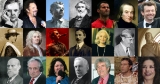
Welsh people

Encyclopedia
The Welsh people are an ethnic group
and nation
associated with Wales
and the Welsh language
.
John Davies
argues that the origin of the "Welsh nation" can be traced to the late 4th and early 5th centuries, following the Roman departure from Britain, although Brythonic
Celtic languages
seem to have been spoken in Wales far longer. The term Welsh people applies to people from Wales and Welsh ancestry perceiving themselves or being perceived as sharing a cultural heritage and shared ancestral origins.
An analysis of the geography of Welsh surnames
commissioned by the Welsh Government found that 718,000 people, or nearly 35% of the Welsh population, have a family name of Welsh origin, compared with 5.3% in the rest of the United Kingdom
, 4.7% in New Zealand
, 4.1% in Australia
, and 3.8% in the United States
, with an estimated 16.3 million people in the countries studied having Welsh ancestry,Today Wales is a country
of the United Kingdom
, and the majority of people living in Wales are British citizens
.
, the ancient Romans
encountered tribes in present-day Wales that they called the Ordovices
, the Demetae
, the Silures
and the Deceangli
. The people of what is now Wales were not distinguished from the rest of the peoples of southern Britain; all were called Britons
and spoke the common British language, a Brythonic
Celtic
tongue. Celtic language and culture seems to have arrived in Britain during the Iron Age
, though some archaeologists argue that there is no evidence for large-scale Iron Age
migrations into Great Britain. The claim has also been made that Indo-European languages
may have been introduced to the British Isles
as early as the early Neolithic
(or even earlier), with Goidelic and Brythonic languages
developing indigenously. Others hold that the close similarity between the Goidelic and Brythonic branches, and their sharing of Late Bronze Age and Early Iron Age terminology with their continental relatives, point to a more recent introduction of Indo-European languages, with Proto-Celtic itself unlikely to have existed before the end of the 2nd millennium BC
at the earliest. The genetic evidence in this case would show that the change to Celtic languages in Britain may have occurred as a cultural shift rather than through migration as was previously supposed.
Some current genetic research supports the idea that people living in the British Isles are likely mainly descended from the indigenous European Paleolithic
(Old Stone Age hunter gatherers
) population (about 80%), with a smaller Neolithic
(New Stone Age farmers) input (about 20%). Paleolithic Europeans seem to have been a homogeneous population, possibly due to a population bottleneck
(or near-extinction event) on the Iberian peninsula
, where a small human population is thought to have survived the glaciation, and expanded into Europe during the Mesolithic
. The assumed genetic imprint of Neolithic incomers is seen as a cline, with stronger Neolithic representation in the east of Europe and stronger Paleolithic representation in the west of Europe. Most in Wales today regard themselves as modern Celts
, claiming a heritage back to the Iron Age tribes, which themselves, based on modern genetic analysis, would appear to have had a predominantly Paleolithic and Neolithic indigenous ancestry. When the Roman legions departed Britain around 400, a Romano-British
culture remained in the areas the Romans had settled, and the pre-Roman cultures in others.
In two recently published books, Blood of the Isles, by Brian Sykes and The Origins of the British, by Stephen Oppenheimer
, both authors state that according to genetic evidence, most Welsh people, like most Britons, descend from the Iberian Peninsula
, as a result of different migrations that took place during the Mesolithic and the Neolithic eras, and which laid the foundations for the present-day populations in the British Isles, indicating an ancient relationship among the populations of Atlantic Europe
. According to Stephen Oppenheimer 96% of lineages in Llangefni
in north Wales derive from Iberia. Genetic research on the Y-chromosome has shown that the Welsh, like the Irish, share a large proportion of their ancestry with the Basques of Northern Spain and South Western France, although the Welsh have a greater presumed Neolithic
input than both the Irish
and the Basques. Genetic marker R1b
averages from 83-89% amongst the Welsh.
 The people in what is now Wales continued to speak Brythonic languages
with additions from Latin, as did some other Celts in areas of Great Britain
. The surviving poem Y Gododdin
is in early Welsh and refers to the Brythonic
kingdom of Gododdin
with a capital at Din Eidyn (Edinburgh
) and extending from the area of Stirling
to the Tyne. John Davies places the change from Brythonic to Welsh between 400 and 700. Offa's Dyke
was erected in the mid-8th century, forming a barrier between Wales and Mercia
.
Gene scientists at the University College of London (UCL) have claimed that the Welsh are the "true" Britons and are remnants of the Celts that were pushed out by Anglo-Saxon invaders after the Roman withdrawal in the fifth century. The genetic tests suggested that between 50% and 100% of the indigenous population of what was to become England was wiped out. In 2001, research for a BBC programme on the Vikings suggested a possible strong link between the Celts and Basques, dating back tens of thousands of years. The UCL research suggested a migration on a huge scale during the Anglo-Saxon period.
"It appears England is made up of an ethnic cleansing event from people coming across from the continent after the Romans left," said Dr Mark Thomas, of the Centre for Genetic Anthropology at UCL. "Our findings completely overturn the modern view of the origins of the English."
The process whereby the indigenous population of 'Wales' came to think of themselves as Welsh is not clear. There is plenty of evidence of the use of the term Brythoniaid (Britons); by contrast, the earliest use of the word Kymry (referring not to the people but to the land—and possibly to northern Britain in addition to modern day territory of Wales) is found in a poem dated to about 633. The name of the region in northern England now known as Cumbria
is believed to be derived from the same root. Only gradually did Cymru (the land) and Cymry (the people) come to supplant Brython. Although the Welsh language was certainly used at the time, Gwyn A. Williams
argues that even at the time of the erection of Offa's Dyke, the people to its west saw themselves as Roman, citing the number of Latin inscriptions still being made into the 8th century. However, it is unclear whether such inscriptions reveal a general or normative use of Latin as a marker of identity or its selective use by the early Christian Church
.
The word Cymry is believed to be derived from the Brythonic combrogi, meaning fellow-countrymen, and thus Cymru carries a sense of "land of fellow-countrymen", "our country"—and, of course, notions of fraternity. The name "Wales", however, comes from the Germanic walha
, a term meaning "stranger" or "foreigner" which was applied particularly to peoples who had been Romanised.
There are two words in modern Welsh for the English and this reflects the idea held by some that the modern English
derive from various Germanic tribes (although there is little evidence for the extinction of the pre-Germanic inhabitants of England, and the idea ignores both the Scandinavian
settlers in England and the Roman and Norman-French influences on English language, culture and identity): Saeson (singular: Sais), meaning originally Saxon; and: Eingl, denoting:-Angles,; meaning Englishmen in modern Welsh. The Welsh word for the English language is Saesneg, while the Welsh word for England is Lloegr.
There was immigration to Wales after the Norman Conquest, several Normans
encouraged immigration to their new lands; the Landsker Line
dividing the Pembrokeshire
"Englishry" and "Welshry" is still detectable today. The terms Englishry and Welshry are used similarly about Gower
.
The population of Wales increased from 587,128 in 1801 to 1,162,139 in 1851 and had reached 2,420,921 by 1911. Part of this increase can be attributed to the demographic transition
seen in most industrialising countries during the Industrial Revolution
, as death-rates dropped and birth-rates remained steady. However, there was also a large-scale migration of people into Wales during the industrial revolution. The English were the most numerous group, but there were also considerable numbers of Irish and smaller numbers of other ethnic groups, including Italians
migrated to South Wales. Wales received other immigration from various parts of the British Commonwealth of Nations
in the 20th century, and African-Caribbean
and Asian
communities add to the ethno-cultural mix, particularly in urban Wales. Many of these self-identify as Welsh. Recently, parts of Wales have seen an increased number of immigrants from recent EU accession countries
such as Poland
.
did not offer 'Welsh' as an option; respondents had to use a box marked "Other". 96% of the population of Wales thus described themselves as being White British
. Controversy surrounding the method of determining ethnicity began as early as 2000, when it was revealed that respondents in Scotland and Northern Ireland would be able to check a box describing themselves as of Scottish
or of Irish
ethnicity, an option not available for Welsh or English respondents. Prior to the census, Plaid Cymru backed a petition calling for the inclusion of a Welsh tick-box and for the National Assembly to have primary law-making powers and its own National Statistics Office.
With an absence of a Welsh tick-box, the only other tick-box available was 'white-British,' 'Irish', or 'other'. The Scottish parliament insisted that a Scottish ethnicity tick-box be included in the census in Scotland, and with this inclusion as many as 88.11% claimed Scottish ethnicity. Critics expected a higher proportion of respondents describing themselves as of Welsh ethnicity, similar to Scottish results, had a Welsh tickbox been made available. Additional criticism was leveled at the timing of the census, which was taken in the middle of the Foot and Mouth crisis of 2001, a fact organizers said did not impact the results. However, the Foot and Mouth crisis did delay UK General Elections
, the first time since the Second World War any event postponed an election.
In the census, as many as 14 per cent of the population took the 'extra step' to write in that they were of Welsh ethnicity. Of these, Gwynedd recorded the highest percentage of those identifying as of Welsh ethnicity (at 27%), followed by Carmarthenshire (23 per cent), Ceredigion (22 per cent) and the Isle of Anglesey (19 per cent). For respondents between 16 and 74 years of age, those claiming Welsh ethnicity were predominately in professional and managerial occupations.
launched a census consultation exercise. They received replies from 28 different Welsh organisations and a large proportion of these referred to Welsh ethnicity, language or identity.
For the first time ever in British census history the 2011 Census gave the opportunity for people to describe their identity as Welsh or English. A 'dress rehearsal' of the Census was carried out on the Welsh island of Anglesey
because of its rural nature and its high numbers of Welsh speakers.
The Census, taken on 27th March 2011, asked a number of questions relating to nationality and national identity, including What is your country of birth? ('Wales' was one of the options), How would you describe your national identity? (for the first time 'Welsh' and 'English' were included as options), What is your ethnic group? ('White Welsh/English/Scottish/Northern Irish/British' was an option) and Can you understand, speak, read or write Welsh?.
According to the survey, when factoring non-Wales born residents, 67 per cent of those surveyed claimed Welsh identity and an additional 7% ticked Welsh and another option, such as Welsh- British, giving a total of 74% overall. This reflects a residential population which includes 30 per cent born outside of Wales. The survey, from the Office for National Statistics
, identified the remaining 33 per cent of respondents as 'Not Welsh'.
A survey carried out by the Centre for Research into Elections and Social Trends at Oxford University, found that only 17.9 per cent of respondents would claim to be Welsh and not British. 20.2 per cent said they were more Welsh than British, while the most popular answer (39 per cent) claimed to be equally Welsh and British.
Surveys indicate that younger people are more likely to self identify as Welsh.
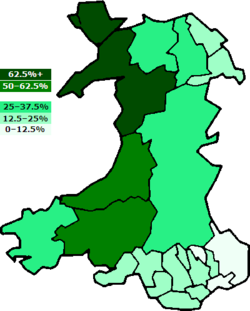 According to the 2001 census the number of Welsh speakers in Wales increased for the first time in 100 years, with 20.5% in a population of over 2.9 million claiming fluency in Welsh, or one in five. Additionally, 28% of the population of Wales claimed to understand Welsh. The census revealed that the increase was most significant in urban areas; such as Cardiff (Caerdydd) with an increase from 6.6% in 1991 to 10.9% in 2001, and Rhondda Cynon Taf with an increase from 9% in 1991 to 12.3% in 2001. However, the number of Welsh speakers declined in Gwynedd
from 72.1% in 1991 to 68.7%, and in Ceredigion
from 59.1% in 1991 to 51.8%. Ceredigion in particular experienced the greatest fluctuation with the a 19.5% influx of new residents since 1991.
The decline in Welsh speakers in much of rural Wales is attributable to non Welsh speaking residents moving to North Wales, driving up property rates above what locals may afford, according to former Gwynedd
county councilor Seimon Glyn of Plaid Cymru
, whose controversial comments in 2001 focused attention on the issue. As many as a third of all properties in Gwynedd are bought by persons from out of the country. The issue of locals being priced out of the local housing market is common to many rural communities throughout Britain, but in Wales the added dimension of language further complicated the issue, as many new residents did not learn the Welsh language.
A Plaid Cymru taskforce headed by Dafydd Wigley recommended land should be allocated for affordable local housing, and called for grants for locals to buy houses, and recommended council tax on holiday homes should double.
However, the same census shows that 25 percent of residents were born outside Wales. The number of Welsh speakers in other places in Britain is uncertain, but numbers are high in the main cities and there are speakers along the Welsh-English border.
Even among the Welsh speakers, very few people speak only Welsh, with nearly all being bilingual in English
. However, a large number of Welsh speakers are more comfortable expressing themselves in Welsh than in English and vice versa, usually depending on the area spoken. Many prefer to speak English in South Wales or the urbanised areas and Welsh in the North or in rural areas. A speaker's choice of language can vary according to the subject domain (known in linguistics as code-switching
).
Thanks to the work of the Mudiad Ysgolion Meithrin (Welsh Nursery School
Movement), recent census data reveals a reversal in decades of linguistic decline: there are now more Welsh speakers under five years of age than over 60. For many young people in Wales, the acquisition of Welsh is a gateway to better careers and increased cultural opportunity: Wales's third greatest revenue earner is media products and Cardiff boasts a world-class animation industry.
Although Welsh is a minority language
, and thus threatened by the dominance of English, support for the language grew during the second half of the 20th century, along with the rise of Welsh nationalism
in the form of groups such as the political party
Plaid Cymru
and Cymdeithas yr Iaith Gymraeg (Welsh Language Society). The language is used in the bilingual Welsh Assembly and entered on its records, with English translation. Technically it is not supposed to be used in the British Parliament as it is referred to as a "foreign language" and is effectively banned as disruptive behaviour, but several Speaker
s (most notably George Thomas, 1st Viscount Tonypandy
, himself born in Wales, close by Tonypandy
) spoke Welsh in longer English-language speeches.
Welsh as a first language
is largely concentrated in the less urban north and west of Wales, principally Gwynedd
, inland Denbighshire
, northern and south-western Powys
, the Isle of Anglesey, Carmarthenshire
, North Pembrokeshire
, Ceredigion
, and parts of western Glamorgan
, although first-language and other fluent speakers can be found throughout Wales. However, Cardiff is now home to an urban Welsh speaking population (both from other parts of Wales and from the growing Welsh medium schools of Cardiff itself) due to the centralisation and concentration of national resources and organisations in the capital.
Speaking Welsh is an important part of Welsh identity. Welsh people actively distinguish between 'Cymry Cymraeg' (Welsh-speaking Welsh), Cymry di-Gymraeg (non Welsh speaking Welsh) and Saeson (English). Parts of the culture are however strongly connected to the language — notably the Eisteddfodic tradition, poetry and aspects of folk music and dance. However, Wales has a strong tradition of poetry in the English language.
or other Christian denomination
s such as the Presbyterian Church of Wales
, or Catholicism
, although there is even a Russian Orthodox chapel in the semi-rural town of Blaenau Ffestiniog
. In particular, Wales has a long tradition of nonconformism and Methodism
. Other religions Welsh people may be affiliated with include Buddhism
, Hinduism
, Judaism
, Islam
, and Sikhism
, with most non-Christian people in Wales found in Cardiff
.
The 2001 Census
showed that slightly less than 10% of the Welsh population are regular church
or chapel
goers (a slightly smaller proportion than in England or Scotland), although about 70% of the population see themselves as some form of Christian. Judaism
has quite a long history in Wales, with a Jewish community recorded in Swansea
from around 1730. In August 1911, during a period of public order and industrial disputes, Jewish shops across the South Wales coalfield
were damaged by mobs. Since that time the Jewish population of that area, which reached a peak of 4,000–5,000 in 1913, has declined with only Cardiff
retaining a sizeable Jewish population, of about 2000 in the 2001 Census. The largest non-Christian faith in Wales is Islam
, with about 22,000 members in 2001 served by about 40 mosques, following the first mosque established in Cardiff
in 1860. A college for training clerics has been established at Llanybydder
in West Wales
. Islam arrived in Wales in the mid 19th century, and it is thought that Cardiff's Yemeni
community is Britain's oldest Muslim community, established when the city was one of the world's largest coal-exporting ports. Hinduism
and Buddhism
each have about 5,000 adherents in Wales, with the rural
county of Ceredigion
being the centre of Welsh Buddhism. Govinda
's temple and restaurant, run by the Hare Krishna
s in Swansea
, is a focal point for many Welsh Hindus. There are about 2,000 Sikh
s in Wales, with the first purpose-built gurdwara
opened in the Riverside
area of Cardiff in 1989. In 2001 some 7,000 people classified themselves as following "other religions" including a reconstructed form of Druidism, which was the pre-Christian religion of Wales (not to be confused with the Druids of the Gorsedd
at the National Eisteddfod of Wales). Approximately one sixth of the population, some 500,000 people, profess no religious faith whatsoever.
The sabbatarian temperance movement
was also historically strong among the Welsh, the sale of alcohol being prohibited on Sundays in Wales by the Sunday Closing (Wales) Act 1881
- the first legislation specifically issued for Wales since the Middle Ages. From the early 1960s, local council areas were permitted to hold referendums every seven years to determine whether they should be "wet" or "dry" on Sundays: most of the industrialised areas in the east and south went "wet" immediately, and by the 1980s the last district, Dwyfor in the northwest, went wet, since then there have been no more Sunday-closing referendums.


 Migration from Wales to the rest of Britain has been occurring throughout its history. Particularly during the Industrial Revolution
hundreds of thousands of Welsh people migrated internally to the big cities of England and Scotland or to work in the coal mines of the north of England. As a result, much of the British population today have ancestry from Wales. The same can be said for the English, Scottish and Irish workers who migrated to Welsh cities such as Merthyr Tydfil
or ports such as Pembroke
in the Industrial Revolution
. As a result, some English, Irish and Scottish have Welsh surnames ("Evans", "Jenkins" "Owen" etc.) and some Welsh have English, Scottish and Irish surnames — as a result, it is relatively rare in South Wales or English-speaking areas to find a person with exclusively Welsh ancestry (or so the Gog's would have you believe!).
Some thousands of Welsh settlers moved to other parts of Europe, but the number was sparse and concentrated to certain areas. During the late 19th and early 20th centuries, a small wave of contract miners from Wales arrived into Northern France
, and the centre of Welsh-French populations are in coal mining towns of the French department Pas-de-Calais. Welsh settlers from Wales (and later Patagonian Welsh) arrived in Newfoundland
, Canada
in the early 1900s; many had founded towns in the province's Labrador
coast region.
In 1852 Thomas Benbow Phillips
of Tregaron
established a settlement of about 100 Welsh people in the state of Rio Grande do Sul
in Brazil
.
Internationally Welsh people have emigrated, in relatively small numbers (in proportion to population Irish emigration to the United States of America
(USA) may have been 26 times greater than Welsh emigration), to many countries, including the USA (in particular, Pennsylvania
), Canada
and Patagonia
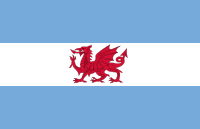
, Argentina. Jackson County, Ohio
was sometimes referred to as Little Wales and the Welsh language was commonly heard or spoken among locals by the mid 20th century. Malad City
in Idaho
, which began as a Welsh Mormon
Settlement, lays claim to having more people of Welsh descent per capita than anywhere outside of Wales itself. Malad's local High School is known as the "Malad Dragons" and flies the Welsh Flag as its school colours. Welsh people have also settled as far as New Zealand
and Australia
.
Around 1.75 million Americans report themselves to have Welsh ancestry, as did 467,000 Canadians in Canada's 2006 census
. This compares with 2.9 million people living in Wales (as of the 2001 census
).
There is no known evidence which would objectively support the legend that the Mandan, a Native American
tribe of the central United States
, are Welsh emigrants who reached North America under Prince Madog in 1170.
The Ukrainian city of Donetsk
was founded in 1869 by a Welsh
businessman, John Hughes
, (an engineer from Merthyr Tydfil
) who constructed a steel plant and several coal mines
in the region; the town was thus named Yuzovka (Юзовка) in recognition of his role in its founding ("Yuz" being a Russian or Ukrainian approximation of Hughes).
Ethnic group
An ethnic group is a group of people whose members identify with each other, through a common heritage, often consisting of a common language, a common culture and/or an ideology that stresses common ancestry or endogamy...
and nation
Nation
A nation may refer to a community of people who share a common language, culture, ethnicity, descent, and/or history. In this definition, a nation has no physical borders. However, it can also refer to people who share a common territory and government irrespective of their ethnic make-up...
associated with Wales
Wales
Wales is a country that is part of the United Kingdom and the island of Great Britain, bordered by England to its east and the Atlantic Ocean and Irish Sea to its west. It has a population of three million, and a total area of 20,779 km²...
and the Welsh language
Welsh language
Welsh is a member of the Brythonic branch of the Celtic languages spoken natively in Wales, by some along the Welsh border in England, and in Y Wladfa...
.
John Davies
John Davies (historian)
John Davies is a Welsh historian, and a television and radio broadcaster.Davies was born in the Rhondda, Wales, and studied at both University College, Cardiff, and Trinity College, Cambridge. He is married with four children...
argues that the origin of the "Welsh nation" can be traced to the late 4th and early 5th centuries, following the Roman departure from Britain, although Brythonic
Brythonic languages
The Brythonic or Brittonic languages form one of the two branches of the Insular Celtic language family, the other being Goidelic. The name Brythonic was derived by Welsh Celticist John Rhys from the Welsh word Brython, meaning an indigenous Briton as opposed to an Anglo-Saxon or Gael...
Celtic languages
Celtic languages
The Celtic languages are descended from Proto-Celtic, or "Common Celtic"; a branch of the greater Indo-European language family...
seem to have been spoken in Wales far longer. The term Welsh people applies to people from Wales and Welsh ancestry perceiving themselves or being perceived as sharing a cultural heritage and shared ancestral origins.
An analysis of the geography of Welsh surnames
Welsh surnames
Fixed family names were adopted in Wales from the 15th century onwards. Hitherto, the Welsh had a patronymic naming system.-History:In 1292, 48 per cent of Welsh names were patronymics, and in some parishes over 70 per cent. Other names were derived from nicknames, occupational names, and a few...
commissioned by the Welsh Government found that 718,000 people, or nearly 35% of the Welsh population, have a family name of Welsh origin, compared with 5.3% in the rest of the United Kingdom
United Kingdom
The United Kingdom of Great Britain and Northern IrelandIn the United Kingdom and Dependencies, other languages have been officially recognised as legitimate autochthonous languages under the European Charter for Regional or Minority Languages...
, 4.7% in New Zealand
New Zealand
New Zealand is an island country in the south-western Pacific Ocean comprising two main landmasses and numerous smaller islands. The country is situated some east of Australia across the Tasman Sea, and roughly south of the Pacific island nations of New Caledonia, Fiji, and Tonga...
, 4.1% in Australia
Australia
Australia , officially the Commonwealth of Australia, is a country in the Southern Hemisphere comprising the mainland of the Australian continent, the island of Tasmania, and numerous smaller islands in the Indian and Pacific Oceans. It is the world's sixth-largest country by total area...
, and 3.8% in the United States
United States
The United States of America is a federal constitutional republic comprising fifty states and a federal district...
, with an estimated 16.3 million people in the countries studied having Welsh ancestry,Today Wales is a country
Countries of the United Kingdom
Countries of the United Kingdom is a term used to describe England, Northern Ireland, Scotland and Wales. These four countries together form the sovereign state of the United Kingdom of Great Britain and Northern Ireland, which is also described as a country. The alternative terms, constituent...
of the United Kingdom
United Kingdom
The United Kingdom of Great Britain and Northern IrelandIn the United Kingdom and Dependencies, other languages have been officially recognised as legitimate autochthonous languages under the European Charter for Regional or Minority Languages...
, and the majority of people living in Wales are British citizens
British nationality law
British nationality law is the law of the United Kingdom that concerns citizenship and other categories of British nationality. The law is complex because of the United Kingdom's former status as an imperial power.-History:...
.
History
During their time in BritainRoman Britain
Roman Britain was the part of the island of Great Britain controlled by the Roman Empire from AD 43 until ca. AD 410.The Romans referred to the imperial province as Britannia, which eventually comprised all of the island of Great Britain south of the fluid frontier with Caledonia...
, the ancient Romans
Ancient Rome
Ancient Rome was a thriving civilization that grew on the Italian Peninsula as early as the 8th century BC. Located along the Mediterranean Sea and centered on the city of Rome, it expanded to one of the largest empires in the ancient world....
encountered tribes in present-day Wales that they called the Ordovices
Ordovices
The Ordovices were one of the Celtic tribes living in Great Britain, before the Roman invasion of Britain. Its tribal lands were located in present day Wales and England between the Silures to the south and the Deceangli to the north-east...
, the Demetae
Demetae
The Demetae were a Celtic people of Iron Age Britain who inhabited modern Pembrokeshire and Carmarthenshire in south-west Wales, and gave their name to the county of Dyfed.-Classical mention:...
, the Silures
Silures
The Silures were a powerful and warlike tribe of ancient Britain, occupying approximately the counties of Monmouthshire, Breconshire and Glamorganshire of present day South Wales; and possibly Gloucestershire and Herefordshire of present day England...
and the Deceangli
Deceangli
The Deceangli or Deceangi were one of the Celtic tribes living in Britain, prior to the Roman invasion of the island. The tribe lived mainly in what is now north-east Wales, though it is uncertain whether their territory covered only the modern counties of Flintshire, Denbighshire and part of...
. The people of what is now Wales were not distinguished from the rest of the peoples of southern Britain; all were called Britons
Britons (historical)
The Britons were the Celtic people culturally dominating Great Britain from the Iron Age through the Early Middle Ages. They spoke the Insular Celtic language known as British or Brythonic...
and spoke the common British language, a Brythonic
Brythonic languages
The Brythonic or Brittonic languages form one of the two branches of the Insular Celtic language family, the other being Goidelic. The name Brythonic was derived by Welsh Celticist John Rhys from the Welsh word Brython, meaning an indigenous Briton as opposed to an Anglo-Saxon or Gael...
Celtic
Celtic languages
The Celtic languages are descended from Proto-Celtic, or "Common Celtic"; a branch of the greater Indo-European language family...
tongue. Celtic language and culture seems to have arrived in Britain during the Iron Age
British Iron Age
The British Iron Age is a conventional name used in the archaeology of Great Britain, referring to the prehistoric and protohistoric phases of the Iron-Age culture of the main island and the smaller islands, typically excluding prehistoric Ireland, and which had an independent Iron Age culture of...
, though some archaeologists argue that there is no evidence for large-scale Iron Age
British Iron Age
The British Iron Age is a conventional name used in the archaeology of Great Britain, referring to the prehistoric and protohistoric phases of the Iron-Age culture of the main island and the smaller islands, typically excluding prehistoric Ireland, and which had an independent Iron Age culture of...
migrations into Great Britain. The claim has also been made that Indo-European languages
Indo-European languages
The Indo-European languages are a family of several hundred related languages and dialects, including most major current languages of Europe, the Iranian plateau, and South Asia and also historically predominant in Anatolia...
may have been introduced to the British Isles
British Isles
The British Isles are a group of islands off the northwest coast of continental Europe that include the islands of Great Britain and Ireland and over six thousand smaller isles. There are two sovereign states located on the islands: the United Kingdom of Great Britain and Northern Ireland and...
as early as the early Neolithic
Neolithic
The Neolithic Age, Era, or Period, or New Stone Age, was a period in the development of human technology, beginning about 9500 BC in some parts of the Middle East, and later in other parts of the world. It is traditionally considered as the last part of the Stone Age...
(or even earlier), with Goidelic and Brythonic languages
Brythonic languages
The Brythonic or Brittonic languages form one of the two branches of the Insular Celtic language family, the other being Goidelic. The name Brythonic was derived by Welsh Celticist John Rhys from the Welsh word Brython, meaning an indigenous Briton as opposed to an Anglo-Saxon or Gael...
developing indigenously. Others hold that the close similarity between the Goidelic and Brythonic branches, and their sharing of Late Bronze Age and Early Iron Age terminology with their continental relatives, point to a more recent introduction of Indo-European languages, with Proto-Celtic itself unlikely to have existed before the end of the 2nd millennium BC
2nd millennium BC
The 2nd millennium BC marks the transition from the Middle to the Late Bronze Age.Its first half is dominated by the Middle Kingdom of Egypt and Babylonia. The alphabet develops. Indo-Iranian migration onto the Iranian plateau and onto the Indian subcontinent propagates the use of the chariot...
at the earliest. The genetic evidence in this case would show that the change to Celtic languages in Britain may have occurred as a cultural shift rather than through migration as was previously supposed.
Some current genetic research supports the idea that people living in the British Isles are likely mainly descended from the indigenous European Paleolithic
Paleolithic
The Paleolithic Age, Era or Period, is a prehistoric period of human history distinguished by the development of the most primitive stone tools discovered , and covers roughly 99% of human technological prehistory...
(Old Stone Age hunter gatherers
Hunter-gatherer
A hunter-gatherer or forage society is one in which most or all food is obtained from wild plants and animals, in contrast to agricultural societies which rely mainly on domesticated species. Hunting and gathering was the ancestral subsistence mode of Homo, and all modern humans were...
) population (about 80%), with a smaller Neolithic
Neolithic
The Neolithic Age, Era, or Period, or New Stone Age, was a period in the development of human technology, beginning about 9500 BC in some parts of the Middle East, and later in other parts of the world. It is traditionally considered as the last part of the Stone Age...
(New Stone Age farmers) input (about 20%). Paleolithic Europeans seem to have been a homogeneous population, possibly due to a population bottleneck
Population bottleneck
A population bottleneck is an evolutionary event in which a significant percentage of a population or species is killed or otherwise prevented from reproducing....
(or near-extinction event) on the Iberian peninsula
Iberian Peninsula
The Iberian Peninsula , sometimes called Iberia, is located in the extreme southwest of Europe and includes the modern-day sovereign states of Spain, Portugal and Andorra, as well as the British Overseas Territory of Gibraltar...
, where a small human population is thought to have survived the glaciation, and expanded into Europe during the Mesolithic
Mesolithic
The Mesolithic is an archaeological concept used to refer to certain groups of archaeological cultures defined as falling between the Paleolithic and the Neolithic....
. The assumed genetic imprint of Neolithic incomers is seen as a cline, with stronger Neolithic representation in the east of Europe and stronger Paleolithic representation in the west of Europe. Most in Wales today regard themselves as modern Celts
Modern Celts
A Celtic identity emerged in the "Celtic" nations of Western Europe, following the identification of the native peoples of the Atlantic fringe as "Celts" by Edward Lhuyd in the 18th century and during the course of the 19th-century Celtic Revival, taking the form of ethnic nationalism particularly...
, claiming a heritage back to the Iron Age tribes, which themselves, based on modern genetic analysis, would appear to have had a predominantly Paleolithic and Neolithic indigenous ancestry. When the Roman legions departed Britain around 400, a Romano-British
Romano-British
Romano-British culture describes the culture that arose in Britain under the Roman Empire following the Roman conquest of AD 43 and the creation of the province of Britannia. It arose as a fusion of the imported Roman culture with that of the indigenous Britons, a people of Celtic language and...
culture remained in the areas the Romans had settled, and the pre-Roman cultures in others.
In two recently published books, Blood of the Isles, by Brian Sykes and The Origins of the British, by Stephen Oppenheimer
Stephen Oppenheimer
Stephen Oppenheimer is a British paediatrician, geneticist, and writer. He is a member of Green Templeton College, Oxford and an honorary fellow of Liverpool School of Tropical Medicine, and carries out and publishes research in the fields of genetics and human prehistory.-Career:Oppenheimer...
, both authors state that according to genetic evidence, most Welsh people, like most Britons, descend from the Iberian Peninsula
Iberian Peninsula
The Iberian Peninsula , sometimes called Iberia, is located in the extreme southwest of Europe and includes the modern-day sovereign states of Spain, Portugal and Andorra, as well as the British Overseas Territory of Gibraltar...
, as a result of different migrations that took place during the Mesolithic and the Neolithic eras, and which laid the foundations for the present-day populations in the British Isles, indicating an ancient relationship among the populations of Atlantic Europe
Atlantic Europe
Atlantic Europe is a geographical and anthropological term for the western portion of Europe which borders the Atlantic Ocean. The term may refer to the idea of Atlantic Europe as a cultural unit and/or as an biogeographical region....
. According to Stephen Oppenheimer 96% of lineages in Llangefni
Llangefni
Llangefni is the county town of Anglesey in Wales and contains the principal offices of the Isle of Anglesey County Council. According to the United Kingdom Census 2001, the population of Llangefni was 4,662 people and it is the second largest settlement on the island...
in north Wales derive from Iberia. Genetic research on the Y-chromosome has shown that the Welsh, like the Irish, share a large proportion of their ancestry with the Basques of Northern Spain and South Western France, although the Welsh have a greater presumed Neolithic
Neolithic
The Neolithic Age, Era, or Period, or New Stone Age, was a period in the development of human technology, beginning about 9500 BC in some parts of the Middle East, and later in other parts of the world. It is traditionally considered as the last part of the Stone Age...
input than both the Irish
Irish people
The Irish people are an ethnic group who originate in Ireland, an island in northwestern Europe. Ireland has been populated for around 9,000 years , with the Irish people's earliest ancestors recorded having legends of being descended from groups such as the Nemedians, Fomorians, Fir Bolg, Tuatha...
and the Basques. Genetic marker R1b
Haplogroup R1b (Y-DNA)
The point of origin of R1b is thought to lie in Eurasia, most likely in Western Asia. T. Karafet et al. estimated the age of R1, the parent of R1b, as 18,500 years before present....
averages from 83-89% amongst the Welsh.
Brythonic languages
The Brythonic or Brittonic languages form one of the two branches of the Insular Celtic language family, the other being Goidelic. The name Brythonic was derived by Welsh Celticist John Rhys from the Welsh word Brython, meaning an indigenous Briton as opposed to an Anglo-Saxon or Gael...
with additions from Latin, as did some other Celts in areas of Great Britain
Great Britain
Great Britain or Britain is an island situated to the northwest of Continental Europe. It is the ninth largest island in the world, and the largest European island, as well as the largest of the British Isles...
. The surviving poem Y Gododdin
Y Gododdin
Y Gododdin is a medieval Welsh poem consisting of a series of elegies to the men of the Britonnic kingdom of Gododdin and its allies who, according to the conventional interpretation, died fighting the Angles of Deira and Bernicia at a place named Catraeth...
is in early Welsh and refers to the Brythonic
Britons (historical)
The Britons were the Celtic people culturally dominating Great Britain from the Iron Age through the Early Middle Ages. They spoke the Insular Celtic language known as British or Brythonic...
kingdom of Gododdin
Gododdin
The Gododdin were a Brittonic people of north-eastern Britain in the sub-Roman period, the area known as the Hen Ogledd or Old North...
with a capital at Din Eidyn (Edinburgh
Edinburgh
Edinburgh is the capital city of Scotland, the second largest city in Scotland, and the eighth most populous in the United Kingdom. The City of Edinburgh Council governs one of Scotland's 32 local government council areas. The council area includes urban Edinburgh and a rural area...
) and extending from the area of Stirling
Stirling
Stirling is a city and former ancient burgh in Scotland, and is at the heart of the wider Stirling council area. The city is clustered around a large fortress and medieval old-town beside the River Forth...
to the Tyne. John Davies places the change from Brythonic to Welsh between 400 and 700. Offa's Dyke
Offa's Dyke
Offa's Dyke is a massive linear earthwork, roughly followed by some of the current border between England and Wales. In places, it is up to wide and high. In the 8th century it formed some kind of delineation between the Anglian kingdom of Mercia and the Welsh kingdom of Powys...
was erected in the mid-8th century, forming a barrier between Wales and Mercia
Mercia
Mercia was one of the kingdoms of the Anglo-Saxon Heptarchy. It was centred on the valley of the River Trent and its tributaries in the region now known as the English Midlands...
.
Gene scientists at the University College of London (UCL) have claimed that the Welsh are the "true" Britons and are remnants of the Celts that were pushed out by Anglo-Saxon invaders after the Roman withdrawal in the fifth century. The genetic tests suggested that between 50% and 100% of the indigenous population of what was to become England was wiped out. In 2001, research for a BBC programme on the Vikings suggested a possible strong link between the Celts and Basques, dating back tens of thousands of years. The UCL research suggested a migration on a huge scale during the Anglo-Saxon period.
"It appears England is made up of an ethnic cleansing event from people coming across from the continent after the Romans left," said Dr Mark Thomas, of the Centre for Genetic Anthropology at UCL. "Our findings completely overturn the modern view of the origins of the English."
The process whereby the indigenous population of 'Wales' came to think of themselves as Welsh is not clear. There is plenty of evidence of the use of the term Brythoniaid (Britons); by contrast, the earliest use of the word Kymry (referring not to the people but to the land—and possibly to northern Britain in addition to modern day territory of Wales) is found in a poem dated to about 633. The name of the region in northern England now known as Cumbria
Cumbria
Cumbria , is a non-metropolitan county in North West England. The county and Cumbria County Council, its local authority, came into existence in 1974 after the passage of the Local Government Act 1972. Cumbria's largest settlement and county town is Carlisle. It consists of six districts, and in...
is believed to be derived from the same root. Only gradually did Cymru (the land) and Cymry (the people) come to supplant Brython. Although the Welsh language was certainly used at the time, Gwyn A. Williams
Gwyn A. Williams
Gwyn Alfred "Alf" Williams was a Welsh historian particularly known for his work on Antonio Gramsci and Francisco Goya as well as on Welsh history.- Life :...
argues that even at the time of the erection of Offa's Dyke, the people to its west saw themselves as Roman, citing the number of Latin inscriptions still being made into the 8th century. However, it is unclear whether such inscriptions reveal a general or normative use of Latin as a marker of identity or its selective use by the early Christian Church
Christian Church
The Christian Church is the assembly or association of followers of Jesus Christ. The Greek term ἐκκλησία that in its appearances in the New Testament is usually translated as "church" basically means "assembly"...
.
The word Cymry is believed to be derived from the Brythonic combrogi, meaning fellow-countrymen, and thus Cymru carries a sense of "land of fellow-countrymen", "our country"—and, of course, notions of fraternity. The name "Wales", however, comes from the Germanic walha
Walha
Walhaz is a reconstructed Proto-Germanic word, meaning "foreigner", "stranger", "Roman", "Romance-speaker", or "Celtic-speaker". The adjective derived from this word can be found in , Old High German walhisk, meaning "Romance", in Old English welisċ, wælisċ, wilisċ, meaning "Romano-British" and in...
, a term meaning "stranger" or "foreigner" which was applied particularly to peoples who had been Romanised.
There are two words in modern Welsh for the English and this reflects the idea held by some that the modern English
English people
The English are a nation and ethnic group native to England, who speak English. The English identity is of early mediaeval origin, when they were known in Old English as the Anglecynn. England is now a country of the United Kingdom, and the majority of English people in England are British Citizens...
derive from various Germanic tribes (although there is little evidence for the extinction of the pre-Germanic inhabitants of England, and the idea ignores both the Scandinavian
Viking
The term Viking is customarily used to refer to the Norse explorers, warriors, merchants, and pirates who raided, traded, explored and settled in wide areas of Europe, Asia and the North Atlantic islands from the late 8th to the mid-11th century.These Norsemen used their famed longships to...
settlers in England and the Roman and Norman-French influences on English language, culture and identity): Saeson (singular: Sais), meaning originally Saxon; and: Eingl, denoting:-Angles,; meaning Englishmen in modern Welsh. The Welsh word for the English language is Saesneg, while the Welsh word for England is Lloegr.
There was immigration to Wales after the Norman Conquest, several Normans
Normans
The Normans were the people who gave their name to Normandy, a region in northern France. They were descended from Norse Viking conquerors of the territory and the native population of Frankish and Gallo-Roman stock...
encouraged immigration to their new lands; the Landsker Line
Landsker Line
The Landsker Line is a term commonly used for the language boundary between the Welsh-speaking and English-speaking areas in southwest Wales. The English-speaking areas, known as Little England beyond Wales, are notable for having been English linguistically and culturally for many centuries...
dividing the Pembrokeshire
Pembrokeshire
Pembrokeshire is a county in the south west of Wales. It borders Carmarthenshire to the east and Ceredigion to the north east. The county town is Haverfordwest where Pembrokeshire County Council is headquartered....
"Englishry" and "Welshry" is still detectable today. The terms Englishry and Welshry are used similarly about Gower
Gower Peninsula
Gower or the Gower Peninsula is a peninsula in south Wales, jutting from the coast into the Bristol Channel, and administratively part of the City and County of Swansea. Locally it is known as "Gower"...
.
The population of Wales increased from 587,128 in 1801 to 1,162,139 in 1851 and had reached 2,420,921 by 1911. Part of this increase can be attributed to the demographic transition
Demographic transition
The demographic transition model is the transition from high birth and death rates to low birth and death rates as a country develops from a pre-industrial to an industrialized economic system. The theory is based on an interpretation of demographic history developed in 1929 by the American...
seen in most industrialising countries during the Industrial Revolution
Industrial Revolution
The Industrial Revolution was a period from the 18th to the 19th century where major changes in agriculture, manufacturing, mining, transportation, and technology had a profound effect on the social, economic and cultural conditions of the times...
, as death-rates dropped and birth-rates remained steady. However, there was also a large-scale migration of people into Wales during the industrial revolution. The English were the most numerous group, but there were also considerable numbers of Irish and smaller numbers of other ethnic groups, including Italians
Welsh Italians
Welsh Italians are British citizens residing in Wales whose ancestry wholly or partly originates in Italy. Most Italian immigration to Wales took place in the 19th and early 20th centuries, with the largest number of migrants settling in Glamorgan and Newport.-Migration history:Italian immigrants...
migrated to South Wales. Wales received other immigration from various parts of the British Commonwealth of Nations
Commonwealth of Nations
The Commonwealth of Nations, normally referred to as the Commonwealth and formerly known as the British Commonwealth, is an intergovernmental organisation of fifty-four independent member states...
in the 20th century, and African-Caribbean
Black British
Black British is a term used to describe British people of Black African descent, especially those of Afro-Caribbean background. The term has been used from the 1950s to refer to Black people from former British colonies in the West Indies and Africa, who are residents of the United Kingdom and...
and Asian
British Asian
British Asian is a term used to describe British citizens who descended from mainly South Asia, also known as South Asians in the United Kingdom...
communities add to the ethno-cultural mix, particularly in urban Wales. Many of these self-identify as Welsh. Recently, parts of Wales have seen an increased number of immigrants from recent EU accession countries
Enlargement of the European Union
The Enlargement of the European Union is the process of expanding the European Union through the accession of new member states. This process began with the Inner Six, who founded the European Coal and Steel Community in 1952...
such as Poland
Poland
Poland , officially the Republic of Poland , is a country in Central Europe bordered by Germany to the west; the Czech Republic and Slovakia to the south; Ukraine, Belarus and Lithuania to the east; and the Baltic Sea and Kaliningrad Oblast, a Russian exclave, to the north...
.
2001 census
It is uncertain how many people in Wales consider themselves to be of Welsh ethnicity, because the 2001 UK censusUnited Kingdom Census 2001
A nationwide census, known as Census 2001, was conducted in the United Kingdom on Sunday, 29 April 2001. This was the 20th UK Census and recorded a resident population of 58,789,194....
did not offer 'Welsh' as an option; respondents had to use a box marked "Other". 96% of the population of Wales thus described themselves as being White British
White British
White British was an ethnicity classification used in the 2001 United Kingdom Census. As a result of the census, 50,366,497 people in the United Kingdom were classified as White British. In Scotland the classification was broken down into two different categories: White Scottish and Other White...
. Controversy surrounding the method of determining ethnicity began as early as 2000, when it was revealed that respondents in Scotland and Northern Ireland would be able to check a box describing themselves as of Scottish
Scottish people
The Scottish people , or Scots, are a nation and ethnic group native to Scotland. Historically they emerged from an amalgamation of the Picts and Gaels, incorporating neighbouring Britons to the south as well as invading Germanic peoples such as the Anglo-Saxons and the Norse.In modern use,...
or of Irish
Irish people
The Irish people are an ethnic group who originate in Ireland, an island in northwestern Europe. Ireland has been populated for around 9,000 years , with the Irish people's earliest ancestors recorded having legends of being descended from groups such as the Nemedians, Fomorians, Fir Bolg, Tuatha...
ethnicity, an option not available for Welsh or English respondents. Prior to the census, Plaid Cymru backed a petition calling for the inclusion of a Welsh tick-box and for the National Assembly to have primary law-making powers and its own National Statistics Office.
With an absence of a Welsh tick-box, the only other tick-box available was 'white-British,' 'Irish', or 'other'. The Scottish parliament insisted that a Scottish ethnicity tick-box be included in the census in Scotland, and with this inclusion as many as 88.11% claimed Scottish ethnicity. Critics expected a higher proportion of respondents describing themselves as of Welsh ethnicity, similar to Scottish results, had a Welsh tickbox been made available. Additional criticism was leveled at the timing of the census, which was taken in the middle of the Foot and Mouth crisis of 2001, a fact organizers said did not impact the results. However, the Foot and Mouth crisis did delay UK General Elections
United Kingdom general election, 2001
The United Kingdom general election, 2001 was held on Thursday 7 June 2001 to elect 659 members to the British House of Commons. It was dubbed "the quiet landslide" by the media, as the Labour Party was re-elected with another landslide result and only suffered a net loss of 6 seats...
, the first time since the Second World War any event postponed an election.
In the census, as many as 14 per cent of the population took the 'extra step' to write in that they were of Welsh ethnicity. Of these, Gwynedd recorded the highest percentage of those identifying as of Welsh ethnicity (at 27%), followed by Carmarthenshire (23 per cent), Ceredigion (22 per cent) and the Isle of Anglesey (19 per cent). For respondents between 16 and 74 years of age, those claiming Welsh ethnicity were predominately in professional and managerial occupations.
2011 census
In advance of the 2011 UK Census, the O.N.S.Office for National Statistics
The Office for National Statistics is the executive office of the UK Statistics Authority, a non-ministerial department which reports directly to the Parliament of the United Kingdom.- Overview :...
launched a census consultation exercise. They received replies from 28 different Welsh organisations and a large proportion of these referred to Welsh ethnicity, language or identity.
For the first time ever in British census history the 2011 Census gave the opportunity for people to describe their identity as Welsh or English. A 'dress rehearsal' of the Census was carried out on the Welsh island of Anglesey
Anglesey
Anglesey , also known by its Welsh name Ynys Môn , is an island and, as Isle of Anglesey, a county off the north west coast of Wales...
because of its rural nature and its high numbers of Welsh speakers.
The Census, taken on 27th March 2011, asked a number of questions relating to nationality and national identity, including What is your country of birth? ('Wales' was one of the options), How would you describe your national identity? (for the first time 'Welsh' and 'English' were included as options), What is your ethnic group? ('White Welsh/English/Scottish/Northern Irish/British' was an option) and Can you understand, speak, read or write Welsh?.
Surveys
According to the 2001/02 Labour Force Survey, 87 per cent of Wales-born residents claimed Welsh ethnic identity. Respondents in the local authority areas of Gwynedd, Ceredigion, Carmarthenshire, and Merthyr Tydfil each returned results of between 91 and 93 per cent claiming Welsh ethnicity, of those born in Wales. Neath Port Talbot, Bridgend, Rhondda Cynon Taff, returned results 88-91 per cent of Wales-born respondents claiming Welsh ethnicity. Powys, Anglesey, Denbighshire, Caerphilly, and the Vale of Glamorgan returned results of 86-88 per cent of respondents born in Wales claiming Welsh ethnicity. Pembrokeshire, Swansea, Cardiff, Newport, Torfaen, Blaenau Gwent, Conwy, Flintshire, and Wrexham returned results of 78-86 per cent of those born in Wales claiming Welsh ethnicity.According to the survey, when factoring non-Wales born residents, 67 per cent of those surveyed claimed Welsh identity and an additional 7% ticked Welsh and another option, such as Welsh- British, giving a total of 74% overall. This reflects a residential population which includes 30 per cent born outside of Wales. The survey, from the Office for National Statistics
Office for National Statistics
The Office for National Statistics is the executive office of the UK Statistics Authority, a non-ministerial department which reports directly to the Parliament of the United Kingdom.- Overview :...
, identified the remaining 33 per cent of respondents as 'Not Welsh'.
A survey carried out by the Centre for Research into Elections and Social Trends at Oxford University, found that only 17.9 per cent of respondents would claim to be Welsh and not British. 20.2 per cent said they were more Welsh than British, while the most popular answer (39 per cent) claimed to be equally Welsh and British.
Surveys indicate that younger people are more likely to self identify as Welsh.
Language
Gwynedd
Gwynedd is a county in north-west Wales, named after the old Kingdom of Gwynedd. Although the second biggest in terms of geographical area, it is also one of the most sparsely populated...
from 72.1% in 1991 to 68.7%, and in Ceredigion
Ceredigion
Ceredigion is a county and former kingdom in mid-west Wales. As Cardiganshire , it was created in 1282, and was reconstituted as a county under that name in 1996, reverting to Ceredigion a day later...
from 59.1% in 1991 to 51.8%. Ceredigion in particular experienced the greatest fluctuation with the a 19.5% influx of new residents since 1991.
The decline in Welsh speakers in much of rural Wales is attributable to non Welsh speaking residents moving to North Wales, driving up property rates above what locals may afford, according to former Gwynedd
Gwynedd
Gwynedd is a county in north-west Wales, named after the old Kingdom of Gwynedd. Although the second biggest in terms of geographical area, it is also one of the most sparsely populated...
county councilor Seimon Glyn of Plaid Cymru
Plaid Cymru
' is a political party in Wales. It advocates the establishment of an independent Welsh state within the European Union. was formed in 1925 and won its first seat in 1966...
, whose controversial comments in 2001 focused attention on the issue. As many as a third of all properties in Gwynedd are bought by persons from out of the country. The issue of locals being priced out of the local housing market is common to many rural communities throughout Britain, but in Wales the added dimension of language further complicated the issue, as many new residents did not learn the Welsh language.
A Plaid Cymru taskforce headed by Dafydd Wigley recommended land should be allocated for affordable local housing, and called for grants for locals to buy houses, and recommended council tax on holiday homes should double.
However, the same census shows that 25 percent of residents were born outside Wales. The number of Welsh speakers in other places in Britain is uncertain, but numbers are high in the main cities and there are speakers along the Welsh-English border.
Even among the Welsh speakers, very few people speak only Welsh, with nearly all being bilingual in English
English language
English is a West Germanic language that arose in the Anglo-Saxon kingdoms of England and spread into what was to become south-east Scotland under the influence of the Anglian medieval kingdom of Northumbria...
. However, a large number of Welsh speakers are more comfortable expressing themselves in Welsh than in English and vice versa, usually depending on the area spoken. Many prefer to speak English in South Wales or the urbanised areas and Welsh in the North or in rural areas. A speaker's choice of language can vary according to the subject domain (known in linguistics as code-switching
Code-switching
In linguistics, code-switching is the concurrent use of more than one language, or language variety, in conversation. Multilinguals—people who speak more than one language—sometimes use elements of multiple languages in conversing with each other...
).
Thanks to the work of the Mudiad Ysgolion Meithrin (Welsh Nursery School
Nursery school
A nursery school is a school for children between the ages of one and five years, staffed by suitably qualified and other professionals who encourage and supervise educational play rather than simply providing childcare...
Movement), recent census data reveals a reversal in decades of linguistic decline: there are now more Welsh speakers under five years of age than over 60. For many young people in Wales, the acquisition of Welsh is a gateway to better careers and increased cultural opportunity: Wales's third greatest revenue earner is media products and Cardiff boasts a world-class animation industry.
Although Welsh is a minority language
Minority language
A minority language is a language spoken by a minority of the population of a territory. Such people are termed linguistic minorities or language minorities.-International politics:...
, and thus threatened by the dominance of English, support for the language grew during the second half of the 20th century, along with the rise of Welsh nationalism
Welsh nationalism
Welsh nationalism emphasises the distinctiveness of Welsh language, culture, and history, and calls for more self-determination for Wales, which may include more Devolved powers for the Welsh Assembly or full independence from the United Kingdom.-Conquest:...
in the form of groups such as the political party
Political party
A political party is a political organization that typically seeks to influence government policy, usually by nominating their own candidates and trying to seat them in political office. Parties participate in electoral campaigns, educational outreach or protest actions...
Plaid Cymru
Plaid Cymru
' is a political party in Wales. It advocates the establishment of an independent Welsh state within the European Union. was formed in 1925 and won its first seat in 1966...
and Cymdeithas yr Iaith Gymraeg (Welsh Language Society). The language is used in the bilingual Welsh Assembly and entered on its records, with English translation. Technically it is not supposed to be used in the British Parliament as it is referred to as a "foreign language" and is effectively banned as disruptive behaviour, but several Speaker
Speaker (politics)
The term speaker is a title often given to the presiding officer of a deliberative assembly, especially a legislative body. The speaker's official role is to moderate debate, make rulings on procedure, announce the results of votes, and the like. The speaker decides who may speak and has the...
s (most notably George Thomas, 1st Viscount Tonypandy
George Thomas, 1st Viscount Tonypandy
Thomas George Thomas, 1st Viscount Tonypandy PC was a British Labour Party politician and Speaker of the House of Commons. Born in Port Talbot, Wales, he initially worked as a teacher in both London and Cardiff...
, himself born in Wales, close by Tonypandy
Tonypandy
Tonypandy is a town in the county borough of Rhondda Cynon Taf, within the historic county boundaries of Glamorgan, Wales, lying in the Rhondda Fawr Valley. A former industrial coal mining town, today Tonypandy is best known as the site of the Tonypandy Riots....
) spoke Welsh in longer English-language speeches.
Welsh as a first language
First language
A first language is the language a person has learned from birth or within the critical period, or that a person speaks the best and so is often the basis for sociolinguistic identity...
is largely concentrated in the less urban north and west of Wales, principally Gwynedd
Gwynedd
Gwynedd is a county in north-west Wales, named after the old Kingdom of Gwynedd. Although the second biggest in terms of geographical area, it is also one of the most sparsely populated...
, inland Denbighshire
Denbighshire
Denbighshire is a county in north-east Wales. It is named after the historic county of Denbighshire, but has substantially different borders. Denbighshire has the distinction of being the oldest inhabited part of Wales. Pontnewydd Palaeolithic site has remains of Neanderthals from 225,000 years...
, northern and south-western Powys
Powys
Powys is a local-government county and preserved county in Wales.-Geography:Powys covers the historic counties of Montgomeryshire and Radnorshire, most of Brecknockshire , and a small part of Denbighshire — an area of 5,179 km², making it the largest county in Wales by land area.It is...
, the Isle of Anglesey, Carmarthenshire
Carmarthenshire
Carmarthenshire is a unitary authority in the south west of Wales and one of thirteen historic counties. It is the 3rd largest in Wales. Its three largest towns are Llanelli, Carmarthen and Ammanford...
, North Pembrokeshire
Pembrokeshire
Pembrokeshire is a county in the south west of Wales. It borders Carmarthenshire to the east and Ceredigion to the north east. The county town is Haverfordwest where Pembrokeshire County Council is headquartered....
, Ceredigion
Ceredigion
Ceredigion is a county and former kingdom in mid-west Wales. As Cardiganshire , it was created in 1282, and was reconstituted as a county under that name in 1996, reverting to Ceredigion a day later...
, and parts of western Glamorgan
Glamorgan
Glamorgan or Glamorganshire is one of the thirteen historic counties and a former administrative county of Wales. It was originally an early medieval kingdom of varying boundaries known as Glywysing until taken over by the Normans as a lordship. Glamorgan is latterly represented by the three...
, although first-language and other fluent speakers can be found throughout Wales. However, Cardiff is now home to an urban Welsh speaking population (both from other parts of Wales and from the growing Welsh medium schools of Cardiff itself) due to the centralisation and concentration of national resources and organisations in the capital.
Speaking Welsh is an important part of Welsh identity. Welsh people actively distinguish between 'Cymry Cymraeg' (Welsh-speaking Welsh), Cymry di-Gymraeg (non Welsh speaking Welsh) and Saeson (English). Parts of the culture are however strongly connected to the language — notably the Eisteddfodic tradition, poetry and aspects of folk music and dance. However, Wales has a strong tradition of poetry in the English language.
Religion
Most Welsh people of faith are affiliated with the Church in WalesChurch in Wales
The Church in Wales is the Anglican church in Wales, composed of six dioceses.As with the primus of the Scottish Episcopal Church, the Archbishop of Wales serves concurrently as one of the six diocesan bishops. The current archbishop is Barry Morgan, the Bishop of Llandaff.In contrast to the...
or other Christian denomination
Christian denomination
A Christian denomination is an identifiable religious body under a common name, structure, and doctrine within Christianity. In the Orthodox tradition, Churches are divided often along ethnic and linguistic lines, into separate churches and traditions. Technically, divisions between one group and...
s such as the Presbyterian Church of Wales
Presbyterian Church of Wales
The Presbyterian Church of Wales , also known as The Calvinistic Methodist Church , is a denomination of Protestant Christianity. It was born out of the Welsh Methodist revival and the preaching of Hywel Harris Howell Harris in the 18th century and seceded from the Church of England in 1811...
, or Catholicism
Catholicism
Catholicism is a broad term for the body of the Catholic faith, its theologies and doctrines, its liturgical, ethical, spiritual, and behavioral characteristics, as well as a religious people as a whole....
, although there is even a Russian Orthodox chapel in the semi-rural town of Blaenau Ffestiniog
Blaenau Ffestiniog
Blaenau Ffestiniog is a town in Gwynedd, north-west Wales. It has a population of 5,000, including Llan Ffestiniog, which makes it the third largest town in Gwynedd, behind Caernarfon & Porthmadog. Although the population reached 12,000 at the peak of the slate industry, the population fell due to...
. In particular, Wales has a long tradition of nonconformism and Methodism
Methodism
Methodism is a movement of Protestant Christianity represented by a number of denominations and organizations, claiming a total of approximately seventy million adherents worldwide. The movement traces its roots to John Wesley's evangelistic revival movement within Anglicanism. His younger brother...
. Other religions Welsh people may be affiliated with include Buddhism
Buddhism
Buddhism is a religion and philosophy encompassing a variety of traditions, beliefs and practices, largely based on teachings attributed to Siddhartha Gautama, commonly known as the Buddha . The Buddha lived and taught in the northeastern Indian subcontinent some time between the 6th and 4th...
, Hinduism
Hinduism
Hinduism is the predominant and indigenous religious tradition of the Indian Subcontinent. Hinduism is known to its followers as , amongst many other expressions...
, Judaism
Judaism
Judaism ) is the "religion, philosophy, and way of life" of the Jewish people...
, Islam
Islam
Islam . The most common are and . : Arabic pronunciation varies regionally. The first vowel ranges from ~~. The second vowel ranges from ~~~...
, and Sikhism
Sikhism
Sikhism is a monotheistic religion founded during the 15th century in the Punjab region, by Guru Nanak Dev and continued to progress with ten successive Sikh Gurus . It is the fifth-largest organized religion in the world and one of the fastest-growing...
, with most non-Christian people in Wales found in Cardiff
Cardiff
Cardiff is the capital, largest city and most populous county of Wales and the 10th largest city in the United Kingdom. The city is Wales' chief commercial centre, the base for most national cultural and sporting institutions, the Welsh national media, and the seat of the National Assembly for...
.
The 2001 Census
Census
A census is the procedure of systematically acquiring and recording information about the members of a given population. It is a regularly occurring and official count of a particular population. The term is used mostly in connection with national population and housing censuses; other common...
showed that slightly less than 10% of the Welsh population are regular church
Church in Wales
The Church in Wales is the Anglican church in Wales, composed of six dioceses.As with the primus of the Scottish Episcopal Church, the Archbishop of Wales serves concurrently as one of the six diocesan bishops. The current archbishop is Barry Morgan, the Bishop of Llandaff.In contrast to the...
or chapel
Chapel
A chapel is a building used by Christians as a place of fellowship and worship. It may be part of a larger structure or complex, such as a church, college, hospital, palace, prison or funeral home, located on board a military or commercial ship, or it may be an entirely free-standing building,...
goers (a slightly smaller proportion than in England or Scotland), although about 70% of the population see themselves as some form of Christian. Judaism
Judaism
Judaism ) is the "religion, philosophy, and way of life" of the Jewish people...
has quite a long history in Wales, with a Jewish community recorded in Swansea
Swansea
Swansea is a coastal city and county in Wales. Swansea is in the historic county boundaries of Glamorgan. Situated on the sandy South West Wales coast, the county area includes the Gower Peninsula and the Lliw uplands...
from around 1730. In August 1911, during a period of public order and industrial disputes, Jewish shops across the South Wales coalfield
South Wales Coalfield
The South Wales Coalfield is a large region of south Wales that is rich with coal deposits, especially the South Wales Valleys.-The coalfield area:...
were damaged by mobs. Since that time the Jewish population of that area, which reached a peak of 4,000–5,000 in 1913, has declined with only Cardiff
Cardiff
Cardiff is the capital, largest city and most populous county of Wales and the 10th largest city in the United Kingdom. The city is Wales' chief commercial centre, the base for most national cultural and sporting institutions, the Welsh national media, and the seat of the National Assembly for...
retaining a sizeable Jewish population, of about 2000 in the 2001 Census. The largest non-Christian faith in Wales is Islam
Islam
Islam . The most common are and . : Arabic pronunciation varies regionally. The first vowel ranges from ~~. The second vowel ranges from ~~~...
, with about 22,000 members in 2001 served by about 40 mosques, following the first mosque established in Cardiff
Cardiff
Cardiff is the capital, largest city and most populous county of Wales and the 10th largest city in the United Kingdom. The city is Wales' chief commercial centre, the base for most national cultural and sporting institutions, the Welsh national media, and the seat of the National Assembly for...
in 1860. A college for training clerics has been established at Llanybydder
Llanybydder
Llanybydder is a market town straddling the River Teifi in Carmarthenshire and Ceredigion, West Wales, with a population of 1,423, almost three quarters of whom are Welsh-speaking according to the United Kingdom Census 2001. The nearest university is the University of Wales, Trinity Saint David,...
in West Wales
West Wales
West Wales is the western area of Wales.Some definitions of West Wales include only Pembrokeshire, Ceredigion and Carmarthenshire, an area which historically comprised the Welsh principality of Deheubarth., an area called "South West Wales" in the Nomenclature of Territorial Units for Statistics....
. Islam arrived in Wales in the mid 19th century, and it is thought that Cardiff's Yemeni
Yemeni British
Yemenis in the United Kingdom include citizens and non-citizen immigrants in the United Kingdom of Yemeni ancestry, as well as their descendants...
community is Britain's oldest Muslim community, established when the city was one of the world's largest coal-exporting ports. Hinduism
Hinduism
Hinduism is the predominant and indigenous religious tradition of the Indian Subcontinent. Hinduism is known to its followers as , amongst many other expressions...
and Buddhism
Buddhism
Buddhism is a religion and philosophy encompassing a variety of traditions, beliefs and practices, largely based on teachings attributed to Siddhartha Gautama, commonly known as the Buddha . The Buddha lived and taught in the northeastern Indian subcontinent some time between the 6th and 4th...
each have about 5,000 adherents in Wales, with the rural
Rural
Rural areas or the country or countryside are areas that are not urbanized, though when large areas are described, country towns and smaller cities will be included. They have a low population density, and typically much of the land is devoted to agriculture...
county of Ceredigion
Ceredigion
Ceredigion is a county and former kingdom in mid-west Wales. As Cardiganshire , it was created in 1282, and was reconstituted as a county under that name in 1996, reverting to Ceredigion a day later...
being the centre of Welsh Buddhism. Govinda
Govinda
' and ' are names of Krishna, referring to his youthful occupation as a cowherd. He is regarded as the Supreme Godhead in the Vaishnava tradition and also by much of the pan-Hindu tradition...
's temple and restaurant, run by the Hare Krishna
International Society for Krishna Consciousness
The International Society for Krishna Consciousness , known colloquially as the Hare Krishna movement, is a Gaudiya Vaishnava religious organization. It was founded in 1966 in New York City by A.C. Bhaktivedanta Swami Prabhupada...
s in Swansea
Swansea
Swansea is a coastal city and county in Wales. Swansea is in the historic county boundaries of Glamorgan. Situated on the sandy South West Wales coast, the county area includes the Gower Peninsula and the Lliw uplands...
, is a focal point for many Welsh Hindus. There are about 2,000 Sikh
Sikh
A Sikh is a follower of Sikhism. It primarily originated in the 15th century in the Punjab region of South Asia. The term "Sikh" has its origin in Sanskrit term शिष्य , meaning "disciple, student" or शिक्ष , meaning "instruction"...
s in Wales, with the first purpose-built gurdwara
Gurdwara
A Gurdwara , meaning the Gateway to the Guru, is the place of worship for Sikhs, the followers of Sikhism. A Gurdwara can be identified from a distance by tall flagpoles bearing the Nishan Sahib ....
opened in the Riverside
Riverside, Cardiff
Riverside is an inner-city southern area of Cardiff, capital of Wales. Riverside is also the name of the electoral ward, which can be split into two very different parts, Riverside and Pontcanna...
area of Cardiff in 1989. In 2001 some 7,000 people classified themselves as following "other religions" including a reconstructed form of Druidism, which was the pre-Christian religion of Wales (not to be confused with the Druids of the Gorsedd
Gorsedd
A gorsedd plural gorseddau, is a community or coming together of modern-day bards. The word is of Welsh origin, meaning "throne". It is occasionally spelled gorsedh , or goursez in Brittany....
at the National Eisteddfod of Wales). Approximately one sixth of the population, some 500,000 people, profess no religious faith whatsoever.
The sabbatarian temperance movement
Temperance movement
A temperance movement is a social movement urging reduced use of alcoholic beverages. Temperance movements may criticize excessive alcohol use, promote complete abstinence , or pressure the government to enact anti-alcohol legislation or complete prohibition of alcohol.-Temperance movement by...
was also historically strong among the Welsh, the sale of alcohol being prohibited on Sundays in Wales by the Sunday Closing (Wales) Act 1881
Sunday Closing (Wales) Act 1881
The Sunday Closing Act 1881 was an Act of the Parliament of the United Kingdom. It required the closure of all public houses in Wales on Sundays. The Act had considerable political importance as a formal acknowledgement of the separate character of Wales, setting a precedent for future...
- the first legislation specifically issued for Wales since the Middle Ages. From the early 1960s, local council areas were permitted to hold referendums every seven years to determine whether they should be "wet" or "dry" on Sundays: most of the industrialised areas in the east and south went "wet" immediately, and by the 1980s the last district, Dwyfor in the northwest, went wet, since then there have been no more Sunday-closing referendums.
National symbols
- The Flag of WalesFlag of WalesThe Flag of Wales consists of a red dragon passant on a green and white field. As with many heraldic charges, the exact representation of the dragon is not standardised and many renderings exist....
incorporates the redRedRed is any of a number of similar colors evoked by light consisting predominantly of the longest wavelengths of light discernible by the human eye, in the wavelength range of roughly 630–740 nm. Longer wavelengths than this are called infrared , and cannot be seen by the naked eye...
dragonDragonA dragon is a legendary creature, typically with serpentine or reptilian traits, that feature in the myths of many cultures. There are two distinct cultural traditions of dragons: the European dragon, derived from European folk traditions and ultimately related to Greek and Middle Eastern...
(Y Ddraig Goch) of Prince CadwaladrCadwaladrCadwaladr ap Cadwallon was King of Gwynedd . Two devastating plagues happened during his reign, one in 664 and the other in 682, with himself a victim of the second one. Little else is known of his reign...
along with the TudorTudor dynastyThe Tudor dynasty or House of Tudor was a European royal house of Welsh origin that ruled the Kingdom of England and its realms, including the Lordship of Ireland, later the Kingdom of Ireland, from 1485 until 1603. Its first monarch was Henry Tudor, a descendant through his mother of a legitimised...
colours of green and white. It was used by Henry VIIHenry VII of EnglandHenry VII was King of England and Lord of Ireland from his seizing the crown on 22 August 1485 until his death on 21 April 1509, as the first monarch of the House of Tudor....
at the battle of Bosworth in 1485 after which it was carried in state to St. Paul's Cathedral. The red dragon was then included in the Tudor royal arms to signify their Welsh descent. It was officially recognised as the Welsh national flag in 1959. The British Union FlagUnion FlagThe Union Flag, also known as the Union Jack, is the flag of the United Kingdom. It retains an official or semi-official status in some Commonwealth Realms; for example, it is known as the Royal Union Flag in Canada. It is also used as an official flag in some of the smaller British overseas...
incorporates the flags of ScotlandScotlandScotland is a country that is part of the United Kingdom. Occupying the northern third of the island of Great Britain, it shares a border with England to the south and is bounded by the North Sea to the east, the Atlantic Ocean to the north and west, and the North Channel and Irish Sea to the...
, IrelandIrelandIreland is an island to the northwest of continental Europe. It is the third-largest island in Europe and the twentieth-largest island on Earth...
and EnglandEnglandEngland is a country that is part of the United Kingdom. It shares land borders with Scotland to the north and Wales to the west; the Irish Sea is to the north west, the Celtic Sea to the south west, with the North Sea to the east and the English Channel to the south separating it from continental...
but does not have any Welsh representation. Technically, however, it is represented by the flag of England due to the Laws in Wales act of 1535 which annexed Wales following the 13th century conquest. - The flag of the princely House of AberffrawKingdom of GwyneddGwynedd was one petty kingdom of several Welsh successor states which emerged in 5th-century post-Roman Britain in the Early Middle Ages, and later evolved into a principality during the High Middle Ages. It was based on the former Brythonic tribal lands of the Ordovices, Gangani, and the...
, which has 4 squares alternating in red and yellow and then a guardant lionLion (heraldry)The lion is a common charge in heraldry. It traditionally symbolises bravery, valour, strength, and royalty, since traditionally, it is regarded as the king of beasts.-Attitudes:...
in each square of the opposite colour. The flag was first associated with Llywelyn I The GreatLlywelyn the GreatLlywelyn the Great , full name Llywelyn ab Iorwerth, was a Prince of Gwynedd in north Wales and eventually de facto ruler over most of Wales...
, who received the fealty of all other Welsh lords at the Treaty of Aberdyfi in 1216, becoming de jure Prince of Wales, according to historian John Davies. The Aberffraw family claimed primacy as princes of Wales as the senior descendants of Rhodri the GreatRhodri the GreatRhodri the Great was King of Gwynedd from 844 until his death. He was the first Welsh ruler to be called 'Great', and the first to rule most of present-day Wales...
, and included Owain IOwain GwyneddOwain Gwynedd ap Gruffydd , in English also known as Owen the Great, was King of Gwynedd from 1137 until his death in 1170. He is occasionally referred to as "Owain I of Gwynedd"; and as "Owain I of Wales" on account of his claim to be King of Wales. He is considered to be the most successful of...
, who was known as princeps WallensiumPrince of WalesPrince of Wales is a title traditionally granted to the heir apparent to the reigning monarch of the United Kingdom of Great Britain and Northern Ireland and the 15 other independent Commonwealth realms...
(Prince of the Welsh), and Llywelyn IILlywelyn ap GruffyddLlywelyn ap Gruffydd may refer to:*Llywelyn the Last *Llywelyn ap Gruffydd Fychan...
. The current claimant may be Sir David Watkin Williams-Wynn, 11th BaronetSir Watkin Williams-Wynn, 11th BaronetSir David Watkin Williams-Wynn, 11th Baronet of Bodelwyddan in the County of Flint , and of Gray's Inn in the county of Middlesex , is a member of the surviving Welsh nobility and is the closest known living heir of the Princely House of Aberffraw, the former ruling family of Gwynedd and the...
.
- The flag of Owain GlyndŵrOwain GlyndwrOwain Glyndŵr , or Owain Glyn Dŵr, anglicised by William Shakespeare as Owen Glendower , was a Welsh ruler and the last native Welshman to hold the title Prince of Wales...
, Prince of WalesPrince of WalesPrince of Wales is a title traditionally granted to the heir apparent to the reigning monarch of the United Kingdom of Great Britain and Northern Ireland and the 15 other independent Commonwealth realms...
, which combined the flags of Powys and Deheubarth, has 4 squares alternating in red and yellow and then a rampant lionLion (heraldry)The lion is a common charge in heraldry. It traditionally symbolises bravery, valour, strength, and royalty, since traditionally, it is regarded as the king of beasts.-Attitudes:...
in each square of the opposite colour. The red lion on a yellow field represented Powys, and the yellow lion on a red field represented Deheubarth. Owain was the senior heir of both Powys and Deheubarth. The flag harkened back to the Aberffraw flag, linking Owain's rule with the Aberffraw princes of Wales in an effort to legitimize his rule.
- The DragonY Ddraig GochThe Welsh Dragon appears on the national flag of Wales . The oldest recorded use of the dragon to symbolise Wales is from the Historia Brittonum, written around 820, but it is popularly supposed to have been the battle standard of King Arthur and other ancient Celtic leaders...
, part of the national flag design, is also a popular Welsh symbol. The oldest recorded use of the dragon to symbolise Wales is from the Historia Brittonum, written around 820, but it is popularly supposed to have been the battle standard of King ArthurKing ArthurKing Arthur is a legendary British leader of the late 5th and early 6th centuries, who, according to Medieval histories and romances, led the defence of Britain against Saxon invaders in the early 6th century. The details of Arthur's story are mainly composed of folklore and literary invention, and...
and other ancient CeltCeltThe Celts were a diverse group of tribal societies in Iron Age and Roman-era Europe who spoke Celtic languages.The earliest archaeological culture commonly accepted as Celtic, or rather Proto-Celtic, was the central European Hallstatt culture , named for the rich grave finds in Hallstatt, Austria....
ic leaders. This myth is likely to have originated from MerlinMerlinMerlin is a legendary figure best known as the wizard featured in the Arthurian legend. The standard depiction of the character first appears in Geoffrey of Monmouth's Historia Regum Britanniae, written c. 1136, and is based on an amalgamation of previous historical and legendary figures...
's vision of a Red (The Native Britons) and White (The Saxon Invaders) dragon battling, with the red dragon being victorious. Following the annexation of Wales by England, the red dragon was used as a supporter in the English monarch's coat of arms. The red dragon is often seen as a shorthand for all things Welsh, being used by many indigenous public and private institutions (e.g.: The Welsh Assembly GovernmentWelsh Assembly GovernmentThe Welsh Government is the devolved government of Wales. It is accountable to the National Assembly for Wales, the legislature which represents the interests of the people of Wales and makes laws for Wales...
, Visit WalesVisit WalesVisit Wales is the Welsh Assembly Government's tourism team within the Department for Heritage to promote Welsh tourism and assist the tourism industry....
, numerous local authorities including Blaenau GwentBlaenau GwentBlaenau Gwent is a county borough in South Wales, sharing its name with a parliamentary constituency. It borders the unitary authority areas of Monmouthshire and Torfaen to the east, Caerphilly to the west and Powys to the north. Its main towns are Abertillery, Brynmawr, Ebbw Vale and...
, CardiffCardiff CouncilThe County Council of the City and County of Cardiff is the governing body for Cardiff, one of the Principal Areas of Wales. The council consists of 75 councillors, representing 29 electoral wards. The authority is properly styled as The County Council of the City and County of Cardiff or in...
, CarmarthenshireCarmarthenshireCarmarthenshire is a unitary authority in the south west of Wales and one of thirteen historic counties. It is the 3rd largest in Wales. Its three largest towns are Llanelli, Carmarthen and Ammanford...
, NewportNewport City CouncilNewport City Council is the governing body for the city of Newport, one of the subdivisions of Wales within the United Kingdom. It consists of 50 councillors, representing the city's 20 wards. Since the 2008 election, the council has been controlled jointly by the Conservatives and Liberal...
, Rhondda, Cynnon TafRhondda Cynon TaffRhondda Cynon Taf, or RCT, is a county borough in the South Wales Valleys of Wales. It consists of 3 valleys: the Rhondda Valley, Cynon Valley and Taff-Ely Valley...
, Swansea, and sports bodies, including the Sport Wales National Centre, the Football Association of WalesFootball Association of WalesThe Football Association of Wales is the governing body of association football in Wales. It is a member of FIFA, UEFA and the IFAB.Established in 1876 , it is the third-oldest national association in the world, and is one of the four associations The Football Association of Wales (FAW) is the...
, Newport Gwent DragonsNewport Gwent DragonsNewport Gwent Dragons are one of the four professional Rugby Union regional teams in Wales. They are jointly owned by Newport RFC and the Welsh Rugby Union and play all their home games at Rodney Parade, Newport. They play in the RaboDirect Pro12, the Anglo-Welsh Cup and the Heineken Cup...
, London Welsh RFC, etc.) - The leek is also a national emblem of Wales. According to legend, Saint DavidSaint DavidSaint David was a Welsh Bishop during the 6th century; he was later regarded as a saint and as the patron saint of Wales. David was a native of Wales, and a relatively large amount of information is known about his life. However, his birth date is still uncertain, as suggestions range from 462 to...
ordered his Welsh soldiers to identify themselves by wearing the vegetable on their helmets in an ancient battle against the SaxonsSaxonsThe Saxons were a confederation of Germanic tribes originating on the North German plain. The Saxons earliest known area of settlement is Northern Albingia, an area approximately that of modern Holstein...
that took place in a leek field. It is still worn on St David's Day each March 1 - The daffodil is the national flower of Wales, and is worn on St David's Day each March 1. (In Welsh, the daffodil is known as "PeterSaint PeterSaint Peter or Simon Peter was an early Christian leader, who is featured prominently in the New Testament Gospels and the Acts of the Apostles. The son of John or of Jonah and from the village of Bethsaida in the province of Galilee, his brother Andrew was also an apostle...
's Leek", cenhinen Bedr/Cenin pedr.)
- The Sessile OakSessile OakQuercus petraea , the Sessile Oak, also known as the Durmast Oak, is a species of oak native to most of Europe, and into Anatolia.-Description:...
is the national tree of Wales.
- The Flag of Saint DavidFlag of Saint DavidThe flag of Saint David is normally a yellow cross on a black field, although it has also appeared as a black cross on a yellow field, or with an engrailed cross...
is sometimes used as an alternative to the national flag and is flown on St David's Day. - The Coat of Arms of the Principality of Wales which are the historic arms of the Kingdom of GwyneddKingdom of GwyneddGwynedd was one petty kingdom of several Welsh successor states which emerged in 5th-century post-Roman Britain in the Early Middle Ages, and later evolved into a principality during the High Middle Ages. It was based on the former Brythonic tribal lands of the Ordovices, Gangani, and the...
are used by Charles, Prince of WalesCharles, Prince of WalesPrince Charles, Prince of Wales is the heir apparent and eldest son of Queen Elizabeth II and Prince Philip, Duke of Edinburgh. Since 1958 his major title has been His Royal Highness The Prince of Wales. In Scotland he is additionally known as The Duke of Rothesay...
in his personal standard. - The Prince of Wales's feathersPrince of Wales's feathersThe Prince of Wales's feathers is the heraldic badge of the Heir Apparent to the British and Commonwealth Realms thrones. It consists of three white feathers emerging from a gold coronet. A ribbon below the coronet bears the motto Ich dien...
, the heraldic badge of the Prince of WalesPrince of WalesPrince of Wales is a title traditionally granted to the heir apparent to the reigning monarch of the United Kingdom of Great Britain and Northern Ireland and the 15 other independent Commonwealth realms...
is sometimes adapted by Welsh bodies for use in Wales. The symbolism is explained on the article for Edward, the Black Prince, who was the first Prince of WalesPrince of WalesPrince of Wales is a title traditionally granted to the heir apparent to the reigning monarch of the United Kingdom of Great Britain and Northern Ireland and the 15 other independent Commonwealth realms...
to bear the emblem; see also John, King of BohemiaJohn I of BohemiaJohn the Blind was the Count of Luxembourg from 1309 and King of Bohemia from 1310 and titular King of Poland. He was the eldest son of the Holy Roman Emperor Henry VII and his wife Margaret of Brabant...
. The Welsh Rugby UnionWelsh Rugby UnionThe Welsh Rugby Union is the governing body of rugby union in Wales, recognised by the International Rugby Board.The union's patron is Queen Elizabeth II, and her grandson Prince William of Wales became the Vice Royal Patron of the Welsh Rugby Union as of February 2007.-History:The roots of the...
uses such a design for its own badge. The national sport is often considered rugby unionRugby unionRugby union, often simply referred to as rugby, is a full contact team sport which originated in England in the early 19th century. One of the two codes of rugby football, it is based on running with the ball in hand...
, though football is very popular too. - The red kiteRed KiteThe Red Kite is a medium-large bird of prey in the family Accipitridae, which also includes many other diurnal raptors such as eagles, buzzards, and harriers. The species is currently endemic to the Western Palearctic region in Europe and northwest Africa, though formerly also occurred just...
is sometimes named as the national symbol of wildlife in Wales. - Patriotic anthems for "the land of Song" include "Hen Wlad fy NhadauHen Wlad Fy NhadauHen Wlad Fy Nhadau is the national anthem of Wales. The title – taken from the first words of the song – means "Old Land of My Fathers", usually rendered in English as simply "Land of My Fathers". The words were written by Evan James and the tune composed by his son, James James, both residents...
" ("Land of My Fathers") (national anthemNational anthemA national anthem is a generally patriotic musical composition that evokes and eulogizes the history, traditions and struggles of its people, recognized either by a nation's government as the official national song, or by convention through use by the people.- History :Anthems rose to prominence...
), "Men of HarlechMen of Harlech"Men of Harlech" or "The March of the Men of Harlech" is a song and military march which is traditionally said to describe events during the seven year long siege of Harlech Castle between 1461 and 1468. Commanded by Constable Dafydd ap Ieuan, the garrison held out in what is the longest known...
", "Cwm RhonddaCwm RhonddaCwm Rhondda, the Welsh name for the Rhondda Valley, is a popular hymn tune written by John Hughes and first performed in 1907. It is often erroneously called Bread of Heaven and is usually used in English as a setting for William Williams's text Guide Me, O Thou Great Jehovah , originally...
" ("Bread of Heaven") (national hymn), "DelilahDelilah (1968 song)"Delilah" is a song recorded by Welsh singer Tom Jones in 1968. It was written by Barry Mason, with music by Les Reed.-Success:It reached No 1 in the charts of several countries including Germany and Switzerland. It reached No 2 in the British charts in March 1968 and was the sixth best selling...
", "Calon LanCalon LanCalon Lân is a Welsh hymn, the words of which were written in the 19th century by Daniel James to a tune by John Hughes ....
", "Sosban FachSosban FachSosban Fach is a traditional Welsh folk song. It is one of the best-known and most often sung songs in the Welsh language....
", "As Long As We Beat The English" (by StereophonicsStereophonicsThe Stereophonics are a Welsh rock band now living in turners x that formed in 1992 in the village of Cwmaman in Cynon Valley, Wales. The band currently comprises lead vocalist and guitarist Kelly Jones, bassist and backing vocalist Richard Jones, drummer Javier Weyler, guitarist and backing...
).
Welsh emigration
Industrial Revolution
The Industrial Revolution was a period from the 18th to the 19th century where major changes in agriculture, manufacturing, mining, transportation, and technology had a profound effect on the social, economic and cultural conditions of the times...
hundreds of thousands of Welsh people migrated internally to the big cities of England and Scotland or to work in the coal mines of the north of England. As a result, much of the British population today have ancestry from Wales. The same can be said for the English, Scottish and Irish workers who migrated to Welsh cities such as Merthyr Tydfil
Merthyr Tydfil
Merthyr Tydfil is a town in Wales, with a population of about 30,000. Although once the largest town in Wales, it is now ranked as the 15th largest urban area in Wales. It also gives its name to a county borough, which has a population of around 55,000. It is located in the historic county of...
or ports such as Pembroke
Pembroke, Pembrokeshire
Pembroke is an historic settlement and former county town of Pembrokeshire in west Wales. The town and the county derive their name from that of the cantref of Penfro: Pen = "head" or "end", and bro = "region", "country", "land", and so it means essentially "Land's End".-History:The main point of...
in the Industrial Revolution
Industrial Revolution
The Industrial Revolution was a period from the 18th to the 19th century where major changes in agriculture, manufacturing, mining, transportation, and technology had a profound effect on the social, economic and cultural conditions of the times...
. As a result, some English, Irish and Scottish have Welsh surnames ("Evans", "Jenkins" "Owen" etc.) and some Welsh have English, Scottish and Irish surnames — as a result, it is relatively rare in South Wales or English-speaking areas to find a person with exclusively Welsh ancestry (or so the Gog's would have you believe!).
Some thousands of Welsh settlers moved to other parts of Europe, but the number was sparse and concentrated to certain areas. During the late 19th and early 20th centuries, a small wave of contract miners from Wales arrived into Northern France
France
The French Republic , The French Republic , The French Republic , (commonly known as France , is a unitary semi-presidential republic in Western Europe with several overseas territories and islands located on other continents and in the Indian, Pacific, and Atlantic oceans. Metropolitan France...
, and the centre of Welsh-French populations are in coal mining towns of the French department Pas-de-Calais. Welsh settlers from Wales (and later Patagonian Welsh) arrived in Newfoundland
Newfoundland and Labrador
Newfoundland and Labrador is the easternmost province of Canada. Situated in the country's Atlantic region, it incorporates the island of Newfoundland and mainland Labrador with a combined area of . As of April 2011, the province's estimated population is 508,400...
, Canada
Canada
Canada is a North American country consisting of ten provinces and three territories. Located in the northern part of the continent, it extends from the Atlantic Ocean in the east to the Pacific Ocean in the west, and northward into the Arctic Ocean...
in the early 1900s; many had founded towns in the province's Labrador
Labrador
Labrador is the distinct, northerly region of the Canadian province of Newfoundland and Labrador. It comprises the mainland portion of the province, separated from the island of Newfoundland by the Strait of Belle Isle...
coast region.
In 1852 Thomas Benbow Phillips
Thomas Benbow Phillips
Thomas Benbow Phillips was a pioneer of the Welsh settlements in Brazil and, more successfully, Patagonia during the 19th century.Phillips was born in either Manchester or Tregaron, where he grew up...
of Tregaron
Tregaron
Tregaron is a market town in the county of Ceredigion, Wales, lying on the River Brenig , a tributary of the River Teifi. The town is twinned with Plouvien, in Finistere, France. According to the 2001 Census, Tregaron's population was 1,183, of whom 68.8% spoke Welsh fluently.-History:Tregaron...
established a settlement of about 100 Welsh people in the state of Rio Grande do Sul
Rio Grande do Sul
Rio Grande do Sul is the southernmost state in Brazil, and the state with the fifth highest Human Development Index in the country. In this state is located the southernmost city in the country, Chuí, on the border with Uruguay. In the region of Bento Gonçalves and Caxias do Sul, the largest wine...
in Brazil
Brazil
Brazil , officially the Federative Republic of Brazil , is the largest country in South America. It is the world's fifth largest country, both by geographical area and by population with over 192 million people...
.
Internationally Welsh people have emigrated, in relatively small numbers (in proportion to population Irish emigration to the United States of America
United States
The United States of America is a federal constitutional republic comprising fifty states and a federal district...
(USA) may have been 26 times greater than Welsh emigration), to many countries, including the USA (in particular, Pennsylvania
Pennsylvania
The Commonwealth of Pennsylvania is a U.S. state that is located in the Northeastern and Mid-Atlantic regions of the United States. The state borders Delaware and Maryland to the south, West Virginia to the southwest, Ohio to the west, New York and Ontario, Canada, to the north, and New Jersey to...
), Canada
Canada
Canada is a North American country consisting of ten provinces and three territories. Located in the northern part of the continent, it extends from the Atlantic Ocean in the east to the Pacific Ocean in the west, and northward into the Arctic Ocean...
and Patagonia
Patagonia
Patagonia is a region located in Argentina and Chile, integrating the southernmost section of the Andes mountains to the southwest towards the Pacific ocean and from the east of the cordillera to the valleys it follows south through Colorado River towards Carmen de Patagones in the Atlantic Ocean...
, Argentina. Jackson County, Ohio
Jackson County, Ohio
Jackson County is a county located in the state of Ohio, United States. As of 2010, the population was 33,225. Its county seat is Jackson and is named for Andrew Jackson, a hero of the War of 1812 who was subsequently elected President of the United States....
was sometimes referred to as Little Wales and the Welsh language was commonly heard or spoken among locals by the mid 20th century. Malad City
Malad City, Idaho
For the Mumbai, India Suburb, see Malad .Malad City is the only city in and the county seat of Oneida County, Idaho, United States. Its population was 2,158 at the 2000 census....
in Idaho
Idaho
Idaho is a state in the Rocky Mountain area of the United States. The state's largest city and capital is Boise. Residents are called "Idahoans". Idaho was admitted to the Union on July 3, 1890, as the 43rd state....
, which began as a Welsh Mormon
Mormon
The term Mormon most commonly denotes an adherent, practitioner, follower, or constituent of Mormonism, which is the largest branch of the Latter Day Saint movement in restorationist Christianity...
Settlement, lays claim to having more people of Welsh descent per capita than anywhere outside of Wales itself. Malad's local High School is known as the "Malad Dragons" and flies the Welsh Flag as its school colours. Welsh people have also settled as far as New Zealand
New Zealand
New Zealand is an island country in the south-western Pacific Ocean comprising two main landmasses and numerous smaller islands. The country is situated some east of Australia across the Tasman Sea, and roughly south of the Pacific island nations of New Caledonia, Fiji, and Tonga...
and Australia
Australia
Australia , officially the Commonwealth of Australia, is a country in the Southern Hemisphere comprising the mainland of the Australian continent, the island of Tasmania, and numerous smaller islands in the Indian and Pacific Oceans. It is the world's sixth-largest country by total area...
.
Around 1.75 million Americans report themselves to have Welsh ancestry, as did 467,000 Canadians in Canada's 2006 census
Canada 2006 Census
The Canada 2006 Census was a detailed enumeration of the Canadian population. Census day was May 16, 2006. The next census following will be the 2011 Census. Canada's total population enumerated by the 2006 census was 31,612,897...
. This compares with 2.9 million people living in Wales (as of the 2001 census
United Kingdom Census 2001
A nationwide census, known as Census 2001, was conducted in the United Kingdom on Sunday, 29 April 2001. This was the 20th UK Census and recorded a resident population of 58,789,194....
).
There is no known evidence which would objectively support the legend that the Mandan, a Native American
Native Americans in the United States
Native Americans in the United States are the indigenous peoples in North America within the boundaries of the present-day continental United States, parts of Alaska, and the island state of Hawaii. They are composed of numerous, distinct tribes, states, and ethnic groups, many of which survive as...
tribe of the central United States
United States
The United States of America is a federal constitutional republic comprising fifty states and a federal district...
, are Welsh emigrants who reached North America under Prince Madog in 1170.
The Ukrainian city of Donetsk
Donetsk
Donetsk , is a large city in eastern Ukraine on the Kalmius river. Administratively, it is a center of Donetsk Oblast, while historically, it is the unofficial capital and largest city of the economic and cultural Donets Basin region...
was founded in 1869 by a Welsh
Wales
Wales is a country that is part of the United Kingdom and the island of Great Britain, bordered by England to its east and the Atlantic Ocean and Irish Sea to its west. It has a population of three million, and a total area of 20,779 km²...
businessman, John Hughes
John Hughes (businessman)
John James Hughes was a Welsh engineer, businessman and founder of a city in Ukraine. The city was originally named Yuzovka or Hughesovka after Hughes, but was renamed Stalino in 1924 .-Biography:Hughes was born in Merthyr Tydfil, Wales,...
, (an engineer from Merthyr Tydfil
Merthyr Tydfil
Merthyr Tydfil is a town in Wales, with a population of about 30,000. Although once the largest town in Wales, it is now ranked as the 15th largest urban area in Wales. It also gives its name to a county borough, which has a population of around 55,000. It is located in the historic county of...
) who constructed a steel plant and several coal mines
Coal mining
The goal of coal mining is to obtain coal from the ground. Coal is valued for its energy content, and since the 1880s has been widely used to generate electricity. Steel and cement industries use coal as a fuel for extraction of iron from iron ore and for cement production. In the United States,...
in the region; the town was thus named Yuzovka (Юзовка) in recognition of his role in its founding ("Yuz" being a Russian or Ukrainian approximation of Hughes).
See also
- Culture of WalesCulture of WalesWales has a distinctive culture including its own language, customs, holidays and music.Wales is primarily represented by the symbol of the red Welsh Dragon, but other national emblems include the leek and daffodil. The Welsh words for leeks and daffodils Wales has a distinctive culture including...
- List of Welsh people
- Modern CeltsModern CeltsA Celtic identity emerged in the "Celtic" nations of Western Europe, following the identification of the native peoples of the Atlantic fringe as "Celts" by Edward Lhuyd in the 18th century and during the course of the 19th-century Celtic Revival, taking the form of ethnic nationalism particularly...
- Welsh AmericanWelsh AmericanWelsh Americans are citizens of the United States whose ancestry originates wholly or partly in Wales. In the 2008 U.S. Census community survey, an estimated 1.98 million Americans had Welsh ancestry, 0.6% of the total U.S. population. This compares with a population of 3 million in Wales. However,...
- Welsh CanadianWelsh CanadianAs of 2006 440,965 Canadian identify themselves as having some Welsh descent, with 27,115 of these identifying as exclusively Welsh.-The Welsh in Canada:...
- Welsh Australian
- Welsh History in ChicagoWelsh history in ChicagoOver the years Chicago has been called home by many immigrant groups and cultures, the Welsh included.-The Welsh in the early history of Chicago:Thomas Jefferson Vance Owen, whose grandparents were from Wales, is considered “The True Founder of Chicago”. He became the first president of the town...
- Welsh immigration
- Welsh ItaliansWelsh ItaliansWelsh Italians are British citizens residing in Wales whose ancestry wholly or partly originates in Italy. Most Italian immigration to Wales took place in the 19th and early 20th centuries, with the largest number of migrants settling in Glamorgan and Newport.-Migration history:Italian immigrants...
- Y Wladfa
Further reading
- John Davies, A History of Wales, published 1990 by Penguin, ISBN 0-14-014581-8
- Norman Davies, The Isles, published 1991 by Papermac, ISBN 0-333-69283-7
- Gwyn A Williams, The Welsh in their History, published 1982 by Croom Helm, ISBN 0-7099-3651-6
- J.F. del Giorgio, The Oldest Europeans, published 2005 by A.J. Place, ISBN 980-6898-00-1
- Adrian Hastings, The Construction of Nationhood: Ethnicity, Religion, and Nationalism, published in 1997 by Cambridge University PressCambridge University PressCambridge University Press is the publishing business of the University of Cambridge. Granted letters patent by Henry VIII in 1534, it is the world's oldest publishing house, and the second largest university press in the world...
, ISBN 0521625440
External links
- BBC Wales: Welsh Comings and Goings: The history of migration in and out of Wales
- BBC News report: The Numbers of Welsh (and Cornish)
- BBC News report: Genes link Celts to Basques
- BBC: The Welsh in Patagonia
- Glaniad - Welsh Settlements in Patagonia
- data-wales.co.uk: Emigration from Wales to America
- data-wales.co.uk: Why do so many Black Americans have Welsh names?
- Genetic data (1)
- Genetic data (2)
- Link2Wales: Encyclopedia of the alternative music scene in Wales
- A Y chromosome census of the British Isles
- data from paper displayed on map of British Isles
- 418,000 write in 'Welsh' on 2001 Census form
- Gathering the Jewels - Welsh Heritage and Culture