
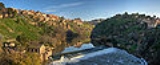
The
Tagus is the longest
riverA river is a natural watercourse, usually freshwater, flowing towards an ocean, a lake, a sea, or another river. In a few cases, a river simply flows into the ground or dries up completely before reaching another body of water. Small rivers may also be called by several other names, including...
on the
Iberian PeninsulaThe Iberian Peninsula , sometimes called Iberia, is located in the extreme southwest of Europe and includes the modern-day sovereign states of Spain, Portugal and Andorra, as well as the British Overseas Territory of Gibraltar...
. It is 1038 km (645 mi) long, 716 km (445 mi) in
SpainSpain , officially the Kingdom of Spain languages]] under the European Charter for Regional or Minority Languages. In each of these, Spain's official name is as follows:;;;;;;), is a country and member state of the European Union located in southwestern Europe on the Iberian Peninsula...
, 47 km (29 mi) along the border between Portugal and Spain and 275 km (171 mi) in
PortugalPortugal , officially the Portuguese Republic is a country situated in southwestern Europe on the Iberian Peninsula. Portugal is the westernmost country of Europe, and is bordered by the Atlantic Ocean to the West and South and by Spain to the North and East. The Atlantic archipelagos of the...
, where it empties into the
Atlantic OceanThe Atlantic Ocean is the second-largest of the world's oceanic divisions. With a total area of about , it covers approximately 20% of the Earth's surface and about 26% of its water surface area...
at
LisbonLisbon is the capital city and largest city of Portugal with a population of 545,245 within its administrative limits on a land area of . The urban area of Lisbon extends beyond the administrative city limits with a population of 3 million on an area of , making it the 9th most populous urban...
. It drains an area of 80100 sqkm (the second largest in the Iberian peninsula after the
DouroThe Douro or Duero is one of the major rivers of the Iberian Peninsula, flowing from its source near Duruelo de la Sierra in Soria Province across northern-central Spain and Portugal to its outlet at Porto...
). The Tagus is highly utilized for most of its course. Several dams and diversions supply drinking water to most of central Spain, including
MadridMadrid is the capital and largest city of Spain. The population of the city is roughly 3.3 million and the entire population of the Madrid metropolitan area is calculated to be 6.271 million. It is the third largest city in the European Union, after London and Berlin, and its metropolitan...
, and Portugal, while dozens of hydroelectric stations create power. Between dams it follows a very constricted course, but after
AlmourolThe Almourol Castle is situated in the small Almourol island, a rocky island, in the middle of the Tagus river , in Praia do Ribatejo, a parish in Vila Nova da Barquinha, Central Portugal. The castle was a Knights Templar stronghold used during the Reconquista.-The conquest of the castle:The site...
it enters a vast alluvial valley prone to flooding. At its mouth is a large estuary on which the port city of Lisbon is situated.
The
Tagus is the longest
riverA river is a natural watercourse, usually freshwater, flowing towards an ocean, a lake, a sea, or another river. In a few cases, a river simply flows into the ground or dries up completely before reaching another body of water. Small rivers may also be called by several other names, including...
on the
Iberian PeninsulaThe Iberian Peninsula , sometimes called Iberia, is located in the extreme southwest of Europe and includes the modern-day sovereign states of Spain, Portugal and Andorra, as well as the British Overseas Territory of Gibraltar...
. It is 1038 km (645 mi) long, 716 km (445 mi) in
SpainSpain , officially the Kingdom of Spain languages]] under the European Charter for Regional or Minority Languages. In each of these, Spain's official name is as follows:;;;;;;), is a country and member state of the European Union located in southwestern Europe on the Iberian Peninsula...
, 47 km (29 mi) along the border between Portugal and Spain and 275 km (171 mi) in
PortugalPortugal , officially the Portuguese Republic is a country situated in southwestern Europe on the Iberian Peninsula. Portugal is the westernmost country of Europe, and is bordered by the Atlantic Ocean to the West and South and by Spain to the North and East. The Atlantic archipelagos of the...
, where it empties into the
Atlantic OceanThe Atlantic Ocean is the second-largest of the world's oceanic divisions. With a total area of about , it covers approximately 20% of the Earth's surface and about 26% of its water surface area...
at
LisbonLisbon is the capital city and largest city of Portugal with a population of 545,245 within its administrative limits on a land area of . The urban area of Lisbon extends beyond the administrative city limits with a population of 3 million on an area of , making it the 9th most populous urban...
. It drains an area of 80100 sqkm (the second largest in the Iberian peninsula after the
DouroThe Douro or Duero is one of the major rivers of the Iberian Peninsula, flowing from its source near Duruelo de la Sierra in Soria Province across northern-central Spain and Portugal to its outlet at Porto...
). The Tagus is highly utilized for most of its course. Several dams and diversions supply drinking water to most of central Spain, including
MadridMadrid is the capital and largest city of Spain. The population of the city is roughly 3.3 million and the entire population of the Madrid metropolitan area is calculated to be 6.271 million. It is the third largest city in the European Union, after London and Berlin, and its metropolitan...
, and Portugal, while dozens of hydroelectric stations create power. Between dams it follows a very constricted course, but after
AlmourolThe Almourol Castle is situated in the small Almourol island, a rocky island, in the middle of the Tagus river , in Praia do Ribatejo, a parish in Vila Nova da Barquinha, Central Portugal. The castle was a Knights Templar stronghold used during the Reconquista.-The conquest of the castle:The site...
it enters a vast alluvial valley prone to flooding. At its mouth is a large estuary on which the port city of Lisbon is situated.
The source of the Tagus is the Fuente de García, in the
Montes UniversalesMontes Universales is a long mountain range in the southwestern end of the Iberian System. Its highest point is the 1,935 m high summit known as Caimodorro...
,
Sistema IbéricoThe Sistema Ibérico or Iberian System is one of the main systems of mountain ranges in Spain.It is a vast and complex system of mountain chains and massifs located in the central regions of the Iberian Peninsula, but reaching almost the Mediterranean coast in the Land of Valencia in the east.From...
,
Sierra de Albarracín ComarcaSierra de Albarracín Comarca is a comarca in Aragon, Spain. It is located in the Iberian System, in an area formerly known locally as Tierra de Albarracín, roughly corresponding to the ancient Señorío de Albarracín feudal manor...
. All its major tributaries enter the Tagus from the right (north) bank. The main cities it passes through are
AranjuezAranjuez is a town lying 48 km south of Madrid, in the southern part of the Community of Madrid. It is located at the confluence of the Tagus and Jarama rivers, 48 km from Toledo. As of 2009, it has a population of 54,055.-History:...
,
ToledoToledo's Alcázar became renowned in the 19th and 20th centuries as a military academy. At the outbreak of the Spanish Civil War in 1936 its garrison was famously besieged by Republican forces.-Economy:...
, Talavera de la Reina and
AlcántaraAlcántara is a municipality in the province of Cáceres, Extremadura, Spain, on the Tagus, near Portugal. The toponym is from the Arabic word al-QanTarah meaning "the bridge".-History:...
in Spain, and
AbrantesAbrantes is a municipality in Portugal, with a population of 41,560 inhabitants, located on the southern margin of the Tagus River.-History:...
,
SantarémSantarém is a city in the Santarém Municipality in Portugal. The city itself has a population of 28,760 and the entire municipality has 64,124 inhabitants.It is the capital of Santarém District....
,
AlmadaAlmada is a municipality in Portugal, covering an area of 70.2 km² located on the southern margin of the Tagus River. Its municipal population in 2008 was 164,844 inhabitants; the urbanized center had a population of 102,357.The seat is the city of Almada....
and Lisbon in Portugal.
In Spain
The first notable town on the Tagus is
SacedónSacedón is a city located in the province of Guadalajara, Castile-La Mancha, Spain. According to the 2007 census, the city has a population of 1.758 inhabitants.-External links:* - Diputación de Guadalajara...
. Below
AranjuezAranjuez is a town lying 48 km south of Madrid, in the southern part of the Community of Madrid. It is located at the confluence of the Tagus and Jarama rivers, 48 km from Toledo. As of 2009, it has a population of 54,055.-History:...
it receives the combined flow of the
HenaresThe Henares is a river in Spain, tributary of the Jarama. It has its source in the Sierra Ministra, in the village of Horna, near Sigüenza, in the province of Guadalajara....
and the Tajuña. Below
ToledoToledo's Alcázar became renowned in the 19th and 20th centuries as a military academy. At the outbreak of the Spanish Civil War in 1936 its garrison was famously besieged by Republican forces.-Economy:...
it receives the Guadarrama river. Above Talavera de la Reina it receives the
AlbercheThe Alberche is a river in the provinces of Ávila, Madrid and Toledo, central Spain. It begins its course at 1,800 m in Fuente Alberche, San Martín de la Vega del Alberche municipal term, Ávila Province...
. At
ValdeverdejaValdeverdeja is a municipality located in the province of Toledo, Castile-La Mancha, Spain. According to the 2006 census , the municipality has a population of 740 inhabitants....
is the upper end of the long upper reservoir, the
Embalse de ValdecañasThe Alcantara Dam, also known as the Jose María de Oriol Dam, in Spain, regulates much of the flow of the Tagus River, the longest of the Iberian Peninsula, just before the river enters Portugal. It was built in 1969 and is the second largest reservoir in Europe...
, beyond which are the
Embalse de Torrejon, into which flow the
TiétarTiétar is a river of Spain. It is a tributary of the Tagus. Its source is in the Sierra de Gredos mountain range and has a length of 170km. It flows into the Tagus at Monfragüe.-External links:*...
, and the lower reservoir, the
Embalse de AlcántaraThe Alcantara Dam, also known as the Jose María de Oriol Dam, in Spain, regulates much of the flow of the Tagus River, the longest of the Iberian Peninsula, just before the river enters Portugal. It was built in 1969 and is the second largest reservoir in Europe...
into which flow the
AlagónAlagón may refer to:*Alagón , a river in Spain, tributary of the Tagus*Alagón, Zaragoza, a municipality in Spain...
at the lower end.
In Portugal
After forming the border it enters Portugal, passing
Vila Velha de RódãoVila Velha de Ródão is a municipality in Portugal with a total area of 329.9 km² and a total population of 3,802 inhabitants.The municipality is composed of 4 parishes and is located in the district of Castelo Branco....
,
AbrantesAbrantes is a municipality in Portugal, with a population of 41,560 inhabitants, located on the southern margin of the Tagus River.-History:...
,
ConstânciaConstância is a municipality in Portugal with a total area of 80.4 km² and a total population of 3796 inhabitants.The municipality is composed of 3 parishes, and is located in Santarém District....
,
EntroncamentoEntroncamento is a municipality in Portugal with a total area of 13.8 km² and a total population of 21,751 inhabitantsThe municipality is composed of 2 civil parishes, contains an important railway junction, and is located in Santarém District....
,
SantarémSantarém is a city in the Santarém Municipality in Portugal. The city itself has a population of 28,760 and the entire municipality has 64,124 inhabitants.It is the capital of Santarém District....
and
Vila Franca de XiraVila Franca de Xira is a municipality in Portugal with a total area of 317.7 km² and a total population of 133,224 inhabitants. Situated on the west bank of the Tagus River, just 32 km north-east of the Portuguese capital Lisbon, Vila Franca de Xira is said to have been founded by French...
at the head of the long narrow estuary, which has
LisbonLisbon is the capital city and largest city of Portugal with a population of 545,245 within its administrative limits on a land area of . The urban area of Lisbon extends beyond the administrative city limits with a population of 3 million on an area of , making it the 9th most populous urban...
at its mouth. There is the largest bridge across the river, the
Vasco da Gama Bridge, which with a total length of 17.2 km is the longest bridge in
EuropeEurope is, by convention, one of the world's seven continents. Comprising the westernmost peninsula of Eurasia, Europe is generally 'divided' from Asia to its east by the watershed divides of the Ural and Caucasus Mountains, the Ural River, the Caspian and Black Seas, and the waterways connecting...
.
The Portuguese regions of
Alentejo and
RibatejoThe Ribatejo is the most central of the traditional provinces of Portugal, with no coastline or border with Spain. The region is crossed by the Tagus River...
take their names from the river. Alentejo, from
Além-Tejo ("beyond the Tagus"), and Ribatejo, from
Arriba-Tejo (above, or before the Tagus). There is a canal and
aqueductAn aqueduct is a water supply or navigable channel constructed to convey water. In modern engineering, the term is used for any system of pipes, ditches, canals, tunnels, and other structures used for this purpose....
between the Tagus and the
SeguraSegura is a medium-sized river in southeastern Spain.It starts at Santiago Pontones , passes Calasparra, Cieza, Murcia, Beniaján, Orihuela, Rojales and ends in the Mediterranean Sea near Guardamar del Segura in the province of Alicante...
river.
Geology
The lower Tagus is on a
fault lineIn geology, fault line refers to the surface trace of a fault.Fault line, Fault Line, or faultline may also refer to:* "Faultline", a song from the 2008 studio album Versus by The Haunted...
. Slippage along it has caused numerous
earthquakeAn earthquake is the result of a sudden release of energy in the Earth's crust that creates seismic waves. The seismicity, seismism or seismic activity of an area refers to the frequency, type and size of earthquakes experienced over a period of time...
s, the major ones being those of 1309, 1531 and
1755The 1755 Lisbon earthquake, also known as the Great Lisbon Earthquake, was a megathrust earthquake that took place on Saturday 1 November 1755, at around 9:40 in the morning. The earthquake was followed by fires and a tsunami, which almost totally destroyed Lisbon in the Kingdom of Portugal, and...
.
History
The
Pepper WreckThe Pepper Wreck is the name of a shipwreck excavated at the mouth of the Tagus River, Lisbon, Portugal, between 1996 and 2001. The ship had been seeking safer anchorage during strong winds in the Tagus, but she struck a submerged rock and went down close to shore with no loss of life...
is the name of a shipwreck located and excavated at the mouth of the Tagus River between 1996 and 2001.
The river also had strategic value to the Spanish and Portuguese empires, as it guarded the approach to
LisbonLisbon is the capital city and largest city of Portugal with a population of 545,245 within its administrative limits on a land area of . The urban area of Lisbon extends beyond the administrative city limits with a population of 3 million on an area of , making it the 9th most populous urban...
. For example, in 1587, Sir
Francis DrakeSir Francis Drake, Vice Admiral was an English sea captain, privateer, navigator, slaver, and politician of the Elizabethan era. Elizabeth I of England awarded Drake a knighthood in 1581. He was second-in-command of the English fleet against the Spanish Armada in 1588. He also carried out the...
briefly approached the river after his successful raid at Cadiz.
The Tagus in song and story
A major river, the Tagus is brought to mind in the songs and stories of the Portuguese. A popular
fadoFado is a music genre which can be traced to the 1820s in Portugal, but probably with much earlier origins. Fado historian and scholar, Rui Vieira Nery, states that "the only reliable information on the history of Fado was orally transmitted and goes back to the 1820s and 1830s at best...
song in Lisbon notes that while people get older, the Tagus remains young ("My hair getting white, the Tagus is always young"). The author,
Fernando PessoaFernando Pessoa, born Fernando António Nogueira de Seabra Pessoa , was a Portuguese poet, writer, literary critic and translator described as one of the most significant literary figures of the 20th century and one of the greatest poets in the Portuguese language.-Early years in Durban:On 13 July...
, wrote a poem that begins: "The Tagus is more beautiful than the river that flows through my village...."
Richard Crashaw's poem "Saint Mary Magdalene, or the Weeper" refers to the "Golden" Tagus as wanting Mary Magdalene's silver tears. In classical poetry the Tagus was famous for its gold-bearing sands (
CatullusGaius Valerius Catullus was a Latin poet of the Republican period. His surviving works are still read widely, and continue to influence poetry and other forms of art.-Biography:...
29.19,
OvidPublius Ovidius Naso , known as Ovid in the English-speaking world, was a Roman poet who is best known as the author of the three major collections of erotic poetry: Heroides, Amores, and Ars Amatoria...
, Amores, 1.15.34,
JuvenalThe Satires are a collection of satirical poems by the Latin author Juvenal written in the late 1st and early 2nd centuries AD.Juvenal is credited with sixteen known poems divided among five books; all are in the Roman genre of satire, which, at its most basic in the time of the author, comprised a...
, Satires, 3.55, etc.