

Lusitanians

Encyclopedia
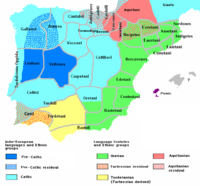
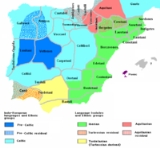
The Lusitanians were an Indo-European people
Proto-Indo-Europeans
The Proto-Indo-Europeans were the speakers of the Proto-Indo-European language , a reconstructed prehistoric language of Eurasia.Knowledge of them comes chiefly from the linguistic reconstruction, along with material evidence from archaeology and archaeogenetics...
living in the Western Iberian Peninsula
Iberian Peninsula
The Iberian Peninsula , sometimes called Iberia, is located in the extreme southwest of Europe and includes the modern-day sovereign states of Spain, Portugal and Andorra, as well as the British Overseas Territory of Gibraltar...
long before it became the Roman
Ancient Rome
Ancient Rome was a thriving civilization that grew on the Italian Peninsula as early as the 8th century BC. Located along the Mediterranean Sea and centered on the city of Rome, it expanded to one of the largest empires in the ancient world....
province of Lusitania
Lusitania
Lusitania or Hispania Lusitania was an ancient Roman province including approximately all of modern Portugal south of the Douro river and part of modern Spain . It was named after the Lusitani or Lusitanian people...
(modern Portugal
Portugal
Portugal , officially the Portuguese Republic is a country situated in southwestern Europe on the Iberian Peninsula. Portugal is the westernmost country of Europe, and is bordered by the Atlantic Ocean to the West and South and by Spain to the North and East. The Atlantic archipelagos of the...
, Extremadura
Extremadura
Extremadura is an autonomous community of western Spain whose capital city is Mérida. Its component provinces are Cáceres and Badajoz. It is bordered by Portugal to the west...
and a small part of Salamanca
Salamanca
Salamanca is a city in western Spain, in the community of Castile and León. Because it is known for its beautiful buildings and urban environment, the Old City was declared a UNESCO World Heritage Site in 1988. It is the most important university city in Spain and is known for its contributions to...
). They spoke the Lusitanian language
Lusitanian language
Lusitanian was a paleohispanic language that apparently belonged to the Indo-European family. Its relationship to the Celtic languages of the Iberian Peninsula, either as a member, a cousin , or as a different branch of Indo-European, is debated. It is known from only five inscriptions, dated from...
which might have been Celtic. The modern Portuguese people
Portuguese people
The Portuguese are a nation and ethnic group native to the country of Portugal, in the west of the Iberian peninsula of south-west Europe. Their language is Portuguese, and Roman Catholicism is the predominant religion....
see the Lusitanians as their ancestors. The most notable Lusitanian was Viriathus
Viriathus
Viriathus was the most important leader of the Lusitanian people that resisted Roman expansion into the regions of Western Hispania , where the Roman province of Lusitania would be established...
.
Origins
Some modern authors consider them to be indigenous and initially dominated by the CeltCelt
The Celts were a diverse group of tribal societies in Iron Age and Roman-era Europe who spoke Celtic languages.The earliest archaeological culture commonly accepted as Celtic, or rather Proto-Celtic, was the central European Hallstatt culture , named for the rich grave finds in Hallstatt, Austria....
s, before gaining full independence from them. Alternatively, archeologist Scarlat Lambrino proposed that they were originally a tribal group of Celtic origin related to the Lusones
Lusones
The Lusones were an ancient Celtic Celtiberian people of the Iberian peninsula , who lived in the high Tajuña River valley, northeast of Guadalajara...
of Saefs
Saefs
The Saefs were a Celtic people. An Early Hallstatt culture, they were first in what is now the Czech-German area and later in Iberia...
origin.
Ethnological speculations abound on the origin Lusitanians and whether they had some substantial connection with the Lusones or that the similarity in their tribal names was merely accidental.
The first area settled by the Lusitanians was probably the Douro valley and the region of Beira Alta
Beira Alta
Beira Alta Province was a Portuguese province in the north of Portugal.Vast plateaus, river valleys, mountains, and castles abound in Beira Alta.Formerly it was part of the Beira Province.The two main cities were Guarda and Viseu...
; then they moved south, and expanded on both sides of the Tagus river, before being conquered by the Romans.
The original Roman province of Lusitania briefly included the territories of Asturia and Gallaecia
Gallaecia
Gallaecia or Callaecia, also known as Hispania Gallaecia, was the name of a Roman province and an early Mediaeval kingdom that comprised a territory in the north-west of Hispania...
, but these were soon ceded to the jurisdiction of the Provincia Tarraconensis in the north, while the south remained the Provincia Lusitania et Vettones
Vettones
The Vettones were one of the pre-Roman Celtic peoples of the Iberian Peninsula .- Origins :...
. After this, Lusitania's northern border was along the Douro river, while its eastern border passed through Salmantica and Caesarobriga to the Anas (Guadiana
Guadiana
The Guadiana , or Odiana, is an international river located on the Portuguese–Spanish border, separating Extremadura and Andalucia from Alentejo and Algarve...
) river.
Culture
Categorising Lusitanian culture generally, including the language, is proving difficult. Some believe it was essentially a pre-Celtic Iberian culture with substantial Celtic influences, while others argue that it was an essentially Celtic culture with strong indigenous pre-Celtic influences.Lusitanians lived in small quadrangular houses (round in the north) with a single floor, made of stones. Their clothes were made of wool or of goat skin. They wore necklaces, bracelets, and other jewelry made of gold. They made their jewels using a filigree method, or by hammering. Wine was only used in festivities and they usually drank water, goats milk and beer. Lusitanians practiced monogamy
Monogamy
Monogamy /Gr. μονός+γάμος - one+marriage/ a form of marriage in which an individual has only one spouse at any one time. In current usage monogamy often refers to having one sexual partner irrespective of marriage or reproduction...
. They used boats made of leather, or from harvested lumber.
They used anointing-rooms twice a day and took baths in vapors that rose from heated stones, then bathing in cold water.
They practiced gymnastic exercises such as boxing and racing. They sacrificed goats, horses, and human prisoners to Cariocecus
Cariocecus
Cariocecus was the god of war in Lusitanian mythology, in the cultural area of Lusitania . He was equated with the Roman god Mars and Greek Ares....
, god of war.
In battles with the Romans, Lusitanians gained a reputation as fierce fighters. They used weapons such as the dagger
Dagger
A dagger is a fighting knife with a sharp point designed or capable of being used as a thrusting or stabbing weapon. The design dates to human prehistory, and daggers have been used throughout human experience to the modern day in close combat confrontations...
, the iron javelin
Pilum
The pilum was a javelin commonly used by the Roman army in ancient times. It was generally about two metres long overall, consisting of an iron shank about 7 mm in diameter and 60 cm long with pyramidal head...
, and the brass spear
Spear
A spear is a pole weapon consisting of a shaft, usually of wood, with a pointed head.The head may be simply the sharpened end of the shaft itself, as is the case with bamboo spears, or it may be made of a more durable material fastened to the shaft, such as flint, obsidian, iron, steel or...
. Roman records attest to their presence among Carthaginian
Carthage
Carthage , implying it was a 'new Tyre') is a major urban centre that has existed for nearly 3,000 years on the Gulf of Tunis, developing from a Phoenician colony of the 1st millennium BC...
mercenaries in battles in the Pyrenees
Pyrenees
The Pyrenees is a range of mountains in southwest Europe that forms a natural border between France and Spain...
.
Religion
The Lusitanians worshipped various gods in a very diverse polytheism, using animal sacrifice. They represented their gods and warriors in rudimentary sculpture. EndovelicusEndovelicus
Endovelicus , was an Iron Age god of public health and safety, worshipped in pre-Roman and Roman Lusitania and Gallaecia. He was associated with chthonic oracles and healing, and was probably the recipient of pig sacrifices...
was the most important god: his cult eventually spread across the Iberian peninsula and beyond, to the rest of the Roman Empire and his cult maintained until the 5th century; he was the god of public health and safety. The goddess Ataegina
Ataegina
Ataegina or Ataecina was a popular goddess worshipped by the ancient Iberians, Lusitanians, and Celtiberians of the Iberian Peninsula.-Name and functions:...
was especially popular in the south; as the goddess of rebirth (Spring), fertility, nature, and cure, she was identified with Proserpina
Proserpina
Proserpina or Proserpine is an ancient Roman goddess whose story is the basis of a myth of Springtime. Her Greek goddess' equivalent is Persephone. The probable origin of her name comes from the Latin, "proserpere" or "to emerge," in respect to the growing of grain...
during the Roman era. Lusitanian mythology was related to or heavily influenced by Celtic mythology, and during later Roman rule, it also became heavily influenced by Roman mythology, while the Romans also adopted some Lusitanian gods. Also well attested in inscriptions are the names Bandua
Bandua
In classical Celtic polytheism as well as in Gallaecian and Lusitanian mythology, Bandua was a theonym used to refer to a god or goddess worshipped in Iberia by Gallaeci and Lusitanians. Whether the name referred to a discrete deity or was an epithet applied to different deities is arguable.-Extent...
, often with a second name linked to a locality such as Bandua Aetobrico and Nabia
Nabia
Nabia was the goddess of rivers and water in Gallaecian and Lusitanian mythology, in the territory of modern Galicia and Portugal.The present-day Navia River and Avia_ in Galicia, was named in honor of the deity...
, possibly a goddess of rivers and streams.
The Lusitanians practiced the cult of the dead, and used cremation.
Language
The Lusitanian language was a paleohispanic languagePaleohispanic languages
The Paleohispanic languages were the languages of the pre-Roman peoples of the Iberian Peninsula, excluding languages of foreign colonies, such as Greek in Emporion and Phoenician in Qart Hadast...
that clearly belongs to the Indo-European
Indo-European languages
The Indo-European languages are a family of several hundred related languages and dialects, including most major current languages of Europe, the Iranian plateau, and South Asia and also historically predominant in Anatolia...
family and may be related to the Celtiberian language
Celtiberian language
Celtiberian is an extinct Indo-European language of the Celtic branch spoken by the Celtiberians in an area of the Iberian Peninsula lyingbetween the headwaters of the Duero, Tajo, Júcar and Turia rivers and the Ebro river...
.
The precise filiation of the Lusitanian language inside Indo-European
Indo-European languages
The Indo-European languages are a family of several hundred related languages and dialects, including most major current languages of Europe, the Iranian plateau, and South Asia and also historically predominant in Anatolia...
family is still in debate: there are those who endorse that it is a Celtic
Celtic languages
The Celtic languages are descended from Proto-Celtic, or "Common Celtic"; a branch of the greater Indo-European language family...
language with an obvious "celticity" to most of the lexicon, over many anthroponyms and toponyms. A second theory relates Lusitanian with the Italic languages
Italic languages
The Italic subfamily is a member of the Indo-European language family. It includes the Romance languages derived from Latin , and a number of extinct languages of the Italian Peninsula, including Umbrian, Oscan, Faliscan, and Latin.In the past various definitions of "Italic" have prevailed...
; based on a relation of the name of Lusitanian deities with other grammatical elements of the area. Finally, Ulrich Schmoll proposed a new branch to which he named "Galician-Lusitanian".
Tribes
Tribe
A tribe, viewed historically or developmentally, consists of a social group existing before the development of, or outside of, states.Many anthropologists use the term tribal society to refer to societies organized largely on the basis of kinship, especially corporate descent groups .Some theorists...
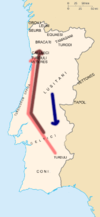
that lived between the rivers Douro and Tagus
Tagus
The Tagus is the longest river on the Iberian Peninsula. It is long, in Spain, along the border between Portugal and Spain and in Portugal, where it empties into the Atlantic Ocean at Lisbon. It drains an area of . The Tagus is highly utilized for most of its course...
. As the Lusitanians fought fiercly against the Romans for independence, the name Lusitania was adopted by the Gallaeci, tribes living north of the Douro, and other closely surrounding tribes, eventually spreading as a label to all the nearby peoples fighting Roman rule in the west of Iberia. It was for this reason that the Romans came to name their original province in the area, that initially covered the entire western side of the Iberian peninsula, Lusitania.
Tribes, often known by their Latin names, living in the area of modern Portugal, prior to Roman rule:
- Bardili (Turduli)Bardili (Turduli)The Bardili were a small, pre-Roman people of Iberia and an offshoot of the widespread Turduli people, who lived in what is now southwestern Portugal in the 5th-1st Centuries BC.- Location :...
- living in the Setúbal peninsula; - BracariBracariThe Bracari were an ancient Celtic tribe of Gallaecia, akin to the Calaicians or Gallaeci, living in the northwest of modern Portugal, in the province of Minho, between the rivers Tâmega and Cávado, around the area of the modern city of Braga .Appian wrote they were a very warlike people...
- living between the rivers Tâmega and CávadoCávado RiverThe Cávado River is a river located in north Portugal.It has its source in Serra do Larouco at 1520 meters. It runs 135 km from Gouveia to its mouth into the Atlantic Ocean next to the city of Esposende...
, in the area of the modern city of BragaBragaBraga , a city in the Braga Municipality in northwestern Portugal, is the capital of the Braga District, the oldest archdiocese and the third major city of the country. Braga is the oldest Portuguese city and one of the oldest Christian cities in the World...
; - CallaiciCallaiciThe Gallaeci or Callaeci were a Celtic people who inhabited Gallaecia, the region roughly corresponding to what is now Galicia, North of Portugal and Western Asturias, through the Roman period...
-living north of the River Douro; - CelticiCeltici]The Celtici were a Celtic tribe or group of tribes of the Iberian peninsula, inhabiting three definite areas: in what today are the provinces of Alentejo and the Algarve in Portugal; in the Province of Badajoz and north of Province of Huelva in Spain, in the ancient Baeturia; and along the...
- Celts living in Alentejo; - CoelerniCoelerniThe Coelerni were an ancient Celtic tribe of Gallaecia in Hispania , part of Calaician or Gallaeci people , living in what was to become the Roman Province of Hispania Citerior, convent of Bracara Augusta , in what is now the southern part of the province of Ourense .Some sources, like Alarcão,...
- living in the mountains between the rivers Tua and Sabor; - Cynetes or ConiiCynetesThe Cynetes or Conii were one of the pre-Roman peoples of the Iberian Peninsula, living in today's Algarve and Low Alentejo regions of southern Portugal before the 6th century BCE .They are often mentioned in the ancient sources under various designations, mostly Greek or Latin derivatives of their...
- living in the Algarve and the south of Alentejo; - EquaesiEquaesiThe Equaesi were an ancient Celtic tribe of Gallaecia, living in the north of modern Portugal, between the provinces of Minho and Trás-os-Montes, near the border of modern Galicia .-External links:*...
- living in the most mountainous region of modern PortugalPortugalPortugal , officially the Portuguese Republic is a country situated in southwestern Europe on the Iberian Peninsula. Portugal is the westernmost country of Europe, and is bordered by the Atlantic Ocean to the West and South and by Spain to the North and East. The Atlantic archipelagos of the...
; - GroviiGroviiThe Grovii were an ancient Celtic tribe of Gallaecia, living in the north of modern Portugal, in the province of Minho, around the Minho river, and spreading into modern day Galicia . One of their main gods was Turiacus.-External links:*...
- a mysterious tribe living in the Minho valley; - InteramiciInteramiciThe Interamici were an ancient Celtic tribe of Gallaecia, living in the north of modern Portugal, in the province of Trás-os-Montes, near the border with Galicia .-External links:*...
- living in Trás-os-MontesTrás-os-Montes (region)Trás-os-Montes was one of the 13 regions of continental Portugal identified by geographer Amorim Girão, in a study published between 1927 and 1930.Together with Alto Douro it formed Trás-os-Montes e Alto Douro Province.- See also :...
and in the border areas with Galicia (in modern SpainSpainSpain , officially the Kingdom of Spain languages]] under the European Charter for Regional or Minority Languages. In each of these, Spain's official name is as follows:;;;;;;), is a country and member state of the European Union located in southwestern Europe on the Iberian Peninsula...
); - LeuniLeuniThe Leuni were an ancient Celtic tribe of Gallaecia, living in the north of modern Portugal, in the province of Minho, between the rivers Lima and Minho.-External links:*...
- living between the rivers Lima and Minho; - LuanquiLuanquiThe Luanqvi were an ancient Celtic tribe of Gallaecia, living in the north of modern Portugal, in the province of Trás-os-Montes, between the rivers Tâmega and Tua.-External links:*...
- living between the rivers Tâmega and Tua; - Lusitani - being the most numerous and dominant of the region;
- LimiciLimiciThe Limici were an ancient Celtic tribe of Gallaecia, living in the swamps of the river Lima, in the border region between Minho and Galicia .-External links:*...
- living in the swamps of the river Lima, on the border between Portugal and Galicia); - NarbasiNarbasiThe Narbasi were an ancient Celtic tribe of Gallaecia, living in the province of Minho and nearby areas of modern Galicia .-External links:*...
- living in the north of modern Portugal (interior) and nearby area of southern Galicia; - NemetatiNemetatiThe Nemetati were an ancient Celtic tribe of Gallaecia, living in the north of modern Portugal between the Cávado and Ave Rivers, in the province of Minho, north of the Douro.They lived near the valley of the Ave River and may have some link with inscriptions to the war god Cosus Nemedecus. The...
- living north of the Douro Valley in the area of Mondim; - PaesuriPaesuriThe Paesuri were an ancient Celtic tribe of Lusitania, akin to the Lusitanians, to whom they were a dependent tribe. Located between the rivers Douro and Vouga, in the modern northern central Portugal, the Paesures comprised four tribes - Ireucoutiori, Aravoni, Seareas and Paisicaicoi, which...
- a dependent tribe of the Lusitanians, living between the rivers Douro and Vouga; - QuaquerniQuaquerniThe Quaquerni were an ancient Celtic tribe of Gallaecia, living in the north of modern Portugal, province of Minho, in the mountains at the mouths of the rivers Tâmega and Cávado.-External links:*...
- living in the mountains at the mouths of rivers Cavado and Tâmega; - SeurbiSeurbiThe Seurbi were an ancient Celtic tribe of Gallaecia, living in the north of modern Portugal, in the province of Minho, between the rivers Cávado and Lima .-External links:*...
- living between the rivers CávadoCávado RiverThe Cávado River is a river located in north Portugal.It has its source in Serra do Larouco at 1520 meters. It runs 135 km from Gouveia to its mouth into the Atlantic Ocean next to the city of Esposende...
and Lima (or even reaching the river Minho); - TamaganiTamaganiThe Tamagani were an ancient Celtic tribe of Gallaecia, living in the north of modern Portugal, in the province of Trás-os-Montes, from the area of Chaves, near the river Tâmega.-External links:*...
- from the area of Chaves, near the river Tâmega; - TapoliTapoliThe Tapoli were an ancient Celtic tribe of Lusitania, akin to the Lusitanians, to whom they were a dependent tribe, living just north of the river Tagus, around the border area of modern day Portugal and Spain.-External links:*...
- another dependent tribe of the Lusitanians, living north of the river Tagus, on the border between modern Portugal and Spain; - TurduliTurduliThe Turduli were an ancient Celtiberian tribe of Lusitania, akin to the Lusitanians. They lived in the south of modern Portugal, in the east of the province of Alentejo, along the Guadiana valley , and Extremadura proper...
- in the east of Alentejo (Guadiana Valley); - Turduli VeteresTurduli VeteresThe Turduli Veteres, also known as "Ancient Turduli" or "Old Turduli" were an ancient Celtic tribe of Lusitania, akin to the Lusitanians and Calaicians or Gallaeci, living south of the estuary of the river Douro, in the north of modern Portugal...
- the "ancient Turduli" living south of the estuary of the river Douro; - Turdulorum OppidaTurdulorum OppidaThe Turdulorum Oppida , or Turduli Oppidani, living in the Portuguese region of Estremadura , were an ancient Celtic tribe of Lusitania, akin to the Lusitanians. They held the fortified towns of Aeminium , Conimbriga , Coniumbriga , Collipo The Turdulorum Oppida (Latin - oppidums of the Turduli),...
- Turduli living in the Portuguese region of EstremaduraEstremadura Province (historical)Estremadura Province is one of the six historical provinces of Portugal....
; - TurodiTurodiThe Turodi were an ancient Celtic tribe of Gallaecia, living in the north of modern Portugal, in the province of Trás-os-Montes and border areas in Galicia .-External links:*...
- living in Trás-os-MontesTrás-os-Montes (region)Trás-os-Montes was one of the 13 regions of continental Portugal identified by geographer Amorim Girão, in a study published between 1927 and 1930.Together with Alto Douro it formed Trás-os-Montes e Alto Douro Province.- See also :...
and bordering areas of Galicia; - VettonesVettonesThe Vettones were one of the pre-Roman Celtic peoples of the Iberian Peninsula .- Origins :...
- living in the Spanish provinces of ÁvilaÁvila (province)Ávila is a province of central-western Spain, in the southern part of the autonomous community of Castile and León. It is bordered on the south by the provinces of Toledo and Cáceres, on the west by Salamanca, on the north by Valladolid, and on the east by Segovia and Madrid. Ávila has a...
and SalamancaSalamanca (province)Salamanca is a province of western Spain, in the western part of the autonomous community of Castile and León. It is bordered by the provinces of Zamora, Valladolid, Ávila, and Cáceres; and by Portugal....
, as well as parts of ZamoraZamora (province)Zamora is a Spanish province of western Spain, in the western part of the autonomous community of Castile and León.The present-day province of Zamora province was one of three provinces formed from the former Kingdom of León in 1833, when Spain was re-organised into 49 provinces.It is bordered by...
, ToledoToledo (province)Toledo is a province of central Spain, in the western part of the autonomous community of Castile-La Mancha. It is bordered by the provinces of Madrid, Cuenca, Ciudad Real, Badajoz, Cáceres, and Ávila....
and CáceresCáceres (province)The province of Cáceres is a province of western Spain, in the northern part of the autonomous community of Extremadura. It is bordered by the provinces of Salamanca, Ávila, Toledo, and Badajoz, and by Portugal....
; - ZoelaeZoelaeThe Zoelae were an ancient Celtic tribe of Gallaecia, living in the north of modern Portugal, in the province of Trás-os-Montes, between the mountains of Serra da Nogueira and the mountains of Mogadouro.-External links:*...
- living in the mountains of Serra da Nogueira, Sanabria and Culebra, up to the mountains of MogadouroMogadouroMogadouro is a municipality in Portugal with a total area of 760.65 km² and a total population of 10,792 inhabitants. The seat is the town of Mogadouro.-History:...
in northern Portugal and adjacent areas of Galicia.
War with the Romans and eventual Romanisation
Since 193 BC, the Lusitanians had been fighting the Romans. In 150 BC, they were defeated by Praetor Servius Galba: springing a clever trap, he killed 9,000 Lusitanians and later sold 20,000 more as slaves in GaulGaul
Gaul was a region of Western Europe during the Iron Age and Roman era, encompassing present day France, Luxembourg and Belgium, most of Switzerland, the western part of Northern Italy, as well as the parts of the Netherlands and Germany on the left bank of the Rhine. The Gauls were the speakers of...
(modern France
France
The French Republic , The French Republic , The French Republic , (commonly known as France , is a unitary semi-presidential republic in Western Europe with several overseas territories and islands located on other continents and in the Indian, Pacific, and Atlantic oceans. Metropolitan France...
). Three years later (147 BC), Viriathus
Viriathus
Viriathus was the most important leader of the Lusitanian people that resisted Roman expansion into the regions of Western Hispania , where the Roman province of Lusitania would be established...
became the leader of the Lusitanians and severely damaged the Roman rule in Lusitania and beyond. In 139 BC Viriathus was betrayed and killed in his sleep by his companions (who had been sent as emissaries to the Romans), Audax, Ditalcus and Minurus
Audax, Ditalcus and Minurus
Audax, Ditalcus and Minurus were the supposed assassins of the Lusitanian leader Viriathus.In 139 BC, after a long war against the Romans, Viriathus was killed in his sleep by Audax , Ditalcus and Minurus , who had been sent as emissaries to the Romans and had been bribed by Marcus Popillius Lenas...
, bribed by Marcus Popillius Laenas
Marcus Popillius Laenas
M. Popillius M.f. Laenas was a consul of the Roman Republic in the year 359 BC. While consul, he defeated a Gallic army....
. However, when Audax, Ditalcus and Minurus returned to receive their reward by the Romans, the Consul Servilius Caepio
Quintus Servilius Caepio
Quintus Servilius Caepio the Elder was a Roman statesman and general, consul in 106 BC, and proconsul of Cisalpine Gaul in 105 BC. He was the father of Quintus Servilius Caepio the Younger and the grandfather of Servilia Caepionis....
ordered their execution, declaring, "Rome does not pay traitors".
After Viriathus' rule, the Lusitanians became largely romanised and more interbred with them, acquiring Roman culture and language; the Lusitanian cities, in a manner similar to those of the rest of the romanised Iberian peninsula, eventually gained the status of "Citizens of Rome". The Portuguese language
Portuguese language
Portuguese is a Romance language that arose in the medieval Kingdom of Galicia, nowadays Galicia and Northern Portugal. The southern part of the Kingdom of Galicia became independent as the County of Portugal in 1095...
itself is a local evolution of the Roman language, Latin
Latin
Latin is an Italic language originally spoken in Latium and Ancient Rome. It, along with most European languages, is a descendant of the ancient Proto-Indo-European language. Although it is considered a dead language, a number of scholars and members of the Christian clergy speak it fluently, and...
.
Contemporary meaning
Lusitanians are often used by Portuguese writers as a metaphorMetaphor
A metaphor is a literary figure of speech that uses an image, story or tangible thing to represent a less tangible thing or some intangible quality or idea; e.g., "Her eyes were glistening jewels." Metaphor may also be used for any rhetorical figures of speech that achieve their effects via...
for the Portuguese people
Portuguese people
The Portuguese are a nation and ethnic group native to the country of Portugal, in the west of the Iberian peninsula of south-west Europe. Their language is Portuguese, and Roman Catholicism is the predominant religion....
, and similarly, Lusophone is used to refer to a Portuguese
Portuguese language
Portuguese is a Romance language that arose in the medieval Kingdom of Galicia, nowadays Galicia and Northern Portugal. The southern part of the Kingdom of Galicia became independent as the County of Portugal in 1095...
speaker.
Lusitanic is at present a term used to categorize persons who share the linguistic and cultural traditions of the Portuguese
Portuguese language
Portuguese is a Romance language that arose in the medieval Kingdom of Galicia, nowadays Galicia and Northern Portugal. The southern part of the Kingdom of Galicia became independent as the County of Portugal in 1095...
-speaking nations and territories of Portugal
Portugal
Portugal , officially the Portuguese Republic is a country situated in southwestern Europe on the Iberian Peninsula. Portugal is the westernmost country of Europe, and is bordered by the Atlantic Ocean to the West and South and by Spain to the North and East. The Atlantic archipelagos of the...
, Brazil
Brazil
Brazil , officially the Federative Republic of Brazil , is the largest country in South America. It is the world's fifth largest country, both by geographical area and by population with over 192 million people...
, Macau
Macau
Macau , also spelled Macao , is, along with Hong Kong, one of the two special administrative regions of the People's Republic of China...
, Timor-Leste, Angola
Angola
Angola, officially the Republic of Angola , is a country in south-central Africa bordered by Namibia on the south, the Democratic Republic of the Congo on the north, and Zambia on the east; its west coast is on the Atlantic Ocean with Luanda as its capital city...
, Mozambique
Mozambique
Mozambique, officially the Republic of Mozambique , is a country in southeastern Africa bordered by the Indian Ocean to the east, Tanzania to the north, Malawi and Zambia to the northwest, Zimbabwe to the west and Swaziland and South Africa to the southwest...
, Cape Verde
Cape Verde
The Republic of Cape Verde is an island country, spanning an archipelago of 10 islands located in the central Atlantic Ocean, 570 kilometres off the coast of Western Africa...
, São Tomé and Príncipe
São Tomé and Príncipe
São Tomé and Príncipe, officially the Democratic Republic of São Tomé and Príncipe, is a Portuguese-speaking island nation in the Gulf of Guinea, off the western equatorial coast of Central Africa. It consists of two islands: São Tomé and Príncipe, located about apart and about , respectively, off...
, Guinea Bissau and others.
See also
- Emerita AugustaEmerita AugustaThe Archaeological Ensemble of Mérida is one of the largest and most extensive archaeological sites in Spain. Mainly of Emerita Augusta, ancient capital of Lusitania . It was declared a World Heritage Site by UNESCO in 1993....
, its capital - History of PortugalHistory of PortugalThe history of Portugal, a European and an Atlantic nation, dates back to the Early Middle Ages. In the 15th and 16th centuries, it ascended to the status of a world power during Europe's "Age of Discovery" as it built up a vast empire including possessions in South America, Africa, Asia and...
- Timeline of Iberian prehistory
- Timeline of pre-Roman Iberian historyTimeline of pre-Roman Iberian historyThis section of the timeline of Iberian history concerns events from before the Carthaginian conquests .-Bronze Age:*2nd millennium BC** c. 1800 BC – The El Argar civilization appears in Almería, south-east of Spain, replacing the earlier civilization of Los Millares. The adoption of bronze...
(before the 3rd century BC) - Timeline of Portuguese history (Lusitania and Gallaecia)Timeline of Portuguese history (Lusitania and Gallaecia)This is a historical timeline of Portugal.-3rd century BC:*237 BC - The Carthaginian General Hamilcar Barca enters Iberia with his armies through Gadir.*228 BC - Hamilcar Barca dies in battle...
(3rd century BC to 4th century AD)
- ExtremaduraExtremaduraExtremadura is an autonomous community of western Spain whose capital city is Mérida. Its component provinces are Cáceres and Badajoz. It is bordered by Portugal to the west...
- HispaniaHispaniaAnother theory holds that the name derives from Ezpanna, the Basque word for "border" or "edge", thus meaning the farthest area or place. Isidore of Sevilla considered Hispania derived from Hispalis....
- Lusitania (Roman province)
- Pre-Roman peoples of the Iberian PeninsulaPre-Roman peoples of the Iberian PeninsulaThis is a list of the Pre-Roman peoples of the Iberian peninsula .-Non-Indo-European:*Aquitanians**Aquitani**Autrigones - some consider them Celtic .**Caristii - some consider them Celtic ....
- Roman EmpireRoman EmpireThe Roman Empire was the post-Republican period of the ancient Roman civilization, characterised by an autocratic form of government and large territorial holdings in Europe and around the Mediterranean....