
All Topics  
Vanillin


   Email Print
   Bookmark   Link


Vanillin


Vanillin, methyl vanillin, or 4-hydroxy-3-methoxybenzaldehyde, is an organic compound
Organic compound

An organic compound is any member of a large class of chemical compounds whose molecules contain carbon. For historical reasons discussed below, a few types of compounds such as carbonates, simple oxides of carbon and cyanides, as well as the allotropes of carbon, are considered Inorganic compound....
 with the molecular formula C8H8O3. Its functional groups include aldehyde
Aldehyde

An aldehyde is an organic compound containing a terminal carbonyl group. This functional group, which consists of a carbon atom bonded to a hydrogen atom and double bond to an oxygen atom , is called the aldehyde group....
, ether
Ether

Ether is a class of organic compounds which contain an ether functional group ? an oxygen atom connected to two alkyl or aryl groups ? of general formula R?O?R....
, and phenol
Phenol

Phenol, also known as carbolic acid, is a toxic, white crystalline solid with a sweet tarry odor, commonly referred to as a "hospital smell"....
. It is the primary component of the extract of the vanilla
Vanilla

Vanilla is a flavoring derived from orchids of the genus Vanilla native to Mexico. Etymologically, vanilla derives from the Spanish language word "", little pod....
 bean. Synthetic vanillin, instead of natural vanilla extract, is sometimes used as a flavoring agent in foods, beverages, and pharmaceuticals.

Methyl vanillin is used by the food industry as well as ethylvanillin
Ethylvanillin

Ethylvanillin is the organic compound with the chemical formula C6H3CHO. This colourless solid consists of a benzene ring with hydroxyl, ethoxy, and formyl groups on the 4, 3, and 1 positions, respectively....
.


Discussion
Ask a question about 'Vanillin'
Start a new discussion about 'Vanillin'
Answer questions from other users
Full Discussion Forum


Recent Posts


Encyclopedia


Vanillin, methyl vanillin, or 4-hydroxy-3-methoxybenzaldehyde, is an organic compound
Organic compound

An organic compound is any member of a large class of chemical compounds whose molecules contain carbon. For historical reasons discussed below, a few types of compounds such as carbonates, simple oxides of carbon and cyanides, as well as the allotropes of carbon, are considered Inorganic compound....
 with the molecular formula C8H8O3. Its functional groups include aldehyde
Aldehyde

An aldehyde is an organic compound containing a terminal carbonyl group. This functional group, which consists of a carbon atom bonded to a hydrogen atom and double bond to an oxygen atom , is called the aldehyde group....
, ether
Ether

Ether is a class of organic compounds which contain an ether functional group ? an oxygen atom connected to two alkyl or aryl groups ? of general formula R?O?R....
, and phenol
Phenol

Phenol, also known as carbolic acid, is a toxic, white crystalline solid with a sweet tarry odor, commonly referred to as a "hospital smell"....
. It is the primary component of the extract of the vanilla
Vanilla

Vanilla is a flavoring derived from orchids of the genus Vanilla native to Mexico. Etymologically, vanilla derives from the Spanish language word "", little pod....
 bean. Synthetic vanillin, instead of natural vanilla extract, is sometimes used as a flavoring agent in foods, beverages, and pharmaceuticals.

Methyl vanillin is used by the food industry as well as ethylvanillin
Ethylvanillin

Ethylvanillin is the organic compound with the chemical formula C6H3CHO. This colourless solid consists of a benzene ring with hydroxyl, ethoxy, and formyl groups on the 4, 3, and 1 positions, respectively....
. The ethyl is more expensive but has a stronger note. It differs from vanillin by having an ethoxy group (-O-CH2CH3) instead of a methoxy group (-O-CH3).

Natural "vanilla extract" is a mixture of several hundred different compounds in addition to vanillin. Artificial vanilla flavoring is a solution of pure vanillin, usually of synthetic origin. Because of the scarcity and expense of natural vanilla extract, there has long been interest in the synthetic preparation of its predominant component. The first commercial synthesis of vanillin began with the more readily available natural compound eugenol
Eugenol

Eugenol , is an allyl chain-substituted guaiacol. Eugenol is a member of the phenylpropanoids class of chemical compounds. It is a clear to pale yellow oily liquid extracted from certain essential oils especially from clove oil, nutmeg, cinnamon, and bay leaf....
. Today, artificial vanillin is made from either guaiacol
Guaiacol

Guaiacol is a naturally occurring organic compound with the Chemical formula C6H4. This colourless aromatic oil is derived from guaiacum or wood creosote....
 or from lignin
Lignin

Lignin or lignen is a complex chemical compound most commonly derived from wood, and an integral part of the secondary cell walls of plants and some algae....
, a constituent of wood
Wood

Wood is an organic material; in the strict sense wood is produced as secondary xylem in the stems of woody plants, notably trees but also shrubs, etc....
 which is a byproduct of the paper industry.

Lignin-based artificial vanilla flavoring is alleged to have a richer flavor profile than oil-based flavoring; the difference is due to the presence of acetovanillone in the lignin-derived product, an impurity not found in vanillin synthesized from guaiacol.

History

Vanilla was cultivated as a flavoring by pre-Columbian Mesoamerican peoples; at the time of their conquest by Hernán Cortés
Hernán Cortés

Hern?n Cort?s de Monroy y Pizarro, 1st Marqu?s del Valle de Oaxaca was a Spain conquistador who led an expedition that caused the conquest of the Aztec Empire and brought large portions of mainland Mexico under the Crown of Castile, in the early 16th century....
, the Aztecs used it as a flavoring for chocolate
Chocolate

Chocolate comprises a number of raw and processed foods that are produced from the seed of the tropical cacao tree.Chocolate has become one of the most popular flavors in the world....
. Europeans became aware of both chocolate and vanilla around the year 1520.

Vanillin was first isolated as a relatively pure substance in 1858 by Nicolas-Theodore Gobley
Nicolas-Theodore Gobley

Nicolas-Theodore Gobley was a French chemist. His most significant work concerned the chemistry of phospholipids.ca:Nicolas Theodore Gobley...
, who obtained it by evaporating a vanilla extract to dryness, and recrystallizing
Recrystallization

Recrystallization is a physical process that has meanings in chemistry, metallurgy and geology....
 the resulting solids from hot water. In 1874, the German scientists Ferdinand Tiemann
Ferdinand Tiemann

Johann Karl Wilhelm Ferdinand Tiemann was a German chemist and together with Reimer discoverer of the Reimer-Tiemann reaction.Beginning in 1866, Tiemann studied pharmacy at the TU Braunschweig where he graduated in 1869....
 and Wilhelm Haarmann
Wilhelm Haarmann

Gustav Ludwig Friedrich Wilhelm Haarmann was a German chemist and together with Karl Ludwig Reimer and Ferdinand Tiemann founded the Haarmann & Reimer chemical plant for the production of vanillin....
 deduced its chemical structure, at the same time finding a synthesis for vanillin from coniferin
Coniferin

Coniferin is a glucoside of coniferyl alcohol. This white crystalline solid is a metabolite in conifers, serving as an intermediate in cell wall lignification, as well as having other biological roles....
, a glycoside
Glycoside

In chemistry, glycosides are certain molecules in which a sugar part is bound to some other part. Glycosides play numerous important roles in living organisms....
 of isoeugenol found in pine
Pine

Pines are Pinophyta trees in the genus Pinus, in the family Pinaceae. They make up the monotypic subfamily Pinoideae. There are about 115 species of pine, although different authorities accept between 105 and 125 species....
 bark. Tiemann and Haarmann founded a company, Haarmann & Reimer (now part of Symrise
Symrise

Symrise is a major producer of flavors and fragrances with sales of ? 1,230 million in 2006 . Major competitors include Firmenich, Givaudan, International Flavors and Fragrances and Takasago International Corporation....
) and started the first industrial production of Vanillin using their process in Holzminden
Holzminden

Holzminden is a town in southern Lower Saxony, Germany. It is the capital of the district of Holzminden . It is located directly on the river Weser, which here is the border to North Rhine-Westphalia....
 (Germany
Germany

Germany , officially the Federal Republic of Germany , is a country in Central Europe. It is bordered to the north by the North Sea, Denmark, and the Baltic Sea; to the east by Poland and the Czech Republic; to the south by Austria and Switzerland; and to the west by France, Luxembourg, Belgium, and the Netherlands....
). In 1876, Karl Reimer synthesized vanillin from guaiacol
Guaiacol

Guaiacol is a naturally occurring organic compound with the Chemical formula C6H4. This colourless aromatic oil is derived from guaiacum or wood creosote....
. By the late 19th century, semisynthetic vanillin derived from the eugenol
Eugenol

Eugenol , is an allyl chain-substituted guaiacol. Eugenol is a member of the phenylpropanoids class of chemical compounds. It is a clear to pale yellow oily liquid extracted from certain essential oils especially from clove oil, nutmeg, cinnamon, and bay leaf....
 found in clove
Clove

Cloves are the aromatic dried flower buds of a tree in the family Myrtaceae. Cloves are native to Indonesia and used as a spice in cuisine all over the world....
 oil was commercially available.

Synthetic vanillin became significantly more available in the 1930s, when production from clove oil was supplanted by production from the lignin
Lignin

Lignin or lignen is a complex chemical compound most commonly derived from wood, and an integral part of the secondary cell walls of plants and some algae....
-containing waste produced by the Sulfite pulping process for preparing wood pulp for the paper
Paper

Paper is thin material mainly used for writing upon, printing upon or packaging. It is produced by pressing together moist fibers, typically cellulose pulp derived from wood, rags or grasses, and drying them into flexible sheets....
 industry. By 1981, a single pulp and paper mill in Ontario supplied 60% of the world market for synthetic vanillin. However, subsequent developments in the wood pulp industry have made its lignin wastes less attractive as a raw material for vanillin synthesis. While some vanillin is still made from lignin wastes, most synthetic vanillin is today synthesized in a two-step process from the petrochemical precursors guaiacol
Guaiacol

Guaiacol is a naturally occurring organic compound with the Chemical formula C6H4. This colourless aromatic oil is derived from guaiacum or wood creosote....
 and glyoxylic acid
Glyoxylic acid

Glyoxylic acid or oxoacetic acid is an organic compound with the chemical formula C2H2O3.Glyoxylic acid is an aldehyde and a carboxylic acid....
.

Beginning in 2000, Rhodia
Rhodia (company)

Rhodia is an international chemical company based in La D?fense, France, a suburb of Paris. It is a leader in several specialty chemical markets....
 began marketing biosynthetic vanillin prepared by the action of microorganisms on ferulic acid
Ferulic acid

Ferulic acid is an organic compound that is an abundant phenolic phytochemical found in plant cell walls. It is a derivative of trans-cinnamic acid....
 extracted from rice bran. At $700/kg, this product, sold under the trademarked name Rhovanil Natural, is not cost-competitive with petrochemical vanillin, which sells for around $15/kg. However, unlike vanillin synthesized from lignin or guaiacol, it can be labeled as a natural flavoring.

Occurrence

Vanillin is most prominent as the principal flavor and aroma compound in vanilla. Cured vanilla pods contain approximately 2% by dry weight vanillin; on cured pods of high quality, relatively pure vanillin may be visible as a white dust or "frost" on the exterior of the pod.

At lower concentrations, vanillin contributes to the flavor and aroma profiles of foodstuffs as diverse as olive oil
Olive oil

Olive oil is a fruit oil obtained from the olive , a traditional tree crop of the Mediterranean Basin. The wild olive tree originated in Anatolia and spread from there as far as southern Africa, Australia, Japan and China....
, butter
Butter

Butter is a dairy product made by churning fresh or fermentation cream or milk. It is generally used as a spread and a condiment, as well as in cooking applications such as baking, sauce making, and frying....
, raspberry
Raspberry

The raspberry is the edible fruit of a multitude of plant species in the subgenus Rubus#Scientific classification of the genus Rubus; the name also applies to these plants themselves....
 and lychee
Lychee

The Lychee , also spelled Litchi or Laichi and Lichu, Chinese language: ??, Hanyu Pinyin: L?zhi, is the sole member of the genus Litchi in the soapberry family Sapindaceae....
 fruits. Aging in oak (wine) barrels imparts vanillin to some wine
Wine

Wine is an alcoholic beverage often made of fermentation grape juice. The natural chemical balance of grapes is such that they can ferment without the addition of sugars, acids, enzymes or other nutrients....
s and spirit
Distilled beverage

A distilled beverage, liquor, or spirit is a drinkable liquid containing ethanol that is produced by means of distillation Fermentation grain, fruit, or vegetables....
s. In other foods, heat treatment evolves vanillin from other chemicals. In this way, vanillin contributes to the flavor and aroma of coffee
Coffee

Coffee is a brewed drink prepared from roasted seeds, commonly called coffee beans, of the Coffea. Caffeinated coffee has a stimulating effect in humans....
, maple syrup
Maple syrup

Maple syrup is a sweetener made from the sap of maple trees. In Canada and the United States it is most often eaten with waffles and pancakes. It is sometimes used as an ingredient in baking, the making of candy, preparing desserts, or as a sugar source and flavoring agent in making beer....
, and whole grain
Whole grain

Whole grains are cereal that contain bran and cereal germ as well as the endosperm, in contrast to refined grains, which retain only the endosperm....
 products including corn tortilla
Tortilla

This aticle contains information about corn tortilla.For fluor tortilla, see: Flour tortilla For spanish tortilla, see: Tortilla_de_patatas...
s and oatmeal
Oatmeal

Oatmeal is a product of ground oat groats or a porridge made from this product . The term, 'oatmeal' can refer also to other products made from oat groats, such as steel-cut oats, crushed oats, and rolled oats....
.

Production

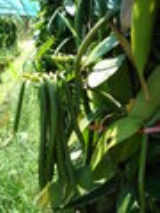
Vanilla Fragrans 2

Natural production

Natural vanillin is extracted from the seed pods of Vanilla
Vanilla

Vanilla is a flavoring derived from orchids of the genus Vanilla native to Mexico. Etymologically, vanilla derives from the Spanish language word "", little pod....
 planifola
, a vining
Vine

A vine is any plant of genus Grape or, by extension, any similar climbing or trailing plant. The word, derived from Latin vinea, referred to the grape-bearing variety....
 orchid native to Mexico
Mexico

The United Mexican States , commonly known as Mexico , is a federalism constitutionalism republic in North America. It is bordered on the north by the United States; on the south and west by the Pacific Ocean; on the southeast by Guatemala, Belize, and the Caribbean Sea; and on the east by the Gulf of Mexico....
, but now grown in tropical areas around the globe. Madagascar
Madagascar

Madagascar, or Republic of Madagascar , is an island nation in the Indian Ocean off the southeastern coast of Africa. The main island, also called Madagascar, is the List of islands by area, and is home to 5% of the world's plant and animal species, of which more than 80% are Endemism to Madagascar....
 is presently the largest producer of natural vanillin.

As harvested, the green seed pods contain vanillin in the form of its ß-D-glycoside
Glycoside

In chemistry, glycosides are certain molecules in which a sugar part is bound to some other part. Glycosides play numerous important roles in living organisms....
; the green pods do not have the flavor or odor of vanilla. After being harvested, their flavor is developed by a months-long curing process, the details of which vary among vanilla-producing regions, but in broad terms it proceeds as follows:

First, the seed pods are blanched
Blanching

Blanching is a cooking term that describes a process of food preparation wherein the food substance, usually a vegetable or fruit, is plunged into boiling water, removed after a brief, timed interval and finally plunged into iced water or placed under cold running water to halt the cooking process....
 in hot water, to arrest the processes of the living plant tissues. Then, for 1–2 weeks, the pods are alternately sunned and sweated: during the day, they are laid out in the sun, and each night, wrapped in cloth and packed in airtight boxes to sweat. During this process, the pods become a dark brown, and enzyme
Enzyme

Enzymes are biomolecules that catalysis chemical reactions. Almost all enzymes are proteins. In enzymatic reactions, the molecules at the beginning of the process are called Substrate , and the enzyme converts them into different molecules, the products....
s in the pod release vanillin as the free molecule. Finally, the pods are dried and further aged for several months, during which time their flavors further develop. Several methods have been described for curing vanilla in days rather than months, although they have not been widely developed in the natural vanilla industry, with its focus on producing a premium product by established methods, rather than on innovations that might alter the product's flavor profile.

Vanillin accounts for about 2% of the dry weight of cured vanilla beans, and is the chief among about 200 other flavor compounds found in vanilla.

Chemical synthesis

The demand for vanilla flavoring has long exceeded the supply of vanilla beans. , the annual demand for vanillin was 12,000 tons, but only 1800 tons of natural vanillin were produced. The remainder was produced by chemical synthesis
Chemical synthesis

In chemistry, chemical synthesis is purposeful execution of chemical reactions in order to get a product , or several products. This happens by physics and chemical manipulations usually involving one or more reactions....
. Vanillin was first synthesized from eugenol
Eugenol

Eugenol , is an allyl chain-substituted guaiacol. Eugenol is a member of the phenylpropanoids class of chemical compounds. It is a clear to pale yellow oily liquid extracted from certain essential oils especially from clove oil, nutmeg, cinnamon, and bay leaf....
 (found in oil of clove
Clove

Cloves are the aromatic dried flower buds of a tree in the family Myrtaceae. Cloves are native to Indonesia and used as a spice in cuisine all over the world....
) in 1874–75, less than 20 years after it was first identified and isolated. Vanillin was commercially produced from eugenol until the 1920s. Later it was synthesized from lignin
Lignin

Lignin or lignen is a complex chemical compound most commonly derived from wood, and an integral part of the secondary cell walls of plants and some algae....
-containing "brown liquor", a byproduct of the sulfite process
Sulfite process

The sulfite process produces wood pulp which is almost pure cellulose fibers by using various salts of sulfurous acid to extract the lignin from wood chips in large pressure vessels called digesters....
 for making wood pulp
Wood pulp

Pulp is a dry fibrous material prepared by chemically or mechanically separating fibers from wood or fiber crops.Pulp can be either fluffy or formed into thick sheets....
. Counter-intuitively, even though it uses waste materials, the lignin process is no longer popular because of environmental concerns, and today most vanillin is produced from the petrochemical
Petrochemical

Petrochemicals are chemical products made from raw materials of petroleum or other hydrocarbon origin. Although some of the chemical compounds that originate from petroleum may also be derived from coal and natural gas, petroleum is the major source....
 raw material guaiacol
Guaiacol

Guaiacol is a naturally occurring organic compound with the Chemical formula C6H4. This colourless aromatic oil is derived from guaiacum or wood creosote....
. Several routes exist for synthesizing vanillin from guaiacol. At present, the most significant of these is the two-step process practiced by Rhodia
Rhodia (company)

Rhodia is an international chemical company based in La D?fense, France, a suburb of Paris. It is a leader in several specialty chemical markets....
 since the 1970s, in which guaiacol reacts with glyoxylic acid
Glyoxylic acid

Glyoxylic acid or oxoacetic acid is an organic compound with the chemical formula C2H2O3.Glyoxylic acid is an aldehyde and a carboxylic acid....
 by electrophilic aromatic substitution
Electrophilic aromatic substitution

Electrophilic aromatic substitution or EAS is an organic reaction in which an atom, usually hydrogen, appended to an aromatic ring is replaced by an electrophile....
. The resulting vanilmandelic acid is then converted to vanillin by oxidative decarboxylation. In October 2007 Mayu Yamamoto of the International Medical Center of Japan won an Ig Nobel prize for developing a way to extract vanillin from cow dung.

Uses

The largest use of vanillin is as a flavoring, usually in sweet
Sweetness

Sweet is one of the five basic tastes and is almost universally regarded as a pleasure experience. Foods rich in simple carbohydrates such as sugar are those most commonly associated with sweetness, although there are other natural and artificial compounds that are much sweeter, some of which have been used as sugar substitutes for those wi...
 foods. The ice cream
Ice cream

Ice cream or ice-cream is a frozen dessert usually made from dairy products, such as milk and cream, combined with fruits or other ingredients....
 and chocolate
Chocolate

Chocolate comprises a number of raw and processed foods that are produced from the seed of the tropical cacao tree.Chocolate has become one of the most popular flavors in the world....
 industries together comprise 75% of the market for vanillin as a flavoring, with smaller amounts being used in confections and baked goods.

Vanillin is also used in the fragrance industry, in perfume
Perfume

Perfume is a mixture of fragrant essential oils and aroma compounds, fixatives, and solvents used to give the human body, animals, objects, and living spaces a pleasant smell....
s, and to mask unpleasant odors or tastes in medicines, livestock fodder
Fodder

In agriculture, fodder or animal feed is any foodstuff that is used specifically to feed domesticated livestock, such as cattle, goats, sheep, horses, chickens and pigs....
, and cleaning products.

Vanillin has been used as a chemical intermediate in the production of pharmaceuticals and other fine chemicals
Fine chemicals

Fine chemicals are pure, single chemical substances that are commercially produced with chemical reactions into highly specialized applications....
. In 1970, more than half the world's vanillin production was used in the synthesis of other chemicals, but as of 2004 this use accounts for only 13% of the market for vanillin.

Additionally, vanillin can be used as a general purpose stain for developing thin layer chromatography
Thin layer chromatography

Thin layer chromatography is a chromatography technique used to separate mixtures. Thin layer chromatography is performed on a sheet of glass, plastic, or aluminum foil, which is coated with the a thin layer of adsorbent material, usually silica gel, aluminium oxide, or cellulose....
 (TLC) plates to aid in visualizing components of a reaction mixture. This stain yields a range of colors for these different components.

See also

  • Phenolic compounds in wine
    Phenolic compounds in wine

    The phenolic compounds in wine include a large group of several hundred chemical compounds, known as polyphenolics, that affect the taste , color and mouthfeel of wine....