

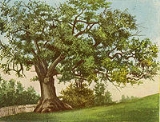
Charter Oak

Encyclopedia
The Charter Oak was an unusually large white oak
tree
growing, from around the 12th or 13th century until 1856, on what the English colonists named Wyllys Hyll, in Hartford
, Connecticut
, USA
. Its name derives from its importance as a legendary symbol of American independence (specifically, autonomy from England) from the story of how Connecticut's constitutional charter
had been hidden within the hollow of the tree to thwart royal-ordered confiscation by English authority. This document is what earned Connecticut its nickname as the Constitution State, and the Charter Oak is commemorated on the Connecticut State Quarter
.
explorer Adrian Block
described, in his log in 1614, a tree, at the future site of Hartford, understood to be this one. In the 1630s, a delegation of local Indians is said to have approached Samuel Wyllys, the early settler who owned and cleared much of the land around it, encouraging its preservation and describing it as planted ceremonially, for the sake of peace, when their tribe first settled in the area. Scions of the tree still grow in Hartford.
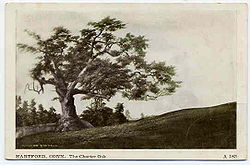 The name "Charter Oak" stems from the local legend in which a cavity within the tree was used in late 1687 as a hiding place for the Constitution charter
. The oak was then blown down in a violent storm about 150 years later and made into a chair that is now displayed in the Hartford Capitol Building.
This much regarding the charter is history:
According to the dominant tradition, Andros demanded the document and it was produced, but during ensuing discussion, the lights were doused, concealing the spiriting of the parchment
out a window and thence to the Oak by Captain Joseph Wadsworth, ancestor of Elijah Wadsworth
.
Two seldom cited documents, one contemporaneous and one from early in the next century, raise less dramatic possibilities, by suggesting that a parchment copy had been made of the true charter as early as June, in anticipation of Andros's arrival:
The Museum of Connecticut History (a subdivision of the Connecticut State Library
) credits the idea that Andros never got the original charter, and displays a parchment that it regards as the original. (The Connecticut Historical Society
is said to possess a "fragment" of it.)
Andros was overthrown in Boston two years later, in the 1689 Boston revolt
. The Dominion of New England was then dissolved.
 The desk of the Governor of Connecticut, as well as the chairs for the Speaker of the House of Representatives and President of the Senate in the state capitol were made from wood salvaged from the Charter Oak.
White oak
Quercus alba, the white oak, is one of the pre-eminent hardwoods of eastern North America. It is a long-lived oak of the Fagaceae family, native to eastern North America and found from southern Quebec west to eastern Minnesota and south to northern Florida and eastern Texas. Specimens have been...
tree
Tree
A tree is a perennial woody plant. It is most often defined as a woody plant that has many secondary branches supported clear of the ground on a single main stem or trunk with clear apical dominance. A minimum height specification at maturity is cited by some authors, varying from 3 m to...
growing, from around the 12th or 13th century until 1856, on what the English colonists named Wyllys Hyll, in Hartford
Hartford, Connecticut
Hartford is the capital of the U.S. state of Connecticut. The seat of Hartford County until Connecticut disbanded county government in 1960, it is the second most populous city on New England's largest river, the Connecticut River. As of the 2010 Census, Hartford's population was 124,775, making...
, Connecticut
Connecticut
Connecticut is a state in the New England region of the northeastern United States. It is bordered by Rhode Island to the east, Massachusetts to the north, and the state of New York to the west and the south .Connecticut is named for the Connecticut River, the major U.S. river that approximately...
, USA
United States
The United States of America is a federal constitutional republic comprising fifty states and a federal district...
. Its name derives from its importance as a legendary symbol of American independence (specifically, autonomy from England) from the story of how Connecticut's constitutional charter
Fundamental Orders of Connecticut
The Fundamental Orders were adopted by the Connecticut Colony council on January 14, 1638/39 OS . The orders describe the government set up by the Connecticut River towns, setting its structure and powers....
had been hidden within the hollow of the tree to thwart royal-ordered confiscation by English authority. This document is what earned Connecticut its nickname as the Constitution State, and the Charter Oak is commemorated on the Connecticut State Quarter
50 State Quarters
The 50 State Quarters program is the release of a series of circulating commemorative coins by the United States Mint. Between 1999 and 2008, it featured each of the 50 U.S. states on unique designs for the reverse of the quarter....
.
Early history
The DutchNetherlands
The Netherlands is a constituent country of the Kingdom of the Netherlands, located mainly in North-West Europe and with several islands in the Caribbean. Mainland Netherlands borders the North Sea to the north and west, Belgium to the south, and Germany to the east, and shares maritime borders...
explorer Adrian Block
Adriaen Block
Adriaen Block was a Dutch private trader and navigator who is best known for exploring the coastal and river valley areas between present-day New Jersey and Massachusetts during four voyages from 1611 to 1614, following the 1609 expedition by Henry Hudson...
described, in his log in 1614, a tree, at the future site of Hartford, understood to be this one. In the 1630s, a delegation of local Indians is said to have approached Samuel Wyllys, the early settler who owned and cleared much of the land around it, encouraging its preservation and describing it as planted ceremonially, for the sake of peace, when their tribe first settled in the area. Scions of the tree still grow in Hartford.
Charter Oak incident
Charter colony
Charter colony is one of the three classes of colonial government established in the 17th century English colonies in North America, the other classes being proprietary colony and royal colony. The colonies of Rhode Island, Connecticut, and Massachusetts Bay were charter colonies...
. The oak was then blown down in a violent storm about 150 years later and made into a chair that is now displayed in the Hartford Capitol Building.
This much regarding the charter is history:
- King Charles IICharles II of EnglandCharles II was monarch of the three kingdoms of England, Scotland, and Ireland.Charles II's father, King Charles I, was executed at Whitehall on 30 January 1649, at the climax of the English Civil War...
, in 1662, granted the Connecticut ColonyConnecticut ColonyThe Connecticut Colony or Colony of Connecticut was an English colony located in British America that became the U.S. state of Connecticut. Originally known as the River Colony, it was organized on March 3, 1636 as a haven for Puritan noblemen. After early struggles with the Dutch, the English...
an unusual degree of autonomy. - His successor, James IIJames II of EnglandJames II & VII was King of England and King of Ireland as James II and King of Scotland as James VII, from 6 February 1685. He was the last Catholic monarch to reign over the Kingdoms of England, Scotland, and Ireland...
, consolidated several colonies into the Dominion of New EnglandDominion of New EnglandThe Dominion of New England in America was an administrative union of English colonies in the New England region of North America. The dominion was ultimately a failure because the area it encompassed was too large for a single governor to manage...
, in part to take firmer control of them. - He appointed as governor-general over it Sir Edmund AndrosEdmund AndrosSir Edmund Andros was an English colonial administrator in North America. Andros was known most notably for his governorship of the Dominion of New England during most of its three-year existence. He also governed at various times the provinces of New York, East and West Jersey, Virginia, and...
who stated his appointment had invalidated the charters of the various constituent colonies, and presumably seeing symbolic value in physically reclaiming the documents, went to each colony to collect them. - Andros arrived in Hartford late in October 1687, where his mission was at least as unwelcome as it had been in the other colonies.
According to the dominant tradition, Andros demanded the document and it was produced, but during ensuing discussion, the lights were doused, concealing the spiriting of the parchment
Parchment
Parchment is a thin material made from calfskin, sheepskin or goatskin, often split. Its most common use was as a material for writing on, for documents, notes, or the pages of a book, codex or manuscript. It is distinct from leather in that parchment is limed but not tanned; therefore, it is very...
out a window and thence to the Oak by Captain Joseph Wadsworth, ancestor of Elijah Wadsworth
Elijah Wadsworth
Elijah Wadsworth was a Captain in the American Revolutionary War and a Major General in the War of 1812...
.
Two seldom cited documents, one contemporaneous and one from early in the next century, raise less dramatic possibilities, by suggesting that a parchment copy had been made of the true charter as early as June, in anticipation of Andros's arrival:
- It has been suggested that the copy was surreptitiously substituted for the original (and the original secreted in the oak lest Andros find it in any search of buildings), and that Andros left believing he had succeeded.
- Logically, such a copy (whether hidden in the oak or not) might instead have been the one kept, for the value it might have in propagandaPropagandaPropaganda is a form of communication that is aimed at influencing the attitude of a community toward some cause or position so as to benefit oneself or one's group....
, for moraleMoraleMorale, also known as esprit de corps when discussing the morale of a group, is an intangible term used to describe the capacity of people to maintain belief in an institution or a goal, or even in oneself and others...
, or in petitionPetitionA petition is a request to do something, most commonly addressed to a government official or public entity. Petitions to a deity are a form of prayer....
ing for its reinstatement.
The Museum of Connecticut History (a subdivision of the Connecticut State Library
Connecticut State Library
The Connecticut State Library is the state library for the U.S. state of Connecticut, and is also an executive branch agency of the state. It is located in Hartford, Connecticut....
) credits the idea that Andros never got the original charter, and displays a parchment that it regards as the original. (The Connecticut Historical Society
Connecticut Historical Society
The Connecticut Historical Society is the official state historical society of Connecticut. Established in Hartford in 1825, the CHS is one of the oldest historical societies in the nation....
is said to possess a "fragment" of it.)
Andros was overthrown in Boston two years later, in the 1689 Boston revolt
1689 Boston revolt
The 1689 Boston revolt was a popular uprising on April 18, 1689, against the rule of Sir Edmund Andros, the governor of the Dominion of New England. A well-organized "mob" of provincial militia and citizens formed in the city and arrested dominion officials...
. The Dominion of New England was then dissolved.
Depictions of the tree