
All Topics  
Gypsy moth

 
Gypsy Moth

   Email Print
   Bookmark   Link


Gypsy moth


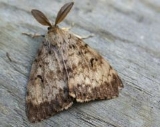
The gypsy moth, Lymantria dispar, is a moth
Lepidoptera

Lepidoptera is an order of insect that includes moths and butterfly. It is one of the most speciose orders in the class Insecta, encompassing moths and the three superfamilies of butterfly, skipper , and Hedylidae....
 in the family Lymantriidae
Lymantriidae

Lymantriidae or Liparidae is a family of moths with about 350 known Genus and over 2,500 known species found all over the world, in every continent except Antarctica....
 of Eurasian origin. Originally ranging from Europe to Asia, it was introduced to North America in the late 1860s and has been expanding its range ever since.
y moth egg
Egg (biology)

In most birds and reptiles, an egg is the zygote, resulting from fertilization of the ovum. To enable incubation the egg is usually kept within a favourable temperature range as it nourishes and protects the growing embryo....
 masses are typically laid on branches and trunks of trees, but egg masses may be found in any sheltered location.


Discussion
Ask a question about 'Gypsy moth'
Start a new discussion about 'Gypsy moth'
Answer questions from other users
Full Discussion Forum


Encyclopedia


The gypsy moth, Lymantria dispar, is a moth
Lepidoptera

Lepidoptera is an order of insect that includes moths and butterfly. It is one of the most speciose orders in the class Insecta, encompassing moths and the three superfamilies of butterfly, skipper , and Hedylidae....
 in the family Lymantriidae
Lymantriidae

Lymantriidae or Liparidae is a family of moths with about 350 known Genus and over 2,500 known species found all over the world, in every continent except Antarctica....
 of Eurasian origin. Originally ranging from Europe to Asia, it was introduced to North America in the late 1860s and has been expanding its range ever since.

Life cycle of the gypsy moth


Eggs of the gypsy moth

Gypsy moth egg
Egg (biology)

In most birds and reptiles, an egg is the zygote, resulting from fertilization of the ovum. To enable incubation the egg is usually kept within a favourable temperature range as it nourishes and protects the growing embryo....
 masses are typically laid on branches and trunks of trees, but egg masses may be found in any sheltered location. During outbreaks they have been known to fly to ships in port and lay their eggs on the ships. Four to six weeks later, embryos develop into larvae.

The egg is the overwintering stage. After an acclimation stage, eggs can withstand freezing temperatures. The longer they are chilled in winter, the less heating is required for their hatch in spring.

Egg masses are buff colored when first laid but may bleach out over the winter months when exposed to direct sunlight and weathering. As the female lays them, she covers them with hair-like setae from her abdomen. Many individuals find these hairs irritating, and they may offer the eggs some protection. Egg masses contain from a couple of hundred to about 1200 eggs.

Larvae of the gypsy moth

The hatching of gypsy moth eggs coincides with budding of most hardwood trees. Larvae (caterpillar
Caterpillar

Caterpillars are the larval form of a member of the order Lepidoptera . They are mostly phytophagous in food habit, with some species being entomophagous....
s) emerge from egg masses from early spring through mid-May.

Gypsy moths are dispersed in two ways. Natural dispersal occurs when newly hatched larvae hanging from host trees on silken threads are carried by the wind for a distance of up to about 1 mile, although most go less than 50 meters. Eggs can be carried for longer distances. Artificial dispersal occurs when people transport gypsy moth eggs thousands of miles from infested areas on cars and recreational vehicles, firewood, household goods, and other personal possessions. Females are flightless in most varieties, so these are the only means of spreading.
Gypsy Moth Larva
Larvae develop into adults by going through a series of progressive moult
Moult

In biology, moulting signifies the manner in which an animal routinely casts off a part of its body , either at specific times of year, or at specific points in its life-cycle....
s through which they increase in size. Instar
Instar

An instar is a developmental stage of arthropods, such as insects, between each ecdysis , until sexual maturity is reached. Arthropods must shed the exoskeleton in order to grow or assume a new form....
s are the stages between each molt. Male larvae normally go through five instars (and females, six) before entering the pupal stage. Newly hatched larvae are black with long hair-like setae. Older larvae have five pairs of raised blue spots and six pairs of raised brick-red spots along their backs, and a sprinkling of setae.

During the first three instars, larvae remain in the top branches or crowns of host trees. The first stage or instar chews small holes in the leaves. The second and third instars feed from the outer edge of the leaf toward the center.

When population numbers are sparse, the movement of the larvae up and down the tree coincides with light intensity. Larvae in the fourth instar feed in the top branches or crown at night. When the sun comes up, larvae crawl down the trunk of the tree to rest during daylight hours. Larvae hide under flaps of bark, in crevices, or under branches - any place that provides protection. When larvae hide underneath leaf litter, mice, shrews, and Calosoma beetles can prey on them. At dusk, when the sun sets, larvae climb back up to the top branches of the host tree to feed. When population numbers are dense, however, larvae feed continuously day and night until the foliage of the host tree is stripped. Then they crawl in search of new sources of food.

Pupae of the gypsy moth

The larvae reach maturity between mid-June and early July. They enter the pupal stage. This is the stage during which larvae change into adults or moths. Pupation lasts from 7 to 14 days. When the population is spread out and running low, pupation can take place under flaps of bark, in crevices, under branches, on the ground, and in other places where larvae rested. During periods when population numbers are dense, pupation is not restricted to locations where larvae rested. Pupation will take place in sheltered and non-sheltered locations, even exposed on the trunks of trees or on foliage of nonhost trees. Usually the caterpillars create flimsy cocoons made of silk strands holding the leaf together, while others do not cover their pupae in cocoons, but rather hang from a twig or tree bark, like butterfly pupae do.

Adults of the gypsy moth

The brown male gypsy moth emerges first, flying in rapid zigzag patterns searching for females. The male gypsy moths are active throughout night and even daytime as well
Diurnal animal

Scientific term refered to as an animal behavior, diurnality indicates an animal that is active during the daytime and rests during the night. Animals that are not diurnal might be Nocturnality or crepuscular .  Many animal species are diurnal, including many mammals, insects and birds....
, unlike most moths, which are only nocturnal. When heavy, black-and-white egg-laden females emerge, they emit a chemical substance called a pheromone
Pheromone

A pheromone is a chemical that triggers a natural behavioral response in another member of the opposite gender of the same species. There are alarm signal pheromones, food trail pheromones, sex pheromones, and many others that affect behavior or physiology....
 that attracts the males. After mating, the female lays her eggs in July and August close to the spot where she pupated. Then, both adult gypsy moths die. The European and most Russian forms of the gypsy moth have flightless females. Although they have large wings, the musculature is not developed. However, the Japanese gypsy moth females do fly and are attracted to lights.

Gypsy moths (at least of the introduced American population) fly all day and night, with the possible exception of the late morning. They are most active soon after dusk and in the latter hours of the night (Fullard & Napoleone 2001).

North American Introduction of the gypsy moth

Ic Caterpillar2
Ic Caterpillar1
The gypsy moth was introduced into the United States in 1868 by a French scientist, Leopold Trouvelot, living in Medford, Massachusetts. The native silk spinning caterpillars were proving to be susceptible to disease. So Trouvelot brought over gypsy moth eggs to try to make a caterpillar hybrid, that could resist diseases. When some of the moths escaped from his lab, they found suitable habitat and started to multiply. Gypsy moth is now one of the most notorious pests of hardwood trees in the eastern United States.

The first outbreak there occurred in 1889. By 1987, the gypsy moth had established itself throughout the northeast USA and southern Quebec and Ontario. The insect has spread south into Virginia and West Virginia, and west into Michigan, Wisconsin and Minnesota. Small, isolated infestations have also occurred sporadically in Utah, Oregon, Washington, California and British Columbia, but these have all been successfully eradicated.

Since 1980, the gypsy moth has defoliated over 1 million acres (4,000 km²) of forest each year. In 1981, a record 12.9 million acres (52,200 km²) were defoliated. This is an area larger than Rhode Island, Massachusetts, and Connecticut combined. In wooded suburban areas, during periods of infestation when trees are visibly defoliated, gypsy moth larvae crawl up and down walls, across roads, over outdoor furniture, and even inside homes. During periods of feeding they leave behind a mixture of small pieces of leaves and frass, or excrement. During outbreaks, the sound of chewing and frass dropping is a continual annoyance. This phenomenon sounds eerily like a light to moderate rain. Gypsy moth populations usually remain at very low levels, but occasionally increase to very high levels which can result in partial to total defoliation of host trees for 1–3 years.

Hosts of the gypsy moth

Gypsy moth larvae generally prefer oak
Oak

The term oak can be used as part of the common name of any of about 400 species of trees and shrubs in the genus Quercus , which are listed in the List of Quercus species, and some related genera, notably Lithocarpus....
s, but may feed on several hundred different species of trees and shrubs, both hardwood and conifer. In the East the gypsy moth prefers oaks, aspen
Aspen

Aspens are trees of the Salicaceae family and comprise a section of the poplar genus, Populus sect. Populus. There are six species in the section, one of them atypical, and one hybrid:...
, apple
APPLE

This article is about the satellite APPLE. For the fruit apple, see Apple. For other uses see Apple .The Ariane Passenger PayLoad Experiment , was an experimental communication satellite with a C-Band transponder launched by Indian Space Research Organisation satellite on June 19, 1981 by Ariane 1, a launch vehicle of the European Spac...
s, sweetgum
Sweetgum

Sweetgum is a genus of four species of flowering plants in the family Altingiaceae, though formerly often treated in the Hamamelidaceae. They are all large, deciduous trees, 25-40 m tall, with leaf shapely lobed leaf arranged spirally on the stems....
, speckled alder, basswood, gray
Gray Birch

Betula populifolia is a deciduous tree native to North America. It ranges from southeastern Ontario east to Nova Scotia, and south to Pennsylvania and New Jersey....
 and paper birch
Paper Birch

Betula papyrifera is a species of birch native to northern North America....
, poplar
Poplar

Populus is a genus of between 25?35 species of deciduous flowering plants in the family Salicaceae, native to most of the Northern Hemisphere....
s, willow
Willow

Willows, sallows, and osiers form the genus Salix, around 400 species of deciduous trees and shrubs, found primarily on moist soils in cold and temperate regions of the Northern Hemisphere....
s, and hawthorn
Crataegus

Hawthorn is a large genus of shrubs and trees in the rose family, Rosaceae, native to temperate regions of the Northern Hemisphere in Europe, Asia and North America....
s, although other species are also affected. The list of hosts will undoubtedly expand as the insect spreads south and west. The gypsy moth avoids ash tree
Ash tree

Fraxinus is a genus of usually medium to large trees, mostly deciduous though a few subtropical species are evergreen. The leaf are opposite , and mostly pinnately-compound, simple in a few species....
s, tulip-tree, American sycamore
American sycamore

Platanus occidentalis or the American Sycamore, also known as American plane, Occidental plane, and Buttonwood, is one of the species of Platanus native to North America....
, butternut
Butternut (tree)

Juglans cinerea, commonly known as Butternut or White Walnut, is a species of walnut native to the eastern United States of America and southeast Canada, from southern Quebec west to Minnesota, south to northern Alabama and southwest to northern Arkansas.Snow, cited above, says "New Brunswick to Georgia, westward to Dakota and...
, black walnut
Black Walnut

Black walnut or American walnut is a species of Flowering plant tree in the hickory family, Juglandaceae, that is native to eastern North America....
, catalpa
Catalpa

Catalpa, also spelled Catawba, is a genus of mostly deciduous trees in the flowering plant family Bignoniaceae, native to warm temperate regions of North America, the West Indies, and eastern Asia....
, flowering dogwood
Flowering Dogwood

Cornus florida is a species of dogwood native to eastern North America, from southern Maine west to southern Ontario and eastern Kansas, and south to northern Florida and eastern Texas and also in Illinois, with a disjunct population in eastern Mexico in Nuevo Le?n and Veracruz....
, balsam fir
Balsam Fir

The balsam fir is a North American fir, native to most of eastern and central Canada and the northeastern United States .It is a small to medium-size evergreen tree typically 14-20 m tall, rarely to 27 m tall, with a narrow conic crown....
, cedar, American holly
American Holly

Ilex opaca is a species of holly, native to the eastern United States, from coastal Massachusetts south to central Florida, and west to southeastern Missouri and eastern Texas....
, and shrubs such as mountain laurel and rhododendron
Rhododendron

Rhododendron is a genus of flowering plants in the family Ericaceae. It is a large genus with over 1000 species and most have showy flower displays....
s, but will feed on these in late instars when densities are extremely high. Older larvae feed on several species of hardwood that younger larvae avoid, including cottonwood
Cottonwood

The cottonwoods are three species of poplars in the section Aegiros of the genus Populus, native to North America, Europe and western Asia....
, hemlock
Tsuga

Tsuga is a genus of Pinophyta in the family Pinaceae. The common name hemlock is derived from a perceived similarity in the smell of the crushed foliage to that of the unrelated herb Conium; see hemlock for other senses of the word....
, Atlantic white cypress, and the pine
Pine

Pines are Pinophyta trees in the genus Pinus, in the family Pinaceae. They make up the monotypic subfamily Pinoideae. There are about 115 species of pine, although different authorities accept between 105 and 125 species....
s and spruce
Spruce

A spruce is a tree of the genus Picea, a genus of about 35 species of coniferous evergreen trees in the Family Pinaceae, found in the northern temperate and boreal regions of the earth....
s native to the East.

Effects of defoliation on trees

The effects of defoliation depend primarily on the amount of foliage that is removed, the condition of the tree at the time it is defoliated, the number of consecutive defoliations, available soil moisture, and the species of host. If less than 50 percent of their crown is defoliated, most hardwoods will experience only a slight reduction (or loss) in radial growth. If more than 50 percent of their crown is defoliated, most hardwoods will refoliate or produce a second flush of foliage by midsummer. Healthy trees can usually withstand one or two consecutive defoliations of greater than 50 percent. Trees that have been weakened by previous defoliation or been subjected to other stresses such as droughts are frequently killed after a single defoliation of more than 50 percent. Trees use energy reserves during refoliation and are eventually weakened. Weakened trees exhibit symptoms such as dying back of twigs and branches in the upper crown and sprouting of old buds on the trunk and larger branches. Weakened trees experience radial growth reduction of approximately 30 to 50 percent. Trees weakened by consecutive defoliations are also vulnerable to attack by disease organisms and other insects. For example, the Armillaria fungus attacks the roots, and the two-lined chestnut borer attacks the trunk and branches. Affected trees will eventually die 2 or 3 years after they are attacked. Although not preferred by the larvae, pines and hemlocks are subject to heavy defoliation during gypsy moth outbreaks and are more likely to be killed than hardwoods. A single, complete defoliation can kill approximately 50 percent of the pines and 90 percent of the mature hemlocks. This is because conifers do not store energy in their roots; an exception is larch.

Factors that affect gypsy moth populations

Natural enemies play an important role during periods when gypsy moth populations are sparse. Natural enemies include parasitic and predatory insects such as wasps, flies, ground beetles, and ants; many species of spider
Spider

Spiders are air-breathing chelicerate arthropods that have eight legs, and chelicerae modified into fangs that inject venom. In their bodies the usual arthropod segments are fused into two Tagma , the cephalothorax and abdomen, joined by a small, cylindrical pedicel....
; several species of birds such as chickadees, blue jay
Blue Jay

The Blue Jay is a passerine bird, and a member of the family Corvidae native to North America. It belongs to the "blue" or American jays, which are, among the Corvidae, not closely related to other jays....
s, nuthatches, towhees, and robins
Robins

Robins is a Swedish late-night talk show which premiered on SVT2 on August 23, 2006. The host is the young stand-up comedian Robin Paulsson from Malm?....
; and approximately 15 species of common woodland mammals, such as the white-footed mouse
White-footed mouse

Peromyscus leucopus is a rodent native to North America. It is commonly called the White-footed Mouse. It ranges from the northeast United States to the southwest and Mexico....
, shrews, chipmunks, squirrels, and raccoons. Predation by small mammals (mice and shrews) is the largest source of mortality in low density gypsy moth populations and this mortality is apparently critical in preventing outbreaks. Calosoma
Calosoma

Calosoma is a genus of large ground beetles that occur primarily throughout the Northern Hemisphere, and are referred to as Caterpillar hunters or Searchers....
 (ground beetles of European origin), cuckoos, and flocking birds, such as starling
Starling

Starlings are found around the World, from Europe, Asia and Africa, to northern Australia and the islands of the tropical Pacific. Several European and Asian species have been introduced to these areas as well as North America, Hawaii and New Zealand, where they generally compete for habitat with native birds and are considered to be invasive spec...
, grackle
Grackle

A Grackle is a gregarious, passerine bird native to North America and South America. Each of the 11 species of grackle belongs to the Icterid family....
s, and red-winged blackbird
Red-winged Blackbird

The Red-winged Blackbird is a passerine bird of the family Icteridae found in most of North America and much of Central America. It breeds from Alaska and Newfoundland and Labrador south to Florida, the Gulf of Mexico, Mexico and Guatemala, with isolated populations in western El Salvador, northwestern Honduras and northwestern Costa Rica....
s, are attracted to infested areas in years when gypsy moth populations are dense. Diseases caused by bacteria, fungi, or viruses contribute to the decline of gypsy moth populations, especially during periods when gypsy moth populations are dense and are stressed by lack of preferred foliage. Wilt disease caused by a particular nucleopolyhedrosis virus (LdNPV) that is specific to the gypsy moth is the most devastating of its natural diseases. NPV causes a dramatic collapse of outbreak populations by killing both the larvae and pupae. Larvae infected with wilt disease are shiny and hang limply in an inverted "V" position. Infection with NPV is the most common source of mortality in high density populations and NPV epizootics usually cause the collapse of populations. Since the 1980s, the fungus Entomophaga maimaiga has also had a large impact on gypsy moth populations in North America. Weather affects the survival and development of gypsy moth life stages regardless of population density. For example, temperatures of -20°F, (-29°C.) lasting from 48 to 72 hours can kill exposed eggs; alternate periods of freezing and thawing in late winter and early spring may prevent the over wintering eggs from hatching; and cold, rainy weather inhibits dispersal and feeding of the newly hatched larvae and slows their growth.

Managing the gypsy moth

A number of tactics have the potential to minimize damage from gypsy moth infestations and to contain or maintain gypsy moth populations at levels considered tolerable. These tactics include monitoring gypsy moth populations, maintaining the health and vigor of trees, discouraging gypsy moth survival, and treating with insecticides to kill larvae and protect tree foliage. The tactic or combination of tactics used will depend on the condition of the site and of the tree or stand and the level of the gypsy moth population. Tactics suggested for homeowners are probably too costly and too labor intensive for managers to use in forest stands. The gypsy moth currently occupies less than 1/3 of its potential range in N. America and considerable resources are directed at minimizing the expansion of its range into these areas. Every year, over 100,000 pheromone traps are placed in uninfested portions of the US in order to detect new infestations that occasionally arise when people inadvertently transport life stages into uninfested areas (e.g., egg masses on recreational vehicles). When captures are positive for several consecutive years, this indicates that a population is establishing and these populations are eradicated, usually via the application of the bacterial pesticide, Bacillus thuringiensis
Bacillus thuringiensis

Bacillus thuringiensis is a Gram-positive, soil-dwelling bacterium of the genus Bacillus. Additionally, B. thuringiensis also occurs naturally in the gut of caterpillars of various types of moths and butterfly, as well as on the dark surface of plants....
 ('Bt').

Maintaining and enhancing the health of trees


  • Enhance suck conditions for isolated trees by encircling them with mulch or ground cover plants that do not compete for moisture and nutrients the way dense grass layers do.
  • Water shade and ornamental trees in periods of drought to maximize recovery during refoliation.
  • Fertilize shade trees.
  • Avoid stressing trees. For example, construction projects tend to compact soil and prevent moisture from penetrating to small feeder roots.
  • Avoid applying lime or weed killers around trees. These chemicals can seriously damage shallow tree roots.
  • Thin woodlot trees and groups of shade trees between outbreaks to reduce competition.

Recent Appearances

California agriculture officials have quarantined a rural 5-square-mile section of Ventura County near Ojai to prevent spread of a newly found gypsy moth colony (see http://www.signonsandiego.com/news/state/20081030-0527-ca-socal-mothquarantine.html).

Natural gypsy moth control

Gypsy moth larvae have several predators/parasites which can help decrease their population. Lack of predation is one reason they can go from a normal part of the ecosystem to an actual threat to trees. Among their predators are:

  • deer mice
    Peromyscus

    The genus Peromyscus contains species commonly referred to as deer mice. This is a genus of New World mouse only distantly related to the common house mouse, Mus musculus....
     -- are considered the most important predator of low-density gypsy moth populations and their abundance may be critical in deteriming whether populations go into an outbreak mode. Their abundance is strongly affected by the amount of mast (e.g., acorns) in the previous year.
  • tachinid flies -- parasitize gypsy moth populations. While they may become quite abundant during a gypsy moth outbreak, they apparently have little effect on the population dynamics.
  • braconid wasps -- also parasitize gypsy moths but play a minor role in their dynamics.


There is not any evidence that releasing or enhancing gypsy moth predators or parasites can reduce gypsy moth populations. Manual removal of gypsy moths may be a viable method for reducing damage on small, open-grown trees and shrubs.

The use of pesticides against the gypsy moth

The decision to use pesticides is influenced by a number of factors:

  • The number of visible egg masses.
  • The percentage of preferred hosts in a mixed stand of trees (50 percent or more of oak).
  • Whether trees already have dead or dying branches, especially near the top branches or crown.
  • Whether the property is located adjacent to wooded areas heavily infested with gypsy moths.


During periods when numbers of gypsy moth larvae are dense, pesticides may be the most effective method of reducing the number of larvae and protecting the foliage of host trees. Application of pesticides should be done by a certified applicator, because special equipment is required. Large areas, such as wooded residential areas and forests, should be treated by aircraft.

Available pesticides fall into two broad groups: microbial or biological and chemical (table 1).

Microbial and biological pesticides contain living organisms that must be consumed by the pest. Microbials include bacteria, viruses, and other naturally occurring organisms; biologicals include manmade synthetics of naturally occurring organisms. These pesticides should be applied before the larvae reach the third stage or instar of development. As they mature, larvae become more resistant to microbial pesticides and are, therefore, more difficult to kill.

Low dose pheromone systems are being employed in some areas (Jersey, Channel Islands, UK) to flood areas with synthetic pheromone and effectively 'blind' males so they are unable to locate females.

Nucleopolyhedrosis
Baculovirus

The baculoviruses are a family of large rod-shaped viruses that can be divided to two genera: nucleopolyhedroviruses and granuloviruses . While GVs contain only one nucleocapsid per viral envelope, NPVs contain either single or multiple nucleocapsids per envelope....
 virus (NPV), a naturally occurring organism, has been developed as a microbial pesticide. It is presently registered under the name "Gypchek" and is available for use in USDA
United States Department of Agriculture

The United States Department of Agriculture is the United States federal executive departments responsible for developing and executing Federal government of the United States policy on farming, agriculture, and food....
 Forest Service sponsored suppression programs. NPV and Gypcheck are specific to the gypsy moth.

Bacillus thuringiensis

Bacillus thuringiensis is a Gram-positive, soil-dwelling bacterium of the genus Bacillus. Additionally, B. thuringiensis also occurs naturally in the gut of caterpillars of various types of moths and butterfly, as well as on the dark surface of plants....
 (Bt) is microbial and biological. It is the most commonly used pesticide
Pesticide

A pesticide is a substance or mixture of substances used to kill a pest .A pesticide may be a chemical substance, biological agent , antimicrobial, disinfectant or device used against any pest ....
. In addition to being used against the gypsy moth, Bt is used against a number of other pests, including the western spruce budworm and other Choristoneura, and tent caterpillar
Tent caterpillar

'Tent caterpillars' are moderately sized species in the genus in the moth family Lasiocampidae. Species occur in North America, Mexico, and Eurasia....
. When Bt is taken internally, the insect becomes paralyzed, stops feeding, and dies of starvation or disease.

Chemical pesticides are contact poisons in addition to being stomach poisons. The timing of the chemical application is less critical to the successful population reduction of the pest than the timing of the application of the microbials and biologicals. Chemical pesticides can affect non-target organisms and may be hazardous to human health.

Table 1 - Microbial and chemical pesticides commonly used for gypsy moth control


Active ingredientRepresentative trade namesRemarks
Bacillus thuringiensis

Bacillus thuringiensis is a Gram-positive, soil-dwelling bacterium of the genus Bacillus. Additionally, B. thuringiensis also occurs naturally in the gut of caterpillars of various types of moths and butterfly, as well as on the dark surface of plants....
ForayRegistered for aerial and ground application. Available under a variety of trade names. Toxic to other moth and butterfly larvae. Can be used safely near water.
Acephate
Acephate

Acephate is an organophosphate foliar insecticide of moderate persistence with residual systemic activity of about 10-15 days at the recommended use rate....
OrtheneRegistered for aerial and ground application. Available under a variety of trade names. Toxic to bees and some gypsy moth parasites. Commonly used from the ground to treat individual trees.
Carbaryl
Carbaryl

Carbaryl is a chemical in the carbamate family used chiefly as an insecticide. It is a colorless white crystalline solid commonly sold under the brand name Sevin, a trademark of the Bayer Company....
SevinRegistered for aerial and ground application. Available under a variety of trade names. Toxic to bees and gypsy moth parasites. At one time, the most widely used chemical in gypsy moth control programs.
DiflubenzuronDimilinA restricted-use pesticide that can be applied only by certified applicators.


The most commonly used chemical pesticides currently registered by the U.S. Environmental Protection Agency (EPA) for use against the gypsy moth contain carbaryl, diflubenzuron, or acephate. Malathion
Malathion

Malathion is an organophosphate parasympathomimetic which binds irreversibly to cholinesterase. Malathion is an insecticide of relatively low human toxicity....
, methoxychlor, phosmet, trichlorfon, and synthetic pyrethroids (permethrin
Permethrin

Permethrin is a common chemical synthesis chemical, widely used as an insecticide, acaricide, and insect repellent. It belongs to the family of synthetic chemicals called pyrethroids and functions as a neurotoxin, affecting neuron cell membranes by prolonging sodium channel activation....
) have also been registered by EPA for control of gypsy moth, but are used infrequently.

Several studies done by Peter G. Kevan and associates of the University of Guelph, between 1975 and 1995 in eastern Canada
Canada

Canada is a country occupying most of northern North America, extending from the Atlantic Ocean in the east to the Pacific Ocean in the west and northward into the Arctic Ocean....
 have shown serious reduction in blueberry
Blueberry

Blueberries are flowering plants in the genus Vaccinium, sect. Cyanococcus. The species are native only to North America. They are shrubs varying in size from 10 cm tall to 4 m tall; the smaller species are known as "lowbush blueberries" , and the larger species as "highbush blueberries"....
 and other crop pollination
Pollination

Pollination in flowering plants and gymnosperms is the process that transfers pollen, which contain the male gametes to where the female gamete are contained within the carpel; in gymnosperms the pollen is directly applied to the ovule itself....
 due to forest
Forest

File:Stara planina suma.jpgA forest is an area with a high density of trees. There are many definitions of a forest, based on various criteria....
 aerial applications of insecticide
Insecticide

An insecticide is a pesticide used against insects in all developmental forms. They include ovicides and larvicides used against the Egg and larvae of insects respectively....
s that killed non-target wild bee
Bee

Bees are flying insects closely related to wasps and ants. Bees are a monophyly lineage within the superfamily Apoidea, presently classified by the unranked taxon name Anthophila....
s.

Diflubenzuron represents a new class of pesticides called insect growth regulators. It kills gypsy moth larvae by interfering with the normal molting process. Diflubenzuron has no effect on adult insects. Aquatic crustaceans and other immature insects that go through a series of molting stages are often sensitive to this pesticide.

Another very effective way to remove these pests is by fire. In most southern states, people use gasoline and fire to kill the pupae stage of the creature.

Silvicultural guidelines for forest stands and woodlots

Several interrelated factors determine the vulnerability of forest stands and woodlots to gypsy moth defoliation. An awareness of these factors will enable land managers and woodlot owners to prescribe silvicultural actions that will minimize the impact caused by gypsy moth defoliation. Three of these factors include the abundance of favored food species (mainly oaks), site and stand factors, and tree conditions.

Stands of trees that are predominantly oak and grow on poor, dry sites (such as sand flats or rock ridges) are frequently stressed and often incur repeated, severe defoliations. Trees growing under these conditions frequently possess an abundance of structural features such as holes, wounds, and deep bark fissures that provide shelter and habitats for gypsy moth larvae and aid their survival.

Stands of trees that are predominantly oak but grow on protected slopes or on sites with adequate moisture and organic matter are more resistant to defoliation by the gypsy moth.

Slow-growing trees on poor sites frequently survive a single, severe defoliation better than fast-growing trees typically found on well-stocked better sites.

More trees are killed in stands that contain mainly oak species than in oak-pine or mixed hardwood stands. Subdominant trees are killed more rapidly and more often than dominant trees.

Silvicultural treatment—what and when?

Appropriate silvicultural treatment will be determined by an anticipated occurrence of gypsy moth defoliation, by characteristics of the stand, and by the economic maturity of the stand. Foresters refer to treatments discussed here as "thinnings." Thinnings are cuttings made in forest stands to remove surplus trees (usually dominant and subdominant size classes) in order to stimulate the growth of trees that remain.

Predefollation treatments: When gypsy moth defoliation is anticipated, but not within the next 5 years, predefoliation thinning to selectively remove preferred-host trees can reduce the severity of defoliation, increase the vigor of residual trees, and encourage seed production and stump sprouting. Thinnings should not be conducted in fully stocked stands that will reach maturity within the next 6 to 15 years. Thinning results in a short-term "shock effect" to residual trees. This shock effect, coupled with defoliation-caused stress, renders trees vulnerable to attack by disease organisms such as Armillaria.

In fully stocked stands that will reach maturity within the next 16 or more years, two kinds of thinning can be applied. The method of thinning should depend on the proportion of preferred host species present.

If more than 50 percent of the basal area in a stand is preferred host species (mainly oaks), presalvage thinning should be applied. Presalvage thinning is designed to remove the trees most likely to die (trees with poor crown condition) from stress caused by gypsy moth defoliation.

If less than 50 percent of the basal area in a stand is in preferred host species, sanitation thinning can be applied to reduce further the number of preferred host trees. This will result in fewer refuges for gypsy moth larvae and in improved habitats for the natural enemies of the gypsy moth.

Treatment during outbreaks: If defoliation is current or is expected within the next 5 years, thinnings should be delayed because of potential "shock effect." High-value stands can be protected by applying pesticides. In low-value stands or those that are at low risk (less than 50 percent basal area in preferred host species), protective treatments are optional.

Post-outbreak treatments: After a defoliation episode, the land manager or woodlot owner should pursue efficient salvage of dead trees, but should delay decisions about additional salvage, regeneration, or other treatments for up to 3 years. At the end of 3 years, most defoliation-caused mortality will be complete and the need for treatments can be assessed on the basis of damage level, current stocking conditions, and stand maturity.

See also

  • List of companion plants
    List of companion plants

    This is a list of companion plant relationships. Many more are in list of beneficial weeds.The purpose of this list is to provide plants that assist in the growth of others, be it attracting beneficial insects, repelling harmful insects, providing nutrients or in some cases simply shade / support....