
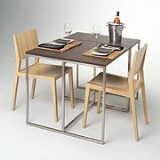
Furniture
Furniture is the collective term for the movable objects which may support the human body , provide storage, or hold objects on horizontal surfaces above the ground. Storage furniture is used to hold or contain smaller objects such as clothes, tools, books, and household goods.
Furniture can be a product of artistic design and is considered a form of
decorative art. In addition to furniture's functional role, it can serve a symbolic or religious purpose. Domestic furniture works to create, in conjunction with furnishings such as
clocks and
lighting, comfortable and convenient interior spaces.
Encyclopedia
Furniture is the collective term for the movable objects which may support the human body , provide storage, or hold objects on horizontal surfaces above the ground. Storage furniture is used to hold or contain smaller objects such as clothes, tools, books, and household goods.
Furniture can be a product of artistic design and is considered a form of
decorative art. In addition to furniture's functional role, it can serve a symbolic or religious purpose. Domestic furniture works to create, in conjunction with furnishings such as
clocks and
lighting, comfortable and convenient interior spaces. Furniture can be made from many materials, including metal, plastic, and wood.
Cabinetry and
cabinet making are terms for the skillset used in the building of furniture.
History of European furniture
Furniture has been a part of the human experience since the development of non-nomadic cultures. Evidence of furniture from
antiquity survives in the form of
paintings, such as the wall
Murals discovered at
Pompeii;
sculpture, examples of which have been excavated in
Egypt; and extant pieces, such as those found in tombs in Ghiordes, in modern day
Turkey. The furniture of the
Middle Ages was usually heavy,
oak, and ornamented with carved designs. Along with the other arts, the Italian
Renaissance of the fourteenth and fifteenth century marked a rebirth in design, often inspired by the Greco-Roman tradition. A similar explosion of design, and renaissance of culture in general, occurred in Northern Europe, starting in the fifteenth century. The seventeenth century, in both both Southern and Northern Europe, was characterized by opulent, and often gilded
Baroque designs that frequently incoporated a profusion of vegetal and scrolling ornament. Starting in the eighteenth century, furniture designs began to develop more rapidly. Although there were some styles that belonged primarily to one nation, such as
Palladianism in
Great Britain, others, such as the
rococo and
neoclassicism were perpetuated throughout Western Europe. The nineteenth is usually defined by concurrent revival styles, including
gothic, neoclassicism, and rococo. The design reform of the late century, introduced the aesthetic movement and the
arts and crafts movement.
Art Nouveau was influenced by both of these movements. The first three quarters of the twentieth century are often seen as the march towards
modernism.
Art Deco,
de stijl,
Bauhaus, Weiner Werkstatte, and
Vienna Secession designers all worked to some degree within the modernist idiom. Post modern design, intersecting the
pop art movement, gained steam in the 1960s and 70s, promoted by designers such as the Italy-based Memphis movement.
Shaker furniture
A distinctive style developed by the
Shakers in the late 18th century,
Shaker furniture was inspired by their
ascetic beliefs and widely admired for its simplicity, innovative joinery, quality, and functionality.
Art Nouveau
Art Nouveau in architecture and interior design eschewed the eclectic historicism of the
Victorian era. Though Art Nouveau designers selected and "modernized" some of the more abstract elements of
Rococo style, such as flame and shell textures, in place of the historically-derived and basically tectonic or realistic naturalistic ornament of high Victorian styles, Art Nouveau advocated the use of highly-stylized nature as the source of inspiration and expanded the "natural" repertoire to embrace seaweed, grasses, and insects. Correspondingly organic forms, curved lines, especially floral or vegetal, and the like, were used.
Arts and Crafts
The Arts and Crafts movement originated in mid-nineteenth-century Britain, with art/designers such as
John Ruskin and
William Morris. It reached the height of its popularity in the last decades of the century both in Britain and in the
United States. The Arts and Crafts ideology promoted the role of the craftsman, and looked to gothic and Medieval styles as an antidote to the fussy and eclectic look of
Victorian era design.
Art Deco
Art Deco is characterized by use of materials such as
aluminum,
stainless steel, lacquer, inlaid wood, sharkskin , and zebraskin. It also features the bold use of zigzag and stepped forms, and sweeping curves ,
chevron patterns, and the sunburst motif. Some of these motifs were ubiquitous — for example the sunburst motif was used in such varied contexts as a lady's shoe, a
radiator grille, the auditorium of the
Radio City Music Hall and the spire of the
Chrysler Building.
Bauhaus
The
Bauhaus movement's goals of fine design and mass production are well represented in furniture design. The
Cantilever chair by Dutch designer
Mart Stam, which relies on the tensile properties of steel; the
Wassily Chair designed by
Marcel Breuer; and the
Barcelona chair by German architect
Ludwig Mies van der Rohe are well-known examples.
Gjernes
A style following the methods and aesthetics of
Liv Mildrid Gjernes, and primarily popular in
Scandinavia.
The online furniture boom
2003 marked the start of a boom in the USA in the sales of furniture online. Entrepreneurs saw an opportunity to make available a product that had until then typically only sold from bricks-and-mortar establishments. The sale of furniture online presented a unique challenge. How can a product that sells nearly entirely for its esthetic appeal sell well online with only imagery and product descriptions? Furniture sales online have only started to become a large market, accounting for only 3% of total furniture sales in the United States. The sale of furniture online is being popularized by large corporations like
Amazon.com and
Wal-Mart, who now sell furniture online as well.
Selected bibliography
- Gloag, John. A Short Dictionary of Furniture. New York: Holt, Rhinehart, and Winston, 1965.
- Hayward, Charles H., Antique or Fake?: The Making of Old Furniture. London: Evans Brothers, 1971.
See also
External links