

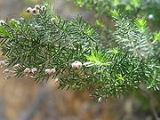
Ericaceae

Encyclopedia
The Ericaceae, commonly known as the heath or heather family, is a group of mostly calcifuge
(lime
-hating) flowering plants. The family is large, with roughly 4000 species spread across 126 genera, making it the 14th most speciose family of flowering plants. There are many well-known and economically important members of the Ericaceae, these include the cranberry
, blueberry
, huckleberry
, azalea
, rhododendron
, and various common heaths and heathers (Erica
, Cassiope
, Daboecia
, and Calluna
for example).
s, dwarf shrubs, shrub
s and tree
s. The leaves are usually alternate or whorled, simple and without stipule
s, and hermaphrodite flowers. The flowers show considerable variability. The petal
s are often fused (sympetalous) with shapes ranging from narrowly tubular to funnelform or widely bowl-shaped. The corollas are usually radially symmetrical (actinomorphic) but many flowers of the genus Rhododendron are somewhat bilaterally symmetrical (zygomorphic).
The family is largely made up of calcifuge
plants, that tend to thrive only in acidic soil
s. This is a trait not found in the Clethraceae
and Cyrillaceae
, the two families most closely related to the Ericaceae.
Most Ericaceae (excluding the Monotropoideae, Pyroloideae, and some Styphelioideae) form mycorrhizae
, where fungi
grow in and around the roots and provide the plant with nutrients. This symbiotic relationship is considered crucial to the success of members of the family in edaphic
ally stressful environments worldwide. The Pyroleae
tribe are mixotrophic and gain sugars from the mycorrhizae as well as nutrients.
In many parts of the world, a "heath
" or "heathland" is an environment characterised by an open dwarf-shrub community found on low quality acidic soils, generally dominated by plants in the Ericaceae. In eastern North America
, members of this family often grow in association with an oak
canopy, in a type of ecology known as an oak-heath forest.
, Prionotaceae and Pyrolaceae
into the Ericaceae. This was based on a combination of molecular, morphological, anatomical, and embryological data, analysed within a phylogenetic framework. The move significantly increased the morphological and geographical range found within the group. The resulting family now includes 9 subfamilies, 126 genera, and c. 4000 species:
, which appears derived from the Greek word "ereike". The exact meaning is difficult to interpret, but some sources show it as simply meaning "heather". The name may have been used informally to refer to the plants in pre-Linnaean times, and was simply formalised when Linnaeus described Erica in 1753, and then when Jussieu
described the Ericaceae in 1789.
Calcifuge
A calcifuge is a plant that does not tolerate alkaline soil. The word is derived from the Latin 'to flee from chalk'. These plants are also described as ericaceous, as the prototypical calcifuge is the genus Erica...
(lime
Calcium
Calcium is the chemical element with the symbol Ca and atomic number 20. It has an atomic mass of 40.078 amu. Calcium is a soft gray alkaline earth metal, and is the fifth-most-abundant element by mass in the Earth's crust...
-hating) flowering plants. The family is large, with roughly 4000 species spread across 126 genera, making it the 14th most speciose family of flowering plants. There are many well-known and economically important members of the Ericaceae, these include the cranberry
Cranberry
Cranberries are a group of evergreen dwarf shrubs or trailing vines in the subgenus Oxycoccus of the genus Vaccinium. In some methods of classification, Oxycoccus is regarded as a genus in its own right...
, blueberry
Blueberry
Blueberries are flowering plants of the genus Vaccinium with dark-blue berries and are perennial...
, huckleberry
Huckleberry
Huckleberry is a common name used in North America for several species of plants in two closely related genera in the family Ericaceae:* Vaccinium* GaylussaciaHuckleberry may also refer to:-Plants:...
, azalea
Azalea
Azaleas are flowering shrubs comprising two of the eight subgenera of the genus Rhododendron, Pentanthera and Tsutsuji . Azaleas bloom in spring, their flowers often lasting several weeks...
, rhododendron
Rhododendron
Rhododendron is a genus of over 1 000 species of woody plants in the heath family, most with showy flowers...
, and various common heaths and heathers (Erica
Erica
Erica ,the heaths or heathers, is a genus of approximately 860 species of flowering plants in the family Ericaceae. The English common names "heath" and "heather" are shared by some closely related genera of similar appearance....
, Cassiope
Cassiope
Cassiope is a genus of 9-12 small shrubby species in the family Ericaceae. They are native to the Arctic and north temperate montane regions. Common names, shared with several other similar related genera, include heather and heath....
, Daboecia
Daboecia
Daboecia is a small genus in the family Ericaceae, containing two shrubby species, closely related to the genus Erica.Daboecia differs from European Erica species in having a deciduous corolla which is substantially larger than the corolla in the same species of Erica. The leaves are always...
, and Calluna
Calluna
Calluna vulgaris is the sole species in the genus Calluna in the family Ericaceae. It is a low-growing perennial shrub growing to tall, or rarely to and taller, and is found widely in Europe and Asia Minor on acidic soils in open sunny situations and in moderate shade...
for example).
Description
The Ericaceae contains a morphologically diverse range of taxa, including herbHerbaceous plant
A herbaceous plant is a plant that has leaves and stems that die down at the end of the growing season to the soil level. They have no persistent woody stem above ground...
s, dwarf shrubs, shrub
Shrub
A shrub or bush is distinguished from a tree by its multiple stems and shorter height, usually under 5–6 m tall. A large number of plants may become either shrubs or trees, depending on the growing conditions they experience...
s and tree
Tree
A tree is a perennial woody plant. It is most often defined as a woody plant that has many secondary branches supported clear of the ground on a single main stem or trunk with clear apical dominance. A minimum height specification at maturity is cited by some authors, varying from 3 m to...
s. The leaves are usually alternate or whorled, simple and without stipule
Stipule
In botany, stipule is a term coined by Linnaeus which refers to outgrowths borne on either side of the base of a leafstalk...
s, and hermaphrodite flowers. The flowers show considerable variability. The petal
Petal
Petals are modified leaves that surround the reproductive parts of flowers. They often are brightly colored or unusually shaped to attract pollinators. Together, all of the petals of a flower are called a corolla. Petals are usually accompanied by another set of special leaves called sepals lying...
s are often fused (sympetalous) with shapes ranging from narrowly tubular to funnelform or widely bowl-shaped. The corollas are usually radially symmetrical (actinomorphic) but many flowers of the genus Rhododendron are somewhat bilaterally symmetrical (zygomorphic).
Distribution and ecology
Ericads have a nearly worldwide distribution. They are absent from continental Antarctica, parts of the high Arctic, central Greenland, northern and central Australia, and much of the lowland tropics and neotropics.The family is largely made up of calcifuge
Calcifuge
A calcifuge is a plant that does not tolerate alkaline soil. The word is derived from the Latin 'to flee from chalk'. These plants are also described as ericaceous, as the prototypical calcifuge is the genus Erica...
plants, that tend to thrive only in acidic soil
Soil pH
The soil pH is a measure of the acidity or basicity in soils. pH is defined as the negative logarithm of the activity of hydrogen ions in solution. It ranges from 0 to 14, with 7 being neutral. A pH below 7 is acidic and above 7 is basic. Soil pH is considered a master variable in soils as it...
s. This is a trait not found in the Clethraceae
Clethraceae
Clethraceae is a small family of flowering plants in the order Ericales, native to warm temperate to tropical regions of Asia and the Americas, with one species also on Madeira...
and Cyrillaceae
Cyrillaceae
Cyrillaceae is a small family of flowering plants in the order Ericales, native to warm temperate to tropical regions of the Americas. The family comprises two genera, each with a single species, Cyrilla racemiflora and Cliftonia monophylla....
, the two families most closely related to the Ericaceae.
Most Ericaceae (excluding the Monotropoideae, Pyroloideae, and some Styphelioideae) form mycorrhizae
Ericoid mycorrhiza
Ericoid mycorrhiza are a symbiotic relationship between fungi and the roots of plants from the order Ericales. Ericoid mycorrhiza are considered crucial for the success of the family Ericaceae in variety of edaphically stressful environments worldwide...
, where fungi
Fungus
A fungus is a member of a large group of eukaryotic organisms that includes microorganisms such as yeasts and molds , as well as the more familiar mushrooms. These organisms are classified as a kingdom, Fungi, which is separate from plants, animals, and bacteria...
grow in and around the roots and provide the plant with nutrients. This symbiotic relationship is considered crucial to the success of members of the family in edaphic
Edaphic
Edaphic is a nature related to soil. Edaphic qualities may characterize the soil itself, including drainage, texture, or chemical properties such as pH. Edaphic may also characterize organisms, such as plant communities, where it specifies their relationships with soil...
ally stressful environments worldwide. The Pyroleae
Pyroleae
Pyroleae is a tribe of plants in the Ericaceae family. It consists of four genera; Chimaphila containing 5 species, Pyrola containing 30 species and Moneses and Orthilia which are monotypic. They are mixotrophic, gaining nutrition from photosynthesis, but also from mycorrhizal fungi....
tribe are mixotrophic and gain sugars from the mycorrhizae as well as nutrients.
In many parts of the world, a "heath
Heath
-Habitats:* Heath or heathland, low-growing woody vegetation, mostly consisting of heathers and related species* Heaths in the British National Vegetation Classification system...
" or "heathland" is an environment characterised by an open dwarf-shrub community found on low quality acidic soils, generally dominated by plants in the Ericaceae. In eastern North America
North America
North America is a continent wholly within the Northern Hemisphere and almost wholly within the Western Hemisphere. It is also considered a northern subcontinent of the Americas...
, members of this family often grow in association with an oak
Oak
An oak is a tree or shrub in the genus Quercus , of which about 600 species exist. "Oak" may also appear in the names of species in related genera, notably Lithocarpus...
canopy, in a type of ecology known as an oak-heath forest.
Systematics
In 2002 systematic research conducted by Kron et al. resulted in the inclusion of the formerly recognised families Empetraceae, Epacridaceae, MonotropaceaeMonotropaceae
Monotropaceae was a small family of flowering plants under the old Cronquist system of plant classification. It included 10 genera Allotropa, Cheilotheca, Hemitomes, Monotropa, Monotropastrum, Monotropsis, Pityopus, Pleuricospora, Pterospora, Sarcodes....
, Prionotaceae and Pyrolaceae
Pyrolaceae
Pyrolaceae was a small family of flowering plants under the old Cronquist system of plant classification. It included the four genera Chimaphila, Moneses, Orthilia, and Pyrola, and sometimes also the eight genera formerly usually placed in the family Monotropaceae.Recent genetic research by the...
into the Ericaceae. This was based on a combination of molecular, morphological, anatomical, and embryological data, analysed within a phylogenetic framework. The move significantly increased the morphological and geographical range found within the group. The resulting family now includes 9 subfamilies, 126 genera, and c. 4000 species:
- EnkianthoideaeEnkianthusEnkianthus is a genus of shrubs or small trees in the heath family . Its native range is in Asia, as far west as the eastern Himalayas, as far south as Indochina, and as far north and east as China and Japan....
Kron, Judd & Anderberg (1 genus, 16 species) - Pyroloideae Kosteltsky (4 genera, 40 species)
- Monotropoideae Arnott (10 genera, 15 species)
- Arbutoideae Niedenzu (5 genera, 80 species)
- CassiopoideaeCassiopeCassiope is a genus of 9-12 small shrubby species in the family Ericaceae. They are native to the Arctic and north temperate montane regions. Common names, shared with several other similar related genera, include heather and heath....
Kron & Judd (1 genus, 12 species) - Ericoideae Link (19 genera, 1790 species)
- Harrimanelloideae Kron & Judd (1 genus, 2 species)
- Styphelioideae Sweet (35 genera, 545 species)
- Vaccinioideae Arnott (50 genera, 1580 species)
Etymology
The name Ericaceae comes from the type genus EricaErica
Erica ,the heaths or heathers, is a genus of approximately 860 species of flowering plants in the family Ericaceae. The English common names "heath" and "heather" are shared by some closely related genera of similar appearance....
, which appears derived from the Greek word "ereike". The exact meaning is difficult to interpret, but some sources show it as simply meaning "heather". The name may have been used informally to refer to the plants in pre-Linnaean times, and was simply formalised when Linnaeus described Erica in 1753, and then when Jussieu
Antoine Laurent de Jussieu
Antoine Laurent de Jussieu was a French botanist, notable as the first to propose a natural classification of flowering plants; much of his system remains in use today.-Life:...
described the Ericaceae in 1789.
External links
- Ericaceae at The Plant List
- Ericaceae, Epacridaceae, Empetraceae, Monotropaceae, and Pyrolaceae at The Families of Flowering Plants (DELTA)
- Ericaceae at the Encyclopedia of Life
- Ericaceae at the Angiosperm Phylogeny Website
- Ericaceae at the online Flora of North America
- Ericaceae at the online Flora of China
- Ericaceae at the online Flora of Pakistan
- Ericaceae at the online Flora of Chile
- Epacridaceae at the online Flora of New Zealand
- Epacridaceae at the online Flora of Western Australia
- Ericaceae at Ericaceae.org
- Ericaceae at the Australian Tropical Rainforest Plants Identification System
- Neotropical Blueberries at the New York Botanical Garden