

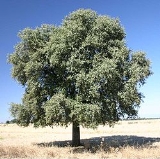
Fagaceae

Encyclopedia
The family Fagaceae, or beech family, comprises about 900 species of both evergreen
and deciduous
trees and shrubs, which are characterized by alternate simple leaves
with pinnate venation, unisexual flower
s in the form of catkin
s, and fruit in the form of cup-like (cupule
) nuts. Fagaceous leaves are often lobed and both petiole
s and stipule
s are generally present. Fruits lack endosperm
and lie in a scaly or spiny husk that may or may not enclose the entire nut, which may consist of one to seven seeds. The best-known group of this family is the oak
s, genus Quercus, the fruit of which is a non-valved nut (usually containing one seed) called an acorn. The husk of the acorn in most oaks only forms a cup in which the nut sits.
Several members of the Fagaceae have important economic uses. Many species of oak
, chestnut
, and beech
(genera Quercus, Castanea, and Fagus respectively) are commonly used as timber for floors, furniture, cabinets, and wine barrels. Cork for stopping wine bottles and a myriad of other uses is made from the bark of cork oak, Quercus suber. Chestnut
s, a tasty treat enjoyed by many in the winter, are the fruits from species of the genus Castanea. Numerous species from several genera are prominent ornamentals, and wood chips from the genus Fagus
are often used in flavoring beers.
of the Fagaceae is strongly supported by both morphological
(especially fruit morphology) and molecular
data.
The Southern Hemisphere genus Nothofagus
, commonly the southern beeches, was historically placed in the Fagaceae sister to the genus Fagus
, but recent molecular evidence suggests otherwise. While Nothofagus shares a number of common characteristics with the Fagaceae, such as cupule fruit structure, it differs significantly in a number of ways including distinct stipule and pollen morphology as well as having a different number of chromosome
s. The currently accepted view by systematic botanists is to place Nothofagus in its own family, Nothofagaceae.
The Quercus subgenus Cyclobalanopsis is treated as a distinct genus by the Flora of China, but as a subgenus by most taxonomists.
The genus Nothofagus
(Southern beeches; about 35 species from the Southern Hemisphere), formerly included in the Fagaceae, is now treated in the separate family Nothofagaceae.
. Genus-level diversity is concentrated in Southeast Asia
, where most of the extant genera are thought to have evolved before migrating to Europe
and North America
(via the Bering Land Bridge
). Members of the Fagaceae (such as Fagus grandifolia, Castanea dentata and Quercus alba in the Northeastern United States
, or Fagus sylvatica, Quercus robur and Q. petraea in Europe) are often ecologically dominant in Northern temperate forest
s.
Evergreen
In botany, an evergreen plant is a plant that has leaves in all seasons. This contrasts with deciduous plants, which completely lose their foliage during the winter or dry season.There are many different kinds of evergreen plants, both trees and shrubs...
and deciduous
Deciduous
Deciduous means "falling off at maturity" or "tending to fall off", and is typically used in reference to trees or shrubs that lose their leaves seasonally, and to the shedding of other plant structures such as petals after flowering or fruit when ripe...
trees and shrubs, which are characterized by alternate simple leaves
Leaves
-History:Vocalist Arnar Gudjonsson was formerly the guitarist with Mower, and he was joined by Hallur Hallsson , Arnar Ólafsson , Bjarni Grímsson , and Andri Ásgrímsson . Late in 2001 they played with Emiliana Torrini and drew early praise from the New York Times...
with pinnate venation, unisexual flower
Flower
A flower, sometimes known as a bloom or blossom, is the reproductive structure found in flowering plants . The biological function of a flower is to effect reproduction, usually by providing a mechanism for the union of sperm with eggs...
s in the form of catkin
Catkin
A catkin or ament is a slim, cylindrical flower cluster, with inconspicuous or no petals, usually wind-pollinated but sometimes insect pollinated . They contain many, usually unisexual flowers, arranged closely along a central stem which is often drooping...
s, and fruit in the form of cup-like (cupule
Cupule
The calybium and the cupule make up the accessory fruit of flowering plants in the family Fagaceae. These two parts derive from different flower components....
) nuts. Fagaceous leaves are often lobed and both petiole
Petiole (botany)
In botany, the petiole is the stalk attaching the leaf blade to the stem. The petiole usually has the same internal structure as the stem. Outgrowths appearing on each side of the petiole are called stipules. Leaves lacking a petiole are called sessile, or clasping when they partly surround the...
s and stipule
Stipule
In botany, stipule is a term coined by Linnaeus which refers to outgrowths borne on either side of the base of a leafstalk...
s are generally present. Fruits lack endosperm
Endosperm
Endosperm is the tissue produced inside the seeds of most flowering plants around the time of fertilization. It surrounds the embryo and provides nutrition in the form of starch, though it can also contain oils and protein. This makes endosperm an important source of nutrition in human diet...
and lie in a scaly or spiny husk that may or may not enclose the entire nut, which may consist of one to seven seeds. The best-known group of this family is the oak
Oak
An oak is a tree or shrub in the genus Quercus , of which about 600 species exist. "Oak" may also appear in the names of species in related genera, notably Lithocarpus...
s, genus Quercus, the fruit of which is a non-valved nut (usually containing one seed) called an acorn. The husk of the acorn in most oaks only forms a cup in which the nut sits.
Several members of the Fagaceae have important economic uses. Many species of oak
Oak
An oak is a tree or shrub in the genus Quercus , of which about 600 species exist. "Oak" may also appear in the names of species in related genera, notably Lithocarpus...
, chestnut
Chestnut
Chestnut , some species called chinkapin or chinquapin, is a genus of eight or nine species of deciduous trees and shrubs in the beech family Fagaceae, native to temperate regions of the Northern Hemisphere. The name also refers to the edible nuts they produce.-Species:The chestnut belongs to the...
, and beech
Beech
Beech is a genus of ten species of deciduous trees in the family Fagaceae, native to temperate Europe, Asia and North America.-Habit:...
(genera Quercus, Castanea, and Fagus respectively) are commonly used as timber for floors, furniture, cabinets, and wine barrels. Cork for stopping wine bottles and a myriad of other uses is made from the bark of cork oak, Quercus suber. Chestnut
Chestnut
Chestnut , some species called chinkapin or chinquapin, is a genus of eight or nine species of deciduous trees and shrubs in the beech family Fagaceae, native to temperate regions of the Northern Hemisphere. The name also refers to the edible nuts they produce.-Species:The chestnut belongs to the...
s, a tasty treat enjoyed by many in the winter, are the fruits from species of the genus Castanea. Numerous species from several genera are prominent ornamentals, and wood chips from the genus Fagus
Beech
Beech is a genus of ten species of deciduous trees in the family Fagaceae, native to temperate Europe, Asia and North America.-Habit:...
are often used in flavoring beers.
Classification
The Fagaceae are often divided into three or four subfamilies and are generally accepted to include nine or ten genera (listed below). MonophylyMonophyly
In common cladistic usage, a monophyletic group is a taxon which forms a clade, meaning that it contains all the descendants of the possibly hypothetical closest common ancestor of the members of the group. The term is synonymous with the uncommon term holophyly...
of the Fagaceae is strongly supported by both morphological
Morphology (biology)
In biology, morphology is a branch of bioscience dealing with the study of the form and structure of organisms and their specific structural features....
(especially fruit morphology) and molecular
Molecular phylogeny
Molecular phylogenetics is the analysis of hereditary molecular differences, mainly in DNA sequences, to gain information on an organism's evolutionary relationships. The result of a molecular phylogenetic analysis is expressed in a phylogenetic tree...
data.
The Southern Hemisphere genus Nothofagus
Nothofagus
Nothofagus, also known as the southern beeches, is a genus of 35 species of trees and shrubs native to the temperate oceanic to tropical Southern Hemisphere in southern South America and Australasia...
, commonly the southern beeches, was historically placed in the Fagaceae sister to the genus Fagus
Beech
Beech is a genus of ten species of deciduous trees in the family Fagaceae, native to temperate Europe, Asia and North America.-Habit:...
, but recent molecular evidence suggests otherwise. While Nothofagus shares a number of common characteristics with the Fagaceae, such as cupule fruit structure, it differs significantly in a number of ways including distinct stipule and pollen morphology as well as having a different number of chromosome
Chromosome
A chromosome is an organized structure of DNA and protein found in cells. It is a single piece of coiled DNA containing many genes, regulatory elements and other nucleotide sequences. Chromosomes also contain DNA-bound proteins, which serve to package the DNA and control its functions.Chromosomes...
s. The currently accepted view by systematic botanists is to place Nothofagus in its own family, Nothofagaceae.
Genera
- CastaneaChestnutChestnut , some species called chinkapin or chinquapin, is a genus of eight or nine species of deciduous trees and shrubs in the beech family Fagaceae, native to temperate regions of the Northern Hemisphere. The name also refers to the edible nuts they produce.-Species:The chestnut belongs to the...
- Chestnuts; eight species, north temperate east Asia, southwest Asia, southeast Europe, eastern North America - CastanopsisCastanopsisCastanopsis is a genus of evergreen trees belonging to the beech family, Fagaceae. The genus contains about 120 species, which are today restricted to tropical and subtropical eastern Asia. A total of 58 species are native to China, with 30 endemic; the other species occur further south, through...
- chinquapins or chinkapins about 125-130 species, southeast AsiaAsiaAsia is the world's largest and most populous continent, located primarily in the eastern and northern hemispheres. It covers 8.7% of the Earth's total surface area and with approximately 3.879 billion people, it hosts 60% of the world's current human population... - ChrysolepisChrysolepisChrysolepis is a small genus in the beech family Fagaceae, endemic to the western United States. Its two species have the common name chinquapin...
- Golden chinkapins; two species, western USAUnited StatesThe United States of America is a federal constitutional republic comprising fifty states and a federal district... - Colombobalanus - one species C. excelsaTrigonobalanus excelsaTrigonobalanus excelsa is a species of plant in the Fagaceae family. It is a tree endemic to Colombia.-Source:* Calderon, E. 1998. . Downloaded on 23 August 2007....
, northern South America, often included in Trigonobalanus - FagusBeechBeech is a genus of ten species of deciduous trees in the family Fagaceae, native to temperate Europe, Asia and North America.-Habit:...
- Beeches; 10 species, north temperate east Asia, southwest Asia, Europe, eastern North America - Formanodendron - one species F. doichangensisTrigonobalanus doichangensisTrigonobalanus doichangensis is a species of plant in the Fagaceae family. It is a tree found in China and Thailand. It is threatened by habitat loss.-Source:* World Conservation Monitoring Centre 1998. . Downloaded on 23 August 2007....
, southeast Asia, often included in Trigonobalanus - LithocarpusLithocarpusLithocarpus is a genus in the beech family Fagaceae, differing from Quercus in the erect male spikes. The World Checklist accepts 334 species, though some other texts suggest as few as 100 species. About 100 Asian species of the genus were formerly treated in the genus Pasania. All but one are...
- Stone oaks; about 330-340 species, warm temperate to tropical Asia - "NotholithocarpusNotholithocarpusNotholithocarpus densiflorus, commonly known as the Tanoak or Tanbark-oak, is an evergreen tree in the beech family Fagaceae, native to the western United States, in California as far south as the Transverse Ranges, north to southwest Oregon, and east in the Sierra Nevada...
" - Tanoaks; 1 species (formerly "Lithocarpus densiflorus", endemic to CaliforniaCaliforniaCalifornia is a state located on the West Coast of the United States. It is by far the most populous U.S. state, and the third-largest by land area...
ad southwest OregonOregonOregon is a state in the Pacific Northwest region of the United States. It is located on the Pacific coast, with Washington to the north, California to the south, Nevada on the southeast and Idaho to the east. The Columbia and Snake rivers delineate much of Oregon's northern and eastern... - QuercusOakAn oak is a tree or shrub in the genus Quercus , of which about 600 species exist. "Oak" may also appear in the names of species in related genera, notably Lithocarpus...
- Oaks; about 500 species, widespread Northern HemisphereNorthern HemisphereThe Northern Hemisphere is the half of a planet that is north of its equator—the word hemisphere literally means “half sphere”. It is also that half of the celestial sphere north of the celestial equator...
, crossing the equatorEquatorAn equator is the intersection of a sphere's surface with the plane perpendicular to the sphere's axis of rotation and containing the sphere's center of mass....
in IndonesiaIndonesiaIndonesia , officially the Republic of Indonesia , is a country in Southeast Asia and Oceania. Indonesia is an archipelago comprising approximately 13,000 islands. It has 33 provinces with over 238 million people, and is the world's fourth most populous country. Indonesia is a republic, with an... - TrigonobalanusTrigonobalanusTrigonobalanus is a genus of three species of evergreen trees in the family Fagaceae, related to beeches and chestnuts. The species are widely scattered, with one in northern South America and two in southeast Asia; some botanists treat the three species in separate genera...
- one species T. verticillata, tropical southeast AsiaAsiaAsia is the world's largest and most populous continent, located primarily in the eastern and northern hemispheres. It covers 8.7% of the Earth's total surface area and with approximately 3.879 billion people, it hosts 60% of the world's current human population...
(three species if Colombobalanus and Formanodendron included)
The Quercus subgenus Cyclobalanopsis is treated as a distinct genus by the Flora of China, but as a subgenus by most taxonomists.
The genus Nothofagus
Nothofagus
Nothofagus, also known as the southern beeches, is a genus of 35 species of trees and shrubs native to the temperate oceanic to tropical Southern Hemisphere in southern South America and Australasia...
(Southern beeches; about 35 species from the Southern Hemisphere), formerly included in the Fagaceae, is now treated in the separate family Nothofagaceae.
Distribution
The Fagaceae are widely distributed across the Northern HemisphereNorthern Hemisphere
The Northern Hemisphere is the half of a planet that is north of its equator—the word hemisphere literally means “half sphere”. It is also that half of the celestial sphere north of the celestial equator...
. Genus-level diversity is concentrated in Southeast Asia
Asia
Asia is the world's largest and most populous continent, located primarily in the eastern and northern hemispheres. It covers 8.7% of the Earth's total surface area and with approximately 3.879 billion people, it hosts 60% of the world's current human population...
, where most of the extant genera are thought to have evolved before migrating to Europe
Europe
Europe is, by convention, one of the world's seven continents. Comprising the westernmost peninsula of Eurasia, Europe is generally 'divided' from Asia to its east by the watershed divides of the Ural and Caucasus Mountains, the Ural River, the Caspian and Black Seas, and the waterways connecting...
and North America
North America
North America is a continent wholly within the Northern Hemisphere and almost wholly within the Western Hemisphere. It is also considered a northern subcontinent of the Americas...
(via the Bering Land Bridge
Bering land bridge
The Bering land bridge was a land bridge roughly 1,000 miles wide at its greatest extent, which joined present-day Alaska and eastern Siberia at various times during the Pleistocene ice ages. Like most of Siberia and all of Manchuria, Beringia was not glaciated because snowfall was extremely light...
). Members of the Fagaceae (such as Fagus grandifolia, Castanea dentata and Quercus alba in the Northeastern United States
United States
The United States of America is a federal constitutional republic comprising fifty states and a federal district...
, or Fagus sylvatica, Quercus robur and Q. petraea in Europe) are often ecologically dominant in Northern temperate forest
Temperate forest
Temperate forests correspond to forest concentrations formed in the northern hemisphere. Main characteristics include: wide leaves, big and tall trees and non seasonal vegetation...
s.
External links
- Fagaceae in Topwalks
- Family Fagaceae Diagnostic photos of many species at The Morton ArboretumMorton ArboretumThe Morton Arboretum, in Lisle, Illinois, covers 1,700 acres and is made up of gardens of various plant types and collections of trees from specific taxonomical and geographical areas. It includes native woodlands and a restored Illinois prairie. The Arboretum has over 4,100 different species of...