


Perun

Encyclopedia
In Slavic mythology
, Perun (Cyrillic
: Перун) is the highest god
of the pantheon
and the god of thunder
and lightning
. His other attributes were the fire
, mountains, the oak
, iris, eagle
, firmament
(in Indo-European languages
this was joined with the notion of the sky of stone), horse
s and cart
s, weapon
s (the hammer
, axe
(Axe of Perun
) and arrow) and war
. He was first associated with weapons made of stone
and later with those of metal
.
Like Germanic
Thor
, Perun is described as a rugged man with a copper beard.
He rides in a chariot pulled by a goat buck and carries a mighty axe, or sometimes a hammer. The axe is hurled at evil people and spirits and will always return to his hand.
historian Procopius
. A short note describing beliefs of a certain South Slavic tribe states they acknowledge that one god, creator of lightning, is the only lord of all: to him do they sacrifice an ox and all sacrificial animals. While the name of the god is not mentioned here explicitly, the fact that word Perun in a number of Slavic languages today simply means "thunder" or "lightning bolt" is proof enough this was a reference of him.
In 980, when prince Vladimir the Great came to throne of Kiev
, he erected statues of five pagan gods in front of his palace. Perun was chief among these, represented with a silver head and a golden moustache. Vladimir's uncle Dobrinja also had a shrine of Perun established in his city of Novgorod. After the Christianization of Kievan Rus, this place became a monastery, which, quite remarkably, continued to bear the name of Perun.
Perun is not mentioned directly in any of the records of Western Slavic paganism, but a reference to him is perhaps made in a short note in Helmod's Chronica Slavorum, written in latter half of the 12th century, which states (quite similarly to Procopius some six centuries earlier) that Slavic tribes, even though they worship many various gods, all agree there is a supreme god in heaven which rules over all other on earth. This could be a reference to Perun, but since he is not named, nor any of his chief attributes (thunder or lightning) mentioned, we cannot be certain.
Moreover, the name of Perun is also commonly found in Southern Slavic toponymy. The Macedonia
n and Bulgaria
n people believe that the name of the mountain Pirin
, one of the highest mountains of the Balkan Peninsula, was named after Perun. There are also places called: Perun (the famous mountain in Bosnia Herzegovina, Vareš
), Perunac, Perunovac, Perunika, Perunička Glava, Peruni Vrh, Perunja Ves, Peruna Dubrava, Perunuša, Perušice, Perudina and Perutovac.
These names today mostly represent mountain tops, but in medieval times, large oaks, sacred groves and even entire villages or citadels were named Perun. Also, as mentioned already, in Ukrainian perun and in Polish piorun means "thunderbolt". Among South Slavs, a mountain plant Iris germanica
is known in folklore as perunika ("Perun's plant") and sometimes also as bogisha, ("god's plant"), and was believed to grow from ground that had been struck by lightning.
/Pērkons from Baltic mythology
, suggesting the existence of an ancestral Balto-Slavic deity, which ultimately derives from the Proto-Indo European
thunder god whose original name has been reconstructed as Perkwunos. The root *perkwu originally probably meant oak, but in Proto-Slavic this evolved into per- meaning "to strike, to slay".
Another version of Perun name's origin is that it's an abbreviation of “Pervo Rune” ( “First Rune” in English) as Perun is the one who gave Runas to his children and he is the main keeper of Holy Runical Fire.
, watery god of the underworld, who continually provoked Perun by stealing his cattle, children or wife. Perun pursued Veles around the earth, attacking him with his lightning bolts from the sky. Veles fled from him by transforming himself into various animals, or hiding behind trees, houses or people; wherever a lightning bolt struck, it was believed, this was because Veles hid from Perun under or behind that particular place. In the end, Perun managed to kill Veles, or to chase him back down into his watery underworld. The supreme god thus reestablished the order in the world which had been disrupted by his chaotic enemy. He then returned to the top of the World tree and proudly informed his opponent down in the roots:Ну, там твое место, там сабе будь! (Nu, tam tvoje mjesto, tam sabje bud'! "Well, there is your place, stay there!"). This line came from a Belarusian
folk tale of great antiquity. To the Slavs, the mythological symbolism of a supreme heavenly god who battles with his underworldly enemy through storms and thunder was extremely significant, and from Perun and Veles, this idea of cosmic battle was passed onto God
and the Devil
following Christianization.
While the exact pantheon characterization differed between the Slavic tribes, Perun is generally believed to have been considered as the supreme god by the majority, or perhaps nearly all Slavs, at least towards the end of Slavic paganism. The earliest supreme god was probably Rod
; it is unclear precisely how and why his worship as the head of pantheon evolved into the worship of Perun. Another candidate for supreme deity among at least some Slavs is Svarog
.
scheme of Georges Dumézil
, Perun was the god of the second function (physical and military power), a god of war, and as such, he was armed with several fantastic weapons. Perun's lightning bolts were believed to be stone
s and stone arrows. According to folk beliefs, fulgurite
s and belemnites and sometimes even remains of prehistoric stone tool
s found in the ground are remains of these weapons. Various Slavic countries also call these deposits "Perun's stones", "thunderbolt stones", "thunderbolt wedges" and "Perun's arrow"; other unrelated names for these include "devil's finger", "God's finger", and "Mother of God finger", and in Lithuania
, "Berkun's finger". These thunderbolt stones were sometimes said to be transferred back to the sky by the wind
after being under earth for a period of seven years. The weapons of Perun protected against bad luck
, evil magic
, disease
, and - naturally enough - lightning itself.
Perun also had another type of weapon in his arsenal, as destructive as his firestone arrows, but even more unusual: mythical golden apples. While this may not seem to be much of a weapon, in many Slavic folk accounts, the golden apple
appears as a talisman
of ultimate destruction. An example from a folk song from Serbia
with strong mythical elements relates:
... Te izvadi tri jabuke zlatne
I baci ih nebu u visine...
...Tri munje od neba pukoše
Jedna gađa dva djevera mlada,
Druga gađa pašu na dorinu,
Treća gađa svata šest stotina,
Ne uteče oka za svjedoka,
Ni da kaže, kako pogiboše.
"...He grabbed three golden apples
And threw them high into the sky...
...Three lightning bolts burst from the sky,
One struck at two young grooms,
Another struck at pasha on a horse,
The third one struck six hundred wedding guests,
Not an eyewitness left
Not even to say, how they died."
It is conjectured that mythical golden apples of Perun were symbols of a rare but notorious form of atmospheric discharge, ball lightning
. The same is probably true for the thunder marks of East Slavic folklore, of which two examples are shown above.
in Novgorod consisted of a wide circular platform centred around a statue, encircled by a trench with eight apse
s, which contained sacrificial altars and possibly additional statues. The overall plan of the shrine shows clear symbolism of the number nine. This is sometimes interpreted that Perun, in fact, had nine sons (or eight sons, with himself, the father, being the ninth Perun). It should also be noted that in some Slavic folk songs, nine unnamed brothers are mentioned.
Similarly to Perkūnas
of Baltic mythology
, Perun was considered to have multiple aspects. In one Lithuania
n song, it is said there are in fact nine versions of Perkūnas. From comparison to the Baltic mythology, and also from additional sources in Slavic folklore, it can also be shown that Perun was married to the Sun. He, however, shared his wife with his enemy Veles, as each night the Sun was thought of as diving behind the horizon and into the underworld, the realm of the dead over which Veles ruled.
Like many other Indo-European thunder gods, Perun's vegetative hypostasis
was the oak
, especially a particularly distinctive or prominent one. In Southern Slavic traditions, marked oaks stood on country borders; communities at these positions were visited during village holidays in the late spring and during the summer. Shrines of Perun were located either on top of mountains or hills, or in sacred groves underneath ancient oaks. These were a general place of worship and holding of sacrifices (with a bull
, an ox
, a ram, and egg
s).
In addition to the tree association, Perun had a day association (Thursday) as well as the material association (tin).
gradually managed to pass much of Perun's characteristics on to a new Christian saint, Elijah the Thunderer, based upon the Old Testament prophet Elijah, whom the Scriptures state rode a flaming chariot through heaven; this seemed a good enough approximation of the old thunder god with his fiery bolts. In the west, the Roman Catholic Church
offered St. Michael the Archangel, who, as a commander of heavenly armies and vanquisher of the Devil
, was also a fitting replacement for Perun. It is also possible that on a local level Perun was replaced with St. Vitus, where this saint did not, due to similarities in names, replace another important Slavic god, Svantovit
; however, it is also possible that already in pagan times, the worship of Perun was challenged by a growing cult of Svetovid (Svantovit). On some levels of folklore and popular Christianity, some of Perun's characteristics were passed on to the Christian God
Himself.
Slavic mythology
Slavic mythology is the mythological aspect of the polytheistic religion that was practised by the Slavs before Christianisation.The religion possesses many common traits with other religions descended from the Proto-Indo-European religion....
, Perun (Cyrillic
Cyrillic alphabet
The Cyrillic script or azbuka is an alphabetic writing system developed in the First Bulgarian Empire during the 10th century AD at the Preslav Literary School...
: Перун) is the highest god
God
God is the English name given to a singular being in theistic and deistic religions who is either the sole deity in monotheism, or a single deity in polytheism....
of the pantheon
Pantheon (gods)
A pantheon is a set of all the gods of a particular polytheistic religion or mythology.Max Weber's 1922 opus, Economy and Society discusses the link between a...
and the god of thunder
Thunder
Thunder is the sound made by lightning. Depending on the nature of the lightning and distance of the listener, thunder can range from a sharp, loud crack to a long, low rumble . The sudden increase in pressure and temperature from lightning produces rapid expansion of the air surrounding and within...
and lightning
Lightning
Lightning is an atmospheric electrostatic discharge accompanied by thunder, which typically occurs during thunderstorms, and sometimes during volcanic eruptions or dust storms...
. His other attributes were the fire
Fire
Fire is the rapid oxidation of a material in the chemical process of combustion, releasing heat, light, and various reaction products. Slower oxidative processes like rusting or digestion are not included by this definition....
, mountains, the oak
Oak
An oak is a tree or shrub in the genus Quercus , of which about 600 species exist. "Oak" may also appear in the names of species in related genera, notably Lithocarpus...
, iris, eagle
Eagle
Eagles are members of the bird family Accipitridae, and belong to several genera which are not necessarily closely related to each other. Most of the more than 60 species occur in Eurasia and Africa. Outside this area, just two species can be found in the United States and Canada, nine more in...
, firmament
Firmament
The firmament is the vault or expanse of the sky. According to Genesis, God created the firmament to separate the oceans from other waters above.-Etymology:...
(in Indo-European languages
Indo-European languages
The Indo-European languages are a family of several hundred related languages and dialects, including most major current languages of Europe, the Iranian plateau, and South Asia and also historically predominant in Anatolia...
this was joined with the notion of the sky of stone), horse
Horse
The horse is one of two extant subspecies of Equus ferus, or the wild horse. It is a single-hooved mammal belonging to the taxonomic family Equidae. The horse has evolved over the past 45 to 55 million years from a small multi-toed creature into the large, single-toed animal of today...
s and cart
Cart
A cart is a vehicle designed for transport, using two wheels and normally pulled by one or a pair of draught animals. A handcart is pulled or pushed by one or more people...
s, weapon
Weapon
A weapon, arm, or armament is a tool or instrument used with the aim of causing damage or harm to living beings or artificial structures or systems...
s (the hammer
Hammer
A hammer is a tool meant to deliver an impact to an object. The most common uses are for driving nails, fitting parts, forging metal and breaking up objects. Hammers are often designed for a specific purpose, and vary widely in their shape and structure. The usual features are a handle and a head,...
, axe
Axe
The axe, or ax, is an implement that has been used for millennia to shape, split and cut wood; to harvest timber; as a weapon; and as a ceremonial or heraldic symbol...
(Axe of Perun
Axe of Perun
The Axe of Perun was the axe wielded by the Slavic god of thunder and lightning, Perun....
) and arrow) and war
War
War is a state of organized, armed, and often prolonged conflict carried on between states, nations, or other parties typified by extreme aggression, social disruption, and usually high mortality. War should be understood as an actual, intentional and widespread armed conflict between political...
. He was first associated with weapons made of stone
Rock (geology)
In geology, rock or stone is a naturally occurring solid aggregate of minerals and/or mineraloids.The Earth's outer solid layer, the lithosphere, is made of rock. In general rocks are of three types, namely, igneous, sedimentary, and metamorphic...
and later with those of metal
Metal
A metal , is an element, compound, or alloy that is a good conductor of both electricity and heat. Metals are usually malleable and shiny, that is they reflect most of incident light...
.
Like Germanic
Germanic paganism
Germanic paganism refers to the theology and religious practices of the Germanic peoples of north-western Europe from the Iron Age until their Christianization during the Medieval period...
Thor
Thor
In Norse mythology, Thor is a hammer-wielding god associated with thunder, lightning, storms, oak trees, strength, the protection of mankind, and also hallowing, healing, and fertility...
, Perun is described as a rugged man with a copper beard.
He rides in a chariot pulled by a goat buck and carries a mighty axe, or sometimes a hammer. The axe is hurled at evil people and spirits and will always return to his hand.
Sources
Of all historic records describing Slavic gods, those mentioning Perun are the most numerous. As early as the 6th century, he was mentioned in De Bello Gothico, a historical source written by the ByzantineByzantine Empire
The Byzantine Empire was the Eastern Roman Empire during the periods of Late Antiquity and the Middle Ages, centred on the capital of Constantinople. Known simply as the Roman Empire or Romania to its inhabitants and neighbours, the Empire was the direct continuation of the Ancient Roman State...
historian Procopius
Procopius
Procopius of Caesarea was a prominent Byzantine scholar from Palestine. Accompanying the general Belisarius in the wars of the Emperor Justinian I, he became the principal historian of the 6th century, writing the Wars of Justinian, the Buildings of Justinian and the celebrated Secret History...
. A short note describing beliefs of a certain South Slavic tribe states they acknowledge that one god, creator of lightning, is the only lord of all: to him do they sacrifice an ox and all sacrificial animals. While the name of the god is not mentioned here explicitly, the fact that word Perun in a number of Slavic languages today simply means "thunder" or "lightning bolt" is proof enough this was a reference of him.
In 980, when prince Vladimir the Great came to throne of Kiev
Kiev
Kiev or Kyiv is the capital and the largest city of Ukraine, located in the north central part of the country on the Dnieper River. The population as of the 2001 census was 2,611,300. However, higher numbers have been cited in the press....
, he erected statues of five pagan gods in front of his palace. Perun was chief among these, represented with a silver head and a golden moustache. Vladimir's uncle Dobrinja also had a shrine of Perun established in his city of Novgorod. After the Christianization of Kievan Rus, this place became a monastery, which, quite remarkably, continued to bear the name of Perun.
Perun is not mentioned directly in any of the records of Western Slavic paganism, but a reference to him is perhaps made in a short note in Helmod's Chronica Slavorum, written in latter half of the 12th century, which states (quite similarly to Procopius some six centuries earlier) that Slavic tribes, even though they worship many various gods, all agree there is a supreme god in heaven which rules over all other on earth. This could be a reference to Perun, but since he is not named, nor any of his chief attributes (thunder or lightning) mentioned, we cannot be certain.
Moreover, the name of Perun is also commonly found in Southern Slavic toponymy. The Macedonia
Republic of Macedonia
Macedonia , officially the Republic of Macedonia , is a country located in the central Balkan peninsula in Southeast Europe. It is one of the successor states of the former Yugoslavia, from which it declared independence in 1991...
n and Bulgaria
Bulgaria
Bulgaria , officially the Republic of Bulgaria , is a parliamentary democracy within a unitary constitutional republic in Southeast Europe. The country borders Romania to the north, Serbia and Macedonia to the west, Greece and Turkey to the south, as well as the Black Sea to the east...
n people believe that the name of the mountain Pirin
Pirin
The Pirin Mountains are a mountain range in southwestern Bulgaria, with Vihren the highest peak, situated at . The range extends about 40 km northwest-southeast, and about 25 km wide. Most of the range is protected in the Pirin National Park...
, one of the highest mountains of the Balkan Peninsula, was named after Perun. There are also places called: Perun (the famous mountain in Bosnia Herzegovina, Vareš
Vareš
Vareš is a town and municipality in central Bosnia and Herzegovina, famous for the local mining activities and production of iron. It is part of the Zenica-Doboj Canton and the Federation of Bosnia and Herzegovina.-About Vareš:...
), Perunac, Perunovac, Perunika, Perunička Glava, Peruni Vrh, Perunja Ves, Peruna Dubrava, Perunuša, Perušice, Perudina and Perutovac.
These names today mostly represent mountain tops, but in medieval times, large oaks, sacred groves and even entire villages or citadels were named Perun. Also, as mentioned already, in Ukrainian perun and in Polish piorun means "thunderbolt". Among South Slavs, a mountain plant Iris germanica
Iris germanica
Iris germanica, the German Iris, is a species in the genus irisThe Iris Germanica grows up to 90 cm high and 10 cm wide. The roots can go up to 10 cm deep. It is an outdoors plant that blooms most in May-August, but planting it would be best in February-April..It is a European hybrid, rather than a...
is known in folklore as perunika ("Perun's plant") and sometimes also as bogisha, ("god's plant"), and was believed to grow from ground that had been struck by lightning.
Etymology
Perun is strongly correlated with the near-identical PerkūnasPerkunas
Perkūnas was the common Baltic god of thunder, one of the most important deities in the Baltic pantheon. In both Lithuanian and Latvian mythology, he is documented as the god of thunder, rain, mountains, oak trees and the sky.-Etymology:...
/Pērkons from Baltic mythology
Baltic mythology
Baltic mythology generally covers the pre-Christian mythology of the Latvians, Lithuanians and Old Prussians, which are thought to have at least some common roots....
, suggesting the existence of an ancestral Balto-Slavic deity, which ultimately derives from the Proto-Indo European
Proto-Indo-European religion
Proto-Indo-European religion is the hypothesized religion of the Proto-Indo-European peoples based on the existence of similarities among the deities, religious practices and mythologies of the Indo-European peoples. Reconstruction of the hypotheses below is based on linguistic evidence using the...
thunder god whose original name has been reconstructed as Perkwunos. The root *perkwu originally probably meant oak, but in Proto-Slavic this evolved into per- meaning "to strike, to slay".
Another version of Perun name's origin is that it's an abbreviation of “Pervo Rune” ( “First Rune” in English) as Perun is the one who gave Runas to his children and he is the main keeper of Holy Runical Fire.
Myth
In Slavic mythology, much like in Norse mythology, the world was represented by a sacred tree, usually an oak, whose branches and trunk represented the living world of heavens and mortals, whilst its roots represented the underworld, i.e. the realm of dead. Perun was a ruler of the living world, sky and earth, and was often symbolised by an eagle sitting on the top of the tallest branch of the tree, from which he kept watch over the entire world. Deep down in the roots of the tree was the place of his enemy, symbolised by a serpent or a dragon: this was VelesVeles (god)
Veles also known as Volos is a major Slavic supernatural force of earth, waters and the underworld, associated with dragons, cattle, magic, musicians, wealth and trickery...
, watery god of the underworld, who continually provoked Perun by stealing his cattle, children or wife. Perun pursued Veles around the earth, attacking him with his lightning bolts from the sky. Veles fled from him by transforming himself into various animals, or hiding behind trees, houses or people; wherever a lightning bolt struck, it was believed, this was because Veles hid from Perun under or behind that particular place. In the end, Perun managed to kill Veles, or to chase him back down into his watery underworld. The supreme god thus reestablished the order in the world which had been disrupted by his chaotic enemy. He then returned to the top of the World tree and proudly informed his opponent down in the roots:Ну, там твое место, там сабе будь! (Nu, tam tvoje mjesto, tam sabje bud'! "Well, there is your place, stay there!"). This line came from a Belarusian
Belarusians
Belarusians ; are an East Slavic ethnic group who populate the majority of the Republic of Belarus. Introduced to the world as a new state in the early 1990s, the Republic of Belarus brought with it the notion of a re-emerging Belarusian ethnicity, drawn upon the lines of the Old Belarusian...
folk tale of great antiquity. To the Slavs, the mythological symbolism of a supreme heavenly god who battles with his underworldly enemy through storms and thunder was extremely significant, and from Perun and Veles, this idea of cosmic battle was passed onto God
God
God is the English name given to a singular being in theistic and deistic religions who is either the sole deity in monotheism, or a single deity in polytheism....
and the Devil
Devil
The Devil is believed in many religions and cultures to be a powerful, supernatural entity that is the personification of evil and the enemy of God and humankind. The nature of the role varies greatly...
following Christianization.
While the exact pantheon characterization differed between the Slavic tribes, Perun is generally believed to have been considered as the supreme god by the majority, or perhaps nearly all Slavs, at least towards the end of Slavic paganism. The earliest supreme god was probably Rod
Rod (god)
Rod is a Slavic deity, often mentioned in the Old Church Slavonic didactic literature which was directed against pagans...
; it is unclear precisely how and why his worship as the head of pantheon evolved into the worship of Perun. Another candidate for supreme deity among at least some Slavs is Svarog
Svarog
Svarog is a Slavic deity known primarily from the Hypatian Codex, a Slavic translation of the Chronicle of John Malalas. Svarog is there identified with Hephaestus, the god of the blacksmith in ancient Greek religion, and as the father of Dažbog, a Slavic solar deity...
.
Weapons
In the classificationCategorization
Categorization is the process in which ideas and objects are recognized, differentiated and understood. Categorization implies that objects are grouped into categories, usually for some specific purpose. Ideally, a category illuminates a relationship between the subjects and objects of knowledge...
scheme of Georges Dumézil
Georges Dumézil
Georges Dumézil was a French comparative philologist best known for his analysis of sovereignty and power in Proto-Indo-European religion and society...
, Perun was the god of the second function (physical and military power), a god of war, and as such, he was armed with several fantastic weapons. Perun's lightning bolts were believed to be stone
Rock (geology)
In geology, rock or stone is a naturally occurring solid aggregate of minerals and/or mineraloids.The Earth's outer solid layer, the lithosphere, is made of rock. In general rocks are of three types, namely, igneous, sedimentary, and metamorphic...
s and stone arrows. According to folk beliefs, fulgurite
Fulgurite
Fulgurites are natural hollow glass tubes formed in quartzose sand, or silica, or soil by lightning strikes. They are formed when lightning with a temperature of at least instantaneously melts silica on a conductive surface and fuses grains together; the fulgurite tube is the cooled product...
s and belemnites and sometimes even remains of prehistoric stone tool
Tool
A tool is a device that can be used to produce an item or achieve a task, but that is not consumed in the process. Informally the word is also used to describe a procedure or process with a specific purpose. Tools that are used in particular fields or activities may have different designations such...
s found in the ground are remains of these weapons. Various Slavic countries also call these deposits "Perun's stones", "thunderbolt stones", "thunderbolt wedges" and "Perun's arrow"; other unrelated names for these include "devil's finger", "God's finger", and "Mother of God finger", and in Lithuania
Lithuania
Lithuania , officially the Republic of Lithuania is a country in Northern Europe, the biggest of the three Baltic states. It is situated along the southeastern shore of the Baltic Sea, whereby to the west lie Sweden and Denmark...
, "Berkun's finger". These thunderbolt stones were sometimes said to be transferred back to the sky by the wind
Wind
Wind is the flow of gases on a large scale. On Earth, wind consists of the bulk movement of air. In outer space, solar wind is the movement of gases or charged particles from the sun through space, while planetary wind is the outgassing of light chemical elements from a planet's atmosphere into space...
after being under earth for a period of seven years. The weapons of Perun protected against bad luck
Luck
Luck or fortuity is good fortune which occurs beyond one's control, without regard to one's will, intention, or desired result. There are at least two senses people usually mean when they use the term, the prescriptive sense and the descriptive sense...
, evil magic
Magic (paranormal)
Magic is the claimed art of manipulating aspects of reality either by supernatural means or through knowledge of occult laws unknown to science. It is in contrast to science, in that science does not accept anything not subject to either direct or indirect observation, and subject to logical...
, disease
Disease
A disease is an abnormal condition affecting the body of an organism. It is often construed to be a medical condition associated with specific symptoms and signs. It may be caused by external factors, such as infectious disease, or it may be caused by internal dysfunctions, such as autoimmune...
, and - naturally enough - lightning itself.
Perun also had another type of weapon in his arsenal, as destructive as his firestone arrows, but even more unusual: mythical golden apples. While this may not seem to be much of a weapon, in many Slavic folk accounts, the golden apple
Golden apple
The golden apple is an element that appears in various national and ethnic folk legends or fairy tales. Recurring themes depict a hero retrieving the golden apples hidden or stolen by a monstrous antagonist...
appears as a talisman
Amulet
An amulet, similar to a talisman , is any object intended to bring good luck or protection to its owner.Potential amulets include gems, especially engraved gems, statues, coins, drawings, pendants, rings, plants and animals; even words said in certain occasions—for example: vade retro satana—, to...
of ultimate destruction. An example from a folk song from Serbia
Serbia
Serbia , officially the Republic of Serbia , is a landlocked country located at the crossroads of Central and Southeast Europe, covering the southern part of the Carpathian basin and the central part of the Balkans...
with strong mythical elements relates:
... Te izvadi tri jabuke zlatne
I baci ih nebu u visine...
...Tri munje od neba pukoše
Jedna gađa dva djevera mlada,
Druga gađa pašu na dorinu,
Treća gađa svata šest stotina,
Ne uteče oka za svjedoka,
Ni da kaže, kako pogiboše.
"...He grabbed three golden apples
And threw them high into the sky...
...Three lightning bolts burst from the sky,
One struck at two young grooms,
Another struck at pasha on a horse,
The third one struck six hundred wedding guests,
Not an eyewitness left
Not even to say, how they died."
It is conjectured that mythical golden apples of Perun were symbols of a rare but notorious form of atmospheric discharge, ball lightning
Ball lightning
Ball lightning is an unexplained atmospheric electrical phenomenon. The term refers to reports of luminous, usually spherical objects which vary from pea-sized to several metres in diameter. It is usually associated with thunderstorms, but lasts considerably longer than the split-second flash of a...
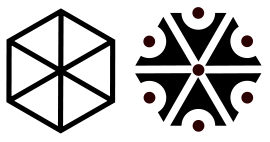
. The same is probably true for the thunder marks of East Slavic folklore, of which two examples are shown above.
Characteristics
Remains of an ancient shrine to Perun discovered beneath medieval Peryn sketeSkete
A Skete is a monastic style community that allows relative isolation for monks, but alsoallows for communal services and the safety of shared resources and protection...
in Novgorod consisted of a wide circular platform centred around a statue, encircled by a trench with eight apse
Apse
In architecture, the apse is a semicircular recess covered with a hemispherical vault or semi-dome...
s, which contained sacrificial altars and possibly additional statues. The overall plan of the shrine shows clear symbolism of the number nine. This is sometimes interpreted that Perun, in fact, had nine sons (or eight sons, with himself, the father, being the ninth Perun). It should also be noted that in some Slavic folk songs, nine unnamed brothers are mentioned.
Similarly to Perkūnas
Perkunas
Perkūnas was the common Baltic god of thunder, one of the most important deities in the Baltic pantheon. In both Lithuanian and Latvian mythology, he is documented as the god of thunder, rain, mountains, oak trees and the sky.-Etymology:...
of Baltic mythology
Baltic mythology
Baltic mythology generally covers the pre-Christian mythology of the Latvians, Lithuanians and Old Prussians, which are thought to have at least some common roots....
, Perun was considered to have multiple aspects. In one Lithuania
Lithuania
Lithuania , officially the Republic of Lithuania is a country in Northern Europe, the biggest of the three Baltic states. It is situated along the southeastern shore of the Baltic Sea, whereby to the west lie Sweden and Denmark...
n song, it is said there are in fact nine versions of Perkūnas. From comparison to the Baltic mythology, and also from additional sources in Slavic folklore, it can also be shown that Perun was married to the Sun. He, however, shared his wife with his enemy Veles, as each night the Sun was thought of as diving behind the horizon and into the underworld, the realm of the dead over which Veles ruled.
Like many other Indo-European thunder gods, Perun's vegetative hypostasis
Hypostasis (linguistics)
In linguistics, a hypostasis , is a relationship between a name and a known quantity, as a cultural personification of an entity or quality...
was the oak
Oak
An oak is a tree or shrub in the genus Quercus , of which about 600 species exist. "Oak" may also appear in the names of species in related genera, notably Lithocarpus...
, especially a particularly distinctive or prominent one. In Southern Slavic traditions, marked oaks stood on country borders; communities at these positions were visited during village holidays in the late spring and during the summer. Shrines of Perun were located either on top of mountains or hills, or in sacred groves underneath ancient oaks. These were a general place of worship and holding of sacrifices (with a bull
Bull
Bull usually refers to an uncastrated adult male bovine.Bull may also refer to:-Entertainment:* Bull , an original show on the TNT Network* "Bull" , an episode of television series CSI: Crime Scene Investigation...
, an ox
Ox
An ox , also known as a bullock in Australia, New Zealand and India, is a bovine trained as a draft animal. Oxen are commonly castrated adult male cattle; castration makes the animals more tractable...
, a ram, and egg
Egg (food)
Eggs are laid by females of many different species, including birds, reptiles, amphibians, and fish, and have probably been eaten by mankind for millennia. Bird and reptile eggs consist of a protective eggshell, albumen , and vitellus , contained within various thin membranes...
s).
In addition to the tree association, Perun had a day association (Thursday) as well as the material association (tin).
Post-Christian Perun
With the arrival of Christianity, various churches had a difficult time trying to overcome the worship of the old supreme deities of the Slavs. In the East, the Eastern Orthodox ChurchEastern Orthodox Church
The Orthodox Church, officially called the Orthodox Catholic Church and commonly referred to as the Eastern Orthodox Church, is the second largest Christian denomination in the world, with an estimated 300 million adherents mainly in the countries of Belarus, Bulgaria, Cyprus, Georgia, Greece,...
gradually managed to pass much of Perun's characteristics on to a new Christian saint, Elijah the Thunderer, based upon the Old Testament prophet Elijah, whom the Scriptures state rode a flaming chariot through heaven; this seemed a good enough approximation of the old thunder god with his fiery bolts. In the west, the Roman Catholic Church
Roman Catholic Church
The Catholic Church, also known as the Roman Catholic Church, is the world's largest Christian church, with over a billion members. Led by the Pope, it defines its mission as spreading the gospel of Jesus Christ, administering the sacraments and exercising charity...
offered St. Michael the Archangel, who, as a commander of heavenly armies and vanquisher of the Devil
Devil
The Devil is believed in many religions and cultures to be a powerful, supernatural entity that is the personification of evil and the enemy of God and humankind. The nature of the role varies greatly...
, was also a fitting replacement for Perun. It is also possible that on a local level Perun was replaced with St. Vitus, where this saint did not, due to similarities in names, replace another important Slavic god, Svantovit
Svantovít
Svantovít is male given name. Slavic in origin, it means lord, ruler, winner or warrior.- Another variants :*Slovak: Svantovít*Bosnian: Svetovid*Croatian: Svantovid*Polish: Świętowit- External links :**...
; however, it is also possible that already in pagan times, the worship of Perun was challenged by a growing cult of Svetovid (Svantovit). On some levels of folklore and popular Christianity, some of Perun's characteristics were passed on to the Christian God
God in Christianity
In Christianity, God is the eternal being that created and preserves the universe. God is believed by most Christians to be immanent , while others believe the plan of redemption show he will be immanent later...
Himself.
See also
- PrenjPrenjPrenj is a mountain in the Dinaric Alps of southern Bosnia and Herzegovina, located in eastern Herzegovina near Mostar, Jablanica and Konjic. The highest peak is the Zelena glava at , and there are several other peaks of similar height....
- Montenegrin perunMontenegrin perunThe perun was the currency that was planned for introduction in Montenegro by Petar II Petrović Njegoš in 1851. However, he died the same year, and Montenegro remained without a currency until the 1906 introduction of the perper by Nicholas I of Montenegro...
- Perperuna
- PerkūnasPerkunasPerkūnas was the common Baltic god of thunder, one of the most important deities in the Baltic pantheon. In both Lithuanian and Latvian mythology, he is documented as the god of thunder, rain, mountains, oak trees and the sky.-Etymology:...
- Perkwunos
- nickname of Petar PerunovicPetar PerunovicPetar Perunović , nicknamed Perun, was a famous Montenegrin and Serbian gusle player....
- ThorThorIn Norse mythology, Thor is a hammer-wielding god associated with thunder, lightning, storms, oak trees, strength, the protection of mankind, and also hallowing, healing, and fertility...
- IndraIndra' or is the King of the demi-gods or Devas and Lord of Heaven or Svargaloka in Hindu mythology. He is also the God of War, Storms, and Rainfall.Indra is one of the chief deities in the Rigveda...
- VelesVeles (god)Veles also known as Volos is a major Slavic supernatural force of earth, waters and the underworld, associated with dragons, cattle, magic, musicians, wealth and trickery...
- VarpulisVarpulisAccording to Slavic mythology, Varpulis is an Eastern European deity known in Czech Republic, Slovakia, Lithuania, and Croatia, and is god of storm winds and companion of the thunder god Perun or Pyerun.-References:*...
- Saint Elijah the Thunderer
- Axe of PerunAxe of PerunThe Axe of Perun was the axe wielded by the Slavic god of thunder and lightning, Perun....
Cultural references
- Robert Jordan's Wheel of TimeWheel of timeThe Wheel of time or wheel of history is a concept found in several religious traditions and philosophies, notably religions of Indian origin such as Hinduism and Buddhism, which regard time as cyclical and consisting of repeating ages...
character Perrin AybaraPerrin AybaraPerrin t'Bashere Aybara, or Goldeneyes, is one of the main characters of Robert Jordan's epic fantasy The Wheel of Time. Character is largely based on Slavic god Perun. In addition to the name similarity Perrin's choice of weapons include the axe, hammer, and bow...
is largely based on Perun. In addition to the name similarity Perrin's choice of weapons include the axe, hammer, and bow. Perrin also shares Perun's association to wolves; Perrin can even talk to wolves. In Christianized versions versions of Slavic mythology, Perun's name is usually replaced with St. Elias. In the Wheel of time, Elyas Machera is yet another character that can speak to wolves.
- Folk Metal band TurisasTurisasTurisas is a Finnish folk metal band from Hämeenlinna. It was founded in 1997 by Mathias Nygård and Jussi Wickström and named after an ancient Finnish God of war....
makes references to Perun in their song "A Portage to the Unknown", as well as describing the general look of one of the ancient symbols of Perun.
- Ukrainian Black Metal band Nokturnal MortumNokturnal MortumNokturnal Mortum is a Ukrainian black metal band from Kharkiv.-History:Nokturnal Mortum started as death metal band Suppuration in 1991, then turned to black metal and changed name to Crystalline Darkness but "had to change the name back in 1993/94 to Nocturnal Mortum because there already existed...
tell about Perun in their song "Perun's Celestial Silver", with references to arrows, lightning and the punishment of thieves.
- Marvel ComicsMarvel ComicsMarvel Worldwide, Inc., commonly referred to as Marvel Comics and formerly Marvel Publishing, Inc. and Marvel Comics Group, is an American company that publishes comic books and related media...
has a character named PerunPerun (comics)Perun is a Marvel Comics character based on the mythical deity in Slavic mythology, with control over thunder and lightning similar to that of the Norse god Thor.-Publication history:...
, a heroic member of the Soviet super-group called 'The People's Protecterate'.
- In Marvel Comics, in the alternate continuity of Ultimates 2, the terrorist group The Liberators has a member Perun. He is described as a Soviet ThorThor (Marvel Comics)Thor is a fictional superhero who appears in publications published by Marvel Comics. The character first appeared in Journey into Mystery #83 and was created by editor-plotter Stan Lee, scripter Larry Lieber, and penciller Jack Kirby....
.
- Perun appears in the HellboyHellboyHellboy is a comic book superhero created by writer-artist Mike Mignola. The character first appeared in San Diego Comic-Con Comics #2 , and has since appeared in various eponymous miniseries, one-shots and intercompany crossovers...
limited series Darkness Calls, in which he aids Hellboy before being killed by the Baba YagaBaba YagaBaba Yaga or Baba Roga is a haggish or witchlike character in Slavic folklore. She flies around on a giant pestle, kidnaps small children, and lives in a hut that stands on chicken legs...
.
- Perun is a major character in The Iron Druid Chronicles novel, Hammered by Kevin Hearne. The series follows the Tempe, Arizona-based 2,100-year old Irish Druid, Atticus O'Sullivan. This particular book in the series' main plot point is the ingress of several characters - Perun, O'Sullivan, a werewolfWerewolfA werewolf, also known as a lycanthrope , is a mythological or folkloric human with the ability to shapeshift into a wolf or an anthropomorphic wolf-like creature, either purposely or after being placed under a curse...
, a vampireVampireVampires are mythological or folkloric beings who subsist by feeding on the life essence of living creatures, regardless of whether they are undead or a living person...
, Finnish folk legend VäinämöinenVäinämöinenVäinämöinen is the central character in the Finnish folklore and the main character in the national epic Kalevala. His name comes from the Finnish word väinämö, meaning minstrel. Originally a Finnish god, he was described as an old and wise man, and he possessed a potent, magical...
, and Taoist fangshiFangshiFangshi was a category of Chinese technical specialists that flourished from the third century BCE to the fifth century CE. English translations of fangshi encompass alchemist, astrologer, diviner, exorcist, geomancer, doctor, magician, mountebank, monk, mystic, necromancer, occultist,...
Zhang Guo Lao - into Asgard to kill NorseNorse mythologyNorse mythology, a subset of Germanic mythology, is the overall term for the myths, legends and beliefs about supernatural beings of Norse pagans. It flourished prior to the Christianization of Scandinavia, during the Early Middle Ages, and passed into Nordic folklore, with some aspects surviving...
thunder god ThorThorIn Norse mythology, Thor is a hammer-wielding god associated with thunder, lightning, storms, oak trees, strength, the protection of mankind, and also hallowing, healing, and fertility...
, for various reasons. Perun's motive for this endeavor is that he was visited by Thor at the behest of OdinOdinOdin is a major god in Norse mythology and the ruler of Asgard. Homologous with the Anglo-Saxon "Wōden" and the Old High German "Wotan", the name is descended from Proto-Germanic "*Wodanaz" or "*Wōđanaz"....
to goad Perun into having his worshippers build statues and monuments to him. While the Eddas preserved Thor and Odin, Perun's monuments crumbled and he is largely forgotten - which he believes Odin planned.