
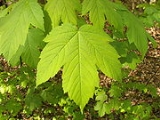
Acer is a
genusIn biology, a genus is a low-level taxonomic rank used in the biological classification of living and fossil organisms, which is an example of definition by genus and differentia...
of
treeA tree is a perennial woody plant. It is most often defined as a woody plant that has many secondary branches supported clear of the ground on a single main stem or trunk with clear apical dominance. A minimum height specification at maturity is cited by some authors, varying from 3 m to...
s or
shrubA shrub or bush is distinguished from a tree by its multiple stems and shorter height, usually under 5–6 m tall. A large number of plants may become either shrubs or trees, depending on the growing conditions they experience...
s commonly known as
maple.
Maples are variously classified in a family of their own, the
AceraceaeAceraceae is a family of flowering plants also called the Maple Family. It contains two to four genera, depending upon the circumscription, of some 120 species of trees and shrubs. A common characteristic is that the leaves are opposite, and the fruit a schizocarp.The maples have long been known...
, or together with the
Hippocastanaceaethumb|230pxHippocastanaceae is the name given to a small group of trees and shrubs, when this group is treated as a family. Its most widespread genus is Aesculus . However, the American genus Billia and the Chinese genus Handeliodendron are also sometimes included in this family...
included in the family
SapindaceaeSapindaceae, also known as the soapberry family, is a family of flowering plants in the order Sapindales. There are about 140-150 genera with 1400-2000 species, including maple, horse chestnut and lychee....
. Modern classifications, including the
Angiosperm Phylogeny GroupThe Angiosperm Phylogeny Group, or APG, refers to an informal international group of systematic botanists who came together to try to establish a consensus on the taxonomy of flowering plants that would reflect new knowledge about plant relationships discovered through phylogenetic studies., three...
system, favour inclusion in Sapindaceae. The
type speciesIn biological nomenclature, a type species is both a concept and a practical system which is used in the classification and nomenclature of animals and plants. The value of a "type species" lies in the fact that it makes clear what is meant by a particular genus name. A type species is the species...
of the genus is
Acer pseudoplatanus (Sycamore maple).
There are approximately 129
speciesIn biology, a species is one of the basic units of biological classification and a taxonomic rank. A species is often defined as a group of organisms capable of interbreeding and producing fertile offspring. While in many cases this definition is adequate, more precise or differing measures are...
, most of which are native to
AsiaAsia is the world's largest and most populous continent, located primarily in the eastern and northern hemispheres. It covers 8.7% of the Earth's total surface area and with approximately 3.879 billion people, it hosts 60% of the world's current human population...
, with a number also appearing in
EuropeEurope is, by convention, one of the world's seven continents. Comprising the westernmost peninsula of Eurasia, Europe is generally 'divided' from Asia to its east by the watershed divides of the Ural and Caucasus Mountains, the Ural River, the Caspian and Black Seas, and the waterways connecting...
, northern
AfricaAfrica is the world's second largest and second most populous continent, after Asia. At about 30.2 million km² including adjacent islands, it covers 6% of the Earth's total surface area and 20.4% of the total land area...
, and
North AmericaNorth America is a continent wholly within the Northern Hemisphere and almost wholly within the Western Hemisphere. It is also considered a northern subcontinent of the Americas...
. Only one species, the poorly studied
Acer laurinum, is native to the Southern Hemisphere. Fifty four species of maples meet the International Union for Conservation of Nature criteria for being under threat of extinction in their native habitat.
The word
Acer derives from a Latin word meaning "sharp" (compare "acerbic"), referring to the characteristic points on
maple leavesThe maple leaf is the characteristic leaf of the maple tree, and is the most widely recognized national symbol of Canada.-Use in Canada:At the beginning of the eighteenth century, the settlements of New France had attained a population of about 18,000...
. It was first applied to the genus by the
FrenchThe French are a nation that share a common French culture and speak the French language as a mother tongue. Historically, the French population are descended from peoples of Celtic, Latin and Germanic origin, and are today a mixture of several ethnic groups...
botanist
Joseph Pitton de TournefortJoseph Pitton de Tournefort was a French botanist, notable as the first to make a clear definition of the concept of genus for plants.- Biography :...
in 1700. The earliest known fossil maple is
Acer alaskenseAcer alaskense is an extinct maple species in the family Sapindaceae described from a fossil leaf. The species is solely known from the Latest Paleocene sediments exposed in the Matanuska River Valley, Matanuska-Susitna Borough, Alaska...
, from the Latest Paleocene of Alaska.
Morphology
Most maples are
treeA tree is a perennial woody plant. It is most often defined as a woody plant that has many secondary branches supported clear of the ground on a single main stem or trunk with clear apical dominance. A minimum height specification at maturity is cited by some authors, varying from 3 m to...
s growing to 10 – 45 meters (30 – 145 ft) in height. Others are
shrubA shrub or bush is distinguished from a tree by its multiple stems and shorter height, usually under 5–6 m tall. A large number of plants may become either shrubs or trees, depending on the growing conditions they experience...
s less than 10 metres tall with a number of small
trunksIn botany, trunk refers to the main wooden axis of a tree that supports the branches and is supported by and directly attached to the roots. The trunk is covered by the bark, which is an important diagnostic feature in tree identification, and which often differs markedly from the bottom of the...
originating at ground level. Most species are
deciduousDeciduous means "falling off at maturity" or "tending to fall off", and is typically used in reference to trees or shrubs that lose their leaves seasonally, and to the shedding of other plant structures such as petals after flowering or fruit when ripe...
, but a few in southern Asia and the Mediterranean region are
evergreenIn botany, an evergreen plant is a plant that has leaves in all seasons. This contrasts with deciduous plants, which completely lose their foliage during the winter or dry season.There are many different kinds of evergreen plants, both trees and shrubs...
. Most are
shade-tolerantIn ecology, shade tolerance is a plant's abilities to tolerate low light levels. The term is also used in horticulture and landscaping, although in this context its use is sometimes sloppy, especially with respect to labeling of plants for sale in nurseries....
when young and are often late-successional in ecology; many of the
rootIn vascular plants, the root is the organ of a plant that typically lies below the surface of the soil. This is not always the case, however, since a root can also be aerial or aerating . Furthermore, a stem normally occurring below ground is not exceptional either...
systems are typically dense and fibrous. A few species, notably
Acer cappadocicum, frequently produce root sprouts, which can develop into
clonal coloniesA clonal colony or genet is a group of genetically identical individuals that have grown in a given location, all originating vegetatively from a single ancestor. In plants, an individual in such a population is referred to as a ramet...
.
Maples are distinguished by opposite
leafA leaf is an organ of a vascular plant, as defined in botanical terms, and in particular in plant morphology. Foliage is a mass noun that refers to leaves as a feature of plants....
arrangement. The leaves in most species are
palmateIn botany, leaf shape is characterised with the following terms :* Acicular : Slender and pointed, needle-like* Acuminate : Tapering to a long point...
veined and lobed, with 3 to 9 (rarely to 13) veins each leading to a lobe, one of which is central or apical. A small number of species differ in having palmate compound,
pinnateIn botany, leaf shape is characterised with the following terms :* Acicular : Slender and pointed, needle-like* Acuminate : Tapering to a long point...
compound, pinnate veined or unlobed leaves. Several species, including
Acer griseum (Paperbark maple);
Acer mandshuricumAcer mandshuricum , is a species of maple native to China , Korea and Russia ....
(Manchurian maple);
Acer maximowiczianumAcer maximowiczianum , is a species of maple widely distributed in China and Japan ....
(Nikko maple); and
Acer triflorumAcer triflorum is a species of maple native to hills of northern China and Korea....
(Three-flowered maple), have trifoliate leaves. One species,
Acer negundoAcer negundo is a species of maple native to North America. Box Elder, Boxelder Maple, and Maple Ash are its most common names in the United States...
(Box-elder), has pinnately compound leaves that may be simply trifoliate or may have five, seven, or rarely nine leaflets. A few, such as
Acer laevigatumAcer laevigatum , is an atypical species of maple native to southern China , northern India , northern Myanmar, Nepal, and northern Vietnam...
(Nepal maple) and
Acer carpinifolium (Hornbeam maple), have pinnately veined simple leaves.
The
flowerA flower, sometimes known as a bloom or blossom, is the reproductive structure found in flowering plants . The biological function of a flower is to effect reproduction, usually by providing a mechanism for the union of sperm with eggs...
s are regular, pentamerous, and borne in
racemeA raceme is a type of inflorescence that is unbranched and indeterminate and bears pedicellate flowers — flowers having short floral stalks called pedicels — along the axis. In botany, axis means a shoot, in this case one bearing the flowers. In a raceme, the oldest flowers are borne...
s, corymbs, or umbels. They have four or five
sepalA sepal is a part of the flower of angiosperms . Collectively the sepals form the calyx, which is the outermost whorl of parts that form a flower. Usually green, sepals have the typical function of protecting the petals when the flower is in bud...
s, four or five
petalPetals are modified leaves that surround the reproductive parts of flowers. They often are brightly colored or unusually shaped to attract pollinators. Together, all of the petals of a flower are called a corolla. Petals are usually accompanied by another set of special leaves called sepals lying...
s about 1 – 6 mm long (absent in some species), four to ten
stamenThe stamen is the pollen producing reproductive organ of a flower...
s about 6 – 10 mm long, and two pistils or a pistil with two styles. The
ovaryIn the flowering plants, an ovary is a part of the female reproductive organ of the flower or gynoecium. Specifically, it is the part of the pistil which holds the ovule and is located above or below or at the point of connection with the base of the petals and sepals...
is superior and has two carpels, whose wings elongate the flowers, making it easy to tell which flowers are female. Maples flower in late
winterWinter is the coldest season of the year in temperate climates, between autumn and spring. At the winter solstice, the days are shortest and the nights are longest, with days lengthening as the season progresses after the solstice.-Meteorology:...
or early
springSpring is one of the four temperate seasons, the transition period between winter and summer. Spring and "springtime" refer to the season, and broadly to ideas of rebirth, renewal and regrowth. The specific definition of the exact timing of "spring" varies according to local climate, cultures and...
, in most species with or just after the appearance of the leaves, but in some before the trees leaf out.
Maple flowers are green, yellow, orange or red. Though individually small, the effect of an entire tree in flower can be striking in several species. Some maples are an early spring source of
pollenPollen is a fine to coarse powder containing the microgametophytes of seed plants, which produce the male gametes . Pollen grains have a hard coat that protects the sperm cells during the process of their movement from the stamens to the pistil of flowering plants or from the male cone to the...
and
nectarNectar is a sugar-rich liquid produced by plants. It is produced in glands called nectaries, either within the flowers, in which it attracts pollinating animals, or by extrafloral nectaries, which provide a nutrient source to animal mutualists, which in turn provide anti-herbivore protection...
for
beeBees are flying insects closely related to wasps and ants, and are known for their role in pollination and for producing honey and beeswax. Bees are a monophyletic lineage within the superfamily Apoidea, presently classified by the unranked taxon name Anthophila...
s.
The distinctive
fruitIn broad terms, a fruit is a structure of a plant that contains its seeds.The term has different meanings dependent on context. In non-technical usage, such as food preparation, fruit normally means the fleshy seed-associated structures of certain plants that are sweet and edible in the raw state,...
are called
samarasA samara is a type of fruit in which a flattened wing of fibrous, papery tissue develops from the ovary wall. A samara is a simple dry fruit and indehiscent . It is a winged achene...
or "maple keys". These
seedA seed is a small embryonic plant enclosed in a covering called the seed coat, usually with some stored food. It is the product of the ripened ovule of gymnosperm and angiosperm plants which occurs after fertilization and some growth within the mother plant...
s, or 'whirlybirds,' occur in distinctive pairs each containing one seed enclosed in a "nutlet" attached to a flattened wing of fibrous, papery tissue. They are shaped to spin as they fall and to carry the seeds a considerable distance on the wind. Children often call them "helicopters" due to the way that they spin as they fall. Seed maturation is usually in a few weeks to six months after flowering, with
seed dispersalBiological dispersal refers to species movement away from an existing population or away from the parent organism. Through simply moving from one habitat patch to another, the dispersal of an individual has consequences not only for individual fitness, but also for population dynamics, population...
shortly after maturity. However, one tree can release hundreds of thousands of seeds at a time. Depending on the species, the seeds can be small and green to orange and big with thicker seed pods. The green seeds are released in pairs, sometimes with the stems still connected. The yellow seeds are released individually and almost always without the stems. Most species require
stratificationIn horticulture, stratification is the process of pretreating seeds to simulate natural winter conditions that a seed must endure before germination. Many seed species undergo an embryonic dormancy phase, and generally will not sprout until this dormancy is broken...
in order to
germinateGermination is the process in which a plant or fungus emerges from a seed or spore, respectively, and begins growth. The most common example of germination is the sprouting of a seedling from a seed of an angiosperm or gymnosperm. However the growth of a sporeling from a spore, for example the...
, and some seeds can remain dormant in the soil for several years before germinating.
The genus is subdivided by its morphology into a multitude of sections and subsections.
Pests and diseases
The leaves are used as a food plant for the
larvaA larva is a distinct juvenile form many animals undergo before metamorphosis into adults. Animals with indirect development such as insects, amphibians, or cnidarians typically have a larval phase of their life cycle...
e of a number of
LepidopteraLepidoptera is a large order of insects that includes moths and butterflies . It is one of the most widespread and widely recognizable insect orders in the world, encompassing moths and the three superfamilies of butterflies, skipper butterflies, and moth-butterflies...
species (see List of Lepidoptera that feed on maples).
AphidAphids, also known as plant lice and in Britain and the Commonwealth as greenflies, blackflies or whiteflies, are small sap sucking insects, and members of the superfamily Aphidoidea. Aphids are among the most destructive insect pests on cultivated plants in temperate regions...
s are also very common sap-feeders on maples. In horticultural applications a dimethoate spray will solve this.
In the United States and Canada, all maple species are threatened by the Asian Longhorned Beetle (Anoplophora glabripennis). Infestations have resulted in the destruction of thousands of maples and other tree species in Illinois, Massachusetts, New Jersey and New York.
Maples are affected by a number of
fungalA fungus is a member of a large group of eukaryotic organisms that includes microorganisms such as yeasts and molds , as well as the more familiar mushrooms. These organisms are classified as a kingdom, Fungi, which is separate from plants, animals, and bacteria...
diseases. Several are susceptible to Verticillium wilt caused by
VerticilliumVerticillium is a genus of fungi in the division Ascomycota, and are an anamorphic form of the Plectosphaerellaceae family. The genus used to include diverse groups comprising saprobes and parasites of higher plants, insects, nematodes, mollusc eggs and other fungi thus it can be seen that the...
species, which can cause significant local mortality. Sooty bark disease, caused by
Cryptostroma species, can kill trees which are under stress due to
droughtA drought is an extended period of months or years when a region notes a deficiency in its water supply. Generally, this occurs when a region receives consistently below average precipitation. It can have a substantial impact on the ecosystem and agriculture of the affected region...
. Death of maples can rarely be caused by
PhytophthoraPhytophthora is a genus of plant-damaging Oomycetes , whose member species are capable of causing enormous economic losses on crops worldwide, as well as environmental damage in natural ecosystems. The genus was first described by Heinrich Anton de Bary in 1875...
root rotRoot rot is a condition found in both indoor and outdoor plants, although more common in indoor plants with poor drainage. As the name states, the roots of the plant rot. Usually, this is a result of overwatering. In houseplants, it is a very common problem, and is slightly less common in outdoor...
and
GanodermaGanoderma is a genus of polypore mushrooms which grow on wood and include about 80 species, many from tropical regions. Because of their extensive use in traditional Asian medicines, and their potential in bioremediation, they are a very important genus economically. Ganoderma can be differentiated...
root decay. Maple leaves in late summer and autumn are commonly disfigured by "tar spot" caused by
RhytismaRhytisma is a genus of fungi in the Rhytismataceae family commonly known as 'tar spot'. There are about 18 species, which live parasitically in the leaves of deciduous trees.-Species:*Rhytisma acerinum*Rhytisma andromedae...
species and
mildewMildew refers to certain kinds of molds or fungi.In Old English, it meant honeydew , and later came to mean mildew in the modern sense of mold or fungus....
caused by
UncinulaUncinula is a genus of fungi. Its species are plant pathogens that cause powdery mildew diseases on various plant hosts. The genus is characterized by its dark chasmothecia which bear filamentous, hyaline appendages with hooked tips. Over one hundred species have been described from mostly...
species, though these diseases do not usually have an adverse effect on the trees' long-term health.
Horticulture
Maples are planted as ornamental trees by homeowners, businesses and municipalities.
Acer platanoides (Norway maple) is especially popular as it is fast-growing and extremely cold-resistant, though it is also an
invasive species"Invasive species", or invasive exotics, is a nomenclature term and categorization phrase used for flora and fauna, and for specific restoration-preservation processes in native habitats, with several definitions....
in some regions. Other maples, especially smaller or more unusual species, are popular as specimen trees.
Cultivars
Numerous maple
cultivarA cultivar'Cultivar has two meanings as explained under Formal definition. When used in reference to a taxon, the word does not apply to an individual plant but to all those plants sharing the unique characteristics that define the cultivar. is a plant or group of plants selected for desirable...
s which have been selected for particular characteristics can be
propagatedPlant propagation is the process of creating new plants from a variety of sources: seeds, cuttings, bulbs and other plant parts. Plant propagation can also refer to the artificial or natural dispersal of plants.-Sexual propagation :...
only by
asexual reproductionAsexual reproduction is a mode of reproduction by which offspring arise from a single parent, and inherit the genes of that parent only, it is reproduction which does not involve meiosis, ploidy reduction, or fertilization. A more stringent definition is agamogenesis which is reproduction without...
such as cuttings,
tissue cultureTissue culture is the growth of tissues or cells separate from the organism. This is typically facilitated via use of a liquid, semi-solid, or solid growth medium, such as broth or agar...
, budding or
graftingGrafting is a horticultural technique whereby tissues from one plant are inserted into those of another so that the two sets of vascular tissues may join together. This vascular joining is called inosculation...
.
Acer palmatumAcer palmatum, called Japanese Maple or Smooth Japanese Maple is a species of woody plant native to Japan, North Korea, South Korea, China, eastern Mongolia, and southeast Russia. Many different cultivars of this maple have been selected and they are grown worldwide for their attractive leaf...
(Japanese maple) alone has over 1,000 cultivars, most selected in Japan, and many of them no longer propagated or not in cultivation in the
Western worldThe Western world, also known as the West and the Occident , is a term referring to the countries of Western Europe , the countries of the Americas, as well all countries of Northern and Central Europe, Australia and New Zealand...
. Some delicate cultivars are usually grown in pots and rarely reach heights of more than 50–100 cm.
Bonsai
Maples are a popular choice for the art of
bonsai is a Japanese art form using miniature trees grown in containers. Similar practices exist in other cultures, including the Chinese tradition of penjing from which the art originated, and the miniature living landscapes of Vietnamese hòn non bộ...
.
Acer palmatumAcer palmatum, called Japanese Maple or Smooth Japanese Maple is a species of woody plant native to Japan, North Korea, South Korea, China, eastern Mongolia, and southeast Russia. Many different cultivars of this maple have been selected and they are grown worldwide for their attractive leaf...
(Japanese maple),
Acer buergerianum (Trident maple),
Acer ginnala (Amur maple),
Acer campestre (Field maple) and Montpellier maple (
A. monspessulanum) are popular choices and respond well to techniques that encourage leaf reduction and
ramificationIn botany, ramification is the divergence of the stem and limbs of a plant into smaller ones, i.e. trunk into branches, branches into increasingly smaller branches, etc. Gardeners stimulate the process of ramification through pruning, thereby making trees, shrubs and other plants bushier and...
, but most species can be used.
Collections
Maple collections, sometimes called
aceretums, occupy space in many gardens and
arboretaAn arboretum in a narrow sense is a collection of trees only. Related collections include a fruticetum , and a viticetum, a collection of vines. More commonly, today, an arboretum is a botanical garden containing living collections of woody plants intended at least partly for scientific study...
around the world including the "five great W's" in
EnglandEngland is a country that is part of the United Kingdom. It shares land borders with Scotland to the north and Wales to the west; the Irish Sea is to the north west, the Celtic Sea to the south west, with the North Sea to the east and the English Channel to the south separating it from continental...
:
Wakehurst Place GardenWakehurst Place is National Trust property located near Ardingly, West Sussex in the High Weald of southern England , comprising a late 16th century country house and a mainly 20th century garden, managed by the Royal Botanic Gardens, Kew...
,
Westonbirt ArboretumWestonbirt, The National Arboretum is managed by the Forestry Commission. Westonbirt Arboretum is located near the historic market town of Tetbury in Gloucestershire, England, and is perhaps the most important and widely known arboretum in the United Kingdom.Planted in the heyday of Victorian plant...
,
Windsor Great ParkWindsor Great Park is a large deer park of , to the south of the town of Windsor on the border of Berkshire and Surrey in England. The park was, for many centuries, the private hunting ground of Windsor Castle and dates primarily from the mid-13th century...
,
Winkworth ArboretumWinkworth Arboretum is a National Trust-owned arboretum located between Godalming and Hascombe, Surrey, England.Winkworth Arboretum exhibits large collections of azalea, rhododendron, and holly on slopes leading down to ornamental lakes. Gertrude Jekyll explored the woods in the early 20th century...
and Wisley Garden. In the
United StatesThe United States of America is a federal constitutional republic comprising fifty states and a federal district...
, the aceretum at the
HarvardHarvard University is a private Ivy League university located in Cambridge, Massachusetts, United States, established in 1636 by the Massachusetts legislature. Harvard is the oldest institution of higher learning in the United States and the first corporation chartered in the country...
-owned Arnold Arboretum in Boston is especially notable. In the number of species and cultivars, the
Esveld AceretumEsveld Aceretum is the largest collection of maples in the world. The aceretum is part of PlantenTuin Esveld, a family-owned commercial nursury in Boskoop, Netherlands that was founded in 1865. The term "aceretum" describes an arboretum devoted to maple trees and shrubs, i.e. plants belonging to...
in
Boskoop, NetherlandsBoskoop is a town and municipality in the western Netherlands, in the province of South Holland. The municipality had a population of 15,217 in 2008, and covers an area of 16.96 km² of which 2.17 km² is water...
is the largest in the world.
Tourism
Many maples have bright autumn foliage, and many countries have leaf-watching traditions. In
JapanJapan is an island nation in East Asia. Located in the Pacific Ocean, it lies to the east of the Sea of Japan, China, North Korea, South Korea and Russia, stretching from the Sea of Okhotsk in the north to the East China Sea and Taiwan in the south...
, the custom of viewing the changing colour of maples in the autumn is called "
momijigari, from the Japanese , "red leaves" or "maple tree" and , "hunting", is the Japanese tradition of going to visit scenic areas where leaves have turned red in the autumn. It is also called . in Hokkaidō...
".
Nikkois a city in the mountains of Tochigi Prefecture, Japan. Approximately 140 km north of Tokyo and 35 km west of Utsunomiya, the capital of Tochigi Prefecture, it is a popular destination for Japanese and international tourists...
and
Kyotois a city in the central part of the island of Honshū, Japan. It has a population close to 1.5 million. Formerly the imperial capital of Japan, it is now the capital of Kyoto Prefecture, as well as a major part of the Osaka-Kobe-Kyoto metropolitan area.-History:...
are particularly favoured destinations for this activity. In addition, in Korea, the same viewing activity is called "Danpung-Nori" and the
SeoraksanSeoraksan is the highest mountain in the Taebaek mountain range in the Gangwon province in eastern South Korea. It is located in a national park near the city of Sokcho. After the Hallasan volcano on Jeju Island and Jirisan in the south, Seoraksan is the third highest mountain in South Korea. The...
and Naejang-san mountains are very famous places for it.
The
Acer saccharum (sugar maple) are a contributor to seasonal
Fall tourismLeaf peeping is an informal term, commonly used in the United States, for people who travel to view and photograph the fall foliage in areas where foliage changes colors, particularly New England.The origin of the term "leaf peeping" is not well known....
in
North AmericaNorth America is a continent wholly within the Northern Hemisphere and almost wholly within the Western Hemisphere. It is also considered a northern subcontinent of the Americas...
, particularly in
Central Ontario,
QuébecQuebec or is a province in east-central Canada. It is the only Canadian province with a predominantly French-speaking population and the only one whose sole official language is French at the provincial level....
,
VermontVermont is a state in the New England region of the northeastern United States of America. The state ranks 43rd in land area, , and 45th in total area. Its population according to the 2010 census, 630,337, is the second smallest in the country, larger only than Wyoming. It is the only New England...
,
New HampshireNew Hampshire is a state in the New England region of the northeastern United States of America. The state was named after the southern English county of Hampshire. It is bordered by Massachusetts to the south, Vermont to the west, Maine and the Atlantic Ocean to the east, and the Canadian...
and
Western MassachusettsWestern Massachusetts is a loosely defined geographical region of the U.S. state of Massachusetts which contains the Berkshires, the Pioneer Valley, and some or all of the Swift River Valley. The region is always considered to include Berkshire, Franklin, Hampshire, and Hampden counties, and the...
.
Commercial uses
Maples are important as source of syrup and
woodWood is a hard, fibrous tissue found in many trees. It has been used for hundreds of thousands of years for both fuel and as a construction material. It is an organic material, a natural composite of cellulose fibers embedded in a matrix of lignin which resists compression...
. Dried wood is often used for the smoking of food. They are also cultivated as
ornamental plantOrnamental plants are plants that are grown for decorative purposes in gardens and landscape design projects, as house plants, for cut flowers and specimen display...
s and have benefits for
tourismTourism is travel for recreational, leisure or business purposes. The World Tourism Organization defines tourists as people "traveling to and staying in places outside their usual environment for not more than one consecutive year for leisure, business and other purposes".Tourism has become a...
and
agricultureAgriculture is the cultivation of animals, plants, fungi and other life forms for food, fiber, and other products used to sustain life. Agriculture was the key implement in the rise of sedentary human civilization, whereby farming of domesticated species created food surpluses that nurtured the...
.
Maple syrup
The
Sugar mapleAcer saccharum is a species of maple native to the hardwood forests of northeastern North America, from Nova Scotia west to southern Ontario, and south to Georgia and Texas...
(
Acer saccharum) is tapped for sap, which is then boiled to produce
maple syrupMaple syrup is a syrup usually made from the xylem sap of sugar maple, red maple, or black maple trees, although it can also be made from other maple species such as the bigleaf maple. In cold climates, these trees store starch in their trunks and roots before the winter; the starch is then...
or made into
maple sugarMaple sugar is a traditional sweetener in the northeastern United States and Canada, prepared from the sap of the sugar maple tree.-Preparation:...
or maple taffy. It takes about 40 litres of Sugar maple sap to make a litre of syrup. Syrup can be made from closely related species as well, but their output is inferior.
Timber
Some of the larger maple species have valuable
timberTimber may refer to:* Timber, a term common in the United Kingdom and Australia for wood materials * Timber, Oregon, an unincorporated community in the U.S...
, particularly Sugar maple in North America, and Sycamore maple in Europe. Sugar maple wood — often known as "hard maple" — is the wood of choice for
bowlingBowling Bowling Bowling (1375–1425; late Middle English bowle, variant of boule Bowling (1375–1425; late Middle English bowle, variant of boule...
pins, bowling alley lanes, pool
cue shaftsA cue stick , is an item of sporting equipment essential to the games of pool, snooker and carom billiards. It is used to strike a ball, usually the...
, and
butcher's blockA butcher's block is a style of assembled wood used as heavy duty chopping blocks, table tops, and cutting boards...
s. Maple wood is also used for the manufacture of wooden
baseball batA baseball bat is a smooth wooden or metal club used in the game of baseball to hit the ball after the ball is thrown by the pitcher. It is no more than 2.75 inches in diameter at the thickest part and no more than 42 inches in length. It typically weighs no more than 33 ounces , but it...
s, though less often than ash or
hickoryTrees in the genus Carya are commonly known as hickory, derived from the Powhatan language of Virginia. The genus includes 17–19 species of deciduous trees with pinnately compound leaves and big nuts...
due to the tendency of maple bats to shatter when broken. The maple bat was introduced to Major League Baseball (MLB) in 1998 by Sam Holman of Sam Bats. Today it is the standard maple bat most in use by professional baseball. Maple is also commonly used in archery as the core material in the limbs of a
Recurve BowIn archery, the shape of the bow is usually taken to be the view from the side. It is the product of the complex relationship of material stresses, designed by a bowyer...
due to its stiffness and strength.
Maple wood is often graded based on physical and aesthetic characteristics. The most common terminology includes the grading scale from common #2 which is unselected, and often used for craft woods, common #1 used for commercial and residential buildings, Clear, and select grade which sought out for fine woodworking.
Some maple wood has a highly decorative
wood grainIn speaking of wood the term grain refers to the alternating regions of relatively darker and lighter wood resulting from the differing growth parameters occurring in different seasons . The term is used in several ways. Perhaps most important is that in woodworking techniques...
, known as
flame mapleFlame maple , also known as flamed maple, curly maple, ripple maple, fiddleback or tiger stripe, is a feature of maple in which the growth of the wood fibers is distorted in an undulating chatoyant pattern, producing wavy lines known as "flames"...
,
quilt mapleQuilt or quilted maple refers to a type of "figure" in maple wood. It is seen on the tangential plane and looks like a wavy "quilted" pattern, often similar to ripples on water. It is a distortion of the grain pattern itself. Prized for its beauty, it is used frequently in the manufacturing of...
,
birdseye mapleBird's eye is a type of figure that occurs within several kinds of wood, most notably in hard maple. It has a distinctive pattern that resembles tiny, swirling eyes disrupting the smooth lines of grain. It is somewhat reminiscent of a burl, but it is quite different: the small knots that make the...
and
burl woodA burl or bur or burr is a tree growth in which the grain has grown in a deformed manner. It is commonly found in the form of a rounded outgrowth on a tree trunk or branch that is filled with small knots from dormant buds.A burl results from a tree undergoing some form of stress. It may be caused...
. This condition occurs randomly in individual trees of several species, and often cannot be detected until the wood has been sawn, though it is sometimes visible in the standing tree as a rippled pattern in the bark.
These select decorative wood pieces also have subcategories which further filter the aesthetic looks. Crotch Wood, Bees Wing, Cats Paw, Old Growth and Mottled are some terms used to describe the look of these decorative woods.
Maples have a long history of use for furniture production in United States.
Tonewood
Maple is considered a
tonewoodTonewood generally refers to any wood which may be used in the construction of a musical instrument. Many acoustic properties are often assigned to specific wood species; however the description of these properties is itself a large subject and beyond the scope of this article...
, or a wood that carries sound waves well, and is used in numerous
musical instrumentA musical instrument is a device created or adapted for the purpose of making musical sounds. In principle, any object that produces sound can serve as a musical instrument—it is through purpose that the object becomes a musical instrument. The history of musical instruments dates back to the...
s. Maple is harder and has a brighter sound than
MahoganyThe name mahogany is used when referring to numerous varieties of dark-colored hardwood. It is a native American word originally used for the wood of the species Swietenia mahagoni, known as West Indian or Cuban mahogany....
, which is the other major tonewood used in instrument manufacture.
The back, sides, and neck of most violins, violas, cellos,
double bassThe double bass, also called the string bass, upright bass, standup bass or contrabass, is the largest and lowest-pitched bowed string instrument in the modern symphony orchestra, with strings usually tuned to E1, A1, D2 and G2...
es and many
guitarThe guitar is a plucked string instrument, usually played with fingers or a pick. The guitar consists of a body with a rigid neck to which the strings, generally six in number, are attached. Guitars are traditionally constructed of various woods and strung with animal gut or, more recently, with...
s are made from maple.
Electric guitarAn electric guitar is a guitar that uses the principle of direct electromagnetic induction to convert vibrations of its metal strings into electric audio signals. The signal generated by an electric guitar is too weak to drive a loudspeaker, so it is amplified before sending it to a loudspeaker...
necks are commonly made from maple. The necks of the Fender Stratocaster and Telecaster were originally an entirely maple one piece neck, but later were also available with
rosewoodRosewood refers to any of a number of richly hued timbers, often brownish with darker veining, but found in many different hues. All rosewoods are strong and heavy, taking an excellent polish, being suitable for guitars, marimbas, turnery , handles, furniture, luxury flooring, etc.In general,...
fingerboards. Maple fingerboards have a brighter sound than rosewood. The tops of
GibsonGibson may refer to:* Gibson Amphitheatre* Gibson Appliance* Gibson Girl* Gibson Guitar Corporation* Gibson * Gibson Generating Station-Places:In the United States:* Gibson, Arkansas* Gibson, Georgia* Gibson, Iowa* Gibson, Louisiana...
's
Les PaulLester William Polsfuss —known as Les Paul—was an American jazz and country guitarist, songwriter and inventor. He was a pioneer in the development of the solid-body electric guitar which made the sound of rock and roll possible. He is credited with many recording innovations...
guitars are made from carved maple. Many Les Pauls have quilted or flamed maple tops, and these models are particularly prized by players and collectors. Very few
solid bodyA solid-body instrument is a string instrument such as a guitar, bass or violin built without its normal sound box and relying on an electric pickup system to directly receive the vibrations of the strings....
guitars are made entirely from maple, as it is considered too heavy. Many guitars do, however, have maple tops or veneers. Gibson uses laminated maple in the manufacture of many of its semi-hollowbody guitars.
Maple is also often used to make
bassoonThe bassoon is a woodwind instrument in the double reed family that typically plays music written in the bass and tenor registers, and occasionally higher. Appearing in its modern form in the 19th century, the bassoon figures prominently in orchestral, concert band and chamber music literature...
s and sometimes for other
woodwind instrumentA woodwind instrument is a musical instrument which produces sound when the player blows air against a sharp edge or through a reed, causing the air within its resonator to vibrate...
s.
Many
drumThe drum is a member of the percussion group of musical instruments, which is technically classified as the membranophones. Drums consist of at least one membrane, called a drumhead or drum skin, that is stretched over a shell and struck, either directly with the player's hands, or with a...
s are made from maple. From the 70s to the 90s, maple drum kits were a vast majority of all drum kits made, but in recent years,
BirchBirch is a tree or shrub of the genus Betula , in the family Betulaceae, closely related to the beech/oak family, Fagaceae. The Betula genus contains 30–60 known taxa...
has become popular for drums once again. Some of the best drum-building companies use maple extensively throughout their mid-pro range. Maple drums are favored for their bright resonant sound.
Agriculture
As they are a major source of
pollenPollen is a fine to coarse powder containing the microgametophytes of seed plants, which produce the male gametes . Pollen grains have a hard coat that protects the sperm cells during the process of their movement from the stamens to the pistil of flowering plants or from the male cone to the...
in early spring before many other plants have flowered, maples are important to the survival of honeybees that play a commercially important role later in the spring and summer.
Pulpwood
Maple is used as
pulpwoodPulpwood refers to timber with the principal use of making wood pulp for paper production.-Applications:* Trees raised specifically for pulp production account for 16% of world pulp production, old growth forests 9% and second- and third- and more generation forests account for the balance...
. The fibers have relatively thick walls that prevents collapsing upon drying. This gives good bulk and opacity in
paperPaper is a thin material mainly used for writing upon, printing upon, drawing or for packaging. It is produced by pressing together moist fibers, typically cellulose pulp derived from wood, rags or grasses, and drying them into flexible sheets....
. Maple also gives paper with good printing properties.