


Castanopsis

Encyclopedia
Castanopsis is a genus
of evergreen
trees belonging to the beech family, Fagaceae
. The genus contains about 120 species
, which are today restricted to tropical and subtropical eastern Asia
. A total of 58 species are native to China
, with 30 endemic
; the other species occur further south, through Indochina
to Indonesia
, and also in Japan
. The English name chinkapin is shared with other related plants, including the golden chinkapins of the Pacific United States
, which are sometimes included within Castanopsis but are more often considered a separate but very closely related genus, Chrysolepis
.
They show many characters typical of Fagaceae
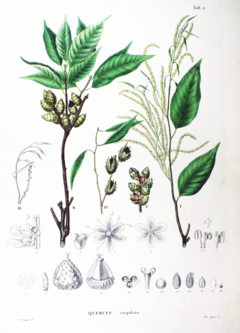
. They are at least large shrubs but some species grow into sizeable trees. Their leaves are usually tough and much sclerotized
and have a well-developed cuticula. Their flower
s are unisexual, and the male ones are borne in erect catkin
s. The epigynous female flowers produce a single seed
each but are congregated in small clusters. The fruit
is a calybium, the kind of encased nut
typical of Fabaceae. The calybium (nut) resembles a pointed acorn
; the cupule (casing) is hard like that of beechnuts and spiny like that of chestnuts. Three thickened ridges run the length of the calybium's shell.
and are often keystone species
in their ecosystems. They are plentiful in ecotone
s as diverse as Borneo montane rain forests
, Taiwan subtropical evergreen forests
and Northern Triangle temperate forests
. Generally they are common in Fagales
-dominated montane forests and temperate to subtropical laurel forest
s. In the latter, they are characteristic elements of the climax vegetation
in essentially their entire continental Asian range, as well as on Taiwan
.
Plants of this genus grow on many soil
types, as long as they are not calcareous
. Several species have adapted to podsol
ic, peat bog, swamp
and other acid
ic and/or wet soils, or to the poor dry soils common in arid
habitat. Around the Oligo
-Miocene
boundary, Castanopsis grew abundantly along rivers and in bogs and swamps of then-subtropical Europe
. The prehistoric plant community Castanopsietum oligo-miocenicum is the source of much of the lignite
("brown coal") deposits in Western and Central Europe.
Most species yield valuable timber
but some have become rare due to unsustainable logging
, C. catappaefolia
is even in danger of extinction. As noted above, however, perhaps the most important use for Castanopsis wood is in its fossil form. 175,400 metric tons of lignite - much of which was former chinkapin trees - were mined in Germany
in 2001.
As with many Fagaceae, the nut
s of many Castanopsis species are edible. The trees may be grown for their nuts, but more often they are used as forestry
or ornamental
trees and the nuts are collected opportunistically. Among many animals, such as tit
s, corvids, rodent
s, deer
and pig
s, the nuts are popular as food too.
Meguro, Tokyo
and Matsudo, Chiba
in Japan
use shii (椎; Castanopsis cuspidata
) as one of their municipal symbols. The well-known and commercially important shiitake
mushroom
likes to grow on the logs of C. cuspidata and derives its common name from this: shii-take simply means "Castanopsis cuspidata mushroom".
Europe
are:
These are known and identifiable from their fruit. It is not entirely clear if they belong here or into Chrysolepis
, but the pattern of biogeography
- with the two genera being most diverse around the Pacific but absent from North America
east of the Rocky Mountains
suggests that they are indeed correctly assigned to Castanopsis. In addition, two form taxa refer to the remains of these trees, at least in part: the fossil wood Castanoxylon eschweilerense and the fossil pollen Tricolporopollenites cingulum ssp. pusillus.
Genus
In biology, a genus is a low-level taxonomic rank used in the biological classification of living and fossil organisms, which is an example of definition by genus and differentia...
of evergreen
Evergreen
In botany, an evergreen plant is a plant that has leaves in all seasons. This contrasts with deciduous plants, which completely lose their foliage during the winter or dry season.There are many different kinds of evergreen plants, both trees and shrubs...
trees belonging to the beech family, Fagaceae
Fagaceae
The family Fagaceae, or beech family, comprises about 900 species of both evergreen and deciduous trees and shrubs, which are characterized by alternate simple leaves with pinnate venation, unisexual flowers in the form of catkins, and fruit in the form of cup-like nuts. Fagaceous leaves are often...
. The genus contains about 120 species
Species
In biology, a species is one of the basic units of biological classification and a taxonomic rank. A species is often defined as a group of organisms capable of interbreeding and producing fertile offspring. While in many cases this definition is adequate, more precise or differing measures are...
, which are today restricted to tropical and subtropical eastern Asia
Asia
Asia is the world's largest and most populous continent, located primarily in the eastern and northern hemispheres. It covers 8.7% of the Earth's total surface area and with approximately 3.879 billion people, it hosts 60% of the world's current human population...
. A total of 58 species are native to China
China
Chinese civilization may refer to:* China for more general discussion of the country.* Chinese culture* Greater China, the transnational community of ethnic Chinese.* History of China* Sinosphere, the area historically affected by Chinese culture...
, with 30 endemic
Endemic (ecology)
Endemism is the ecological state of being unique to a defined geographic location, such as an island, nation or other defined zone, or habitat type; organisms that are indigenous to a place are not endemic to it if they are also found elsewhere. For example, all species of lemur are endemic to the...
; the other species occur further south, through Indochina
Indochina
The Indochinese peninsula, is a region in Southeast Asia. It lies roughly southwest of China, and east of India. The name has its origins in the French, Indochine, as a combination of the names of "China" and "India", and was adopted when French colonizers in Vietnam began expanding their territory...
to Indonesia
Indonesia
Indonesia , officially the Republic of Indonesia , is a country in Southeast Asia and Oceania. Indonesia is an archipelago comprising approximately 13,000 islands. It has 33 provinces with over 238 million people, and is the world's fourth most populous country. Indonesia is a republic, with an...
, and also in Japan
Japan
Japan is an island nation in East Asia. Located in the Pacific Ocean, it lies to the east of the Sea of Japan, China, North Korea, South Korea and Russia, stretching from the Sea of Okhotsk in the north to the East China Sea and Taiwan in the south...
. The English name chinkapin is shared with other related plants, including the golden chinkapins of the Pacific United States
United States
The United States of America is a federal constitutional republic comprising fifty states and a federal district...
, which are sometimes included within Castanopsis but are more often considered a separate but very closely related genus, Chrysolepis
Chrysolepis
Chrysolepis is a small genus in the beech family Fagaceae, endemic to the western United States. Its two species have the common name chinquapin...
.
They show many characters typical of Fagaceae
Fagaceae
The family Fagaceae, or beech family, comprises about 900 species of both evergreen and deciduous trees and shrubs, which are characterized by alternate simple leaves with pinnate venation, unisexual flowers in the form of catkins, and fruit in the form of cup-like nuts. Fagaceous leaves are often...
. They are at least large shrubs but some species grow into sizeable trees. Their leaves are usually tough and much sclerotized
Sclerosis (medicine)
In medicine, sclerosis refers to the stiffening of a structure, usually caused by a replacement of the normal organ-specific tissue with connective tissue.Types include:...
and have a well-developed cuticula. Their flower
Flower
A flower, sometimes known as a bloom or blossom, is the reproductive structure found in flowering plants . The biological function of a flower is to effect reproduction, usually by providing a mechanism for the union of sperm with eggs...
s are unisexual, and the male ones are borne in erect catkin
Catkin
A catkin or ament is a slim, cylindrical flower cluster, with inconspicuous or no petals, usually wind-pollinated but sometimes insect pollinated . They contain many, usually unisexual flowers, arranged closely along a central stem which is often drooping...
s. The epigynous female flowers produce a single seed
Seed
A seed is a small embryonic plant enclosed in a covering called the seed coat, usually with some stored food. It is the product of the ripened ovule of gymnosperm and angiosperm plants which occurs after fertilization and some growth within the mother plant...
each but are congregated in small clusters. The fruit
Fruit
In broad terms, a fruit is a structure of a plant that contains its seeds.The term has different meanings dependent on context. In non-technical usage, such as food preparation, fruit normally means the fleshy seed-associated structures of certain plants that are sweet and edible in the raw state,...
is a calybium, the kind of encased nut
Nut (fruit)
A nut is a hard-shelled fruit of some plants having an indehiscent seed. While a wide variety of dried seeds and fruits are called nuts in English, only a certain number of them are considered by biologists to be true nuts...
typical of Fabaceae. The calybium (nut) resembles a pointed acorn
Acorn
The acorn, or oak nut, is the nut of the oaks and their close relatives . It usually contains a single seed , enclosed in a tough, leathery shell, and borne in a cup-shaped cupule. Acorns vary from 1–6 cm long and 0.8–4 cm broad...
; the cupule (casing) is hard like that of beechnuts and spiny like that of chestnuts. Three thickened ridges run the length of the calybium's shell.
Uses and ecology
In their rather circumscribed area of occurrence, Castanopsis are able to inhabit a wide range of temperate to tropical habitatHabitat
* Habitat , a place where a species lives and grows*Human habitat, a place where humans live, work or play** Space habitat, a space station intended as a permanent settlement...
and are often keystone species
Keystone species
A keystone species is a species that has a disproportionately large effect on its environment relative to its abundance. Such species play a critical role in maintaining the structure of an ecological community, affecting many other organisms in an ecosystem and helping to determine the types and...
in their ecosystems. They are plentiful in ecotone
Ecotone
An ecotone is a transition area between two biomes but different patches of the landscape, such as forest and grassland. It may be narrow or wide, and it may be local or regional...
s as diverse as Borneo montane rain forests
Borneo montane rain forests
The Borneo montane rain forests are an ecoregion, of Cloud forest, within the Tropical and subtropical moist broadleaf forests Biome, of the island of Borneo in south-east Asia .-Location and description:...
, Taiwan subtropical evergreen forests
Taiwan subtropical evergreen forests
The Taiwan subtropical evergreen forests is an ecoregion that covers most of the island of Taiwan, with the exception of the southern tip of the island, which constitutes the South Taiwan monsoon rain forests ecoregion...
and Northern Triangle temperate forests
Northern Triangle temperate forests
The Northern Triangle temperate forests is a temperate broadleaf and mixed forest ecoregion of thick forest covering the mountains of northern Myanmar.-Setting:...
. Generally they are common in Fagales
Fagales
The Fagales are an order of flowering plants, including some of the best known trees. The order name is derived from genus Fagus, Beeches. They belong among the rosid group of dicotyledons...
-dominated montane forests and temperate to subtropical laurel forest
Laurel forest
Laurel forest is a subtropical or mild temperate forest, found in areas with high humidity and relatively stable and mild temperatures. They are characterized by tree species with evergreen, glossy, enlongated leaves, known as laurophyll or lauroide...
s. In the latter, they are characteristic elements of the climax vegetation
Climax vegetation
Climax vegetation is the vegetation which establishes itself on a given site for given climatic conditions in the absence of anthropic action after a long time ....
in essentially their entire continental Asian range, as well as on Taiwan
Taiwan
Taiwan , also known, especially in the past, as Formosa , is the largest island of the same-named island group of East Asia in the western Pacific Ocean and located off the southeastern coast of mainland China. The island forms over 99% of the current territory of the Republic of China following...
.
Plants of this genus grow on many soil
Soil
Soil is a natural body consisting of layers of mineral constituents of variable thicknesses, which differ from the parent materials in their morphological, physical, chemical, and mineralogical characteristics...
types, as long as they are not calcareous
Calcareous
Calcareous is an adjective meaning mostly or partly composed of calcium carbonate, in other words, containing lime or being chalky. The term is used in a wide variety of scientific disciplines.-In zoology:...
. Several species have adapted to podsol
Podsol
In soil science, podzols are the typical soils of coniferous, or boreal forests. They are also the typical soils of eucalypt forests and heathlands in southern Australia...
ic, peat bog, swamp
Swamp
A swamp is a wetland with some flooding of large areas of land by shallow bodies of water. A swamp generally has a large number of hammocks, or dry-land protrusions, covered by aquatic vegetation, or vegetation that tolerates periodical inundation. The two main types of swamp are "true" or swamp...
and other acid
Acid
An acid is a substance which reacts with a base. Commonly, acids can be identified as tasting sour, reacting with metals such as calcium, and bases like sodium carbonate. Aqueous acids have a pH of less than 7, where an acid of lower pH is typically stronger, and turn blue litmus paper red...
ic and/or wet soils, or to the poor dry soils common in arid
Arid
A region is said to be arid when it is characterized by a severe lack of available water, to the extent of hindering or even preventing the growth and development of plant and animal life...
habitat. Around the Oligo
Oligocene
The Oligocene is a geologic epoch of the Paleogene Period and extends from about 34 million to 23 million years before the present . As with other older geologic periods, the rock beds that define the period are well identified but the exact dates of the start and end of the period are slightly...
-Miocene
Miocene
The Miocene is a geological epoch of the Neogene Period and extends from about . The Miocene was named by Sir Charles Lyell. Its name comes from the Greek words and and means "less recent" because it has 18% fewer modern sea invertebrates than the Pliocene. The Miocene follows the Oligocene...
boundary, Castanopsis grew abundantly along rivers and in bogs and swamps of then-subtropical Europe
Europe
Europe is, by convention, one of the world's seven continents. Comprising the westernmost peninsula of Eurasia, Europe is generally 'divided' from Asia to its east by the watershed divides of the Ural and Caucasus Mountains, the Ural River, the Caspian and Black Seas, and the waterways connecting...
. The prehistoric plant community Castanopsietum oligo-miocenicum is the source of much of the lignite
Lignite
Lignite, often referred to as brown coal, or Rosebud coal by Northern Pacific Railroad,is a soft brown fuel with characteristics that put it somewhere between coal and peat...
("brown coal") deposits in Western and Central Europe.
Most species yield valuable timber
Timber
Timber may refer to:* Timber, a term common in the United Kingdom and Australia for wood materials * Timber, Oregon, an unincorporated community in the U.S...
but some have become rare due to unsustainable logging
Logging
Logging is the cutting, skidding, on-site processing, and loading of trees or logs onto trucks.In forestry, the term logging is sometimes used in a narrow sense concerning the logistics of moving wood from the stump to somewhere outside the forest, usually a sawmill or a lumber yard...
, C. catappaefolia
Castanopsis catappaefolia
Castanopsis catappaefolia is a species of plant in the Fagaceae family. It is endemic to Malaysia. It is threatened by habitat loss.-Source:* World Conservation Monitoring Centre 1998. . Downloaded on 21 August 2007....
is even in danger of extinction. As noted above, however, perhaps the most important use for Castanopsis wood is in its fossil form. 175,400 metric tons of lignite - much of which was former chinkapin trees - were mined in Germany
Germany
Germany , officially the Federal Republic of Germany , is a federal parliamentary republic in Europe. The country consists of 16 states while the capital and largest city is Berlin. Germany covers an area of 357,021 km2 and has a largely temperate seasonal climate...
in 2001.
As with many Fagaceae, the nut
Nut (fruit)
A nut is a hard-shelled fruit of some plants having an indehiscent seed. While a wide variety of dried seeds and fruits are called nuts in English, only a certain number of them are considered by biologists to be true nuts...
s of many Castanopsis species are edible. The trees may be grown for their nuts, but more often they are used as forestry
Forestry
Forestry is the interdisciplinary profession embracing the science, art, and craft of creating, managing, using, and conserving forests and associated resources in a sustainable manner to meet desired goals, needs, and values for human benefit. Forestry is practiced in plantations and natural stands...
or ornamental
Ornamental
Ornamental may refer to:*Ornamental grass, a type of grass grown as a decoration*Ornamental iron, mild steel that has been formed into decorative shapes, similar to wrought iron work*Ornamental plant, a plant that is grown for its ornamental qualities...
trees and the nuts are collected opportunistically. Among many animals, such as tit
Tit
TIT, Tit., tit., Tit, or Tits may refer to:- Birds :* Tit , of the family Paridae, including tits, chickadees and titmice* Long-tailed tits, of the family Aegithalidae* Wrentit, of the family Sylviidae...
s, corvids, rodent
Rodent
Rodentia is an order of mammals also known as rodents, characterised by two continuously growing incisors in the upper and lower jaws which must be kept short by gnawing....
s, deer
Deer
Deer are the ruminant mammals forming the family Cervidae. Species in the Cervidae family include white-tailed deer, elk, moose, red deer, reindeer, fallow deer, roe deer and chital. Male deer of all species and female reindeer grow and shed new antlers each year...
and pig
Pig
A pig is any of the animals in the genus Sus, within the Suidae family of even-toed ungulates. Pigs include the domestic pig, its ancestor the wild boar, and several other wild relatives...
s, the nuts are popular as food too.
Meguro, Tokyo
Meguro, Tokyo
is one of the 23 special wards of Tokyo, Japan. It calls itself Meguro City in English.Meguro hosts fifteen foreign embassies and consulates. One of Tokyo's most exclusive residential neighborhoods is located in Meguro....
and Matsudo, Chiba
Matsudo, Chiba
is a city located in northern Chiba Prefecture, Japan. As of February 2011, the city had an estimated population of 484,578 and a population density of 7900 persons per km²...
in Japan
Japan
Japan is an island nation in East Asia. Located in the Pacific Ocean, it lies to the east of the Sea of Japan, China, North Korea, South Korea and Russia, stretching from the Sea of Okhotsk in the north to the East China Sea and Taiwan in the south...
use shii (椎; Castanopsis cuspidata
Castanopsis cuspidata
Castanopsis cuspidata is a species of Castanopsis native to southern Japan and southern Korea....
) as one of their municipal symbols. The well-known and commercially important shiitake
Shiitake
The Shiitake is an edible mushroom native to East Asia, which is cultivated and consumed in many Asian countries, as well as being dried and exported to many countries around the world. It is a feature of many Asian cuisines including Vietnamese, Chinese, Japanese, Korean and Thai...
mushroom
Mushroom
A mushroom is the fleshy, spore-bearing fruiting body of a fungus, typically produced above ground on soil or on its food source. The standard for the name "mushroom" is the cultivated white button mushroom, Agaricus bisporus; hence the word "mushroom" is most often applied to those fungi that...
likes to grow on the logs of C. cuspidata and derives its common name from this: shii-take simply means "Castanopsis cuspidata mushroom".
Selected species
- Castanopsis acuminatissimaCastanopsis acuminatissimaCastanopsis acuminatissima is an evergreen tree native to Southeast Asia and New Guinea. It is known by a variety of common names over its range, including White Oak, New Guinea Oak, Papua New Guinea Oak, ki riung, ko-duai, ko-soi, ko-mat, meranak, and riung anak.-Form:Castanopsis acuminatissima is...
(Blume) A. DC. (= Castanea acuminatissima Blume, Quercus junghuhnii Miq.) - Castanopsis argentea (Blume) A. DC. (= Castanea argentea (Blume) Blume)
- Castanopsis argyrophylla King ex Hook. f.
- Castanopsis calathiformis
- Castanopsis carlesii (Hemsl.) Hayata (= Quercus carlesii Hemsl.)
- Castanopsis catappaefoliaCastanopsis catappaefoliaCastanopsis catappaefolia is a species of plant in the Fagaceae family. It is endemic to Malaysia. It is threatened by habitat loss.-Source:* World Conservation Monitoring Centre 1998. . Downloaded on 21 August 2007....
- Castanopsis ceratacantha
- Castanopsis cerebrina
- Castanopsis choboensis
- Castanopsis chunii
- Castanopsis clarkei
- Castanopsis concinnaCastanopsis concinnaCastanopsis concinna is a species of plant in the Fagaceae family. It is a tree found in China and Hong Kong. It is threatened by habitat loss.-References:* World Conservation Monitoring Centre 1998. . Downloaded on 21 August 2007....
- Castanopsis crassifolia
- Castanopsis curtisiiCastanopsis curtisiiCastanopsis curtisii is a species of plant in the Fagaceae family. It is endemic to Malaysia. It is threatened by habitat loss.-Source:* Chua, L.S.L. 1998. . Downloaded on 21 August 2007....
- Castanopsis cuspidata – Japanese Chinquapin, shii
- Castanopsis delavayi Franch.
- Castanopsis diversifolia (Kurz) King ex Hook. f. (= Castanea diversifolia Kurz)
- Castanopsis eyrei (Champ. ex Benth.) Tutcher (= Castanopsis caudata Franch., Quercus eyrei Champ. ex Benth.)
- Castanopsis fabri Hance (= Castanopsis stellatospina Hayata)
- Castanopsis fargesii Franch. (= Castanopsis taiwaniana Hayata)
- Castanopsis fissa
- Castanopsis fordii
- Castanopsis globigemmata
- Castanopsis hainanensis
- Castanopsis hystrixCastanopsis hystrixCastanopsis hystrix is a species of evergreen broadleaf tree, which grows up to 30 meters in height.The tree is found in subtropical broadleaved evergreen forests, ranging from the eastern Himalayas of Nepal, Bhutan, and northeastern India, across Indochina , southern China Castanopsis hystrix is a...
- Castanopsis indica (Roxb. ex Lindl.) A. DC. (= Castanea indica Roxb.)
- Castanopsis inermis (Lindl.) Benth. & Hook. f. (= Callaeocarpus sumatrana Miq., Castanea inermis Lindl., Castanopsis sumatrana (Miq.) A. DC.)
- Castanopsis javanica (Blume) A. DC. (= Castanea javanica (Blume) Blume, Fagus javanica Blume, Quercus discocarpa Hance, Quercus javanica (Blume) Drake)
- Castanopsis kawakamiiCastanopsis kawakamiiCastanopsis kawakamii is a species of plant in the Fagaceae family. It is found in China, Taiwan, and Vietnam. It is threatened by habitat loss.-Source:* Temperate Broadleaved Tree Specialist Group 1998. . Downloaded on 21 August 2007....
- Castanopsis kweichowensis
- Castanopsis lamontii
- Castanopsis lanceifolia (Kurz) Hickel & A. Camus
- Castanopsis longzhouica
- Castanopsis mekongensis
- Castanopsis nephelioidesCastanopsis nephelioidesCastanopsis nephelioides is a species of plant in the Fagaceae family. It is found in Malaysia and Singapore. It is threatened by habitat loss.-References:* Chua, L.S.L. 1998. . Downloaded on 21 August 2007....
- Castanopsis orthacantha
- Castanopsis philipensis (Blanco) S. Vidal (= Fagus philipensis Blanco)
- Castanopsis platyacantha
- Castanopsis rockii
- Castanopsis sclerophylla (Lindl. & Paxton) Schottky (= Quercus chinensis C. Abel, Quercus sclerophylla Lindl. & Paxton)
- Castanopsis scortechiniiCastanopsis scortechiniiCastanopsis scortechinii is a species of plant in the Fagaceae family. It is endemic to Malaysia. It is threatened by habitat loss.-References:* Chua, L.S.L. 1998. . Downloaded on 21 August 2007....
- Castanopsis sieboldii (Makino) Hatus. (= Castanopsis cuspidata var. sieboldii (Makino) Nakai, Pasania cuspidata var. sieboldii Makino)
- Castanopsis tessellata Hickel & A. Camus
- Castanopsis tibetana Hance)
- Castanopsis tribuloides (Sm.) A. DC. (= Quercus tribuloides Sm.)
- Castanopsis tungurrut (Blume) A. DC. (= Castanea tungurrut Blume)
- Castanopsis uraiana
- Castanopsis wallichiiCastanopsis wallichiiCastanopsis wallichii is a species of plant in the Fagaceae family. It is found in Malaysia and Singapore. It is threatened by habitat loss.-References:* Chua, L.S.L. 1998. . Downloaded on 21 August 2007....
- Castanopsis wattii
- Castanopsis xichouensis
Formerly placed here
- Castanea henryi (Skan) Rehder & E. H. Wilson (as C. henryi
- ChrysolepisChrysolepisChrysolepis is a small genus in the beech family Fagaceae, endemic to the western United States. Its two species have the common name chinquapin...
Fossil record
Fossil species known from MioceneMiocene
The Miocene is a geological epoch of the Neogene Period and extends from about . The Miocene was named by Sir Charles Lyell. Its name comes from the Greek words and and means "less recent" because it has 18% fewer modern sea invertebrates than the Pliocene. The Miocene follows the Oligocene...
Europe
Europe
Europe is, by convention, one of the world's seven continents. Comprising the westernmost peninsula of Eurasia, Europe is generally 'divided' from Asia to its east by the watershed divides of the Ural and Caucasus Mountains, the Ural River, the Caspian and Black Seas, and the waterways connecting...
are:
- Castanopsis pyramidata (Menzel) Kirchheimer
- Castanopsis salinarum (Unger) Kirchheimer
- Castanopsis schmidtiana (Geinitz) Kräusel
These are known and identifiable from their fruit. It is not entirely clear if they belong here or into Chrysolepis
Chrysolepis
Chrysolepis is a small genus in the beech family Fagaceae, endemic to the western United States. Its two species have the common name chinquapin...
, but the pattern of biogeography
Biogeography
Biogeography is the study of the distribution of species , organisms, and ecosystems in space and through geological time. Organisms and biological communities vary in a highly regular fashion along geographic gradients of latitude, elevation, isolation and habitat area...
- with the two genera being most diverse around the Pacific but absent from North America
North America
North America is a continent wholly within the Northern Hemisphere and almost wholly within the Western Hemisphere. It is also considered a northern subcontinent of the Americas...
east of the Rocky Mountains
Rocky Mountains
The Rocky Mountains are a major mountain range in western North America. The Rocky Mountains stretch more than from the northernmost part of British Columbia, in western Canada, to New Mexico, in the southwestern United States...
suggests that they are indeed correctly assigned to Castanopsis. In addition, two form taxa refer to the remains of these trees, at least in part: the fossil wood Castanoxylon eschweilerense and the fossil pollen Tricolporopollenites cingulum ssp. pusillus.