
See Also

Acorn

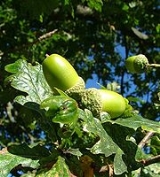
The acorn is the fruit Fruit

The term fruit has different meanings depending on context.... 

 of the oak Oak

The term oak can be used as part of the common name of any of several hundred species of tree [i]s and shrub [i] ... 

 tree . It is a nut, containing a single seed Seed

A seed is the ripened ovule [i] of gymnosperm [i] or angiosperm [i] plant [i]s. ... 

 , enclosed in a tough, leathery shell, and borne in a cup-shaped cupule Cupule

A cupule is a fruit [i] structure found in flowering plant [i]s in the family Fagaceae [i]. ... 

. Acorns vary from 1-6 cm long and 0.8-4 cm broad. Acorns take about 6 or 24 months to mature; see List of Quercus species for details of oak classification, in which acorn morphology and phenology are important factors.

Discussions

  Discussion Features

   Ask a question about 'Acorn'

   Start a new discussion about 'Acorn'

   Answer questions about 'Acorn'

   'Acorn' discussion forum


Encyclopedia


The acorn is the fruit Fruit

The term fruit has different meanings depending on context.... 

 of the oak Oak

The term oak can be used as part of the common name of any of several hundred species of tree [i]s and shrub [i] ... 

 tree . It is a nut, containing a single seed Seed

A seed is the ripened ovule [i] of gymnosperm [i] or angiosperm [i] plant [i]s. ... 

 , enclosed in a tough, leathery shell, and borne in a cup-shaped cupule Cupule

A cupule is a fruit [i] structure found in flowering plant [i]s in the family Fagaceae [i]. ... 

. Acorns vary from 1-6 cm long and 0.8-4 cm broad. Acorns take about 6 or 24 months to mature; see List of Quercus species for details of oak classification, in which acorn morphology and phenology are important factors.

Nutrition

Acorns are one of the most important wildlife foods in areas where oaks occur. Creatures that make acorns an important part of their diet include bird Bird

Birds are biped [i]al, warm-blooded [i], oviparous [i] vertebrate [i] animals characterized [i] ... 

s such as jay Jay

Jay is a common name for several species [i] of medium-sized, usually colorful and noisy passerine [i] o ... 

s, pigeon Dove

The pigeons and doves are some 300 species [i] of near passerine [i] bird [i]s in the order Columbiformes [i] ... 

s, some duck Duck

Duck is the common name for a number of species in the Anatidae [i] family of bird [i]s. ... 

s and several species of woodpecker Woodpecker

Woodpeckers are near passerine [i] bird [i]s of the order Piciformes [i]. ... 

s. Small mammals that feed on acorns include mice Mouse

A mouse is a mammal [i] that belongs to one of numerous species [i] of small rodent [i]s.
... 

, squirrel Squirrel

Squirrel is the common name for rodent [i]s of the family Sciuridae [i] . ... 

s and several other rodent Rodent

Rodentia is an order [i] of mammal [i]s . Members of the order Rodentia are called rodents. ... 

s. Large mammals such as pig Pig

Pigs are ungulate [i]s native to Eurasia [i] collectively grouped under the genus [i] Sus with ... 

s, bear Bear

A bear is a large mammal [i] in the family Ursidae of the order Carnivora [i].... 

s and deer Deer

A deer is a ruminant [i] mammal [i] belonging to the family [i] Cervidae. ... 

 also consume large amounts of acorns; they may constitute up to 25% of the diet of deer in the autumn. In some of the large oak forests in southwest Europe Europe

Europe is one of the seven traditional continent [i]s of the Earth [i]. ... 

, pigs are still turned loose in oak groves in the autumn, to fill and fatten themselves on acorns. However, acorns are toxic to some other animals, such as horse Horse

The horse is a large odd-toed ungulate [i] mammal [i], one of ten modern species of the genus Equus [i]... 

s.

In some human Human

Humans, or human beings, are biped [i]al primate [i]s belonging to the mammal [i]ian species ... 

 cultures, acorns once constituted a dietary staple, though they are now generally only a very minor food.

The larva Larva

A larva is a juvenile form of animal [i] with indirect development [i], undergoin... 

e of some moth Moth

A moth is an insect [i] closely related to the butterfly [i]. ... 

s and weevil Weevil

A weevil is a beetle [i] from the Curculionoidea superfamily [i]. ... 

s also live in young acorns, consuming the kernels as they develop.

Acorns are attractive to animals because they are large and thus efficiently consumed or cached. Acorns are also rich in nutrients. Percentages vary from species to species, but all acorns contain large amounts of protein Protein

Proteins are large organic compound [i]s made of amino acid [i]s arranged in a linear chain and joined b ... 

, carbohydrate Carbohydrate

Carbohydrates are chemical compound [i]s that contain oxygen [i], hydrogen [i], and carbon [i] atom [i]s ... 

s and fats, as well as the minerals calcium, phosphorus Phosphorus

|-
| Critical temperature [i] || 994 K [i]
... 

 and potassium Potassium

Potassium is a chemical element [i].... 

, and the vitamin Vitamin

Vitamins are nutrient [i]s required for essential metabolic reactions in the body . ... 

 niacin Niacin

Niacin, also known as nicotinic acid or vitamin B3, is a water-soluble vitamin [i] whose der ... 

. Total food energy Food energy

Food energy is the amount of energy [i] in food that is available through digestion [i]. ... 

 in an acorn also varies by species, but all compare well with other wild foods and with other nuts.

Acorns also contain bitter tannins, the amount varying with the species. Since tannins, which are plant polyphenols, interfere with an animal's ability to metabolize Metabolism

[i]s in [[life|living]... 

 protein, creatures must adapt in different ways to utilize the nutritional value that acorns contain. Animals may preferentially select acorns that contain fewer tannins. Creatures that cache acorns, such as jays and squirrels, may wait to consume some of these acorns until sufficient groundwater has percolated through them to leach the tannins out. Other animals buffer their acorn diet with other foods. Many insects, birds and mammals metabolize tannins with fewer ill-effects than humans. Several humans cultures devised acorn-leaching methods that involved tools, and that could be passed on to their children.


Species of acorn that contain large amounts of tannins are very bitter, astringent, and potentially irritating if eaten raw. This is particularly true of the acorns of red oaks. The acorns of white oaks, being much lower in tannins, are nutty in flavor, which is enhanced if the acorns are given a light roast before grinding. Tannins can be removed by boiling chopped acorns in several changes of water, until water no longer turns brown. Being rich in fat Fat

Fats consist of a wide group of compounds that are generally soluble in organic solvents and largely ins... 

, acorn flour can spoil or get mold Mold

Molds, or moulds, are fungi [i] that grow in the form of mycelia [i] and usually p ... 

y easily and must be carefully stored. Acorns are also sometimes prepared as a massage oil.

Acorn dispersal agents

Acorns, being too heavy to blow in wind, do not fall far from the tree at maturity. Because of this, oaks depend on seed dispersal agents to move the acorns beyond the canopy of the mother tree and into an environment in which they can germinate and find access to adequate water, sunlight and soil nutrients, ideally a minimum of 20-30 m from the parent tree. Many acorn predators eat unripe acorns on the tree or ripe acorns from the ground, with no reproductive benefit to the oak. However, some acorn predators also serve as seed dispersal agents. Jays and squirrels that scatter-hoard acorns in caches for future use, effectively plant acorns in a variety of locations in which it is possible for them to germinate and thrive. Although jays and squirrels retain remarkably large mental maps of cache locations and return to consume them, the odd acorn may be lost, or a jay or squirrel may die before consuming all of its stores. A small number of acorns manage to germinate and survive, producing the next generation of oaks.

Scatter-hoarding behavior depends on jays and squirrels associating with plants that provide good packets of food that are nutritionally valuable, but not too big for the dispersal agent to handle. The beak sizes of jays determine how large acorns may get before jays ignore them.

Acorns germinate on different schedules, depending on their place in the oak family. Once acorns sprout, they are less nutritious, as the seed tissue converts to the indigestible lignin Lignin

Lignin is a chemical compound [i] that is most commonly derived from wood [i] and is an integral part of ... 

s that form the root.

Cultural aspects

Acorns appear only on adult trees, and thus are often a symbol of patience and the fruition of long, hard labor. For example, an English proverb states that Great oaks from little acorns grow, urging the listener to wait for maturation of a project or idea. A German Germany

Germany , officially the Federal Republic of Germany , is a country [i] in central Europe [i]. ... 

 folktale has a farmer try to outwit Satan Satan

Satan is a term with its origins in the Abrahamic faiths which is traditionally applied to an angel [i] ... 

, to whom he has promised his soul, by asking for a reprieve until his first crop is harvested; he plants acorns and has many years to enjoy first. In Britain, one old tradition has it that if a woman carries an acorn on her person it will delay the aging process and keep her forever young.

The Norse Norse mythology

Norse or Scandinavian mythology comprises the pre-Christian [i] religion [i], beliefs ... 

 legend that Thor Thor

Thor is the red-haired and bearded god of thunder [i] in Norse Mythology [i] and more generally Germanic mythology [i] ... 

 sheltered from a thunderstorm under an oak tree has led to the belief that having an acorn on a windowsill will prevent a house from being struck by lightning Lightning

Lightning is a powerful natural electrostatic discharge [i] produced during a thunderstorm [i]. ... 

, hence the popularity of window blind pulls decorated as acorns. In ancient Japan Japan

is an island country [i] in East Asia [i]. ... 

, , acorn was an important food. They harvested, peeled and soaked acorns in natural or artificial ponds for several days to remove tannins, then processed it to make acorn cakes. In Korea Korea

Korea
One of the world's oldest civilization [i]s, Korea began with the founding of Gojoseon [i] in 2333 ... 

, an edible jelly named dotorimuk Dotorimuk

Dotorimuk or acorn jelly is a Korea [i]n food which is a jelly made from acorn [i] starch [i]. ... 

is made from acorns.

A motif in Roman architecture and popular in Celtic and Scandinavian art, the symbol is used as an ornament on cutlery Cutlery

Cutlery refers to any hand utensil [i] used in preparing, serving, and especially eating food [i].... 

, jewelry, furniture, and appears on finial Finial

The finial is an architectural device, typically carved in stone and employed to decoratively emphasise the ap... 

s at Westminster Abbey Westminster Abbey

The Collegiate Church of St Peter, Westminster, which is almost always referred to as Westminster Abb... 

. The Gothic Gothic language

The Gothic language is an extinct [i] Germanic language [i] that was spoken by the Goths [i] ... 

 name akran, German Eicher, etc., had the sense of "fruit of the unenclosed land". The word was applied to the most important forest produce, that of the oak. Chaucer Geoffrey Chaucer

Geoffrey Chaucer was an English [i] author [i], poet [i], philosopher [i] ... 

 spoke of "achornes of okes" in the 1300s. By degrees, popular etymology connected the word both with "corn" and "oak-horn", and the spelling changed accordingly.

In the 1600s, a juice extracted from acorns was administered to habitual drunkards to cure them of their condition or else to give them the strength to resist another bout of drinking. Young lovers may place two acorns, representing themselves and the object of their affection, in a bowl of water in order to predict whether they have a future together; if the acorns drift towards each other they are certain to marry .

By analogy with the shape, in nautical language, the word acorn also refers to a piece of wood keeping the vane on the mast-head.

Native American management of acorn resources

Acorns were a traditional food of many indigenous Indigenous peoples of the Americas

The term Indigenous peoples of the Americas encompasses the inhabitants of the Americas [i] before the European discovery of the Americas [i] ... 

 peoples of North America, but served an especially important role in California, where the ranges of several species of oaks overlap, increasing the reliability of the resource.

Acorns, unlike many other plant foods, do not need to be eaten or processed immediately, but may be stored for long time periods. In years that oaks produced many acorns, Native Americans sometimes collected enough acorns to store for two years as insurance against poor acorn production years. After drying them in the sun to discourage mold and germination, Indian women took acorns back to their villages and cached them in hollow trees or structures on poles, to keep acorns safe from mice and squirrels. These acorns could be used as needed. Storage of acorns permitted Native American women to process acorns when convenient, particularly during winter months when other resources were scarce. Women's caloric contributions to the village increased when they stored acorns for later processing and focused on gathering or processing other resources available in the autumn.

Women shelled and pulverized those acorns that germinate in the fall before those that germinate in spring. Because of their high fat content, stored acorns can become rancid. Molds may also grow on them.

Native North Americans took an active and sophisticated role in management of acorn resources through the use of fire, which increased the production of acorns and made them easier to collect. The deliberate setting of light ground fires killed the larvae of acorn moths and acorn weevils that have the potential to infest and consume more than 95% of an oak's acorns, by burning them during their dormancy period in the soil. Fires released the nutrients bound in dead leaves and other plant debris into the soil, thus fertilizing oak trees while clearing the ground to make acorn collection faster and easier. Most North American oaks tolerate light fires, especially when consistent burning has eliminated woody fuel accumulation around their trunks. Consistent burning encouraged oak growth at the expense of other trees that are less tolerant of fire, thus keeping landscapes in a subclimax state in which oaks dominated. Since oaks produce more acorns when they are not in close competition with other oaks for sunlight, water and soil nutrients, eliminating young oaks more vulnerable to fire than old oaks created open oak savannahs with trees ideally spaced to maximize acorn production. Finally, frequent fires prevented accumulation of flammable debris, which reduced the risk of destructive canopy fires that destroyed oak trees. After a century during which North American landscapes have not been managed by indigenous peoples, disastrous fires have ravaged crowded, fuel-laden forests. Land managers have realized that they can learn much from indigenous resource management techniques, such as controlled burning Controlled burn

Prescribed or controlled burning is a technique sometimes used in forest [i] management [i], farming [i] ... 

, widely practiced by Native Americans to enhance such resources as acorns.

References and external links

  • Baumhoff, Martin A. Ecological Determinants of Aboriginal California Populations. University of California Publications in American Archaeology and Etnology 49155-235.
  • Brown, Leland R. Insects Feeding on California Oak Treesin Proceedings of the Symposium on Multiple-Use Management of California's Hardwood Resources, Timothy Plum and Norman Pillsbury . Gen. Tech. Rep. PSW-44, USDA, Forest Service, Pac. S.W. Forest and Range Experiment Station, Berkeley, California, pp. 184-194.
  • Janzen, Daniel H. Seed Predation by Animals in Annual Review of Ecology and Systematics. Richard F. Johnson, Peter W. Frank and Charles Michner .