
All Topics  
Tanning

 
Tanning

   Email Print
   Bookmark   Link


Tanning


Tanning is the process of making leather
Leather

Leather is a material created through the tanning of rawhides and skins of animals, primarily cattlehide. The tanning process converts the putrescible skin into a durable, long-lasting and versatile natural material for various uses....
, which does not easily decompose
Decomposition

Decomposition refers to the process by which tissues of dead organisms break down into simpler forms of matter. Such a breakdown of dead organisms is essential for new growth and development of living organisms because it recycles the finite chemical constituents and frees up the limited physical space in the biome....
, from the skins of animals, which do. Often this uses tannin
Tannin

Tannins are astringent, bitter plant polyphenols that either bind and Precipitation or shrink proteins. The astringency from the tannins is what causes the dry and puckery feeling in the mouth following the consumption of red wine or an unripened fruit....
, an acid
Acid

An acid is traditionally considered any chemical compound that, when dissolved in water, gives a solution with a hydrogen ion Activity greater than in pure water, i.e....
ic chemical compound
Chemical compound

A chemical compound is a Chemical substance consisting of two or more different chemical element Chemical bond together in a fixed mass ratio that can be split into simpler substances....
. Coloring may occur during tanning.

Tanning leather involves a process which permanently alters the protein structure of skin so that it can not ever return to rawhide
Rawhide

Rawhide is a Hides or animal skin that has not been exposed to tanning. It is much lighter in color than leather made by traditional vegetable tanning....
.


Discussion
Ask a question about 'Tanning'
Start a new discussion about 'Tanning'
Answer questions from other users
Full Discussion Forum


Encyclopedia


Tanned Leather
Tanning is the process of making leather
Leather

Leather is a material created through the tanning of rawhides and skins of animals, primarily cattlehide. The tanning process converts the putrescible skin into a durable, long-lasting and versatile natural material for various uses....
, which does not easily decompose
Decomposition

Decomposition refers to the process by which tissues of dead organisms break down into simpler forms of matter. Such a breakdown of dead organisms is essential for new growth and development of living organisms because it recycles the finite chemical constituents and frees up the limited physical space in the biome....
, from the skins of animals, which do. Often this uses tannin
Tannin

Tannins are astringent, bitter plant polyphenols that either bind and Precipitation or shrink proteins. The astringency from the tannins is what causes the dry and puckery feeling in the mouth following the consumption of red wine or an unripened fruit....
, an acid
Acid

An acid is traditionally considered any chemical compound that, when dissolved in water, gives a solution with a hydrogen ion Activity greater than in pure water, i.e....
ic chemical compound
Chemical compound

A chemical compound is a Chemical substance consisting of two or more different chemical element Chemical bond together in a fixed mass ratio that can be split into simpler substances....
. Coloring may occur during tanning.

Tanning leather involves a process which permanently alters the protein structure of skin so that it can not ever return to rawhide
Rawhide

Rawhide is a Hides or animal skin that has not been exposed to tanning. It is much lighter in color than leather made by traditional vegetable tanning....
. Making rawhide does not require the use of tannin and is made simply by removing the flesh and then the hair by way of soaking in an aqueous solution (often called liming when using lime and water or bucking when using wood ash (lye
Lye

Lye is a corrosive alkaline substance, commonly, sodium hydroxide . Previously, lye was among the many different alkalis leached from hardwood ashes....
) and water), then scraping over a beam with a somewhat dull knife, and then leaving to dry, usually stretched on a frame so that it dries flat. The two aforementioned solutions for removing the hair also act to clean the fiber network of the skin and therefore allow penetration and action of the tanning agent.

Ancient methods of tanning

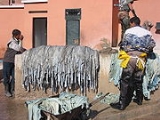
Moroccofes Tannerybig
In ancient history
Ancient history

Ancient history is the history from the History of writing until the Early Middle Ages in Europe, the Qin Dynasty in China, the Chola Empire in India, and some less defined point in the rest of the world ....
, tanning was considered a noxious or "odiferous trade" and relegated to the outskirts of town
City-state

A city-state is an independent country whose territory consists solely of a single major city and the area immediately surrounding it. Examples include the city-states of ancient Greece , the Phoenician cities of Canaan , the Sumerian cities of Mesopotamia , the Mayans of pre-Columbian Mesoamerica , the central Asian cities along the Silk Roa...
, amongst the poor
Poverty

Poverty is the shortage of common things such as food, clothing, shelter and safe drinking water, all of which determine our quality of life. It may also include the lack of access to opportunities such as education and employment which aid the escape from poverty and/or allow one to enjoy the respect of fellow citizens....
. Indeed, tanning by ancient methods is so foul smelling that tanneries are still isolated from those towns today where the old methods are used. The ancients used leather for waterskins, bag
Bag

A bag is a non-Stiffness or semi-rigid container, made of paper, cloth, plastic, leather, or some other flexible material.A bag is used for packaging and/or carrying items....
s, harness
Harness

A harness is a looped restraint or support.Harness may also refer to:*Harness , a character in the Marvel Comics universe*Child harness...
es, boats, armor, quiver
Quiver

A quiver is a container for arrow , quarrel or dart , such as those shot from a bow , crossbow or blowgun. Quivers have different forms depending on their use: quivers may hang from an Archery's belt , from a saddle, or be worn on the back....
s, scabbard
Scabbard

A scabbard is a sheath for holding a sword or other large blade.Scabbards have been made of many materials over the millennia, including leather, wood, and metals such as brass or steel....
s, boot
Boot

A boot is a type of shoe that covers at least the foot and the ankle and sometimes extends up to the knee or even the hip. Most have a heel that is clearly distinguishable from the rest of the sole, even if the two are made of one piece....
s and sandal
Sandal (footwear)

Sandals are an open type of footwear, consisting of a sole held to the wearer's foot by straps or thongs passing over the instep and around the ankle....
s. Tanning was being carried out by the South Asia
South Asia

South Asia, also known as Southern Asia, is the southern region of the Asian continent, which comprises the sub-Himalayan countries and, for some authorities , also includes the adjoining countries on the west and the east....
n inhabitants of Mehrgarh
Mehrgarh

Mehrgarh, one of the most important Neolithic sites in archaeology, lies on what is now the "Kachi plain" of today's Balochistan , Pakistan. It is one of the earliest sites with evidence of farming and herding in South Asia."...
 between 7000–3300 BC. Around 2500 BC, the Sumer
Sumer

Sumer was a civilization and a historical region located in Southern Iraq , known as the Cradle of civilization. It lasted from the first settlement of Eridu in the Ubaid period through the Uruk period and the Dynastic periods until the rise of Babylon in the early 2nd millennium BC....
ians began using leather, affixed by copper
Copper

Copper is a chemical element with the symbol Cu and atomic number 29.It is a ductile metal with very high thermal and electrical conductivity....
 stud
Stud

Stud may refer to:* Stud , an animal retained for breeding* Stud farm, a property where livestock are bredObjects:* Shirt stud, a small ornamental button...
s, on chariot
Chariot

The chariot is the earliest and simplest type of carriage, used in both peace and war as the chief vehicle of many ancient peoples. Chariots were built in Mesopotamia by the Mesopotamians as early as 3000 BC and in China during the 2nd millennium BC....
 wheel
Wheel

A wheel is a circular device that is capable of rotating on its axis, facilitating movement or transportation whilst supporting a load , or performing labour in machines....
s.

Skins typically arrived at the tannery dried stiff and dirty with soil and gore. First, the ancient tanners would soak the skins in water to clean and soften them. Then they would pound and scour the skin to remove any remaining flesh
Flesh

Flesh is the soft part of the body of a person or animal which is between the skin and the bones. In ordinary speech, it typically contrasts with bone, as in the merism flesh and bone....
 and fat
Fat

Fats consist of a wide group of compounds that are generally soluble in organic solvents and largely insoluble in water. Chemistry, fats are generally ester of glycerol and fatty acids....
. Next, the tanner needed to remove the hair fiber
Fiber

Fiber or fibre is a class of materials that are continuous filaments or are in discrete elongated pieces, similar to lengths of yarn. They are very important in the biology of both plants and animals, for holding tissue s together....
s from the skin. This was done by either soaking the skin in urine
Urine

Urine is a liquid waste product of the body secreted by the kidneys by a process of filtration from blood called urination and excreted through the urethra....
, painting it with an alkaline lime mixture, or simply letting the skin putrefy for several months then dipping it in a salt
Salt

A salt, in chemistry, is defined as the product formed from the neutralisation reaction of acids and base . Salts are ionic compounds composed of cations and anions so that the product is electrically electric charge ....
 solution
Solution

In chemistry, a solution is a homogeneous mixture composed of two or more substances. In such a mixture, a solute is dissolved in another substance, known as a solvent....
. After the hair fibers were loosened, the tanners scraped them off with a knife
Knife

A knife is a handheld sharp-edged instrument consisting of a handle attached to a blade that is used for cutting. Knives were used at least Stone Age, as evidenced by the Oldowan tools....
.

Once the hair was removed, the tanners would bate the material by pounding dung
Feces

Feces, faeces, or f?ces is a waste product from an animal's gastrointestinal tract expelled through the anus during defecation....
 into the skin or soaking the skin in a solution of animal brains. Among the kinds of dung commonly used were that of dogs or pigeons. Sometimes the dung was mixed with water in a large vat, and the prepared skins were kneaded in the dung water until they became supple, but not too soft. The ancient tanner might use his bare feet to knead the skins in the dung water, and the kneading could last two or three hours.

It was this combination of urine, animal feces and decaying flesh that made ancient tanneries so odiferous.

Children employed as dung gatherers were a common sight in ancient cities. Also common were "piss-pots" located on street corners, where human urine could be collected for use in tanneries or by washerwomen. In some variations of the process, cedar oil
Cedar oil

Cedar oil was used as the base for paints by the ancient Sumerians. They would grind cobalt chemical compounds in a mortar and pestle to produce a blue pigment....
, alum
Alum

Alum, refers to a specific chemical compound and a class of chemical compounds. The specific compound is the hydrated aluminum potassium sulfate with the chemical formula KAl2.12H2O....
 or tannin were applied to the skin as a tanning agent. As the skin was stretched, it would lose moisture
Moisture

Moisture generally refers to the presence of water, often in trace amounts.The moisture content is often an important aspect of various Food including cheese and many dried goods such as tea where excess moisture can promote Bacteria, Bacterial decay, Mold, or Rot over time....
 and absorb the agent.

Leftover leather would be turned into glue
Animal glue

An animal glue is an adhesive that is created by prolonged boiling of animal connective tissue.These protein colloid glues are formed through hydrolysis of the collagen from skins, bones, tendons, and other tissues, similar to gelatin....
. Tanners would place scraps of hides
Hides

Hides are skins obtained from animals for human use. Examples of animal hide sources are deer and cattle typically used for producing leather, alligator skins, snake skins for shoes and fashion accessories and wild cats, minks and bears, whose skins are primarily sought for their fur....
 in a vat of water and let them deteriorate for months. The mixture would then be placed over a fire to boil
Boiling

Boiling, a type of phase transition, is the rapid vaporization of a liquid, which typically occurs when a liquid is heated to its boiling point, the temperature at which the vapor pressure of the liquid is equal to the pressure exerted on the liquid by the surrounding environmental pressure....
 off the water to produce hide glue
Animal glue

An animal glue is an adhesive that is created by prolonged boiling of animal connective tissue.These protein colloid glues are formed through hydrolysis of the collagen from skins, bones, tendons, and other tissues, similar to gelatin....
.

Variations of these methods are still used by do-it-yourself outdoorsmen to tan hides. The use of brains and the idea that each animal (except buffalo) has just enough brains for the tanning process have led to the saying "Every animal has just enough brains to preserve its own hide, dead or alive."

Modern methods of tanning


The first stage is the preparation for tanning. The second stage is the actual tanning and other chemical treatment. The third stage, known as retanning, applies retanning agents and dyes to the material to provide the physical strength and properties desired depending on the end product. The fourth and final stage, known as finishing, is used to apply finishing material to the surface or finish the surface without the application of any chemicals if so desired.

Preparing hides begins by curing them with salt. Curing is employed to check putrifaction of the protein substance (Collagen) because of the chance of bacterial infection due to the time lag that might occur from procuring it to processing it. It removes the excess water from the hides and skins where water flows from inside because of difference in osmotic pressure. Thus the moisture content of hides and skins get greatly reduced. In wet-salting, the hides are heavily salted, then pressed into packs for about 30 days. In brine
Brine

File:Kissingen-Solepumpe-1848.JPGFile:Kissingen-Solepumpe-1848-2.JPGBrine is water Saturation or nearly saturated with a Salt .It is used to preserve vegetables, fish, and meat, in a process known as brining ....
-curing the hides are agitated in a salt water bath for about 16 hours. Generally speaking, methods employed for curing greatly make the chance of bacterial growth unfavorable. Thus curing is also done by preserving the hides and skins at a very low temperature

The hides are then soaked in clean water to remove the salt and mainly to bring back the moisture content to a desirable level so that the hide or skin can be treated with chemicals in an aqueous medium. This process is known as "Soaking" and sometimes a hydrating agent is also employed along with water in a very low percentage for hides and skins which have become very dry.

Liming Process of Hides & Skins

After soaking, the soaked hides and skins are taken for the next operation where these are treated with milk of lime with or without the addition of sharpening agents like sulfide, cyanides, amines etc. The objective of this operation are mainly to:

  • Remove the hairs, nails and other keratinous matters
  • Remove some of the interfibrillary soluble proteins like mucins
  • Swell up and split up the fibers to the desired extent
  • Remove the natural grease and fats to some extent
  • Bring the collagen to a proper condition for satisfactory tannage


The weakening of hair is dependent on the breakdown of the disulfide link of the amino acid called cystine, which is the characteristic of the keratin class of protein like hair and wools. The hydrogen atoms supplied by the sharpening agent reduce the cystine molecule to cystine and the covalent links are ruptured.

The isoelectric point
Isoelectric point

The isoelectric point , sometimes abbreviated to IEP, is the pH at which a particular molecule or surface carries no net electric charge....
 of the collagen is also shifted to around 4.7, due to liming which is more towards an acidic tannage.

Unhairing Agents used during liming are:

  • Sodium sulfide
    Sodium sulfide

    Sodium sulfide is the name used to refer to the chemical compound Na2S but more commonly its hydrate Na2S.9H2O....
  • Sodium Hydroxide
    Sodium hydroxide

    Sodium hydroxide , also known as lye, caustic soda and sodium hydrate, is a caustic metallic Base . Sodium hydroxide forms a strong alkaline solution when dissolved in a solvent such as water, however, only the hydroxide ion is basic....
  • Sodium Hydrosulfite
  • Arsenic sulfide
    Arsenic sulfide

    Arsenic sulfide may refer to:*Arsenic trisulfide, As2S3, the mineral orpiment*Tetraarsenic tetrasulfide, As4S4, the mineral realgar...
  • Calcium Hydrosulfide
  • Dimethyl Amine
  • Sodium Sulphydrate


The majority of hair is then removed using a machine, with remaining hair being removed by hand using a dull knife, a process known as scudding. Depending on the end use of the leather, hides may be treated with enzymes to soften them in a process called "bating." But before bating, the pH
PH

pH is a measure of the Acid or Base of a solution. It is defined as the cologarithm of the Activity of dissolved hydrogen ions . Hydrogen ion activity coefficients cannot be measured experimentally, so they are based on theoretical calculations....
 of the collagen is brought down to a lower level so that enzymes might act on it. This process is known as "Deliming." Once bating is complete, the hides and skins are treated with a mixture of common salt and Sulphuric acid in case a mineral tanning is to be done. This is done to bring down the pH of collagen to a very low level so as to facilitate the penetration of mineral tanning agent into the substance. This process is known as "Pickling." The common salt penetrates the substance twice as fast as the acid and checks the ill effect of sudden drop of pH.

Tanning can be performed with either vegetable or mineral methods. Before tanning, the skins are unhaired, degreased, desalted and soaked in water over a period of 6 hours to 2 days. To prevent damage of the skin by bacterial growth during the soaking period, biocide
Biocide

A biocide is a chemical substance capable of killing life, usually in a selective way. Biocides are commonly used in medicine, agriculture, forestry, and in industry where they prevent the fouling of water and oil pipelines....
s, such as pentachlorophenol
Pentachlorophenol

Pentachlorophenol is a synthetic substance that was first produced in the 1930s. It is marketed under the trade names Santophen, Pentachlorol, Chlorophen, Chlon, Dowicide 7, Pentacon, Penwar, Sinituho and Penta among others....
, are used.

Vegetable tanning uses tannin (this is where the name tanning comes from). Tannin occurs naturally in bark. The primary barks used in modern times are chestnut
Chestnut

Chestnut , is a genus of eight or nine species of deciduous trees and shrubs in the Beech family Fagaceae, native to temperate climate regions of the Northern Hemisphere....
, oak
Oak

The term oak can be used as part of the common name of any of about 400 species of trees and shrubs in the genus Quercus , which are listed in the List of Quercus species, and some related genera, notably Lithocarpus....
, tanoak
Tanoak

Lithocarpus densiflorus, commonly known as the Tanoak or Tanbark-oak, is an evergreen tree in the beech family Fagaceae, native to the western United States, in California as far south as the Transverse Ranges and north to southwest Oregon....
, hemlock
Tsuga

Tsuga is a genus of Pinophyta in the family Pinaceae. The common name hemlock is derived from a perceived similarity in the smell of the crushed foliage to that of the unrelated herb Conium; see hemlock for other senses of the word....
, quebracho
Quebracho

Quebracho is one of the common names, in Spanish language, of at least three similar species of trees that grow in the Gran Chaco region of South America:...
, mangrove
Mangrove

Mangroves are trees and shrubs that grow in saline water coastal habitats in the tropics and subtropics. The word is used in at least three senses: most broadly to refer to the habitat and entire plant assemblage or mangal, for which the terms mangrove swamp and mangrove forest are also used, to refer to all trees and...
, wattle
Acacia

Acacia is a genus of shrubs and trees belonging to the subfamily Mimosoideae of the family Fabaceae, first described in Africa by the Sweden botanist Carolus Linnaeus in 1773....
 and myrobalan. Hides are stretched on frames and immersed for several weeks in vats of increasing concentrations of tannin. Vegetable tanned hide is flexible and is used for luggage and furniture.

Mineral tanning usually uses chromium
Chromium

Chromium is a chemical element which has the symbol Cr and atomic number 24. It is a steely-gray, Lustre , hard metal that takes a high polish and has a high melting point....
 in the form of basic chromium sulfate
Chromium sulfate

Chromium sulfate usually refers to the inorganic compound with the chemical formula Cr2312. This purple solid consists of the water of crystallization sulfate salt of [Cr6]3+ ion....
. It is employed after picking. Once the desired level of penetration of chrome into the substance is achieved,the pH of the material is raised again to facilitate the process. This is known as Basification. In the raw state chrome tanned skins are blue and therefore referred to as "wet blue." Chrome tanning is faster than vegetable tanning (less than a day for this part of the process) and produces a stretchable leather which is excellent for use in handbags and garments. (Encarta, 2003)

Depending on the finish desired, the hide may be waxed, rolled, lubricated, injected with oil, split, shaved and, of course, dyed. Suede
Suede

Suede is a type of leather with a nap finish. However, it can also refer to a similar napped or brushed finish on many kinds of fabrics. The term comes from the French "gants de Su?de", which literally means "gloves of Sweden"....
s, nubuck
Nubuck

Nubuck is top-grain cattle rawhide leather that has been sanded or buffed on the grain side, or outside, to give a slight nap of short protein fibers, producing a velvet-like surface....
s etc. are finished by raising the nap of the leather by rolling with a rough surface.

Bibliography

  • Microsoft Encarta, 2003
  • Possehl, Gregory L. (1996). Mehrgarh in Oxford Companion to Archaeology, edited by Brian Fagan. Oxford University Press.


External links

  • hosted by the