


National Trust for Places of Historic Interest or Natural Beauty

Encyclopedia
The National Trust for Places of Historic Interest or Natural Beauty, usually known as the National Trust, is a conservation organisation
in England
, Wales
and Northern Ireland
. The Trust does not operate in Scotland
, where there is an independent National Trust for Scotland
.
According to its website:
The trust owns many heritage properties, including historic houses and gardens, industrial monuments and social history sites. It is one of the largest landowners in the United Kingdom, owning many beauty spots, most of which are open to the public free of charge. It is the largest membership organisation in the United Kingdom, and one of the largest UK charities by both income and assets.
; it was later incorporated by six separate Acts of Parliament (The National Trust Acts 1907-1971 – as varied by a parliamentary scheme implemented by The Charities (National Trust) Order 2005), it is also a charitable organisation
registered under the Charities Act 1993.
Its formal purpose is:
The Trust was founded on 12 January 1894 by:
prompted in part by the earlier success of Charles Eliot and the Kyrle Society
. A fourth individual, the 1st Duke of Westminster
(1825–1899), is also referred to in many texts as being a principal contributor to the formation of the Trust.
In the early days the Trust was concerned primarily with protecting open spaces and a variety of threatened buildings; its first property was Alfriston Clergy House
and its first nature reserve
was Wicken Fen
. Its first archaeological monument was White Barrow
.
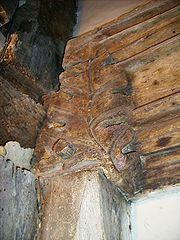
The Trust's symbol, a sprig of oak
leaves and acorn
s, is thought to have been inspired by a carving in the cornice
of the Alfriston Clergy House.
 The Trust has been the beneficiary of numerous donations of both property and money. However, probably the most bizarre were those given by a mysterious masked group known as Ferguson's Gang
between about 1932 and 1940.
The focus on country houses
and gardens which now comprise the majority of its most visited properties came about in the mid 20th century when it was realised that the private owners of many of these properties were no longer able to afford to maintain them. Many were donated to the Trust in lieu of death duties. The diarist James Lees-Milne
is usually credited with playing a central role in the main phase of the Trust's country house acquisition programme, though he was in fact simply an employee of the Trust, and was carrying through policies which had already been decided by its governing body.
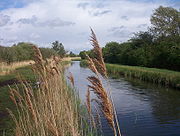 One of the biggest crises in the Trust's history erupted at the 1967 annual general meeting, when the leadership of the Trust was accused of being out of touch and placing too much emphasis on conserving country houses. In response, the Council asked Sir Henry Benson
to chair an advisory Committee to review the structure of the trust. Following the publication of the Benson Report in 1968 much of the administration of the Trust was devolved to the regions.
In 2005 the Trust moved to a new head office in Swindon
, Wiltshire
. The building was constructed on an abandoned railway yard, and is intended as a model of brownfield renewal. It is named Heelis, which is the married name of writer Beatrix Potter
, who was one of the National Trust's most important benefactors.
rather than a government institution (English Heritage
and its equivalents in other parts of the United Kingdom are government bodies which perform some functions which overlap with the work of the National Trust).
It was founded as a not-for-profit company
in 1895 but was later re-incorporated by a private Act of Parliament, the National Trust Act 1907. Subsequent Acts of Parliament between 1919 and 1978 amended and extended the Trust's powers and remit. In 2005 the governance of the Trust was substantially changed under a scheme made by the Charity Commission
.
The Trust is governed by a twelve-strong Board of Trustees. The Board is appointed and overseen by a Council which comprises 26 people elected by the members of the Trust, and 26 people appointed by other organisations whose work is related to that of the Trust, such as The Soil Association
, the Royal Horticultural Society
, and the Council for British Archaeology
.
At an operational level the Trust is organised into regions which are aligned with the official local government regions. Its headquarters are in Swindon
. The Central Office building is Heelis, taken from the married name of children's author Beatrix Potter
, a huge supporter and donor to the Trust.
Expenses included £177.4 million for routine property running costs and £100 million for capital projects.
The Trust is heavily supported by volunteers, who numbered about 61,000 in 2009/10, contributing 3.5 million hours of work with an estimated value of £29.2 million.
The members elect half of the Council of the National Trust, and periodically (most recently in 2006) vote on the organisations which may appoint the other half of the Council. Members may also propose and vote on motions at the annual general meeting, although these are advisory and do not decide the policy of the Trust.
In the 1990s a dispute over whether stag hunting should be permitted on National Trust land caused bitter disputes within the organisation and was the subject of much debate at annual general meetings, but it did little to slow down the growth in member numbers.
There is a separate organisation called The Royal Oak Foundation
for American supporters.
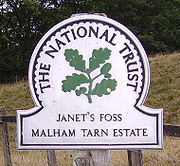 The Trust owns two hundred historic houses that are open to the public. The majority of them are country houses and most of the others are associated with famous individuals. The majority of these country houses contain collections of pictures, furniture, books, metalwork, ceramics and textiles that have remained in their historic context. Most of the houses also have important gardens attached to them, and the Trust also owns some important gardens not attached to a house. The properties include some of the most famous stately homes in the country and some of the key gardens in the history of British gardening.
The trust acquired the majority of its country houses in the mid 20th century, when death duties
were at their most punitive. James Lees-Milne
was secretary of the trust's Country House Committee in the key period either side of World War II. The arrangements made with families bequeathing their homes to the trust often allowed them to continue to live in part of the property. Since the 1980s the trust has been reluctant to take over large houses without substantial accompanying endowment funds, and its acquisitions in this category have been less frequent.
.jpg) The Trust's land holdings account for more than 630,000 acres (985 square miles, 2550 km²), mostly of countryside, covering nearly 1.5% of the total land mass of England, Wales and Northern Ireland. A large proportion of this consists of the parks and agricultural estates attached to country houses, but there are also many countryside properties which were acquired specifically for their scenic or scientific value. The Trust owns or has covenant over about a quarter of the Lake District
The Trust's land holdings account for more than 630,000 acres (985 square miles, 2550 km²), mostly of countryside, covering nearly 1.5% of the total land mass of England, Wales and Northern Ireland. A large proportion of this consists of the parks and agricultural estates attached to country houses, but there are also many countryside properties which were acquired specifically for their scenic or scientific value. The Trust owns or has covenant over about a quarter of the Lake District
; it has similar control over about 12% of the Peak District National Park (See for example South Peak Estate
, High Peak Estate
). It owns or protects roughly one fifth of the coast in England, Wales and Northern Ireland (704 miles, 1126 km), and has a long-term campaign, Project Neptune
, which seeks to acquire more.
s and Paul McCartney
and John Lennon
's childhood homes.
. This prevents the land from being sold or mortgaged against the Trust's wishes without special parliamentary procedure. The inalienability of Trust land was overridden by Parliament in the case of proposals to construct a section of the Plympton
by-pass through the park at Saltram, on the grounds that the road proposal had been known about before the park at Saltram was declared inalienable.
The Acts also give the Trust the power to make bylaw
s to regulate the activities of people when on its land. All photography at National Trust properties, other than that for private and personal use or for entry into approved competitions, is strictly prohibited. Since "private and personal use" means that they may not be displayed on the Internet, visitors are instead directed to request images from the National Trust Photo Library.
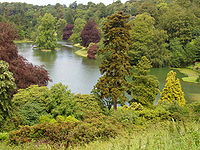
 The 2009–10 annual report contains a list of all National Trust properties for which an admission charge is made that attracted more than 50,000 visitors in the year. The top ten were:
Building Preservation and Conservation Trusts in the UK
The National Trust and English Heritage are the best known building conservation trusts in the United Kingdom for the protection of listed buildings and buildings of architectural importance. However, there are many buildings within the United Kingdom that are not under the care of either trust but...
in England
England
England is a country that is part of the United Kingdom. It shares land borders with Scotland to the north and Wales to the west; the Irish Sea is to the north west, the Celtic Sea to the south west, with the North Sea to the east and the English Channel to the south separating it from continental...
, Wales
Wales
Wales is a country that is part of the United Kingdom and the island of Great Britain, bordered by England to its east and the Atlantic Ocean and Irish Sea to its west. It has a population of three million, and a total area of 20,779 km²...
and Northern Ireland
Northern Ireland
Northern Ireland is one of the four countries of the United Kingdom. Situated in the north-east of the island of Ireland, it shares a border with the Republic of Ireland to the south and west...
. The Trust does not operate in Scotland
Scotland
Scotland is a country that is part of the United Kingdom. Occupying the northern third of the island of Great Britain, it shares a border with England to the south and is bounded by the North Sea to the east, the Atlantic Ocean to the north and west, and the North Channel and Irish Sea to the...
, where there is an independent National Trust for Scotland
National Trust for Scotland
The National Trust for Scotland for Places of Historic Interest or Natural Beauty, commonly known as the National Trust for Scotland describes itself as the conservation charity that protects and promotes Scotland's natural and cultural heritage for present and future generations to...
.
According to its website:
- "The National Trust works to preserve and protect the coastline, countryside and buildings of England, Wales and Northern Ireland.
- We do this in a range of ways, through practical caring and conservation, through educating and informing, and through encouraging millions of people to enjoy their national heritage."
The trust owns many heritage properties, including historic houses and gardens, industrial monuments and social history sites. It is one of the largest landowners in the United Kingdom, owning many beauty spots, most of which are open to the public free of charge. It is the largest membership organisation in the United Kingdom, and one of the largest UK charities by both income and assets.
History
The National Trust for Places of Historic Interest or Natural Beauty was incorporated in 1894 as an "association not for profit" under the Companies Acts 1862 to 1890, in which the liability of its members was limited by guaranteeCompany limited by guarantee
In British and Irish company law, a private company limited by guarantee is an alternative type of corporation used primarily for non-profit organisations that require legal personality. A guarantee company does not usually have a share capital or shareholders, but instead has members who act as...
; it was later incorporated by six separate Acts of Parliament (The National Trust Acts 1907-1971 – as varied by a parliamentary scheme implemented by The Charities (National Trust) Order 2005), it is also a charitable organisation
Charitable organization
A charitable organization is a type of non-profit organization . It differs from other types of NPOs in that it centers on philanthropic goals A charitable organization is a type of non-profit organization (NPO). It differs from other types of NPOs in that it centers on philanthropic goals A...
registered under the Charities Act 1993.
Its formal purpose is:
The preservation for the benefit of the Nation of lands and tenementsTenement (law)A tenement , in law, is anything that is held, rather than owned. This usage is a holdover from feudalism, which still forms the basis of all real-estate law in the English-speaking world, in which the monarch alone owned the allodial title to all the land within his kingdom.Under feudalism, land...
(including buildings) of beauty or historic interest and, as regards lands, for the preservation of their natural aspect, features and animal and plant life. Also the preservation of furniture, pictures and chattels of any description having national and historic or artistic interest.
The Trust was founded on 12 January 1894 by:
- Octavia HillOctavia HillOctavia Hill was an English social reformer, whose main concern was the welfare of the inhabitants of cities, especially London, in the second half of the nineteenth century. Born into a family with a strong commitment to alleviating poverty, she herself grew up in straitened circumstances owing...
(1838–1912), - Robert Hunter (1844–1913) and
- Canon Hardwicke RawnsleyHardwicke RawnsleyCanon Hardwicke Drummond Rawnsley , was an English clergyman, poet, writer of hymns and conservationist, known as one of the co-founders of the National Trust for Places of Historic Interest or Natural Beauty...
(1851–1920),
prompted in part by the earlier success of Charles Eliot and the Kyrle Society
Miranda Hill
Miranda Hill was an English social reformer. She worked closely, from 1891, with her more famous sister Octavia Hill on major housing reform projects in England. She was the daughter of James Hill, corn merchant and banker, and Caroline Southwood Smith, the daughter of Dr Thomas Southwood Smith,...
. A fourth individual, the 1st Duke of Westminster
Hugh Grosvenor, 1st Duke of Westminster
Hugh Lupus Grosvenor, 1st Duke of Westminster KG, PC, JP , styled Viscount Belgrave between 1831 and 1845 and Earl Grosvenor between 1845 and 1869 and known as the 3rd Marquess of Westminster between 1869 and 1874, was an English landowner, politician and racehorse owner.He inherited the estate of...
(1825–1899), is also referred to in many texts as being a principal contributor to the formation of the Trust.
In the early days the Trust was concerned primarily with protecting open spaces and a variety of threatened buildings; its first property was Alfriston Clergy House
Alfriston Clergy House
Alfriston Clergy House in Alfriston, Polegate, East Sussex, England, was the first property to be acquired by the National Trust. It was purchased in 1896 for £10. The house lies adjacent to the Church of St. Andrew.-History:...
and its first nature reserve
Nature reserve
A nature reserve is a protected area of importance for wildlife, flora, fauna or features of geological or other special interest, which is reserved and managed for conservation and to provide special opportunities for study or research...
was Wicken Fen
Wicken Fen
Wicken Fen is a wetland nature reserve situated near the village of Wicken, Cambridgeshire, England.It is one of Britain's oldest nature reserves, and was the first reserve acquired by the National Trust, in 1899. The reserve includes fenland, farmland, marsh, and reedbeds...
. Its first archaeological monument was White Barrow
White Barrow
White Barrow is a large Neolithic long barrow situated on a chalk ridge on Salisbury Plain just outside of the village of Tilshead in Wiltshire. It is a scheduled monument, and is owned by the National Trust. It was the first ancient monument to be purchased by the Trust.- History :White Barrow...
.
The Trust's symbol, a sprig of oak
Oak
An oak is a tree or shrub in the genus Quercus , of which about 600 species exist. "Oak" may also appear in the names of species in related genera, notably Lithocarpus...
leaves and acorn
Acorn
The acorn, or oak nut, is the nut of the oaks and their close relatives . It usually contains a single seed , enclosed in a tough, leathery shell, and borne in a cup-shaped cupule. Acorns vary from 1–6 cm long and 0.8–4 cm broad...
s, is thought to have been inspired by a carving in the cornice
Cornice
Cornice molding is generally any horizontal decorative molding that crowns any building or furniture element: the cornice over a door or window, for instance, or the cornice around the edge of a pedestal. A simple cornice may be formed just with a crown molding.The function of the projecting...
of the Alfriston Clergy House.
Ferguson's Gang
Ferguson's Gang was an anonymous and somewhat enigmatic group that raised funds for the National Trust during the period between the late 1920s and the outbreak of the Second World War...
between about 1932 and 1940.
The focus on country houses
English country house
The English country house is a large house or mansion in the English countryside. Such houses were often owned by individuals who also owned a London house. This allowed to them to spend time in the country and in the city—hence, for these people, the term distinguished between town and country...
and gardens which now comprise the majority of its most visited properties came about in the mid 20th century when it was realised that the private owners of many of these properties were no longer able to afford to maintain them. Many were donated to the Trust in lieu of death duties. The diarist James Lees-Milne
James Lees-Milne
James Lees-Milne was an English writer and expert on country houses. He was an architectural historian, novelist, and a biographer. He is also remembered as a diarist.-Biography:...
is usually credited with playing a central role in the main phase of the Trust's country house acquisition programme, though he was in fact simply an employee of the Trust, and was carrying through policies which had already been decided by its governing body.
Henry Benson, Baron Benson
Henry Alexander Benson, Baron Benson was a British accountant best known as a partner of Coopers & Lybrand, an advisor to the Bank of England, his work organising the accountancy profession as president of ICAEW and for the part he played in various Royal Commissions.Born in Johannesburg to...
to chair an advisory Committee to review the structure of the trust. Following the publication of the Benson Report in 1968 much of the administration of the Trust was devolved to the regions.
In 2005 the Trust moved to a new head office in Swindon
Swindon
Swindon is a large town within the borough of Swindon and ceremonial county of Wiltshire, in South West England. It is midway between Bristol, west and Reading, east. London is east...
, Wiltshire
Wiltshire
Wiltshire is a ceremonial county in South West England. It is landlocked and borders the counties of Dorset, Somerset, Hampshire, Gloucestershire, Oxfordshire and Berkshire. It contains the unitary authority of Swindon and covers...
. The building was constructed on an abandoned railway yard, and is intended as a model of brownfield renewal. It is named Heelis, which is the married name of writer Beatrix Potter
Beatrix Potter
Helen Beatrix Potter was an English author, illustrator, natural scientist and conservationist best known for her imaginative children’s books featuring animals such as those in The Tale of Peter Rabbit which celebrated the British landscape and country life.Born into a privileged Unitarian...
, who was one of the National Trust's most important benefactors.
Governance
The Trust is an independent charityCharitable organization
A charitable organization is a type of non-profit organization . It differs from other types of NPOs in that it centers on philanthropic goals A charitable organization is a type of non-profit organization (NPO). It differs from other types of NPOs in that it centers on philanthropic goals A...
rather than a government institution (English Heritage
English Heritage
English Heritage . is an executive non-departmental public body of the British Government sponsored by the Department for Culture, Media and Sport...
and its equivalents in other parts of the United Kingdom are government bodies which perform some functions which overlap with the work of the National Trust).
It was founded as a not-for-profit company
Company
A company is a form of business organization. It is an association or collection of individual real persons and/or other companies, who each provide some form of capital. This group has a common purpose or focus and an aim of gaining profits. This collection, group or association of persons can be...
in 1895 but was later re-incorporated by a private Act of Parliament, the National Trust Act 1907. Subsequent Acts of Parliament between 1919 and 1978 amended and extended the Trust's powers and remit. In 2005 the governance of the Trust was substantially changed under a scheme made by the Charity Commission
Charity Commission
The Charity Commission for England and Wales is the non-ministerial government department that regulates registered charities in England and Wales....
.
The Trust is governed by a twelve-strong Board of Trustees. The Board is appointed and overseen by a Council which comprises 26 people elected by the members of the Trust, and 26 people appointed by other organisations whose work is related to that of the Trust, such as The Soil Association
Soil Association
The Soil Association is a charity based in the United Kingdom. Founded in 1946, it has over 27,000 members today. Its activities include campaign work on issues including opposition to intensive farming, support for local purchasing and public education on nutrition; as well the certification of...
, the Royal Horticultural Society
Royal Horticultural Society
The Royal Horticultural Society was founded in 1804 in London, England as the Horticultural Society of London, and gained its present name in a Royal Charter granted in 1861 by Prince Albert...
, and the Council for British Archaeology
Council for British Archaeology
Established in 1944, the is an educational charity working throughout the UK to involve people in archaeology and to promote the appreciation and care of the historic environment for the benefit of present and future generations...
.
At an operational level the Trust is organised into regions which are aligned with the official local government regions. Its headquarters are in Swindon
Swindon
Swindon is a large town within the borough of Swindon and ceremonial county of Wiltshire, in South West England. It is midway between Bristol, west and Reading, east. London is east...
. The Central Office building is Heelis, taken from the married name of children's author Beatrix Potter
Beatrix Potter
Helen Beatrix Potter was an English author, illustrator, natural scientist and conservationist best known for her imaginative children’s books featuring animals such as those in The Tale of Peter Rabbit which celebrated the British landscape and country life.Born into a privileged Unitarian...
, a huge supporter and donor to the Trust.
Funding
For the year ended 28 February 2010, the Trust's total income was £406 million. The largest sources of income were membership subscriptions (£125.2 million), direct property income (£105.6 million) and legacies (£50.3 million). In addition, the Trust's commercial arm, National Trust Enterprises Ltd, which undertakes profit-making activities such as running gift shops and restaurants at properties, contributed £54.7 million.Expenses included £177.4 million for routine property running costs and £100 million for capital projects.
The Trust is heavily supported by volunteers, who numbered about 61,000 in 2009/10, contributing 3.5 million hours of work with an estimated value of £29.2 million.
Membership
The Trust is one of the largest membership organisations in the world and annual subscriptions are its most important source of income. Membership numbers have grown from 226,200 when the Trust celebrated its 75th anniversary in 1970 to 500,000 in 1975, one million in 1981, two million in 1990 and by 2010, membership had reached 3.7 million. Members are entitled to free entry to trust properties that are open to the public at a charge.The members elect half of the Council of the National Trust, and periodically (most recently in 2006) vote on the organisations which may appoint the other half of the Council. Members may also propose and vote on motions at the annual general meeting, although these are advisory and do not decide the policy of the Trust.
In the 1990s a dispute over whether stag hunting should be permitted on National Trust land caused bitter disputes within the organisation and was the subject of much debate at annual general meetings, but it did little to slow down the growth in member numbers.
There is a separate organisation called The Royal Oak Foundation
The Royal Oak Foundation
The Royal Oak Foundation is an alliance of American citizens supporting the mission of the National Trust of England, Wales, and Northern Ireland, which is Britain's largest heritage organisation. The foundation is headquartered in New York City....
for American supporters.
Volunteering
The National Trust was founded in 1895 by 3 volunteers. Last year the National Trust was helped by 61,000 volunteers. Volunteering experiences at the National Trust are varied, ranging from helping in historic houses and gardens to fundraising and providing specialist skills. Thanks to the volunteering opportunities and schemes which the Trust runs for children, it is a member of The National Council for Voluntary Youth Services (NCVYS) in recognition of its work for the personal and social development of young people.Historic houses and gardens
The trust acquired the majority of its country houses in the mid 20th century, when death duties
Inheritance Tax (United Kingdom)
In the United Kingdom, Inheritance Tax is a transfer tax. It was introduced with effect from 18 March 1986 replacing Capital Transfer Tax.-History:...
were at their most punitive. James Lees-Milne
James Lees-Milne
James Lees-Milne was an English writer and expert on country houses. He was an architectural historian, novelist, and a biographer. He is also remembered as a diarist.-Biography:...
was secretary of the trust's Country House Committee in the key period either side of World War II. The arrangements made with families bequeathing their homes to the trust often allowed them to continue to live in part of the property. Since the 1980s the trust has been reluctant to take over large houses without substantial accompanying endowment funds, and its acquisitions in this category have been less frequent.
Coast and countryside
Lake District
The Lake District, also commonly known as The Lakes or Lakeland, is a mountainous region in North West England. A popular holiday destination, it is famous not only for its lakes and its mountains but also for its associations with the early 19th century poetry and writings of William Wordsworth...
; it has similar control over about 12% of the Peak District National Park (See for example South Peak Estate
South Peak Estate
The South Peak Estate of the National Trust comprises several land holdings in the Southern Peak District. Some of these, like Shining Cliff Wood and Alport Height, are just outside the National Park boundary...
, High Peak Estate
High Peak Estate
The High Peak Estate is an area of Pennine moorland in the ownership of the National Trust in the Dark Peak area of Derbyshire, England.The National Trust High Peak Estate is to be known as the 'Dark Peak Area' from summer 2010 which is now part of the Peak District Estate...
). It owns or protects roughly one fifth of the coast in England, Wales and Northern Ireland (704 miles, 1126 km), and has a long-term campaign, Project Neptune
Project Neptune
Project Neptune, also known as Enterprise Neptune, is a long-term project of the National Trust to acquire or put under covenant a substantial part of the Welsh, English and Northern Irish coastline. In 1999 it was relaunched as the Neptune Coastline Campaign...
, which seeks to acquire more.
Other properties
In recent years the Trust has sought to broaden its activities and appeal by acquiring properties such as former mills (early factories), workhouseWorkhouse
In England and Wales a workhouse, colloquially known as a spike, was a place where those unable to support themselves were offered accommodation and employment...
s and Paul McCartney
Paul McCartney
Sir James Paul McCartney, MBE, Hon RAM, FRCM is an English musician, singer-songwriter and composer. Formerly of The Beatles and Wings , McCartney is listed in Guinness World Records as the "most successful musician and composer in popular music history", with 60 gold discs and sales of 100...
and John Lennon
John Lennon
John Winston Lennon, MBE was an English musician and singer-songwriter who rose to worldwide fame as one of the founding members of The Beatles, one of the most commercially successful and critically acclaimed acts in the history of popular music...
's childhood homes.
Protection of Trust property
The National Trust Acts grant the Trust the unique statutory power to declare land inalienableInAlienable
InAlienable is a 2008 science fiction horror film written and produced by Walter Koenig, and directed by Robert Dyke.-Plot:Dr. Eric Norris remains wracked with guilt after a terrible tragedy that cost him his family, and when he learns that an alien parasite is not only growing inside him but...
. This prevents the land from being sold or mortgaged against the Trust's wishes without special parliamentary procedure. The inalienability of Trust land was overridden by Parliament in the case of proposals to construct a section of the Plympton
Plympton
Plympton, or Plympton Maurice or Plympton St Maurice or Plympton St Mary or Plympton Erle, in south-western Devon, England is an ancient stannary town: an important trading centre in the past for locally mined tin, and a former seaport...
by-pass through the park at Saltram, on the grounds that the road proposal had been known about before the park at Saltram was declared inalienable.
The Acts also give the Trust the power to make bylaw
Bylaw
By-law can refer to a law of local or limited application passed under the authority of a higher law specifying what things may be regulated by the by-law...
s to regulate the activities of people when on its land. All photography at National Trust properties, other than that for private and personal use or for entry into approved competitions, is strictly prohibited. Since "private and personal use" means that they may not be displayed on the Internet, visitors are instead directed to request images from the National Trust Photo Library.
2009–10
- Wakehurst Place GardenWakehurst Place GardenWakehurst Place is National Trust property located near Ardingly, West Sussex in the High Weald of southern England , comprising a late 16th century country house and a mainly 20th century garden, managed by the Royal Botanic Gardens, Kew...
— 439,627 (administered and maintained by the Royal Botanic Gardens, KewRoyal Botanic Gardens, KewThe Royal Botanic Gardens, Kew, usually referred to as Kew Gardens, is 121 hectares of gardens and botanical glasshouses between Richmond and Kew in southwest London, England. "The Royal Botanic Gardens, Kew" and the brand name "Kew" are also used as umbrella terms for the institution that runs...
) - StourheadStourheadStourhead is a 2,650 acre estate at the source of the River Stour near Mere, Wiltshire, England. The estate includes a Palladian mansion, the village of Stourton, gardens, farmland, and woodland...
— 351,358 - Waddesdon ManorWaddesdon ManorWaddesdon Manor is a country house in the village of Waddesdon, in Buckinghamshire, England. The house was built in the Neo-Renaissance style of a French château between 1874 and 1889 for Baron Ferdinand de Rothschild . Since this was the preferred style of the Rothschilds it became also known as...
— 348,308 - Fountains Abbey & Studley RoyalFountains AbbeyFountains Abbey is near to Aldfield, approximately two miles southwest of Ripon in North Yorkshire, England. It is a ruined Cistercian monastery, founded in 1132. Fountains Abbey is one of the largest and best preserved Cistercian houses in England. It is a Grade I listed building and owned by the...
— 339,326 - Attingham ParkAttingham ParkAttingham Park is a country house in Shropshire, England, which is owned by the National Trust. It is a Grade I listed building.- Location :It is located near to the village of Atcham, on the B4380 Shrewsbury to Wellington road.- History :...
- 257,340 - Polesden LaceyPolesden LaceyPolesden Lacey is an Edwardian house and estate. It is located on the North Downs at Great Bookham, near Dorking, Surrey, England. It is owned and run by the National Trust and is one of the Trust's most popular properties....
— 256,493 - Belton HouseBelton HouseBelton House is a Grade I listed country house in Belton near Grantham, Lincolnshire, England. The mansion is surrounded by formal gardens and a series of avenues leading to follies within a larger wooded park...
— 249,785 - Carrick-a-Rede Rope BridgeCarrick-a-Rede Rope BridgeCarrick-a-Rede Rope Bridge is a rope suspension bridge near Ballintoy, County Antrim, Northern Ireland. The bridge links the mainland to the tiny Carrick Island. The site is owned and maintained by the National Trust, spans twenty metres and is thirty metres above the rocks below. Today the bridge...
— 248,609 - Calke AbbeyCalke AbbeyCalke Abbey is a Grade I listed country house near Ticknall, Derbyshire, England, in the care of the charitable National Trust.The site was an Augustinian priory from the 12th century until its dissolution by Henry VIII...
- 244,767 - St Michael's MountSt Michael's MountSt Michael's Mount is a tidal island located off the Mount's Bay coast of Cornwall, United Kingdom. It is a civil parish and is united with the town of Marazion by a man-made causeway of granite setts, passable between mid-tide and low water....
— 240,557
National Trust Places in the United Kingdom
- National Trust Properties in England
- National Trust Properties in Wales
- National Trust Properties in Northern Ireland
See also
- National Trust for ScotlandNational Trust for ScotlandThe National Trust for Scotland for Places of Historic Interest or Natural Beauty, commonly known as the National Trust for Scotland describes itself as the conservation charity that protects and promotes Scotland's natural and cultural heritage for present and future generations to...
- Conservatoire du littoralConservatoire du littoralThe Conservatoire du littoral is a French public organisation created in 1975 to ensure the protection of outstanding natural areas on the coast, banks of lakes and stretches of water of 10 square kilometres or more...
- Conservatoria delle Coste della SardegnaConservatoria delle CosteThe Conservatoria delle Coste is a Sardinian public agency created by the Regional Law N°2 of the 29th of May 2007, to ensure the protection of outstanding natural areas on the Sardinian coast.Its creation was inspired...
- National Trust MagazineNational Trust MagazineNational Trust Magazine is the members’ publication of National Trust for Places of Historic Interest or Natural Beauty. With a readership of 3.76 million it currently has the sixth highest magazine circulation in Britain...
External links
- The Preservation of Places of Interest or Beauty, (1907), lecture by Sir Robert HunterRobert Hunter-Politics:*Robert Hunter , Lieutenant Governor of Virginia Colony, Governor of New York, New Jersey, Jamaica*Robert C. Hunter , U.S. judge, North Carolina Court of Appeals...
- The National Trust Acts 1907-71
- The National Trust website
- The National Trust Conservatory Collection website
- Annual report for 2004–05, including financial data (PDF document)
- Annual report for 2005–06, including financial data (PDF document)
- Intelligent Giving profile of The National Trust
- The Royal Oak Foundation website
- The Official National Trust Print Website