


Gall

Encyclopedia
Plant
Plants are living organisms belonging to the kingdom Plantae. Precise definitions of the kingdom vary, but as the term is used here, plants include familiar organisms such as trees, flowers, herbs, bushes, grasses, vines, ferns, mosses, and green algae. The group is also called green plants or...
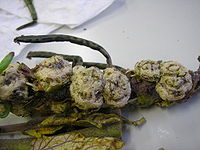
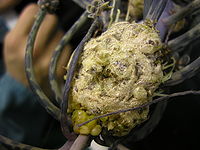
tissues and can be caused by various parasites, from fungi and bacteria
Bacteria
Bacteria are a large domain of prokaryotic microorganisms. Typically a few micrometres in length, bacteria have a wide range of shapes, ranging from spheres to rods and spirals...
, to insect
Insect
Insects are a class of living creatures within the arthropods that have a chitinous exoskeleton, a three-part body , three pairs of jointed legs, compound eyes, and two antennae...
s and mite
Mite
Mites, along with ticks, are small arthropods belonging to the subclass Acari and the class Arachnida. The scientific discipline devoted to the study of ticks and mites is called acarology.-Diversity and systematics:...
s. Plant galls are often highly organized structures and because of this the cause of the gall can often be determined without the actual agent being identified. This applies particularly to some insect and mite plant galls. In pathology
Pathology
Pathology is the precise study and diagnosis of disease. The word pathology is from Ancient Greek , pathos, "feeling, suffering"; and , -logia, "the study of". Pathologization, to pathologize, refers to the process of defining a condition or behavior as pathological, e.g. pathological gambling....
, a gall is a raised sore on the skin, usually caused by chafing or rubbing.
Insects
Insect galls are the highly distinctive plant structures formed by some herbivorousHerbivore
Herbivores are organisms that are anatomically and physiologically adapted to eat plant-based foods. Herbivory is a form of consumption in which an organism principally eats autotrophs such as plants, algae and photosynthesizing bacteria. More generally, organisms that feed on autotrophs in...
insects as their own microhabitats. They are plant tissue which is controlled by the insect. Galls act as both the habitat and food source for the maker of the gall. The interior of a gall can contain edible nutritious starch and other tissues. Some galls act as "physiologic sinks", concentrating resources in the gall from the surrounding plant parts. Galls may also provide the insect with physical protection from predators.
Insect galls are usually induced by chemicals injected by the larva
Larva
A larva is a distinct juvenile form many animals undergo before metamorphosis into adults. Animals with indirect development such as insects, amphibians, or cnidarians typically have a larval phase of their life cycle...
e or the adult
Adult
An adult is a human being or living organism that is of relatively mature age, typically associated with sexual maturity and the attainment of reproductive age....
s of the insects into the plants, and possibly mechanical damage. After the galls are formed, the larvae develop inside until fully grown, when they leave. In order to form galls, the insects must seize the time when plant cell division occurs quickly: the growing season, usually spring in temperate climates, but which is extended in the tropics.
The meristem
Meristem
A meristem is the tissue in most plants consisting of undifferentiated cells , found in zones of the plant where growth can take place....
s, where plant cell division occurs, are the usual sites of galls, though insect galls can be found on other parts of the plant, such as the leaves, stalks
Plant stem
A stem is one of two main structural axes of a vascular plant. The stem is normally divided into nodes and internodes, the nodes hold buds which grow into one or more leaves, inflorescence , conifer cones, roots, other stems etc. The internodes distance one node from another...
, branch
Branch
A branch or tree branch is a woody structural member connected to but not part of the central trunk of a tree...
es, bud
Bud
In botany, a bud is an undeveloped or embryonic shoot and normally occurs in the axil of a leaf or at the tip of the stem. Once formed, a bud may remain for some time in a dormant condition, or it may form a shoot immediately. Buds may be specialized to develop flowers or short shoots, or may have...
s, root
Root
In vascular plants, the root is the organ of a plant that typically lies below the surface of the soil. This is not always the case, however, since a root can also be aerial or aerating . Furthermore, a stem normally occurring below ground is not exceptional either...
s, and even flower
Flower
A flower, sometimes known as a bloom or blossom, is the reproductive structure found in flowering plants . The biological function of a flower is to effect reproduction, usually by providing a mechanism for the union of sperm with eggs...
s and fruit
Fruit
In broad terms, a fruit is a structure of a plant that contains its seeds.The term has different meanings dependent on context. In non-technical usage, such as food preparation, fruit normally means the fleshy seed-associated structures of certain plants that are sweet and edible in the raw state,...
s. Gall-inducing insects are usually species-specific and sometimes tissue-specific on the plants they gall.
Gall-inducing insect
Gall-inducing insect
A gall-inducing insect is any insect that can cause the growth of gall within plants. The term gall fly is also used to cover these species, although most are not true flies.There are several groups of insects that meet this description...
s include gall wasp
Gall wasp
Gall wasps , also called Gallflies, are a family of the order Hymenoptera and are classified with the Apocrita suborder of wasps in the superfamily Cynipoidea...
s, gall midges, gall flies
Tephritidae
Tephritidae is one of two fly families referred to as "fruit flies", the other family being Drosophilidae. Tephritidae does not include the biological model organisms of the genus Drosophila , which is often called the "common fruit fly". There are nearly 5,000 described species of tephritid...
, aphid
Aphid
Aphids, also known as plant lice and in Britain and the Commonwealth as greenflies, blackflies or whiteflies, are small sap sucking insects, and members of the superfamily Aphidoidea. Aphids are among the most destructive insect pests on cultivated plants in temperate regions...
s (such as Melaphis chinensis
Melaphis chinensis
Melaphis chinensis, the Chinese sumac aphid, is an aphid species in the genus Melaphis.The species produce galls on the Chinese sumac . The gall is called Chinese gall, Galla Chinensis or wu bei zi in Chinese. It is rich in gallotannins, a type of hydrolysable tannins...
), and psyllids.
Fungi
One gall-inducing fungus is Cedar-apple rust.Gymnosporangium
Gymnosporangium is a genus of heteroecious plant-pathogenic fungi which alternately infect members of the family Cupressaceae, primarily species in the genus Juniperus , and members of the family Rosaceae in the subfamily Maloideae...
Galls are often seen in Millettia pinnata leaves and fruits. Leaf galls appear like tiny clubs; however, flower galls are globose.
It is worth noting that the fungus Ustilago esculenta associated with Zizania latifolia, a wild rice, produces an edible gall highly valued as a food source in the Zhejiang and Jiangsu provinces of China.
Uses
Galls are rich in resins and tannic acidTannic acid
Tannic acid is a specific commercial form of tannin, a type of polyphenol. Its weak acidity is due to the numerous phenol groups in the structure...
and have been used in the manufacture of permanent inks (such as iron gall ink) and astringent ointments, in dyeing
Dyeing
Dyeing is the process of adding color to textile products like fibers, yarns, and fabrics. Dyeing is normally done in a special solution containing dyes and particular chemical material. After dyeing, dye molecules have uncut Chemical bond with fiber molecules. The temperature and time controlling...
, and in tanning
Tanning
Tanning is the making of leather from the skins of animals which does not easily decompose. Traditionally, tanning used tannin, an acidic chemical compound from which the tanning process draws its name . Coloring may occur during tanning...
. A high-quality ink has long been made from the Aleppo gall
Oak marble gall
Oak marble galls develop as a chemically induced distortion of leaf buds on pedunculate oak , or sessile oak trees, caused by the parthenogenetic gall wasp which lays eggs within leaf buds using their ovipositor...
, found on oaks in the Middle East; it is one of a number of galls resembling nuts and called "gallnuts" or "nutgalls". The yeast that makes lager beer possibly originated in galls on Patagonian beech trees.
The larvae in galls are useful for a survival food and fishing bait; see the Indigenous Australian
Indigenous Australians
Indigenous Australians are the original inhabitants of the Australian continent and nearby islands. The Aboriginal Indigenous Australians migrated from the Indian continent around 75,000 to 100,000 years ago....
foods Bush coconut
Bush coconut
The Bush coconut, is an Australian bush tucker food, often eaten by Aborigines of Central Australia.The bush coconut is in fact a combination of plant and animal; the Cysticoccus pomiformis grows inside the wood of the Corymbia terminalis tree.Bush coconut is called Merne arrkirlpangkwerle in the...
and Mulga apple
Mulga apple
The mulga apple, is an Australian bush tucker food, often eaten by Aborigines of Central Australia.The mulga apple is in fact a combination of plant and animal; the insect gall grows inside the wood of the mulga tree ....
. Nutgalls also produce purpurogallin
Purpurogallin
Purpurogallin is a red, crystalline compound, and the aglycon of several glycosides from nutgalls and oak barks. It can inhibit hydroxyestradiol methylation by catechol-O-methyltransferase....
.
See also
- Bush coconutBush coconutThe Bush coconut, is an Australian bush tucker food, often eaten by Aborigines of Central Australia.The bush coconut is in fact a combination of plant and animal; the Cysticoccus pomiformis grows inside the wood of the Corymbia terminalis tree.Bush coconut is called Merne arrkirlpangkwerle in the...
- Chirosia betuletiChirosia betuletiThe Knotting gall, is caused by the dipteron fly Chirosia betuleti . The gall develops in the terminal shoots of ferns, such as Broad buckler fern Dryopteris dilatata, Male shield fern Dryopteris filix-mas, Lady fern Athyrium filix-femina, and the Ostrich fern, Matteuccia struthiopteris.-The...
- Mulga appleMulga appleThe mulga apple, is an Australian bush tucker food, often eaten by Aborigines of Central Australia.The mulga apple is in fact a combination of plant and animal; the insect gall grows inside the wood of the mulga tree ....
- Oak appleOak appleOak apple is the common name for a large, round, vaguely apple-like gall commonly found on many species of oak. Oak apples range in size from 2-5cm. Oak apples are caused by chemicals injected by the larva of certain kinds of gall wasp in the family Cynipidae. The adult female wasp lays single...
- Oak Marble gallOak marble gallOak marble galls develop as a chemically induced distortion of leaf buds on pedunculate oak , or sessile oak trees, caused by the parthenogenetic gall wasp which lays eggs within leaf buds using their ovipositor...
- Knopper gallKnopper gallAndricus quercuscalicis is a gall wasp species inducing Knopper galls.Knopper galls develop as a chemically induced distortion of growing acorns on Pedunculate Oak trees, caused by gall wasps, which lay eggs in buds with their ovipositor...
- Oak artichoke gallOak artichoke gallOak artichoke galls, oak hop galls, larch-cone galls or hop strobiledevelop as a chemically induced distortion of leaf axillary or terminal buds on Pedunculate Oak or Sessile Oak trees, caused by the parthenogenetic gall wasp Andricus fecundator, which lays single eggs within leaf buds using...
- Rose bedeguar gallRose bedeguar gallThe Rose bedeguar gall, Robin's pincushion gall, or Moss galldevelops as a chemically induced distortion of an unopened leaf axillary or terminal buds mostly on Field Rose or Dog rose shrubs, caused by the parthenogenetic hymenopteran gall wasp , previous synonyms are D...
- Pineapple gall
- Cola-nut gallCola-nut gallCola-nut galls develop as a chemically induced distortion of leaf axillary or terminal buds on Pedunculate Oak or Sessile Oak trees, caused by the agamic gall wasp Andricus lignicola which lays single eggs within leaf buds using their ovipositor. A previous name or synonym for the species A....
- Neuroterus quercusbaccarumNeuroterus quercusbaccarumThe common spangle gall on the underside of leaves and the currant gall on the male catkins or occasionally the leaves, develop as chemically induced distortions on pedunculate oak , or sessile oak trees, caused by the cynipid wasp Neuroterus quercusbaccarum which has both agamic and bisexual...
Common Spangle and Currant galls