
In Depth
See Also

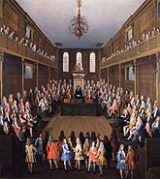
British House of Commons

|align=left| *Parliament Parliament of the United Kingdom

The Parliament of the United Kingdom of Great Britain and Northern Ireland is the supreme legislative body [i] ... 

**State Opening of Parliament State Opening of Parliament

In the United Kingdom [i], the State Opening of Parliament is an annual event held usually in October or ... 

*Sovereign British monarchy

The British monarch or Sovereign is the head of state [i] of the United Kingdom [i] and in the British overseas territories [i] ... 

: Queen Elizabeth II Elizabeth II of the United Kingdom

} |- | |} Elizabeth II is the Queen [i] of 16 independent sovereign [i] state [i] ... 

*House of Lords House of Lords

The House of Lords is the upper house [i] of the Parliament of the United Kingdom [i]. ... 

**Lord Speaker Lord Speaker

The Lord Speaker is the speaker [i] of the House of Lords [i] in the Parliament of the United Kingdom [i] ... 

: Baroness Hayman Helene Hayman, Baroness Hayman

Hlne Valerie Hayman, Baroness Hayman, PC [i], ne Middleweek is a Labour Party [i] ... 

*House of Commons British House of Commons

|align=left| *Parliament [i] ... 

**Speaker Speaker of the British House of Commons

In the United Kingdom [i], the Speaker of the House of Commons is the presiding officer of the House of Commons [i] ... 

: Michael Martin **Prime Minister's Questions |- |align=left style="border-top:1px solid;" width=200px| *Her Majesty's Government *Cabinet Cabinet of the United Kingdom

In the politics of the United Kingdom [i], the Cabinet is a formal body composed of government officials ... 

**Prime Minister Prime Minister of the United Kingdom

The Prime Minister of the United Kingdom of Great Britain and Northern Ireland [i] is in ... 

: Tony Blair Tony Blair

Anthony Charles Lynton Blair, known as Tony Blair, is the outgoing Prime Minister of the United Kingdom [i] ... 


Discussions

  Discussion Features

   Ask a question about 'British House of Commons'

   Start a new discussion about 'British House of Commons'

   Answer questions about 'British House of Commons'

   'British House of Commons' discussion forum

Timeline

1649   The House of Commons British House of Commons

|align=left| *Parliament [i] ... 

 pass an act abolishing the House of Lords House of Lords

The House of Lords is the upper house [i] of the Parliament of the United Kingdom [i]. ... 

, declaring that it is ''"useless and dangerous to the people of England"''.

1812   Bankrupt Bankruptcy

Bankruptcy is a legally declared inability or impairment of ability of an individual or organization to ... 

 banker assassinates British United Kingdom of Great Britain and Ireland

| align="center" colspan="2"| United Kingdom ofGreat Britain and Ireland ... 

 Prime Minister Prime minister

A prime minister is the most senior minister of a cabinet [i] in the executive [i] b ... 

 Spencer Perceval Spencer Perceval

Spencer Perceval was a British [i] statesman and Prime Minister [i] ... 

 in the lobby of the British House of Commons.

1914   The United Kingdom United Kingdom

The United Kingdom of Great Britain and Northern Ireland is a country and sovereign state [i] tha ... 

's House of Commons British House of Commons

|align=left| *Parliament [i] ... 

 passes Irish Home Rule Home Rule Act 1914

The Government of Ireland Act 1914, more generally known as the Third Home Rule Act or the (Iri... 

.

1919   November 28 — The American-born Lady Astor Nancy Astor, Viscountess Astor

Nancy Witcher Astor, Viscountess Astor, CH [i], , was the wife of Waldorf Astor, 2nd Viscount Astor [i] ... 

 is elected to the British House of Commons, becoming on December 1 the first female MP to take a seat.

1941   World War II: The United Kingdom United Kingdom

The United Kingdom of Great Britain and Northern Ireland is a country and sovereign state [i] tha ... 

's House of Commons British House of Commons

|align=left| *Parliament [i] ... 

 is damaged by the Luftwaffe Luftwaffe

The Deutsche Luftwaffe or Luftwaffe is the commonly used term for the German [i] air force [i] ... 

 in an air raid Strategic bombing

[i] style [[military campaign|campaign]... 

.

1946   In Britain, the House of Commons British House of Commons

|align=left| *Parliament [i] ... 

 decides to nationalize mines.

1964   British House of Commons votes to abolish the death penalty for murder in Britain.

1971   The British House of Commons votes in favour of joining the EEC by 356-244.

1992   Betty Boothroyd Betty Boothroyd

Betty Boothroyd, Baroness Boothroyd, OM [i], PC [i], ... 

 is elected the first woman to be Speaker Speaker of the British House of Commons

In the United Kingdom [i], the Speaker of the House of Commons is the presiding officer of the House of Commons [i] ... 

 of the British House of Commons.

2004   The British government narrowly wins a House of Commons British House of Commons

|align=left| *Parliament [i] ... 

 vote on the proposed introduction of tuition top-up fees Top-up fees

Top-up fees are a new way of charging tuition [i] to undergraduate [i] and PGCE [i] student [i]s who stu ... 

 in British universities University

[i], which grants [[academic degree]... 

.

   More Events >>


Encyclopedia

|align=left|
  • Parliament Parliament of the United Kingdom

    The Parliament of the United Kingdom of Great Britain and Northern Ireland is the supreme legislative body [i] ... 

    • State Opening of Parliament State Opening of Parliament

      In the United Kingdom [i], the State Opening of Parliament is an annual event held usually in October or ... 

  • Sovereign British monarchy

    The British monarch or Sovereign is the head of state [i] of the United Kingdom [i] and in the British overseas territories [i] ... 

    : Queen Elizabeth II Elizabeth II of the United Kingdom

    }

|-
|
|}
Elizabeth II is the Queen [i] of 16 independent sovereign [i] state [i] ... 


  • House of Lords House of Lords

    The House of Lords is the upper house [i] of the Parliament of the United Kingdom [i]. ... 

    • Lord Speaker Lord Speaker

      The Lord Speaker is the speaker [i] of the House of Lords [i] in the Parliament of the United Kingdom [i] ... 

      : Baroness Hayman Helene Hayman, Baroness Hayman

      Hlne Valerie Hayman, Baroness Hayman, PC [i], ne Middleweek is a Labour Party [i] ... 

  • House of Commons British House of Commons

    |align=left|
  • Parliament [i]

... 


    • Speaker Speaker of the British House of Commons

      In the United Kingdom [i], the Speaker of the House of Commons is the presiding officer of the House of Commons [i]... 

      : Michael Martin
    • Prime Minister's Questions

|-
|align=left style="border-top:1px solid;" width=200px|
  • Her Majesty's Government
  • Cabinet Cabinet of the United Kingdom

    In the politics of the United Kingdom [i], the Cabinet is a formal body composed of government officials ... 

    • Prime Minister Prime Minister of the United Kingdom

      The Prime Minister of the United Kingdom of Great Britain and Northern Ireland [i] is in... 

      : Tony Blair Tony Blair

      Anthony Charles Lynton Blair, known as Tony Blair, is the outgoing Prime Minister of the United Kingdom [i] ... 

    • Deputy Prime Minister: John Prescott John Prescott

      John Leslie Prescott MP [i] is a British [i] Labour Party [i] ... 

    • Chancellor of the Exchequer Chancellor of the Exchequer

      The Chancellor of the Exchequer is the title held by the British cabinet [i] minister [i] responsible fo ... 

      : Gordon Brown Gordon Brown

      Dr. James Gordon Brown is the Chancellor of the Exchequer [i] in the United Kingdom [i] and a British [i] ... 

    • Foreign Secretary Secretary of State for Foreign and Commonwealth Affairs

      The Secretary of State for Foreign and Commonwealth Affairs, commonly referred to as the Foreign Sec... 

      : Margaret Beckett Margaret Beckett

      Margaret Mary Beckett is a British [i] Labour Party [i] politician [i] who c ... 

    • Home Secretary: John Reid
    • Lord Chancellor Lord Chancellor

      The Lord High Chancellor of Great Britain, or Lord Chancellor and in former times the Chancello... 

      : Lord Falconer of Thoroton Charles Falconer, Baron Falconer of Thoroton

      Charles Leslie Falconer, Baron Falconer of Thoroton, PC [i], QC [i] ... 

  • Government departments
  • The Civil Service

|-
|align=left style="border-top:1px solid;" width=200px|
  • Official Opposition
    • Leader of the Opposition: David Cameron David Cameron

      David William Donald Cameron is a British politician [i], Leader of the Conservative Party [i] ... 

    • Shadow Cabinet

|-
|align=left style="border-top:1px solid;"|
  • Courts of the United Kingdom
    • Courts of England and Wales Courts of England and Wales

      The Courts of England and Wales are the civil [i] and criminal [i] court [i]s res ... 

    • Courts of Northern Ireland
    • Courts of Scotland

|-
|align=left style="border-top:1px solid;"|
  • Constituent countries
  • Scottish Parliament Scottish Parliament

    The Scottish Parliament is the national unicameral [i] legislature [i] of Scotland [i], in the capital ... 

    • Scottish Executive Scottish Executive

      The term Scottish Executive is used in two different, but closely-related senses: to denote the executive arm [i] ... 

  • National Assembly for Wales National Assembly for Wales

    Electoral system

Under mixed member proportional representation [i] a ... 


    • Welsh Assembly Government Welsh Assembly Government

      The Welsh Assembly Government is the executive [i] body of the National Assembly for Wales [i] ... 

  • Northern Ireland Assembly Northern Ireland Assembly

    The Northern Ireland Assembly is a home rule [i] legislature [i] established in Northern Ireland [i] ... 

    • Northern Ireland Executive
  • Reserved matters

|-
|align=left style="border-top:1px solid;"|
  • Local government Local government in the United Kingdom

    There is no single system of local government in the United Kingdom.... 

  • Greater London Authority Greater London Authority

    The Greater London Authority administers the 1579 km of Greater London [i], covering the 32 London boroughs [i] ... 


|-
|align=left style="border-top:1px solid;"|
  • Elections Elections in the United Kingdom

    The United Kingdom [i] has five distinct types of election [i]s: general, local, regional, European and mayora... 

    : 2001 United Kingdom general election, 2001

    The UK general election, 2001 was held on 7 June [i] 2001 [i] and was dubbed "the quiet landslide" by th ... 

     - 2005 United Kingdom general election, 2005

    The United Kingdom general election of 2005 was held on Thursday, 5 May 2005 and won by the Labour Party [i] ... 

     - 2009/10 Next United Kingdom general election

    Under the provisions of the Parliament Acts of 1911 and 1949 [i], the next United Kingdom ge... 

  • Political parties
  • Constitution
  • Human rights
  • Foreign relations Foreign relations of the United Kingdom

    The United Kingdom [i] is a major player in international politics, with interests throughout the world. ... 


|-
|align=left style="border-top:1px solid;"|The House of Commons is the lower house of the Parliament of the United Kingdom Parliament of the United Kingdom

The Parliament of the United Kingdom of Great Britain and Northern Ireland is the supreme legislative body [i] ... 

. Parliament also includes the Sovereign British monarchy

The British monarch or Sovereign is the head of state [i] of the United Kingdom [i] and in the British overseas territories [i] ... 

 and the upper house, the House of Lords House of Lords

The House of Lords is the upper house [i] of the Parliament of the United Kingdom [i]. ... 

; the House of Commons is the dominant branch. The House of Commons is a democratically Democracy

Democracy is a form of government [i] for a nation state, or for an organiz ... 

 elected body, consisting of 646 members, who are known as "Members of Parliament" or MPs. Members are elected by the first-past-the-post Plurality voting system

The plurality voting system is a system used to elect members of a parliament which is based on single m... 

 system of election, holding office until Parliament is dissolved . Each member is elected by, and represents, an electoral district known as a constituency. The House of Commons is the source of the vast majority of government ministers and every Prime Minister Prime Minister of the United Kingdom

The Prime Minister of the United Kingdom of Great Britain and Northern Ireland [i] is in... 

 since 1902, with the very brief exception of Sir Alec Douglas-Home Alec Douglas-Home

Alexander Frederick Douglas-Home1 [i], Baron Home of the Hirsel, KT [i], PC [i] ... 

 in 1963 .

The House of Commons evolved at some point during the 14th century and has been in continuous existence since. The House of Commons was once far less powerful than the House of Lords , but is now by far the dominant branch of Parliament. The House of Commons' legislative powers exceed those of the House of Lords; under the Parliament Act 1911 Parliament Act

The Parliament Acts are two Acts [i] of Parliament [i] ... 

, the Lords' power to reject most bills was reduced to a mere delaying power. Moreover, the Government of the United Kingdom is answerable to the House of Commons; the Prime Minister stays in office only as long as he or she retains the support of the lower house.

The full, formal style and title of the House of Commons is The Honourable the Commons of the United Kingdom of Great Britain and Northern Ireland in Parliament assembled. The term "Commons" derives from the Norman French Norman language

Norman is a Romance language [i] and one of the Ol languages [i]. ... 

 word communes, meaning "localities." It is often misunderstood that "Commons" comes from the word "commoners", referring to those sitting in the House, similar to the way in which the name "House of Lords" indicates that those sitting in the "Other Place Another Place

Another Place is a piece of modern sculpture [i] by Antony Gormley [i]. ... 

" are elevated to the Peerage Peerage

The Peerage is a system of titles [i] of nobility [i] that exists in the United Kingdom [i] and is one p ... 

. This explanation, however, is ahistorical. Both Houses, the Commons and Lords, meet in the Palace of Westminster Palace of Westminster

The Palace of Westminster, also known as the Houses of Parliament or Westminster Palace, in ... 

. Both Houses have in the past met elsewhere, and retain the right to do so, provided the Mace Ceremonial mace

The ceremonial mace is a highly ornamented staff of metal and wood, carried before a sovereign [i] ... 

 is present.

The information resource of the House is the House of Commons Library.

History

Parliament developed from the council that advised the monarch during mediæval times. This royal council, meeting for short-term periods, included ecclesiastics, noblemen, as well as representatives of the counties County

A county is generally a sub-unit of regional self-government within a sovereign jurisdiction.... 

 . The chief duty of the council was to approve taxes proposed by the Crown. In many cases, however, the council demanded the redress of the people's grievances before proceeding to vote on taxation. Thus, it developed legislative powers.

In the "Model Parliament" of 1295, representatives of the borough Borough

A borough is an administrative division [i] used in various countries. ... 

s were also admitted. Thus, it became settled practice that each county send two knights of the shire, and that each borough send two burgesses. At first, the burgesses were almost entirely powerless; whilst county representation was fixed, the monarch could enfranchise or disfranchise boroughs at pleasure. Any show of independence by burgesses would have led to the exclusion of their towns from Parliament. The knights of the shire were in a better position, though less powerful than their aristocratic counterparts in the still unicameral Parliament. The division of Parliament into two houses occurred during the reign of Edward III Edward III of England

Edward III was one of the most successful English [i] kings [i] of medieval [i] times. ... 

: the knights and burgesses formed the House of Commons, whilst the clergy and nobility became the House of Lords.

Though they remained subordinate to both the Crown and the Lords, the Commons did act with increasing boldness. During the Good Parliament , the Speaker of the House of Commons Speaker of the British House of Commons

In the United Kingdom [i], the Speaker of the House of Commons is the presiding officer of the House of Commons [i]... 

, Sir Peter de la Mare, complained of heavy taxes, demanded an accounting of the royal expenditures, and criticised the King's management of the military. The Commons even proceeded to impeach Impeachment

In the constitution [i]s of several countries, impeachment is the first of two stages in a specific proc ... 

 some of the King's ministers. The bold Speaker was imprisoned, but was soon released after the death of King Edward III. During the reign of the next monarch, Richard II Richard II of England

Richard II was the son of Edward the Black Prince [i], Prince of Wales [i], and Joan "The Fair Maid of Kent" [i] ... 

, the Commons once again began to impeach errant ministers of the Crown. They insisted that they could not only control taxation, but also public expenditures. Despite such gains in authority, however, the Commons still remained much less powerful than the House of Lords and the Crown.

The influence of the Crown was further increased by the civil wars of the late fifteenth century, which destroyed the power of the great nobles. Both houses of Parliament held little power during the ensuing years, and the absolute supremacy of the Sovereign was restored. The domination of the monarch grew even further under the Tudor dynasty Tudor dynasty

The Tuhdor dynasty or House of Tudor was a series of five monarchs of Welsh [i] origin who ... 

 in the sixteenth century. This trend, however, was somewhat reversed when the House of Stuart House of Stuart

The House of Stuart or Stewart was a royal house [i] of the Kingdom of Scotland [i], later of the ... 

 came to the English Throne in 1603. The first two Stuart monarchs, James I James I of England

James VI of Scotland/James I of England and Ireland was King of England [i] ... 

 and Charles I Charles I of England

[i] [[1625]... 

, provoked conflicts with the Commons over issues such as taxation, religion, and royal powers.

The bitter differences between Charles I and Parliament were great, and were settled only by the English Civil War English Civil War

The English Civil War was a series of armed conflicts and political machinations which took place betwee... 

. The King was beheaded, and the monarchy and Upper House abolished, in 1649. Although the Commons were in theory supreme, the nation was truly under the control of a military dictator, Oliver Cromwell Oliver Cromwell

Oliver Cromwell was an English [i] military and political leader, best known for making England ... 

, who eventually abolished Parliament in 1653. However, the monarchy and the House of Lords were both restored along with the Commons in 1660, soon after Cromwell's death. The influence of the Crown had been lessened, and was further diminished when James II James II of England

James VII of Scotland and James II of England became King of Scots [i], King of England [i], and King of Ireland [i] ... 

 was deposed in the course of the Glorious Revolution Glorious Revolution

The Glorious Revolution was the overthrow of James II of England [i] in 1688 [i] by a union of Parliamentarians [i]... 

 .

The eighteenth century was notable in that it was marked by the development of the office of Prime Minister. The modern notion that the Government may remain in power only as long as it retains the support of Parliament soon became established, leading to history's first-ever motion of no confidence, as a result of the failure of Lord North's government to end the American Revolution American Revolution

The American Revolution was a political movement that ended British [i] control ... 

. The modern notion that only the support of the House of Commons is necessary, however, was of much later development. Similarly, the custom that the Prime Minister is always a Member of the Lower House, rather than the Upper one, did not evolve immediately.

The House of Commons experienced an important period of reform during the nineteenth century. The Crown had made use of its prerogative of enfranchising and disenfranchising boroughs very irregularly, and several anomalies had developed in borough representation. Many towns that were once important but had become inconsiderable by the nineteenth century retained their ancient right of electing two Members each. The most notorious of these "rotten boroughs" was Old Sarum Old Sarum

Old Sarum is the site of the earliest settlement of Salisbury [i], in England [i]. ... 

, which had only eleven voters; at the same time, large cities such as Manchester Manchester

The City of Manchester is a major city [i] and metropolitan borough [i] in the North [i] of England [i], ... 

 received no separate representation, although their eligible residents were able to vote in the corresponding county seat—in the case of Manchester, Lancashire Lancashire

Lancashire is a county [i] in North West [i] England [i], bounded ... 

. Also notable were the pocket boroughs, small constituencies controlled by wealthy landowners and aristocrats, whose "nominees" were invariably elected by the voters.

The Commons attempted to address these anomalies by passing a Reform Bill in 1831. At first, the House of Lords proved unwilling to pass the bill, but were forced to relent when the Prime Minister, Charles Grey, 2nd Earl Grey Charles Grey, 2nd Earl Grey

Charles Grey, 2nd Earl Grey, KG [i], PC [i], kno ... 

, advised King William IV William IV of the United Kingdom

William IV was King of the United Kingdom [i] and of Hanover [i] from 26 June [i] 1830 [i] un ... 

 to flood the House of Lords with several pro-Reform peers. Before the King could take such an action, the Lords passed the bill in 1832. The Reform Act 1832, also known as the "Great Reform Act," abolished the rotten boroughs, established uniform voting requirements for the boroughs, and granted representation to populous cities, but also retained many pocket boroughs. In the ensuing years, the Commons grew more assertive, the influence of the House of Lords having been damaged by the Reform Bill Crisis, and the power of the patrons of pocket boroughs having been diminished. The Lords became more reluctant to reject bills that the Commons passed with large majorities, and it became an accepted political principle that the support of the House of Commons alone was necessary for a Prime Minister to remain in office.

Many further reforms were introduced during the latter half of the nineteenth century. The Reform Act 1867 Reform Act 1867

The Reform Act 1867, 30 & 31 Vict.... 

 lowered property requirements for voting in the boroughs, reduced the representation of the less populous boroughs, and granted parliamentary seats to several growing industrial towns. The electorate was further expanded by the Representation of the People Act 1884, under which property qualifications in the counties were lowered. The Redistribution of Seats Act of the following year replaced almost all multi-member constituencies with single-member constituencies.


The next important phase in the history of the House of Commons came during the early twentieth century. In 1908, the Liberal Government under Herbert Henry Asquith H. H. Asquith

Herbert Henry Asquith, 1st Earl of Oxford and Asquith, KG [i], PC [i] ... 

 introduced a number of social welfare programmes, which, together with an expensive arms race with Germany Germany

Germany , officially the Federal Republic of Germany , is a country [i] in central Europe [i]. ... 

, had forced the Government to seek more funding in the form of tax increases. In 1909, the Chancellor of the Exchequer Chancellor of the Exchequer

The Chancellor of the Exchequer is the title held by the British cabinet [i] minister [i] responsible fo ... 

, David Lloyd George David Lloyd George

David Lloyd George, 1st Earl Lloyd George of Dwyfor, OM [i], PC [i] ... 

, introduced the "People's Budget", which proposed a new tax targeting wealthy landowners. The unpopular measure, however, failed in the heavily Conservative House of Lords. Having made the powers of the House of Lords a primary campaign issue, the Liberals were re-elected in January 1910. Asquith then proposed that the powers of the House of Lords be severely curtailed. Proceedings on the bill were briefly interrupted by the death of King Edward VII Edward VII of the United Kingdom

Edward VII was King [i] of the United Kingdom of Great Britain and Ireland [i], King of the Commonwealth Realms [i] ... 

, but were soon recommenced under the new monarch, George V George V of the United Kingdom

George V was the first British monarch [i] belonging to the House of Windsor [i], as a result of his cr... 

. After the election in December 1910 the Asquith Government secured the passage of a bill to curtail the powers of the House of Lords. The Prime Minister proposed, and the King agreed, that the House of Lords could be flooded by the creation of 500 new Liberal peers if it failed to pass the bill. The Parliament Act 1911 Parliament Act

The Parliament Acts are two Acts [i] of Parliament [i] ... 

 came into effect, destroying the legislative equality of the two Houses of Parliament. The House of Lords was permitted only to delay most legislation, for a maximum of three parliamentary sessions or two calendar years . Since the passage of these Acts, the House of Commons has remained the dominant branch of Parliament, both in theory and in practice.

Since the 17th century, MPs had been unpaid. Most of the men elected to the Commons had private incomes, while a few relied on financial support from a wealthy patron. Early Labour MPs were often provided with a salary by a trade union, but this was declared illegal by a House of Lords judgement of 1910. Consequently a clause was included in the Parliament Act 1911 introducing salaries for MPs. It should be noted, however, that government ministers had always been paid.

Members and elections


Each Member of Parliament represents a single constituency. Prior to the reforms of the 19th century, the constituencies had little basis in population: the counties and the boroughs were, for the most part, represented by two Members each. Reforms enacted during the 19th century, starting with the Reform Act 1832, led to a more even distribution of seats. Moreover, the reforms of 1885 abolished most two-member constituencies; the few that remained were all abolished in 1948. University constituencies  were abolished in the same year. Thus, each constituency now elects only one Member of Parliament. There is still a technical distinction between county constituencies and borough constituencies, but the only effect of this difference involves the amount of money candidates are allowed to spend during campaigns.

The boundaries of the constituencies are determined by four permanent and independent Boundary Commissions, one each for England England

England is the largest and most populous constituent country [i] of the United Kingdom [i]. ... 

, Wales Wales

Wales is one of four constituent parts [i] of the United Kingdom [i]. ... 

, Scotland Scotland

Scotland is a nation [i] in northwest Europe [i] and one of the constituent [i] countries [i] ... 

, and Northern Ireland Northern Ireland

Northern Ireland is part of the United Kingdom [i] and covers 5,459 square miles [i] in the north... 

. The number of constituencies assigned to the four parts of the United Kingdom is based roughly on population, but subject to certain statutory regulations. England, Wales, and Scotland must have a total of approximately 613 constituencies, and Northern Ireland between 16 and 18 constituencies, and Wales at least 35 constituencies. The Commissions conduct general reviews of electoral boundaries once every 8 to 12 years, as well as a number of interim reviews. In drawing boundaries, they are required to take into account local government boundaries, but may deviate from this requirement in order to prevent great disparities in the populations of the various constituencies. The proposals of the Boundary Commissions are subject to parliamentary approval, but may not be amended by Parliament. After the next general review of constituencies, the Boundary Commissions will be absorbed into the Electoral Commission, which was established in 2000. Currently the United Kingdom is divided into 646 constituencies, with 529 in England, 40 in Wales, 59 in Scotland, and 18 in Northern Ireland.

General elections occur whenever Parliament is dissolved by the Sovereign. The timing of the dissolution is normally chosen by the Prime Minister ; however, a parliamentary term may not last for more than five years, unless a Bill extending the life of Parliament passes both Houses and receives Royal Assent. The House of Lords, exceptionally, retains its power of veto over such a Bill.

The date of a General Election is the choice of the Prime Minister Prime minister

A prime minister is the most senior minister of a cabinet [i] in the executive [i] b ... 

, but traditionally, it tends to be a Thursday. Each candidate must submit nomination papers signed by ten registered voters from the constituency, and pay a deposit of £500, which is refunded only if the candidate wins at least five per cent of the vote. The deposit seeks to discourage frivolous candidates. Each constituency returns one Member, using the first-past-the-post Plurality voting system

The plurality voting system is a system used to elect members of a parliament which is based on single m... 

 electoral system, under which the candidate with a plurality of votes wins. Minors, Members of the House of Lords, prisoners, and insane persons are not qualified to become Members of the House of Commons. In order to vote, one must be a resident of the United Kingdom as well as a citizen of the United Kingdom United Kingdom

The United Kingdom of Great Britain and Northern Ireland is a country and sovereign state [i] tha ... 

, of a British overseas territory British overseas territories

A British overseas territory is one of 14 territories which are under the sovereignty [i] of the United Kingdom [i] ... 

, of the Republic of Ireland Republic of Ireland

The Republic of Ireland is the official description of the sovereign state which covers approximately f... 

, or of a member of the Commonwealth of Nations Commonwealth of Nations

The Commonwealth of Nations, usually known as the Commonwealth, is a voluntary association [i] of ... 

. Also, British citizens living abroad are allowed to vote for 15 years after moving from the United Kingdom. No person may vote in more than one constituency.

Once elected, the Member of Parliament normally continues to serve until the next dissolution of Parliament or until death. If a Member, however, ceases to be qualified , his or her seat falls vacant. It is possible for the House of Commons to expel a Member, but this power is exercised only when the Member has engaged in serious misconduct or criminal activity. In each case, a vacancy may be filled by a by-election in the appropriate constituency. The same electoral system is used as in general elections.

The term "Member of Parliament" is normally used only to refer to Members of the House of Commons, even though the House of Lords is also a part of Parliament. Members of the House of Commons may use the post-nominal letters "MP". The annual salary of each Member is £59,095; Members may receive additional salaries in right of other offices they hold . Most Members also claim between £100,000 and £150,000 for various office expenses and also in the case of non-London Members for the costs of maintaining a home in London.

Qualifications

There are numerous qualifications that apply to Members of Parliament. Most importantly, one must be aged at least 21 , and must be a citizen of the United Kingdom, of a British overseas territory, of the Republic of Ireland, or of a member of the Commonwealth of Nations, in order to be eligible. These restrictions were introduced by the British Nationality Act 1981, but were previously far more stringent: under the Act of Settlement 1701 Act of Settlement 1701

The Act of Settlement was an Act of the Parliament of England [i]. ... 

, only natural-born subjects were qualified. Members of the House of Lords may not serve in the House of Commons, or even vote in parliamentary elections; however, they are permitted to sit in the chamber during debates.

A person may not sit in the House of Commons if he or she is the subject of a Bankruptcy Restrictions Order Bankruptcy in the United Kingdom

There is no single law on bankruptcy in the United Kingdom with there being one system for England and Wales [i] ... 

 , or if he or she is adjudged bankrupt , or if his or her estate is sequestered . Also, lunatics are ineligible to sit in the House of Commons. Under the Mental Health Act 1983, two specialists must report to the Speaker that a Member is suffering from mental illness before a seat can be declared vacant. There also exists a common law precedent from the 18th century that the "deaf and dumb" are ineligible to sit in the Lower House; this precedent, however, has not been tested in recent years, and is highly unlikely to be upheld by the courts. Jack Ashley continued to serve as an MP for 25 years after becoming profoundly deaf.

Anyone found guilty of high treason may not sit in Parliament until he or she has either completed the term of imprisonment, or received a full pardon from the Crown. Moreover, anyone serving a prison sentence of one year or more is ineligible. Finally, the Representation of the People Act 1983 disqualifies for ten years those found guilty of certain election-related offences. Several other disqualifications are established by the House of Commons Disqualification Act 1975. Holders of high judicial office Judge

A judge or justice is an official [i] who presides over a court [i]. ... 

s, civil servants, members of the regular armed forces Armed forces

The armed forces of a state [i] are its government sponsored defense and fighting forces and organizatio ... 

, members of foreign legislatures , and holders of several Crown offices listed in the Act are all disqualified. The provisions of the House of Commons Disqualification Act 1975 largely consolidate the clauses of several previous enactments; in particular, several Crown officers had already been disqualified since the passage of the Act of Settlement 1701. Ministers, even though they are paid officers of the Crown, are not disqualified.

The rule that precludes certain Crown officers from serving in the House of Commons is used to circumvent a resolution adopted by the House of Commons in 1623, under which Members are not permitted to resign their seats . In practice, however, they always can. Should a Member wish to resign from the House of Commons, he may request appointment to one of two ceremonial Crown offices: that of Crown Steward and Bailiff of the Chiltern Hundreds, or that of Crown Steward and Bailiff of the Manor of Northstead. These offices are sinecures ; they exist solely in order to permit the "resignation" of Members of the House of Commons. The Chancellor of the Exchequer Chancellor of the Exchequer

The Chancellor of the Exchequer is the title held by the British cabinet [i] minister [i] responsible fo ... 

 is responsible for making the appointment, and, by convention, never refuses to do so when asked by a Member who desires to leave the House of Commons.

Officers


The House of Commons elects a presiding officer, known as the Speaker, at the beginning of each new parliamentary term, and also whenever a vacancy arises. If the incumbent Speaker seeks a new term, then the House may re-elect him or her merely by passing a motion; otherwise, a secret ballot is held. A Speaker-elect cannot take office until he or she has been approved by the Sovereign; the granting of the royal approbation, however, is a formality. The Speaker is assisted by three Deputy Speakers, the most senior of which holds the title of Chairman of Ways and Means. The two other Deputy Speakers are known as the First and Second Deputy Chairman of Ways and Means. These titles derive from the Committee of Ways and Means, a body over which the Chairman once used to preside; even though the Committee was abolished in 1967, the traditional titles of the Deputy Speakers are still retained. The Speaker and the Deputy Speakers are always Members of the House of Commons.

Whilst presiding, the Speaker or Deputy Speaker wears a ceremonial black robe. The presiding officer may also wear a wig, but this tradition has been abandoned by the present Speaker, Michael Martin, and by his predecessor, Betty Boothroyd Betty Boothroyd

Betty Boothroyd, Baroness Boothroyd, OM [i], PC [i], ... 

. The Speaker or Deputy Speaker presides from a chair at the front of the House. The Speaker is Chairman of the House of Commons Commission, which oversees the running of the House, and controls debates by calling on Members to speak. If a Member believes that a rule has been breached, he or she may raise a "point of order," on which the Speaker makes a ruling that is not subject to any appeal. The Speaker may discipline Members who fail to observe the rules of the House. Thus, the Speaker is far more powerful than his Lords counterpart, the Lord Speaker Lord Speaker

The Lord Speaker is the speaker [i] of the House of Lords [i] in the Parliament of the United Kingdom [i] ... 

, who has no disciplinary powers at all. Customarily, the Speaker and the Deputy Speakers are non-partisan; they do not vote, or participate in the affairs of any political party. By convention, a Speaker seeking re-election is not opposed in his or her constituency by any of the major parties. The lack of partisanship continues even after the Speaker leaves the House of Commons.

The Clerk of the House is both the House's chief adviser on matters of procedure and Chief Executive of the House of Commons. He is a permanent official, not a Member of the House itself. The Clerk advises the Speaker on the rules and procedure of the House, signs orders and official communications, and signs and endorses bills. He chairs the Board of Management, which consists of the heads of the six departments of the House. The Clerk's deputy is known as the Clerk Assistant. Another officer of the House is the Serjeant-at-Arms Serjeant-at-Arms

A Serjeant at Arms is an officer appointed by a deliberative body [i], usually a legislature [i], to kee ... 

, whose duties include the maintenance of law, order, and security on the House's premises. The Serjeant-at-Arms carries the ceremonial Mace Ceremonial mace

The ceremonial mace is a highly ornamented staff of metal and wood, carried before a sovereign [i] ... 

, a symbol of the authority of the Crown and of the House of Commons, into the House each day in front of the Speaker. The Mace is laid upon the Table of the House of Commons during sittings.

Procedure


Like the House of Lords, the House of Commons meets in the Palace of Westminster in London. The Commons Chamber is small and modestly decorated in green, in contrast with the large, lavishly furnished red Lords Chamber. There are benches on two sides of the Chamber, divided by a centre aisle. This arrangement reflects the design of St Stephen's Chapel, which served as the home of the House of Commons until destroyed by fire in 1834. The Speaker's chair is at one end of the Chamber; in front of it is the Table of the House, on which the Mace rests. The Clerks sit at one end of the Table, close to the Speaker so that they may advise him or her on procedure when necessary. Members of the Government sit on the benches on the Speaker's right, whilst members of the Opposition occupy the benches on the Speaker's left.

In front of each set of benches, a red line is drawn on the carpet. The red lines in front of the two sets of benches are two sword-lengths apart; a Member is traditionally not allowed to cross the line during debates, for he or she is then supposed to be able to attack an individual on the opposite side. Government ministers and important Opposition leaders sit on the front rows, and are known as "frontbenchers." Other Members of Parliament, in contrast, are known as "backbenchers." Oddly, all Members of Parliament cannot fit in the Chamber, which can seat only 427 of the 646 Members. Members who arrive late must stand near the entrance of the House if they wish to listen to debates. Sittings in the Chamber are held each day from Monday to Thursday, and also on some Fridays. During times of national emergency, the House may also sit on Saturdays.

Due to recent reforms, the House of Commons sometimes meets in another chamber in the Palace of Westminster, Westminster Hall. Debates in Westminster Hall are generally uncontroversial or non-partisan; business which leads to actual votes must still be conducted in the main Chamber. Westminster Hall sittings take place each Tuesday, Wednesday and Thursday. On Wednesdays the sitting is suspended for a lunch break. Sittings are also suspended whenever there is a division taking place in the House itself.

Sittings of the House are open to the public, but the House may at any time vote to sit in private, by the vote of a simple majority. Traditionally, a Member who desired that the House sit privately could shout "I spy strangers", and a vote would automatically follow. In the past, when relations between the Commons and the Crown were less than cordial, this procedure was used whenever the House wanted to keep its debate private. More often, however, this device was used to delay and disrupt proceedings; as a result, it was abolished in 1998. Now, Members seeking that the House sit in private must make a formal motion to that effect. Public debates are broadcast on the radio Radio

Radio is the wireless transmission of signals [i], by modulation [i] of electromagnetic waves [i] ... 

, and on television Television

Television is a telecommunication [i] system for
... 

 by BBC Parliament, and are recorded in Hansard.

Sessions of the House of Commons have sometimes been disrupted by angry protesters who hurl objects into the Chamber from the Strangers Gallery and other galleries. Items which have been thrown into the House include leaflets, manure, flour , and a canister of chlorobenzylidene malonitrile CS gas

CS or 2-chlorobenzalmalononitrile is a substance that is used as a riot control agent [i] and is u ... 

 . Even members have been known to disturb proceedings of the House; for instance, in 1976, Conservative MP Michael Heseltine Michael Heseltine

Michael Ray Dibdin Heseltine, Baron Heseltine, CH [i], PC [i] ... 

 seized and brandished the Mace of the House during a heated debate. Perhaps the most famous disruption of the House of Commons was caused by King Charles I Charles I of England

[i] [[1625]... 

, who entered the Commons Chamber in 1642 with an armed force in order to arrest five Members of Parliament—who belonged to an anti-royalist faction—for high treason. This action, however, was deemed a grave breach of the privilege of Parliament, and has given rise to the tradition that the monarch may not set foot in the House of Commons.

Each year, the parliamentary session begins with the State Opening of Parliament State Opening of Parliament

In the United Kingdom [i], the State Opening of Parliament is an annual event held usually in October or ... 

, a ceremony in the Lords Chamber during which the Sovereign, in the presence of Members of both Houses, delivers an address on the Government's legislative agenda. The Gentleman Usher of the Black Rod  is responsible for summoning the Commons to the Lords Chamber; when he arrives to deliver his summons, the doors of the Commons Chamber are slammed shut in his face, symbolising the right of the Lower House to debate without interference. The Gentleman Usher knocks on the door thrice with his Black Rod, and only then is he granted admittance. He then informs the MPs that the Monarch awaits them. Then they all go to the House of Lords for the Queen's Speech Speech from the Throne

The Speech from the Throne is an event in certain monarchies [i] in which the monarch [i] reads a prepar ... 

.

During debates, Members may only speak if called upon by the Speaker . Traditionally, the presiding officer alternates between calling Members from the Government and Opposition. The Prime Minister, the Leader of the Opposition, and other leaders from both sides are normally given priority when more than one Member rises to speak at the same time. Formerly, all Privy Counsellors Privy Council of the United Kingdom

Her Majesty's Most Honourable Privy Council is a body of advisors to the British Sovereign [i] ... 

 were granted priority; however, the modernisation of Commons procedure led to the abolition of this tradition in 1998.

Speeches are addressed to the presiding officer, using the words "Mr Speaker," "Madam Speaker," "Mr Deputy Speaker," or "Madam Deputy Speaker." Only the presiding officer may be directly addressed in debate; other Members must be referred to in the third person. Traditionally, Members do not refer to each other by name, but by constituency, using forms such as "the Honourable Member for [constituency]," or, in the case of Privy Counsellors, "the Right Honourable Member for [constituency]." The Speaker enforces the rules of the House, and may warn and punish Members who deviate from them. Disregarding the Speaker's instructions is considered a severe breach of the rules of the House, and may result in the suspension of the offender from the House. In the case of grave disorder, the Speaker may adjourn the House without taking a vote.

The Standing Orders of the House of Commons do not establish any formal time limits for debates. The Speaker may, however, order a Member who persists in making a tediously repetitive or irrelevant speech to stop speaking. The time set aside for debate on a particular motion is, however, often limited by informal agreements between the parties. Debate may, however, be restricted by the passage of "Allocation of Time Motions", which are more commonly known as "Guillotine Motions". Alternatively, the House may put an immediate end to debate by passing a motion to invoke the Closure. The Speaker is allowed to deny the motion if he or she believes that it infringes upon the rights of the minority.

When the debate concludes, or when the Closure is invoked, the motion in question is put to a vote. The House first votes by voice vote; the Speaker or Deputy Speaker puts the question, and Members respond either "Aye" or "No" . The presiding officer then announces the result of the voice vote, but if his or her assessment is challenged by any Member, a recorded vote known as a division follows. If a division does occur, Members enter one of two lobbies on either side of the Chamber, where their names are recorded by clerks. At each lobby are two Tellers who count the votes of the Members.

Once the division concludes, the Tellers provide the results to the presiding officer, who then announces them to the House. If there is an equality of votes, the Speaker or Deputy Speaker has a casting vote. Traditionally, this casting vote is exercised in favour of the government. Ties rarely occur—the last one was in 1980. The quorum of the House of Commons is 40 members for any vote; if fewer than 40 members have participated, the division is invalid. Formerly, if a Member sought to raise a point of order during a division, he was required to wear a hat, thereby signalling that he was not engaging in debate. Collapsible top hats were kept in the Chamber just for this purpose. This custom was discontinued in 1998.

The outcome of most votes is largely known beforehand, since political parties normally instruct members on how to vote. A party normally entrusts some Members of Parliament, known as whips Whip

A whip is a tapered flexible length of either a single cord or plaited leather or other material, common... 

, with the task of ensuring that all party Members vote as desired. Members of Parliament do not tend to vote against such instructions, since those who do so are unlikely to reach higher political ranks in their parties. Errant Members may be deselected as official party candidates during future elections, and, in serious cases, may be expelled from their parties outright. Ministers, junior ministers and PPSes who vote against the whips' instructions are likely to lose their positions. Thus, the independence of Members of Parliament tends to be extremely low, and "backbench rebellions" by Members discontent with their party's policies are rare. In some circumstances, however, parties announce "free votes", allowing Members to vote as they please. Votes relating to issues of conscience such as abortion Abortion

An abortion is the removal or expulsion of an embryo [i] or fetus [i] from the uterus [i], resulting in,... 

 and capital punishment Capital punishment

Capital punishment, or the death penalty, is the execution [i] of a convicted criminal by the ... 

 are typically free votes.

Committees

The Parliament of the United Kingdom uses committees for a variety of purposes; one common use is for the review of bills. Committees consider bills in detail, and may make amendments. Bills of great constitutional importance, as well as some important financial measures, are usually sent to the Committee of the Whole House, a body that, as its name suggests, includes all members of the House of Commons. Instead of the Speaker, the Chairman or a Deputy Chairman of Ways and Means presides. The Committee meets in the House of Commons Chamber.

Most bills are considered by Standing Committees, which consist of between 16 and 50 members each. The membership of each Standing Committee roughly reflects the standing of the parties in the whole House. Though "standing" may imply permanence, the membership of Standing Committees changes constantly; new Members are assigned each time the Committee considers a new bill. There is no formal limit on the number of Standing Committees, but there are usually only ten. Rarely, a bill may be committed to a Special Standing Committee, which operates much like a Standing Committee, but also investigates and holds hearings on the issues raised by the bill.

The House of Commons also has several Departmental Select Committees. The membership of these bodies, like that of the Standing Committees, reflects the strength of the parties in the House of Commons. Each committee elects its own Chairman. The primary function of a Departmental Select Committee is to scrutinise and investigate the activities of a particular Government Department; to fulfil these aims, it is permitted to hold hearings and collect evidence. Bills may be referred to Departmental Select Committees, but such a procedure is very seldom used.

A separate type of Select Committee is the Domestic Committee. Domestic Committees oversee the administration of the House and the services provided to Members. Other committees of the House of Commons include Joint Committees , the Committee on Standards and Privileges , and the Committee of Selection .

Legislative functions

Although legislation may be introduced in either House, bills normally originate in the House of Commons.

The supremacy of the Commons in legislative matters is assured by the Parliament Acts, under which certain types of bills may be presented for the Royal Assent Royal Assent

The granting of Royal Assent is the formal method by which a constitutional monarch [i] ... 

 without the consent of the House of Lords. The Lords may not delay a money bill for more than one month. Moreover, the Lords may not delay most other public bills for more than two parliamentary sessions, or one calendar year. These provisions, however, only apply to public bills that originate in the House of Commons. Moreover, a bill that seeks to extend a parliamentary term beyond five years requires the consent of the House of Lords.

By a custom that prevailed even before the Parliament Acts, the superiority of the House of Commons is ensured insofar as financial matters are concerned. Only the House of Commons may originate bills concerning taxation or Supply; furthermore, Supply bills passed by the House of Commons are immune to amendments in the House of Lords. In addition, the House of Lords is barred from amending a bill so as to insert a taxation or Supply-related provision, but the House of Commons often waives its privileges and allows the Lords to make amendments with financial implications. Under a separate convention, known as the Salisbury Convention, the House of Lords does not seek to oppose legislation promised in the Government's election manifesto.

Hence, as the power of the House of Lords has been severely curtailed by statute and by practice, the House of Commons is clearly the more powerful branch of Parliament.

Relationship with the Government


Though it does not elect the Prime Minister, the House of Commons indirectly controls the premiership according to the constitution. By convention, the Prime Minister is answerable to, and must maintain the support of, the House of Commons. Thus, whenever the office of Prime Minister falls vacant, the Sovereign appoints the person most likely to command the support of the House—normally, the leader of the largest party in the Lower House. In modern times, and practically by convention, the Prime Minister is always a member of the House of Commons, rather than the House of Lords.

The Prime Minister may only stay in office as long as he or she retains the confidence of the House of Commons. The Lower House may indicate its lack of support for the Government by rejecting a Motion of Confidence, or by passing a Motion of No Confidence. Confidence and No Confidence Motions are sometimes phrased explicitly, for instance: "That this House has no confidence in Her Majesty's Government." Many other motions are considered confidence issues, even though not explicitly phrased as such. In particular, important bills that form a part of the Government's agenda are generally considered matters of confidence, as is the annual Budget. When a Government has lost the confidence of the House of Commons, the Prime Minister is obliged to either resign, or request the monarch to dissolve Parliament, thereby precipitating a general election.

Except when compelled to do so by an adverse vote on a confidence issue, the Prime Minister is allowed to choose the timing of dissolutions, and consequently the timing of general elections. The timing reflects political considerations, and is generally most opportune for the Prime Minister's party. However, no parliamentary term can last for more than five years; a dissolution is automatic upon the expiry of this period unless an act of Parliament is passed extending the maximum term as happened during both World Wars. Parliament is almost never permitted to sit for the maximum possible term, with dissolutions customarily being requested earlier.

Whatever the reason—the expiry of Parliament's five year term, the choice of the Prime Minister, or a Government defeat in the House of Commons—a dissolution is followed by general elections. If the Prime Minister's party retains its majority in the House of Commons, then the Prime Minister may remain in power. On the other hand, if his or her party has lost its majority, the Prime Minister is compelled to resign, allowing the Sovereign to appoint a new premier. A Prime Minister may resign even if he or she is not defeated at the polls ; in such a case, the premiership goes to the new leader of the outgoing Prime Minister's party. Extraordinarily, the Conservative Party had no mechanism for electing a leader until 1965 and when Anthony Eden Anthony Eden

Robert Anthony Eden, 1st Earl of Avon, KG [i], MC [i], PC [i] ... 

 resigned in 1957 without recommending a successor, the party was unable to nominate one. It fell to the Queen to appoint Harold Macmillan Harold Macmillan

Maurice Harold Macmillan, 1st Earl of Stockton, OM [i], PC [i] ... 

 as the new Prime Minister, after taking the advice of ministers, and thus simultaneously appoint the leader of a political party.

By convention, all ministers must be members of the House of Commons or House of Lords. A handful have bee