
All Topics  
Leaf


Leaf


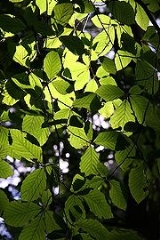
In botanyBotany

Botany is the scientific study of plantlife....
, a leaf is an above-ground plantPlant Summary

Plants are a major group of living things including familiar organisms such as trees, flowers, herbs, ferns, and mosses....
 organOrgan (anatomy)

In biology, an organ is a group of tissues that perform a specific function or group of functions....
 specialized for photosynthesisPhotosynthesis

Photosynthesis , generally, is the synthesis of sugar from light, carbon dioxide and water, with oxygen as a waste product....
. For this purpose, a leaf is typically flat (laminar) and thin, to expose the cells containing chloroplastChloroplast

Chloroplasts are organelles found in plant cells and eukaryotic algae that conduct photosynthesis....
 to lightLight

Light is electromagnetic radiation with a wavelength that is visible to the eye or, in a technical or scientific context, e...
 over a broad area, and to allow light to penetrate fully into the tissues. Leaves are also the sites in most plants where transpirationTranspiration

Transpiration is the evaporation of water from aerial parts of plants, especially leaves but also stems, flowers and fruits....
 and guttationGuttation

Guttation is the appearance of drops of xylem sap on the tips or edges of leaves of some vascular plants, such as grasses....
 take place. Leaves can store foodFood

Food is any substance, usually comprised primarily of carbohydrates, fats, vitamins, water and/or proteins, that can be eate...
 and waterWater Overview

Water is a tasteless, odorless substance that is essential to all known forms of life and is known as the universal solve...
, and are modified in some plants for other purposes.


Discussion
Ask a question about 'Leaf'
Start a new discussion about 'Leaf'
Answer questions from other users
Full Discussion Forum


Recent Posts


Encyclopedia


In botanyBotany

Botany is the scientific study of plantlife....
, a leaf is an above-ground plantPlant Summary

Plants are a major group of living things including familiar organisms such as trees, flowers, herbs, ferns, and mosses....
 organOrgan (anatomy)

In biology, an organ is a group of tissues that perform a specific function or group of functions....
 specialized for photosynthesisPhotosynthesis

Photosynthesis , generally, is the synthesis of sugar from light, carbon dioxide and water, with oxygen as a waste product....
. For this purpose, a leaf is typically flat (laminar) and thin, to expose the cells containing chloroplastChloroplast

Chloroplasts are organelles found in plant cells and eukaryotic algae that conduct photosynthesis....
 to lightLight

Light is electromagnetic radiation with a wavelength that is visible to the eye or, in a technical or scientific context, e...
 over a broad area, and to allow light to penetrate fully into the tissues. Leaves are also the sites in most plants where transpirationTranspiration

Transpiration is the evaporation of water from aerial parts of plants, especially leaves but also stems, flowers and fruits....
 and guttationGuttation

Guttation is the appearance of drops of xylem sap on the tips or edges of leaves of some vascular plants, such as grasses....
 take place. Leaves can store foodFood

Food is any substance, usually comprised primarily of carbohydrates, fats, vitamins, water and/or proteins, that can be eate...
 and waterWater Overview

Water is a tasteless, odorless substance that is essential to all known forms of life and is known as the universal solve...
, and are modified in some plants for other purposes. The comparable structures of fernFern

A fern is any one of a group of about 20,000 species of plants classified in the phylum or division Pteridophyta, also...
s are correctly referred to as frondFrond

A frond is the breast- like structure of a fern or alga....
s. Furthermore, leaves are prominent in the humanHuman

Humans, or human beings, are bipedal primates belonging to the mammalian species Homo sapiens under the fami...
 dietDiet (nutrition) Summary

In nutrition, the diet is the sum of the food consumed by an organism....
 as leaf vegetableLeaf vegetable

Leaf vegetables, also called potherbs, greens, or leafy greens, are plant leaves eaten as a vegetable, som...
s.

Leaf anatomy

A structurally complete leaf of an angiospermFlowering plant

The flowering plants are a major group of land plants....
 consists of a petiolePetiole (botany)

In botany, the petiole is the small stalk attaching the leaf blade to the stem....
 (leaf stem), a lamina (leaf blade), and stipuleStipule

In botany, stipule refers to outgrowths borne on either side of the base of a leafstalk....
s (small processes located to either side of the base of the petiole). The petiole attaches to the stem at a point called the "leaf axil". Not every species produces leaves with all of the aforementioned structural components. In some species, paired stipules are not obvious or are absent altogether. A petiole may be absent, or the blade may not be laminar (flattened). The tremendous variety shown in leaf structure (anatomy) from species to species is presented in detail below under Leaf morphology. After a period of time (i.e. seasonally, during the autumn), deciduous trees shed their leaves. These leaves then decompose into the soil.

A leaf is considered a plant organ and typically consists of the following tissues:
  1. An epidermis that covers the upper and lower surfaces
  2. An interior chlorenchyma called the mesophyll
  3. An arrangement of veins (the vascular tissue).


Epidermis


The epidermisEpidermis (botany)

The epidermis is the outer single-layered group of cells covering a plant, especially the leaf and young tissues of a vascul...
 is the outer multi-layered group of cellsCell (biology)

The cell is the structural and functional unit of all living organisms, and is sometimes called the "building block of life....
 covering the leaf. It forms the boundary separating the plant's inner cells from the external world. The epidermis serves several functions: protection against water loss, regulation of gas exchange, secretion of metabolicMetabolism

Metabolism is the biochemical modification of chemical compounds in living organisms and cells....
 compounds, and (in some species) absorption of water. Most leaves show dorsoventral anatomy: the upper (adaxial) and lower (abaxial) surfaces have somewhat different construction and may serve different functions.

The epidermis is usually transparentFacts About Transparency (optics)

In optics, transparency is the property of allowing light to pass....
 (epidermal cells lack chloroplasts) and coated on the outer side with a waxy cuticlePlant cuticle

Plant cuticles are a protective waxy covering produced only by the epidermal cells of leaves, young shoots and all other aer...
 that prevents water loss. The cuticle is in some cases thinner on the lower epidermis than on the upper epidermis, and is thicker on leaves from dry climates as compared with those from wet climates.

The epidermis tissue includes several differentiated cell types: epidermal cells, guard cells, subsidiary cells, and epidermal hairs. The epidermal cells are the most numerous, largest, and least specialized. These are typically more elongated in the leaves of monocots than in those of dicots.

The epidermis is covered with pores called stomaStoma

In botany, a stoma is a tiny opening or pore, found mostly on the under-surface of a plant leaf, and used for gas exchange....
ta
, part of a stoma complex consisting of a pore surrounded on each side by chloroplast-containing guard cells, and two to four subsidiary cells that lack chloroplasts. The stoma complex regulates the exchange of gases and water vapor between the outside air and the interior of the leaf. Typically, the stomata are more numerous over the abaxial (lower) epidermis than the adaxial (upper) epidermis.

Mesophyll

Most of the interior of the leaf between the upper and lower layers of epidermis is a parenchymaParenchyma

In animals The parenchyma are the functional parts of an organ in the body....
(ground tissue) or chlorenchyma tissue called the mesophyll (Greek for "middle leaf"). This assimilationAssimilation (biology)

Assimilation, in biology, designates the process of the transformation of external substances and materials into substances ...
 tissue is the primary location of photosynthesis in the plant. The products of photosynthesis are called "assimilates".

In ferns and most flowering plants the mesophyll is divided into two layers:
  • An upper palisade layerPalisade cell

    Palisade cells is type of mesophyll and can be found inside the leaf of a green plants....
    of tightly packed, vertically elongated cells, one to two cells thick, directly beneath the adaxial epidermis. Its cells contain many more chloroplasts than the spongy layer. These long cylindrical cells are regularly arranged in one to five rows. Cylindrical cells, with the chloroplasts close to the walls of the cell, can take optimal advantage of light. The slight separation of the cells provides maximum absorptionAbsorption (chemistry) Overview

    Absorption, in chemistry, is a physical or chemical phenomenon or a process in which atoms, molecules, or ions enter some bu...
     of carbon dioxide. This separation must be minimal to afford capillary actionCapillary action

    Capillary action or capillarity is the ability of a substance to draw a liquid upwards against the force of gravity....
     for water distribution. In order to adapt to their different environment (such as sun or shade), plants had to adapt this structure to obtain optimal result. Sun leaves have a multi-layered palisade layer, while shade leaves or older leaves closer to the soil, are single-layered.
  • Beneath the palisade layer is the spongy layer. The cells of the spongy layer are more rounded and not so tightly packed. There are large intercellular air spaces. These cells contain fewer chloroplasts than those of the palisade layer.


The pores or stomata of the epidermis open into substomatal chambers, connecting to air spaces between the spongy layer cells.

These two different layers of the mesophyll are absent in many aquatic and marsh plants. Even an epidermis and a mesophyll may be lacking. Instead for their gaseous exchanges they use a homogeneous aerenchymaAerenchyma

Aerenchyma is the spongy tissue occurring mainly in the stems of many aquatic or marsh plants....
(thin-walled cells separated by large gas-filled spaces). Their stomata are situated at the upper surface.

Leaves are normally greenGreen

Green is a color with many different shades, all within a wavelength of roughly 520570 nm....
 in color, which comes from chlorophyllChlorophyll

Chlorophyll is a green photosynthetic pigment found in most plants, algae, and cyanobacteria....
 found in plastidPlastid

Plastids are major organelles found only in plants and algae....
s in the chlorenchyma cells. Plants that lack chlorophyll cannot photosynthesizePhotosynthesis

Photosynthesis , generally, is the synthesis of sugar from light, carbon dioxide and water, with oxygen as a waste product....
.


Leaves in temperateTemperate

In geography, temperate latitudes of the globe lie between the tropics and the polar circles....
, borealBoreal

Boreal may refer to these:*Northern from the eponymous Boreas, god of the North Wind in Greek mythology....
, and seasonally dry zones may be seasonally deciduousDeciduous

Deciduous means "temporary" or "tending to fall off" ....
 (falling off or dying for the inclement season). This mechanism to shed leaves is called abscissionAbscission

Abscission is the shedding of a body part....
. After the leaf is shed, a leaf scar develops on the twig. In cold autumns they sometimes change colorAutumn leaf color

Autumn leaf color is a phenomenon that affects the normally green leaves of many deciduous trees and shrubs by which they ta...
, and turn yellowYellow

Yellow is any color of light that stimulates both the red and green cone cells of the retina, but not the blue cone cells....
, bright orangeOrange (colour)

The colour orange occurs between red and yellow in the visible spectrum at a wavelength of about 585–620 nanometres....
 or redFacts About Red

Red is any of a number of similar colors at the lowest frequencies of light discernible by the human eye....
 as various accessory pigments are revealed when the tree responds to cold and reduced sunlightSunlight

Sunlight in the broad sense is the total spectrum of electromagnetic radiation given off by the Sun....
 by curtailing chlorophyll production. Red anthocyanin pigments are now thought to be produced in the leaf as it dies.

Veins

The veins are the vascular tissueVascular tissue

Vascular tissue is a complex tissue found in vascular plants....
 of the leaf and are located in the spongy layer of the mesophyll. They are typical examples of pattern formationPattern formation Summary

The science of pattern formation deals with the visible, orderly outcomes of self-organisation and the common principles beh...
 through ramificationRamification (botany)

Ramification, in botany, is the divergence of the stem and limbs of a plant into smaller ones, i.e....
. The pattern of the veins is called venationFacts About Venation

The arrangements of veins and veinlets is called venation. Venation is classified into reticulate and parallel venations....
.

The veins are made up of:
  • xylemXylem

    In vascular plants, xylem is one of the two types of transport tissue in plants, phloem being the other one....
    , tubes that brings water and minerals from the roots into the leaf.
  • phloemPhloem

    In vascular plants, phloem is the living tissue that carries organic nutrients, particularly sucrose, to all parts of the pl...
    , tubes that usually moves sap, with dissolved sucrose, produced by photosynthesis in the leaf, out of the leaf.


The xylem typically lies over the phloem. Both are embedded in a dense parenchyma tissue, called "pith", with usually some structural collenchyma tissue present.

Leaf morphology


External leaf characteristics (such as shape, margin, hairs, etc.) are important for identifying plant speciesSpecies

In biology, a species is one of the basic units of biodiversity....
, and botanists have developed a rich terminologyTerminology

Terminology, in its general sense, simply refers to the usage and study of terms, that is to say words and compound words ge...
 for describing leaf characteristics. These structures are a part of what makes leaves determinant; they grow and achieve a specific pattern and shape, then stop. Other plant parts like stems or roots are non-determinant, and will usually continue to grow as long as they have the resources to do so.

Classification of leaves can occur through many different designative schema, and the type of leaf is usually characteristic of a species, although some species produce more than one type of leaf. The longest type of leaf is a leaf from palm trees, measuring at nine feet long. The terminology associated with the description of leaf morphology is presented, in illustrated form, at .

Basic leaf types


  • FernFern

    A fern is any one of a group of about 20,000 species of plants classified in the phylum or division Pteridophyta, also...
    s have fronds.
  • Conifer leaves are typically needle-, awl-, or scale-shaped
  • AngiospermFlowering plant

    The flowering plants are a major group of land plants....
     (flowering plant) leaves: the standard form includes stipules, a petiole, and a lamina.
  • LycophytesLycopodiophyta

    The Division Lycopodiophyta is a tracheophyte subdivision of the Kingdom Plantae....
     have microphyllMicrophyll

    Microphyll refers to the leaves of the Lycopodiophyta....
     leaves.
  • SheathMonocotyledon

    Insert non-formatted text hereThe Monocotyledons or monocots are a group of flowering plants, dominating great parts ...
     leaves (type found in most grassesPoaceae

    The true grasses are monocotyledonous plants in the Family Poaceae, also known as Gramineae....
    ).
  • Other specialized leaves (such as those of NepenthesNepenthes

    The Nepenthes, popularly known as Tropical Pitcher Plants or Monkey Cups, are a plant genus in the monotypic...
    )

Arrangement on the stem

Different terms are usually used to describe leaf placement:

  • Alternate — leaf attachments are singular at nodes, and leaves alternate direction, to a greater or lesser degree, along the stem.
  • Opposite — leaf attachments are paired at each node; decussate if, as typical, each successive pair is rotated 90° progressing along the stem; or distichous if not rotated, but two-ranked (in the same geometric flat-plane).
  • Whorled — three or more leaves attach at each point or node on the stem. As with opposite leaves, successive whorls may or may not be decussate, rotated by half the angle between the leaves in the whorl (i.e., successive whorls of three rotated 60°, whorls of four rotated 45°, etc). Opposite leaves may appear whorled near the tip of the stem.
  • Rosulate — leaves form a rosetteRosette (botany) Overview

    In botany, a rosette is a circular arrangement of the leaves, with all the leaves at a single height....


As a stem grows, leaves tend to appear arranged around the stem in a way that optimizes yield of light. In essence, leaves form a helixHelix

A helix, from the Greek word ????a?/????, is a twisted shape like a spring, screw or a spiral staircase....
 pattern centred around the stem, either clockwise or counterclockwiseClockwise and counterclockwise

A clockwise motion is one that proceeds 'like the clock's hands': from the top to the right, then down and then to the left,...
, with (depending upon the species) the same angle of divergence. There is a regularity in these angles and they follow the numbers in a Fibonacci sequence: 1/2, 2/3, 3/5, 5/8, 8/13, 13/21, 21/34, 34/55, 55/89. This series tends to a limit of 360° x 34/89 = 137.52 or 137° 30', an angle known mathematically as the golden angleGolden angle

In geometry, the golden angle is the angle created by dividing the circumference c of a circle into a section a and ...
. In the series, the numeratorNumerator Summary

A numerator is a person who counts, also called a tabulator, or a numeral used to indicate a count....
 indicates the number of complete turns or "gyres" until a leaf arrives at the initial position. The denominator indicates the number of leaves in the arrangement. This can be demonstrated by the following:

  • alternate leaves have an angle of 180° (or 1/2)
  • 120° (or 1/3) : three leaves in one circle
  • 144° (or 2/5) : five leaves in two gyres
  • 135° (or 3/8) : eight leaves in three gyres.

Divisions of the lamina (blade)

Two basic forms of leaves can be described considering the way the blade is divided. A simple leaf has an undivided blade. However, the leaf shape may be formed of lobes, but the gaps between lobes do not reach to the main vein. A compound leaf has a fully subdivided blade, each leafletLeaflet

A leaflet in botany is a part of a compound leaf....
 of the blade separated along a main or secondary vein. Because each leaflet can appear to be a simple leaf, it is important to recognize where the petiole occurs to identify a compound leaf. Compound leaves are a characteristic of some families of higher plants, such as the FabaceaeFabaceae Overview

Fabaceae is the botanical name of a plant family....
. The middle vein of a compound leaf or a frondFrond

A frond is the breast- like structure of a fern or alga....
, when it is present, is called a rachisRachis

The rachis is the main axis of the inflorescence, or spike, of wheat and other cereals, to which the spikelets are attached....
.
  • Palmately compound leaves have the leaflets radiating from the end of the petiole, like fingers off the palm of a hand, e.g. CannabisCannabis

    Cannabis is a genus of flowering plant that includes one or more species....
    (hemp) and AesculusAesculus

    The genus Aesculus comprises 2025 species of deciduous trees and shrubs native to the temperate northern hemisphere, wit...
    (buckeyes).
  • Pinnately compound leaves have the leaflets arranged along the main or mid-vein.
    • odd pinnate: with a terminal leaflet, e.g. FraxinusAsh tree

      An ash can be any of four different tree genera from four very distinct families , but originally and most commonly refers t...
      (ash).
    • even pinnate: lacking a terminal leaflet, e.g. SwieteniaMahogany

      This article refers to the timber only....
      (mahogany).
  • Bipinnately compound leaves are twice divided: the leaflets are arranged along a secondary vein that is one of several branching off the rachis. Each leaflet is called a "pinnule". The pinnules on one secondary vein are called "pinna"; e.g. AlbiziaAlbizia

    Albizia is a genus of about 150 species of mostly fast-growing subtropical and tropical trees and shrubs in the Subfamil...
    (silk tree).
  • trifoliate: a pinnate leaf with just three leaflets, e.g. TrifoliumClover

    Clover is a genus of about 300 species of plants in the pea family Fabaceae....
    (clover), LaburnumLaburnum Summary

    Laburnum is a genus of two species of small trees in the subfamily Faboideae of the pea family Fabaceae, Laburnum anag...
    (laburnum).
  • pinnatifid: pinnately dissected to the midrib, but with the leaflets not entirely separate, e.g. PolypodiumPolypodium

    Polypodium is a large genus of true ferns, widely distributed throughout the world, but specially developed in the tropi...
    , some SorbusSorbus

    The genus Sorbus is a genus of about 100-200 species of trees and shrubs in the subfamily Maloideae of the Rose family R...
    (whitebeams).

Characteristics of the petiole


Petiolated leaves have a petiolePetiole (botany) Overview

In botany, the petiole is the small stalk attaching the leaf blade to the stem....
. Sessile leaves do not: the blade attaches directly to the stem. In clasping or decurrent leaves, the blade partially or wholly surrounds the stem, often giving the impression that the shoot grows through the leaf. When this is actually the case, the leaves are called "perfoliate", such as in Claytonia perfoliataFacts About Claytonia perfoliata

Claytonia perfoliata is a fleshy annual plant native to the western mountain and coastal regions of North America from s...
. In peltate leaves, the petiole attaches to the blade inside from the blade margin.

In some AcaciaAcacia Overview

Acacia is a genus of shrubs and trees of Gondwanian origin belonging to the Subfamily Mimosoideae of the Pea Family , fi...
species, such as the Koa Tree (Acacia koa), the petioles are expanded or broadened and function like leaf blades; these are called phyllodePhyllode

Phyllodes are modified petioles or leaf stems....
s. There may or may not be normal pinnate leaves at the tip of the phyllode.

A stipuleStipule

In botany, stipule refers to outgrowths borne on either side of the base of a leafstalk....
, present on the leaves of many dicotyledonDicotyledon

Dicotyledons or "dicots" is a name for a group of flowering plants whose seed typically contains two embryonic leaves ...
s, is an appendage on each side at the base of the petiole resembling a small leaf. Stipules may be lasting and not be shed (a stipulate leaf, such as in roseRose

A rose is a flowering shrub of the genus Rosa, and the flower of this shrub....
s and beanBean

Bean is a common name for large plant seeds of several genera of Fabaceae used for food or feed....
s), or be shed as the leaf expands, leaving a stipule scar on the twig (an exstipulate leaf).
  • The situation, arrangement, and structure of the stipules is called the "stipulation".
    • free
    • adnate : fused to the petiole base
    • ochreate : provided with ochreaOchrea

      Ochrea, commonly spelled ocrea, is a structure formed of stipules fused into a sheath surrounding the stem....
      , or sheath-formed stipules, e.g. rhubarbRhubarb

      Rhubarb is a perennial plant that grows from thick short rhizomes, comprising the genus Rheum....
      ,
    • encircling the petiole base
    • interpetiolar : between the petioles of two opposite leaves.
    • intrapetiolar : between the petiole and the subtending stem

Venation (arrangement of the veins)


There are two subtypes of venation, namely, craspedodromous, where the major veins stretch up to the margin of the leaf, and camptodromous, when major veins extend close to the margin, but bend before they intersect with the margin.
  • Feather-veined, reticulate — the veins arise pinnately from a single mid-vein and subdivide into veinlets. These, in turn, form a complicated network. This type of venation is typical for (but by no means limited to) dicotyledonDicotyledon

    Dicotyledons or "dicots" is a name for a group of flowering plants whose seed typically contains two embryonic leaves ...
    s.
    • Pinnate-netted, penniribbed, penninerved, penniveined; the leaf has usually one main vein (called the mid-vein), with veinlets, smaller veins branching off laterally, usually somewhat parallel to each other; eg MalusMalus

      Malus, the apples, is a genus of about 30-35 species of small deciduous trees or shrubs in the family Rosaceae, in...
      (apples).
    • Three main veins branch at the base of the lamina and run essentially parallel subsequently, as in CeanothusCeanothus

      Ceanothus L. is a genus of about 5060 species of shrubs or small trees in the buckthorn family Rhamnaceae....
      . A similar pattern (with 3-7 veins) is especially conspicuous in MelastomataceaeMelastomataceae

      The family Melastomataceae is a taxon of dicotyledonous flowering plants found mostly in the tropics comprising some 200 gen...
      .
    • Palmate-netted, palmate-veined, fan-veined; several main veins divergeDivergence

      In vector calculus, the divergence is an operator that measures a vector field's tendency to originate from or converge upo...
       from near the leaf base where the petiole attaches, and radiate toward the edge of the leaf; e.g. most AcerMaple

      Maples are trees or shrubs of the genus Acer....
       (maples).
  • Parallel-veined, parallel-ribbed, parallel-nerved, penniparallel — veins run parallelParallel (geometry)

    Parallel is a term in geometry and in everyday life that refers to a property in Euclidean space of two or more lines or pla...
     for the length of the leaf, from the base to the apex. Commissural veins (small veins) connect the major parallel veins. Typical for most monocotyledonMonocotyledon

    Insert non-formatted text hereThe Monocotyledons or monocots are a group of flowering plants, dominating great parts ...
    s, such as grassesPoaceae

    The true grasses are monocotyledonous plants in the Family Poaceae, also known as Gramineae....
    .
  • Dichotomous — There are no dominant bundles, with the veins forking regularly by pairs; found in GinkgoGinkgo

    The Ginkgo , frequently misspelled as "Gingko", and sometimes known as the Maidenhair Tree, is a unique tree with no c...
    and some pteridophyteFern

    A fern is any one of a group of about 20,000 species of plants classified in the phylum or division Pteridophyta, also...
    s.


Note that although it is the more complex pattern, branching veins appear to be plesiomorphic and in some form were present in ancient seed plants as long as 250 million years ago. A pseudo-reticulate venation that is actually a highly modified penniparallel one is an autapomorphy of some MelanthiaceaeMelanthiaceae

Melanthiaceae is the botanical name of a family of flowering plants....
 which are monocots, e.g. Paris quadrifoliaParis quadrifolia Overview

Paris quadrifolia is a species of the genus Paris in the family Melanthiaceae although authorities formerly regarde...
(True-lover's Knot).

Leaf morphology changes within a single plant

  • Homoblasty - Characteristic in which a plant has small changes in leaf size, shape, and growth habit between juvenile and adult stages.
  • Heteroblasty - Charactistic in which a plant has marked changes in leaf size, shape, and growth habit between juvenile and adult stages.


Leaf terminology


Shape


Margins (edge)

The leaf margin is characteristic for a genus and aids in determining the species.
  • entire: even; with a smooth margin; without toothing
  • ciliate: fringed with hairs
  • crenate: wavy-toothed; dentate with rounded teeth, such as FagusBeech

    Beech is a genus of ten species of deciduous trees in the family Fagaceae, native to temperate Europe, Asia, and North Ameri...
     (beech)
  • dentate: toothed, such as CastaneaChestnut Summary

    Chestnuts , including the chinkapins, are a genus of eight or nine species of trees and shrubs in the beech family Fag...
     (chestnut)
    • coarse-toothed: with large teeth
    • glandular toothed: with teeth that bear glands.
  • denticulate: finely toothed
  • doubly toothed: each tooth bearing smaller teeth, such as UlmusElm

    Elms are deciduous and semi-deciduous trees comprising the genus Ulmus, family Ulmaceae, native to temperate regions of ...
     (elm)
  • lobate: indented, with the indentations not reaching to the center, such as many QuercusOak Overview

    The term oak can be used as part of the common name of any of several hundred species of trees and shrubs in the genus Que...
     (oaks)
    • palmately lobed: indented with the indentations reaching to the center, such as HumulusHop (plant)

      The hop is a small genus of flowering plants, native to the temperate Northern Hemisphere....
       (hop).
  • serrate: saw-toothed with asymmetrical teeth pointing forward, such as UrticaNettle

    Nettle is the common name for any of between 30-45 species of flowering plants of the genus Urtica in the family Urticac...
     (nettle)
  • serrulate: finely serrate
  • sinuate: with deep, wave-like indentations; coarsely crenate, such as many RumexRumex

    The docks and sorrels, genus Rumex L., are a genus of about 200 species of annual, biennial and perennial he...
    (docks)
  • spiny: with stiff, sharp points, such as some IlexHolly

    Holly is a genus of about 400 species of flowering plants in the family Aquifoliaceae, and the only genus in that family....
     (hollies) and CirsiumThistle

    Thistle is the common name of a polyphyletic group of flowering plants characterised by leaves with sharp spines on the marg...
     (thistles).

Tip of the leaf


  • acuminate: long-pointed, prolonged into a narrow, tapering point in a concave manner.
  • acute: ending in a sharp, but not prolonged point
  • cuspidate: with a sharp, elongated, rigid tip; tipped with a cusp.
  • emarginate: indented, with a shallow notch at the tip.
  • mucronate: abruptly tipped with a small short point, as a continuation of the midrib; tipped with a mucro.
  • mucronulate: mucronate, but with a smaller spine.
  • obcordate: inversely heart-shaped, deeply notched at the top.
  • obtuse: rounded or blunt
  • truncate: ending abruptly with a flat end, that looks cut off.

Base of the leaf

  • acuminate: coming to a sharp, narrow, prolonged point.
  • acute: coming to a sharp, but not prolonged point.
  • auriculate: ear-shaped
  • cordate: heart-shaped with the notch towards the stalk.
  • cuneate: wedge-shaped.
  • hastate: shaped like an halberd and with the basal lobes pointing outward.
  • oblique: slanting.
  • reniform: kidney-shaped but rounder and broader than long.
  • rounded: curving shape.
  • sagittate: shaped like an arrowhead and with the acute basal lobes pointing downward.
  • truncate: ending abruptly with a flat end, that looks cut off.

Surface of the leaf


The surface of a leaf can be described by several botanical terms:
  • farinose: bearing farina; mealy, covered with a waxy, whitish powder.
  • glabrous: smooth, not hairy.
  • glaucous: with a whitish bloom; covered with a very fine, bluish-white powder.
  • glutinous: sticky, viscid.
  • papillate, papillose: bearing papillae (minute, nipple-shaped protuberances).
  • pubescentPubescent

    Pubescent has several meanings:#A pubescent person is a young individual who is undergoing the physical and mental changes ...
    : covered with erect hairs (especially soft and short ones)
  • punctate: marked with dots; dotted with depressions or with translucent glands or colored dots.
  • rugose: deeply wrinkled; with veins clearly visible.
  • scurfy: covered with tiny, broad scalelike particles.
  • tuberculate: covered with tubercles; covered with warty prominences.
  • verrucose: warted, with warty outgrowths.
  • viscid, viscous: covered with thick, sticky secretions.


The leaf surface is also host to a large variety of microorganisms; in this context it is referred to as the phyllospherePhyllosphere

The phyllosphere is a term used in microbiology to refer to leaf surfaces or total above-ground surfaces of a plant as a hab...
.

Hairiness (trichomes)


"Hairs" on plants are properly called trichomeTrichome Overview

Trichomes, from the Greek meaning "growth of hair", are fine outgrowths or appendages on plants and protists....
s. Leaves can show several degrees of hairiness. The meaning of several of the following terms can overlap.
  • glabrous: no hairs of any kind present.
  • arachnoid, arachnose: with many fine, entangled hairs giving a cobwebby appearance.
  • barbellate: with finely barbed hairs (barbellae).
  • bearded: with long, stiff hairs.
  • bristly: with stiff hair-like prickles.
  • canescent: hoary with dense grayish-white pubescence.
  • ciliate: marginally fringed with short hairs (cilia).
  • ciliolate: minutely ciliate.
  • floccose: with flocks of soft, woolly hairs, which tend to rub off.
  • glandular: with a gland at the tip of the hair.
  • hirsute: with rather rough or stiff hairs.
  • hispid: with rigid, bristly hairs.
  • hispidulous: minutely hispid.
  • hoary: with a fine, close grayish-white pubescence.
  • lanate, lanose: with woolly hairs.
  • pilose: with soft, clearly separated hairs.
  • puberulent, puberulous: with fine, minute hairs.
  • pubescent: with soft, short and erect hairs.
  • scabrous, scabrid: rough to the touch
  • sericeous: silky appearance through fine, straight and appressed (lying close and flat) hairs.
  • silky: with adpressed, soft and straight pubescence.
  • stellate, stelliform: with star-shaped hairs.
  • strigose: with appressed, sharp, straight and stiff hairs.
  • tomentose: densely pubescent with matted, soft white woolly hairs.
    • cano-tomentose: between canescent and tomentose
    • felted-tomentose: woolly and matted with curly hairs.
  • villous: with long and soft hairs, usually curved.
  • woolly: with long, soft and tortuous or matted hairs.

Adaptations


In the course of evolution, leaves adapted to different environmentEnvironment (biophysical)

The environment, in the biophysical context, is the physical and biological factors along with their chemical interactions t...
s in the following ways:
  • A certain surface structure avoids moistening by rain and contaminations.
  • Sliced leaves reduce wind resistance.
  • Hairs on the leaf surface trap humidity in dry climates and creates a large boundary layer and reduces water loss.
  • WaxWax

    Wax has traditionally referred to a substance that is secreted by bees and used by them in constructing their honeycombs....
    y leaf surfaces reduce water loss.
  • Shiny leaves deflect the sunSun Summary

    |+ The Sun   |+|-| colspan="2" align="center" | |-...
    's rays.
  • Reductions of leaf sizes accompanied by a transfer of the photosynthetic functions to the stems reduces water loss.
  • In more or less opaque or buried in the soil leaves translucent windows filter the light before the photosynthetis takes place at the inner leaf surfaces (e.g. FenestrariaFenestraria

    Fenestraria is a monotypic genus of succulent plants in the family Aizoaceae....
    ).
  • Thicker leaves store water (leaf succulents).
  • Aromatic oils, poisons or pheromones produced by leaf borne glands deter herbivores (e.g. eucalypts).
  • Inclusions of crystalline minerals deters herbivores.
  • A transformation into petalPetal

    A petal, regarded as a highly modified leaf, is one member or part of the corolla of a flower....
    s attracts pollinators.
  • A transformation into spinesSpine (botany)

    A spine is a rigid, pointed surface protuberance or needle-like structure on a plant, presumably serving as a defense agains...
     protects the plants (e.g. cactusCactus

    Cactus is the name given to any member of the flowering plant family Cactaceae....
    ).
  • A transformation into insect traps helps feeding the plants.
  • A transformation into bulbBulb

    A bulb is an underground vertical shoot that has modified leaves that are used as food storage organs by a dormant plant....
    s helps storing food and water (e.g. onionOnion

    Onion in the general sense can be used for any plant in the genus Allium but used without qualifiers usually means All...
    ).
  • A transformation into tendrilTendril

    In botany, a tendril is a specialized stem, leaf or petiole with a threadlike shape that is used by climbing plants for supp...
    s allow the plant to climb (e.g. peaPea

    A pea is the small, edible round green bean which grows in a pod on the leguminous vine Pisum sativum, or in some ...
    ).
  • A transformation into bractBract Summary

    In botany, a bract is a modified or specialized leaf, from the axil of which a flower or flower stalk arises; or a bract may...
    s and pseudanthiaFacts About Pseudanthium

    A pseudanthium is a special type of inflorescence, in which several flowers are grouped together to form a flower-like stru...
     (false flowers) replaces normal flower structures if the true flowers are extremely reduced (e.g. SpurgeSpurge Summary

    Spurges are a very large and variable worldwide plant taxon, belonging to the spurge family, or Euphorbiaceae....
    s).

Interactions with other organisms


Although not as nutritious as other organs such as fruit, leaves provide a food source for many organisms. Animals which eat leaves are known as folivoreFolivore

In Zoology, a folivore is an animal that specializes in eating leaves....
s. The leaf is one of the most vital parts of the plant, and plants have evolved protection against folivores such as tanninTannin

Tannins are astringent, bitter-tasting plant polyphenols that bind and precipitate proteins....
s, chemicals which hinder the digestion of proteins and have an unpleasant taste. Some animals have crypticCrypsis

In zoology, crypsis is the ability of an organism to avoid observation....
 adaptations to avoid their own predators, for example some caterpillars will create a small home in the leaf by folding it over themselves, while other herbivores and their prey mimic the appearance of the leaf. Some insects, such as the katydid, take this even further, moving from side to side much like a leaf does in the wind.

Bibliography

  • Leaves: The formation, charactistics and uses of hundred of leaves in all parts of the world by Ghillean Tolmie Prance. 324 photographic plates in black and white, and colour by Kjell B Sandved 256 pages

See also

  • AbscissionFacts About Abscission

    Abscission is the shedding of a body part....
     (losing of leaves)
  • CladophyllCladophyll

    Cladophylls also called cladodes are photosynthetic branches or portions of a stem that resemble and function as a lea...
  • GuttationGuttation

    Guttation is the appearance of drops of xylem sap on the tips or edges of leaves of some vascular plants, such as grasses....
     (beads of fluid forming at leaf margins)
  • Leaf area indexLeaf Area Index

    The Leaf Area Index or LAI is the ratio of total upper leaf surface of a crop divided by the surface area of the land ...
  • PhyllocladePhylloclade

    Phylloclades are flattened, photosynthetic short shoots which are modified branches that greatly resemble or perform the fun...
  • VernationVernation

    Vernation is the formation of new leaves or fronds....
     (sprouting of leaves)
  • Evolution of leavesPlant evolutionary developmental biology

    Evolutionary developmental biology refers to the study of developmental programs and patterns from an evolutionary perspective....


External links

  • Leaf structure and transpiration resource for teens.