



is derived) is the elected spiritual leader of the worldwide Ahmadiyya Muslim Community
and is the successor of Mirza Ghulam Ahmad
of Qadian
. The Khalifatul Masih is believed by the Ahmadiyya Community to be divinely guided, continuing the same divine communion which the founder, Mirza Ghulam Ahmad is said to have enjoyed. The Lahore Ahmadiyya Movement
however does not subscribe to this belief. The Khalifatul Masih is also referred to by members of the Ahmadiyya Muslim Community as Amir al-Muminin
(leader of the faithful). The current Khalifatul Masih is Mirza Masroor Ahmad
.
After the death of Ghulam Ahmad, his successors directed the Ahmadiyya Community from Qadian
which remained the headquarters of the community until 1947 with the creation of Pakistan
. From this time on the headquarters remained in Rabwah
, a land bought in Pakistan by the community. In 1984, Ordinance XX
was promulgated by the government of Pakistan which rendered the Khalifa unable to perform his duties and put the very institution of the Ahmadiyya Caliphate in jeopardy. Due to these circumstances, Khalifatul Masih IV
left Pakistan and migrated to London
, England
, provisionally changing the headquarters to the Fazl Mosque.
Overview
The members of the community believe that the Ahmadiyya Caliphate (Arabic: Khilāfah) is the continuation of the Islamic Caliphate, first being the Rashidun(rightly guided) Caliphate (of Righteous Caliphs). This is believed to have been suspended with Ali
, the son-in-law of Muhammad
and re-established with the appearance of Ghulam Ahmad whom Ahmadis believe was the Promised Messiah and Mahdi
.
Ahmadi Muslims believe that God
has assured them that this Caliphate will endure to the end of time, depending on their righteousness and faith in God. The Khalifa provides unity, security and progress for the Jama’at-i-Ahmadiyya. It is required that the Khalifa carry out his duties through consultation and taking into consideration the views of the members of the Shura (consultative body). However, it is not incumbent upon him to always accept the views and recommendations of the members. The Khalifatul Masih has overall authority for all religious and organisational matters and is bound to decide and act in accordance with the Qur'an
and Hadith
. According to Ahmadiyya thought, it is not essential for a Khalifa to be the head of a state, rather the spiritual and religious significance of the Khilāfah is emphasised.
Quranic reference
There are two kinds of Khalifa (pl. Khulafā) mentioned in the Quran, one which is directly appointed by God i.e. a prophet and vicegerent of God, (like Adam and Davidwho have been called God’s vicegerent in the Quran. and ). The other is one who succeeds a prophet and is a vicegerent of a prophet, referred to in the verse:
Reestablishment of the Rashidun Caliphate
The Ahmadiyya Muslim Community believes that their Caliphate is the second era and re-establishment of the first Caliphate, that of the Rashidun. As is stated in the Hadith
:
The first era of Caliphate mentioned in the above saying of Muhammad is commonly accepted by Muslims as that of the Rashidun. The second era mentioned is thought by Ahmadis to be that of the Ahmadiyya Caliphate.
Qudrat-e-Sānia (The second Manifestation of God’s power)
The Khilafat is believed by the Ahmadiyya Muslim Community to be the second manifestation of God’s power that was promised by Mirza Ghulam Ahmad to be witnessed by his patient and true followers after his demise. Ghulam Ahmad wrote in his last testament Al-Wassiyyat (The Will)System of election
The Ahmadiyya Muslim community holds that the Khilafat is a holy trust entrusted to a person on account of his piety, righteousness and ability through election and that the Khilafat is not hereditary, even though all the Khulafā of the Ahmadiyya community from the Khalifatul Masih II have been related. The Khalifa is elected to the office by voting of the members of the Electoral College, which was established for this purpose by Mirza Mahmood Ahmad. During the life of a Khalifa, the Electoral College works under his supervision. However, after the demise of a Khalifa, the Electoral College becomes completely independent and elects the next Khalifatul Masih. During the election, names are proposed and seconded by the members of the Electoral College, and then they vote for the proposed names by raising their hands. Though the Khalifa is elected, it is God however, who is believed to guide the members towards election of a righteous and able person as the Khalifatul Masih. Thus it is believed that it is God who chooses the Khalifa.List of Ahmadiyya Caliphs
| Name | Picture | Lifespan | Caliphate | Notes |
|---|---|---|---|---|
| Khalifatul Masih I. Hakeem Noor-ud-Din |
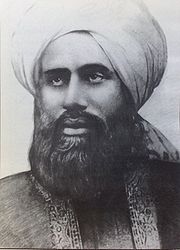 |
1841–1914 | 1908–1914 | Renowned physician of India, close companion of Mirza Ghulam Ahmad, he sent the first Ahmadiyya Muslim missionaries to the UK, and successfully dealt with internal dissensions within the community. |
| Khalifatul Masih II. Mirza Basheer-ud-Din Mahmood Ahmad |
1889–1965 | 1914–1965 | Son of Mirza Ghulam Ahmad Mirza Ghulam Ahmad Mīrzā Ghulām Aḥmad was a religious figure from India and the founder of the Ahmadiyya Community. He claimed to be the Mujaddid of the 14th Islamic century, the promised Messiah , and the Mahdi awaited by the Muslims in the end days... , was elected as Khalifa at the young age of 25, considered to be the 'promised son'. He established the entire organisational structure of the community, and is known for extensive missionary activity outside the subcontinent of India. |
|
| Khalifatul Masih III. Mirza Nasir Ahmad |
1909–1982 | 1965–1982 | Spoke himself for the Ahmadiyya community at the National Assembly of Pakistan, laid the foundation of the first mosque in Spain Spain Spain , officially the Kingdom of Spain languages]] under the European Charter for Regional or Minority Languages. In each of these, Spain's official name is as follows:;;;;;;), is a country and member state of the European Union located in southwestern Europe on the Iberian Peninsula... after 750 years. He oversaw the compilation of the dreams, visions, and revelations and the dialogues of the founder, Ghulam Ahmad Mirza Ghulam Ahmad Mīrzā Ghulām Aḥmad was a religious figure from India and the founder of the Ahmadiyya Community. He claimed to be the Mujaddid of the 14th Islamic century, the promised Messiah , and the Mahdi awaited by the Muslims in the end days... . |
|
| Khalifatul Masih IV. Mirza Tahir Ahmad |
1928–2003 | 1982–2003 | Led the community through periods of severe persecution, provisionally changed the Ahmadiyya headquarters from Rabwah Rabwah Rabwah is a private city in the Chiniot District of Punjab Province, Pakistan located on the Chenab River near the historic city of Chiniot... to London and launched the first Muslim satellite TV channel by the name of Muslim Television Ahmadiyya International. |
|
| Khalifatul Masih V. Mirza Masroor Ahmad |
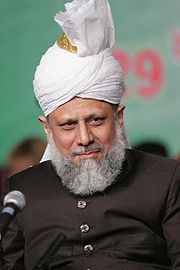 |
1950–present | 2003–present | Presently guiding the community through a period of widespread skepticism towards Islam, regularly holds peace conferences. Launched sister channels MTA 2 MTA 2 MTA 2 also known as MTA Ath-Thania is the second television channel of the MTA International satellite network. It was launched in early 2004. The programmes are broadcast throughout Europe and parts of Africa below the Sahel region. The channel was established under the auspices of Mirza Masroor... and MTA3 Al Arabiyya MTA 3 MTA 3 also known as MTA3 Al Arabiya is the third television channel of the MTA International satellite network. It was launched on 23 March 2007. The programmes are broadcast throughout the Middle East, North Africa and North America. It is also available for live streaming via the Internet... . |