

Corporation

Encyclopedia
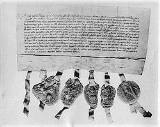
A corporation is created under the laws of a state
as a separate legal entity
that has privileges and liabilities that are distinct from those of its members. There are many different forms of corporations, most of which are used to conduct business
. Early corporations were established by charter (i.e. by an ad hoc act passed by a parliament or legislature). Most jurisdictions now allow the creation of new corporations through registration.
An important (but not universal) contemporary feature of a corporation is limited liability
. If a corporation fails, shareholders may lose their investments, and employees may lose their jobs, but neither will be liable for debts to the corporation's creditors.
Despite not being natural persons, corporations are recognized by the law to have rights and responsibilities like natural persons ("people"). Corporations can exercise human rights
against real individuals and the state, and they can themselves be responsible for human rights violations. Corporations are conceptually immortal but they can "die" when they are "dissolved" either by statutory operation, order of court, or voluntary action on the part of shareholders. Insolvency
may result in a form of corporate 'death', when creditors force the liquidation and dissolution of the corporation under court order, but it most often results in a restructuring of corporate holdings. Corporations can even be convicted of criminal offenses, such as fraud
and manslaughter
. However corporations are not living entities in the way that humans are.
Although corporate law varies in different jurisdictions, there are four characteristics of the business corporation:
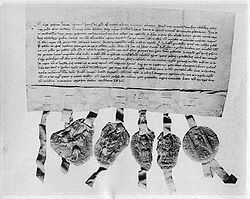 The word "corporation" derives from corpus, the Latin
word for body, or a "body of people." Entities which carried on business and were the subjects of legal rights were found in ancient Rome, and the Maurya Empire
in ancient India. In medieval Europe, churches became incorporated, as did local governments, such as the Pope
and the City of London Corporation. The point was that the incorporation would survive longer than the lives of any particular member, existing in perpetuity. The alleged oldest commercial corporation in the world, the Stora Kopparberg mining community in Falun
, Sweden
, obtained a charter
from King Magnus Eriksson in 1347. Many European nations chartered corporations to lead colonial ventures, such as the Dutch East India Company
or the Hudson's Bay Company
, and these corporations came to play a large part in the history of corporate colonialism.
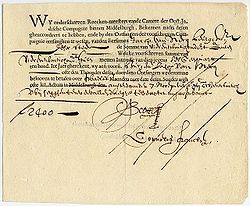
During the time of colonial expansion in the 17th century, the true progenitors of the modern corporation emerged as the "chartered company". Acting under a charter sanctioned by the Dutch government, the Dutch East India Company
(VOC) defeated Portuguese
forces and established itself in the Moluccan Islands in order to profit from the Europe
an demand for spices. Investors in the VOC were issued paper certificates as proof of share ownership, and were able to trade their shares on the original Amsterdam
stock exchange. Shareholders are also explicitly granted limited liability
in the company's royal charter. In the late 18th century, Stewart Kyd, the author of the first treatise on corporate law
in English, defined a corporation as,
 Labeled by both contemporaries and historians as "the grandest society of merchants in the universe", the British East India Company
would come to symbolize the dazzlingly rich potential of the corporation, as well as new methods of business that could be both brutal and exploitative. On 31 December 1600, the English monarchy granted the company a 15-year monopoly on trade to and from the East Indies
and Africa
. By 1611, shareholders in the East India Company were earning an almost 150% return on their investment
. Subsequent stock offerings demonstrated just how lucrative the Company had become. Its first stock offering in 1613-1616 raised ₤418,000, and its first offering in 1617-1622 raised ₤1.6 million.
In the United States
, government chartering began to fall out of vogue in the mid-19th century. Corporate law at the time was focused on protection of the public interest, and not on the interests of corporate shareholders. Corporate charters were closely regulated by the states. Forming a corporation usually required an act of legislature. Investors generally had to be given an equal say in corporate governance, and corporations were required to comply with the purposes expressed in their charters. Many private firms in the 19th century avoided the corporate model for these reasons (Andrew Carnegie
formed his steel operation as a limited partnership
, and John D. Rockefeller
set up Standard Oil
as a trust
). Eventually, state governments began to realize the greater corporate registration revenues available by providing more permissive corporate laws. New Jersey
was the first state to adopt an "enabling" corporate law, with the goal of attracting more business to the state. Delaware
followed, and soon became known as the most corporation-friendly state in the country after New Jersey raised taxes on the corporations, driving them out. New Jersey reduced these taxes after this mistake was realized, but by then it was too late; even today, most major public corporations in the United States are set up under Delaware law.
By the beginning of the 19th century, government policy on both sides of the Atlantic began to change, reflecting the growing popularity of the proposition that corporations were riding the economic wave of the future. In 1819, the U. S. Supreme Court granted corporations a plethora of rights they had not previously recognized or enjoyed. Corporate charters were deemed "inviolable", and not subject to arbitrary amendment or abolition by state governments. The Corporation as a whole was labeled an "artificial person, " possessing both individuality and immortality.
At around the same time, British legislation was similarly freeing the corporation from historical restrictions. In 1844 the British Parliament passed the Joint Stock Companies Act, which allowed companies to incorporate without a royal charter or an Act of Parliament. Ten years later, limited liability
, the key provision of modern corporate law, passed into English law: in response to increasing pressure from newly emerging capital interests, Parliament passed the Limited Liability Act of 1855, which established the principle that any corporation could enjoy limited legal liability on both contract and tort claims simply by registering as a "limited" company with the appropriate government agency.
This prompted the English periodical The Economist
to write in 1855 that "never, perhaps, was a change so vehemently and generally demanded, of which the importance was so much overrated. " The glaring inaccuracy of the second part of this judgment was recognized by the same magazine more than 70 years later, when it claimed that, "[t]he economic historian of the future. . . may be inclined to assign to the nameless inventor of the principle of limited liability, as applied to trading corporations, a place of honour with Watt
and Stephenson
, and other pioneers of the Industrial Revolution
. "
The well-known Santa Clara County v. Southern Pacific Railroad
decision began to influence policymaking and the modern corporate era had begun.
The 20th century saw a proliferation of enabling law across the world, which helped to drive economic booms in many countries before and after World War I. Starting in the 1980s, many countries with large state-owned corporations moved toward privatization
, the selling of publicly owned services and enterprises to corporations. Deregulation
(reducing the regulation of corporate activity) often accompanied privatization as part of a laissez-faire
policy. Another major postwar shift was toward the development of conglomerates
, in which large corporations purchased smaller corporations to expand their industrial base. Japanese firms developed a horizontal conglomeration model, the keiretsu
, which was later duplicated in other countries as well.
Haldane
,
The legal personality has two economic implications. First it grants creditors (as opposed to shareholders or employees) priority over the corporate assets upon liquidation. Second, corporate assets cannot be withdrawn by its shareholders, nor can the assets of the firm be taken by personal creditors of its shareholders. The second feature requires special legislation and a special legal framework, as it cannot be reproduced via standard contract law.
The regulations most favorable to incorporation
include:
and other corporations) can have the right to vote or receive dividends once declared by the board of directors
. In the case of for-profit corporations, these voters hold shares
of stock and are thus called shareholders or stockholders. When no stockholders exist, a corporation may exist as a non-stock corporation
(in the United Kingdom, a "company limited by guarantee") and instead of having stockholders, the corporation has members who have the right to vote on its operations. Voting members are not the only members of a "Corporation". The members of a non-stock corporation are identified in the Articles of Incorporation (UK equivalent: Articles of Association) and the titles of the member classes may include "Trustee," "Active," "Associate," and/or "Honorary." However, each of these listed in the Articles of Incorporation are members of the Corporation. The Articles of Incorporation may define the "Corporation" by another name, such as "The ABC Club, Inc." and, in which case, the "Corporation" and "The ABC Club, Inc." or just "The Club" are considered synonymous and interchangeable as they may appear elsewhere in the Articles of Incorporation or the By-Laws. If the non-stock corporation is not operated for profit, it is called a not-for-profit corporation. In either category, the corporation comprises a collective of individuals with a distinct legal status and with special privileges not provided to ordinary unincorporated businesses, to voluntary association
s, or to groups of individuals.
There are two broad classes of corporate governance forms in the world. In most of the world, control of the corporation is determined by a board of directors
which is elected by the shareholders. In some jurisdictions, such as Germany, the control of the corporation is divided into two tiers with a supervisory board
which elects a managing board. Germany is also unique in having a system known as co-determination
in which half of the supervisory board consists of representatives of the employees. The CEO, president, treasurer, and other titled officers are usually chosen by the board to manage the affairs of the corporation.
In addition to the limited influence of shareholders, corporations can be controlled (in part) by creditors such as banks. In return for lending money to the corporation, creditors can demand a controlling interest analogous to that of a member, including one or more seats on the board of directors. In some jurisdictions, such as Germany and Japan, it is standard for banks to own shares in corporations whereas in other jurisdictions such as the United States, under the Glass–Steagall Act of 1933, and the United Kingdom, under the Bank of England
, banks are prohibited from owning shares in external corporations. However, since 1999 in the U. S., commercial banks have been allowed to enter into investment banking through separate subsidiaries thanks to the Financial Services Modernization Act or Gramm-Leach-Bliley Act
. Since 1997, banks in the U. K. are supervised by the Financial Services Authority; its rules are non-restrictive allowing both foreign and domestic capital to operate all financial institutions, including insurance, commercial and financial banking.
Upon the Board's decision to dissolve a for-profit corporation, shareholders receive the leftovers, following creditors and others with interests in the corporation. However shareholders receive the benefit of limited liability, so they are liable only for the amount they contributed.
granted by government. Today, corporations are usually registered with the state, province, or national government and regulated by the laws enacted by that government. Registration is the main prerequisite to the corporation's assumption of limited liability. The law sometimes requires the corporation to designate its principal address, as well as a registered agent
(a person or company designated to receive legal service of process). It may also be required to designate an agent or other legal representative of the corporation.
Generally, a corporation files articles of incorporation
with the government, laying out the general nature of the corporation, the amount of stock it is authorized to issue, and the names and addresses of directors. Once the articles are approved, the corporation's directors meet to create bylaws that govern the internal functions of the corporation, such as meeting procedures and officer positions.
The law of the jurisdiction in which a corporation operates will regulate most of its internal activities, as well as its finances. If a corporation operates outside its home state, it is often required to register with other governments as a foreign corporation
, and is almost always subject to laws of its host state pertaining to employment
, crime
s, contract
s, civil actions, and the like.
In most countries, corporate names include a term or an abbreviation that denotes the corporate status of the entity (for example, "Incorporated" or "Inc." in the United States) or the limited liability of its members (for example, "Limited" or "Ltd."). These terms vary by jurisdiction and language. In some jurisdictions they are mandatory, and in others they are not. Their use puts everybody on constructive notice
that they are dealing with an entity whose liability
is limited, and does not reach back to the persons who own the entity: one can only collect from whatever assets the entity still controls when one obtains a judgment against it.
Some jurisdictions do not allow the use of the word "company" alone to denote corporate status, since the word "company
" may refer to a partnership
or some other form of collective ownership (in the United States it can be used by a sole proprietorship
but this is not generally the case elsewhere).
and other data, so that creditors who do business with the corporation are able to assess the creditworthiness of the corporation and cannot enforce claims against shareholders. Shareholders therefore sacrifice some loss of privacy in return for limited liability. This requirement generally applies in Europe, but not in Anglo-American
jurisdictions, except for publicly traded corporations, where financial disclosure is required for investor protection.
, and specifically, corporate manslaughter
.
The law differs among jurisdictions, and is in a state of flux. Some argue that shareholders should be ultimately responsible in such circumstances, forcing them to consider issues other than profit when investing, but a corporation may have millions of small shareholders who know nothing about its business activities. Moreover, traders — especially hedge fund
s — may turn over shares in corporations many times a day. The issue of corporate repeat offenders (see H. Glasbeek, "Wealth by Stealth: Corporate Crime, Corporate Law, and the Perversion of Democracy", ISBN 978-1896357416, Between the Lines Press: Toronto 2002) raises the question of the so-called "death penalty for corporations."
Most corporations are registered with the local jurisdiction as either a stock corporation or a non-stock corporation. Stock corporations sell stock to generate capital. A stock corporation is generally a for-profit corporation. A non-stock corporation
does not have stockholders, but may have members who have voting rights in the corporation.
Some jurisdictions (Washington, D.C.
, for example) separate corporations into for-profit and non-profit, as opposed to dividing into stock and non-stock.
Several states also allow a variation of the corporation for use by professionals (i.e., those individuals typically considered as professionals who require a license from the state to conduct business). In some states, such as Georgia, these corporations are known as "professional corporations".
commonly appear in a wide variety of business and non-profit
activities. Though the laws governing these creatures of statute
often differ, the courts often interpret provisions of the law that apply to profit-making enterprises in the same manner (or in a similar manner) when applying principles to non-profit organizations — as the underlying structures of these two types of entity often resemble each other.
or Nasdaq
in the United States) where shares of stock of corporations are bought and sold by and to the general public. Most of the largest businesses in the world are publicly traded corporations. However, the majority of corporations are said to be closely held, privately held or close corporations, meaning that no ready market exists for the trading of shares. Many such corporations are owned and managed by a small group of businesspeople or companies, although the size of such a corporation can be as vast as the largest public corporations.
Closely held corporations do have some advantages over publicly traded corporations. A small, closely held company can often make company-changing decisions much more rapidly than a publicly traded company. A publicly traded company is also at the mercy of the market, having capital flow in and out based not only on what the company is doing but the market and even what the competitors are doing. Publicly traded companies also have advantages over their closely held counterparts. Publicly traded companies often have more working capital
and can delegate debt throughout all shareholders. This means that people invested in a publicly traded company will each take a much smaller hit to their own capital as opposed to those involved with a closely held corporation. Publicly traded companies though suffer from this exact advantage. A closely held corporation can often voluntarily take a hit to profit with little to no repercussions (as long as it is not a sustained loss). A publicly traded company though often comes under extreme scrutiny if profit and growth are not evident to stock holders, thus stock holders may sell, further damaging the company. Often this blow is enough to make a small public company fail.
Often communities benefit from a closely held company more so than from a public company. A closely held company is far more likely to stay in a single place that has treated them well, even if going through hard times. The shareholders can incur some of the damage the company may receive from a bad year or slow period in the company profits. Closely held companies often have a better relationship with workers. In larger, publicly traded companies, often when a year has gone badly the first area to feel the effects are the work force with lay offs or worker hours, wages or benefits being cut. Again, in a closely held business the shareholders can incur this profit damage rather than passing it to the workers.
The affairs of publicly traded and closely held corporations are similar in many respects. The main difference in most countries is that publicly traded corporations have the burden of complying with additional securities laws, which (especially in the U.S.) may require additional periodic disclosure (with more stringent requirements), stricter corporate governance standards, and additional procedural obligations in connection with major corporate transactions (for example, mergers) or events (for example, elections of directors).
A closely held corporation may be a subsidiary
of another corporation (its parent company
), which may itself be either a closely held or a public corporation. In some jurisdictions, the subsidiary of a listed public corporation is also defined as a public corporation (for example,, Australia
).
The chartering of Benefit Corporations is an attempt to reclaim the original purpose for which corporations were chartered in early America. Then, states chartered corporations to acheive a specific public purpose, such as building bridges or roads. Their legitimacy stemmed from their delegated charter, although they could still earn profits while fulfilling it.
Over time, however, corporations came to be chartered without any public purpose, while being legally bound to the singular purpose of profit-maximization for its shareholders. Advocates of Benefit Corporations assert that this singular focus has resulted in a variety of societal ills, including the thwarting of democracy, diminished social good, and negative environmental impacts.
In April 2010, Maryland became the first U.S. state to pass Benefit Corporation legislation. Hawaii, Virginia, California, Vermont, and New Jersey soon followed. Additionally, as of November 2011, Benefit Corporation legislation had been introduced or partially passed in Colorado, New York, North Carolina, Pennsylvania, and Michigan.
Benefit Corporation laws address concerns held by entrepreneurs who wish to raise growth capital but fear losing control of the social or environmental mission of their business. In addition, the laws provide companies the ability to consider factors other than the highest purchase offer at the time of sale, in spite of the ruling on Revlon, Inc. v. MacAndrews & Forbes Holdings, Inc.
. Chartering as a Benefit Corporation also allows companies to distinguish themselves as businesses with a social conscience, and as one that aspires to a standard they consider higher than mere profit-maximization for shareholders.
s: growing beyond national boundaries to attain sometimes remarkable positions of power and influence in the process of globalizing
.
The typical "transnational" or "multinational" may fit into a web of overlapping shareholders and directorships, with multiple branches and lines in different regions, many such sub-groupings comprising corporations in their own right. Growth by expansion may favor national or regional branches; growth by acquisition
or merger can result in a plethora of groupings scattered around and/or spanning the globe, with structures and names which do not always make clear the structures of shareholder ownership and interaction.
In the spread of corporations across multiple continents, the importance of corporate culture
has grown as a unifying factor and a counterweight to local national sensibilities and cultural awareness.
corporations are registered and regulated by the Commonwealth Government through the Australian Securities and Investments Commission
. Corporations law has been largely codified in the Corporations Act 2001
.
there are many different types of legal entities ("sociedades"), but the two most common ones commercially speaking are: (i) "sociedade limitada", identified by "Ltda." or "Limitada" after the company's name, equivalent to the British limited liability company, and (ii) "sociedade anônima" or "companhia", identified by "S.A." or "Companhia" in the company's name, equivalent to the British public limited company. The "Ltda." is mainly governed by the new Civil Code, enacted in 2002, and the "S.A." by the Law 6.404 dated December 15, 1976, as amended.
both the federal government and the province
s have corporate statutes, and thus a corporation may have a provincial or a federal charter. Many older corporations in Canada stem from Acts of Parliament
passed before the introduction of general corporation law. The oldest corporation in Canada is the Hudson's Bay Company
; though its business has always been based in Canada, its Royal Charter
was issued in England by King Charles II
in 1670, and became a Canadian charter by amendment in 1970 when it moved its corporate headquarters from London to Canada. Federally recognized corporations are regulated by the Canada Business Corporations Act
.
, Austria
, Switzerland
and Liechtenstein
recognize two forms of company limited by shares: the Aktiengesellschaft
(AG), analogous to public limited companies
(or corporations in US/Can) in the English-speaking world, and the Gesellschaft mit beschränkter Haftung
(GmbH), similar to the modern private limited company.
(società per azioni, or S.p.A), and the publicly-traded partnership (società in accomandita per azioni, or S.a.p.a.). The latter is a hybrid of the limited partnership
and public limited company, having two categories of shareholders, some with and some without limited liability, and is rarely used in practice.
, both the state and local public entities under the Local Autonomy Law
(prefectures
and municipalities
) are considered to be . Non-profit corporations may be established under the Civil Code
.
The term is used to refer to business corporations. The predominant form is the kabushiki kaisha
(株式会社), used by public corporations as well as smaller enterprises. Mochibun kaisha
(持分会社), a form for smaller enterprises, are becoming increasingly common. Between 2002 and 2008, the existed to bridge the gap between for-profit companies and non-governmental and non-profit organizations.
there are two types of companies: with limited liability called "S.L", or "Sociedad Limitada" (a private limited company
) and "S.A." or "Sociedad Anónima" (similar to a Public Limited Company
).
, 'corporation' most commonly refers to a body corporate formed by Royal Charter
or by statute, of which few now remain. The BBC
is the oldest and best known corporation within the UK that is still in existence. Others, such as the British Steel Corporation, were privatized in the 1980s.
In the private sector, corporations are referred to as companies, and are regulated by the Companies Act 2006
(or the Northern Ireland
equivalent). The most common type of company is the private limited company
("Limited" or "Ltd."). Private limited companies can either be limited by shares or by guarantee. Other corporate forms include the public limited company
("PLC") and the private unlimited company
, and companies limited by guarantee.
A special type of corporation is a corporation sole
, which is an office held by an individual natural person (the incumbent), but which has a continuing legal entity separate from that person: an example is a Church of England
bishopric
. Generically, any business entity that is recognized as distinct from the people who own it (i.e., is not a sole proprietorship or a partnership) is a corporation. This generic label includes entities that are known by such legal labels as ‘association’, ‘organization’ and ‘limited liability company’, as well as corporations proper.
Only a company that has been formally incorporated according to the laws of a particular state is called ‘corporation’. A corporation was defined in the Dartmouth College case of 1819, in which Chief Justice Marshall of the United States Supreme Court stated that " A corporation is an artificial being, invisible, intangible, and existing only in contemplation of the law". A corporation is a legal entity, distinct and separate from the individuals who create and operate it. As legal entity the corporation can acquire, own, and dispose of property in its own name like buildings, land and equipment. It can also incur liabilities and enter into contracts like franchising and leasing. American corporations can be either profit-making companies or non-profit entities. Tax-exempt non-profit corporations are often called “501(c)3 corporation”, after the section of the Internal Revenue Code
that addresses the tax exemption for many of them.
The federal government can only create corporate entities pursuant to relevant powers in the U.S. Constitution
. For example, Congress has constitutional power to provide postal services, so it has power to operate the United States Postal Service
. Although the federal government could theoretically preempt all state corporate law under the courts' current expansive interpretation of the Commerce Clause
, it has chosen not to do so. As a result, much of American corporate law continues to be a matter of state law under the Tenth Amendment to the United States Constitution
. Thus, virtually all corporations in the U.S. are incorporated under the laws of a particular state.
All states have some kind of "general corporation law" (California, Delaware, Kansas, Nevada and Ohio actually use that exact name) which authorizes the formation of private corporations without having to obtain a charter for each one from the state legislature (as was formerly the case in the 19th century). Many states have separate, self-contained laws authorizing the formation and operation of certain specific types of corporations that are wholly independent of the state general corporation law. For example, in California, nonprofit corporations are incorporated under the Nonprofit Corporation Law, and in Illinois, insurers are incorporated under the Illinois Insurance Code.
Corporations are created by filing the requisite documents with a particular state government. The process is called “incorporation,” referring to the abstract concept of clothing the entity with a "veil" of artificial personhood (embodying, or “corporating” it, ‘corpus’ being the Latin word for ‘body’). Only certain corporations, including banks, are chartered. Others simply file their articles of incorporation with the state government as part of a registration process.
Once incorporated, a corporation has artificial personhood everywhere it may operate, until such time as the corporation may be dissolved. A corporation that operates in one state while being incorporated in another is a “foreign corporation.” This label also applies to corporations incorporated outside of the United States. Foreign corporations must usually register with the secretary of state’s office in each state to lawfully conduct business in that state.
A corporation is legally a citizen of the state (or other jurisdiction) in which it is incorporated (except when circumstances direct the corporation be classified as a citizen of the state in which it has its head office, or the state in which it does the majority of its business). Corporate business law differs dramatically from state to state. Many prospective corporations choose to incorporate in a state whose laws are most favorable to its business interests. Many large corporations are incorporated in Delaware
, for example, without being physically located there because that state has very favorable corporate tax and disclosure laws.
Companies set up for privacy
or asset protection often incorporate in Nevada
, which does not require disclosure of share ownership. Many states, particularly smaller ones, have modeled their corporate statutes after the Model Business Corporation Act
, one of many model sets of law prepared and published by the American Bar Association
.
As juristic persons, corporations have certain rights that attach to natural persons. The vast majority of them attach to corporations under state law, especially the law of the state in which the company is incorporated – since the corporations very existence is predicated on the laws of that state. A few rights also attach by federal constitutional and statutory law, but they are few and far between compared to the rights of natural persons. For example, a corporation has the personal right to bring a lawsuit (as well as the capacity to be sued) and, like a natural person, a corporation can be libeled.
But a corporation has no constitutional right to freely exercise its religion because religious exercise is something that only "natural" persons can do. That is, only human beings, not business entities, have the necessary faculties of belief and spirituality that enable them to possess and exercise religious beliefs.
Harvard College
(a component of Harvard University
), formally the President and Fellows of Harvard College
(also known as the Harvard Corporation), is the oldest corporation in the western hemisphere. Founded in 1636, the second of Harvard’s two governing boards was incorporated by the Great and General Court of Massachusetts
in 1650. Significantly, Massachusetts itself was a corporate colony at that time – owned and operated by the Massachusetts Bay Company (until it lost its charter in 1684) - so Harvard College is a corporation created by a corporation.
Many nations have modeled their own corporate laws on American business law. Corporate law in Saudi Arabia
, for example, follows the model of New York State corporate law. In addition to typical corporations in the United States, the federal government, in 1971 passed the Alaska Native Claims Settlement Act
(ANCSA), which authorized the creation of 12 regional native corporations for Alaska Natives
and over 200 village corporations that were entitled to a settlement of land and cash. In addition to the 12 regional corporations, the legislation permitted a 13th regional corporation without a land settlement for those Alaska Natives living out of the State of Alaska at the time of passage of ANCSA.
", because any profits distributed to shareholders will eventually be taxed twice. One solution to this (as in the case of the Australian and UK tax systems) is for the recipient of the dividend to be entitled to a tax credit which addresses the fact that the profits represented by the dividend have already been taxed. The company profit being passed on is therefore effectively only taxed at the rate of tax paid by the eventual recipient of the dividend. In other systems, dividends are taxed at a lower rate than other income (for example, in the US) or shareholders are taxed directly on the corporation's profits and dividends are not taxed (for example, S corporation
s in the US).
pointed out in the Wealth of Nations, when ownership is separated from management (i.e. the actual production process required to obtain the capital), the latter will inevitably begin to neglect the interests of the former, creating dysfunction within the company. Some maintain that recent events in corporate America
may serve to reinforce Smith's warnings about the dangers of legally protected collectivist hierarchies.
). Other organizations that may carry out activities that are generally considered to be business exist under the laws of various countries. These include:
Other
State (polity)
A state is an organized political community, living under a government. States may be sovereign and may enjoy a monopoly on the legal initiation of force and are not dependent on, or subject to any other power or state. Many states are federated states which participate in a federal union...
as a separate legal entity
Separate Legal Entity
In the United States a Separate Legal Entity or SLE refers to a type of legal entity with detached accountability. A business can be set up as an SLE to legally separate it from the individual or owner, such as a limited liability company or a corporation....
that has privileges and liabilities that are distinct from those of its members. There are many different forms of corporations, most of which are used to conduct business
Business
A business is an organization engaged in the trade of goods, services, or both to consumers. Businesses are predominant in capitalist economies, where most of them are privately owned and administered to earn profit to increase the wealth of their owners. Businesses may also be not-for-profit...
. Early corporations were established by charter (i.e. by an ad hoc act passed by a parliament or legislature). Most jurisdictions now allow the creation of new corporations through registration.
An important (but not universal) contemporary feature of a corporation is limited liability
Limited liability
Limited liability is a concept where by a person's financial liability is limited to a fixed sum, most commonly the value of a person's investment in a company or partnership with limited liability. If a company with limited liability is sued, then the plaintiffs are suing the company, not its...
. If a corporation fails, shareholders may lose their investments, and employees may lose their jobs, but neither will be liable for debts to the corporation's creditors.
Despite not being natural persons, corporations are recognized by the law to have rights and responsibilities like natural persons ("people"). Corporations can exercise human rights
Human rights
Human rights are "commonly understood as inalienable fundamental rights to which a person is inherently entitled simply because she or he is a human being." Human rights are thus conceived as universal and egalitarian . These rights may exist as natural rights or as legal rights, in both national...
against real individuals and the state, and they can themselves be responsible for human rights violations. Corporations are conceptually immortal but they can "die" when they are "dissolved" either by statutory operation, order of court, or voluntary action on the part of shareholders. Insolvency
Insolvency
Insolvency means the inability to pay one's debts as they fall due. Usually used to refer to a business, insolvency refers to the inability of a company to pay off its debts.Business insolvency is defined in two different ways:...
may result in a form of corporate 'death', when creditors force the liquidation and dissolution of the corporation under court order, but it most often results in a restructuring of corporate holdings. Corporations can even be convicted of criminal offenses, such as fraud
Fraud
In criminal law, a fraud is an intentional deception made for personal gain or to damage another individual; the related adjective is fraudulent. The specific legal definition varies by legal jurisdiction. Fraud is a crime, and also a civil law violation...
and manslaughter
Manslaughter
Manslaughter is a legal term for the killing of a human being, in a manner considered by law as less culpable than murder. The distinction between murder and manslaughter is said to have first been made by the Ancient Athenian lawmaker Dracon in the 7th century BC.The law generally differentiates...
. However corporations are not living entities in the way that humans are.
Although corporate law varies in different jurisdictions, there are four characteristics of the business corporation:
- Legal personality
- Limited liabilityLimited liabilityLimited liability is a concept where by a person's financial liability is limited to a fixed sum, most commonly the value of a person's investment in a company or partnership with limited liability. If a company with limited liability is sued, then the plaintiffs are suing the company, not its...
- Transferable shares
- Centralized management under a boardBoard of directorsA board of directors is a body of elected or appointed members who jointly oversee the activities of a company or organization. Other names include board of governors, board of managers, board of regents, board of trustees, and board of visitors...
structure
History
Latin
Latin is an Italic language originally spoken in Latium and Ancient Rome. It, along with most European languages, is a descendant of the ancient Proto-Indo-European language. Although it is considered a dead language, a number of scholars and members of the Christian clergy speak it fluently, and...
word for body, or a "body of people." Entities which carried on business and were the subjects of legal rights were found in ancient Rome, and the Maurya Empire
Maurya Empire
The Maurya Empire was a geographically extensive Iron Age historical power in ancient India, ruled by the Mauryan dynasty from 321 to 185 BC...
in ancient India. In medieval Europe, churches became incorporated, as did local governments, such as the Pope
Pope
The Pope is the Bishop of Rome, a position that makes him the leader of the worldwide Catholic Church . In the Catholic Church, the Pope is regarded as the successor of Saint Peter, the Apostle...
and the City of London Corporation. The point was that the incorporation would survive longer than the lives of any particular member, existing in perpetuity. The alleged oldest commercial corporation in the world, the Stora Kopparberg mining community in Falun
Falun
Falun is a city and the seat of Falun Municipality in Dalarna County, Sweden, with 36,447 inhabitants in 2005. It is also the capital of Dalarna County...
, Sweden
Sweden
Sweden , officially the Kingdom of Sweden , is a Nordic country on the Scandinavian Peninsula in Northern Europe. Sweden borders with Norway and Finland and is connected to Denmark by a bridge-tunnel across the Öresund....
, obtained a charter
Charter
A charter is the grant of authority or rights, stating that the granter formally recognizes the prerogative of the recipient to exercise the rights specified...
from King Magnus Eriksson in 1347. Many European nations chartered corporations to lead colonial ventures, such as the Dutch East India Company
Dutch East India Company
The Dutch East India Company was a chartered company established in 1602, when the States-General of the Netherlands granted it a 21-year monopoly to carry out colonial activities in Asia...
or the Hudson's Bay Company
Hudson's Bay Company
The Hudson's Bay Company , abbreviated HBC, or "The Bay" is the oldest commercial corporation in North America and one of the oldest in the world. A fur trading business for much of its existence, today Hudson's Bay Company owns and operates retail stores throughout Canada...
, and these corporations came to play a large part in the history of corporate colonialism.
During the time of colonial expansion in the 17th century, the true progenitors of the modern corporation emerged as the "chartered company". Acting under a charter sanctioned by the Dutch government, the Dutch East India Company
Dutch East India Company
The Dutch East India Company was a chartered company established in 1602, when the States-General of the Netherlands granted it a 21-year monopoly to carry out colonial activities in Asia...
(VOC) defeated Portuguese
Portugal
Portugal , officially the Portuguese Republic is a country situated in southwestern Europe on the Iberian Peninsula. Portugal is the westernmost country of Europe, and is bordered by the Atlantic Ocean to the West and South and by Spain to the North and East. The Atlantic archipelagos of the...
forces and established itself in the Moluccan Islands in order to profit from the Europe
Europe
Europe is, by convention, one of the world's seven continents. Comprising the westernmost peninsula of Eurasia, Europe is generally 'divided' from Asia to its east by the watershed divides of the Ural and Caucasus Mountains, the Ural River, the Caspian and Black Seas, and the waterways connecting...
an demand for spices. Investors in the VOC were issued paper certificates as proof of share ownership, and were able to trade their shares on the original Amsterdam
Amsterdam
Amsterdam is the largest city and the capital of the Netherlands. The current position of Amsterdam as capital city of the Kingdom of the Netherlands is governed by the constitution of August 24, 1815 and its successors. Amsterdam has a population of 783,364 within city limits, an urban population...
stock exchange. Shareholders are also explicitly granted limited liability
Limited liability
Limited liability is a concept where by a person's financial liability is limited to a fixed sum, most commonly the value of a person's investment in a company or partnership with limited liability. If a company with limited liability is sued, then the plaintiffs are suing the company, not its...
in the company's royal charter. In the late 18th century, Stewart Kyd, the author of the first treatise on corporate law
Corporate law
Corporate law is the study of how shareholders, directors, employees, creditors, and other stakeholders such as consumers, the community and the environment interact with one another. Corporate law is a part of a broader companies law...
in English, defined a corporation as,
Mercantilism
British East India Company
The East India Company was an early English joint-stock company that was formed initially for pursuing trade with the East Indies, but that ended up trading mainly with the Indian subcontinent and China...
would come to symbolize the dazzlingly rich potential of the corporation, as well as new methods of business that could be both brutal and exploitative. On 31 December 1600, the English monarchy granted the company a 15-year monopoly on trade to and from the East Indies
East Indies
East Indies is a term used by Europeans from the 16th century onwards to identify what is now known as Indian subcontinent or South Asia, Southeastern Asia, and the islands of Oceania, including the Malay Archipelago and the Philippines...
and Africa
Africa
Africa is the world's second largest and second most populous continent, after Asia. At about 30.2 million km² including adjacent islands, it covers 6% of the Earth's total surface area and 20.4% of the total land area...
. By 1611, shareholders in the East India Company were earning an almost 150% return on their investment
Return on investment
Return on investment is one way of considering profits in relation to capital invested. Return on assets , return on net assets , return on capital and return on invested capital are similar measures with variations on how “investment” is defined.Marketing not only influences net profits but also...
. Subsequent stock offerings demonstrated just how lucrative the Company had become. Its first stock offering in 1613-1616 raised ₤418,000, and its first offering in 1617-1622 raised ₤1.6 million.
In the United States
United States
The United States of America is a federal constitutional republic comprising fifty states and a federal district...
, government chartering began to fall out of vogue in the mid-19th century. Corporate law at the time was focused on protection of the public interest, and not on the interests of corporate shareholders. Corporate charters were closely regulated by the states. Forming a corporation usually required an act of legislature. Investors generally had to be given an equal say in corporate governance, and corporations were required to comply with the purposes expressed in their charters. Many private firms in the 19th century avoided the corporate model for these reasons (Andrew Carnegie
Andrew Carnegie
Andrew Carnegie was a Scottish-American industrialist, businessman, and entrepreneur who led the enormous expansion of the American steel industry in the late 19th century...
formed his steel operation as a limited partnership
Limited partnership
A limited partnership is a form of partnership similar to a general partnership, except that in addition to one or more general partners , there are one or more limited partners . It is a partnership in which only one partner is required to be a general partner.The GPs are, in all major respects,...
, and John D. Rockefeller
John D. Rockefeller
John Davison Rockefeller was an American oil industrialist, investor, and philanthropist. He was the founder of the Standard Oil Company, which dominated the oil industry and was the first great U.S. business trust. Rockefeller revolutionized the petroleum industry and defined the structure of...
set up Standard Oil
Standard Oil
Standard Oil was a predominant American integrated oil producing, transporting, refining, and marketing company. Established in 1870 as a corporation in Ohio, it was the largest oil refiner in the world and operated as a major company trust and was one of the world's first and largest multinational...
as a trust
Trust law
In common law legal systems, a trust is a relationship whereby property is held by one party for the benefit of another...
). Eventually, state governments began to realize the greater corporate registration revenues available by providing more permissive corporate laws. New Jersey
New Jersey
New Jersey is a state in the Northeastern and Middle Atlantic regions of the United States. , its population was 8,791,894. It is bordered on the north and east by the state of New York, on the southeast and south by the Atlantic Ocean, on the west by Pennsylvania and on the southwest by Delaware...
was the first state to adopt an "enabling" corporate law, with the goal of attracting more business to the state. Delaware
Delaware
Delaware is a U.S. state located on the Atlantic Coast in the Mid-Atlantic region of the United States. It is bordered to the south and west by Maryland, and to the north by Pennsylvania...
followed, and soon became known as the most corporation-friendly state in the country after New Jersey raised taxes on the corporations, driving them out. New Jersey reduced these taxes after this mistake was realized, but by then it was too late; even today, most major public corporations in the United States are set up under Delaware law.
By the beginning of the 19th century, government policy on both sides of the Atlantic began to change, reflecting the growing popularity of the proposition that corporations were riding the economic wave of the future. In 1819, the U. S. Supreme Court granted corporations a plethora of rights they had not previously recognized or enjoyed. Corporate charters were deemed "inviolable", and not subject to arbitrary amendment or abolition by state governments. The Corporation as a whole was labeled an "artificial person, " possessing both individuality and immortality.
At around the same time, British legislation was similarly freeing the corporation from historical restrictions. In 1844 the British Parliament passed the Joint Stock Companies Act, which allowed companies to incorporate without a royal charter or an Act of Parliament. Ten years later, limited liability
Limited liability
Limited liability is a concept where by a person's financial liability is limited to a fixed sum, most commonly the value of a person's investment in a company or partnership with limited liability. If a company with limited liability is sued, then the plaintiffs are suing the company, not its...
, the key provision of modern corporate law, passed into English law: in response to increasing pressure from newly emerging capital interests, Parliament passed the Limited Liability Act of 1855, which established the principle that any corporation could enjoy limited legal liability on both contract and tort claims simply by registering as a "limited" company with the appropriate government agency.
This prompted the English periodical The Economist
The Economist
The Economist is an English-language weekly news and international affairs publication owned by The Economist Newspaper Ltd. and edited in offices in the City of Westminster, London, England. Continuous publication began under founder James Wilson in September 1843...
to write in 1855 that "never, perhaps, was a change so vehemently and generally demanded, of which the importance was so much overrated. " The glaring inaccuracy of the second part of this judgment was recognized by the same magazine more than 70 years later, when it claimed that, "[t]he economic historian of the future. . . may be inclined to assign to the nameless inventor of the principle of limited liability, as applied to trading corporations, a place of honour with Watt
James Watt
James Watt, FRS, FRSE was a Scottish inventor and mechanical engineer whose improvements to the Newcomen steam engine were fundamental to the changes brought by the Industrial Revolution in both his native Great Britain and the rest of the world.While working as an instrument maker at the...
and Stephenson
George Stephenson
George Stephenson was an English civil engineer and mechanical engineer who built the first public railway line in the world to use steam locomotives...
, and other pioneers of the Industrial Revolution
Industrial Revolution
The Industrial Revolution was a period from the 18th to the 19th century where major changes in agriculture, manufacturing, mining, transportation, and technology had a profound effect on the social, economic and cultural conditions of the times...
. "
Modern corporations
By the end of the 19th century the Sherman Act, New Jersey allowing holding companies, and mergers resulted in larger corporations with dispersed shareholders. (See The Modern Corporation and Private PropertyThe Modern Corporation and Private Property
The Modern Corporation and Private Property is a book written by Adolf Berle and Gardiner Means published in 1932. It explores the evolution of big business through a legal and economic lens, and argues that in the modern world those who legally have ownership over companies have been separated...
The well-known Santa Clara County v. Southern Pacific Railroad
Santa Clara County v. Southern Pacific Railroad
Santa Clara County v. Southern Pacific Railroad Company, was a United States Supreme Court case dealing with taxation of railroad properties...
decision began to influence policymaking and the modern corporate era had begun.
The 20th century saw a proliferation of enabling law across the world, which helped to drive economic booms in many countries before and after World War I. Starting in the 1980s, many countries with large state-owned corporations moved toward privatization
Privatization
Privatization is the incidence or process of transferring ownership of a business, enterprise, agency or public service from the public sector to the private sector or to private non-profit organizations...
, the selling of publicly owned services and enterprises to corporations. Deregulation
Deregulation
Deregulation is the removal or simplification of government rules and regulations that constrain the operation of market forces.Deregulation is the removal or simplification of government rules and regulations that constrain the operation of market forces.Deregulation is the removal or...
(reducing the regulation of corporate activity) often accompanied privatization as part of a laissez-faire
Laissez-faire
In economics, laissez-faire describes an environment in which transactions between private parties are free from state intervention, including restrictive regulations, taxes, tariffs and enforced monopolies....
policy. Another major postwar shift was toward the development of conglomerates
Conglomerate (company)
A conglomerate is a combination of two or more corporations engaged in entirely different businesses that fall under one corporate structure , usually involving a parent company and several subsidiaries. Often, a conglomerate is a multi-industry company...
, in which large corporations purchased smaller corporations to expand their industrial base. Japanese firms developed a horizontal conglomeration model, the keiretsu
Keiretsu
A is a set of companies with interlocking business relationships and shareholdings. It is a type of business group. The keiretsu has maintained dominance over the Japanese economy for the greater half of the twentieth century....
, which was later duplicated in other countries as well.
Corporate law
The existence of a corporation requires a special legal framework and body of law that specifically grants the corporation legal personality, and typically views a corporation as a fictional person, a legal person, or a moral person (as opposed to a natural person). Corporate statutes typically empower corporations to own property, sign binding contracts, and pay taxes in a capacity separate from that of its shareholders (who are sometimes referred to as "members"). According to Lord ChancellorLord Chancellor
The Lord High Chancellor of Great Britain, or Lord Chancellor, is a senior and important functionary in the government of the United Kingdom. He is the second highest ranking of the Great Officers of State, ranking only after the Lord High Steward. The Lord Chancellor is appointed by the Sovereign...
Haldane
Richard Haldane, 1st Viscount Haldane
Richard Burdon Haldane, 1st Viscount Haldane KT, OM, PC, KC, FRS, FBA, FSA , was an influential British Liberal Imperialist and later Labour politician, lawyer and philosopher. He was Secretary of State for War between 1905 and 1912 during which time the "Haldane Reforms" were implemented...
,
The legal personality has two economic implications. First it grants creditors (as opposed to shareholders or employees) priority over the corporate assets upon liquidation. Second, corporate assets cannot be withdrawn by its shareholders, nor can the assets of the firm be taken by personal creditors of its shareholders. The second feature requires special legislation and a special legal framework, as it cannot be reproduced via standard contract law.
The regulations most favorable to incorporation
Incorporation (business)
Incorporation is the forming of a new corporation . The corporation may be a business, a non-profit organisation, sports club, or a government of a new city or town...
include:
| Regulation | Description |
|---|---|
| Limited liability | Unlike a partnership Partnership A partnership is an arrangement where parties agree to cooperate to advance their mutual interests.Since humans are social beings, partnerships between individuals, businesses, interest-based organizations, schools, governments, and varied combinations thereof, have always been and remain commonplace... or sole proprietorship Sole proprietorship A sole proprietorship, also known as the sole trader or simply a proprietorship, is a type of business entity that is owned and run by one individual and in which there is no legal distinction between the owner and the business. The owner receives all profits and has unlimited responsibility for... , shareholders of a modern business corporation have "limited" liability Legal liability Legal liability is the legal bound obligation to pay debts.* In law a person is said to be legally liable when they are financially and legally responsible for something. Legal liability concerns both civil law and criminal law. See Strict liability. Under English law, with the passing of the Theft... for the corporation's debts and obligations. As a result, their losses cannot exceed the amount which they contributed to the corporation as dues or payment for shares. This enables corporations to "socialize their costs" for the primary benefit of shareholders; to socialize a cost is to spread it to society in general. The economic rationale for this is that it allows anonymous trading in the shares of the corporation, by eliminating the corporation's creditors as a stakeholder in such a transaction. Without limited liability, a creditor would probably not allow any share to be sold to a buyer at least as creditworthy as the seller. Limited liability further allows corporations to raise large amounts of finance for their enterprises by combining funds from many owners of stock. Limited liability reduces the amount that a shareholder can lose in a company. This increases the attraction to potential shareholders, and thus increases both the number of willing shareholders and the amount they are likely to invest. However, some jurisdictions also permit another type of corporation, in which shareholders' liability is unlimited, for example the unlimited liability corporation Unlimited liability corporation Unlimited Liability Corporations exist in three of Canada's 10 provinces - Alberta , Nova Scotia , and British Columbia.... in two provinces of Canada, and the unlimited company Unlimited Company An unlimited company or private unlimited company is a hybrid company incorporated either with or without a share capital but where the liability of the members or shareholders is not limited - that is, its members or shareholders have a joint, several and unlimited obligation to meet any... in the United Kingdom. |
| Perpetual lifetime | Another advantage is that the assets and structure of the corporation may continue beyond the lifetimes of its shareholders and bondholders. This allows stability and the accumulation of capital, which is thus available for investment in larger and longer-lasting projects than if the corporate assets were subject to dissolution Dissolution (law) In law, dissolution has multiple meanings.Dissolution is the last stage of liquidation, the process by which a company is brought to an end, and the assets and property of the company redistributed.... and distribution Liquidation In law, liquidation is the process by which a company is brought to an end, and the assets and property of the company redistributed. Liquidation is also sometimes referred to as winding-up or dissolution, although dissolution technically refers to the last stage of liquidation... . This was also important in medieval times, when land donated to the Church (a corporation) would not generate the feudal fees that a lord could claim upon a landholder's death. In this regard, see Statute of Mortmain. (However a corporation can be dissolved by a government authority, putting an end to its existence as a legal entity. But this usually only happens if the company breaks the law, for example, fails to meet annual filing requirements, or in certain circumstances if the company requests dissolution.) |
Ownership and control
Persons and other legal entities composed of persons (such as trustsTrust company
A trust company is a corporation, especially a commercial bank, organized to perform the fiduciary of trusts and agencies. It is normally owned by one of three types of structures: an independent partnership, a bank, or a law firm, each of which specializes in being a trustee of various kinds of...
and other corporations) can have the right to vote or receive dividends once declared by the board of directors
Board of directors
A board of directors is a body of elected or appointed members who jointly oversee the activities of a company or organization. Other names include board of governors, board of managers, board of regents, board of trustees, and board of visitors...
. In the case of for-profit corporations, these voters hold shares
Share (finance)
A joint stock company divides its capital into units of equal denomination. Each unit is called a share. These units are offered for sale to raise capital. This is termed as issuing shares. A person who buys share/shares of the company is called a shareholder, and by acquiring share or shares in...
of stock and are thus called shareholders or stockholders. When no stockholders exist, a corporation may exist as a non-stock corporation
Non-stock corporation
A non-stock corporation is a corporation that does not have owners represented by shares of stock. That type of corporation is called a stock corporation. Instead, a non-stock corporation typically has members, who are the functional equivalent of stockholders in a stock corporation Non-stock...
(in the United Kingdom, a "company limited by guarantee") and instead of having stockholders, the corporation has members who have the right to vote on its operations. Voting members are not the only members of a "Corporation". The members of a non-stock corporation are identified in the Articles of Incorporation (UK equivalent: Articles of Association) and the titles of the member classes may include "Trustee," "Active," "Associate," and/or "Honorary." However, each of these listed in the Articles of Incorporation are members of the Corporation. The Articles of Incorporation may define the "Corporation" by another name, such as "The ABC Club, Inc." and, in which case, the "Corporation" and "The ABC Club, Inc." or just "The Club" are considered synonymous and interchangeable as they may appear elsewhere in the Articles of Incorporation or the By-Laws. If the non-stock corporation is not operated for profit, it is called a not-for-profit corporation. In either category, the corporation comprises a collective of individuals with a distinct legal status and with special privileges not provided to ordinary unincorporated businesses, to voluntary association
Voluntary association
A voluntary association or union is a group of individuals who enter into an agreement as volunteers to form a body to accomplish a purpose.Strictly speaking, in many jurisdictions no formalities are necessary to start an association...
s, or to groups of individuals.
There are two broad classes of corporate governance forms in the world. In most of the world, control of the corporation is determined by a board of directors
Board of directors
A board of directors is a body of elected or appointed members who jointly oversee the activities of a company or organization. Other names include board of governors, board of managers, board of regents, board of trustees, and board of visitors...
which is elected by the shareholders. In some jurisdictions, such as Germany, the control of the corporation is divided into two tiers with a supervisory board
Supervisory board
A supervisory board or supervisory committee, often called board of directors, is a group of individuals chosen by the stockholders of a company to promote their interests through the governance of the company and to hire and supervise the executive directors and CEO.Corporate governance varies...
which elects a managing board. Germany is also unique in having a system known as co-determination
Co-determination
Co-determination is a practice whereby the employees have a role in management of a company. The word is a literal translation from the German word Mitbestimmung. Co-determination rights are different in different legal environments. In some countries, like the USA, the workers have virtually no...
in which half of the supervisory board consists of representatives of the employees. The CEO, president, treasurer, and other titled officers are usually chosen by the board to manage the affairs of the corporation.
In addition to the limited influence of shareholders, corporations can be controlled (in part) by creditors such as banks. In return for lending money to the corporation, creditors can demand a controlling interest analogous to that of a member, including one or more seats on the board of directors. In some jurisdictions, such as Germany and Japan, it is standard for banks to own shares in corporations whereas in other jurisdictions such as the United States, under the Glass–Steagall Act of 1933, and the United Kingdom, under the Bank of England
Bank of England
The Bank of England is the central bank of the United Kingdom and the model on which most modern central banks have been based. Established in 1694, it is the second oldest central bank in the world...
, banks are prohibited from owning shares in external corporations. However, since 1999 in the U. S., commercial banks have been allowed to enter into investment banking through separate subsidiaries thanks to the Financial Services Modernization Act or Gramm-Leach-Bliley Act
Gramm-Leach-Bliley Act
The Gramm–Leach–Bliley Act , also known as the Financial Services Modernization Act of 1999, is an act of the 106th United States Congress...
. Since 1997, banks in the U. K. are supervised by the Financial Services Authority; its rules are non-restrictive allowing both foreign and domestic capital to operate all financial institutions, including insurance, commercial and financial banking.
Upon the Board's decision to dissolve a for-profit corporation, shareholders receive the leftovers, following creditors and others with interests in the corporation. However shareholders receive the benefit of limited liability, so they are liable only for the amount they contributed.
Formation
Historically, corporations were created by a charterCharter
A charter is the grant of authority or rights, stating that the granter formally recognizes the prerogative of the recipient to exercise the rights specified...
granted by government. Today, corporations are usually registered with the state, province, or national government and regulated by the laws enacted by that government. Registration is the main prerequisite to the corporation's assumption of limited liability. The law sometimes requires the corporation to designate its principal address, as well as a registered agent
Registered Agent
A registered agent, also known as a resident agent or statutory agent, in United States business law, is a business or individual designated to receive service of process when a business entity is a party in a legal action such as a lawsuit or summons...
(a person or company designated to receive legal service of process). It may also be required to designate an agent or other legal representative of the corporation.
Generally, a corporation files articles of incorporation
Articles of Incorporation
The Articles of Incorporation are the primary rules governing the management of a corporation in the United States and Canada, and are filed with a state or other regulatory agency.An equivalent term for LLCs in the United States is the Articles of Organization...
with the government, laying out the general nature of the corporation, the amount of stock it is authorized to issue, and the names and addresses of directors. Once the articles are approved, the corporation's directors meet to create bylaws that govern the internal functions of the corporation, such as meeting procedures and officer positions.
The law of the jurisdiction in which a corporation operates will regulate most of its internal activities, as well as its finances. If a corporation operates outside its home state, it is often required to register with other governments as a foreign corporation
Foreign corporation
A foreign corporation is a term used in the United States for an existing corporation that is registered to do business in a state or other jurisdiction other than where it was originally incorporated...
, and is almost always subject to laws of its host state pertaining to employment
Employment
Employment is a contract between two parties, one being the employer and the other being the employee. An employee may be defined as:- Employee :...
, crime
Crime
Crime is the breach of rules or laws for which some governing authority can ultimately prescribe a conviction...
s, contract
Contract
A contract is an agreement entered into by two parties or more with the intention of creating a legal obligation, which may have elements in writing. Contracts can be made orally. The remedy for breach of contract can be "damages" or compensation of money. In equity, the remedy can be specific...
s, civil actions, and the like.
Naming
Corporations generally have a distinct name. Historically, some corporations were named after their membership: for instance, "The President and Fellows of Harvard College." Nowadays, corporations in most jurisdictions have a distinct name that does not need to make reference to their membership. In Canada, this possibility is taken to its logical extreme: many smaller Canadian corporations have no names at all, merely numbers based on a registration number (for example,, "12345678 Ontario Limited"), which is assigned by the provincial or territorial government where the corporation incorporates.In most countries, corporate names include a term or an abbreviation that denotes the corporate status of the entity (for example, "Incorporated" or "Inc." in the United States) or the limited liability of its members (for example, "Limited" or "Ltd."). These terms vary by jurisdiction and language. In some jurisdictions they are mandatory, and in others they are not. Their use puts everybody on constructive notice
Constructive notice
Constructive notice also known as the Doctrine of Constructive Notice is a legal fiction used in the law of both common law and civil law systems to signify that a person or entity is legally presumed to have knowledge of something, even if they have no actual knowledge of it.-Intellectual...
that they are dealing with an entity whose liability
Legal liability
Legal liability is the legal bound obligation to pay debts.* In law a person is said to be legally liable when they are financially and legally responsible for something. Legal liability concerns both civil law and criminal law. See Strict liability. Under English law, with the passing of the Theft...
is limited, and does not reach back to the persons who own the entity: one can only collect from whatever assets the entity still controls when one obtains a judgment against it.
Some jurisdictions do not allow the use of the word "company" alone to denote corporate status, since the word "company
Company
A company is a form of business organization. It is an association or collection of individual real persons and/or other companies, who each provide some form of capital. This group has a common purpose or focus and an aim of gaining profits. This collection, group or association of persons can be...
" may refer to a partnership
Partnership
A partnership is an arrangement where parties agree to cooperate to advance their mutual interests.Since humans are social beings, partnerships between individuals, businesses, interest-based organizations, schools, governments, and varied combinations thereof, have always been and remain commonplace...
or some other form of collective ownership (in the United States it can be used by a sole proprietorship
Sole proprietorship
A sole proprietorship, also known as the sole trader or simply a proprietorship, is a type of business entity that is owned and run by one individual and in which there is no legal distinction between the owner and the business. The owner receives all profits and has unlimited responsibility for...
but this is not generally the case elsewhere).
Financial disclosure
In many jurisdictions, corporations whose shareholders benefit from limited liability are required to publish annual financial statementsFinancial statements
A financial statement is a formal record of the financial activities of a business, person, or other entity. In British English—including United Kingdom company law—a financial statement is often referred to as an account, although the term financial statement is also used, particularly by...
and other data, so that creditors who do business with the corporation are able to assess the creditworthiness of the corporation and cannot enforce claims against shareholders. Shareholders therefore sacrifice some loss of privacy in return for limited liability. This requirement generally applies in Europe, but not in Anglo-American
Common law
Common law is law developed by judges through decisions of courts and similar tribunals rather than through legislative statutes or executive branch action...
jurisdictions, except for publicly traded corporations, where financial disclosure is required for investor protection.
Unresolved issues
The nature of the corporation continues to evolve in response to new situations as existing corporations promote new ideas and structures, the courts respond, and governments issue new regulations. A question of long standing is that of diffused responsibility. For example, if a corporation is found liable for a death, how should culpability and punishment for it be allocated among shareholders, directors, management and staff, and the corporation itself? See corporate liabilityCorporate liability
In criminal law, corporate liability determines the extent to which a corporation as a legal person can be liable for the acts and omissions of the natural persons it employs...
, and specifically, corporate manslaughter
Corporate manslaughter
Corporate manslaughter is a criminal offence in English law, being an act of homicide committed by a company or organisation. In general, in English criminal law, a juristic person is in the same position as a natural person, and may be convicted for committing many offences...
.
The law differs among jurisdictions, and is in a state of flux. Some argue that shareholders should be ultimately responsible in such circumstances, forcing them to consider issues other than profit when investing, but a corporation may have millions of small shareholders who know nothing about its business activities. Moreover, traders — especially hedge fund
Hedge fund
A hedge fund is a private pool of capital actively managed by an investment adviser. Hedge funds are only open for investment to a limited number of accredited or qualified investors who meet criteria set by regulators. These investors can be institutions, such as pension funds, university...
s — may turn over shares in corporations many times a day. The issue of corporate repeat offenders (see H. Glasbeek, "Wealth by Stealth: Corporate Crime, Corporate Law, and the Perversion of Democracy", ISBN 978-1896357416, Between the Lines Press: Toronto 2002) raises the question of the so-called "death penalty for corporations."
Types
- For a list of types of corporation and other business types by country, see Types of business entity.
Most corporations are registered with the local jurisdiction as either a stock corporation or a non-stock corporation. Stock corporations sell stock to generate capital. A stock corporation is generally a for-profit corporation. A non-stock corporation
Non-stock corporation
A non-stock corporation is a corporation that does not have owners represented by shares of stock. That type of corporation is called a stock corporation. Instead, a non-stock corporation typically has members, who are the functional equivalent of stockholders in a stock corporation Non-stock...
does not have stockholders, but may have members who have voting rights in the corporation.
Some jurisdictions (Washington, D.C.
Washington, D.C.
Washington, D.C., formally the District of Columbia and commonly referred to as Washington, "the District", or simply D.C., is the capital of the United States. On July 16, 1790, the United States Congress approved the creation of a permanent national capital as permitted by the U.S. Constitution....
, for example) separate corporations into for-profit and non-profit, as opposed to dividing into stock and non-stock.
Several states also allow a variation of the corporation for use by professionals (i.e., those individuals typically considered as professionals who require a license from the state to conduct business). In some states, such as Georgia, these corporations are known as "professional corporations".
For-profit and non-profit
In modern economic systems, conventions of corporate governanceCorporate governance
Corporate governance is a number of processes, customs, policies, laws, and institutions which have impact on the way a company is controlled...
commonly appear in a wide variety of business and non-profit
Non-profit organization
Nonprofit organization is neither a legal nor technical definition but generally refers to an organization that uses surplus revenues to achieve its goals, rather than distributing them as profit or dividends...
activities. Though the laws governing these creatures of statute
Statute
A statute is a formal written enactment of a legislative authority that governs a state, city, or county. Typically, statutes command or prohibit something, or declare policy. The word is often used to distinguish law made by legislative bodies from case law, decided by courts, and regulations...
often differ, the courts often interpret provisions of the law that apply to profit-making enterprises in the same manner (or in a similar manner) when applying principles to non-profit organizations — as the underlying structures of these two types of entity often resemble each other.
Closely held corporations and publicly traded corporations
The institution most often referenced by the word "corporation" is a publicly traded corporation, the shares of which are traded on a public stock exchange (for example, the New York Stock ExchangeNew York Stock Exchange
The New York Stock Exchange is a stock exchange located at 11 Wall Street in Lower Manhattan, New York City, USA. It is by far the world's largest stock exchange by market capitalization of its listed companies at 13.39 trillion as of Dec 2010...
or Nasdaq
NASDAQ
The NASDAQ Stock Market, also known as the NASDAQ, is an American stock exchange. "NASDAQ" originally stood for "National Association of Securities Dealers Automated Quotations". It is the second-largest stock exchange by market capitalization in the world, after the New York Stock Exchange. As of...
in the United States) where shares of stock of corporations are bought and sold by and to the general public. Most of the largest businesses in the world are publicly traded corporations. However, the majority of corporations are said to be closely held, privately held or close corporations, meaning that no ready market exists for the trading of shares. Many such corporations are owned and managed by a small group of businesspeople or companies, although the size of such a corporation can be as vast as the largest public corporations.
Closely held corporations do have some advantages over publicly traded corporations. A small, closely held company can often make company-changing decisions much more rapidly than a publicly traded company. A publicly traded company is also at the mercy of the market, having capital flow in and out based not only on what the company is doing but the market and even what the competitors are doing. Publicly traded companies also have advantages over their closely held counterparts. Publicly traded companies often have more working capital
Working capital
Working capital is a financial metric which represents operating liquidity available to a business, organization or other entity, including governmental entity. Along with fixed assets such as plant and equipment, working capital is considered a part of operating capital. Net working capital is...
and can delegate debt throughout all shareholders. This means that people invested in a publicly traded company will each take a much smaller hit to their own capital as opposed to those involved with a closely held corporation. Publicly traded companies though suffer from this exact advantage. A closely held corporation can often voluntarily take a hit to profit with little to no repercussions (as long as it is not a sustained loss). A publicly traded company though often comes under extreme scrutiny if profit and growth are not evident to stock holders, thus stock holders may sell, further damaging the company. Often this blow is enough to make a small public company fail.
Often communities benefit from a closely held company more so than from a public company. A closely held company is far more likely to stay in a single place that has treated them well, even if going through hard times. The shareholders can incur some of the damage the company may receive from a bad year or slow period in the company profits. Closely held companies often have a better relationship with workers. In larger, publicly traded companies, often when a year has gone badly the first area to feel the effects are the work force with lay offs or worker hours, wages or benefits being cut. Again, in a closely held business the shareholders can incur this profit damage rather than passing it to the workers.
The affairs of publicly traded and closely held corporations are similar in many respects. The main difference in most countries is that publicly traded corporations have the burden of complying with additional securities laws, which (especially in the U.S.) may require additional periodic disclosure (with more stringent requirements), stricter corporate governance standards, and additional procedural obligations in connection with major corporate transactions (for example, mergers) or events (for example, elections of directors).
A closely held corporation may be a subsidiary
Subsidiary
A subsidiary company, subsidiary, or daughter company is a company that is completely or partly owned and wholly controlled by another company that owns more than half of the subsidiary's stock. The subsidiary can be a company, corporation, or limited liability company. In some cases it is a...
of another corporation (its parent company
Parent company
A parent company is a company that owns enough voting stock in another firm to control management and operations by influencing or electing its board of directors; the second company being deemed as a subsidiary of the parent company...
), which may itself be either a closely held or a public corporation. In some jurisdictions, the subsidiary of a listed public corporation is also defined as a public corporation (for example,, Australia
Australia
Australia , officially the Commonwealth of Australia, is a country in the Southern Hemisphere comprising the mainland of the Australian continent, the island of Tasmania, and numerous smaller islands in the Indian and Pacific Oceans. It is the world's sixth-largest country by total area...
).
Benefit corporation
A Benefit Corporation, or in short-hand a B Corporation, is a class of corporation required by law to create general benefit for society as well as for shareholders. Benefit Corporations must create a material positive impact on society, and consider how their decisions affect their employees, community, and the environment. Moreover, they must publicly report on their social and environmental performances using established third-party standards.The chartering of Benefit Corporations is an attempt to reclaim the original purpose for which corporations were chartered in early America. Then, states chartered corporations to acheive a specific public purpose, such as building bridges or roads. Their legitimacy stemmed from their delegated charter, although they could still earn profits while fulfilling it.
Over time, however, corporations came to be chartered without any public purpose, while being legally bound to the singular purpose of profit-maximization for its shareholders. Advocates of Benefit Corporations assert that this singular focus has resulted in a variety of societal ills, including the thwarting of democracy, diminished social good, and negative environmental impacts.
In April 2010, Maryland became the first U.S. state to pass Benefit Corporation legislation. Hawaii, Virginia, California, Vermont, and New Jersey soon followed. Additionally, as of November 2011, Benefit Corporation legislation had been introduced or partially passed in Colorado, New York, North Carolina, Pennsylvania, and Michigan.
Benefit Corporation laws address concerns held by entrepreneurs who wish to raise growth capital but fear losing control of the social or environmental mission of their business. In addition, the laws provide companies the ability to consider factors other than the highest purchase offer at the time of sale, in spite of the ruling on Revlon, Inc. v. MacAndrews & Forbes Holdings, Inc.
Revlon, Inc. v. MacAndrews & Forbes Holdings, Inc.
Revlon, Inc. v. MacAndrews & Forbes Holdings, Inc., 506 A.2d 173 was a landmark decision of the Delaware Supreme Court on hostile takeovers....
. Chartering as a Benefit Corporation also allows companies to distinguish themselves as businesses with a social conscience, and as one that aspires to a standard they consider higher than mere profit-maximization for shareholders.
Mutual benefit corporations
A mutual benefit nonprofit corporation is a corporation formed in the United States solely for the benefit of its members. An example of a mutual benefit nonprofit corporation is a golf club. Individuals pay to join the club, memberships may be bought and sold, and any property owned by the club is distributed to its members if the club dissolves. The club can decide, in its corporate bylaws, how many members to have, and who can be a member. Generally, while it is a nonprofit corporation, a mutual benefit corporation is not a charity. Because it is not a charity, a mutual benefit nonprofit corporation cannot obtain 501(c)(3) status. If there is a dispute as to how a mutual benefit nonprofit corporation is being operated, it is up to the members to resolve the dispute since the corporation exists to solely serve the needs of its membership and not the general public.Corporations globally
Following on the success of the corporate model at a national level, many corporations have become transnational or multinational corporationMultinational corporation
A multi national corporation or enterprise , is a corporation or an enterprise that manages production or delivers services in more than one country. It can also be referred to as an international corporation...
s: growing beyond national boundaries to attain sometimes remarkable positions of power and influence in the process of globalizing
Globalization
Globalization refers to the increasingly global relationships of culture, people and economic activity. Most often, it refers to economics: the global distribution of the production of goods and services, through reduction of barriers to international trade such as tariffs, export fees, and import...
.
The typical "transnational" or "multinational" may fit into a web of overlapping shareholders and directorships, with multiple branches and lines in different regions, many such sub-groupings comprising corporations in their own right. Growth by expansion may favor national or regional branches; growth by acquisition
Takeover
In business, a takeover is the purchase of one company by another . In the UK, the term refers to the acquisition of a public company whose shares are listed on a stock exchange, in contrast to the acquisition of a private company.- Friendly takeovers :Before a bidder makes an offer for another...
or merger can result in a plethora of groupings scattered around and/or spanning the globe, with structures and names which do not always make clear the structures of shareholder ownership and interaction.
In the spread of corporations across multiple continents, the importance of corporate culture
Organizational culture
Organizational culture is defined as “A pattern of shared basic assumptions invented, discovered, or developed by a given group as it learns to cope with its problems of external adaptation and internal integration" that have worked well enough to be considered valid and therefore, to be taught to...
has grown as a unifying factor and a counterweight to local national sensibilities and cultural awareness.
Australia
In AustraliaAustralia
Australia , officially the Commonwealth of Australia, is a country in the Southern Hemisphere comprising the mainland of the Australian continent, the island of Tasmania, and numerous smaller islands in the Indian and Pacific Oceans. It is the world's sixth-largest country by total area...
corporations are registered and regulated by the Commonwealth Government through the Australian Securities and Investments Commission
Australian Securities and Investments Commission
The Australian Securities & Investments Commission is an independent Australian government body that acts as Australia's corporate regulator...
. Corporations law has been largely codified in the Corporations Act 2001
Corporations Act 2001
The Corporations Act 2001 , sometimes referred to just as the Corporations Act , is an act of the Commonwealth of Australia that sets out the laws dealing with business entities in Australia at federal and interstate level...
.
Brazil
In BrazilBrazil
Brazil , officially the Federative Republic of Brazil , is the largest country in South America. It is the world's fifth largest country, both by geographical area and by population with over 192 million people...
there are many different types of legal entities ("sociedades"), but the two most common ones commercially speaking are: (i) "sociedade limitada", identified by "Ltda." or "Limitada" after the company's name, equivalent to the British limited liability company, and (ii) "sociedade anônima" or "companhia", identified by "S.A." or "Companhia" in the company's name, equivalent to the British public limited company. The "Ltda." is mainly governed by the new Civil Code, enacted in 2002, and the "S.A." by the Law 6.404 dated December 15, 1976, as amended.
Canada
In CanadaCanada
Canada is a North American country consisting of ten provinces and three territories. Located in the northern part of the continent, it extends from the Atlantic Ocean in the east to the Pacific Ocean in the west, and northward into the Arctic Ocean...
both the federal government and the province
Province
A province is a territorial unit, almost always an administrative division, within a country or state.-Etymology:The English word "province" is attested since about 1330 and derives from the 13th-century Old French "province," which itself comes from the Latin word "provincia," which referred to...
s have corporate statutes, and thus a corporation may have a provincial or a federal charter. Many older corporations in Canada stem from Acts of Parliament
Act of Parliament
An Act of Parliament is a statute enacted as primary legislation by a national or sub-national parliament. In the Republic of Ireland the term Act of the Oireachtas is used, and in the United States the term Act of Congress is used.In Commonwealth countries, the term is used both in a narrow...
passed before the introduction of general corporation law. The oldest corporation in Canada is the Hudson's Bay Company
Hudson's Bay Company
The Hudson's Bay Company , abbreviated HBC, or "The Bay" is the oldest commercial corporation in North America and one of the oldest in the world. A fur trading business for much of its existence, today Hudson's Bay Company owns and operates retail stores throughout Canada...
; though its business has always been based in Canada, its Royal Charter
Royal Charter
A royal charter is a formal document issued by a monarch as letters patent, granting a right or power to an individual or a body corporate. They were, and are still, used to establish significant organizations such as cities or universities. Charters should be distinguished from warrants and...
was issued in England by King Charles II
Charles II of England
Charles II was monarch of the three kingdoms of England, Scotland, and Ireland.Charles II's father, King Charles I, was executed at Whitehall on 30 January 1649, at the climax of the English Civil War...
in 1670, and became a Canadian charter by amendment in 1970 when it moved its corporate headquarters from London to Canada. Federally recognized corporations are regulated by the Canada Business Corporations Act
Canada Business Corporations Act
The Canada Business Corporations Act, also known as Bill C-44, is a Canadian act respecting Canadian business corporations.-External links:*...
.
German-speaking countries
GermanyGermany
Germany , officially the Federal Republic of Germany , is a federal parliamentary republic in Europe. The country consists of 16 states while the capital and largest city is Berlin. Germany covers an area of 357,021 km2 and has a largely temperate seasonal climate...
, Austria
Austria
Austria , officially the Republic of Austria , is a landlocked country of roughly 8.4 million people in Central Europe. It is bordered by the Czech Republic and Germany to the north, Slovakia and Hungary to the east, Slovenia and Italy to the south, and Switzerland and Liechtenstein to the...
, Switzerland
Switzerland
Switzerland name of one of the Swiss cantons. ; ; ; or ), in its full name the Swiss Confederation , is a federal republic consisting of 26 cantons, with Bern as the seat of the federal authorities. The country is situated in Western Europe,Or Central Europe depending on the definition....
and Liechtenstein
Liechtenstein
The Principality of Liechtenstein is a doubly landlocked alpine country in Central Europe, bordered by Switzerland to the west and south and by Austria to the east. Its area is just over , and it has an estimated population of 35,000. Its capital is Vaduz. The biggest town is Schaan...
recognize two forms of company limited by shares: the Aktiengesellschaft
Aktiengesellschaft
Aktiengesellschaft is a German term that refers to a corporation that is limited by shares, i.e. owned by shareholders, and may be traded on a stock market. The term is used in Germany, Austria and Switzerland...
(AG), analogous to public limited companies
Public limited company
A public limited company is a limited liability company that sells shares to the public in United Kingdom company law, in the Republic of Ireland and Commonwealth jurisdictions....
(or corporations in US/Can) in the English-speaking world, and the Gesellschaft mit beschränkter Haftung
Gesellschaft mit beschränkter Haftung
Gesellschaft mit beschränkter Haftung is a type of legal entityvery common in Germany, Austria, Switzerland, and other Central European countries...
(GmbH), similar to the modern private limited company.
Italy
Italy recognizes three types of company limited by shares: the private limited company (società a responsabilità limitata, or S.r.l), public limited companyPublic limited company
A public limited company is a limited liability company that sells shares to the public in United Kingdom company law, in the Republic of Ireland and Commonwealth jurisdictions....
(società per azioni, or S.p.A), and the publicly-traded partnership (società in accomandita per azioni, or S.a.p.a.). The latter is a hybrid of the limited partnership
Limited partnership
A limited partnership is a form of partnership similar to a general partnership, except that in addition to one or more general partners , there are one or more limited partners . It is a partnership in which only one partner is required to be a general partner.The GPs are, in all major respects,...
and public limited company, having two categories of shareholders, some with and some without limited liability, and is rarely used in practice.
Japan
In JapanJapan
Japan is an island nation in East Asia. Located in the Pacific Ocean, it lies to the east of the Sea of Japan, China, North Korea, South Korea and Russia, stretching from the Sea of Okhotsk in the north to the East China Sea and Taiwan in the south...
, both the state and local public entities under the Local Autonomy Law
Local Autonomy Law
The Local Autonomy Law of Japan was passed as Law No. 67 on April 17, 1947, an Act of Devolution that established most of Japan's contemporary local government structures, including prefectures, municipalities and other entities....
(prefectures
Prefectures of Japan
The prefectures of Japan are the country's 47 subnational jurisdictions: one "metropolis" , Tokyo; one "circuit" , Hokkaidō; two urban prefectures , Osaka and Kyoto; and 43 other prefectures . In Japanese, they are commonly referred to as...
and municipalities
Municipalities of Japan
Japan has three levels of government: national, prefectural, and municipal. The nation is divided into 47 prefectures. Each prefecture consists of numerous municipalities. There are four types of municipalities in Japan: cities, towns, villages and special wards...
) are considered to be . Non-profit corporations may be established under the Civil Code
Civil code
A civil code is a systematic collection of laws designed to comprehensively deal with the core areas of private law. A jurisdiction that has a civil code generally also has a code of civil procedure...
.
The term is used to refer to business corporations. The predominant form is the kabushiki kaisha
Kabushiki kaisha
is a type of business defined under Japanese law.-Usage in language:Both kabushiki kaisha and the rendaku form kabushiki gaisha are used. The "K" spelling is much more common in the names of companies and in English-language legal literature, whereas the "G" pronunciation is dominant in...
(株式会社), used by public corporations as well as smaller enterprises. Mochibun kaisha
Mochibun kaisha
are a class of corporations under Japanese law. While mochibun kaisha have legal personality as corporations, their internal functions are similar to partnerships, as they are both owned and operated by a single group of .-Types:...
(持分会社), a form for smaller enterprises, are becoming increasingly common. Between 2002 and 2008, the existed to bridge the gap between for-profit companies and non-governmental and non-profit organizations.
Spain
In SpainSpain
Spain , officially the Kingdom of Spain languages]] under the European Charter for Regional or Minority Languages. In each of these, Spain's official name is as follows:;;;;;;), is a country and member state of the European Union located in southwestern Europe on the Iberian Peninsula...
there are two types of companies: with limited liability called "S.L", or "Sociedad Limitada" (a private limited company
Limited company
A limited company is a company in which the liability of the members or subscribers of the company is limited to what they have invested or guaranteed to the company. Limited companies may be limited by shares or by guarantee. And the former of these, a limited company limited by shares, may be...
) and "S.A." or "Sociedad Anónima" (similar to a Public Limited Company
Public limited company
A public limited company is a limited liability company that sells shares to the public in United Kingdom company law, in the Republic of Ireland and Commonwealth jurisdictions....
).
United Kingdom
In the United KingdomUnited Kingdom
The United Kingdom of Great Britain and Northern IrelandIn the United Kingdom and Dependencies, other languages have been officially recognised as legitimate autochthonous languages under the European Charter for Regional or Minority Languages...
, 'corporation' most commonly refers to a body corporate formed by Royal Charter
Royal Charter
A royal charter is a formal document issued by a monarch as letters patent, granting a right or power to an individual or a body corporate. They were, and are still, used to establish significant organizations such as cities or universities. Charters should be distinguished from warrants and...
or by statute, of which few now remain. The BBC
BBC
The British Broadcasting Corporation is a British public service broadcaster. Its headquarters is at Broadcasting House in the City of Westminster, London. It is the largest broadcaster in the world, with about 23,000 staff...
is the oldest and best known corporation within the UK that is still in existence. Others, such as the British Steel Corporation, were privatized in the 1980s.
In the private sector, corporations are referred to as companies, and are regulated by the Companies Act 2006
Companies Act 2006
The Companies Act 2006 is an Act of the Parliament of the United Kingdom which forms the primary source of UK company law. It had the distinction of being the longest in British Parliamentary history: with 1,300 sections and covering nearly 700 pages, and containing 16 schedules but it has since...
(or the Northern Ireland
Northern Ireland
Northern Ireland is one of the four countries of the United Kingdom. Situated in the north-east of the island of Ireland, it shares a border with the Republic of Ireland to the south and west...
equivalent). The most common type of company is the private limited company
Limited company
A limited company is a company in which the liability of the members or subscribers of the company is limited to what they have invested or guaranteed to the company. Limited companies may be limited by shares or by guarantee. And the former of these, a limited company limited by shares, may be...
("Limited" or "Ltd."). Private limited companies can either be limited by shares or by guarantee. Other corporate forms include the public limited company
Public limited company
A public limited company is a limited liability company that sells shares to the public in United Kingdom company law, in the Republic of Ireland and Commonwealth jurisdictions....
("PLC") and the private unlimited company
Unlimited Company
An unlimited company or private unlimited company is a hybrid company incorporated either with or without a share capital but where the liability of the members or shareholders is not limited - that is, its members or shareholders have a joint, several and unlimited obligation to meet any...
, and companies limited by guarantee.
A special type of corporation is a corporation sole
Corporation sole
A corporation sole is a legal entity consisting of a single incorporated office, occupied by a single man or woman. This allows a corporation to pass vertically in time from one office holder to the next successor-in-office, giving the position legal continuity with each subsequent office...
, which is an office held by an individual natural person (the incumbent), but which has a continuing legal entity separate from that person: an example is a Church of England
Church of England
The Church of England is the officially established Christian church in England and the Mother Church of the worldwide Anglican Communion. The church considers itself within the tradition of Western Christianity and dates its formal establishment principally to the mission to England by St...
bishopric
United States
Several types of conventional corporations exist in the United StatesUnited States
The United States of America is a federal constitutional republic comprising fifty states and a federal district...
. Generically, any business entity that is recognized as distinct from the people who own it (i.e., is not a sole proprietorship or a partnership) is a corporation. This generic label includes entities that are known by such legal labels as ‘association’, ‘organization’ and ‘limited liability company’, as well as corporations proper.
Only a company that has been formally incorporated according to the laws of a particular state is called ‘corporation’. A corporation was defined in the Dartmouth College case of 1819, in which Chief Justice Marshall of the United States Supreme Court stated that " A corporation is an artificial being, invisible, intangible, and existing only in contemplation of the law". A corporation is a legal entity, distinct and separate from the individuals who create and operate it. As legal entity the corporation can acquire, own, and dispose of property in its own name like buildings, land and equipment. It can also incur liabilities and enter into contracts like franchising and leasing. American corporations can be either profit-making companies or non-profit entities. Tax-exempt non-profit corporations are often called “501(c)3 corporation”, after the section of the Internal Revenue Code
Internal Revenue Code
The Internal Revenue Code is the domestic portion of Federal statutory tax law in the United States, published in various volumes of the United States Statutes at Large, and separately as Title 26 of the United States Code...
that addresses the tax exemption for many of them.
The federal government can only create corporate entities pursuant to relevant powers in the U.S. Constitution
United States Constitution
The Constitution of the United States is the supreme law of the United States of America. It is the framework for the organization of the United States government and for the relationship of the federal government with the states, citizens, and all people within the United States.The first three...
. For example, Congress has constitutional power to provide postal services, so it has power to operate the United States Postal Service
United States Postal Service
The United States Postal Service is an independent agency of the United States government responsible for providing postal service in the United States...
. Although the federal government could theoretically preempt all state corporate law under the courts' current expansive interpretation of the Commerce Clause
Commerce Clause
The Commerce Clause is an enumerated power listed in the United States Constitution . The clause states that the United States Congress shall have power "To regulate Commerce with foreign Nations, and among the several States, and with the Indian Tribes." Courts and commentators have tended to...
, it has chosen not to do so. As a result, much of American corporate law continues to be a matter of state law under the Tenth Amendment to the United States Constitution
Tenth Amendment to the United States Constitution
The Tenth Amendment to the United States Constitution, which is part of the Bill of Rights, was ratified on December 15, 1791...
. Thus, virtually all corporations in the U.S. are incorporated under the laws of a particular state.
All states have some kind of "general corporation law" (California, Delaware, Kansas, Nevada and Ohio actually use that exact name) which authorizes the formation of private corporations without having to obtain a charter for each one from the state legislature (as was formerly the case in the 19th century). Many states have separate, self-contained laws authorizing the formation and operation of certain specific types of corporations that are wholly independent of the state general corporation law. For example, in California, nonprofit corporations are incorporated under the Nonprofit Corporation Law, and in Illinois, insurers are incorporated under the Illinois Insurance Code.
Corporations are created by filing the requisite documents with a particular state government. The process is called “incorporation,” referring to the abstract concept of clothing the entity with a "veil" of artificial personhood (embodying, or “corporating” it, ‘corpus’ being the Latin word for ‘body’). Only certain corporations, including banks, are chartered. Others simply file their articles of incorporation with the state government as part of a registration process.
Once incorporated, a corporation has artificial personhood everywhere it may operate, until such time as the corporation may be dissolved. A corporation that operates in one state while being incorporated in another is a “foreign corporation.” This label also applies to corporations incorporated outside of the United States. Foreign corporations must usually register with the secretary of state’s office in each state to lawfully conduct business in that state.
A corporation is legally a citizen of the state (or other jurisdiction) in which it is incorporated (except when circumstances direct the corporation be classified as a citizen of the state in which it has its head office, or the state in which it does the majority of its business). Corporate business law differs dramatically from state to state. Many prospective corporations choose to incorporate in a state whose laws are most favorable to its business interests. Many large corporations are incorporated in Delaware
Delaware corporation
The Delaware General Corporation Law is the statute governing corporate law in the state of Delaware. Delaware is well known as a corporate haven. Over 50% of U.S...
, for example, without being physically located there because that state has very favorable corporate tax and disclosure laws.
Companies set up for privacy
Privacy
Privacy is the ability of an individual or group to seclude themselves or information about themselves and thereby reveal themselves selectively...
or asset protection often incorporate in Nevada
Nevada
Nevada is a state in the western, mountain west, and southwestern regions of the United States. With an area of and a population of about 2.7 million, it is the 7th-largest and 35th-most populous state. Over two-thirds of Nevada's people live in the Las Vegas metropolitan area, which contains its...
, which does not require disclosure of share ownership. Many states, particularly smaller ones, have modeled their corporate statutes after the Model Business Corporation Act
Model Business Corporation Act
The Model Business Corporation Act is a model set of law prepared by the Committee on Corporate Laws of the Section of Business Law of the American Bar Association and is followed by twenty-four states.-History:...
, one of many model sets of law prepared and published by the American Bar Association
American Bar Association
The American Bar Association , founded August 21, 1878, is a voluntary bar association of lawyers and law students, which is not specific to any jurisdiction in the United States. The ABA's most important stated activities are the setting of academic standards for law schools, and the formulation...
.
As juristic persons, corporations have certain rights that attach to natural persons. The vast majority of them attach to corporations under state law, especially the law of the state in which the company is incorporated – since the corporations very existence is predicated on the laws of that state. A few rights also attach by federal constitutional and statutory law, but they are few and far between compared to the rights of natural persons. For example, a corporation has the personal right to bring a lawsuit (as well as the capacity to be sued) and, like a natural person, a corporation can be libeled.
But a corporation has no constitutional right to freely exercise its religion because religious exercise is something that only "natural" persons can do. That is, only human beings, not business entities, have the necessary faculties of belief and spirituality that enable them to possess and exercise religious beliefs.
Harvard College
Harvard College
Harvard College, in Cambridge, Massachusetts, is one of two schools within Harvard University granting undergraduate degrees...
(a component of Harvard University
Harvard University
Harvard University is a private Ivy League university located in Cambridge, Massachusetts, United States, established in 1636 by the Massachusetts legislature. Harvard is the oldest institution of higher learning in the United States and the first corporation chartered in the country...
), formally the President and Fellows of Harvard College
President and Fellows of Harvard College
The President and Fellows of Harvard College is the more fundamental of Harvard University's two governing boards...
(also known as the Harvard Corporation), is the oldest corporation in the western hemisphere. Founded in 1636, the second of Harvard’s two governing boards was incorporated by the Great and General Court of Massachusetts
Massachusetts General Court
The Massachusetts General Court is the state legislature of the Commonwealth of Massachusetts. The name "General Court" is a hold-over from the Colonial Era, when this body also sat in judgment of judicial appeals cases...
in 1650. Significantly, Massachusetts itself was a corporate colony at that time – owned and operated by the Massachusetts Bay Company (until it lost its charter in 1684) - so Harvard College is a corporation created by a corporation.
Many nations have modeled their own corporate laws on American business law. Corporate law in Saudi Arabia
Saudi Arabia
The Kingdom of Saudi Arabia , commonly known in British English as Saudi Arabia and in Arabic as as-Sa‘ūdiyyah , is the largest state in Western Asia by land area, constituting the bulk of the Arabian Peninsula, and the second-largest in the Arab World...
, for example, follows the model of New York State corporate law. In addition to typical corporations in the United States, the federal government, in 1971 passed the Alaska Native Claims Settlement Act
Alaska Native Claims Settlement Act
The Alaska Native Claims Settlement Act, commonly abbreviated ANCSA, was signed into law by President Richard M. Nixon on December 23, 1971, the largest land claims settlement in United States history. ANCSA was intended to resolve the long-standing issues surrounding aboriginal land claims in...
(ANCSA), which authorized the creation of 12 regional native corporations for Alaska Natives
Alaska Natives
Alaska Natives are the indigenous peoples of Alaska. They include: Aleut, Inuit, Tlingit, Haida, Tsimshian, Eyak, and a number of Northern Athabaskan cultures.-History:In 1912 the Alaska Native Brotherhood was founded...
and over 200 village corporations that were entitled to a settlement of land and cash. In addition to the 12 regional corporations, the legislation permitted a 13th regional corporation without a land settlement for those Alaska Natives living out of the State of Alaska at the time of passage of ANCSA.
Corporate taxation
In many countries corporate profits are taxed at a corporate tax rate, and dividends paid to shareholders are taxed at a separate rate. Such a system is sometimes referred to as "double taxationDouble taxation
Double taxation is the systematic imposition of two or more taxes on the same income , asset , or financial transaction . It refers to taxation by two or more countries of the same income, asset or transaction, for example income paid by an entity of one country to a resident of a different country...
", because any profits distributed to shareholders will eventually be taxed twice. One solution to this (as in the case of the Australian and UK tax systems) is for the recipient of the dividend to be entitled to a tax credit which addresses the fact that the profits represented by the dividend have already been taxed. The company profit being passed on is therefore effectively only taxed at the rate of tax paid by the eventual recipient of the dividend. In other systems, dividends are taxed at a lower rate than other income (for example, in the US) or shareholders are taxed directly on the corporation's profits and dividends are not taxed (for example, S corporation
S Corporation
An S corporation, for United States federal income tax purposes, is a corporation that makes a valid election to be taxed under Subchapter S of Chapter 1 of the Internal Revenue Code....
s in the US).
Criticisms
As Adam SmithAdam Smith
Adam Smith was a Scottish social philosopher and a pioneer of political economy. One of the key figures of the Scottish Enlightenment, Smith is the author of The Theory of Moral Sentiments and An Inquiry into the Nature and Causes of the Wealth of Nations...
pointed out in the Wealth of Nations, when ownership is separated from management (i.e. the actual production process required to obtain the capital), the latter will inevitably begin to neglect the interests of the former, creating dysfunction within the company. Some maintain that recent events in corporate America
Corporate America
Corporate America is an informal phrase describing the world of corporations within the United States not under government ownership....
may serve to reinforce Smith's warnings about the dangers of legally protected collectivist hierarchies.
Other business entities
Almost every recognized type of organization carries out some economic activities (for example, the familyFamily business
A family business is a business in which one or more members of one or more families have a significant ownership interest and significant commitments toward the business’ overall well-being....
). Other organizations that may carry out activities that are generally considered to be business exist under the laws of various countries. These include:
- Consumers' cooperativeConsumers' cooperativeConsumer cooperatives are enterprises owned by consumers and managed democratically which aim at fulfilling the needs and aspirations of their members. They operate within the market system, independently of the state, as a form of mutual aid, oriented toward service rather than pecuniary profit...
- Holding companyHolding companyA holding company is a company or firm that owns other companies' outstanding stock. It usually refers to a company which does not produce goods or services itself; rather, its purpose is to own shares of other companies. Holding companies allow the reduction of risk for the owners and can allow...
- Limited companyLimited companyA limited company is a company in which the liability of the members or subscribers of the company is limited to what they have invested or guaranteed to the company. Limited companies may be limited by shares or by guarantee. And the former of these, a limited company limited by shares, may be...
(Ltd.) - Limited liability companyLimited liability companyA limited liability company is a flexible form of enterprise that blends elements of partnership and corporate structures. It is a legal form of company that provides limited liability to its owners in the vast majority of United States jurisdictions...
(LLC) - Limited liability limited partnershipLimited liability limited partnershipThe limited liability limited partnership is a relatively new modification of the limited partnership, a form of business entity recognized under U.S. commercial law. An LLLP is a limited partnership and as such consists of one or more general partners and one or more limited partners...
(LLLP) - Limited liability partnershipLimited liability partnershipA limited liability partnership is a partnership in which some or all partners have limited liability. It therefore exhibits elements of partnerships and corporations. In an LLP one partner is not responsible or liable for another partner's misconduct or negligence. This is an important...
(LLP) - Limited partnershipLimited partnershipA limited partnership is a form of partnership similar to a general partnership, except that in addition to one or more general partners , there are one or more limited partners . It is a partnership in which only one partner is required to be a general partner.The GPs are, in all major respects,...
(LP) - Low-profit limited liability companyL3CA low-profit limited liability company is a legal form of business entity in the United States that was created to bridge the gap between non-profit and for-profit investing by providing a structure that facilitates investments in socially beneficial, for-profit ventures while simplifying...
(L3C) - Not-for-profit corporation
- PartnershipPartnershipA partnership is an arrangement where parties agree to cooperate to advance their mutual interests.Since humans are social beings, partnerships between individuals, businesses, interest-based organizations, schools, governments, and varied combinations thereof, have always been and remain commonplace...
- Sole proprietorshipSole proprietorshipA sole proprietorship, also known as the sole trader or simply a proprietorship, is a type of business entity that is owned and run by one individual and in which there is no legal distinction between the owner and the business. The owner receives all profits and has unlimited responsibility for...
- Trust companyTrust companyA trust company is a corporation, especially a commercial bank, organized to perform the fiduciary of trusts and agencies. It is normally owned by one of three types of structures: an independent partnership, a bank, or a law firm, each of which specializes in being a trustee of various kinds of...
, Trust lawTrust lawIn common law legal systems, a trust is a relationship whereby property is held by one party for the benefit of another...
See also
Law- Corporate lawCorporate lawCorporate law is the study of how shareholders, directors, employees, creditors, and other stakeholders such as consumers, the community and the environment interact with one another. Corporate law is a part of a broader companies law...
- United Kingdom company lawUnited Kingdom company lawUnited Kingdom company law is the body of rules that concern corporations formed under the Companies Act 2006. Also regulated by the Insolvency Act 1986, the UK Corporate Governance Code, European Union Directives and court cases, the company is the primary legal vehicle to organise and run business...
- United States corporate law
- German company lawGerman company lawGerman company law is an influential legal regime for companies in Germany. The primary form of company is the public company or Aktiengesellschaft . The private company with limited liability is known as a Gesellschaft mit beschränkte Haftung...
- European company lawEuropean company lawEuropean company law is an emerging field of legal scholarship, which concerns the formation, operation and insolvency of corporations within the European Union. There is presently no substantive European company law as such, although a host of minimum standards are applicable to companies...
- Commercial lawCommercial lawCommercial law is the body of law that governs business and commercial transactions...
Other
- Alaska Native CorporationAlaska Native Claims Settlement ActThe Alaska Native Claims Settlement Act, commonly abbreviated ANCSA, was signed into law by President Richard M. Nixon on December 23, 1971, the largest land claims settlement in United States history. ANCSA was intended to resolve the long-standing issues surrounding aboriginal land claims in...
- Anti-corporate activismAnti-corporate activismAnti-corporate activists believe that the influence of large business corporations poses a threat to the public good and democratic authority...
- Blocker corporationBlocker corporationA blocker corporation is a type of C Corporation in the United States that has been used by tax exempt individuals to protect their investments from taxation when they participate in private equity or with hedge funds...
- Community interest companyCommunity interest companyA community interest company is a new type of company introduced by the United Kingdom government in 2005 under the Companies Act 2004, designed for social enterprises that want to use their profits and assets for the public good...
- Company (law)
- Conglomerate (company)Conglomerate (company)A conglomerate is a combination of two or more corporations engaged in entirely different businesses that fall under one corporate structure , usually involving a parent company and several subsidiaries. Often, a conglomerate is a multi-industry company...
- CooperativeCooperativeA cooperative is a business organization owned and operated by a group of individuals for their mutual benefit...
- Corporate crimeCorporate crimeIn criminology, corporate crime refers to crimes committed either by a corporation , or by individuals acting on behalf of a corporation or other business entity...
- Corporate governanceCorporate governanceCorporate governance is a number of processes, customs, policies, laws, and institutions which have impact on the way a company is controlled...
- Corporate havenCorporate havenA corporate haven is a jurisdiction with laws friendly to corporationsthereby encouraging them to choose that jurisdiction as a legal domicile.- History :...
- Corporate scandalCorporate scandalA corporate scandal is a scandal involving allegations of unethical behavior by people acting within or on behalf of a corporation. A corporate scandal sometimes involves accounting fraud of some sort...
s - Corporate welfareCorporate welfareCorporate welfare is a pejorative term describing a government's bestowal of money grants, tax breaks, or other special favorable treatment on corporations or selected corporations. The term compares corporate subsidies and welfare payments to the poor, and implies that corporations are much less...
- CorporatismCorporatismCorporatism, also known as corporativism, is a system of economic, political, or social organization that involves association of the people of society into corporate groups, such as agricultural, business, ethnic, labor, military, patronage, or scientific affiliations, on the basis of common...
- Evil corporationEvil corporationAn evil corporation is a staple of science fiction , usually a big multinational company which values profits over ethics....
- Finance capitalismFinance capitalismFinance capitalism is a term in Marxian political economics defined as the subordination of processes of production to the accumulation of money profits in a financial system. It is characterized by the pursuit of profit from the purchase and sale of, or investment in, currencies and financial...
- Good standingGood standingA person or organisation in good standing is regarded as having complied with all his or its explicit obligations and having unabated powers to conduct his or its activities.-Businesses in the USA:...
- GuildGuildA guild is an association of craftsmen in a particular trade. The earliest types of guild were formed as confraternities of workers. They were organized in a manner something between a trade union, a cartel, and a secret society...
- Incorporation (business)Incorporation (business)Incorporation is the forming of a new corporation . The corporation may be a business, a non-profit organisation, sports club, or a government of a new city or town...
- List of strikes
- Megacorporation
- Multinational corporationMultinational corporationA multi national corporation or enterprise , is a corporation or an enterprise that manages production or delivers services in more than one country. It can also be referred to as an international corporation...
- Organizational cultureOrganizational cultureOrganizational culture is defined as “A pattern of shared basic assumptions invented, discovered, or developed by a given group as it learns to cope with its problems of external adaptation and internal integration" that have worked well enough to be considered valid and therefore, to be taught to...
- Preferred stockPreferred stockPreferred stock, also called preferred shares, preference shares, or simply preferreds, is a special equity security that has properties of both an equity and a debt instrument and is generally considered a hybrid instrument...
- Professional corporationProfessional corporationProfessional corporations are those corporate entities for which many corporation statutes make special provision, regulating the use of the corporate form by licensed professionals such as attorneys, architects, engineers, public accountants and physicians...
(PC or P.C.) - Public limited companyPublic limited companyA public limited company is a limited liability company that sells shares to the public in United Kingdom company law, in the Republic of Ireland and Commonwealth jurisdictions....
(PLC) - Registered AgentRegistered AgentA registered agent, also known as a resident agent or statutory agent, in United States business law, is a business or individual designated to receive service of process when a business entity is a party in a legal action such as a lawsuit or summons...
- Shelf CorporationShelf corporationA shelf corporation, shelf company, or aged corporation, is a company or corporation that has had no activity. It was created and left with no activity - metaphorically put on the "shelf" to "age"...
- Stock certificateStock certificateIn corporate law, a stock certificate is a legal document that certifies ownership of a specific number of stock shares in a corporation...
s - State-owned Corporation
- Unlimited companyUnlimited CompanyAn unlimited company or private unlimited company is a hybrid company incorporated either with or without a share capital but where the liability of the members or shareholders is not limited - that is, its members or shareholders have a joint, several and unlimited obligation to meet any...
- Unlimited liability corporationUnlimited liability corporationUnlimited Liability Corporations exist in three of Canada's 10 provinces - Alberta , Nova Scotia , and British Columbia....
Further reading
- Low, Albert, 2008. "Conflict and Creativity at Work: Human Roots of Corporate Life, Sussex Academic Press. ISBN 978-1-84519-272-3
External links
- US Corporate Law at Wikibooks
- US Corporate Law
- an Audio from a talk about the history of corporations and the English Law by Barrister Daniel Bennett