


Messiah

Encyclopedia
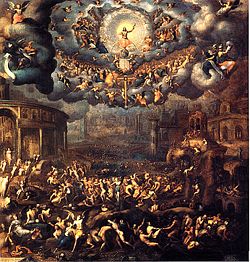
Eschatology
Eschatology is a part of theology, philosophy, and futurology concerned with what are believed to be the final events in history, or the ultimate destiny of humanity, commonly referred to as the end of the world or the World to Come...
improvement of the state of humanity or the world, in other words the World to Come
World to Come
The World to Come is an eschatological phrase reflecting the belief that the "current world" is flawed or cursed and will be replaced in the future by a better world or a paradise. The concept is similar to the concepts of Heaven and the afterlife, but Heaven is another place generally seen as...
.
Messiahs appear in many religions including Hinduism
Hinduism
Hinduism is the predominant and indigenous religious tradition of the Indian Subcontinent. Hinduism is known to its followers as , amongst many other expressions...
, Judaism, Christianity and Islam. In the Hebrew Bible
Hebrew Bible
The Hebrew Bible is a term used by biblical scholars outside of Judaism to refer to the Tanakh , a canonical collection of Jewish texts, and the common textual antecedent of the several canonical editions of the Christian Old Testament...
messiahs are priests and kings, who were traditionally anointed
Anointing
To anoint is to pour or smear with perfumed oil, milk, water, melted butter or other substances, a process employed ritually by many religions. People and things are anointed to symbolize the introduction of a sacramental or divine influence, a holy emanation, spirit, power or God...
with holy anointing oil
Holy anointing oil
The holy anointing oil , formed an integral part of the ordination of the priesthood and the high priest as well as in the consecration of the articles of the tabernacle and subsequent temples in Jerusalem...
as described in Exodus 30:22-25. In later Jewish messianic
Jewish Messiah
Messiah, ; mashiah, moshiah, mashiach, or moshiach, is a term used in the Hebrew Bible to describe priests and kings, who were traditionally anointed with holy anointing oil as described in Exodus 30:22-25...
tradition and eschatology
Jewish eschatology
Jewish eschatology is concerned with the Jewish Messiah, afterlife, and the revival of the dead. Eschatology, generically, is the area of theology and philosophy concerned with the final events in the history of the world, the ultimate destiny of humanity, and related concepts.-The Messiah:The...
, messiah refers to a leader anointed by God, and in some cases, a future King
Monarch
A monarch is the person who heads a monarchy. This is a form of government in which a state or polity is ruled or controlled by an individual who typically inherits the throne by birth and occasionally rules for life or until abdication...
of Israel
United Monarchy
According to Biblical tradition, the united Kingdom of Israel was a kingdom that existed in the Land of Israel, a period referred to by scholars as the United Monarchy. Biblical historians date the kingdom from c. 1020 BCE to c...
, physically descended from the Davidic line
Davidic line
The Davidic line refers to the tracing of lineage to the King David referred to in the Hebrew Bible, as well as the New Testament...
, who will rule the united tribes of Israel and herald the Messianic Age
Messianic Age
Messianic Age is a theological term referring to a future time of universal peace and brotherhood on the earth, without crime, war and poverty. Many religions believe that there will be such an age; some refer to it as the "Kingdom of God" or the "World to Come".- Terminology: "messianic" and...
of global peace. In Judaism
Judaism
Judaism ) is the "religion, philosophy, and way of life" of the Jewish people...
, the Messiah is not considered to be God
God
God is the English name given to a singular being in theistic and deistic religions who is either the sole deity in monotheism, or a single deity in polytheism....
or a Son of God
Son of God
"Son of God" is a phrase which according to most Christian denominations, Trinitarian in belief, refers to the relationship between Jesus and God, specifically as "God the Son"...
.
The translation of the Hebrew word as Χριστός (Khristós) in the Greek
Ancient Greek
Ancient Greek is the stage of the Greek language in the periods spanning the times c. 9th–6th centuries BC, , c. 5th–4th centuries BC , and the c. 3rd century BC – 6th century AD of ancient Greece and the ancient world; being predated in the 2nd millennium BC by Mycenaean Greek...
Septuagint became the accepted Christian designation and title of Jesus
Jesus
Jesus of Nazareth , commonly referred to as Jesus Christ or simply as Jesus or Christ, is the central figure of Christianity...
of Nazareth, indicative of the principal character and function of his ministry. Christians believe that prophecies in the Hebrew Bible
Hebrew Bible
The Hebrew Bible is a term used by biblical scholars outside of Judaism to refer to the Tanakh , a canonical collection of Jewish texts, and the common textual antecedent of the several canonical editions of the Christian Old Testament...
(especially Isaiah) refer to a spiritual savior and believe Jesus to be that Messiah (Christ
Christ
Christ is the English term for the Greek meaning "the anointed one". It is a translation of the Hebrew , usually transliterated into English as Messiah or Mashiach...
).
Islamic tradition holds the view that Jesus (Isa), son of Mary, was indeed the promised prophet and Messiah (Masih
Masih
Masih is the Arabic word for Messiah. In modern Arabic it is used as one of the many titles of Isa , who is known to Christians as Jesus...
), sent to the Semitic Jewish tribes living in Israel. He will again return to Earth in the end times and descend from heaven to defeat the "great deceiver", the Dajjal
Dajjal
al-Masih ad-Dajjal , is an evil figure in Islamic eschatology. He is to appear pretending to be Masih at a time in the future, before Yawm al-Qiyamah , directly comparable to the figures of the Antichrist and Armilus in Christian and Jewish eschatology, respectively.-Name: is a common Arabic word ...
(false messiah/antichrist
Antichrist
The term or title antichrist, in Christian theology, refers to a leader who fulfills Biblical prophecies concerning an adversary of Christ, while resembling him in a deceptive manner...
).
Etymology
The (GreekAncient Greek
Ancient Greek is the stage of the Greek language in the periods spanning the times c. 9th–6th centuries BC, , c. 5th–4th centuries BC , and the c. 3rd century BC – 6th century AD of ancient Greece and the ancient world; being predated in the 2nd millennium BC by Mycenaean Greek...
) Septuagint version of the Old Testament
Old Testament
The Old Testament, of which Christians hold different views, is a Christian term for the religious writings of ancient Israel held sacred and inspired by Christians which overlaps with the 24-book canon of the Masoretic Text of Judaism...
renders all thirty-nine instances of the Hebrew word for "anointed" () as Χριστός (Khristós). The New Testament
New Testament
The New Testament is the second major division of the Christian biblical canon, the first such division being the much longer Old Testament....
records the Greek transliteration Μεσσίας, Messias twice in John
Gospel of John
The Gospel According to John , commonly referred to as the Gospel of John or simply John, and often referred to in New Testament scholarship as the Fourth Gospel, is an account of the public ministry of Jesus...
.
Messiah ' onMouseout='HidePop("84351")' href="/topics/Aramaic_language">Aramaic
Aramaic language
Aramaic is a group of languages belonging to the Afroasiatic language phylum. The name of the language is based on the name of Aram, an ancient region in central Syria. Within this family, Aramaic belongs to the Semitic family, and more specifically, is a part of the Northwest Semitic subfamily,...
: , Greek
Greek language
Greek is an independent branch of the Indo-European family of languages. Native to the southern Balkans, it has the longest documented history of any Indo-European language, spanning 34 centuries of written records. Its writing system has been the Greek alphabet for the majority of its history;...
: , Syriac
Syriac language
Syriac is a dialect of Middle Aramaic that was once spoken across much of the Fertile Crescent. Having first appeared as a script in the 1st century AD after being spoken as an unwritten language for five centuries, Classical Syriac became a major literary language throughout the Middle East from...
: , , , , Latin
Latin
Latin is an Italic language originally spoken in Latium and Ancient Rome. It, along with most European languages, is a descendant of the ancient Proto-Indo-European language. Although it is considered a dead language, a number of scholars and members of the Christian clergy speak it fluently, and...
: Messias) literally means "anointed (one)". In standard Hebrew, The Messiah is often referred to as מלך המשיח, (in the Tiberian vocalization
Tiberian vocalization
The Tiberian vocalization is a system of diacritics devised by the Masoretes to add to the consonantal Masoretic text of the Hebrew Bible; this system soon became used to vocalize other texts as well...
pronounced ), literally meaning "the Anointed King."
In Hinduism
Hinduism
Hinduism is the predominant and indigenous religious tradition of the Indian Subcontinent. Hinduism is known to its followers as , amongst many other expressions...
, an Avatar
Avatar
In Hinduism, an avatar is a deliberate descent of a deity to earth, or a descent of the Supreme Being and is mostly translated into English as "incarnation," but more accurately as "appearance" or "manifestation"....
, Sanskrit
Sanskrit
Sanskrit , is a historical Indo-Aryan language and the primary liturgical language of Hinduism, Jainism and Buddhism.Buddhism: besides Pali, see Buddhist Hybrid Sanskrit Today, it is listed as one of the 22 scheduled languages of India and is an official language of the state of Uttarakhand...
for "descent" [viz., from heaven to earth]) is a deliberate descent of a deity from heaven to earth, or a descent of the Supreme Being and is mostly translated into English as "incarnation", but more accurately as "appearance" or "manifestation". The title Avatar describes a fully freed soul incarnating directly from God on this physical planet or elsewhere. An Avatar fulfills a highly spiritual task in the name of God and returns to God after accomplishing his task. His Love for God and his creation is beyond description and imagination, his faith in God absolute as there is no difference between an Avatar and God.
Judaism
Belief in the eventual coming of a future messiah is a fundamental part of Judaism, and is one of MaimonidesMaimonides
Moses ben-Maimon, called Maimonides and also known as Mūsā ibn Maymūn in Arabic, or Rambam , was a preeminent medieval Jewish philosopher and one of the greatest Torah scholars and physicians of the Middle Ages...
' 13 Principles of Faith
Jewish principles of faith
The concept of an explicit, paramount definition of faith does not exist in Judaism as it does in other monotheistic religions such as Christianity. Although Jews and religious leaders share a core of monotheistic principles, and there are many fundamental principles quoted in the Talmud to define...
. The term Messiah is derived from the Hebrew "Mashiach", which means "the anointed one," and refers to the ancient practice of anointing future kings with oil. The Messiah is the one who will be anointed as king in the End of Days.
The Torah
Torah
Torah- A scroll containing the first five books of the BibleThe Torah , is name given by Jews to the first five books of the bible—Genesis , Exodus , Leviticus , Numbers and Deuteronomy Torah- A scroll containing the first five books of the BibleThe Torah , is name given by Jews to the first five...
describes the advent of the Messiah in the portion of Balak
Balak
Balak was king of Moab around 1200 BC. According to Book of Numbers 22:2, and the Book of Joshua 24:9, Zippor was the father of Balak.Book of Revelation 2:12 - 2:14 says about Balak:...
, couched in poetic prophetic prose: "I see him, but not now. I perceive him, but he is not near. There shall step forth a star out of Jacob, and a scepter shall rise out of Israel... From Jacob shall issue out and destroy the remnant of the city", which Jewish Biblical scholars expound refers to the Messiah's victory over Israel's enemies.
There are many references to the Mashiach and to the End of Days throughout the Tanakh
Tanakh
The Tanakh is a name used in Judaism for the canon of the Hebrew Bible. The Tanakh is also known as the Masoretic Text or the Miqra. The name is an acronym formed from the initial Hebrew letters of the Masoretic Text's three traditional subdivisions: The Torah , Nevi'im and Ketuvim —hence...
, especially in the section of the Nevi'im
Nevi'im
Nevi'im is the second of the three major sections in the Hebrew Bible, the Tanakh. It falls between the Torah and Ketuvim .Nevi'im is traditionally divided into two parts:...
(prophets).
The Talmud
Talmud
The Talmud is a central text of mainstream Judaism. It takes the form of a record of rabbinic discussions pertaining to Jewish law, ethics, philosophy, customs and history....
is replete with references and anecdotes about the Messiah and the Messianic era, and also provides exegesis
Exegesis
Exegesis is a critical explanation or interpretation of a text, especially a religious text. Traditionally the term was used primarily for exegesis of the Bible; however, in contemporary usage it has broadened to mean a critical explanation of any text, and the term "Biblical exegesis" is used...
of scriptural verses which illustrate the events that will occur at that time. For example, resurrection of the dead
Resurrection of the dead
Resurrection of the Dead is a belief found in a number of eschatologies, most commonly in Christian, Islamic, Jewish and Zoroastrian. In general, the phrase refers to a specific event in the future; multiple prophesies in the histories of these religions assert that the dead will be brought back to...
, which is exegetically supported by a verse in Exodus 15: "Az Yashir Moshe..." - "Then [Moses] will sing...", from which is derived that "then" (in the Messianic Era) Moses will arise and once again sing as he did at the time of the Exodus
The Exodus
The Exodus is the story of the departure of the Israelites from ancient Egypt described in the Hebrew Bible.Narrowly defined, the term refers only to the departure from Egypt described in the Book of Exodus; more widely, it takes in the subsequent law-givings and wanderings in the wilderness...
.
The Messianic Age
Messianic Age
Messianic Age is a theological term referring to a future time of universal peace and brotherhood on the earth, without crime, war and poverty. Many religions believe that there will be such an age; some refer to it as the "Kingdom of God" or the "World to Come".- Terminology: "messianic" and...
is described as follows by Maimonides:
- "And at that time there will be no hunger or war, no jealousy or rivalry. For the good will be plentiful, and all delicacies available as dust.
- The entire occupation of the world will be only to know God... the people Israel will be of great wisdom; they will perceive the esoteric truths and comprehend their Creator's wisdom as is the capacity of man. As it is written (Isaiah 11:9): "For the earth shall be filled with the knowledge of God, as the waters cover the sea." "
Maimonides describes the identity of the Messiah in the following terms:
- "And if a king shall arise from among the House of David, studying Torah and occupied with commandments like his father David, according to the written and oral Torah, and he will impel all of Israel to follow it and to strengthen breaches in its observance, and will fight Hashem's [God's] wars, this one is to be treated as if he were the anointed one.
- If he succeeded and built the Holy Temple in its proper place and gathered the dispersed ones of Israel together, this is indeed the anointed one for certain, and he will mend the entire world to worship the Lord together, as it is stated: "For then I shall turn for the nations a clear tongue, so that they will all procalim the Name of the Lord, and to worship Him with a united resolve (Zephaniah 3:9)."
The concept of the coming of The Messiah was held in the highest regard by pre-Christian Judaism. The Talmud records: "All the prophets prophesied [all the good things] only in respect of the Messianic era." In another folio, the Talmud says, "The Jews are destined to eat [their fill] in the days of the Messiah," and "The world was created only...for the sake of the Messiah."
A prominent Judaism Web site claims:
The literal translation of the word, messiah (moshiach), is “anointed,” which refers to a ritual of consecrating someone or something by putting holy oil upon it. It is used throughout the Jewish Bible in reference to a wide variety of individuals and objects; for example, a Jewish king, Jewish priests, and prophets, the Jewish Temple and its utensils, unleavened bread, and a non-Jewish king (Cyrus king of Persia).
A common modern rabbinic
Rabbinic literature
Rabbinic literature, in its broadest sense, can mean the entire spectrum of rabbinic writings throughout Jewish history. However, the term often refers specifically to literature from the Talmudic era, as opposed to medieval and modern rabbinic writing, and thus corresponds with the Hebrew term...
interpretation is that there is a potential messiah in every generation. The Talmud, which often uses stories to make a moral point (aggadah), tells of a highly respected rabbi
Rabbi
In Judaism, a rabbi is a teacher of Torah. This title derives from the Hebrew word רבי , meaning "My Master" , which is the way a student would address a master of Torah...
who found the Messiah at the gates of Rome
Rome
Rome is the capital of Italy and the country's largest and most populated city and comune, with over 2.7 million residents in . The city is located in the central-western portion of the Italian Peninsula, on the Tiber River within the Lazio region of Italy.Rome's history spans two and a half...
and asked him, "When will you finally come?" He was quite surprised when he was told, "Today." Overjoyed and full of anticipation, the man waited all day. The next day he returned, disappointed and puzzled, and asked, "You said messiah would come 'today' but he didn't come! What happened?" The Messiah replied, "Scripture says, 'Today, 'if you will but hearken to His voice.'"
Modern, rabbinical Judaism
Rabbinic Judaism
Rabbinic Judaism or Rabbinism has been the mainstream form of Judaism since the 6th century CE, after the codification of the Talmud...
asserts that a unique future physical messiah will usher in the messianic age of peace to the world.
In Judaism today, as always, the fervent—in the words of Rambam—"believe in the coming of the Messiah and await it daily although it may be delayed." As religious Jews were herded into the gas chambers by the Nazis, a song arose as if to proclaim that no force can wreck their trust in the Messianic future, to the words of the Rambam.
Particularly the Chabad movement—the largest and most influential Jewish outreach movement today [promoting Judaism and morality to Jews and gentiles] has a fervent hope that the Messianic age is manifesting through the radical positive changes occurring, for example the miraculous turnaround in Russian policy to free her Jews. Whereas such cataclysmic regime changes necessitated bloodshed [of epic proportions] in the past, miraculously Michael Gorbachav of his own accord freed the Jews who were subject to the harshest of torment, exile, and imprisonment for over seventy years. Furthermore as if to underscore the Messianic notion in play, hundreds of thousands of these Jews emigrated to Israel—fulfilling the Biblical Prophecy "even if you will be in the farthest places of earth I will return you (to Israel)."
However, it must be emphasized that for the most part the world will not change. Maimonides says, "The world will remain as it is," and that the various verses in the Bible such as those in Isaiah 11:6-7 'The wolf also shall dwell with the lamb...' are a metaphor". Furthermore, the Messiah does not have to perform any miracles such as resurrection for him to be believed.
Hinduism
In HinduismHinduism
Hinduism is the predominant and indigenous religious tradition of the Indian Subcontinent. Hinduism is known to its followers as , amongst many other expressions...
, Kalki
Kalki
In Hinduism, Kalki is the tenth and final Maha Avatar of Vishnu who will come to end the present age of darkness and destruction known as Kali Yuga. The name Kalki is often a metaphor for eternity or time...
is the tenth and final Maha Avatar(Messiah or Incarnation) of Lord Vishnu
Vishnu
Vishnu is the Supreme god in the Vaishnavite tradition of Hinduism. Smarta followers of Adi Shankara, among others, venerate Vishnu as one of the five primary forms of God....
who will come to end the present age of darkness and destruction known as Kali Yuga
Kali Yuga
Kali Yuga is the last of the four stages that the world goes through as part of the cycle of yugas described in the Indian scriptures. The other ages are Satya Yuga, Treta Yuga and Dvapara Yuga...
. The name Kalki
Kalki
In Hinduism, Kalki is the tenth and final Maha Avatar of Vishnu who will come to end the present age of darkness and destruction known as Kali Yuga. The name Kalki is often a metaphor for eternity or time...
is often a metaphor for eternity or time. The origins of the name probably lie in the Sanskrit
Sanskrit
Sanskrit , is a historical Indo-Aryan language and the primary liturgical language of Hinduism, Jainism and Buddhism.Buddhism: besides Pali, see Buddhist Hybrid Sanskrit Today, it is listed as one of the 22 scheduled languages of India and is an official language of the state of Uttarakhand...
word "Kalka" which refers to mud, dirt, filth, or foulness and hence denotes the "destroyer of foulness," "destroyer of confusion," "destroyer of darkness," or "annihilator of ignorance."[1] Other similar and divergent interpretations based on varying etymological derivations from Sanskrit - including one simply meaning "White Horse" - have been made.
Hindu
Hindu
Hindu refers to an identity associated with the philosophical, religious and cultural systems that are indigenous to the Indian subcontinent. As used in the Constitution of India, the word "Hindu" is also attributed to all persons professing any Indian religion...
traditions permit numerous interpretations of what avatars are and to what purpose they act. Avatara means "descent" and indicates a descent of the divine awareness into manifestations of the mundane form. The Garuda Purana
Garuda Purana
Garuda Purana is one of the Puranas which are part of the Hindu body of texts known as smriti. It is a Vaishnava Purana and its first part contains a dialog between Vishnu and Garuda, the King of Birds...
lists ten avatars, with Kalki being the tenth. The Bhagavata Purana
Bhagavata purana
The Bhāgavata Purāṇa is one of the "Maha" Puranic texts of Hindu literature, with its primary focus on bhakti to the incarnations of Vishnu, particularly Krishna...
initially lists twenty-two avatars, but mentions an additional three for a total of twenty-five avatars. He is presented as the twenty-second avatar in this list. Popular images depict him riding a white horse with wings known as Devadatta (God-given.) In these images, Kalki
Kalki
In Hinduism, Kalki is the tenth and final Maha Avatar of Vishnu who will come to end the present age of darkness and destruction known as Kali Yuga. The name Kalki is often a metaphor for eternity or time...
is brandishing a sword in his left hand and is intent on eradicating the corrupt destitution and debauchery of Kali Yuga.
The Agni Purana
Agni Purana
The Agni Purana, one of the 18 Mahapuranas, a genre of Hindu religious texts, contains descriptions and details of various incarnations of Vishnu. It also has details account about Rama, Krishna, Prithvi, and the stars...
explains that when the evil men who pose as kings begin to feed on human beings and try to destroy the righteous, Kalki, as the son of Vishnuyasha, and Yajnavalkya as his priest and teacher, will destroy these evil men with His weapons. He will establish moral law in the form of the fourfold varnas, or the suitable organization of society in four classes. After that people will return to the path of righteousness. (16.7-9) The Agni Purana
Agni Purana
The Agni Purana, one of the 18 Mahapuranas, a genre of Hindu religious texts, contains descriptions and details of various incarnations of Vishnu. It also has details account about Rama, Krishna, Prithvi, and the stars...
also relates that Hari
Hari
Hari is an Avatar, another name of and , and appears as the 650th name in the Vishnu sahasranama of Mahabharata. In Sanskrit "hari" sometimes refers to a colour, green, yellow, or fawn-coloured/khaki. It is the colour of the Sun and of Soma...
, after giving up the form of Kalki
Kalki
In Hinduism, Kalki is the tenth and final Maha Avatar of Vishnu who will come to end the present age of darkness and destruction known as Kali Yuga. The name Kalki is often a metaphor for eternity or time...
, will go to heaven. Then the Krita or Satya Yuga
Satya Yuga
The Satya Yuga , also called Sat Yuga, Krta Yuga and Krita Yuga in Hinduism, is the "Yuga of Truth", when mankind is governed by gods, and every manifestation or work is close to the purest ideal and mankind will allow intrinsic goodness to rule supreme...
will return as before. (16.10)
The Vishnu Purana
Vishnu Purana
The Vishnu Purana is a religious Hindu text and one of the eighteen Mahapuranas. It is considered one of the most important Puranas and has been given the name Puranaratna...
also explains that, "When the practices taught in the Vedas and institutes of law have nearly ceased, and the close of the Kali
Kali
' , also known as ' , is the Hindu goddess associated with power, shakti. The name Kali comes from kāla, which means black, time, death, lord of death, Shiva. Kali means "the black one". Since Shiva is called Kāla - the eternal time, Kālī, his consort, also means "Time" or "Death" . Hence, Kāli is...
age shall be nigh, a portion of that divine being who exists of His own spiritual nature, and who is the beginning and end, and who comprehends all things, shall descend upon earth. He will be born in the family of Vishnuyasha, an eminent Brahmana
Brahmana
The Brāhmaṇas are part of the Hindu śruti literature. They are commentaries on the four Vedas, detailing the proper performance of rituals....
of Shambhala village, as Kalki
Kalki
In Hinduism, Kalki is the tenth and final Maha Avatar of Vishnu who will come to end the present age of darkness and destruction known as Kali Yuga. The name Kalki is often a metaphor for eternity or time...
, endowed with eight superhuman faculties. By his irresistible might he will destroy all the mlecchas (Barbarians) and thieves, and all whose minds are devoted to iniquity. He will re-establish righteousness upon earth, and the minds of those who live at the end of the Kali age shall be awakened, and shall be as clear as crystal. The men who are thus changed by virtue of that peculiar time shall be as the seeds of human beings, and shall give birth to a race who will follow the laws of the Krita age or Satya Yuga
Satya Yuga
The Satya Yuga , also called Sat Yuga, Krta Yuga and Krita Yuga in Hinduism, is the "Yuga of Truth", when mankind is governed by gods, and every manifestation or work is close to the purest ideal and mankind will allow intrinsic goodness to rule supreme...
, the age of purity. As it is said, 'When the sun and moon, and the lunar asterism Tishya, and the planet Jupiter
Jupiter
Jupiter is the fifth planet from the Sun and the largest planet within the Solar System. It is a gas giant with mass one-thousandth that of the Sun but is two and a half times the mass of all the other planets in our Solar System combined. Jupiter is classified as a gas giant along with Saturn,...
, are in one mansion, the Krita age shall return.'" (Book Four, Chapter 24)
The Padma Purana
Padma Purana
Padma Purana , one of the major eighteen Puranas, a Hindu religious text, is divided into five parts.In the first part of the text, sage Pulastya explains to Bhishma about religion and the essence of the religion. The second part describes in detail Prithvi...
relates that Lord Kalki will end the age of Kali and will kill all the wicked mlecchas and, thus, destroy the bad condition of the world. He will gather all of the distinguished brahmanas and will propound the highest truth. He will know all the ways of life that have perished and will remove the prolonged hunger of the genuine brahmanas and the pious. He will be the only ruler of the world that cannot be controlled, and will be the banner of victory and adorable to the world. (6.71.279-282)
The Bhagavata Purana states, "At the end of Kali Yuga, when there exist no topics on the subject of God, even at the residences of so-called saints and respectable gentlemen , and when the power of government is transferred to the hands of ministers elected from the evil men, and when nothing is known of the techniques of sacrifice, even by word, at that time the Lord will appear as the supreme chastiser. (2.7.38) It further describes Lord Kalki's activities as follows: "Lord Kalki, the Lord of the universe, will mount His swift white horse Devadatta and, sword in hand, travel over the earth exhibiting His eight mystic opulences and eight special qualities of Godhead. Displaying His unequaled effulgence and riding with great speed, He will kill by the millions those thieves who have dared dress as kings." (12.2.19-20)
The Kalki Purana combines all of the elements from the puranas above. He is one who has power to change the course of time stream in the favour of the good. He will be one to whom the power to change the destiny of the world will be given.It states the evil family of the demon Kali will spring from the back of Bramha. They will descend to earth and cause mankind to turn towards depravity. When man stops offering yagna to the gods, Vishnu
Vishnu
Vishnu is the Supreme god in the Vaishnavite tradition of Hinduism. Smarta followers of Adi Shankara, among others, venerate Vishnu as one of the five primary forms of God....
himself will descend to earth to rid the world of evil. He will be reborn as Kalki to noted Brahmin family in the city of Shambhala. As a young man, He will be mentored in the arts of war by Parashurama
Parashurama
Parashurama , is the sixth avatar of Vishnu and belongs to the treta yuga, and is the son of a Brahmin father Jamadagni and mother Renuka. He is considered one of the seven immortal human. He received an axe after undertaking a terrible penance to please Shiva, from whom he learned the methods of...
, the sixth incarnation of Vishnu
Vishnu
Vishnu is the Supreme god in the Vaishnavite tradition of Hinduism. Smarta followers of Adi Shankara, among others, venerate Vishnu as one of the five primary forms of God....
.[5] He will then set out across the world battling evil kings and false prophets. He finally defeats Kali and brings about the Satya Yuga
Satya Yuga
The Satya Yuga , also called Sat Yuga, Krta Yuga and Krita Yuga in Hinduism, is the "Yuga of Truth", when mankind is governed by gods, and every manifestation or work is close to the purest ideal and mankind will allow intrinsic goodness to rule supreme...
. Having completed His mission, He will assume his four-armed form and return to heaven as Vishnu
Vishnu
Vishnu is the Supreme god in the Vaishnavite tradition of Hinduism. Smarta followers of Adi Shankara, among others, venerate Vishnu as one of the five primary forms of God....
.
Christianity
ChristianityChristianity
Christianity is a monotheistic religion based on the life and teachings of Jesus as presented in canonical gospels and other New Testament writings...
emerged
Early Christianity
Early Christianity is generally considered as Christianity before 325. The New Testament's Book of Acts and Epistle to the Galatians records that the first Christian community was centered in Jerusalem and its leaders included James, Peter and John....
early in the first century AD as a movement among Jews and their Gentile
Gentile
The term Gentile refers to non-Israelite peoples or nations in English translations of the Bible....
converts
Proselyte
The biblical term "Proselyte", derives from the Koine Greek προσήλυτος/proselytos, as used in the Septuagint for "stranger", i.e. a "newcomer to Israel"; a "sojourner in the land", and in the New Testament for a convert to Judaism from Paganism...
who believed that Jesus
Jesus
Jesus of Nazareth , commonly referred to as Jesus Christ or simply as Jesus or Christ, is the central figure of Christianity...
is the Messiah. The name "Christian" was first coined by the Jews in Antioch. The Greek word for 'Messiah' is khristos (χριστος). Christians commonly refer to Jesus as either the "Christ" or the "Messiah." In Christian theology
Christian theology
- Divisions of Christian theology :There are many methods of categorizing different approaches to Christian theology. For a historical analysis, see the main article on the History of Christian theology.- Sub-disciplines :...
the two words are synonymous.
Christians believe Jesus to be the Messiah that Jews were expecting:
The first thing AndrewSaint AndrewSaint Andrew , called in the Orthodox tradition Prōtoklētos, or the First-called, is a Christian Apostle and the brother of Saint Peter. The name "Andrew" , like other Greek names, appears to have been common among the Jews from the 3rd or 2nd century BC. No Hebrew or Aramaic name is recorded for him...
did was to find his brother SimonSaint PeterSaint Peter or Simon Peter was an early Christian leader, who is featured prominently in the New Testament Gospels and the Acts of the Apostles. The son of John or of Jonah and from the village of Bethsaida in the province of Galilee, his brother Andrew was also an apostle...
and tell him, "We have found the Messiah" (that is, the Christ). And he brought him to Jesus.
The Christian concept of the Christ/Messiah as "the Word made Flesh" (see also Logos
Logos
' is an important term in philosophy, psychology, rhetoric and religion. Originally a word meaning "a ground", "a plea", "an opinion", "an expectation", "word," "speech," "account," "reason," it became a technical term in philosophy, beginning with Heraclitus ' is an important term in...
) is fundamentally different from the Jewish
Jewish Messiah
Messiah, ; mashiah, moshiah, mashiach, or moshiach, is a term used in the Hebrew Bible to describe priests and kings, who were traditionally anointed with holy anointing oil as described in Exodus 30:22-25...
and Islamic. The majority of historical and mainline Christian theologies, as seen within the Nicene Creed
Nicene Creed
The Nicene Creed is the creed or profession of faith that is most widely used in Christian liturgy. It is called Nicene because, in its original form, it was adopted in the city of Nicaea by the first ecumenical council, which met there in the year 325.The Nicene Creed has been normative to the...
, consider Jesus to be God or God the Son
God the Son
God the Son is the second person of the Trinity in Christian theology. The doctrine of the Trinity identifies Jesus of Nazareth as God the Son, united in essence but distinct in person with regard to God the Father and God the Holy Spirit...
.
Christians believe that Daniel
Daniel
Daniel is the protagonist in the Book of Daniel of the Hebrew Bible. In the narrative, when Daniel was a young man, he was taken into Babylonian captivity where he was educated in Chaldean thought. However, he never converted to Neo-Babylonian ways...
(Hebrew: דָּנִיֵּאל, or Daniyyel) was a prophet and gave an indication of when the Messiah, the prince mashiyach nagiyd, would come in the Prophecy of Seventy Weeks
Prophecy of Seventy Weeks
The Prophecy of Seventy Septets appears in the angel Gabriel's reply to Daniel, beginning with verse 22 and ending with verse 27 in the ninth chapter of the Book of Daniel, a work included in both the Jewish Tanakh and the Christian Bible; as well as the Septuagint...
. Daniel's prophecies refer to him as a descendant of King David, a Son of Man
Son of man
The phrase son of man is a primarily Semitic idiom that originated in Ancient Mesopotamia, used to denote humanity or self. The phrase is also used in Judaism and Christianity. The phrase used in the Greek, translated as Son of man is ὁ υἱὸς τοὺ ἀνθρώπου...
, who will rebuild the nation of Israel, destroy the wicked, and ultimately judge the whole world
Last Judgment
The Last Judgment, Final Judgment, Day of Judgment, Judgment Day, or The Day of the Lord in Christian theology, is the final and eternal judgment by God of every nation. The concept is found in all the Canonical gospels, particularly the Gospel of Matthew. It will purportedly take place after the...
.
In Christian theology, the Christ/Messiah serves a number of roles. The Nicene Creed
Nicene Creed
The Nicene Creed is the creed or profession of faith that is most widely used in Christian liturgy. It is called Nicene because, in its original form, it was adopted in the city of Nicaea by the first ecumenical council, which met there in the year 325.The Nicene Creed has been normative to the...
of 325 and 381 A.D. provides a convenient framework:
- He suffers and dies to make reconciliation with God.
- He was raised from the dead on the third day after He was crucified to prove that He has defeated death and the power of SatanSatanSatan , "the opposer", is the title of various entities, both human and divine, who challenge the faith of humans in the Hebrew Bible...
, thus enabling those that receive Him as their Savior to live under God's grace. - He ascended to heaven where He currently reigns over the world at God's right hand and from where he will return
- He serves as the pioneer and embodiment of the culture and living presence of the kingdom of GodKingdom of GodThe Kingdom of God or Kingdom of Heaven is a foundational concept in the Abrahamic religions: Judaism, Christianity and Islam.The term "Kingdom of God" is found in all four canonical gospels and in the Pauline epistles...
- When he returns he will judge the world and reign over a new creation. Christian believers are invited to spend eternity in this new world. (The exact order of these things differs according to the preferred theological framework of MillennialismMillennialismMillennialism , or chiliasm in Greek, is a belief held by some Christian denominations that there will be a Golden Age or Paradise on Earth in which "Christ will reign" for 1000 years prior to the final judgment and future eternal state...
used to interpret the passages) - He is the God of AbrahamAbrahamAbraham , whose birth name was Abram, is the eponym of the Abrahamic religions, among which are Judaism, Christianity and Islam...
, IsaacIsaacIsaac as described in the Hebrew Bible, was the only son Abraham had with his wife Sarah, and was the father of Jacob and Esau. Isaac was one of the three patriarchs of the Israelites...
and Jacob and he came to earth as a humanIncarnationIncarnation literally means embodied in flesh or taking on flesh. It refers to the conception and birth of a sentient creature who is the material manifestation of an entity, god or force whose original nature is immaterial....
. : In the beginning was the WordLogos' is an important term in philosophy, psychology, rhetoric and religion. Originally a word meaning "a ground", "a plea", "an opinion", "an expectation", "word," "speech," "account," "reason," it became a technical term in philosophy, beginning with Heraclitus ' is an important term in...
and the Word was with God and the Word was God. He was in the beginning with God. 14a And the Word became flesh and dwelt among us. : Most assuredly, I say to you, before Abraham was, I AM.
In the New Testament
New Testament
The New Testament is the second major division of the Christian biblical canon, the first such division being the much longer Old Testament....
, Jesus often referred to himself as 'Son of Man
Son of man
The phrase son of man is a primarily Semitic idiom that originated in Ancient Mesopotamia, used to denote humanity or self. The phrase is also used in Judaism and Christianity. The phrase used in the Greek, translated as Son of man is ὁ υἱὸς τοὺ ἀνθρώπου...
' which Christianity interprets as a reference to (KJV):
Because Christians believe that Jesus is the Messiah and that he claimed to be the Son of Man referred to by Daniel, Christianity interprets as a statement of the Messiah's authority and that the Messiah will have an everlasting kingdom. Jesus' use of this title is seen as a direct claim to be the Messiah.
Some identified Jesus as the Messiah, his opponents accused him of such a claim, and he is recorded at least twice as asserting it himself directly.
Christianity interprets a wide range of biblical passages in the Old Testament (Hebrew scripture) as predicting the coming of the Messiah (see Christianity and Biblical prophecy for examples), and believes that they are fulfilled in Jesus' own explicit life and teaching:
- Will be born in Bethlehem
- The root of Jesse ...to whom the Gentiles will seek.
- He said to them..."Then he said unto them, O fools, and slow of heart to believe all that the prophets have spoken: Ought not Christ to have suffered these things, and to enter into his glory? And beginning at Moses and all the prophets, he expoundedExpounding of the LawThe Expounding of the Law is a highly structured part of the Sermon on the Mount in the New Testament...
unto them in all the scriptures the things concerning himself." - "Then opened he their understanding, that they might understand the scriptures, And said unto them, Thus it is written, and thus it behooved Christ to suffer, and to rise from the dead the third day: And that repentance and remission of sins should be preached in his name among all nations, beginning at Jerusalem."
- The Gospel of MatthewGospel of MatthewThe Gospel According to Matthew is one of the four canonical gospels, one of the three synoptic gospels, and the first book of the New Testament. It tells of the life, ministry, death, and resurrection of Jesus of Nazareth...
repeatedly says, "This was to fulfill the prophecy…." - Psalm 22 describes the actions of the crucifixion in John 19
Christians believe the Messianic prophecies were fulfilled in the mission, death, and resurrection of Jesus, and seeks to spread throughout the world
Great Commission
The Great Commission, in Christian tradition, is the instruction of the resurrected Jesus Christ to his disciples, that they spread his teachings to all the nations of the world. It has become a tenet in Christian theology emphasizing missionary work, evangelism, and baptism...
its interpretation that the Messiah (Jesus) is the only God, and that Jesus will return
Second Coming
In Christian doctrine, the Second Coming of Christ, the Second Advent, or the Parousia, is the anticipated return of Jesus Christ from Heaven, where he sits at the Right Hand of God, to Earth. This prophecy is found in the canonical gospels and in most Christian and Islamic eschatologies...
to fulfill the rest of Messianic prophecy.
Islam
The Qur'anQur'an
The Quran , also transliterated Qur'an, Koran, Alcoran, Qur’ān, Coran, Kuran, and al-Qur’ān, is the central religious text of Islam, which Muslims consider the verbatim word of God . It is regarded widely as the finest piece of literature in the Arabic language...
states Jesus the Son of Mary (Arabic: Isa ibn Maryum) is the Messiah or "Prophet" sent to the Jews, and Muslims believe Jesus is alive in Heaven and will return to Earth to defeat the Antichrist
Antichrist
The term or title antichrist, in Christian theology, refers to a leader who fulfills Biblical prophecies concerning an adversary of Christ, while resembling him in a deceptive manner...
(Arabic: Dajjal).
A hadith
Hadith
The term Hadīth is used to denote a saying or an act or tacit approval or criticism ascribed either validly or invalidly to the Islamic prophet Muhammad....
in Abu Dawud says:
Narrated Abu HurayrahAbu HurairahAbu Hurairah , was a companion of the Islamic prophet Muhammad and the narrator of Hadith most quoted in the isnad by Sunnis.-Early life:...
: The Prophet said: There is no prophet between me and him, that is, Jesus. He will descend (to the earth). When you see him, recognise him: a man of medium height, reddish hair, wearing two light yellow garments, looking as if drops were falling down from his head though it will not be wet. He will fight for the cause of Islam. He will break the cross, kill the swine, and put an end to war (in another Tradition, there is the word Jizyah instead of Harb (war), meaning that he will abolish jizyah); God will perish all religions except Islam. He [Jesus] will destroy the Antichrist who will live on the earth for forty days and then he will die. The Muslims will pray behind him.
Both Sunni and Shia Muslims agree al-Mahdi
Mahdi
In Islamic eschatology, the Mahdi is the prophesied redeemer of Islam who will stay on Earth for seven, nine or nineteen years- before the Day of Judgment and, alongside Jesus, will rid the world of wrongdoing, injustice and tyranny.In Shia Islam, the belief in the Mahdi is a "central religious...
will arrive first, and after him, Jesus. Jesus will proclaim that the true leader is al-Mahdi. A war, literally Jihad (Jihade Asghar) will be fought—the Dajjal (evil) against al-Mahdi and Jesus (good). This war will mark the approach of the coming of the Last Day. After Jesus slays al-Dajjāl at the Gate of Lud
Lud
The name Lud may refer to:* Lud son of Heli, a legendary British king who in Geoffrey of Monmouth's pseudohistorical Historia Regum Britanniae founded London and was buried at Ludgate...
, he will bear witness and reveal that Islam
Islam
Islam . The most common are and . : Arabic pronunciation varies regionally. The first vowel ranges from ~~. The second vowel ranges from ~~~...
is indeed the true and last word from God to humanity as Yusuf Ali's translation reads: "And there is none of the People of the Book but must believe in him before his death; and on the Day of Judgment He will be a witness against them." He will live for several years, marry, have children and will be buried in Medina.
A hadith
Hadith
The term Hadīth is used to denote a saying or an act or tacit approval or criticism ascribed either validly or invalidly to the Islamic prophet Muhammad....
in Sahih Bukhari
Sahih Bukhari
Ṣaḥīḥ al-Bukhārī , as it is commonly referred to, is one of the six canonical hadith collections of Islam. These prophetic traditions, or hadith, were collected by the Persian Muslim scholar Muhammad ibn Ismail al-Bukhari, after being transmitted orally for generations. Muslims view this as one of...
says:
- Allah's Apostle said "How will you be when the son of Mary descends amongst you and your Imam is from amongst you."
Very few scholars outside of mainstream Islam reject all the quotes (Hadith) attributed to Prophet Muhammad that mention the second return of Jesus, the Dajjal and Imam Mahdi, believing that they have no Qur'anic basis. However, Quran emphatically rejects the implication of termination of Jesus’ life when he was allegedly crucified. Yusuf Ali’s translation reads "That they said (in boast), "We killed Christ Jesus the son of Mary, the Messenger of Allah";― but they killed him not, nor crucified him, but so it was made to appear to them and those who differ therein are full of doubts, with no (certain) knowledge, but only conjecture to follow, for of a surety they killed him not.― (157) Nay, Allah raised him up unto Himself; and Allah is Exalted in Power, Wise. (158) Verses imply that Jesus was not killed physically but it was made to appear so. Verse
"So Peace is on me the day I was born, the day that I die and the day that I shall be raised up to life (again)"! implies that Jesus will die someday. The unified opinion of Islam maintains that the bodily death of Jesus will happen after his second coming.
Many classical commentators such as Ibn Kathir, At-Tabari, al-Qurtubi, Suyuti, al-Undlusi (Bahr al-Muhit), Abu al-Fadl al-Alusi (Ruh al-Maani) clearly mention that verse of the Qur'an refers to the descent of Jesus before the Day of Resurrection, indicating that Jesus would be the Sign that the Hour is close.
- And (Jesus) shall be a Sign (for the coming of) the Hour (of Judgment): therefore have no doubt about the (Hour)...
Those that reject the second coming of Jesus argue that the knowledge of the Hour is only with God, and that the Hour will come suddenly. They maintain that if the second coming of Jesus were true, whenever it happens, billions of people would then be certain the Hour is about to come. The response given to this is that signs that the Last Hour is near have been foretold and given, including that of the second coming of Jesus, as signs indicating the Last Hour is near. They will not clarify when it is to come in any specific sense, and hence do not reveal it.
Allama Iqbal while commenting on the second coming of Jesus said, "It is the basic idea of Magian religion, for it contains implicitly the conception of the world-historical struggle between Good and Evil, with the power of Evil prevailing in the middle period, and the Good finally triumphant on the Day of Judgement. If this view of the prophetic teaching is meant to apply to Islam it is obviously a misrepresentation. The point to note is that the Magian admitted the existence of false gods; only they did not turn to worship them. Islam denies the very existence of false gods."
Ahmadiyya
In Ahmadiyya IslamAhmadiyya
Ahmadiyya is an Islamic religious revivalist movement founded in India near the end of the 19th century, originating with the life and teachings of Mirza Ghulam Ahmad , who claimed to have fulfilled the prophecies about the world reformer of the end times, who was to herald the Eschaton as...
, the terms "Messiah" and "Mahdi" are synonymous terms for one and the same person. The term "Mahdi" means guided by God, thus implying a direct ordainment by God of a divinely chosen individual. According to Ahmadiyya thought, Messiahship is a phenomenon through which a special emphasis is given on the transformation of a people by way of offering suffering for the sake of God instead of giving suffering (i.e. refraining from revenge). Ahmadis believe that this special emphasis was given through the person of Jesus and Mirza Ghulam Ahmad
Mirza Ghulam Ahmad
Mīrzā Ghulām Aḥmad was a religious figure from India and the founder of the Ahmadiyya Community. He claimed to be the Mujaddid of the 14th Islamic century, the promised Messiah , and the Mahdi awaited by the Muslims in the end days...
among others.
Ahmadis hold that the prophesied eschatological figures of Christianity and Islam, the Messiah and Mahdi, were in fact to be fulfilled in one person who was to represent all previous prophets. The prophecies concerning the Mahdi or the Second Coming of Jesus are seen by Ahmadis as metaphorical and subject to interpretation. It is argued that one was to be born and rise within the dispensation of Muhammad
Muhammad
Muhammad |ligature]] at U+FDF4 ;Arabic pronunciation varies regionally; the first vowel ranges from ~~; the second and the last vowel: ~~~. There are dialects which have no stress. In Egypt, it is pronounced not in religious contexts...
, who by virtue of his similarity and affinity with Jesus, and the similarity in nature, temperament and disposition of the people of Jesus' time and the people of the time of the promised one (the Mahdi) is called by the same name.
Numerous hadith are presented by the Ahmadis in support of their view, such as one from Sunan Ibn Majah which says, There is No Mahdi but Jesus son of Mary.
Ahmadis believe that the prophecies concerning the Mahdi and the second coming of Jesus have been fulfilled in Mirza Ghulam Ahmad
Mirza Ghulam Ahmad
Mīrzā Ghulām Aḥmad was a religious figure from India and the founder of the Ahmadiyya Community. He claimed to be the Mujaddid of the 14th Islamic century, the promised Messiah , and the Mahdi awaited by the Muslims in the end days...
(1835–1908), the founder of the Ahmadiyya Movement. Contrary to mainstream Islam, the Ahmadis do not believe that Jesus is alive in heaven, but that he survived the crucifixion and migrated towards the east where he died a natural death and that Ghulam Ahmad was only the promised spiritual second coming and likeness of Jesus, the promised Messiah and Mahdi.
Other traditions
- Bahá'u'lláhBahá'u'lláhBahá'u'lláh , born ' , was the founder of the Bahá'í Faith. He claimed to be the prophetic fulfilment of Bábism, a 19th-century outgrowth of Shí‘ism, but in a broader sense claimed to be a messenger from God referring to the fulfilment of the eschatological expectations of Islam, Christianity, and...
, founder of the Bahá'í FaithBahá'í FaithThe Bahá'í Faith is a monotheistic religion founded by Bahá'u'lláh in 19th-century Persia, emphasizing the spiritual unity of all humankind. There are an estimated five to six million Bahá'ís around the world in more than 200 countries and territories....
, claimed to be the figure prophesied in the scriptures of the world's religions. - Li HongLi Hong (Taoist eschatology)Li Hong is a messianic figure in religious Taoism prophesied to appear at the end of the world cycle to rescue the chosen people, who would be distinguished by certain talismans, practices and virtues. Myths surrounding Li Hong took shape in literature during the Han dynasty...
, a messianic figure in Taoist eschatology prophesied to appear at the end of the world cycle - MaitreyaMaitreyaMaitreya , Metteyya , or Jampa , is foretold as a future Buddha of this world in Buddhist eschatology. In some Buddhist literature, such as the Amitabha Sutra and the Lotus Sutra, he or she is referred to as Ajita Bodhisattva.Maitreya is a bodhisattva who in the Buddhist tradition is to appear on...
, a bodhisattva in Buddhist eschatology prophesied to appear at a time when the Dharma will have been forgotten. - Maitreya (Theosophy)Maitreya (Theosophy)Maitreya or Lord Maitreya is described in Theosophical literature of the late 19th-century and subsequent periods as an advanced spiritual entity and high-ranking member of a hidden Spiritual Hierarchy, the so-called Masters of the Ancient Wisdom...
, a being that Theosophists believe will physically manifest sometime in the 21st century and who will be the Messiah all rolled into one expected by various religions. - SaoshyantSaoshyantSaoshyant is a figure of Zoroastrian eschatology who brings about the final renovation of the world, the Frashokereti. The Avestan language name literally means "one who brings benefit," and is also used as common noun.-In scripture:...
, a figure in Zoroastrian eschatology who it is said will initiate the final renovation of the world
See also
- False messiahFalse messiah-Judaism:Armilus is an anti-Messiah figure in late-period Jewish eschatology, comparable to the Christian Antichrist and Muslim Dajjal, who will conquer Jerusalem and persecute the Jews until his final defeat at the hands of God or the true Messiah...
- Jewish Messiah claimantsJewish Messiah claimantsThe Messiah in Judaism has a number of interpretations, including any king chosen by God; a holy king who will lead Israel; and someone who will usher in an idyllic age of peace and justice...
- List of messiah claimants
- People claiming to be the MahdiPeople claiming to be the MahdiIn Shia and Sunni eschatology, the Mahdi is a Messianic figure who, it is believed, will appear on Earth before the Day of Judgment and, alongside Jesus, will rid the world of wrongdoing, injustice and tyranny...
- Year 6000Year 6000According to classical Jewish sources, the Hebrew year 6000 marks the latest time for the initiation of the Messianic Age. The Talmud, the Midrash, and the Kabbalistic work, the Zohar, state that the 'deadline' by which the Messiah must appear is 6,000 years from creation...
External links
- Messiah in the 1911 Encyclopædia BritannicaEncyclopædia BritannicaThe Encyclopædia Britannica , published by Encyclopædia Britannica, Inc., is a general knowledge English-language encyclopaedia that is available in print, as a DVD, and on the Internet. It is written and continuously updated by about 100 full-time editors and more than 4,000 expert...
- Jewish Encyclopedia: Messiah
- The Qur'anic Verses That Mention the Title "Messiah"
- The Concept of Messiah in Islam
- The Concept of Messiah in Messianic Judaism