
All Topics  
Muslim history


   Email Print
   Bookmark   Link


Muslim history


Muslim history began in Arabia with Muhammad
Muhammad

Muhammad Patronymic#Arabic Abd Allah ibn Abd al Muttalib , is the founder of the Major religious groups of Islam and is regarded by Muslims as a Rasul and prophet of , the last and the greatest law-bearer in a series of prophets....
's first recitations of the Qur'an in the 7th century. Islam's historical development has affected political, economic, and military trends both inside and outside the Islamic world.

concept of an Islamic world is useful in looking at different periods of human history; similarly useful is an understanding of the identification with a quasi-political community of believers, or ummah
Ummah

Ummah is an Arabic language word meaning "community" or "nation". It is commonly used to mean either the collective nation of Islamic state, or the whole Arab world....
, on the part of Islam's practitioners down the centuries.

Within a century of Muhammad's recitations of the Qur'an
Qur'an

The Qur?an is the central religious text of Islam. Muslims believe the Qur?an to be the book of divine guidance and direction for mankind, and consider the original Arabic text to be the final revelation of God....
, an Islamic state stretched from the Atlantic Ocean
Atlantic Ocean

The Atlantic Ocean is the second-largest of the world's oceanic divisions; with a total area of about 106.4 million square kilometres . It covers approximately one-fifth of the Earth's surface....
 in the west to Central Asia
Central Asia

Central Asia is a region of Asia from the Caspian Sea in the west to central China in the east, and from southern Russia in the north to northern India in the south....
 in the east.


Discussion
Ask a question about 'Muslim history'
Start a new discussion about 'Muslim history'
Answer questions from other users
Full Discussion Forum


Encyclopedia


Muslim history began in Arabia with Muhammad
Muhammad

Muhammad Patronymic#Arabic Abd Allah ibn Abd al Muttalib , is the founder of the Major religious groups of Islam and is regarded by Muslims as a Rasul and prophet of , the last and the greatest law-bearer in a series of prophets....
's first recitations of the Qur'an in the 7th century. Islam's historical development has affected political, economic, and military trends both inside and outside the Islamic world.

Intro

The concept of an Islamic world is useful in looking at different periods of human history; similarly useful is an understanding of the identification with a quasi-political community of believers, or ummah
Ummah

Ummah is an Arabic language word meaning "community" or "nation". It is commonly used to mean either the collective nation of Islamic state, or the whole Arab world....
, on the part of Islam's practitioners down the centuries.

Within a century of Muhammad's recitations of the Qur'an
Qur'an

The Qur?an is the central religious text of Islam. Muslims believe the Qur?an to be the book of divine guidance and direction for mankind, and consider the original Arabic text to be the final revelation of God....
, an Islamic state stretched from the Atlantic Ocean
Atlantic Ocean

The Atlantic Ocean is the second-largest of the world's oceanic divisions; with a total area of about 106.4 million square kilometres . It covers approximately one-fifth of the Earth's surface....
 in the west to Central Asia
Central Asia

Central Asia is a region of Asia from the Caspian Sea in the west to central China in the east, and from southern Russia in the north to northern India in the south....
 in the east. This new polity soon broke into a civil war known to Islamic historians as the First Fitna
First Fitna

The First Islamic Civil War , also called the First Fitna , was the first major civil war within the Islamic Caliphate. It arose as a struggle over who had the legitimate right to become the ruling Caliph....
, and was later affected by a Second Fitna
Second Fitna

The Second Fitna, or Second Islamic Civil War, was a period of general political and military disorder that afflicted the Islamic world during the early Umayyad dynasty, following the death of the first Umayyad caliph Muawiyah I....
. Through its history, there would be rival dynasties claiming the caliphate
Caliphate

The caliphate represented the political leadership of the Muslim ummah in classical and medieval Islamic history and juristic theory. The head of state's position is based on the notion of a successor to the Prophets of Islam Muhammad's political authority....
, or leadership of the Muslim world, and many Islamic states and empires offered only token obedience to a caliph
Caliph

The Caliph is the head of state in a Caliphate, and the title for the leader of the Islamic Ummah, an Islamic community ruled by the Shari'ah....
 unable to unify the Islamic world.

The subsequent empires of the Umayyads, Abbasids, the Fatimids, the Mughals
Mughal Empire

The Mughal Empire was a Muslim imperial power of the Indian subcontinent which began in 1526, ruled most of the Indian Subcontinent by the late 17th and early 18th centuries, and ended in the mid-19th century....
, the Safavids, and Ottomans
Ottoman Empire

The Ottoman Empire , also known by its contemporaries as the Turkish Empire or Turkey , was an empire that lasted from 1299?1923. It was Treaty of Lausanne by the Republic of Turkey, which was officially proclaimed on October 29, 1923....
 were among the largest and most powerful in the world. The peoples of the Islamic world gave rise to many centers of culture and science and produced notable scientists, astronomers, mathematicians, doctors, nurses and philosophers
Islamic philosophy

Islamic philosophy is a branch of Islamic studies, and is a longstanding attempt to create harmony between philosophy and the religious teachings of Islam ....
 during the Golden Age of Islam. Technology flourished; there was much investment in economic infrastructure, such as irrigation systems and canals; stress on the importance of reading the Qur'an produced a comparatively high level of literacy in the general populace.

In the 18th and 19th centuries A.D., Islamic regions fell under the sway of European imperial powers. Following World War I, the remnants of the Ottoman empire were parcelled out as European protectorates
League of Nations mandate

A League of Nations mandate refers to a legal status for certain territories transferred from the control of one country to another following World War I, or the legal instruments that contained the terms for administering the territory on behalf of the League....
. Since then, there has been no major widely-accepted claim to the caliphate (which had been last claimed by the Ottomans).

Although affected by various ideologies, such as communism
Communism

Communism is a socioeconomic structure and political ideology that promotes the establishment of an egalitarianism, classlessness, stateless society based on common ownership and control of the means of production and property in general....
, during much of the twentieth century, Islamic identity and Islam's salience on political questions have arguably increased during the late twentieth century and early twenty-first century. Rapid growth, western interests in Islamic regions, international conflicts and globalization
Globalization

Globalization in its literal sense is the process of transformation of local or regional phenomena into global ones. It can be described as a process by which the people of the world are unified into a single society and function together....
 influenced Islam's importance in shaping the world of the twenty-first century.

There are several Muslim versions of early Islamic history
Historiography of early Islam

The historiography of early Islam refers to the study of the early origins of Islam based on a critical analysis, evaluation, and examination of authentic primary sources materials and the organization of these sources into a narrative timeline....
 as written by the Sunni, Shi'a, and Ibadi
Ibadi

The Ibadi movement or Ibadiyya is a form of Islam distinct from the Shi'a and Sunni denominations. It is the dominant form of Islam in Oman....
 sects. Nineteenth century Western scholars tended to privilege the Sunni versions; the Sunni are the largest branch of Islam, and their books and scholars were easily available. Over the last hundred years, Western scholars have become much more willing to question the orthodox view and to advance new theories and new narratives.

Origins


According to the traditionalist view, the Qur'an
Qur'an

The Qur?an is the central religious text of Islam. Muslims believe the Qur?an to be the book of divine guidance and direction for mankind, and consider the original Arabic text to be the final revelation of God....
 began with Muhammad
Muhammad

Muhammad Patronymic#Arabic Abd Allah ibn Abd al Muttalib , is the founder of the Major religious groups of Islam and is regarded by Muslims as a Rasul and prophet of , the last and the greatest law-bearer in a series of prophets....
's (PEACE BE UPON HIM)claims of divine revelations
Wahy

Wahy is the Arabic word for revelation. In Islamic context, it refers to the revelations and inspirations of God to his prophets, for all humankind....
 in AD 610
610

This article is about the year 610....
. The verses of the Qur'an were written down and memorized during his life. Mecca
Mecca

Mecca , also spelled Makkah , Makka is a city in Saudi Arabia. Home to the Masjid al-Haram, it is the holy city in Islam and plays an important role in the faith....
 was conquered by the Muslims in the year AD 630
630

Events...
. In 628
628

Events...
 the Meccan tribe of Quraish and the Muslim community in Medina had signed a truce called the Treaty of Hudaybiyya beginning a ten-year period of peace, which was broken when the Quraish and their allies, the tribe of Bakr, attacked the tribe of Khuza'ah, who were allies of the Muslims. Muhammad died in June 632. The Battle of Yamama
Battle of Yamama

The Battle of Yamama was fought in December AD 632 in the plain of Aqraba in the region of Yamama between the forces of Muslim Caliph Abu Bakr and Musailima, a self-proclaimed prophet....
 was fought in December of the same year, between the forces of Rashidun Caliph Abu Bakr
Abu Bakr

Abu Bakr Abdallah ibn Abi Quhafa As-Siddiq was an early convert to Islam and a senior companion of the Prophets of Islam Muhammad. Throughout his life, Abu Bakr remained a friend and confidante of Muhammad....
 and Musailima..

Early Caliphate


After Muhammad died, a series of Caliphs governed the Islamic State: Abu Bakr, Umar, Uthman, and Ali. These first Caliphs are popularly known as the "Rashidun
Rashidun

The Rightly Guided Caliphs or The Righteous Caliphs is a term used in Sunni Islam to refer to the first four Caliphs who established the Rashidun Empire....
" or "rightly-guided" Caliphs in Sunni Islam
Sunni Islam

Sunni Islam is the Demographics of Islam Divisions of Islam of Islam. Sunni Islam is also referred to as Ahl as-Sunnah wa?l-Jama?ah or Ahl as-Sunnah for short....
. After the Rashidun
Rashidun

The Rightly Guided Caliphs or The Righteous Caliphs is a term used in Sunni Islam to refer to the first four Caliphs who established the Rashidun Empire....
, a series of Caliphate
Caliphate

The caliphate represented the political leadership of the Muslim ummah in classical and medieval Islamic history and juristic theory. The head of state's position is based on the notion of a successor to the Prophets of Islam Muhammad's political authority....
s were established. Each caliphate
Caliphate

The caliphate represented the political leadership of the Muslim ummah in classical and medieval Islamic history and juristic theory. The head of state's position is based on the notion of a successor to the Prophets of Islam Muhammad's political authority....
 was like a monarchy, developed its own unique laws and adopted a particular sect of Islam as a State religion. There were at times competing claims to the Sunni caliphate, and the Imams
Imamah (Shi'a Ismaili doctrine)

The Ismaili view on the Imamah differs from the Imamah as well as Sunni views, in particular because the Imam in Ismailism is the Face of Allah....
 of Ismaili
Ismaili

Ismailism is a branch of the Islam, and is the second largest part of the Shia Islam community, after the mainstream Twelvers . The Ismaili get their name from their acceptance of Ismail bin Jafar as the divinely appointed spiritual successor to Jafar al-Sadiq, wherein they differ from the Twelvers, who accept Musa al-Kazim, younger bro...
 Shi'a Islam
Shi'a Islam

Shia Islam , is the second largest denomination of Islam, after Sunni Islam.Similiar to other branches of Islam, Shi'a Islam is based on the teachings of Islamic holy book, the Qur'an and message of the final prophet of Islam, Muhammad....
, descended from Ali
Ali

Ali ibn Abi alib was the cousin and son-in-law of the Prophets of Islam Muhammad, who ruled over the Rashidun empire from 656 to 661. Sunni Muslims consider Ali as the fourth and final Rashidun while Shia Islam Muslims regard Ali as the first Imamah and consider him and his descendants as the Succession to Muhammad, all of which are me...
 and Muhammad
Muhammad

Muhammad Patronymic#Arabic Abd Allah ibn Abd al Muttalib , is the founder of the Major religious groups of Islam and is regarded by Muslims as a Rasul and prophet of , the last and the greatest law-bearer in a series of prophets....
 through his daughter Fatimah
Fatimah

Fatimah was a daughter of the Islamic prophet Muhammad from his first wife Khadija. Sheis regarded by Muslims as an exemplar for men and women....
, set up their own caliphate which ruled the Fatimid Empire.

Timeline


Al-Rashidun - "The Rightly-Guided Khalifahs"


Following Muhammad's death, a series of four Caliphs lead the Islamic Empire during this period.

Abbasids - "Islamic Golden Age"

The gains of the Ummayad empire were consolidated upon when the Abbasid
Abbasid

The Abbasid Caliphate was the third of the Islamic Caliphates of the Islamic Empire. The Caliphate is one of the high points of Islam, and at the time Muslim civilization, together with that of Byzantium, China and India, was the most developed part of the world....
 dynasty rose to power in 750, with the conquest of the Mediterranean islands
List of islands in the Mediterranean

This is a list of islands in the Mediterranean Sea:...
 including the Balearics and Sicily
Sicily

Sicily is an Autonomous regions with special statute of Italy. Of all the regions of Italy, Sicily covers the largest land area at 25,708 km? and currently has just over five million inhabitants....
. The new ruling party
Ruling party

The ruling party in a parliamentary system is the political party or coalition of the majority in parliament. Within a parliamentary system, the majority in the legislature also controls the Executive branch of government, thus leaving no possibility of dueling parties concurrently occupying the executive and legislative branches of governm...
 had been instated on the wave of dissatisfaction propagated against the Ummayads, cultured mainly by the Abbasid revolutionary, Abu Muslim
Abu Muslim

Abu Muslim Abd al-Rahman ibn Muslim al-Khorasani was an Abbasid general of Persian people origin, born in city of Balkh in Greater Khorasan who led the first liberal movement against the Umayyad dynasty....
. Under the Abbasids, Islamic civilization flourished. Most notable was the development of Arabic prose
Arabic literature

Arabic literature is the writing produced, both prose and poetry, by writers of the Arabic language. It does not usually include works written using the Arabic alphabet but not in the Arabic language such as Persian literature and Urdu literature....
 and poetry
Arabic poetry

Arabic poetry is the earliest form of Arabic literature. Our present knowledge of poetry in Arabic dates from the 6th century, but oral poetry is believed to predate that....
, termed by The Cambridge History of Islam as its "golden age." This was also the case for commerce and industry (considered a Muslim Agricultural Revolution
Muslim Agricultural Revolution

The Islamic Golden Age from the 8th century to the 13th century witnessed a fundamental transformation in agriculture known as the Arab Agricultural Revolution, Medieval Green Revolution, or Muslim Agricultural Revolution....
), and the arts and sciences (considered a Muslim Scientific Revolution
Islamic science

Science in medival Islam, also known as Islamic science, is a term used in the history of science to refer to the science developed in the Muslim world between 7th and 16th centuries, a period also known as the Islamic Golden Age....
), which prospered, especially under the rule of Abbasid caliphs al-Mansur
Al-Mansur

Al-Mansur, Almanzor or Abu Ja'far Abdallah ibn Muhammad al-Mansur was the second Abbasid Caliph. He was born at al-Humaymah, the home of the 'Abbasid family after their emigration from the Hejaz in 687?688....
 (ruled 754 — 775), Harun al-Rashid
Harun al-Rashid

Harun al-Rashid ; also spelled Harun ar-Rashid; , Aaron the Just, or Aaron the Rightly-Guided; March 17, 763 – March 24, 809) was the fifth and most famous Abbasid Caliphate Caliph....
 (ruled 786 — 809), al-Ma'mun
Al-Ma'mun

Abu Jafar al-Ma'mun ibn Harun was an Abbasid caliph who reigned from 813 until his death in 833. He succeeded his brother al-Amin....
 (ruled 809 — 813), and their immediate successors.

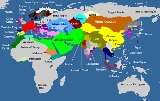
Caliphate and contemporary states and empires in 820.]]

Baghdad
Baghdad

Baghdad is the Capital of Iraq and of Baghdad Governorate, with which it is also coterminous. With a municipal population estimated at 6.5 million, it is the largest city in Iraq, and the second largest city in the Arab World....
 was made the new capital of the caliphate (moved from the previous capital, Damascus) due to the importance placed by the Abbasids upon eastern affairs in Persia and Transoxania. It was at this time however, that the caliphate showed signs of fracture and we witness the uprising of regional dynasties. Although the Ummayad family had been killed by the revolting Abbasids, one family member, Abd ar-Rahman I
Abd ar-Rahman I

Abd ar-Rahman I was the founder of the Umayyad Emirate of C?rdoba, Spain, a Muslim dynasty that ruled the greater part of Iberian Peninsula for nearly three centuries ....
, was able to flee to Spain and establish an independent caliphate there in 756. In the Maghreb region, Harun al-Rashid appointed the Arab Aghlabid
Aghlabid

The Aghlabid dynasty of emirs, members of the Arab tribe of Bani Tamim, ruled Ifriqiya, nominally on behalf of the Abbasid Caliph, for about a century, until overthrown by the new power of the Fatimids....
s as virtually autonomous rulers, although they continued to recognise the authority of the central caliphate. Aghlabid rule was short lived, as they were deposed by the Shiite Fatimid
Fatimid

The Fatimid Caliphate or al-Fatimiyyun was an Arab Shi'a dynasty that ruled over varying areas of the Maghreb, Egypt, Sicily, Malta and the Levant from 5 January 909 to 1171....
 dynasty in 909. By around 960, the Fatimids had conquered Abbasid Egypt, building a new capital there in 973 called "al-Qahirah" (meaning "the planet of victory", known today as Cairo
Cairo

Cairo , which means "the triumphant", is the Cairo and largest city of Egypt.It is the most populous metropolitan area in Egypt and is also one of the most populous in the world....
). Similar was the case in Persia, where the Turkic
Turkic peoples

The Turkic peoples are Eurasian peoples residing in northern, central and western Eurasia, and who mostly speak languages belonging to the Turkic languages....
 Ghaznavids managed to snatch power from the Abbasids. Whatever temporal power
Temporal power

The temporal power of the Popes is the political and governmental activity of the Popes of the Roman Catholic Church, as distinguished from their spiritual and pastoral activity, which is also called eternal power, to contrast it with the Church's secular power....
 of the Abbasids remained had eventually been consumed by the Seljuq Turks (a Muslim Turkish clan which had migrated into mainland Persia), in 1055.

During this time, expansion continued, sometimes by military warfare, sometimes by peaceful proselytism
Dawah

Da?wah usually denotes preaching of Islam. Da?wah means literally "issuing a summons" or "making an invitation", being the active participle of a verb meaning variously "to summon, to invite" ....
. The first stage in the conquest of India began just before the year 1000. By some 200 (from 1193 — 1209) years later, the area up to the Ganges river
Ganges River

The 'Ganges' is one of the major rivers of the Indian subcontinent, flowing east through the Gangetic Plain of northern India into Bangladesh....
 had been conquered. In sub-Saharan West Africa
West Africa

West Africa or Western Africa is the westernmost region of the African continent. Geopolitically, the United Nations subregion of Western Africa includes the following 16 countries distributed over an area of approximately 5 million square km:...
, it was just after the year 1000 that Islam was established. Muslim rulers are known to have been in Kanem
Kanem Region

Kanem is one of the regions of Chad of Chad, corresponding to the former Kanem Prefecture. Its capital is Mao, Chad.The region of Kanem is divided into departments of Chad:...
 starting from sometime between 1081 to 1097, with reports of a Muslim prince at the head of Gao
Gao

||-||-||}Gao is a city in Songhai and capital of the Gao Region on the River Niger, with a population of 57,978 in 2005.It is also the capital of the surrounding Gao Cercle....
 as early as 1009. The Islamic kingdoms associated with Mali
Mali Empire

The Mali Empire or Manding Empire or Manden Kurufa was a West African civilization of the Mandinka people from c. 1230 to c. 1600. The empire was founded by Sundiata Keita and became renowned for the wealth of its rulers, especially Mansa Mansa Musa....
 reached prominence later, in the 13th century.

During the Abbasid reign, Baghdad
Baghdad

Baghdad is the Capital of Iraq and of Baghdad Governorate, with which it is also coterminous. With a municipal population estimated at 6.5 million, it is the largest city in Iraq, and the second largest city in the Arab World....
 became one of the greatest cultural centers of the world. The Abbasids were said to be descendents of Abbas the uncle of Muhammad claiming that they were the 'messiah' or saviours of the people under the Ummayad rule. Abbasid caliphs Harun al-Rashid
Harun al-Rashid

Harun al-Rashid ; also spelled Harun ar-Rashid; , Aaron the Just, or Aaron the Rightly-Guided; March 17, 763 – March 24, 809) was the fifth and most famous Abbasid Caliphate Caliph....
 and Al-Mamun were great patrons of arts and sciences, and enabled these domains to flourish. Islamic philosophy also developed as the Shariah was codified, and the four Madhabs were established and built. This era also saw the rise of classical Sufism
Sufism

Sufi is generally understood to be the inner, mystical dimension of Islam. A practitioner of this tradition is generally known as a ufi , though some adherents of the tradition reserve this term only for those practitioners who have attained the goals of the Sufi tradition....
. The greatest achievement, however, was completion of the canonical collections of Hadith
Hadith

Hadith are oral traditions relating to the words and deeds of the Prophets of Islam Muhammad. Hadith collections are regarded by all traditional madhab as important tools for determining the Muslim way of life, the sunnah....
 of Sahih Bukhari
Sahih Bukhari

The authentic collection...
 and others.

The Fatimid Empire

The Fatimids had their origins in Ifriqiya
Ifriqiya

In Middle Ages, Ifriqiya or Ifriqiyah was the area comprising the coastal regions of what are today western Libya, Tunisia, and eastern Algeria....
 (modern-day Tunisia
Tunisia

Tunisia , officially the Tunisian Republic , is a country located in North Africa. It is bordered by Algeria to the west and Libya to the southeast....
 and eastern Algeria
Algeria

Algeria , officially the People's Democratic Republic of Algeria, is a country located in North Africa. It is the largest country of the Mediterranean sea, second largest in the Arab World, and the second largest on the African continent and the eleventh-largest country in the world in terms of land area....
). The dynasty was founded in 909 by , who legitimised his claim through descent from Muhammad
Muhammad

Muhammad Patronymic#Arabic Abd Allah ibn Abd al Muttalib , is the founder of the Major religious groups of Islam and is regarded by Muslims as a Rasul and prophet of , the last and the greatest law-bearer in a series of prophets....
 by way of his daughter Fatima as-Zahra
Fatimah

Fatimah was a daughter of the Islamic prophet Muhammad from his first wife Khadija. Sheis regarded by Muslims as an exemplar for men and women....
 and her husband , the first Imam
Imam

File:Medaillon chiite.jpgAn imam is an Islamic leadership position. Often the leader of a mosque and the community. Similar to spiritual leaders, the imam is the one who leads the prayer during Islamic gatherings....
, hence the name al-Fatimiyyun "Fatimid".

Abdullah al-Mahdi's control soon extended over all of central Maghreb
Maghreb

The Maghreb , also rendered Maghrib , meaning "place of sunset" or "western" in Arabic, is a region in North Africa. The term is generally applied to all of Morocco, Algeria, and Tunisia, but in older Arabic usage pertained only to the area of the three countries between the high ranges of the Atlas Mountains and the Mediterranean Sea....
, an area consisting of the modern countries of Morocco
Morocco

Morocco , officially the Kingdom of Morocco , is a country located in North Africa with a population of nearly 34 million and an area just under 447,000 km2....
, Algeria
Algeria

Algeria , officially the People's Democratic Republic of Algeria, is a country located in North Africa. It is the largest country of the Mediterranean sea, second largest in the Arab World, and the second largest on the African continent and the eleventh-largest country in the world in terms of land area....
, Tunisia
Tunisia

Tunisia , officially the Tunisian Republic , is a country located in North Africa. It is bordered by Algeria to the west and Libya to the southeast....
 and Libya
Libya

Libya , officially the Great Socialist People's Libyan Arab Jamahiriya , is a country located in North Africa. Bordering the Mediterranean Sea to the north, Libya lies between Egypt to the east, Sudan to the southeast, Chad and Niger to the south, and Algeria and Tunisia to the west....
, which he ruled from Mahdia
Mahdia

Mahdia, Arabic language: ??????? , is a Tunisian coastal city with 37,000 inhabitants, south of Monastir, Tunisia and southeast of Sousse....
, his newly-built capital in Tunisia.

The Fatimids entered Egypt in the late 900s, conquering the Ikhshidid dynasty
Ikhshidid dynasty

The Ikhshidid dynasty of Egypt ruled from 935 to 969. It was founded by Muhammad bin Tughj, a Turkic slave soldier, who began as governor, and was later given the title Ikhshid by the Caliph....
 and founding a new capital at al-Qahira (Cairo
Cairo

Cairo , which means "the triumphant", is the Cairo and largest city of Egypt.It is the most populous metropolitan area in Egypt and is also one of the most populous in the world....
) in 969. The name was a reference to the planet Mars, "The Subduer", which was prominent in the sky at the moment that city construction started. Cairo was intended as a royal enclosure for the Fatimid caliph and his army, though the actual administrative and economic capital of Egypt was in cities such as Fustat until 1169. After Egypt, the Fatimids continued to conquer the surrounding areas until they ruled from Tunisia to Syria
Syria

Syria , officially the Syrian Arab Republic , is an Arab-majority country in Southwest Asia, bordering Lebanon and the Mediterranean Sea to the west, Israel to the southwest, Jordan to the south, Iraq to the east, and Turkey to the north....
 and even crossed over into Sicily
Sicily

Sicily is an Autonomous regions with special statute of Italy. Of all the regions of Italy, Sicily covers the largest land area at 25,708 km? and currently has just over five million inhabitants....
 and southern Italy
Italy

Italy , officially the Italian Republic , is a country located on the Italian Peninsula in Southern Europe and on the two largest islands in the Mediterranean Sea, Sicily and Sardinia....
.

Under the Fatimids, Egypt became the center of an empire
Empire

Empire derives from the Latin word imperium, denoting ?military command? in Roman. Politically, an empire is a geographically extensive group of states and peoples united and ruled either by a monarch or an oligarchy....
 that included at its peak North Africa
North Africa

North Africa or Northern Africa is the northernmost region of the African continent, separated by the Sahara from Sub-Saharan Africa.Geopolitically, the United Nations subregion of Northern Africa includes the following seven countries or territories:...
, Sicily
Sicily

Sicily is an Autonomous regions with special statute of Italy. Of all the regions of Italy, Sicily covers the largest land area at 25,708 km? and currently has just over five million inhabitants....
, Palestine
Palestine

Palestine is a name which has been widely used since Roman times to refer to the region between the Mediterranean Sea and the Jordan River. It is derived from a name used already much earlier for a narrower geographical region, mainly along the coastal region....
, Lebanon
Lebanon

Lebanon , officially the Republic of Lebanon or Lebanese Republic , is a country in Western Asia, on the eastern shore of the Mediterranean Sea....
, Syria
Syria

Syria , officially the Syrian Arab Republic , is an Arab-majority country in Southwest Asia, bordering Lebanon and the Mediterranean Sea to the west, Israel to the southwest, Jordan to the south, Iraq to the east, and Turkey to the north....
, the Red Sea
Red Sea

The Red Sea is a salt water inlet of the Indian Ocean between Africa and Asia. The connection to the ocean is in the south through the Bab el Mandeb sound and the Gulf of Aden....
 coast of Africa, Yemen
Yemen

Yemen , officially the Republic of Yemen is an Arab country located on the Arabian Peninsula in Southwest Asia. Yemen has an estimated population of more than 23 million people and is bordered by Saudi Arabia to the North, the Red Sea to the West, the Arabian Sea and Gulf of Aden to the South, and Oman to the east....
 and the Hejaz
Hejaz

al-Hejaz is a region in the west of present-day Saudi Arabia. Defined mostly by the Red Sea, it extends from Haql on the Gulf of Aqaba to Jizan....
. Egypt flourished, and the Fatimids developed an extensive trade network in both the Mediterranean and the Indian Ocean
Indian Ocean

The Indian Ocean is the third largest of the world's oceanic divisions, covering about 20% of the water on the Earth's surface. It is bounded on the north by Asia ; on the west by Africa; on the east by Indochina, the Sunda Islands, and Australia; and on the south by the Southern Ocean ....
. Their trade and diplomatic ties extended all the way to China
China

China is a Culture of China, an ancient civilization, and, depending on perspective, a national or multinational entity extending over a large area in East Asia....
 and its Song Dynasty
Song Dynasty

The Song Dynasty was a ruling Chinese dynasty in China between 960–1279 AD; it succeeded the Five Dynasties and Ten Kingdoms Period, and was followed by the Yuan Dynasty....
, which eventually determined the economic course of Egypt during the High Middle Ages
High Middle Ages

The High Middle Ages was the periodization of history of Europe in the 11th, 12th, and 13th centuries . The High Middle Ages were preceded by the Early Middle Ages and followed by the Late Middle Ages, which by convention end around 1500....
.

Unlike other governments in the area, Fatimid advancement in state offices was based more on merit than on heredity. Members of other branches of Islam, like the Sunnis, were just as likely to be appointed to government posts as Shiites. Tolerance was extended even to non-Muslims such as Christian
Christian

A Christian is a person who adheres to Christianity, a Monotheism#Christian view religion centered on the life and teachings of Jesus and interpreted by Christians to have been prophesied in the Hebrew Bible/Old Testament....
s and Jews, who occupied high levels in government
Government

Government is the body within any organization that has the authority to make and the power to enforce laws, regulations, or rules. Typically, the government refers to a civil government -- local, provincial, or national -- but commercial, academic, religious, or other formal organizations are also administered by governing bodies....
 based on ability. There were, however, exceptions to this general attitude of tolerance, most notably Al-Hakim bi-Amr Allah
Al-Hakim bi-Amr Allah

Abu ?Ali Mansur Tariqu l-?akim, called bi Amr al-Lah , was the sixth Fatimid caliph and 16th Ismaili imam .Born in 985, Abu ?Ali ?Mansur? succeeded his father Al-Aziz at the age of eleven on 14 October, 996 with the caliphal title of al-Hakim Bi-Amr Allah....
.

The Fatimid palace was two parts. it used to be in the Khan el-Khalili
Khan el-Khalili

Khan el-Khalili is a major souk in the Old Cairo of Cairo. The bazaar district is one of Cairo's main attractions for tourists and Egyptians alike....
 area at Bin El-Quasryn street.

Regional powers

The Abbasids soon became caught within a three-way rivalry of Arabs, Persians and the immigrant Turks. In addition, the cost of running a large empire became too great. The political unity of Islam began to disintegrate. The Emirates, still recognizing the theoretical leadership of the caliphs, drifted into independence, and a brief revival of control was ended with the establishment of rival caliphates. Eventually the Abbasids ruled as puppets for the Buwayhid
Buwayhid

File:Buyid Persian Empire.pngBuyid dynasty or the Buyids , also known as Buwaihids or Buyyids, were a Shia Islam Persian people dynasty that originated from Daylaman....
 emirs. During this time, great advancements were made in the areas of astronomy, poetry, philosophy science and mathematics.

Spain & the Umayyads


The Arabs first began their conquest of southern Spain or al-Andalus in 710 and created a province under the Caliphate which extended as far as the north of the peninsula. After the Abbasids came to power, some Ummayads fled to Muslim Spain
Al-Andalus

Al-Andalus was the Arabic name given to the parts of the Iberian Peninsula governed by Arab Muslims, at various times in the period between 711 and 1492....
 and established themselves in Córdoba
Córdoba, Spain

viktor chucchuc he sucsuck my dick||-||-|File:Cordoba Water Wheel.jpg|}Cordova is a city in Andalusia, southern Spain, and the capital of the C?rdoba ....
. By the end of the 10th century, the ruler Abd al-Rahman III (912-61) took over the title of Caliph.

The Crusaders

Beginning in the 8th century C.E. the Christian
Christian

A Christian is a person who adheres to Christianity, a Monotheism#Christian view religion centered on the life and teachings of Jesus and interpreted by Christians to have been prophesied in the Hebrew Bible/Old Testament....
 kingdoms of Spain
Spain in the Middle Ages

After the disorders of the passage of the Vandal#Iberia and Alans down the Mediterranean coast of Hispania from 408, the history of Medieval Spain begins with the Iberian kingdom of the Arianismist Visigoths , who were Christianization with their king Reccared in 587....
 had begun the Reconquista
Reconquista

The Reconquista was a period of 800 years in the Middle Ages during which several Christian kingdoms of the Iberian Peninsula succeeded in retaking the Iberian Peninsula from the Muslims....
 aimed at retaking Al-Andalus
Al-Andalus

Al-Andalus was the Arabic name given to the parts of the Iberian Peninsula governed by Arab Muslims, at various times in the period between 711 and 1492....
 from the Moors
Moors

In the Spanish language, the term for Moors is Moro; in Portuguese language the word is mouro. There seems to have been some confusion about the relationship of the word moro/mouro to the word moreno , both from Greek language ma?ros, i.e....
. In 1095, Pope Urban II
Pope Urban II

Pope Urban II , born Otho de Lagery , was Pope from March 12, 1088 until his death. He is most known for starting the First Crusade and setting up the modern day Roman Curia, in the manner of a royal court, to help run the Church....
, inspired by the perceived holy wars in Spain and implored by the eastern Roman emperor
Alexios I Komnenos

Alexios I Komnenos, or Comnenus , Byzantine Empire List of Byzantine Emperors , was the son of Ioannis Komnenos and Anna Dalassena, and the nephew of Isaac I Komnenos ....
 to help defend Christianity in the East, called for the First Crusade
First Crusade

The First Crusade was launched in 1095 by Pope Urban II with the primary goal of responding to the appeal from Byzantine Emperor Alexius I. The Emperor requested that western volunteers come to their aid and repel the Seljuk Turks in Anatolia, Modern day Turkey....
 from Western Europe which captured Edessa, Antioch
Antioch

Antioch on the Orontes was an ancient city on the eastern side of the Orontes River. It is near the modern city of Antakya, Turkey.Founded near the end of the 4th century BC by Seleucus I Nicator, one of Alexander the Great's generals, Antioch eventually rivaled Alexandria as the chief city of the nearer East and was a cradle of gentile hi...
, Tripoli
Tripoli

Tripoli is the largest and Capital city of Libya.Tripoli has a population of 1.69 million. The city is located in the northwest of the country on the edge of the desert, on a point of rocky land projecting into the Mediterranean Sea and forming a bay....
 and Jerusalem
Jerusalem

Jerusalem is the capital of Israel and its List of Israeli cities in both population and area, with a population of 747,600 residents over an area of if Positions on Jerusalem East Jerusalem is included....
. The Christian Kingdom of Jerusalem
Kingdom of Jerusalem

The Kingdom of Jerusalem was a Christianity kingdom established in the Levant in 1099 after the First Crusade. It lasted nearly two hundred years, from 1099 until 1291 when the last remaining possession, Acre, Israel, was destroyed by the Mamluks....
 emerged and for a time controlled many holy sites of Islam
Holy Land

The Holy Land , generally refers to the geographical region of the Levant called Land of Canaan or Land of Israel in the Bible, and constitutes the Promised land....
. Saladin
Saladin

ala ad-Din Yusuf ibn Ayyub , better known as Saladin in medieval Europe, was the Sultan of Egypt and Greater Syria. He led the Islamic opposition to the Second Crusade and Third Crusade....
, however, restored unity within the Umma by defeating the Fatimids, and was then able to put an end to the Kingdom of Jerusalem in 1187 C.E. Other crusades were launched with at least the nominal intent to recapture the holy city and other holy lands, but hardly more was ever accomplished than the errant looting and occupation of Christian Constantinople
Constantinople

Constantinople was the empire capital of the Roman Empire , the Byzantine Empire , the Latin Empire , and the Ottoman Empire . Strategically located between the Golden Horn and the Sea of Marmara at the point where Europe meets Asia, Byzantine Constantinople had been the capital of a Christendom empire, successor to ancient ancient Greece...
, leaving the Eastern Roman, or Byzantine Empire severely weakened and ripe for later conquest. However, the crusaders did manage to weaken Muslim territories preventing them from further expansion into Christendom.

The Mamluks

In 1250 C.E., the short-lived Ayyubid dynasty (established by Saladin
Saladin

ala ad-Din Yusuf ibn Ayyub , better known as Saladin in medieval Europe, was the Sultan of Egypt and Greater Syria. He led the Islamic opposition to the Second Crusade and Third Crusade....
) was overthrown by slave regiments, and a new dynasty—the Mamluks—was born. The Mamluks soon expanded into Palestine, expelled the remaining Crusader states and repelled the Mongol attempt to invade Syria. Thus they united Syria
Syria

Syria , officially the Syrian Arab Republic , is an Arab-majority country in Southwest Asia, bordering Lebanon and the Mediterranean Sea to the west, Israel to the southwest, Jordan to the south, Iraq to the east, and Turkey to the north....
 and Egypt
Egypt

Egypt is a country mainly in North Africa, with the Sinai Peninsula forming a land bridge in Western Asia. Covering an area of about , Egypt borders the Mediterranean Sea to the north, the Gaza Strip and Israel to the northeast, the Red Sea to the east, Sudan to the south and Libya to the west....
 for the longest period of time between the Abbasid and Ottoman empires (1250-1517).

Islam in Africa

The first continent outside of Arabia to have an Islamic history was Africa
Africa

Africa is the world's second-largest and second most-populous continent, after Asia. At about 30.2 million km? including adjacent islands, it covers 6% of the Earth's total surface area and 20.4% of the total land area....
 beginning with the hijirah to modern day Ethiopia via modern day Eritrea (All part of Abyssinia). Islam in Eritrea & Ethiopia can be dated back to the founding of the religion; in 615, when a band of Muslims were counseled by Muhammad to escape persecution in Mecca and travel to Abyssinia, which was ruled by, in Muhammad's estimation, a pious Christian king. Moreover, Islamic tradition states that Bilal, one of the foremost companions of Muhammad, was from Abyssinia (Habasha).

Islam in Maghreb

The Maghreb meaning "place of sunset
Sunset

File:Sunset 2007-1.jpgSunset is the daily disappearance of the sun below the horizon as a result of the Earth's rotation. The atmospheric conditions created by the setting of the sun are also commonly referred to as "a sunset"....
" or "west
West

West is most commonly a noun, adjective, or adverb indicating Direction or geography.West is one of the four cardinal directions or compass points....
ern" in Arabic, is the region of Africa
Africa

Africa is the world's second-largest and second most-populous continent, after Asia. At about 30.2 million km? including adjacent islands, it covers 6% of the Earth's total surface area and 20.4% of the total land area....
 north of the Sahara
Sahara

The Sahara is the world's largest hot desert. At over 9,000,000 square kilometers , it covers most of Northern Africa, making it almost as large as the United States or the continent of Europe....
 Desert and west of the Nile
Nile

The Nile is a major north-flowing river in Africa, generally regarded as the List of rivers by length in the world.The Nile has two major tributary, the White Nile and Blue Nile, the latter being the source of most of the Nile's water and silt, but the former being the longer of the two....
 — specifically, coinciding with the Atlas Mountains
Atlas Mountains

The Atlas Mountains are a mountain range across a northern stretch of Africa extending about 2,400 km through Morocco, Algeria, and Tunisia. The highest peak is Jbel Toubkal, with an elevation of in southwestern Morocco....
. Geopolitically, the area includes Morocco
Morocco

Morocco , officially the Kingdom of Morocco , is a country located in North Africa with a population of nearly 34 million and an area just under 447,000 km2....
, Algeria
Algeria

Algeria , officially the People's Democratic Republic of Algeria, is a country located in North Africa. It is the largest country of the Mediterranean sea, second largest in the Arab World, and the second largest on the African continent and the eleventh-largest country in the world in terms of land area....
, Tunisia
Tunisia

Tunisia , officially the Tunisian Republic , is a country located in North Africa. It is bordered by Algeria to the west and Libya to the southeast....
, and Libya
Libya

Libya , officially the Great Socialist People's Libyan Arab Jamahiriya , is a country located in North Africa. Bordering the Mediterranean Sea to the north, Libya lies between Egypt to the east, Sudan to the southeast, Chad and Niger to the south, and Algeria and Tunisia to the west....
, Western Sahara
Western Sahara

Western Sahara is a territory of North Africa, bordered by Morocco to the north, Algeria in the northeast, Mauritania to the east and south, and the Atlantic Ocean on the west....
, and sometimes Mauritania
Mauritania

Mauritania , officially the Islamic Republic of Mauritania, is a country in northwest Africa. It is bordered by the Atlantic Ocean on the west, by Senegal on the southwest, by Mali on the east and southeast, by Algeria on the northeast, and by the Morocco-controlled Western Sahara on the northwest....
, which is often placed in West Africa
West Africa

West Africa or Western Africa is the westernmost region of the African continent. Geopolitically, the United Nations subregion of Western Africa includes the following 16 countries distributed over an area of approximately 5 million square km:...
 instead. This part of Islamic territory has had independent governments during most of Islamic history, with a number being of historical importance.

Idrisid dynasty The Idrisids were the first Arab dynasty in the western Maghreb
Maghreb

The Maghreb , also rendered Maghrib , meaning "place of sunset" or "western" in Arabic, is a region in North Africa. The term is generally applied to all of Morocco, Algeria, and Tunisia, but in older Arabic usage pertained only to the area of the three countries between the high ranges of the Atlas Mountains and the Mediterranean Sea....
, ruling from 788 to 985. The dynasty is named after its first sultan
Sultan

Sultan is an Islamic honorifics, with several historical meanings. Originally it was an Arabic language abstract noun meaning "strength", "authority", or "rulership", derived from the verbal noun ???? sulah, meaning "authority" or "power"....
 Idris I
Idris I

Idris I was the first ruler and founder of the Idrisid Dynasty, ruling from 788 to 791 AD. He is credited with founding the dynasty that was instrumental in the early Islamization of Morocco and Spain....
.

Almoravid dynasty was a Berber
Berber people

Berbers are the indigenous ethnic groups of North Africa west of the Nile Valley. They are discontinuously distributed from the Atlantic to the Siwa oasis, in Egypt, and from the Mediterranean to the Niger River....
 dynasty from the Sahara
Sahara

The Sahara is the world's largest hot desert. At over 9,000,000 square kilometers , it covers most of Northern Africa, making it almost as large as the United States or the continent of Europe....
 that flourished over a wide area of North-Western Africa
North Africa

North Africa or Northern Africa is the northernmost region of the African continent, separated by the Sahara from Sub-Saharan Africa.Geopolitically, the United Nations subregion of Northern Africa includes the following seven countries or territories:...
 and the Iberian peninsula
Iberian Peninsula

The Iberian Peninsula, or Iberia, is located in the extreme southwest of Europe and includes modern-day Spain, Portugal, Andorra and Gibraltar and a very small area of France....
 during the 11th century. Under this dynasty the Moorish empire was extended over present-day Morocco
Morocco

Morocco , officially the Kingdom of Morocco , is a country located in North Africa with a population of nearly 34 million and an area just under 447,000 km2....
, Western Sahara
Western Sahara

Western Sahara is a territory of North Africa, bordered by Morocco to the north, Algeria in the northeast, Mauritania to the east and south, and the Atlantic Ocean on the west....
, Mauritania
Mauritania

Mauritania , officially the Islamic Republic of Mauritania, is a country in northwest Africa. It is bordered by the Atlantic Ocean on the west, by Senegal on the southwest, by Mali on the east and southeast, by Algeria on the northeast, and by the Morocco-controlled Western Sahara on the northwest....
, Gibraltar
Gibraltar

Gibraltar is a British overseas territory located near the southernmost tip of the Iberian Peninsula overlooking the Strait of Gibraltar. The territory shares a border with Spain to the north....
, Tlemcen
Tlemcen

Tlemcen is a town in Northwestern Algeria, and the capital of the Tlemcen Province. Its population is 132,341 as of the 1998 census. Located inland, it is located in the center of a region known for its olive plantations and vineyards....
 (in Algeria
Algeria

Algeria , officially the People's Democratic Republic of Algeria, is a country located in North Africa. It is the largest country of the Mediterranean sea, second largest in the Arab World, and the second largest on the African continent and the eleventh-largest country in the world in terms of land area....
) and a great part of what is now Senegal
Senegal

Senegal , officially the Republic of Senegal, is a country south of the S?n?gal River in West Africa. Senegal is bounded by the Atlantic Ocean to the west, Mauritania to the north, Mali to the east, and Guinea and Guinea-Bissau to the south....
 and Mali
Mali

Mali, officially the Republic of Mali, is a landlocked nation in West Africa. Mali is the seventh largest country in Africa, bordering Algeria on the north, Niger on the east, Burkina Faso and the C?te d'Ivoire on the south, Guinea on the south-west, and Senegal and Mauritania on the west....
 in the south, and Spain
Spain

Spain or the Kingdom of Spain , is a country located in Southern Europe on the Iberian Peninsula.The Spanish constitution does not establish any official denomination of the country, even though Espa?a , Estado espa?ol and Naci?n espa?ola are used interchangeably....
 and Portugal
Portugal

Portugal , officially the Portuguese Republic , is a country on the Iberian Peninsula. Located in southwestern Europe, Portugal is the westernmost country of mainland Europe and is bordered by the Atlantic Ocean to the west and south and by Spain to the north and east....
 in the north.

Almohad Dynasty or "the Unitarians," were a Berber
Berber people

Berbers are the indigenous ethnic groups of North Africa west of the Nile Valley. They are discontinuously distributed from the Atlantic to the Siwa oasis, in Egypt, and from the Mediterranean to the Niger River....
 Muslim religious
Religion

A religion is an organized approach to human spirituality which usually encompasses a set of myth, symbols, beliefs and practices, often with a supernatural or transcendence quality, that give meaning to the practitioner's experiences of life through reference to a higher power or truth....
 power which founded the fifth Moorish dynasty
Dynasty

A dynasty is a succession of rulers who belong to the same family for generations. A dynasty is also often called a "Royal House", e.g. the House of Saud or House of Habsburg....
 in the 12th century, and conquered all northern Africa
Africa

Africa is the world's second-largest and second most-populous continent, after Asia. At about 30.2 million km? including adjacent islands, it covers 6% of the Earth's total surface area and 20.4% of the total land area....
 as far as Egypt
Egypt

Egypt is a country mainly in North Africa, with the Sinai Peninsula forming a land bridge in Western Asia. Covering an area of about , Egypt borders the Mediterranean Sea to the north, the Gaza Strip and Israel to the northeast, the Red Sea to the east, Sudan to the south and Libya to the west....
, together with Al-Andalus
Al-Andalus

Al-Andalus was the Arabic name given to the parts of the Iberian Peninsula governed by Arab Muslims, at various times in the period between 711 and 1492....
.

Islam in East Africa

There were also Islamic governments in Tanzania
Tanzania

Tanzania , officially the United Republic of Tanzania , is a country in East Africa that is bordered by Kenya and Uganda on the north, Rwanda, Burundi and the Democratic Republic of the Congo on the west, and Zambia, Malawi and Mozambique on the south....
. The people of Zayd were allegedly the first Muslims to immigrate to East Africa. Islam came to east Africa mainly through trade routes. The African peoples that lived along these routes became converts due to the close contact they had with Arab traders in areas like Tabora, from which they affected the manners of Muslims, this leading to eventual conversion neither with encouragement nor discouragement by the Muslim Arabs. In pre-colonial East Africa, the structure of Islamic authority was held up through the 'Ulama (wanawyuonis, in Swahili). Their base was mainly in Zanzibar. These leaders had some degree of authority over most of the Muslims in East Africa at this time; especially before territorial boundaries were established. This is because the majority of Muslims lived within the sphere of influence of the Sultanate in Zanzibar, the chief Qadi there being recognized for having the final religious authority. Reference: August H. Nimtz, Jr.Islam and Politics in East Aftrica. the Sufi Order in Tanzania. University of Minnesota Press, Minneapolis, 1980.

Islam in West Africa

Usman dan Fodio
Usman dan Fodio

Shaihu Usman dan Fodio was the founder of the Sokoto Caliphate in 1809, a religious teacher, writer and Islamic reformer. Dan Fodio was one of a class of urbanized ethnic Fulani living in the Hausa States in what is today northern Nigeria....
 after the Fulani War
Fulani War

The Fulani War of 1804-1810, also known as the Fulani Jihad or Jihad of Usman dan Fodio, was a military conquest in present day Nigeria and Cameroon....
, found himself in command of the largest state in Africa, the Fulani Empire
Fulani Empire

The Sokoto Caliphate is an Islamic spiritual community in Nigeria, led by the Sultan of Sokoto, Sa?adu Abubakar. Founded during the Fulani Jihad in the early 1800s, it was one of the most powerful empires in sub-Saharan Africa prior to European conquest and colonization....
. Dan Fodio worked to establish an efficient government, one grounded in Islamic law. Already aged at the beginning of the war, dan Fodio retired in 1815 passing the title of Sultan of Sokoto to his son Muhammed Bello
Muhammed Bello

Muhammed Bello was the son and aide of Usman dan Fodio. He became the second Sultan of Sokoto following his father's 1815 retirement from the throne....
.

Islam in Asia


Indian Subcontinent

See also: Islam in India
Islam in India

Islam in India is the second-most practiced religion after Hinduism. There are approximately Islam by country in India's population as of 2008 , i.e., 13.4% of the population....
, Islam in Pakistan
Islam in Pakistan

Islam is the official religion of the Islamic Republic of Pakistan. In the 1998 census, it found 96% of the total population were Muslims, and in 2007 at 96% and out of Muslim population ....
Islamic rule came to the region in the 8th century, when Muhammad bin Qasim
Muhammad bin Qasim

Muhammad bin Qasim Al-Thaqafi was an Umayyad general who conquered the Sindh and Punjab regions along the Indus River . He was born in the city of Taif ....
 conquered Sindh
Sindh

Sindh is one of the four Subdivisions of Pakistan of Pakistan and historically is home to the Sindhi people. Different cultural and ethnic groups also reside in Sindh including Urdu-speaking Muslim refugees who migrated to Pakistan from India upon independence as well as the people migrated from other provinces after independence....
, (Pakistan
Pakistan

Pakistan , officially the Islamic Republic of Pakistan, is a country located in South Asia and borders Central Asia and the Middle East. It has a 1,046 kilometre coastline along the Arabian Sea and Gulf of Oman in the south, and is bordered by Afghanistan and Iran in the west, India in the east and People's Republic of China in th...
). Muslim conquests were expanded under Mahmud
Mahmud of Ghazni

'Mahmud of Ghazni Province' , also known as , was the founder of the Ghaznavid Empire, which he ruled from 997 until his death. Mahmud turned the former provincial city of Ghazni into the wealthy capital of an extensive empire which extended from Afghanistan into most of Iran as well as Pakistan and regions of North-West India....
 and the Ghaznavids until the late twelfth century, when the Ghurids
Ghurids

The Ghurids or Ghorids were a Persian people and Muslim dynasty in Greater Khorasan, most likely of Eastern Iranian Tajiks origin. The Ghurid empire was based in the region of Ghor Province , and stretched over a vast area that included the whole of Afghanistan, parts of modern Iran and South Asia ....
 overran the Ghaznavids and extended the conquests in northern India. Qutb-ud-din Aybak
Qutb-ud-din Aybak

Qutb-ud-din Aybak was a :Category:Turkic rulers of medieval India , the first Sultanate of Delhi and founder of the Slave dynasty . He served as sultan for only four years, from 1206 to 1210....
, conquered Delhi in 1206 and began the reign of the Delhi Sultanate
Delhi Sultanate

The Delhi Sultanate refers to the many Muslim countries that ruled in Hindustan from 1206 to 1526. Several Turkic peoples and Pashtun people dynasties ruled from Delhi: the Mamluk Sultanate , the Khilji dynasty , the Tughlaq dynasty , the Sayyid dynasty , and the Lodhi dynasty ....
s.

In the fourteenth century, Alauddin Khilji
Alauddin Khilji

Ala-ud-din Khilji , was the second ruler of the Khilji dynasty in India. He reigned from 1296 to 1316.His historic attack on Chittor in 1303 AD, after hearing of the beauty of queen of Chittor, Rani Padmini, the wife of King Rawal Ratan Singh and the subsequent story has been immortalized in the epic poem Padmavat, written by Malik Muhamm...
 extended Muslim rule south to Gujarat
Gujarat

Gujarat is a States and territories of India in western India. Gujarat borders Pakistan to the north west and the state of Rajasthan to the north and northeast, Madhya Pradesh to the east, Maharashtra and the Union territory of Diu, Daman District, India, Dadra and Nagar Haveli to the south....
, Rajasthan
Rajasthan

Rajasthan is the largest States and territories of India of the Republic of India in terms of area. It encompasses most of the area of the large, inhospitable Great Indian Desert , which has an edge paralleling the Sutlej-Indus river valley along its border with Pakistan....
 and Deccan. Various other Muslim dynasties also formed and ruled across India from the 13th to the 18th century such as the Qutb Shahi and the Bahmani, but none rivalled the power and extensive reach of the Mughal Empire
Mughal Empire

The Mughal Empire was a Muslim imperial power of the Indian subcontinent which began in 1526, ruled most of the Indian Subcontinent by the late 17th and early 18th centuries, and ended in the mid-19th century....
 at its peak.

China


Southeast Asia

Islam reached the islands of Southeast Asia
Southeast Asia

Southeast Asia or Southeastern Asia is a subregion of Asia, consisting of the countries that are geographically south of China, east of India and north of Australia....
 through Indian Muslim
Islam in India

Islam in India is the second-most practiced religion after Hinduism. There are approximately Islam by country in India's population as of 2008 , i.e., 13.4% of the population....
 traders from Gujarat near the end of the 13th century. Soon, many Sufi missionaries translated classical Sufi literature from Arabic and Persian into Malay
Malay language

The Malay language is an Austronesian languages spoken by the Malays and people of other ethnic groups who reside in Peninsular Malaysia, southern Thailand, Singapore, central eastern Sumatra, the Riau Islands and parts of the coast of Borneo....
. Coupled with the composing of original Islamic literature
Islamic literature

Islamic literature refers to literature written with an Islamic perspective, in any language.For the literature of some predominantly Islamic cultures, see:...
 in Malay, this led the way to the transformation of Malay into an Islamic language. By 1292, when Marco Polo
Marco Polo

Marco Polo was a trader and exploration from the Venetian Republic who gained fame for his worldwide travels, recorded in the book Il Milione also known as Oriente Poliano and the Description of the World....
 visited Sumatra, most of the inhabitants had converted to Islam. The Sultanate of Malacca was founded by Parameswara, a Srivijayan Prince in the Malay peninsula. Through trade and commerce, Islam spread to Borneo
Borneo

Borneo is the List of islands by area and is located at the centre of Maritime Southeast Asia. Administratively, this island is divided between Indonesia, Malaysia and Brunei....
 and Java, Indonesia. By the late 15th century, Islam had been introduced to the Philippines
Philippines

The Philippines, officially known as the Republic of the Philippines, is a country in Southeast Asia with Manila as its capital city. It comprises 7,107 islands in the western Pacific Ocean....
.

As Islam spread, three main Muslim political powers emerged. Aceh
Aceh

Aceh is a Provinces of Indonesia of Indonesia, located on the northern tip of the island of Sumatra. Its full name is Nanggr?e Aceh Darussalam....
, the most important Muslim power, was based firmly in Northern Sumatra. It controlled much of the area between Southeast Asia and India. The Sultunate also attracted Sufi poets. The second Muslim power was the Sultanate of Malacca on the Malay peninsula. The Sultanate of Demak
Demak

Demak is on the north coast of Central Java province, on the island of Java, Indonesia.* Demak, Indonesia - the modern-day large town.* Demak Sultanate - the sixteenth century sultanate....
 was the third power, appearing in Java, where the emerging Muslim forces defeated the local Majapahit kingdom in the early 16th century. Although the sultanate managed to expand its territory somewhat, its rule remained brief.

Portuguese
Portuguese Empire

The Portuguese Empire was the first global empire in history and also the earliest and longest lived of the modern European Colonialism empires, spanning almost six centuries, from the capture of Ceuta in 1415 to the handover of Macau in 1999....
 forces captured Malacca in 1511 under the naval general Afonso de Albuquerque
Afonso de Albuquerque

Dom Afonso de Albuquerque was a Portugal fidalgo, or nobleman, a naval general officer whose military and administrative activities conquered and established the Portuguese empire in the Indian ocean....
. With Malacca subdued, the Aceh Sultanate
Aceh Sultanate

The Sultanate of Aceh was a sultanate centered in the modern area of Aceh Province, Sumatra, Indonesia, which was a major regional power in the 16th and 17th centuries, before experiencing a long period of decline....
 and Brunei established themselves as centers of Islam in Southeast Asia. Brunei's sultanate remains intact even to this day.

Mongol invasions

The wave of Mongol invasions
Mongol invasions

The Mongol invasions progressed throughout the 13th century, resulting in the vast Mongol Empire covering much of Asia by 1300.The Mongol Empire emerged in the course of the 13th century by a series of conquests and invasions throughout Central Asia and Western Asia, reaching Eastern Europe by the 1240s....
, which had initially commenced in the early 13th century under the leadership of Genghis Khan
Genghis Khan

Genghis Khan , born , was the founder, Khan and Khagan of the Mongol Empire, the World's largest empires contiguous empire in history....
, marked a violent end to the Abbasid era. The Mongol Empire
Mongol Empire

The Mongol Empire was the List of largest empires#Contiguous Empires empire and the largest bar none. It emerged from the unification of Mongols and Turkic peoples tribes in modern day Mongolia, and grew through Mongol invasions, after Genghis Khan had been proclaimed ruler of all Mongols in 1206....
 had spread rapidly throughout Central Asia and Persia: the Persian city of Isfahan had fallen to them by 1237. With the election of Khan Mongke
Mongke

The name Mongke may refer to:* M?ngke Khan , Great khan of the Mongol Empire* Mengu-Timur , also known as Mongke Temur, khan of the Golden Horde, 1267-1280...
 in 1251, Mongol sights were set upon the Abbasid capital, Baghdad. Mongke's brother, Hulegu, was made the head of the Mongol Army assigned the task of subduing Baghdad. This was achieved at the Battle of Baghdad (1258)
Battle of Baghdad (1258)

The Battle of Baghdad in 1258 was a pivotal battle in which the Mongols destroyed the greatest center of Islamic power. The battle was a victory for the leader Hulagu Khan, a grandson of Genghis Khan....
, which saw the Abbasids overrun by the superior Mongol army. The last Abbasid caliph, al-Musta'sim
Al-Musta'sim

Al-Musta'sim Billah was the last Abbasid Caliph in Baghdad; he ruled from 1242 to 1258....
, was captured and killed; and Baghdad was ransacked and subsequently destroyed. The cities of Damascus and Aleppo
Aleppo

Aleppo is a city in northern Syria, capital of the Aleppo Governorate; the Governorate extends around the city for over 16,000 km? and has a population of 4,393,000, making it the largest Governorate in Syria by population....
 fell shortly afterwards, in 1260. Any prospective conquest of Egypt was temporarily delayed due to the death of Mongke at around the same time.

With Mongol conquest in the east, the Ayyubid dynasty
Ayyubid dynasty

The Ayyubid or Ayyoubid Dynasty was a Muslim dynasty of Kurds origins which ruled Egypt, Syria, Yemen , Diyar Bakr, Mecca, Hejaz and northern Iraq in the 12th and 13th centuries....
 ruling over Egypt had been replaced by the slave-soldier Mamluk
Mamluk

A mamluk was a slavery soldier who converted to Islam and served the Muslim caliphs and the Ayyubid sultans from the 9th to the 13th centuries....
s in 1250. This had been done through the marriage between Shajar al-Durr, the widow of Ayyubid caliph al-Salih Ayyub, with the Mamluk general Aybak
Aybak

Izz al-Din Aybak was the first of the Mamluk sultans of Egypt in the Turkic peoples, or Bahri dynasty, line....
. Military prestige was at the center of Mamluk society, and it played a key role in the confrontations with the Mongol forces. After the assassination of Aybak, and the succession of Qutuz
Qutuz

Saif ad-Din Qutuz, also spelled Kutuz, Although Qutuz's reign was short, he is one of the most popular Mamluk sultans in the Islamic world and holds one of the highest positions in Islamic history....
 in 1259, the Mamluks challenged and decisively routed the Mongols at the Battle of Ain Jalut
Battle of Ain Jalut

The Battle of Ain Jalut took place on 3 September 1260 between the Egyptian Mamluks and the Mongols in Palestine, in the Jezreel Valley in Galilee, just north of Biblical Samaria....
 in late 1260. This signalled an adverse shift in fortunes for the Mongols, who were again defeated by the Mamluks at the Battle of Hims a few months later, and then driven out of Syria altogether. With this, the Mamluks were also able to conquer the last of the crusader territories.

Three Muslim empires

In the 15th and 16th centuries three major Muslim empires were created: the aforementioned Ottoman Empire
Ottoman Empire

The Ottoman Empire , also known by its contemporaries as the Turkish Empire or Turkey , was an empire that lasted from 1299?1923. It was Treaty of Lausanne by the Republic of Turkey, which was officially proclaimed on October 29, 1923....
 in much of the Middle East
Middle East

File:GreaterMiddleEast1.pngThe Middle East is a region that spans southwestern Asia, western Asia, and northeastern Africa. It has no clear boundaries, often used as a synonym to Near East, in opposition to Far East....
, the Balkans
Balkans

The Balkans is the historical name of a geographic subregion of southeastern Europe. The region takes its name from the Balkan Mountains, which run through the centre of Bulgaria into eastern Serbia....
 and Northern Africa; the Safavid Empire in Greater Iran
Greater Iran

Greater Iran refers to the regions that have significant Iranian cultural influence. It roughly corresponds to the territory surrounding the Iranian plateau, stretching from the Caucasus to the Indus River, and conform to the historical understanding of the full territory of "Etymology of Iran."...
; and the Mughul Empire in South Asia
South Asia

South Asia, also known as Southern Asia, is the southern region of the Asian continent, which comprises the sub-Himalayan countries and, for some authorities , also includes the adjoining countries on the west and the east....
. These new imperial powers were made possible by the discovery and exploitation of gunpowder
Gunpowder

Gunpowder, also called black powder, is an explosive mixture of sulfur, charcoal and potassium nitrate, KNO3 that burns rapidly, producing volumes of hot solids and gases which can be used as a propellant in firearms and as a pyrotechnic composition in fireworks....
, and more efficient administration. By the end of the 19th century, all three had declined significantly, and by the early 20th century, with the Ottomans' defeat in World War I, the last Muslim empire collapsed.

Mughal Empire

The Mughal Empire was a product of various Central Asia
Central Asia

Central Asia is a region of Asia from the Caspian Sea in the west to central China in the east, and from southern Russia in the north to northern India in the south....
n invasions into the Indian subcontinent
Indian subcontinent

The Indian subcontinent is a large section of the Asian continent consisting of the land lying substantially on the Indian Plate. The subcontinent includes parts of various countries in South Asia, including those on the continental crust , an Island#Continental islands country on the continental shelf , and an Island#Oceanic islands countr...
. It was founded by the Timurid
Timurid

Timurid may refer to:* Timur* Timurid Dynasty * Timurid Emirates...
 prince Babur
Babur

Babur was a Muslim conqueror from Central Asia who, following a series of setbacks, finally succeeded in laying the basis for the Mughal Empire of Indian subcontinent....
 in 1526 with the destruction of the Delhi sultanate
Delhi Sultanate

The Delhi Sultanate refers to the many Muslim countries that ruled in Hindustan from 1206 to 1526. Several Turkic peoples and Pashtun people dynasties ruled from Delhi: the Mamluk Sultanate , the Khilji dynasty , the Tughlaq dynasty , the Sayyid dynasty , and the Lodhi dynasty ....
, with its capital in Agra
Agra

Agra is a city on the banks of the Yamuna in the northern States and territories of India of Uttar Pradesh, India. It finds mention in the epic Mahabharata when it was called Agrabana, or Paradise....
. Babur's death some years later, and the indecisive rule of his son, Humayun, brought a degree of instability to Mughal rule. The resistance of the Afghani
Afghani

Afghani may refer to:* Something of, from, or related to Afghanistan.* The Afghan afghani, official currency of Afghanistan.* The Pashto language, which is also referred to as Afghani or Afghani language....
 Sher Shah
Sher Shah Suri

Sher Shah Suri , also known as Farid Khan or Sher Khan , was a powerful medievalIndian emperor from Sasaram, Bihar, India. Sher Shah was of Pashtun people descent who founded the dynasty known as Sur Dynasty in 1540 in North India....
, through which a string of defeats had been dealt to Humayun, significantly weakened the Mughals. Just a year before his death, however, Humayun managed to recover much of the lost territories, leaving a substantial legacy for his son, the 13 year old Akbar
Akbar the Great

Jalaluddin Muhammad Akbar , also known as Akbar the Great was the son of Nasiruddin Humayun whom he succeeded as ruler of the Mughal Empire from 1556 to 1605....
 (later known as Akbar the Great), in 1556. Under Akbar, consolidation of the Mughal Empire occurred through both expansion and administrative reforms. After Akbar, Jahangir and Shah Jahan came to power. Subsequently, Aurangazeb ruled vast areas include Afghanisthan, Pakistan, India and Bangladesh.

The empire ruled most of present-day India
India

India, officially the Republic of India , is a country in South Asia. It is the List of countries and outlying territories by total area country by geographical area, the List of countries by population country, and the most populous liberal democracy in the world....
, Pakistan
Pakistan

Pakistan , officially the Islamic Republic of Pakistan, is a country located in South Asia and borders Central Asia and the Middle East. It has a 1,046 kilometre coastline along the Arabian Sea and Gulf of Oman in the south, and is bordered by Afghanistan and Iran in the west, India in the east and People's Republic of China in th...
, Bangladesh
Bangladesh

, officially the People's Republic of Bangladesh is a country in South Asia. It is bordered by India on all sides except for a small border with Burma to the far southeast and by the Bay of Bengal to the south....
 and Afghanistan
Afghanistan

Afghanistan , officially the Islamic republic of Afghanistan, is a landlocked country that is located approximately in the center of Asia....
 for several centuries, before it declined in the early 18th century, which led to India being divided into smaller kingdoms and princely states. The Mughal dynasty was eventually dissolved by the British Empire
British Empire

The British Empire comprised the dominions, Crown colony, protectorates, League of Nations mandate, and other Dependent territory ruled or administered by the United Kingdom , that had originated with the overseas colonies and trading posts established by England in the late 16th and early 17th centuries....
 after the Indian rebellion of 1857
Indian Rebellion of 1857

The Indian Rebellion of 1857 began as a mutiny of sepoys of British Honourable East India Company's army on 10 May 1857, in the town of Meerut, and soon erupted into other mutinies and civilian rebellions largely in the Upper Gangetic Plains moist deciduous forests and central India, with the major hostilities confined to present-day Uttar Pr...
. It left a lasting legacy on Indian culture and architecture. Famous buildings built by the Mughals, include: the Taj Mahal
Taj Mahal

The Taj Mahal is a mausoleum located in Agra, India, built by Mughal Empire list of Mughal emperors Shah Jahan in memory of his favorite wife, Mumtaz Mahal....
, the Red Fort, the Badshahi Mosque
Badshahi Mosque

The Badshahi Mosque , or the 'Emperor's Mosque', was built in 1673 by the Mughal Emperor Aurangzeb in Lahore, Pakistan. It is one of the city's best known landmarks, and a major tourist attraction epitomising the beauty and grandeur of the Mughal era....
, the Lahore Fort
Lahore Fort

The Lahore Fort, locally referred to as Shahi Qila is citadel of the city of Lahore, Punjab , Pakistan. It is located in the northwestern corner of the Walled City of Lahore....
, the Shalimar Gardens
Shalimar Gardens (Lahore)

The Shalimar Gardens , sometimes written Shalamar Gardens, is a Persian garden and it was built by the Mughal empire Shah Jahan in Lahore, modern day Pakistan....
 and the Agra Fort
Agra Fort

Agra Fort is a UNESCO World Heritage site located in Agra, India. The fort is also known as Lal Qila, Fort Rouge and Red Fort of Agra....
. During the empire's reign, Muslim communities flourished all over India, particularly in Gujarat
Gujarat

Gujarat is a States and territories of India in western India. Gujarat borders Pakistan to the north west and the state of Rajasthan to the north and northeast, Madhya Pradesh to the east, Maharashtra and the Union territory of Diu, Daman District, India, Dadra and Nagar Haveli to the south....
, Bengal
Bengal

Bengal , is a historical and geographical region in the northeast of South Asia. Today it is mainly divided between the independent sovereign nation of the Bangladesh and the state of West Bengal in India, although some regions of the previous kingdoms of Bengal are now part of the neighboring Indian states of Bihar, Assam, Tripura and Oris...
 and Hyderabad. Various Sufi orders from Afghanistan
Afghanistan

Afghanistan , officially the Islamic republic of Afghanistan, is a landlocked country that is located approximately in the center of Asia....
 and Iran
Iran

Iran , officially the Islamic Republic of Iran and formerly known internationally as Persian Empire until 1935, is a country in Central Eurasia, located on the northeastern shore of the Persian Gulf and the southern shore of the Caspian Sea....
 were very active throughout the region. Consequently, more than a quarter of the population converted to Islam
Islam

Islam is a Monotheism, Abrahamic religion originating with the teachings of the Prophets of Islam Muhammad, a 7th century Arab religious and political figure....
.

Safavid Empire

The Safavids were an Iran
Iran

Iran , officially the Islamic Republic of Iran and formerly known internationally as Persian Empire until 1935, is a country in Central Eurasia, located on the northeastern shore of the Persian Gulf and the southern shore of the Caspian Sea....
ian dynasty from Iranian Azarbaijan that ruled from 1501 to 1736, and which established Twelver Shi'a Islam
Islam

Islam is a Monotheism, Abrahamic religion originating with the teachings of the Prophets of Islam Muhammad, a 7th century Arab religious and political figure....
 as Iran's official religion and united its provinces under a single Iranian sovereignty, thereby reigniting the Persian
Persian Empire

The 'Persian Empire' was a series of successive Iranian or Persianization empires that ruled over the Iranian plateau, the original Persian homeland, and beyond in Southwest Asia, South Asia, Central Asia and the Caucasus....
 identity.


Although claiming to be the descendants of Ali ibn Abu Talib, the Safavids were originally Sunni (the name "Safavid" comes from a Sufi order called Safavi). Their origins go back to Firuz Shah Zarrinkolah, an Iranian local dignitary from Iran's north. During their rule, the Safavids recognized Twelver Shi'a Islam
Shi'a Islam

Shia Islam , is the second largest denomination of Islam, after Sunni Islam.Similiar to other branches of Islam, Shi'a Islam is based on the teachings of Islamic holy book, the Qur'an and message of the final prophet of Islam, Muhammad....
 as the State religion, thus giving Iran
Iran

Iran , officially the Islamic Republic of Iran and formerly known internationally as Persian Empire until 1935, is a country in Central Eurasia, located on the northeastern shore of the Persian Gulf and the southern shore of the Caspian Sea....
 a separate identity from its Sunni neighbours.

In 1524, Tahmasp
Tahmasp

Tahmasp is the name of two Safavid shahs of Persian Empire:*Tahmasp I *Tahmasp II ...
 acceded to the throne, initiating a revival of the arts in the region. Carpet making became a major industry, gaining new importance in Iran
Iran

Iran , officially the Islamic Republic of Iran and formerly known internationally as Persian Empire until 1935, is a country in Central Eurasia, located on the northeastern shore of the Persian Gulf and the southern shore of the Caspian Sea....
's cities. But the finest of all artistic revivals was the commissioning of the Shahnama. The Shahnama was meant to glorify the reign of the Shah through artistic means. The two-volume copy contained 258 large paintings to illustrate the works of Firdawsi, a Persian poet. The Shah also prohibited the drinking of wine, forbade the use of hashish
Hashish

Hashish is a preparation of cannabis composed of the compressed trichomes collected from the cannabis plant. It contains the same active ingredients but in higher concentrations than other parts of the plant such as the buds or the leaves....
 and ordered the removal of gambling casinos, taverns and brothels.

Tahmasp
Tahmasp

Tahmasp is the name of two Safavid shahs of Persian Empire:*Tahmasp I *Tahmasp II ...
's grandson, Shah Abbas I, also managed to increase the glory of the empire. Abbas restored the shrine of the eighth Twelver Shi'a Imam, Ali al-Ridha at Mashhad, and restored the dynastic shrine at Ardabil
Ardabil

Ardabil is a historical city in north-western Iran. The name Ardabil probably comes from the Zoroastrian name of "Artavil" which means a holy place....
. Both shrines received jewelry, fine manuscripts and Chinese porcelains. Abbas also moved the empire's capital to Isfahan
Isfahan (city)

Esfahan or Isfahan , located about 340 km south of Tehran at , is the capital of Esfahan Province and Iran's third largest city . Esfahan City had a population of 1,583,609 and the Esfahan metropolitan area had a population of 3,430,353 in the 2006 Census, the second most populous metropolitan area in Iran after Tehran....
, revived old ports, and established thriving trade with the Europeans. Amongst Abbas's most visible cultural achievements was the construction of Naqsh-e Jahan Square ("Design of the World"). The plaza, located near a Friday mosque, covered , thus dwarfing Piazza San Marco
Piazza San Marco

Piazza San Marco , is the principal town square of Venice, Italy.A remark often attributed to Napoleon I of France calls the Piazza San Marco "The drawing room of Europe"....
 and St. Peter's Square.

Ottoman Empire

The Seljuk Turks fell apart rapidly in the second half of the 13th century, especially after the Mongol invasion of Anatolia
Mongol invasion of Anatolia

Mongol invasion of Anatolia may refer to one of the following events and historical periods*Battle of K?se Dag - 13th century*Battle of Ankara - 15th century...
. This resulted in the establishment of multiple Turkish principalities, known as beylik
Beylik

Beylik is a Turkish word, meaning:*The territory under the jurisdiction of a Bey*Beuluk, a member of the Ottoman Sultan's janissary bodyguard...
s. Osman I
Osman I

Osman IOsman Gazi or Othman I El-Gazi Ottoman Turkish language: ????? ?? ??????, or Osman Bey or I.Osman or Osman Sayed II) was the leader of the Ottoman Turks, and the founder of the Ottoman dynasty that established and ruled the Ottoman Empire....
, the founder of the Ottoman dynasty
Ottoman Dynasty

File:Barber cape.jpgThe Ottoman Dynasty ruled the Ottoman Empire from 1299 to 1922, beginning with Osman I , though the dynasty was not proclaimed until Orhan Bey declared himself sultan....
, assumed leadership of one of these principalities (Sögüt
Sögüt

S?g?t is a town and district of Bilecik Province in the Marmara Region, Turkey region of Turkey. S?g?t has an area of and borders Bilecik to the west, G?lpazari to the north, Inhisar to the northeast, Eskisehir to the southeast, and Boz?y?k to the southwest....
) in 1281, succeeding his father Ertugrul
Ertugrul

This article is about the Ottoman leader Ertugrul. For the Ottoman frigate, see Ertugrul .Ertugrul, called Virile Falcon , also Ertogrul , was the father of Osman I, the founder of the Ottoman Empire....
. Declaring an independent Ottoman emirate in 1299, Osman I led it to a series of consecutive victories over the Byzantine Empire. By 1331, the Ottomans had captured Nicaea, the former Byzantine capital, under the leadership of Osman's son and successor, Orhan I
Orhan I

Orhan I , was the second Bey, or chief, of the nascent Ottoman Empire from 1326 to 1359. He was the son of Osman I, and his mother was Kamariya Sultana Mal, daughter of Abdulaziz Bey....
. Victory at the Battle of Kosovo
Battle of Kosovo

The Battle of Kosovo was fought on Vidovdan between the Serbian Empire, her allies, and the Ottoman Empire, in a Gazimestan about 5 kilometers northwest of Pristina....
 against the Serbs in 1389 then facilitated their expansion into Europe. The Ottomans were firmly established in the Balkans
Balkans

The Balkans is the historical name of a geographic subregion of southeastern Europe. The region takes its name from the Balkan Mountains, which run through the centre of Bulgaria into eastern Serbia....
 and Anatolia by the time Bayezid I
Bayezid I

Bayezid I was the Sultan of the Ottoman Empire, then R?m, from 1389 to 1402. He was the son of Murad I who was of Turkish people origin and Valide Sultan Gulcicek Hatun or G?l?i?ek Hatun who was of ethnic Greek people descent....
 ascended to power in the same year, now at the helm of a swiftly growing empire.

Further growth was brought to a sudden halt, as Bayezid I had been captured by Mongol warlord Timur
Timur

Timur , among his other names, commonly known as Tamerlane in the West, was a 14th century Turko-Mongol conqueror of much of western and Central Asia, and founder of the Timurid dynasty in Central Asia, which survived until 1857 as the Mughal Empire of India....
 (also known as "Tamerlane") in the Battle of Ankara
Battle of Ankara

The Battle of Ankara or Battle of Angora, fought on July 20, 1402, took place at the field of ?ubuk between the forces of the Ottoman Empire sultan Bayezid I and the Turko-Mongol forces of Timur, ruler of the Timurid Empire....
 in 1402, upon which a turbulent period known as the Ottoman Interregnum
Ottoman Interregnum

The Ottoman Interregnum was a period in the beginning of the 15th century when chaos reigned in the Ottoman Empire following the defeat of Sultan Bayezid I in 1402 by the Turco-Mongol warlord Tamerlane ....
 ensued. This episode was characterized by the division of the Ottoman territory amongst Bayezid I's sons, who submitted to Timurid
Timurid Dynasty

The Timurids, self-designated Gurkani , were a Persianate society Central Asian Sunni Islam dynasty of originally Turko-Mongol descent whose empire included the whole of Central Asia, Iran, modern Afghanistan and Pakistan, as well as large parts of India, Mesopotamia and Caucasus....
 authority. When a number of the territories recently conquered by the Ottomans regained independent status, potential ruin for the Ottoman Empire became imminent. However, the empire quickly recovered, as the youngest son of Bayezid I, Mehmed I
Mehmed I

Mehmed I ?elebi was a Sultan of the Ottoman Empire from 1413 to 1421....
, waged offensive campaigns against his ruling brothers, thereby reuniting Asia Minor and declaring himself the new Ottoman sultan in 1413.

(Süleymaniye Camii) in Istanbul
Istanbul

Istanbul is the largest city in Turkey, List of metropolitan areas in Europe by population, and List of cities proper by population in the world with a population of 12.6 million....
 was built on the order of sultan Suleiman the Magnificent
Suleiman the Magnificent

Suleiman I, His Imperial Majesty , was the tenth and longest-reigning Sultan of the Ottoman Empire, from 1520 to his death in 1566. He is known in Western world as Suleiman the Magnificent and in Eastern world, as the Lawgiver , for his complete reconstruction of the Ottoman legal system....
 by the great Ottoman
Ottoman Empire

The Ottoman Empire , also known by its contemporaries as the Turkish Empire or Turkey , was an empire that lasted from 1299?1923. It was Treaty of Lausanne by the Republic of Turkey, which was officially proclaimed on October 29, 1923....
 architect Sinan
Sinan

Koca Mi?mar Sinan Aga was the chief Ottoman Empire architect and civil engineer for sultans Suleiman I, Selim II and Murad III....
 in 1557]]

At around this time the naval
Navy

A navy is the branch of a nation's military forces principally designated for naval warfare and amphibious warfare; namely, lake- or ocean-borne combat operations and related functions....
 fleet of the Ottomans developed considerably, such that they were able to challenge Venice
Republic of Venice

The Most Serene Republic of Venice or Venetian Republic was a state originating from the city of Venice . It existed for over a millennium, from the late 7th century AD until the year 1797....
, traditionally a naval power. Focus was also directed towards reconquering the Balkans. By the time of Mehmed I's grandson, Mehmed II
Mehmed II

Mehmed II , was Sultan of the Ottoman Empire for a short time from 1444 to September 1446, and later from February 1451 to 1481. At the age of 21, he Fall of Constantinople, bringing an end to the medieval Byzantine Empire....
 (ruled 1444 — 1446; 1451 — 1481), the Ottomans felt strong enough to lay siege to Constantinople
Constantinople

Constantinople was the empire capital of the Roman Empire , the Byzantine Empire , the Latin Empire , and the Ottoman Empire . Strategically located between the Golden Horn and the Sea of Marmara at the point where Europe meets Asia, Byzantine Constantinople had been the capital of a Christendom empire, successor to ancient ancient Greece...
, the capital of Byzantium. A decisive factor in this siege was the use of firearms
Musket

A musket is a Muzzle -loaded, smoothbore long gun, which is intended to be fired from the shoulder.Usually, the musket is thought to be the weapon that replaced the arquebus, and was in turn replaced by the rifle....
 and large cannon
Cannon

A cannon is any tubular piece of artillery, that uses gunpowder or other usually explosive-based propellants to launch a projectile over a distance....
s introduced by the Ottomans (adapted from Europe and improved upon), against which the Byzantines were unable to compete. The Byzantine fortress finally succumbed to the Ottoman invasion
Fall of Constantinople

The Fall of Constantinople was a siege in which the Ottoman Empire under the command of Sultan Mehmed II attempted to capture the capital of the Byzantine Empire, Constantinople which was defended by the army of Emperor Constantine XI....
 in 1453, 54 days into the siege. Mehmed II, entering the city victorious, renamed it Istanbul
Istanbul

Istanbul is the largest city in Turkey, List of metropolitan areas in Europe by population, and List of cities proper by population in the world with a population of 12.6 million....
. With its capital conceded to the Ottomans, the rest of the Byzantine Empire quickly disintegrated. The future successes of the Ottomans and later empires would depend heavily upon the exploitation of gunpowder
Gunpowder

Gunpowder, also called black powder, is an explosive mixture of sulfur, charcoal and potassium nitrate, KNO3 that burns rapidly, producing volumes of hot solids and gases which can be used as a propellant in firearms and as a pyrotechnic composition in fireworks....
.

In the early 16th century, the Shi'ite Safavid dynasty
Safavid dynasty

The Safavids were an Iranian Shia dynasty of mixed Azerbaijani people and Kurdistan origins which ruled Persia from 1501/1502 to 1722. Safavids established the greatest Iranian empire since the Islamic conquest of Persia and established the Twelvers of Imamah as the official religion of their empire, marking one of the most important turni...
 assumed control in Persia under the leadership of Shah
Shah

Shah is a Persian language term for a monarch that has been adopted in many other languages.Shah used as a last name by Jains and Hindus is unrelated....
 Ismail I
Ismail I

Shah Isma'il Abu'l-Mozaffar bin Sheikh Haydar bin Sheikh Junayd Safawi , was a Shah of Iran and the founder of the Safavids, which survived until 1736....
, upon the defeat of the ruling Turcoman federation Aq Qoyunlu (also called the "White Sheep Turkomans") in 1501. The Ottoman sultan Selim I
Selim I

Selim I also known as "the Grim" or "the Brave", or the best translation "the Stern", Yavuz in Turkish language, the long name is Yavuz Sultan Selim; October 10 1465/1466/1470 September 22, 1520) was the Sultan of the Ottoman Empire from 1512 to 1520....
 quickly sought to repel Safavid expansion, challenging and defeating them at the Battle of Chaldiran
Battle of Chaldiran

The Battle of Chaldiran occurred on 23 August 1514 and ended with a decisive victory for the Ottoman Empire over the Safavids. As a result the Ottomans gained control over the north western part of Iran....
 in 1514. Selim I also deposed the ruling Mamluks in Egypt, absorbing their territories into the Ottoman Empire in 1517. Suleiman I (also known as Suleiman the Magnificent), Selim I's successor, took advantage of the diversion of Safavid focus to the Uzbek
Uzbek

Uzbek and Uzbekistani may refer to:* Something of, from, or related to Uzbekistan, a Landlocked_country#Doubly_landlocked_country country in Central Asia, formerly part of the Soviet Union....
s on the eastern frontier and recaptured Baghdad, which had previously fallen under Safavid control. Despite this, Safavid power remained substantial, with their empire rivalling the Ottomans'. Suleiman I also advanced deep into Hungary
Hungary

Hungary , officially in English the Republic of Hungary , is a landlocked country in the Carpathian Basin of Central Europe, bordered by Austria, Slovakia, Ukraine, Romania, Serbia, Croatia, and Slovenia....
 following the Battle of Mohács
Battle of Mohács

The Battle of Moh?cs was fought on August 29, 1526 near Moh?cs, Hungary. In the battle, forces of the Kingdom of Hungary led by King of Hungary Louis II of Hungary and Bohemia were defeated by forces of the Ottoman Empire led by Sultan Suleiman the Magnificent....
 in 1526 — reaching as far as the gates of Vienna
Siege of Vienna

The Siege of Vienna in 1529, as distinct from the Battle of Vienna in 1683, was the first attempt of the Muslim Ottoman Empire, led by Sultan Suleiman I , to capture the city of Vienna, Austria....
 thereafter, and signed a Franco-Ottoman alliance with Francis I of France
Francis I of France

Francis I , was crowned King of France in 1515 in the cathedral at Reims and reigned until 1547.Francis I is considered to be France's first Renaissance monarch....
 against Charles V
Charles V, Holy Roman Emperor

Charles V was ruler of the Holy Roman Empire from 1519 and, as Charles I of Spain, of the Spanish realms from 1516 until his abdication in 1556....
 of the Holy Roman Empire
Holy Roman Empire

The Holy Roman Empire was a union of territories in Central Europe during the Middle Ages and the Early modern Europe under a Holy Roman Emperor....
 10 years later. Suleiman I's rule (1520 — 1566) signified the height of the Ottoman Empire, after which it fell into a relative decline with the rapid industrialization of the European empires.

Wahhabism

During the 18th century, Muhammad ibn Abd al Wahhab (1703 – 1792) led a religious movement (Wahhabism
Wahhabism

Wahhabi or Wahhabism is a conservative form of Sunni Islam attributed to Muhammad ibn Abd-al-Wahhab, an 18th century scholar from what is today known as Saudi Arabia, who advocated a return to the practices of the first three generations of Muslim history....
) in Najd
Najd

Nejd or Najd is the central region of the Arabian Peninsula....
 (central Arabia) that sought to purify Islam. Wahhab wanted to return Islam to what he thought were its original principles as taught by the as-salaf as-saliheen (the earliest converts to Islam) and rejected what he regarded as corruptions introduced by bid‘ah (religious innovation) and Shirk (polytheism)
Shirk (polytheism)

Shirk is the Islamic concept of the sin of polytheism specifically, but in a more general way refers to worshipping other than Allah, associating partners with him, giving his characteristics to others beside him, or not believing in his characteristics....
. He allied himself with the House of Saud
House of Saud

House of Saud is the royal family of the Saudi Arabia. The modern nation of Saudi Arabia was established in 1932, though the roots and influence for the House of Saud had been planted in the Arabian Peninsula several centuries earlier....
, which eventually triumphed over the Rashidi
Rashidi

The House of Rashid were a historic houses of Saudi Arabia of the Arabian Peninsula, and the most formidable enemies of the House of Saud in Nejd....
s to control Central Arabia, and led several revolts against the Ottoman empire. Initial success (the conquest of Mecca and Medina) was followed by ignominious defeat, then a resurgence which culminated in the creation of Saudi Arabia
Saudi Arabia

The Kingdom of Saudi Arabia, KSA , is an Arab country and the largest country of the Arabian Peninsula. It is bordered by Jordan on the northwest, Iraq on the north and northeast, Kuwait, Qatar, Bahrain, and the United Arab Emirates on the east, Oman on the southeast, and Yemen on the south....
.

The 20th century

The modern age brought radical technological and organizational changes to Europe and Islamic countries found themselves less modern when compared to many western nations. Europe's state-based government and rampant colonization allowed the West to dominate the globe economically and forced Islamic countries to question change.

Demise of the Ottoman Empire


By the end of the 19th century, the Ottoman empire had declined due to internal conflict and the failure to keep pace with European technological and economic development. Their decision to back Germany in World War I meant they shared the Central Powers' defeat in that war, which led directly to the overthrow of the Ottomans by Turkish nationalists led by Kemal Atatürk. Following World War I
World War I

World War I, or the First World War , was a global military conflict which involved the Great powers, organized into two opposing military alliances: the Allies of World War I and the Central Powers....
, its remnants were parceled out as European protectorate
Protectorate

A protectorate, in international law, is an autonomous territory that is protected diplomatically or militarily against third parties by a stronger state or entity, in exchange for which the protectorate usually accepts specified obligations, which may vary greatly, depending on the real nature of their relationship....
s or spheres of influence
Sphere of influence

A sphere of influence is an area or region over which an organization or state exercises cultural, economic, military or political domination....
. Ottoman successor states include today's Albania
Albania

Albania , officially the Republic of Albania , is a country in Balkans. It is bordered by Greece to the south-east, Montenegro to the north, Kosovo to the northeast, and the Republic of Macedonia to the east....
, Bosnia and Herzegovina
Bosnia and Herzegovina

Bosnia and Herzegovina is a country on the Balkans peninsula of South Eastern Europe with an area of 51,129 square kilometres . Bordered by Croatia to the north, west and south, Serbia to the east, and Montenegro to the south, Bosnia and Herzegovina is Landlocked#Nearly landlocked, except for 26 kilometres of the Adriatic Sea coas...
, Bulgaria
Bulgaria

The state of Bulgaria , Scientific transliteration Balgarija, officially the Republic of Bulgaria has played a significant role in the Balkans in south-eastern Europe for over fourteen centuries....
, Egypt
Egypt

Egypt is a country mainly in North Africa, with the Sinai Peninsula forming a land bridge in Western Asia. Covering an area of about , Egypt borders the Mediterranean Sea to the north, the Gaza Strip and Israel to the northeast, the Red Sea to the east, Sudan to the south and Libya to the west....
, Greece
Greece

Greece , officially the Hellenic Republic , is a country in southeastern Europe, situated on the southern end of the Balkans. It has borders with Albania, Bulgaria and the former Yugoslav Republic of Macedonia to the north, and Turkey to the east....
, Iraq
Iraq

Iraq , officially the Republic of Iraq , is a country in Western Asia spanning most of the northwestern end of the Zagros Mountains, the eastern part of the Syrian Desert and the northern part of the Arabian Desert....
, Lebanon
Lebanon

Lebanon , officially the Republic of Lebanon or Lebanese Republic , is a country in Western Asia, on the eastern shore of the Mediterranean Sea....
, Montenegro
Montenegro

Montenegro , Montenegrin language/Serbian language: ???? ????, Crna Gora , ) is a country located in Balkans. It has a coast on the Adriatic Sea to the south and is bordered by Croatia to the west, Bosnia and Herzegovina to the northwest, Serbia to the north, Kosovo to the east and Albania to the south....
, Romania
Romania

Romania is a country located in Southeastern Europe Central Europe, North of the Balkan Peninsula, on the Lower Danube, within and outside the Carpathian Mountains, bordering on the Black Sea....
, Saudi Arabia
Saudi Arabia

The Kingdom of Saudi Arabia, KSA , is an Arab country and the largest country of the Arabian Peninsula. It is bordered by Jordan on the northwest, Iraq on the north and northeast, Kuwait, Qatar, Bahrain, and the United Arab Emirates on the east, Oman on the southeast, and Yemen on the south....
, Serbia
Serbia

Serbia , officially the Republic of Serbia , is a country in Central Europe and Balkans Europe, covering the southern part of the Pannonian Plain and the central part of the Balkans....
, Syria
Syria

Syria , officially the Syrian Arab Republic , is an Arab-majority country in Southwest Asia, bordering Lebanon and the Mediterranean Sea to the west, Israel to the southwest, Jordan to the south, Iraq to the east, and Turkey to the north....
, Jordan
Jordan

Jordan , officially the Hashemite Kingdom of Jordan, is an Arab country in Southwest Asia spanning the southern part of the Syrian Desert down to the Gulf of Aqaba....
, Turkey
Turkey

Turkey , known officially as the Republic of Turkey , is a Eurasian country that stretches across the Anatolian peninsula in southwest Asia and Thrace in the Balkans region of Southern Europe....
, other Balkan states, North Africa
North Africa

North Africa or Northern Africa is the northernmost region of the African continent, separated by the Sahara from Sub-Saharan Africa.Geopolitically, the United Nations subregion of Northern Africa includes the following seven countries or territories:...
 and the north shore of the Black sea.

Many Muslim countries sought to adopt European political organization and nationalism
Nationalism

Nationalism refers to an ideology, a feeling, a form of culture, or a social movement that focuses on the nation. While there is significant debate over the historical origins of nations, nearly all Expert accept that nationalism, at least as an ideology and social movement, is a Modernity phenomenon originating in Europe....
 began to emerge in the Muslim world. Countries like Egypt
Egypt

Egypt is a country mainly in North Africa, with the Sinai Peninsula forming a land bridge in Western Asia. Covering an area of about , Egypt borders the Mediterranean Sea to the north, the Gaza Strip and Israel to the northeast, the Red Sea to the east, Sudan to the south and Libya to the west....
, Syria
Syria

Syria , officially the Syrian Arab Republic , is an Arab-majority country in Southwest Asia, bordering Lebanon and the Mediterranean Sea to the west, Israel to the southwest, Jordan to the south, Iraq to the east, and Turkey to the north....
, and Turkey
Turkey

Turkey , known officially as the Republic of Turkey , is a Eurasian country that stretches across the Anatolian peninsula in southwest Asia and Thrace in the Balkans region of Southern Europe....
 organized their governments with definable policies and sought to develop national pride amongst their citizens. Other places, like Iraq
Iraq

Iraq , officially the Republic of Iraq , is a country in Western Asia spanning most of the northwestern end of the Zagros Mountains, the eastern part of the Syrian Desert and the northern part of the Arabian Desert....
, were not as successful due to a lack of unity and an inability to resolve age-old prejudices between Muslim sects and against non-Muslims.

Some Muslim countries, such as Turkey
Turkey

Turkey , known officially as the Republic of Turkey , is a Eurasian country that stretches across the Anatolian peninsula in southwest Asia and Thrace in the Balkans region of Southern Europe....
 and Egypt
Egypt

Egypt is a country mainly in North Africa, with the Sinai Peninsula forming a land bridge in Western Asia. Covering an area of about , Egypt borders the Mediterranean Sea to the north, the Gaza Strip and Israel to the northeast, the Red Sea to the east, Sudan to the south and Libya to the west....
, sought to separate Islam from the secular government. In other cases, such as Saudi Arabia
Saudi Arabia

The Kingdom of Saudi Arabia, KSA , is an Arab country and the largest country of the Arabian Peninsula. It is bordered by Jordan on the northwest, Iraq on the north and northeast, Kuwait, Qatar, Bahrain, and the United Arab Emirates on the east, Oman on the southeast, and Yemen on the south....
, the new government brought out new religious expression in the re-emergence of the puritanical form of Sunni Islam known to its detractors as Wahhabism
Wahhabism

Wahhabi or Wahhabism is a conservative form of Sunni Islam attributed to Muhammad ibn Abd-al-Wahhab, an 18th century scholar from what is today known as Saudi Arabia, who advocated a return to the practices of the first three generations of Muslim history....
 which found its way into the Saudi royal family.

Partition of India

The partition of India refers to the creation in August 1947 of the two sovereign states of India
India

India, officially the Republic of India , is a country in South Asia. It is the List of countries and outlying territories by total area country by geographical area, the List of countries by population country, and the most populous liberal democracy in the world....
 and Pakistan
Pakistan

Pakistan , officially the Islamic Republic of Pakistan, is a country located in South Asia and borders Central Asia and the Middle East. It has a 1,046 kilometre coastline along the Arabian Sea and Gulf of Oman in the south, and is bordered by Afghanistan and Iran in the west, India in the east and People's Republic of China in th...
. The two nations were formed out of the former British Raj
British Raj

British Raj primarily refers to the British rule in the Indian subcontinent between 1858 and 1947; it can also refer to the period of dominion, and even the region under the rule....
, including treaty states, when Britain granted independence to the area (see Undivided India
Undivided India

Undivided India , in official use, is a term which refers to the major part of South Asia which comprised India under the British Raj and included the current Sovereignty states of India, Bangladesh, and Pakistan....
). In particular, the term refers to the partition of Bengal
Bengal

Bengal , is a historical and geographical region in the northeast of South Asia. Today it is mainly divided between the independent sovereign nation of the Bangladesh and the state of West Bengal in India, although some regions of the previous kingdoms of Bengal are now part of the neighboring Indian states of Bihar, Assam, Tripura and Oris...
 and Punjab
Punjab (British India)

Punjab was a province of British India, it was one of the last areas of the Indian subcontinent to fall under British rule. With the end of British rule in 1947 the province was split between India and Pakistan....
, the two main provinces of what would be Pakistan.

In 1947, after the partition of India, Pakistan became the largest Islamic Country in the world (by population) and the tenth largest post-WWII state in the modern world. In 1971, after a bloody war of independence the Bengal part of Pakistan became an independent state called Bangladesh.

Today, Pakistan is the second largest Islamic country in the world following Indonesia. Pakistan is presently the only nuclear power of the Muslim world.

Arab-Israeli conflict

The Arab-Israeli conflict spans about a century of political tensions and open hostilities. It involves the establishment of the modern State of Israel
Israel

Israel officially the State of Israel , is a country in the Middle East located on the eastern shore of the Mediterranean Sea. It borders Lebanon in the north, Syria in the northeast, Jordan in the east, and Egypt on the southwest, and contains geographically diverse features within its relatively small area....
 as a Jew
Jew

A Jew is a member of the Jewish people, an ethnoreligious group that traces its ancestry to the Israelites or Hebrews of the Ancient Near East....
ish nation state
Nation-state

The nation-state is a certain form of state that derives its legitimacy from serving as a Sovereignty entity for a nation as a sovereign territorial unit....
, the consequent displacement of the Palestinian people, as well as the adverse relationship between the Arab
Arab

An Arab is a person who Identity as such on linguistic or cultural grounds. The plural form, Arabs , refers to the Ethnocultural group at large....
 nations and the state of Israel (see related Israeli-Palestinian conflict
Israeli-Palestinian conflict

The Israeli?Palestinian conflict is an ongoing dispute between Israelis and the Palestinian people. It forms part of the wider Arab?Israeli conflict....
). Despite initially involving the Arab states, animosity has developed between other Muslim nations
Muslim world

.The term Muslim world has several meanings. In a Culture sense it refers to the worldwide community of Muslims, adherents of Islam. This community Islam by country, roughly one-fifth of the world population....
 and Israel. Many countries, individuals and non-governmental organizations elsewhere in the world feel involved in this conflict for reasons such as cultural and religious ties with Islam
Islam

Islam is a Monotheism, Abrahamic religion originating with the teachings of the Prophets of Islam Muhammad, a 7th century Arab religious and political figure....
, Arab culture, Christianity
Christianity

Christianity is a Monotheistic religion #Christian view religion centered on the life and teachings of Jesus as New Testament view on Jesus' life....
, Judaism
Judaism

Judaism is a set of beliefs and practices originating in the Hebrew Bible , as later further explored and explained in the Talmud and other texts....
, Jewish culture or for ideological, human rights
Human rights

Human rights refer to the "basic rights and freedom to which all humans are entitled." Examples of rights and freedoms which have come to be commonly thought of as human rights include civil and political rights, such as the right to life and liberty, freedom of speech, and equality before the law; and social, cultural and economic rights, i...
, or strategic reasons. While some consider the Arab-Israeli conflict a part of (or a precursor to) a wider clash of civilizations
Clash of Civilizations

The Clash of Civilizations is a theory, proposed by political scientist Samuel P. Huntington, that people's cultural and religious Identity will be the primary source of conflict in the post-Cold War world....
 between the Western World
Western world

The term Western world, the West or the Occident can have multiple meanings dependent on its context . Accordingly, the basic definition of what constitutes "the West" varies, expanding and contracting over time, in relation to various historical circumstances....
 and the Arab or Muslim world
Muslim world

.The term Muslim world has several meanings. In a Culture sense it refers to the worldwide community of Muslims, adherents of Islam. This community Islam by country, roughly one-fifth of the world population....
, others oppose this view. Animosity emanating from this conflict has caused numerous attacks on supporters (or perceived supporters) of each side by supporters of the other side in many countries around the world.

Oil wealth

Between 1953 and 1964, King Saud re-organized the government of the monarchy his father, Ibn Saud, had created. Saudi Arabia's new ministries included Communication (1953) Agriculture and Water (1953), Petroleum (1960), Pilgrimage and Islamic Endowments (1960), Labour and Social Affairs (1962) and Information (1963). He also put Talal, one of his many younger brothers (by 29 years his younger) in charge of the Ministry of Transport.

In 1958-59, Talal proposed the formation of a National Council. As he proposed it, it would have been a consultative body, not a legislature. Still, he thought of it as a first step toward broader popular participation in the government. Talal presented this proposal to the king when the Crown Prince was out of the country. Saud simply forwarded the proposal to the ulama
Ulema

Ulema refers to the educated class of Muslim legal scholars engaged in the several fields of Islamic studies. They are best known as the arbiters of Sharia law....
 asking them whether a National Council was a legitimate institution in Islam. The idea seems to have died in committee, so to speak. It would be revived more than three decades later. A Consultative Council came into existence in 1992.

Meantime, the Organization of Petroleum Exporting Countries came into existence in 1960. For the first decade or more of its existence, it was ineffectual in terms of increasing revenue for member nations. But it would have its day. Tension between Faisal and Saud continued to mount until a final showdown in 1964. Saud threatened to mobilize the Royal Guard against Faisal and Faisal threatened to mobilize the National Guard against Saud. It was Saud who blinked, abdicating and leaving for Cairo, then Greece, where he would die in 1969. Faisal then became King.

The 1967 war had other effects. It effectively closed the Suez canal
Suez Canal

The Suez Canal is a canal in Egypt. Opened in November 1869, it allows water transportation between Europe and Asia without navigating around Africa or carrying goods overland between the Mediterranean and the Red Sea....
, it may have contributed to the revolution in Libya that put Muammar al-Gaddafi
Muammar al-Gaddafi

Muammar Abu Minyar al-Gaddafi#Name also known as Colonel Gaddafi has been the de facto leader of Libya since a 1969 coup....
 in power, and it led in May 1970 to the closure of the "tapline" from Saudi Arabia through Syria
Syria

Syria , officially the Syrian Arab Republic , is an Arab-majority country in Southwest Asia, bordering Lebanon and the Mediterranean Sea to the west, Israel to the southwest, Jordan to the south, Iraq to the east, and Turkey to the north....
 to Lebanon
Lebanon

Lebanon , officially the Republic of Lebanon or Lebanese Republic , is a country in Western Asia, on the eastern shore of the Mediterranean Sea....
. These developments had the effect of increasing the importance of petroleum in Libya
Libya

Libya , officially the Great Socialist People's Libyan Arab Jamahiriya , is a country located in North Africa. Bordering the Mediterranean Sea to the north, Libya lies between Egypt to the east, Sudan to the southeast, Chad and Niger to the south, and Algeria and Tunisia to the west....
, which is a conveniently short (and canal-free) shipping distance from Europe.

In 1970, it was Occidental Petroleum
Occidental Petroleum

Occidental Petroleum Corporation is an international oil and gas exploration and production company with operations in the United States, the Middle East, North Africa, and South America....
 which constituted the first crack in the wall of oil company solidarity in dealing with the oil producing nations; specifically, in this case, with the demands for price increases from the new Qaddafi government.

In October 1973, another war between Israel and its Muslim neighbors, known as the Yom Kippur War
Yom Kippur War

The Yom Kippur War, Ramadan War or October War , also known as the 1973 Arab-Israeli War and the Fourth Arab-Israeli War, was fought from October 6 to October 26, 1973 by a coalition of Arab states led by Egypt and Syria against Israel....
, got underway just as oil company executives were heading to Vienna
Vienna

Vienna is the Capital of Republic of Austria and also one of the nine states of Austria. Vienna is Austria's primary city, with a population of about 1.7 million...
, site of a planned meeting with OPEC
OPEC

The Organization of Petroleum Exporting Countries is a cartel of twelve countries made up of Algeria, Angola, Ecuador, Iran, Iraq, Kuwait, Libya, Nigeria, Qatar, Saudi Arabia, the United Arab Emirates, and Venezuela....
 leaders. OPEC had been emboldened by the success of Libya's demands anyway, and the war strengthened the unity of their new demands.

The Arab defeats in the Six Day and 1973 Arab-Israeli wars triggered the 1973 oil crisis
1973 oil crisis

The 1973 oil crisis started on October 15, 1973, when the members of Organization of Arab Petroleum Exporting Countries or the OAPEC proclaimed an oil embargo "in response to the U.S....
. In response to the emergency re-supply effort by the West
West

West is most commonly a noun, adjective, or adverb indicating Direction or geography.West is one of the four cardinal directions or compass points....
 that enabled Israel to defeat Egyptian and Syrian forces, the Arab world imposed the 1973 oil embargo against the United States and Western Europe. Faisal agreed that Saudi Arabia would use some of its oil wealth to finance the "front-line states," those that bordered Israel, in their struggle.

The centrality of petroleum, the Arab-Israeli Conflict and political and economic instability and uncertainty remain constant features of the politics of the region.

Two Iranian revolutions

The Iranian Constitutional Revolution
Iranian Constitutional Revolution

The Persian Constitutional Revolution took place between 1905 and 1911. The revolution led to the establishment of a Majlis of Iran in Persia ....
 took place between 1905 and 1911. The revolution marked the beginning of the end of Iran's feudalistic society and led to the establishment of a parliament in Persia and restriction of the power of Shah
Shah

Shah is a Persian language term for a monarch that has been adopted in many other languages.Shah used as a last name by Jains and Hindus is unrelated....
 (king). The first constitution of Iran was approved. But after the final victory of revolutionaries over Shah, the modernist and conservative blocks began to fight with each other. Then World War I
World War I

World War I, or the First World War , was a global military conflict which involved the Great powers, organized into two opposing military alliances: the Allies of World War I and the Central Powers....
 took place and all of the combatants invaded Iran and weakened the government and threatened the independence of Iran. The system of constitutional monarchy created by the decree of Mozzafar al-Din Shah
Mozzafar al-Din Shah

Mozaffar al-Din Shah Qajar, Order of the Garter was the fifth Qajar dynasty Shah of Iran. He ruled between the years 1896 and 1907.He is credited with the start of Iranian Cinema, the creation of the Iranian constitution, the first Iranian national anthem, and often wrongly credited with the rise of the Persian Constitutional Revolution...
 that was established in Persia as a result of the Revolution was weakened in 1925 with the dissolution of the Qajar dynasty and the accension of Reza Shah Pahlavi to the throne.

In 1979 the Iranian Revolution
Iranian Revolution

The Iranian Revolution was the revolution that transformed Iran from a Iranian monarchy under Shah Mohammad Reza Pahlavi to an Islamic republic under Ayatollah Ruhollah Khomeini, the leader of the revolution and founder of the Islamic Republic....
 (also called "The Islamic Revolution" ) transformed Iran
Iran

Iran , officially the Islamic Republic of Iran and formerly known internationally as Persian Empire until 1935, is a country in Central Eurasia, located on the northeastern shore of the Persian Gulf and the southern shore of the Caspian Sea....
 from a constitutional monarchy
Iranian monarchy

What is known as the Iranian monarchy went through many transformations over the centuries, from the days of the Persian Empire to the establishment of the modern day Persia, Iran....
, under Shah
Shah

Shah is a Persian language term for a monarch that has been adopted in many other languages.Shah used as a last name by Jains and Hindus is unrelated....
 Mohammad Reza Pahlavi
Mohammad Reza Pahlavi

Mohammad Reza Shah Pahlavi, List of kings of Persia, , styled His Imperial Majesty, and holding the imperial titles of Shahanshah , and Aryamehr , was the monarchy of Iran from September 16, 1941, until his overthrow by the Iranian Revolution on February 11, 1979....
, to a populist
Populism

Populism is a discourse which supports "the people" versus "the elites." Populism may involve either a philosophy urging social and political system changes and/or a rhetorical style deployed by members of political or social movements competing for advantage within the existing party system....
 theocratic
Theocracy

Theocracy is a form of government in which a god or deity is recognized as the state's supreme civil ruler, or in a broader sense, a form of government in which a state is governed by immediate divine guidance or by officials who are regarded as divinely guided....
 Islamic republic
Islamic republic

Islamic Republic is the name given to several states in the Muslim world including the Islamic Republics of Pakistan, Iran, Afghanistan and Mauritania....
 under the rule of Ayatollah
Ayatollah

Ayatollah is a high ranking title given to Usuli Twelver Shia Islam clergy. Those who carry the title are experts in Islamic studies such as jurisprudence, ethics, and philosophy and usually teach in Hawza....
 Ruhollah Khomeini
Ruhollah Khomeini

Sayyid Ruhollah Musavi Khomeini was an Iranian religious leader and scholar, politician, and leader of the 1979 Iranian Revolution which saw the overthrow of Mohammad Reza Pahlavi, the late Iranian monarchy of Iran....
, a Shi`i Muslim
Islam

Islam is a Monotheism, Abrahamic religion originating with the teachings of the Prophets of Islam Muhammad, a 7th century Arab religious and political figure....
 cleric
Clergy

Clergy is the generic term used to describe the formal religious leadership within a given religion. The term comes from the Greek language ?????? - kleros, "a lot", "that which is assigned by lot" or metaphorically, "heritage"....
 and marja
Marja

Marja , also appearing as Marja Taqlid or Marja Dini , literally means "Source to Imitate/Follow" or "Religious Reference". It is the label provided to Shia authority, a Grand Ayatollah with the authority to make legal decisions within the confines of Sharia for followers and less-credentialed clerics....
. Following the Revolution, an Iranian referendum established the Islamic republic
Islamic republic

Islamic Republic is the name given to several states in the Muslim world including the Islamic Republics of Pakistan, Iran, Afghanistan and Mauritania....
 as a new government, and a new constitution was approved, electing Ruhollah Khomeini Supreme Leader of Iran. During the following two years, liberals, leftists, and Islamic groups fought with each other, and ultimately Islamics captured power. At the same time, the U.S., USSR, and most of the Arab governments of the Middle East
Middle East

File:GreaterMiddleEast1.pngThe Middle East is a region that spans southwestern Asia, western Asia, and northeastern Africa. It has no clear boundaries, often used as a synonym to Near East, in opposition to Far East....
 feared that their dominance in the region was challenged by the new Islamic ideology, so they encouraged and supported Saddam Hussein
Saddam Hussein

Saddam Hussein Abd al-Majid al-Tikriti was the President of Iraq of Iraq from 16 July 1979 until 9 April 2003.A leading member of the revolutionary Ba'ath Party, which espoused secular pan-Arabism, economic modernization, and Arab socialism, Saddam played a key role in the 1968 coup that brought the party to long-term power....
 to invade Iran, which resulted in the Iran-Iraq war
Iran-Iraq War

The Iran?Iraq War, also known as the Imposed War and Holy Defense in Iran, and Saddam's Battle of al-Qadisiyyah in Iraq, and the First Persian Gulf War in the Arab world , was a war between the armed forces of Iraq and Iran lasting from September 1980 to August 1988....
.

The 21st century

, Red: Shia, Blue:Ibadi
Ibadi

The Ibadi movement or Ibadiyya is a form of Islam distinct from the Shi'a and Sunni denominations. It is the dominant form of Islam in Oman....
]]

Islam in Turkey

Since the establishment of the Republic of Turkey
Turkey

Turkey , known officially as the Republic of Turkey , is a Eurasian country that stretches across the Anatolian peninsula in southwest Asia and Thrace in the Balkans region of Southern Europe....
 in 1923, there has been a strong tradition of secularism in Turkey
Secularism in Turkey

Secularism in Turkey was introduced with the Turkish Constitution of 1924 and later the Atat?rk's Reforms set the administrative and political requirements to create a modern, democracy, secular state aligned with the Kemalist ideology....
 established and institutionalized by Atatürk's Reforms
Atatürk's Reforms

Atat?rk's Reforms were a series of political, legal, cultural, social and economic reform movement that were implemented to transform the young Republic of Turkey into a modern, Politics of Turkey and secularism in Turkey nation-state....
. Although the First Grand National Assembly of Turkey had rallied support from the population for the Independence War against the occupying forces on behalf of Islamic principles, Islam was gradually omitted from the public sphere after the Independence War. The principle of secularism was thus inserted in the Turkish Constitution as late as 1937. This legal action was assisted by stringent state policies against domestic Islamist groups and establishments to neutralize the strong appeal of Islam in Turkish society. Even though an overwhelming majority of the population, at least nominally, adheres to Islam in Turkey
Islam in Turkey

The region comprising modern Turkey has a long and rich Islamic tradition stretching back to the dawn of the Seljuk period and Ottoman Empire. The country has many historical mosques present throughout the cities and towns, including many in Istanbul....
; the state, which was established with the Kemalist ideology
Kemalist ideology

Kemalist Ideology, "Kemalism" or also known as the "Six Arrows" is the principle that defines the basic characteristics of the Republic of Turkey....
 has no official religion nor promotes any and it actively monitors the area between the religions using the Presidency of Religious Affairs. The Republic Protests
Republic Protests

The Republic Protests were a series of peaceful mass rallies that took place in Turkey in the spring of 2007 in support of the Kemalist ideology ideal of state secularism....
 were a series of peaceful mass rallies by Turkish secular citizens that took place in Turkey in 2007. The target of the first protest was the possible presidential candidacy of the Prime Minister Recep Tayyip Erdogan
Recep Tayyip Erdogan

Recep Tayyip Erdogan is a Turkey Politics of Turkey, a former List of mayors of Istanbul of Istanbul and the List of Prime Ministers of Turkey of the Republic of Turkey since 14 March, 2003....
, afraid that if elected President of Turkey Erdogan would alter the Turkish secularist state
Secularism in Turkey

Secularism in Turkey was introduced with the Turkish Constitution of 1924 and later the Atat?rk's Reforms set the administrative and political requirements to create a modern, democracy, secular state aligned with the Kemalist ideology....
 

Chronology


Dynasties of Muslim Rulers

There are Muslim Dynasties
List of Muslim dynasties

This is an incomplete list of Muslim Dynasties....
 which can be found in list of dynasties of Muslim Rulers
List of dynasties of Muslim Rulers

The list gives the dynasties of Muslim Rulers in the Muslim history....


See also

  • Averroes
    Averroes

    Abu 'l-Walid Mu?ammad ibn A?mad ibn Rushd , better known just as Ibn Rushd , and in European literature as Averroes , was an Al-Andalus-Arab Muslim polymath: a master of early Islamic philosophy, Islamic theology, Maliki Sharia and Fiqh, Logic in Islamic philosophy, Psychology in medieval Islam, Arabic music theory, and the Scien...
  • Avicenna
    Avicenna

    , known as Abu Ali Sina Balkhi or Ibn Sina and commonly known in English by his Latinized name Avicenna , was a Persian people polymath and the foremost Islamic medicine and Early Islamic philosophy of his time....
  • Al-Andalus
    Al-Andalus

    Al-Andalus was the Arabic name given to the parts of the Iberian Peninsula governed by Arab Muslims, at various times in the period between 711 and 1492....
  • History of the Balkans
    History of the Balkans

    The Balkans is an area of southeastern Europe situated at a major crossroads between mainland Europe and the Near East. The distinct identity and fragmentation of the Balkans owes much to its common and often violent history and to its very mountainous geography....
  • Muslim conquests
    Muslim conquests

    Arab Muslim conquests , also referred to as the Islamic conquests or Arab conquests, began after the death of the Islamic prophet Muhammad....
  • Islamic Golden Age
    Islamic Golden Age

    The Islamic Golden Age, also sometimes known as the Islamic Renaissance, was traditionally dated from the 700 A.D. to 1200 A.D.Common Era, but has been extended to the 15th and 16th centuries by some scholars....
  • Islam by country
    Islam by country

    Islam is the world's Major religious groups after Christianity with over 1.0-1.8 billion adherents, comprising 20-25% of the world population while most estimates figures that there are 1.5 billion Muslims worldwide....
     - a list
  • List of wars in the Islamic world
  • List of the Muslim Empires
  • Muslim World
    Muslim world

    .The term Muslim world has several meanings. In a Culture sense it refers to the worldwide community of Muslims, adherents of Islam. This community Islam by country, roughly one-fifth of the world population....
  • Timeline of Islamic history
  • Disputes over Islamic historical dates
    Disputes over Islamic historical dates

    There are a number of uncertainties and disputed issues in the early Islamic history....


External links

  • The Haven of the First Hijra (Migration): an African nation is the Muslims’ first refuge