
All Topics  
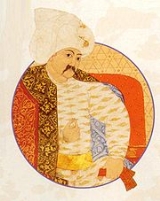
Selim I


   Email Print
   Bookmark   Link


Selim I


Selim I (Ottoman Turkish
Ottoman Turkish language

Ottoman Turkish is the variety of the Turkish language that was used as the administrative and literary language of the Ottoman Empire. It contains extensive borrowings from Arabic language and Persian language languages and was written in a variant of the Arabic script....
: ???? ????, Modern Turkish
Turkish language

Turkish is a language spoken by over 63 million people worldwide, making it the most commonly spoken of the Turkic languages. Its speakers are located predominantly in Turkey and Cyprus, with smaller groups in Iraq, Greece, Bulgaria, the Republic of Macedonia, Kosovo, Albania and other parts of Eastern Europe....
: I.Selim) also known as "the Grim" or "the Brave", or the best translation "the Stern", Yavuz in Turkish
Turkish language

Turkish is a language spoken by over 63 million people worldwide, making it the most commonly spoken of the Turkic languages. Its speakers are located predominantly in Turkey and Cyprus, with smaller groups in Iraq, Greece, Bulgaria, the Republic of Macedonia, Kosovo, Albania and other parts of Eastern Europe....
, the long name is Yavuz Sultan Selim; October 10 1465/1466/1470 September 22, 1520) was the Sultan of the Ottoman Empire
Ottoman Empire

The Ottoman Empire , also known by its contemporaries as the Turkish Empire or Turkey , was an empire that lasted from 1299?1923. It was Treaty of Lausanne by the Republic of Turkey, which was officially proclaimed on October 29, 1923....
 from 1512 to 1520.

Selim's father was Bayezid II and his mother was Valide Sultan
Valide Sultan

Valide Sultan was the title held by the mother of a ruling Sultan in the Ottoman Empire. The Turkish phonology pronunciation of the word Valide, rendered in Help:IPA, is ....
 (1512) Aysha Hatun, from Dulkadir
Dulkadir

The Anatolian Turkish Beyliks of Dulkadir or Dulkadiroglu, with its capital in Kahramanmaras, formerly Maras, was one of the frontier principalities established by Oghuz Turks Turkic peoples clans after the decline of Seljuk Sultanate of R?m....
.

Selim carried the empire to the leadership of the Sunni branch
Sunni Islam

Sunni Islam is the Demographics of Islam Divisions of Islam of Islam. Sunni Islam is also referred to as Ahl as-Sunnah wa?l-Jama?ah or Ahl as-Sunnah for short....
 of Islam by his conquest of the Middle East
Middle East

File:GreaterMiddleEast1.pngThe Middle East is a region that spans southwestern Asia, western Asia, and northeastern Africa. It has no clear boundaries, often used as a synonym to Near East, in opposition to Far East....
.


Discussion
Ask a question about 'Selim I'
Start a new discussion about 'Selim I'
Answer questions from other users
Full Discussion Forum


Encyclopedia


Selim I (Ottoman Turkish
Ottoman Turkish language

Ottoman Turkish is the variety of the Turkish language that was used as the administrative and literary language of the Ottoman Empire. It contains extensive borrowings from Arabic language and Persian language languages and was written in a variant of the Arabic script....
: ???? ????, Modern Turkish
Turkish language

Turkish is a language spoken by over 63 million people worldwide, making it the most commonly spoken of the Turkic languages. Its speakers are located predominantly in Turkey and Cyprus, with smaller groups in Iraq, Greece, Bulgaria, the Republic of Macedonia, Kosovo, Albania and other parts of Eastern Europe....
: I.Selim) also known as "the Grim" or "the Brave", or the best translation "the Stern", Yavuz in Turkish
Turkish language

Turkish is a language spoken by over 63 million people worldwide, making it the most commonly spoken of the Turkic languages. Its speakers are located predominantly in Turkey and Cyprus, with smaller groups in Iraq, Greece, Bulgaria, the Republic of Macedonia, Kosovo, Albania and other parts of Eastern Europe....
, the long name is Yavuz Sultan Selim; October 10 1465/1466/1470 September 22, 1520) was the Sultan of the Ottoman Empire
Ottoman Empire

The Ottoman Empire , also known by its contemporaries as the Turkish Empire or Turkey , was an empire that lasted from 1299?1923. It was Treaty of Lausanne by the Republic of Turkey, which was officially proclaimed on October 29, 1923....
 from 1512 to 1520.

Selim's father was Bayezid II and his mother was Valide Sultan
Valide Sultan

Valide Sultan was the title held by the mother of a ruling Sultan in the Ottoman Empire. The Turkish phonology pronunciation of the word Valide, rendered in Help:IPA, is ....
 (1512) Aysha Hatun, from Dulkadir
Dulkadir

The Anatolian Turkish Beyliks of Dulkadir or Dulkadiroglu, with its capital in Kahramanmaras, formerly Maras, was one of the frontier principalities established by Oghuz Turks Turkic peoples clans after the decline of Seljuk Sultanate of R?m....
.

Selim carried the empire to the leadership of the Sunni branch
Sunni Islam

Sunni Islam is the Demographics of Islam Divisions of Islam of Islam. Sunni Islam is also referred to as Ahl as-Sunnah wa?l-Jama?ah or Ahl as-Sunnah for short....
 of Islam by his conquest of the Middle East
Middle East

File:GreaterMiddleEast1.pngThe Middle East is a region that spans southwestern Asia, western Asia, and northeastern Africa. It has no clear boundaries, often used as a synonym to Near East, in opposition to Far East....
. He represents a sudden change in the expansion policy of the empire
Growth of the Ottoman Empire

During the growth of the Ottoman Empire , the Ottoman Empire expanded southwestwards into North Africa and battled with the re-emergent Persian Shi'ia Safavid Empire to the east....
, which was working mostly against the West
Western world

The term Western world, the West or the Occident can have multiple meanings dependent on its context . Accordingly, the basic definition of what constitutes "the West" varies, expanding and contracting over time, in relation to various historical circumstances....
 and the Beyliks
Anatolian Turkish Beyliks

Image:Anadolu Beylikleri.pngAnatolian Beyliks or Turkmen Beyliks were small Turkey emirates or Muslim principalities governed by Beys, which were founded across Anatolia at the end of the 11th century in a first period, and more extensively during the decline of the Seljuk Sultanate of R?m during the second half of the 13th century....
 before his reign. On the eve of his death in 1520, the Ottoman empire
Ottoman Empire

The Ottoman Empire , also known by its contemporaries as the Turkish Empire or Turkey , was an empire that lasted from 1299?1923. It was Treaty of Lausanne by the Republic of Turkey, which was officially proclaimed on October 29, 1923....
 spanned almost 1 billion acres (trebling during Selim's reign).

Life

Born in Amasya
Amasya

Amasya is the administrative district of Amasya Province in northern Turkey. It covers an area of 1730 km?, and the population is 133,000, of which 74,000 live in the city and the remainder in surrounding villages....
, Selim dethroned his father Bayezid II
Bayezid II

Bayezid II was the Sultan of the Ottoman Empire from 1481 to 1512....
 (1481–1512) in 1512. Bayezid's death followed immediately thereafter. Like his grandfather Mehmed II
Mehmed II

Mehmed II , was Sultan of the Ottoman Empire for a short time from 1444 to September 1446, and later from February 1451 to 1481. At the age of 21, he Fall of Constantinople, bringing an end to the medieval Byzantine Empire....
 (1451–81), Selim put his brothers and nephews to death upon his accession in order to eliminate potential pretenders to the throne. This fratricidal policy was motivated by bouts of civil strife that had been sparked by the antagonism between Selim's father Beyazid and his uncle Cem
Cem

Prince Cem , sometimes called Djem or Jem Sultan, was a pretender to the Ottoman Empire throne in the 15th century. He was a son of Mehmed II the Conqueror and younger brother of Sultan Bayezid II....
, and between Selim himself and his brother Ahmed.

He married Valide Sultan
Valide Sultan

Valide Sultan was the title held by the mother of a ruling Sultan in the Ottoman Empire. The Turkish phonology pronunciation of the word Valide, rendered in Help:IPA, is ....
 (1520) Aishe Hafsa Sultan or Hafsa Hatun Sultan, :tr:Ayse Hafsa Sultan, who died in 1534, mother of Suleiman I.

Conquest of the Middle East

For Selim, one of the first challenges as the Sultan was the conflict between his empire and the powerful Safavid Empire. Shah Ismail
Ismail I

Shah Isma'il Abu'l-Mozaffar bin Sheikh Haydar bin Sheikh Junayd Safawi , was a Shah of Iran and the founder of the Safavids, which survived until 1736....
 was a patron of Shia Islam in the region, a situation which was a threat against the Sunni rulers of the Ottoman Empire. Selim had to eliminate the risk of a westward attack from Iran to Anatolia while he was attacking the Mamluks of Egypt. Therefore, Selim assembled his army and marched to Iran in 1514 and defeated Shah Ismail at the Battle of Chaldiran
Battle of Chaldiran

The Battle of Chaldiran occurred on 23 August 1514 and ended with a decisive victory for the Ottoman Empire over the Safavids. As a result the Ottomans gained control over the north western part of Iran....
. Ottoman army paraded in the capital of the Safavid Empire, Tabriz
Tabriz

Tabriz is the largest city in northwestern Iran. It is situated north of the volcanic cone of Sahand, south of the Eynali mountain. It is the capital of East Azarbaijan Province....
.

Then, Selim attacked and destroyed the Mamluk Sultanate first at the Battle of Marj Dabiq
Battle of Marj Dabiq

The battle of Marj Dabiq was a decisive military clash in History of the Middle East, fought on 24 August 1516, 44 km north of Halab, Syria....
 and then at the Battle of Ridanieh
Battle of Ridanieh

The Battle of Ridaniya was fought on January 22, 1517 in Egypt. The Ottoman Empire Turkish forces of Selim I defeated the Mamluk forces under Al-Ashraf Tuman bay II....
, which led to the annexation of Syria
Syria

Syria , officially the Syrian Arab Republic , is an Arab-majority country in Southwest Asia, bordering Lebanon and the Mediterranean Sea to the west, Israel to the southwest, Jordan to the south, Iraq to the east, and Turkey to the north....
, Palestine
Palestine

Palestine is a name which has been widely used since Roman times to refer to the region between the Mediterranean Sea and the Jordan River. It is derived from a name used already much earlier for a narrower geographical region, mainly along the coastal region....
 and Egypt
Egypt

Egypt is a country mainly in North Africa, with the Sinai Peninsula forming a land bridge in Western Asia. Covering an area of about , Egypt borders the Mediterranean Sea to the north, the Gaza Strip and Israel to the northeast, the Red Sea to the east, Sudan to the south and Libya to the west....
. He also extended Ottoman power to the holy cities of Mecca
Mecca

Mecca , also spelled Makkah , Makka is a city in Saudi Arabia. Home to the Masjid al-Haram, it is the holy city in Islam and plays an important role in the faith....
 and Medina
Medina

Medina is a city in the Hejaz region of western Saudi Arabia, and serves as the capital of the Al Madinah Province. It is the second holiest city in Islam, and the burial place of the Prophet Muhammad....
. Rather than style himself the Hakim ul Haremeyn, or The Ruler of The Two Holy Shrines, he accepted the more pious title Khadim ul Haremeyn, or The Servant of The Two Holy Shrines.

After the conquest of Egypt and the Holy Cities in 1517, Selim induced the vanquished Al-Mutawakkil III
Al-Mutawakkil III

Muhammad al-Mutawakkil III , reigned 1509 to 1516, and again in 1517, was the last caliph of the later, Egyptian-based period of the Abbasid dynasty....
 (1509–17), the last ruler of the Mamluk Sultanate, to formally surrender the title of Caliph
Caliph

The Caliph is the head of state in a Caliphate, and the title for the leader of the Islamic Ummah, an Islamic community ruled by the Shari'ah....
 and its emblems, the sword and the mantle of Muhammad
Muhammad

Muhammad Patronymic#Arabic Abd Allah ibn Abd al Muttalib , is the founder of the Major religious groups of Islam and is regarded by Muslims as a Rasul and prophet of , the last and the greatest law-bearer in a series of prophets....
. These are kept in the Topkapi Palace Museum at Istanbul, Turkey.

Death

After his return from his Egyptian campaign, Selim began to prepare for an expedition which is believed to be against Rhodes
Rhodes

Rhodes is a Greece List of islands of Greece approximately southwest of Turkey in eastern Aegean Sea. It is the largest of the Dodecanese islands in terms of both land area and population, with a population of 117,007 of which 53,709 resided in the Rhodes capital city of the island....
. This campaign was cut short when he was overwhelmed by sickness and subsequently died in the ninth year of his reign. He was about fifty-five years of age. It is said that Selim succumbed to sirpence, a skin infection which he developed during his long campaigns on horseback. (Sirpence was an anthrax
Anthrax

Anthrax is an Acute disease in humans and animals caused by the bacterium Bacillus anthracis, which is highly lethal in some forms. There are effective vaccines against anthrax, and some forms of the disease respond well to antibiotic treatment....
 infection sometimes seen among leatherworkers and others who worked with livestock). Some historians claim that he was poisoned by the doctor tending to his infection and some historians claim that the disease he suffered from was skin cancer
Skin cancer

Skin cancer is a malignant growth on the skin which can have many causes. The most common skin cancers are basal cell cancer, squamous cell cancer, and melanoma....
. He died at Corlu, Edirne
Edirne

Edirne is a city in Thrace, the westernmost part of Turkey, close to the borders with Greece and Bulgaria. It is the capital of Edirne Province and its estimated population in 2002 was 128,400, up from 119,298 in 2000....
.

Titles

After claiming the Caliphate, Selim assumed the title Malik ul-Barreyn, wa Khakan ul-Bahrayn, wa Kasir ul-Jayshayn, wa Khadim ul-Haramayn - that is, King of the Two Lands (continents Europe and Asia), Khagan
Khagan

Khagan or Great Khan , is a title of empire rank in the Turkic languages and Mongolian language languages equal to the status of emperor and someone who rules a Khaganate ....
 of the Two Seas (Mediterranian and Indian Seas), Conqueror of the Two Armies (European and Safavid armies), and Servant of the Two Holy Shrines (Mecca
Mecca

Mecca , also spelled Makkah , Makka is a city in Saudi Arabia. Home to the Masjid al-Haram, it is the holy city in Islam and plays an important role in the faith....
 and Medina
Medina

Medina is a city in the Hejaz region of western Saudi Arabia, and serves as the capital of the Al Madinah Province. It is the second holiest city in Islam, and the burial place of the Prophet Muhammad....
)
. This title alludes to his dominions in Africa and Asia (namely, Egypt, Anatolia, and much of the Fertile Crescent), his control over the Mediterranean and Black seas, his defeat of both the Mamluk and Safavid armies, and his guardianship of the shrines of Mecca and Medina.

Personality

By most accounts, Selim had a fiery temper and full-blooded personality. He seems to have had high expectations of his subordinates, and executed many of his own viziers (one vizier playfully asked for advance notice of his own execution, so that he could put his affairs in order, to which Selim replied that he had indeed been thinking for a while of having him executed but hadn't found a suitable replacement, but that as soon as he did, he would be happy to oblige).

Accordingly, his court was dynamic, with the rewards as great as the risks. He was possibly very energetic and effective, though sometimes cruel, ruler. His reign was short, but may have prepared the Ottoman empire for its zenith under the achievements of his son. A popular legend has it that Selim had filled the royal treasury to the brink and locked it with his own seal. He decreed that "he who will fill the treasury more than this, may use his seal to lock it." The treasury remained locked with Selim's seal until the collapse of the Empire 400 years later.

Selim was also a distinguished poet who wrote both Turkish and Persian verse under the nickname mahlas Selimi; collections of his Persian poetry are extant today. In one of his poems, he wrote;

External links