
All Topics  
Lighthouse of Alexandria

 
Lighthouse of Alexandria

   Email Print
   Bookmark   Link


Lighthouse of Alexandria


The Lighthouse of Alexandria (or The Pharos of Alexandria, Greek
Greek language

Greek is an Indo-European languages native to the southern Balkan peninsula, the language of the Greek people. It forms an independent branch within Indo-European....
: ) was a tower built in the 3rd century BC (between 285 and 247 BC) on the island
Island

An island or isle is any piece of land that is surrounded by water. Very small islands such as emergent land features on atolls are called islets....
 of Pharos in Alexandria
Alexandria

Alexandria , with a population of 4.1 million, is the second-largest city in Egypt, and is the country's largest seaport, serving about 80% of Egypt's imports and exports....
, Egypt
Egypt

Egypt is a country mainly in North Africa, with the Sinai Peninsula forming a land bridge in Western Asia. Covering an area of about , Egypt borders the Mediterranean Sea to the north, the Gaza Strip and Israel to the northeast, the Red Sea to the east, Sudan to the south and Libya to the west....
 to serve as that port's landmark, and later, its lighthouse
Lighthouse

A lighthouse is a tower, building, or framework designed to emit light from a system of lamps and lens or, in older times, from a fire and used as an aid to navigation and to Maritime pilot at sea....
.

With a height variously estimated at between it was among the tallest man-made structures on Earth for many centuries, and was identified as one of the Seven Wonders of the Ancient World
Seven Wonders of the Ancient World

The Seven Wonders of the World is a well known list of seven remarkable constructions of classical antiquity. It was based on guide-books popular among Ancient Greece tourists and only includes works located around the Mediterranean rim....
 by Antipater of Sidon
Antipater of Sidon

Antipater of Sidon , Antipatros or Antipatros Sidonios in the Anthologies, was a Ancient Greece poet in the second half of the 1st century BCE....
. It may have been the third tallest building after the two Great Pyramids (of Khufu
Khufu

Khufu was a Pharaoh of Ancient Egypt's Old Kingdom. He reigned from around 2589 to 2566 B.C. Khufu was the second pharaoh of the Fourth dynasty of Egypt....
 and Khafra
Khafra

Khafra or Khafre *?a?af-ri?u) was an Egyptian pharaoh of the Fourth dynasty of Egypt, who had his capital at Memphis, Egypt. According to some authors he was the son and successor of Khufu, but it is more commonly accepted that Djedefra was Khufu's successor and Khafra was Djedefra's....
) for its entire life.


Discussion
Ask a question about 'Lighthouse of Alexandria'
Start a new discussion about 'Lighthouse of Alexandria'
Answer questions from other users
Full Discussion Forum


Recent Posts


Encyclopedia


The Lighthouse of Alexandria (or The Pharos of Alexandria, Greek
Greek language

Greek is an Indo-European languages native to the southern Balkan peninsula, the language of the Greek people. It forms an independent branch within Indo-European....
: ) was a tower built in the 3rd century BC (between 285 and 247 BC) on the island
Island

An island or isle is any piece of land that is surrounded by water. Very small islands such as emergent land features on atolls are called islets....
 of Pharos in Alexandria
Alexandria

Alexandria , with a population of 4.1 million, is the second-largest city in Egypt, and is the country's largest seaport, serving about 80% of Egypt's imports and exports....
, Egypt
Egypt

Egypt is a country mainly in North Africa, with the Sinai Peninsula forming a land bridge in Western Asia. Covering an area of about , Egypt borders the Mediterranean Sea to the north, the Gaza Strip and Israel to the northeast, the Red Sea to the east, Sudan to the south and Libya to the west....
 to serve as that port's landmark, and later, its lighthouse
Lighthouse

A lighthouse is a tower, building, or framework designed to emit light from a system of lamps and lens or, in older times, from a fire and used as an aid to navigation and to Maritime pilot at sea....
.

With a height variously estimated at between it was among the tallest man-made structures on Earth for many centuries, and was identified as one of the Seven Wonders of the Ancient World
Seven Wonders of the Ancient World

The Seven Wonders of the World is a well known list of seven remarkable constructions of classical antiquity. It was based on guide-books popular among Ancient Greece tourists and only includes works located around the Mediterranean rim....
 by Antipater of Sidon
Antipater of Sidon

Antipater of Sidon , Antipatros or Antipatros Sidonios in the Anthologies, was a Ancient Greece poet in the second half of the 1st century BCE....
. It may have been the third tallest building after the two Great Pyramids (of Khufu
Khufu

Khufu was a Pharaoh of Ancient Egypt's Old Kingdom. He reigned from around 2589 to 2566 B.C. Khufu was the second pharaoh of the Fourth dynasty of Egypt....
 and Khafra
Khafra

Khafra or Khafre *?a?af-ri?u) was an Egyptian pharaoh of the Fourth dynasty of Egypt, who had his capital at Memphis, Egypt. According to some authors he was the son and successor of Khufu, but it is more commonly accepted that Djedefra was Khufu's successor and Khafra was Djedefra's....
) for its entire life. Some scholars estimate that would make the tower the tallest building up to the 14th century.

History

Pharos was a small island just off the coast of Alexandria. It was linked to the mainland by a man-made connection named the Heptastadion
Heptastadion

The Heptastadion was a giant causeway, often referred to as a mole or a dyke built by the people of Alexandria, Egypt during the Ptolemaic period....
, which thus formed one side of the city's harbor. As the Egyptian coast is very flat and lacking in the kind of landmark used at the time for navigation
Navigation

Navigation is the process of reading, and controlling the movement of a craft or vehicle from one place to another. It is also the term of art used for the specialized knowledge used by navigators to perform navigation tasks....
, a marker of some sort at the mouth of the harbour was deemed necessary—a function the Pharos was initially designed to serve. Use of the building as a lighthouse, with a fire and reflective mirrors at the top, is thought to date to around the 1st century AD, during the Roman period. Prior to that time the Pharos served solely as a landmark or day beacon
Day beacon

A day beacon is an unlighted nautical sea mark. Typically, day beacons supplement channel whose key points are marked by lighted buoys. Day beacons may also mark smaller navigable routes in their entirety....
.

Construction and destruction

The lighthouse was completed in the 3rd century B.C., after having been initiated by Satrap
Satrap

Satrap was the name given to the governors of the provinces of ancient Medes and Persian Empire empires, including the Achaemenid Empire and in several of their heirs, such as the Sassanid Empire and the Hellenistic civilization empires....
 (governor) Ptolemy I Soter
Ptolemy I Soter

Ptolemy I Soter was a Macedonian general under Alexander the Great who became ruler of Egypt and founder of both the Ptolemaic Kingdom and the Ptolemaic Dynasty....
, Egypt's first Macedonian ruler and a general of Alexander the Great
Alexander the Great

Alexander the Great , also known as Alexander III of Macedon was an ancient Greeks King of Macedon . He was one of the most successful military commanders of all time and is presumed undefeated in battle....
. After Alexander died unexpectedly at age 32, Ptolemy Soter (Saviour, named so by the inhabitants of Rhodes) made himself king in 305 B.C. and ordered the construction of the Pharos shortly thereafter. The building was finished during the reign of his son, Ptolemy Philadelphos
Ptolemy II Philadelphus

Ptolemy II Philadelphus , was the king of Ptolemaic Egypt from 283 BC to 246 BC. He was the son of the founder of the Ptolemaic kingdom Ptolemy I Soter and Berenice I of Egypt, and was educated by Philitas of Cos....
.

According to legend, Sostratus
Sostratus of Cnidus

Sostratus of Knidos , was a Greeks architect and engineer. He designed the lighthouse of Alexandria, one of the Seven Wonders of the World , on the island of Pharos off Alexandria, Egypt....
 was forbidden by Ptolemy from putting his name on his work. But the architect
Architect

An architect is trained and licenced in planning and designing buildings, and participates in supervising the construction of a building. Etymologically, architect derives from the Latin architectus, itself derived from the Greek arkhitekton , i.e....
 left the following inscription on the base's walls nonetheless: "Sostratus, the son of Dexiphanes, the Cnidian, dedicated (or erected) this to the Saviour gods, on behalf of those who sail the seas"; the original Greek inscription "S?S?????S ????F???? ??????S T???S SO???S?? ???? ?O? ??O??????O?" literally means: "Sostratos of Dexiphanes [meaning: son of Dexiphanes] the Cnidian to Saviour Gods for the seafarers (or seafaring [ones])". These words were hidden under a layer of plaster, on top of which was chiseled another inscription honoring Ptolemy the king as builder of the Pharos. After centuries the plaster wore away, revealing the name of Sostratus.

The lighthouse was badly damaged in the earthquake of 956, then again in 1303 and 1323. The fullest description of it comes from the Arab traveler Abou Haggag Youssef Ibn Mohammed el-Andaloussi who visited the structure as a tourist in 1166. His description runs:
"The Pharos rises at the end of the island. The building is square, about 8.5m [just under 28 feet] each side. The sea surrounds the Pharos except on the east and south sides. This platform measures, along its sides, from the tip up to the foot of the Pharos walls, 6.5m [a little over 21 feet] in height. However, on the sea side, it is larger because of the construction and is steeply inclined like the side of a mountain. As the height of the platform increases towards the walls of the Pharos its width narrows until it arrives at the measurements above.

On this side it is strongly built, the stones being well shaped and laid along with a rougher finish than elsewhere on the building. This part of the building that I have just described is recent because on this side the ancient work needed to be replaced.

On the seaward south side, there is an ancient inscription which I cannot read; it is not a proper inscription because the forms of the letters are carried out in hard black stone. The combination of the sea and the air has worn away the background stone and the letters stand out in relief because of their harshness. The A measures a little over 54cm [slight more than 21 inches]. The top of the M stands out like a huge hole in a copper boiler. The other letters are generally of the same size. The doorway to the Pharos is high up. A ramp about 183m [600 feet] long used to lead up to it. This ramp rests on a series of curved arches; my companion got beneath one of the arches and stretched out his arms but he was not able to reach the sides. There are 16 of these arches, each gradually getting higher until the doorway is reached, the last one being especially high."


The el-Andaloussi description of the dimensions does not appear to match the Thiersch drawing, the classic painting, or the graphic reconstruction, all of which show buildings with a footprint that would have been at least 80 x 80 feet, based on the scale of surrounding objects.

There are ancient claims the light from the lighthouse could be seen from up to away. Unconfirmed legend
Legend

A legend is a narrative of human actions that are perceived both by teller and listeners to take place within human history and to possess certain qualities that give the tale verisimilitude ....
s claim the light from Pharos could burn enemy ships before they reached shore.

Constructed from large block
Block

selfref|For Wikipedia's use of blocks, please see the...
s of light-coloured stone
Masonry

Masonry is the building of structures from individual units laid in and bound together by mortar , and the term "masonry" can also refer to the units themselves....
, the tower
Tower

Towers are tall human-made structures that are always taller than they are wide, usually by a significant margin. Towers are generally built to take advantage of their height, and can stand alone or as part of a larger structure....
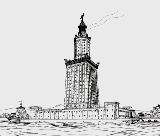
 was made up of three stages: a lower square section with a central core, a middle octagonal section, and, at the top, a circular section. At its apex was positioned a mirror
Mirror

A mirror is an object with one surface polished, which leads to reflection and another opaque. The most familiar type of mirror is the plane mirror, which has a flat surface....
 which reflected sunlight
Sunlight

Sunlight, in the broad sense, is the total spectroscopy of the electromagnetic radiation given off by the Sun. On Earth, sunlight is Filter ed through the Earth's atmosphere, and the solar radiation is obvious as daylight when the Sun is above the horizon....
 during the day; a fire
Fire

Fire is the oxidation of a combustion material releasing heat, light, and various Chemical reaction products such as carbon dioxide and water....
 was lit at night. Extant Roman coins struck by the Alexandrian mint show that a statue of a triton
Triton (mythology)

Triton is a mythological Greek mythology, the messenger of the deep. He is the son of Poseidon, god of the sea, and Amphitrite, goddess of the sea....
 was positioned on each of the building's four corners. A statue of Poseidon
Poseidon

In Greek mythology, Poseidon was the god of the sea and, as "Earth-Shaker," of earthquakes. The name of the god Nethuns in Etruscan mythology was adopted in Latin for Neptune in Roman mythology: both were sea gods analogous to Poseidon....
 stood atop the tower during the Roman period.
Pharos of Alexandria
The Pharos' walls were strengthened in order to withstand the pounding of the waves through the use of molten lead to hold its masonry together, and possibly as a result the building survived the longest of the Seven Wonders—with the sole exception of the Great Pyramid of Giza
Great Pyramid of Giza

The Great Pyramid of Giza, also called Khufu's Pyramid or the Pyramid of Khufu, and Pyramid of Cheops, is the oldest and largest of the three Egyptian pyramidss in the Giza Necropolis bordering what is now Cairo , Egypt, and is the only remaining member of the Seven Wonders of the Ancient World....
. It was still standing when the Muslim
Muslim

:A Muslim , , is an adherent of the religion of Islam. The feminine form is Muslimah . Literally, the word means "one who submits "....
 traveller Ibn Jubayr
Ibn Jubayr

Ibn Jubayr was a geography, traveler and poet from al-Andalus....
 visited the city in 1183. He said of it that: "Description of it falls short, the eyes fail to comprehend it, and words are inadequate, so vast is the spectacle." It appears that in his time, there was a church located on the top.

The two earthquake
Earthquake

An earthquake is the result of a sudden release of energy in the Earth's crust that creates seismic waves. Earthquakes are recorded with a seismometer, also known as a seismograph....
s in 1303 and 1323, damaged the lighthouse to the extent that the Arab traveler Ibn Battuta
Ibn Battuta

Ibn Battuta was a Muslim Berber, scholar and traveller who is known for the account of his travels and excursions called the Rihla. His journeys lasted for a period of nearly thirty years and covered almost the entirety of the known Muslim world and beyond, extending from North Africa, West Africa, Southern Europe and Eastern Europe in t...
 reported no longer being able to enter the ruin. Even the stubby remnant disappeared in 1480, when the then-Sultan of Egypt, Qaitbay
Qaitbay

Al-Ashraf Sayf al-Din Qa'it Bay was the eighteenth Burji dynasty Mamluk Sultan of Egypt from 872-901 Islamic calendar . He was Circassian by birth, and was purchased by the ninth sultan Barsbay before being freed by the eleventh sultan az-Zahir Sayf-ad-Din Jaqmaq ....
, built a medieval fort on the former location of the building, using some of the fallen stone. The remnants of the Pharos that were incorporated into the walls of Fort Qaitbey
Citadel of Qaitbay

The Citadel of Qaitbay is a 15th century defensive fortress located on the Mediterranean sea coast, built upon/from the ruins of the Lighthouse of Alexandria, in Alexandria, Egypt....
 are clearly visible due to their excessive size in comparison to surrounding masonry.

The fate of the Lighthouse of Alexandria from the Arab conquest until its collapse in the 14th century has been investigated by Doris Behrens-Abouseif in her article "The Islamic History of the Lighthouse of Alexandria" (in: Muqarnas XXIII [2006], pp. 1-14).

Recent archaeological research

Some remains of the lighthouse were found on the floor of Alexandria's Eastern Harbour by divers in fall of 1994. More of the remains have subsequently been revealed by satellite imaging.

A Nova
NOVA (TV series)

Nova is a popular science television series from the United States produced by WGBH-TV Boston. It can be seen on the Public Broadcasting Service in the United States, and in more than 100 other countries....
 program chronicled the underwater discovery of the fabled Pharos lighthouse. It is possible to go diving and see the ruins.

Significance

Pharos became the etymological origin of the word 'lighthouse' in Greek
Greek language

Greek is an Indo-European languages native to the southern Balkan peninsula, the language of the Greek people. It forms an independent branch within Indo-European....
 (f????), Bulgarian
Bulgarian language

Bulgarian is an Indo-European languages, a member of the Slavic languages linguistic group.Bulgarian demonstrates several linguistic innovations that set it apart from all other Slavic languages except Macedonian language, such as the elimination of grammatical case, the development of a suffixed definite article , the lack of a verb infin...
 (???) and many Romance languages
Romance languages

The Romance languages are a branch of the Indo-European languages comprising all the languages that descend from Latin language, the language of ancient Rome....
, such as French
French language

French is a Romance language spoken around the world by around 80 million people as first language, by 190 million as second language, and by about another 200 million people as an acquired tongue, with significant speakers in 54 countries....
 (phare), Italian
Italian language

Italian is a Romance languages spoken by about 63 million people as a first language, primarily in Italy. In Switzerland, Italian is one of four Linguistic geography of Switzerlands....
 (faro), Portuguese
Portuguese language

Portuguese is a Romance language that originated in what is now Galicia and Portugal. It is derived from the Latin language spoken by the Romanization Pre-Roman peoples of the Iberian Peninsula around 2000 years ago....
 (farol), Spanish
Spanish language

Spanish or Castilian is a Romance languages that originated in northern Spain, and gradually spread in the Kingdom of Castile and evolved into the principal language of government and trade....
 (faro), Romanian
Romanian language

Romanian or Daco-Romanian ; self-designation: limba rom?na, ) is a Romance languages spoken by around 24 to 28 million people, primarily in Romania and Moldova....
, and Catalan
Catalan language

Catalan is a Romance languages, the national language and official language of Andorra, and a official language in the Autonomous Communities of Spain of the Balearic Islands, Catalonia and Valencian Community and in the city of Alghero in the Italy List of islands in the Mediterranean of Sardinia....
 (far).

The design of minaret
Minaret

Minarets are distinctive architectural features of Islamic mosques. Minarets are generally tall spires with onion dome, usually either free standing or much taller than any surrounding support structure....
s in many early Egyptian Islam
Islam

Islam is a Monotheism, Abrahamic religion originating with the teachings of the Prophets of Islam Muhammad, a 7th century Arab religious and political figure....
ic mosque
Mosque

A mosque is a place of worship for followers of Islam. Muslims often refer to the mosque by its Arabic name, masjid, ? . The word "mosque" in English refers to all types of buildings dedicated for Islamic worship, although there is a distinction in Arabic between the smaller, privately owned mosque and the larger, "collective" mosque ,...
s followed a similar three-stage design to that of the Pharos, attesting to the building's broader architectural influence.

Pharos in culture


In architecture

  • A well-preserved ancient tomb in the town of Abu Qir
    Abu Qir

    Abu Qir is a village on the Mediterranean coast of Egypt, 23 kilometers northeast of Alexandria by rail, containing a castle used as a state prison by Muhammad Ali of Egypt....
    , east of Alexandria, is thought to be a scaled-down model of the Alexandria Pharos. Known colloquially under various names—the Pharos of Abuqir, the Abuqir funerary monument and Burg al-Arab (Arab's Tower)—it consists of a 3-story tower, approximately in height, with a square base, a hexagonal midsection and cylindrical upper section, like the building upon which it was apparently modeled. It dates to the reign of Ptolemy II (285-246 BC), and is therefore likely to have been built at about the same time as the Alexandria Pharos.
  • The Tower of Hercules
    Tower of Hercules

    The Tower of Hercules is an ancient Rome lighthouse on a peninsula about 2.4 kilometers from the centre of La Coru?a, Galicia , in north-western Spain....
    , near A Coruña
    A Coruña

    A Coru?a is the second largest city in Galicia in northwestern Spain, second only in size to the port of Vigo in the Pontevedra . The city is also the capital of A Coru?a and it was the capital of Galicia from the year 1563 to 1982 when it moved to Santiago de Compostela....
     in Spain
    Spain

    Spain or the Kingdom of Spain , is a country located in Southern Europe on the Iberian Peninsula.The Spanish constitution does not establish any official denomination of the country, even though Espa?a , Estado espa?ol and Naci?n espa?ola are used interchangeably....
    , a 2nd century AD Roman
    Ancient Rome

    Ancient Rome was a civilization that grew out of a small agricultural community founded on the Italian Peninsula as early as the 10th century BC....
     lighthouse, is closely modelled on the Alexandrian Pharos.
  • A replica of the Lighthouse of Alexandria was constructed in the Window of the World
    Window of the World

    The Window of the World is a theme park located in the western part of the city of Shenzhen in the People's Republic of China. It has about 130 reproductions of some of the most famous tourist attractions in the world squeezed into 48 hectares....
     Cultural Park in Shenzhen
    Shenzhen

    Shenzhen is a city of sub-provincial city administrative status in southern China's Guangdong province, situated immediately north of Hong Kong....
    , China
    China

    China is a Culture of China, an ancient civilization, and, depending on perspective, a national or multinational entity extending over a large area in East Asia....
    .
  • The design of the George Washington Masonic National Memorial
    George Washington Masonic National Memorial

    George Washington Masonic National Memorial is a Masonic Lodge and memorial dedicated to the memory of George Washington, the first president of the United States of America and a Freemasonry....
     in Alexandria, Virginia
    Alexandria, Virginia

    Alexandria is an independent city in the Commonwealth of Virginia. As of the United States Census 2000, the city had a total population of 128,283....
     was partially inspired by the Lighthouse of Alexandria.


In books

Matthew Reilly
Matthew Reilly (writer)

Matthew John "Matt" Reilly is an Australian action thriller writer. His novels are noted for their fast pace, plot convolutions and intense action....
 uses this ancient wonder as the location of a piece of the golden capstone in his novel that states in the cultural section from Book 2 of the Cambridge Latin Course
Cambridge Latin Course

The Cambridge Latin Course is a series of textbooks published by Cambridge University Press, used to teach Latin to high school students. First published in 1970, the series is now in its fifth edition, and has sold over 3.5 million copies....
, the Pharos of Alexandria is mentioned, along with the history of Alexandria, as one of the greatest international ports of the ancient world.

See also

  • Knidos
    Knidos

    Cnidus or Knidos was an ancient Greece city in Anatolia, part of the Dorian Hexapolis. It was situated at the extremity of the long Dat?a peninsula, which forms the southern side of the Sinus Ceramicus or Gulf of G?kova....
  • List of buildings and structures
  • List of disasters
    List of disasters

    * List of accidents and disasters by death toll lists accidental man-made disasters.* List of natural disasters by death toll lists disasters caused by other forces of nature....
  • List of lighthouses and lightvessels
    List of lighthouses and lightvessels

    The list of lighthouses and lightvessels is a link page for any lighthouse or lightvessel anywhere in the world....