


E. M. Forster

Encyclopedia
Edward Morgan Forster OM
, CH
(1 January 18797 June 1970) was an English novelist, short story writer, essayist and librettist. He is known best for his ironic and well-plotted novels examining class
difference and hypocrisy in early 20th-century British society. Forster's humanistic
impulse toward understanding and sympathy may be aptly summed up in the epigraph
to his 1910 novel Howards End
: "Only connect."
. He inherited £8,000 (£ as of ), from his paternal great-aunt Marianne Thornton (daughter of the abolitionist Henry Thornton
), who died on 5 November 1887. The money was enough to live on and enabled him to become a writer. He attended the famous public school Tonbridge School
in Kent as a day boy. The theatre at the school is named after him.
At King's College, Cambridge
, between 1897 and 1901, he became a member of a discussion society known as the Apostles
(formally named the Cambridge Conversazione Society). Many of its members went on to constitute what came to be known as the Bloomsbury Group
, of which Forster was a peripheral member in the 1910s and 1920s. There is a famous recreation of Forster's Cambridge at the beginning of The Longest Journey
.
After leaving university he travelled in continental Europe with his mother. He visited Egypt
, Germany and India with the classicist Goldsworthy Lowes Dickinson
in 1914. By that time, Forster had written all but one of his novels. In the First World War, as a conscientious objector
, he volunteered for the International Red Cross, travelling to Alexandria
, Egypt.
Forster spent a second spell in India in the early 1920s as the private secretary to Tukojirao III
, the Maharajah of Dewas
. The Hill of Devi
is his non-fictional account of this trip. After returning from India, he completed his last novel, A Passage to India
(1924), for which he won the James Tait Black Memorial Prize
for fiction. He also edited the graphic letters from India of Eliza Fay
(1756–1816).
 In the 1930s and 1940s Forster became a successful broadcaster on BBC Radio
and a public figure associated with the Union of Ethical Societies
. He was awarded a Benson Medal
in 1937.
Forster was a humanist, homosexual, lifelong bachelor. Forster developed a long-term loving relationship with Bob Buckingham, a married policeman (his wife's name was May), and included the couple in his circle, which also included the writer and arts editor of The Listener, J.R. Ackerley, the psychologist W. J. H. Sprott
, and, for a time, the composer Benjamin Britten
. Other writers with whom Forster associated included the poet Siegfried Sassoon
and the Belfast
-based novelist Forrest Reid
.
From 1925 until Forster's mother's death at age 90 on 11 March 1945, he lived with her at West Hackhurst, Abinger Hammer
, finally leaving on or around 23 September 1946. His London base was 26 Brunswick Square
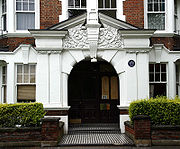
from 1930 to 1939, after which he rented 9 Arlington Park Mansions in Chiswick until at least 1961.
Forster was elected an honorary fellow
of King's College, Cambridge
in January 1946, and lived for the most part in the college, doing relatively little. He declined a knighthood in 1949 and was made a Companion of Honour in 1953. In 1969 he was made a member of the Order of Merit. Forster died of a stroke in Coventry on 7 June 1970 at the age of 91, at the home of the Buckinghams.
appeared shortly after his death, it had been written nearly sixty years earlier. A seventh novel, Arctic Summer, was never finished.
His first novel, Where Angels Fear to Tread
(1905), is the story of Lilia, a young English widow who falls in love with an Italian man, and of the efforts of her bourgeois relatives to get her back from Monteriano
(based on San Gimignano
). The mission of Philip Herriton to retrieve her from Italy has features in common with that of Lambert Strether
in Henry James
's The Ambassadors
, a work Forster discussed ironically and somewhat disapprovingly in his book Aspects of the Novel (1927). Where Angels Fear to Tread was adapted into a film by Charles Sturridge
in 1991.
Next, Forster published The Longest Journey
(1907), an inverted bildungsroman
following the lame Rickie Elliott from Cambridge to a career as a struggling writer and then to a post as a schoolmaster, married to the unappetising Agnes Pembroke. In a series of scenes on the hills of Wiltshire which introduce Rickie's wild half-brother Stephen Wonham, Forster attempts a kind of sublime
related to those of Thomas Hardy
and D. H. Lawrence
.
Forster's third novel, A Room with a View
(1908), is his lightest and most optimistic. It was started before any of his others, as early as 1901, and exists in earlier forms referred to as "Lucy". The book is the story of young Lucy Honeychurch's trip to Italy with her cousin, and the choice she must make between the free-thinking George Emerson and the repressed aesthete Cecil Vyse. George's father Mr Emerson quotes thinkers who influenced Forster, including Samuel Butler. A Room with a View
was filmed by Merchant-Ivory in 1985.
Where Angels Fear to Tread and A Room with a View can be seen collectively as Forster's Italian novels. Both include references to the famous Baedeker
guidebooks and concern narrow-minded middle-class English tourists abroad. The books share many themes with short stories collected in The Celestial Omnibus
and The Eternal Moment
.
Howards End (1910) is an ambitious "condition-of-England" novel concerned with different groups within the Edwardian middle classes represented by the Schlegels (bohemian intellectuals), the Wilcoxes (thoughtless plutocrats) and the Basts (struggling lower-middle-class aspirants).
It is frequently observed that characters in Forster's novels die suddenly. This is true of Where Angels Fear to Tread, Howards End and, most particularly, The Longest Journey.
Forster achieved his greatest success with A Passage to India
(1924). The novel takes as its subject the relationship between East and West, seen through the lens of India in the later days of the British Raj
. Forster connects personal relationships with the politics of colonialism through the story of the Englishwoman Adela Quested, the Indian Dr. Aziz, and the question of what did or did not happen between them in the Marabar Caves. Forster makes special mention of Ahmed Ali
and his Twilight in Delhi in his Preface to its Everyman's Library Edition.
Maurice
(1971) was published posthumously. It is a homosexual love story which also returns to matters familiar from Forster's first three novels, such as the suburbs of London in the English home counties
, the experience of attending Cambridge, and the wild landscape of Wiltshire
. The novel was controversial, given that Forster's sexuality had not been previously known or widely acknowledged. Today's critics continue to argue over the extent to which Forster's sexuality, even his personal activities, influenced his writing.
E. M. Forster: A Study, which began:
are at the heart of his work, which often depicts the pursuit of personal connections in spite of the restrictions of contemporary society. His humanist attitude is expressed in the non-fictional essay What I Believe
.
Forster's two best-known works, A Passage to India and Howards End, explore the irreconcilability of class differences. A Room with a View
also shows how questions of propriety and class can make connection difficult. The novel is his most widely read and accessible work, remaining popular long after its original publication. His posthumous novel Maurice
explores the possibility of class reconciliation as one facet of a homosexual relationship.
Sexuality is another key theme in Forster's works, and it has been argued that a general shift from heterosexual love to homosexual love can be detected over the course of his writing career. The foreword to Maurice describes his struggle with his own homosexuality, while similar issues are explored in several volumes of homosexually charged short stories. Forster's explicitly homosexual writings, the novel Maurice
and the short-story collection The Life to Come
, were published shortly after his death.
Forster is noted for his use of symbol
ism as a technique in his novels, and he has been criticised (as by his friend Roger Fry
) for his attachment to mysticism
. One example of his symbolism is the wych elm
tree in Howards End; the characters of Mrs Wilcox in that novel and Mrs Moore in A Passage to India have a mystical link with the past and a striking ability to connect with people from beyond their own circles.
Sources (plain text and HTML)
LGBT
Order of Merit
The Order of Merit is a British dynastic order recognising distinguished service in the armed forces, science, art, literature, or for the promotion of culture...
, CH
Order of the Companions of Honour
The Order of the Companions of Honour is an order of the Commonwealth realms. It was founded by King George V in June 1917, as a reward for outstanding achievements in the arts, literature, music, science, politics, industry or religion....
(1 January 18797 June 1970) was an English novelist, short story writer, essayist and librettist. He is known best for his ironic and well-plotted novels examining class
Social class
Social classes are economic or cultural arrangements of groups in society. Class is an essential object of analysis for sociologists, political scientists, economists, anthropologists and social historians. In the social sciences, social class is often discussed in terms of 'social stratification'...
difference and hypocrisy in early 20th-century British society. Forster's humanistic
Humanism
Humanism is an approach in study, philosophy, world view or practice that focuses on human values and concerns. In philosophy and social science, humanism is a perspective which affirms some notion of human nature, and is contrasted with anti-humanism....
impulse toward understanding and sympathy may be aptly summed up in the epigraph
Epigraph (literature)
In literature, an epigraph is a phrase, quotation, or poem that is set at the beginning of a document or component. The epigraph may serve as a preface, as a summary, as a counter-example, or to link the work to a wider literary canon, either to invite comparison or to enlist a conventional...
to his 1910 novel Howards End
Howards End
Howards End is a novel by E. M. Forster, first published in 1910, which tells a story of class struggle in turn-of-the-century England. The main theme is the difficulties, troubles, and also the benefits of relationships between members of different social classes...
: "Only connect."
Early years
Forster was born into an Anglo-Irish and Welsh middle-class family at 6 Melcombe Place, Dorset Square, London NW1, in a building that no longer exists. He was the only child of Edward Morgan Llewellyn Forster, an architect, and Alice Clara "Lily" (née Whichelo). His name was officially registered as Henry Morgan Forster, but at his baptism he was accidentally named Edward Morgan Forster. To distinguish him from his father, he was always called Morgan thereafter. His father died of consumption on 30 October 1880, before Morgan's 2nd birthday. Among Forster's ancestors were members of the Clapham SectClapham Sect
The Clapham Sect or Clapham Saints were a group of influential like-minded Church of England social reformers based in Clapham, London at the beginning of the 19th century...
. He inherited £8,000 (£ as of ), from his paternal great-aunt Marianne Thornton (daughter of the abolitionist Henry Thornton
Henry Thornton (abolitionist)
Henry Thornton was an English economist, banker, philanthropist and parliamentarian.-Early life:He was the son of John Thornton of Clapham, London, who had been one of the early patrons of the evangelical movement in Britain...
), who died on 5 November 1887. The money was enough to live on and enabled him to become a writer. He attended the famous public school Tonbridge School
Tonbridge School
Tonbridge School is a British boys' independent school for both boarding and day pupils in Tonbridge, Kent, founded in 1553 by Sir Andrew Judd . It is a member of the Eton Group, and has close links with the Worshipful Company of Skinners, one of the oldest London livery companies...
in Kent as a day boy. The theatre at the school is named after him.
At King's College, Cambridge
King's College, Cambridge
King's College is a constituent college of the University of Cambridge, England. The college's full name is "The King's College of our Lady and Saint Nicholas in Cambridge", but it is usually referred to simply as "King's" within the University....
, between 1897 and 1901, he became a member of a discussion society known as the Apostles
Cambridge Apostles
The Cambridge Apostles, also known as the Cambridge Conversazione Society, is an intellectual secret society at the University of Cambridge founded in 1820 by George Tomlinson, a Cambridge student who went on to become the first Bishop of Gibraltar....
(formally named the Cambridge Conversazione Society). Many of its members went on to constitute what came to be known as the Bloomsbury Group
Bloomsbury Group
The Bloomsbury Group or Bloomsbury Set was a group of writers, intellectuals, philosophers and artists who held informal discussions in Bloomsbury throughout the 20th century. This English collective of friends and relatives lived, worked or studied near Bloomsbury in London during the first half...
, of which Forster was a peripheral member in the 1910s and 1920s. There is a famous recreation of Forster's Cambridge at the beginning of The Longest Journey
The Longest Journey (novel)
The Longest Journey is a bildungsroman by E. M. Forster.-Plot summary:Rickie Elliot is a student at early 20th century Cambridge, a university that seems like paradise to him, amongst bright if cynical companions, when he receives a visit from two friends, an engaged young woman, Agnes Pembroke,...
.
After leaving university he travelled in continental Europe with his mother. He visited Egypt
Egypt
Egypt , officially the Arab Republic of Egypt, Arabic: , is a country mainly in North Africa, with the Sinai Peninsula forming a land bridge in Southwest Asia. Egypt is thus a transcontinental country, and a major power in Africa, the Mediterranean Basin, the Middle East and the Muslim world...
, Germany and India with the classicist Goldsworthy Lowes Dickinson
Goldsworthy Lowes Dickinson
Goldsworthy Lowes Dickinson , was a British historian and political activist. He led most of his life at Cambridge, where he wrote a dissertation on Neoplatonism before becoming a fellow. He was closely associated with the Bloomsbury Group.A noted pacifist, Dickinson protested against Britain's...
in 1914. By that time, Forster had written all but one of his novels. In the First World War, as a conscientious objector
Conscientious objector
A conscientious objector is an "individual who has claimed the right to refuse to perform military service" on the grounds of freedom of thought, conscience, and/or religion....
, he volunteered for the International Red Cross, travelling to Alexandria
Alexandria
Alexandria is the second-largest city of Egypt, with a population of 4.1 million, extending about along the coast of the Mediterranean Sea in the north central part of the country; it is also the largest city lying directly on the Mediterranean coast. It is Egypt's largest seaport, serving...
, Egypt.
Forster spent a second spell in India in the early 1920s as the private secretary to Tukojirao III
Tukojirao III
Tukojirao III was the ruling Maharaja of the princely state of Dewas from 1900 to 1937. He succeeded to the gadi of Dewas following the death of his uncle, Raja Krishnajirao II. The first Maharaja of Dewas, he was granted the title by the British Government on his thirtieth birthday in 1918...
, the Maharajah of Dewas
Dewas
Dewas is an ancient town situated on the Malwa plateau in the West-central part of Indian state called Madhya Pradesh, about 160 km south west from state capital, Bhopal. It is the administrative center of the Dewas District, and was formerly the seat of two princely states during the British...
. The Hill of Devi
The Hill of Devi
The Hill of Devi is an account by E. M. Forster of two visits to India in 1912-1913 and 1921, during which he worked as the private secretary to the Maharaja of the state of Dewas Senior. The book was first published in 1953.E. M...
is his non-fictional account of this trip. After returning from India, he completed his last novel, A Passage to India
A Passage to India
A Passage to India is a novel by E. M. Forster set against the backdrop of the British Raj and the Indian independence movement in the 1920s. It was selected as one of the 100 great works of English literature by the Modern Library and won the 1924 James Tait Black Memorial Prize for fiction. Time...
(1924), for which he won the James Tait Black Memorial Prize
James Tait Black Memorial Prize
Founded in 1919, the James Tait Black Memorial Prizes are among the oldest and most prestigious book prizes awarded for literature written in the English language and are Britain's oldest literary awards...
for fiction. He also edited the graphic letters from India of Eliza Fay
Eliza Fay
Eliza Fay was an English letter-writer and traveller.-Early life:...
(1756–1816).
After A Passage to India
BBC Radio
BBC Radio is a service of the British Broadcasting Corporation which has operated in the United Kingdom under the terms of a Royal Charter since 1927. For a history of BBC radio prior to 1927 see British Broadcasting Company...
and a public figure associated with the Union of Ethical Societies
British Humanist Association
The British Humanist Association is an organisation of the United Kingdom which promotes Humanism and represents "people who seek to live good lives without religious or superstitious beliefs." The BHA is committed to secularism, human rights, democracy, egalitarianism and mutual respect...
. He was awarded a Benson Medal
Benson Medal
The Benson Medal is a medal awarded by the Royal Society of Literature in the UK.It was founded in 1916 by A. C. Benson who was a Fellow of the Society, to honour those who produce "meritorious works in poetry, fiction, history and belles-lettres."...
in 1937.
Forster was a humanist, homosexual, lifelong bachelor. Forster developed a long-term loving relationship with Bob Buckingham, a married policeman (his wife's name was May), and included the couple in his circle, which also included the writer and arts editor of The Listener, J.R. Ackerley, the psychologist W. J. H. Sprott
W. J. H. Sprott
Walter John Herbert Sprott, known to friends as ‘Sebastian’ Sprott, and also known as Jack Sprott was a British psychologist and writer....
, and, for a time, the composer Benjamin Britten
Benjamin Britten
Edward Benjamin Britten, Baron Britten, OM CH was an English composer, conductor, and pianist. He showed talent from an early age, and first came to public attention with the a cappella choral work A Boy Was Born in 1934. With the premiere of his opera Peter Grimes in 1945, he leapt to...
. Other writers with whom Forster associated included the poet Siegfried Sassoon
Siegfried Sassoon
Siegfried Loraine Sassoon CBE MC was an English poet, author and soldier. Decorated for bravery on the Western Front, he became one of the leading poets of the First World War. His poetry both described the horrors of the trenches, and satirised the patriotic pretensions of those who, in Sassoon's...
and the Belfast
Belfast
Belfast is the capital of and largest city in Northern Ireland. By population, it is the 14th biggest city in the United Kingdom and second biggest on the island of Ireland . It is the seat of the devolved government and legislative Northern Ireland Assembly...
-based novelist Forrest Reid
Forrest Reid
Forrest Reid was an Irish novelist, literary critic and translator. He was, along with Hugh Walpole and J.M. Barrie, a leading pre-war British novelist of boyhood...
.
From 1925 until Forster's mother's death at age 90 on 11 March 1945, he lived with her at West Hackhurst, Abinger Hammer
Abinger Hammer
Abinger Hammer is a village situated on the A25 between Dorking and Guildford in Surrey, England. It lies with the parish of Abinger which includes Abinger Common and Sutton Abinger...
, finally leaving on or around 23 September 1946. His London base was 26 Brunswick Square
Brunswick Square
Brunswick Square is a public garden in Bloomsbury, in the London Borough of Camden. It is overlooked by the School of Pharmacy and the Foundling Museum to the north and the Brunswick Centre to the west...
from 1930 to 1939, after which he rented 9 Arlington Park Mansions in Chiswick until at least 1961.
Forster was elected an honorary fellow
Fellow
A fellow in the broadest sense is someone who is an equal or a comrade. The term fellow is also used to describe a person, particularly by those in the upper social classes. It is most often used in an academic context: a fellow is often part of an elite group of learned people who are awarded...
of King's College, Cambridge
King's College, Cambridge
King's College is a constituent college of the University of Cambridge, England. The college's full name is "The King's College of our Lady and Saint Nicholas in Cambridge", but it is usually referred to simply as "King's" within the University....
in January 1946, and lived for the most part in the college, doing relatively little. He declined a knighthood in 1949 and was made a Companion of Honour in 1953. In 1969 he was made a member of the Order of Merit. Forster died of a stroke in Coventry on 7 June 1970 at the age of 91, at the home of the Buckinghams.
Novels
Forster had five novels published in his lifetime. Although MauriceMaurice (novel)
Maurice is a novel by E. M. Forster. A tale of homosexual love in early 20th century England, it follows Maurice Hall from his schooldays, through university and beyond. It was written from 1913 onwards...
appeared shortly after his death, it had been written nearly sixty years earlier. A seventh novel, Arctic Summer, was never finished.
His first novel, Where Angels Fear to Tread
Where Angels Fear to Tread
Where Angels Fear to Tread is a novel by E. M. Forster, originally entitled Monteriano. The title comes from a line in Alexander Pope's An Essay on Criticism: "For fools rush in where angels fear to tread"....
(1905), is the story of Lilia, a young English widow who falls in love with an Italian man, and of the efforts of her bourgeois relatives to get her back from Monteriano
Monteriano
Monteriano is a fictional Tuscan hill town. It was the original title and is the principal locale of E. M. Forster's 1905 novel Where Angels Fear to Tread. The author describes the town in an incomplete faux entry to Central Italy by Baedeker as follows:—The location of Monteriano is not...
(based on San Gimignano
San Gimignano
San Gimignano is a small walled medieval hill town in the province of Siena, Tuscany, north-central Italy. It is mainly famous for its medieval architecture, especially its towers, which may be seen from several kilometres outside the town....
). The mission of Philip Herriton to retrieve her from Italy has features in common with that of Lambert Strether
Lambert Strether
Lewis Lambert Strether is the protagonist of Henry James's 1903 novel The Ambassadors. He is a cultured man in his fifties from the fictional town of Woollett, Massachusetts, who is dispatched to Paris to find Chad, the wayward son of his fiancee Mrs Newsome...
in Henry James
Henry James
Henry James, OM was an American-born writer, regarded as one of the key figures of 19th-century literary realism. He was the son of Henry James, Sr., a clergyman, and the brother of philosopher and psychologist William James and diarist Alice James....
's The Ambassadors
The Ambassadors
The Ambassadors is a 1903 novel by Henry James, originally published as a serial in the North American Review . This dark comedy, one of the masterpieces of James's final period, follows the trip of protagonist Lewis Lambert Strether to Europe in pursuit of Chad, his widowed fiancée's supposedly...
, a work Forster discussed ironically and somewhat disapprovingly in his book Aspects of the Novel (1927). Where Angels Fear to Tread was adapted into a film by Charles Sturridge
Charles Sturridge
Charles B. G. Sturridge is an English screenwriter, producer, stage, television and film director.-Personal life:Sturridge was born in London, England to Alyson Bowman Vaughan and Jerome Sturridge. He was educated at Stonyhurst College...
in 1991.
Next, Forster published The Longest Journey
The Longest Journey (novel)
The Longest Journey is a bildungsroman by E. M. Forster.-Plot summary:Rickie Elliot is a student at early 20th century Cambridge, a university that seems like paradise to him, amongst bright if cynical companions, when he receives a visit from two friends, an engaged young woman, Agnes Pembroke,...
(1907), an inverted bildungsroman
Bildungsroman
In literary criticism, bildungsroman or coming-of-age story is a literary genre which focuses on the psychological and moral growth of the protagonist from youth to adulthood , and in which character change is thus extremely important...
following the lame Rickie Elliott from Cambridge to a career as a struggling writer and then to a post as a schoolmaster, married to the unappetising Agnes Pembroke. In a series of scenes on the hills of Wiltshire which introduce Rickie's wild half-brother Stephen Wonham, Forster attempts a kind of sublime
Sublime (literary)
The sublime is a form of expression in literature in which the author refers to things in nature or art that affect the mind with a sense of overwhelming grandeur or irresistible power. It is calculated to inspire awe, deep reverence, or lofty emotion, by reason of its beauty, vastness, or grandeur...
related to those of Thomas Hardy
Thomas Hardy
Thomas Hardy, OM was an English novelist and poet. While his works typically belong to the Naturalism movement, several poems display elements of the previous Romantic and Enlightenment periods of literature, such as his fascination with the supernatural.While he regarded himself primarily as a...
and D. H. Lawrence
D. H. Lawrence
David Herbert Richards Lawrence was an English novelist, poet, playwright, essayist, literary critic and painter who published as D. H. Lawrence. His collected works represent an extended reflection upon the dehumanising effects of modernity and industrialisation...
.
Forster's third novel, A Room with a View
A Room with a View
A Room with a View is a 1908 novel by English writer E. M. Forster, about a young woman in the repressed culture of Edwardian England. Set in Italy and England, the story is both a romance and a critique of English society at the beginning of the 20th century...
(1908), is his lightest and most optimistic. It was started before any of his others, as early as 1901, and exists in earlier forms referred to as "Lucy". The book is the story of young Lucy Honeychurch's trip to Italy with her cousin, and the choice she must make between the free-thinking George Emerson and the repressed aesthete Cecil Vyse. George's father Mr Emerson quotes thinkers who influenced Forster, including Samuel Butler. A Room with a View
A Room with a View (film)
A Room with a View is a 1985 British drama film directed by James Ivory and produced by Ismail Merchant. The film is a close adaptation of E. M...
was filmed by Merchant-Ivory in 1985.
Where Angels Fear to Tread and A Room with a View can be seen collectively as Forster's Italian novels. Both include references to the famous Baedeker
Baedeker
Verlag Karl Baedeker is a Germany-based publisher and pioneer in the business of worldwide travel guides. The guides, often referred as simply "Baedekers" , contain important introductions, descriptions of buildings, of museum collections, etc., written by the best specialists, and...
guidebooks and concern narrow-minded middle-class English tourists abroad. The books share many themes with short stories collected in The Celestial Omnibus
The Celestial Omnibus
The Celestial Omnibus and Other Stories is the title of a collection of short stories by E. M. Forster, first published in 1911. It contains stories written over the previous ten years, and together with the collection The Eternal Moment forms part of Forster's Collected Short Stories...
and The Eternal Moment
The Eternal Moment
The Eternal Moment and Other Stories is the title of a collection of short stories by E. M. Forster, first published in 1928. It contains stories written between about 1903 and 1914. Together with the stories contained in The Celestial Omnibus , it was collected as Forster's Collected Short Stories...
.
Howards End (1910) is an ambitious "condition-of-England" novel concerned with different groups within the Edwardian middle classes represented by the Schlegels (bohemian intellectuals), the Wilcoxes (thoughtless plutocrats) and the Basts (struggling lower-middle-class aspirants).
It is frequently observed that characters in Forster's novels die suddenly. This is true of Where Angels Fear to Tread, Howards End and, most particularly, The Longest Journey.
Forster achieved his greatest success with A Passage to India
A Passage to India
A Passage to India is a novel by E. M. Forster set against the backdrop of the British Raj and the Indian independence movement in the 1920s. It was selected as one of the 100 great works of English literature by the Modern Library and won the 1924 James Tait Black Memorial Prize for fiction. Time...
(1924). The novel takes as its subject the relationship between East and West, seen through the lens of India in the later days of the British Raj
British Raj
British Raj was the British rule in the Indian subcontinent between 1858 and 1947; The term can also refer to the period of dominion...
. Forster connects personal relationships with the politics of colonialism through the story of the Englishwoman Adela Quested, the Indian Dr. Aziz, and the question of what did or did not happen between them in the Marabar Caves. Forster makes special mention of Ahmed Ali
Ahmed Ali
Ahmed Ali was an Indian novelist, poet, critic, translator, diplomat and scholar, who was responsible for writing Twilight in Delhi. Born in Delhi, India, he was involved in progressive literary movements as a young man...
and his Twilight in Delhi in his Preface to its Everyman's Library Edition.
Maurice
Maurice (novel)
Maurice is a novel by E. M. Forster. A tale of homosexual love in early 20th century England, it follows Maurice Hall from his schooldays, through university and beyond. It was written from 1913 onwards...
(1971) was published posthumously. It is a homosexual love story which also returns to matters familiar from Forster's first three novels, such as the suburbs of London in the English home counties
Home Counties
The home counties is a term which refers to the counties of South East England and the East of England which border London, but do not include the capital city itself...
, the experience of attending Cambridge, and the wild landscape of Wiltshire
Wiltshire
Wiltshire is a ceremonial county in South West England. It is landlocked and borders the counties of Dorset, Somerset, Hampshire, Gloucestershire, Oxfordshire and Berkshire. It contains the unitary authority of Swindon and covers...
. The novel was controversial, given that Forster's sexuality had not been previously known or widely acknowledged. Today's critics continue to argue over the extent to which Forster's sexuality, even his personal activities, influenced his writing.
Critical reception
In the United States, interest in, and appreciation for, Forster was spurred by Lionel Trilling'sLionel Trilling
Lionel Trilling was an American literary critic, author, and teacher. With wife Diana Trilling, he was a member of the New York Intellectuals and contributor to the Partisan Review. Although he did not establish a school of literary criticism, he is one of the leading U.S...
E. M. Forster: A Study, which began:
Key themes
Forster was President of the Cambridge Humanists from 1959 until his death and a member of the Advisory Council of the British Humanist Association from 1963 until his death. His views as a humanistHumanism
Humanism is an approach in study, philosophy, world view or practice that focuses on human values and concerns. In philosophy and social science, humanism is a perspective which affirms some notion of human nature, and is contrasted with anti-humanism....
are at the heart of his work, which often depicts the pursuit of personal connections in spite of the restrictions of contemporary society. His humanist attitude is expressed in the non-fictional essay What I Believe
What I Believe
"What I Believe" is the title of two essays espousing humanism, by Bertrand Russell and by E. M. Forster , respectively.Several other authors have also written works with the same title, alluding to either or both of these essays....
.
Forster's two best-known works, A Passage to India and Howards End, explore the irreconcilability of class differences. A Room with a View
A Room with a View
A Room with a View is a 1908 novel by English writer E. M. Forster, about a young woman in the repressed culture of Edwardian England. Set in Italy and England, the story is both a romance and a critique of English society at the beginning of the 20th century...
also shows how questions of propriety and class can make connection difficult. The novel is his most widely read and accessible work, remaining popular long after its original publication. His posthumous novel Maurice
Maurice (novel)
Maurice is a novel by E. M. Forster. A tale of homosexual love in early 20th century England, it follows Maurice Hall from his schooldays, through university and beyond. It was written from 1913 onwards...
explores the possibility of class reconciliation as one facet of a homosexual relationship.
Sexuality is another key theme in Forster's works, and it has been argued that a general shift from heterosexual love to homosexual love can be detected over the course of his writing career. The foreword to Maurice describes his struggle with his own homosexuality, while similar issues are explored in several volumes of homosexually charged short stories. Forster's explicitly homosexual writings, the novel Maurice
Maurice (novel)
Maurice is a novel by E. M. Forster. A tale of homosexual love in early 20th century England, it follows Maurice Hall from his schooldays, through university and beyond. It was written from 1913 onwards...
and the short-story collection The Life to Come
The Life to Come
The Life to Come is a short story by E. M. Forster, written in 1922 and published posthumously in "The Life to Come " in 1972.It was written into four chapters: Night, Evening, Day and Morning....
, were published shortly after his death.
Forster is noted for his use of symbol
Symbol
A symbol is something which represents an idea, a physical entity or a process but is distinct from it. The purpose of a symbol is to communicate meaning. For example, a red octagon may be a symbol for "STOP". On a map, a picture of a tent might represent a campsite. Numerals are symbols for...
ism as a technique in his novels, and he has been criticised (as by his friend Roger Fry
Roger Fry
Roger Eliot Fry was an English artist and art critic, and a member of the Bloomsbury Group. Establishing his reputation as a scholar of the Old Masters, he became an advocate of more recent developments in French painting, to which he gave the name Post-Impressionism...
) for his attachment to mysticism
Mysticism
Mysticism is the knowledge of, and especially the personal experience of, states of consciousness, i.e. levels of being, beyond normal human perception, including experience and even communion with a supreme being.-Classical origins:...
. One example of his symbolism is the wych elm
Wych Elm
Ulmus glabra, the Wych elm or Scots elm, has the widest range of the European elm species, from Ireland eastwards to the Urals, and from the Arctic Circle south to the mountains of the Peloponnese in Greece; it is also found in Iran...
tree in Howards End; the characters of Mrs Wilcox in that novel and Mrs Moore in A Passage to India have a mystical link with the past and a striking ability to connect with people from beyond their own circles.
Novels
- Where Angels Fear to TreadWhere Angels Fear to TreadWhere Angels Fear to Tread is a novel by E. M. Forster, originally entitled Monteriano. The title comes from a line in Alexander Pope's An Essay on Criticism: "For fools rush in where angels fear to tread"....
(1905) - The Longest JourneyThe Longest Journey (novel)The Longest Journey is a bildungsroman by E. M. Forster.-Plot summary:Rickie Elliot is a student at early 20th century Cambridge, a university that seems like paradise to him, amongst bright if cynical companions, when he receives a visit from two friends, an engaged young woman, Agnes Pembroke,...
(1907) - A Room with a ViewA Room with a ViewA Room with a View is a 1908 novel by English writer E. M. Forster, about a young woman in the repressed culture of Edwardian England. Set in Italy and England, the story is both a romance and a critique of English society at the beginning of the 20th century...
(1908) - Howards EndHowards EndHowards End is a novel by E. M. Forster, first published in 1910, which tells a story of class struggle in turn-of-the-century England. The main theme is the difficulties, troubles, and also the benefits of relationships between members of different social classes...
(1910) - A Passage to IndiaA Passage to IndiaA Passage to India is a novel by E. M. Forster set against the backdrop of the British Raj and the Indian independence movement in the 1920s. It was selected as one of the 100 great works of English literature by the Modern Library and won the 1924 James Tait Black Memorial Prize for fiction. Time...
(1924) - MauriceMaurice (novel)Maurice is a novel by E. M. Forster. A tale of homosexual love in early 20th century England, it follows Maurice Hall from his schooldays, through university and beyond. It was written from 1913 onwards...
(written in 1913–14, published posthumously in 1971) - Arctic Summer (an incomplete fragment, written in 1912–13, published posthumously in 2003)
- Book of Love
Short stories
- The Celestial Omnibus (and other stories)The Celestial OmnibusThe Celestial Omnibus and Other Stories is the title of a collection of short stories by E. M. Forster, first published in 1911. It contains stories written over the previous ten years, and together with the collection The Eternal Moment forms part of Forster's Collected Short Stories...
(1911) - The Eternal Moment and other storiesThe Eternal MomentThe Eternal Moment and Other Stories is the title of a collection of short stories by E. M. Forster, first published in 1928. It contains stories written between about 1903 and 1914. Together with the stories contained in The Celestial Omnibus , it was collected as Forster's Collected Short Stories...
(1928) - Collected Short Stories (1947) a combination of the above two titles, containing:
- "The Story of a Panic"
- "The Other Side Of The Hedge"
- "The Celestial Omnibus"
- "Other Kingdom"
- "The Curate's Friend"
- "The Road from Colonus"
- "The Machine StopsThe Machine Stops"The Machine Stops" is a science fiction short story by E. M. Forster. After initial publication in The Oxford and Cambridge Review , the story was republished in Forster's The Eternal Moment and Other Stories in 1928...
" - "The Point of It"
- "Mr Andrews"
- "Co-ordination"
- "The Story of the Siren"
- "The Eternal Moment"
- The Life to Come and other stories (1972) (posthumous) containing the following stories written between approximately 1903 and 1960:
- "Ansell"
- "Albergo Empedocle"
- "The Purple Envelope"
- "The Helping Hand"
- "The Rock"
- "The Life to ComeThe Life to ComeThe Life to Come is a short story by E. M. Forster, written in 1922 and published posthumously in "The Life to Come " in 1972.It was written into four chapters: Night, Evening, Day and Morning....
" - "Dr Woolacott"
- "Arthur Snatchfold"
- "The Obelisk"
- "What Does It Matter? A Morality"
- "The Classical AnnexThe Classical AnnexThe Classical Annex is a short story by E. M. Forster, written in 1930-1931 and published posthumously in "The Life to Come " in 1972.- External links :*...
" - "The Torque"
- "The Other BoatThe Other BoatThe Other Boat is a short story by E. M. Forster, written in 1957-1958 and published posthumously in "The Life to Come " in 1972.- Summary :...
" - "Three Courses and a Dessert: Being a New and Gastronomic Version of the Old Game of Consequences"
Film scripts
- A Diary for Timothy (1945) (directed by Humphrey JenningsHumphrey JenningsFrank Humphrey Sinkler Jennings was an English documentary filmmaker and one of the founders of the Mass Observation organization...
, spoken by Michael RedgraveMichael RedgraveSir Michael Scudamore Redgrave, CBE was an English stage and film actor, director, manager and author.-Youth and education:...
)
Libretto
- Billy BuddBilly Budd (opera)Billy Budd is an opera by Benjamin Britten, from a libretto by E. M. Forster and Eric Crozier, was first performed at the Royal Opera House, Covent Garden, London on 1 December 1951. It is based on the short novel Billy Budd by Herman Melville....
(1951) (with Eric CrozierEric CrozierEric Crozier was a British theatrical director and opera librettist, long associated with Benjamin Britten....
; based on Melville'sHerman MelvilleHerman Melville was an American novelist, short story writer, essayist, and poet. He is best known for his novel Moby-Dick and the posthumous novella Billy Budd....
novelBilly BuddBilly Budd is a short novel by Herman Melville.Billy Budd can also refer to:*Billy Budd , a 1962 film produced, directed, and co-written by Peter Ustinov, based on Melville's novel...
, for the opera by BrittenBenjamin BrittenEdward Benjamin Britten, Baron Britten, OM CH was an English composer, conductor, and pianist. He showed talent from an early age, and first came to public attention with the a cappella choral work A Boy Was Born in 1934. With the premiere of his opera Peter Grimes in 1945, he leapt to...
)
Collections of essays and broadcasts
- Abinger Harvest (1936)
- Two Cheers for Democracy (1951)
Literary criticism
- Aspects of the Novel (1927)
- The Feminine Note in Literature (posthumous) (2001)
Biography
- Goldsworthy Lowes Dickinson (1934)
- Marianne Thornton, A Domestic Biography (1956)
Travel writing
- Alexandria: A History and Guide (1922)
- Pharos and Pharillon (A Novelist's Sketchbook of Alexandria Through the Ages) (1923)
- The Hill of Devi (1953)
Miscellaneous writings
- Selected Letters (1983–85)
- Commonplace Book (fascimile ed. 1978; edited by Philip Gardner, 1985)
- Locked Diary (2007) (held at King's College, CambridgeKing's College, CambridgeKing's College is a constituent college of the University of Cambridge, England. The college's full name is "The King's College of our Lady and Saint Nicholas in Cambridge", but it is usually referred to simply as "King's" within the University....
)
Notable films based upon novels by Forster
- The Machine Stops (1966), dramatised for the BBCBBCThe British Broadcasting Corporation is a British public service broadcaster. Its headquarters is at Broadcasting House in the City of Westminster, London. It is the largest broadcaster in the world, with about 23,000 staff...
anthology series Out of the UnknownOut of the UnknownOut of the Unknown is a British television science fiction anthology drama series, produced by the BBC and broadcast on BBC2 in four series between 1965 and 1971. Each episode was an independent dramatisation of a separate science fiction short story... - A Passage to IndiaA Passage to India (film)A Passage to India is a 1984 drama film written and directed by David Lean. The screenplay is based on the 1924 novel of the same title by E. M. Forster and the 1960 play by Santha Rama Rau that was inspired by the novel....
(1984), dir. David LeanDavid LeanSir David Lean CBE was an English film director, producer, screenwriter, and editor best remembered for big-screen epics such as The Bridge on the River Kwai , Lawrence of Arabia ,... - A Room with a ViewA Room with a View (film)A Room with a View is a 1985 British drama film directed by James Ivory and produced by Ismail Merchant. The film is a close adaptation of E. M...
(1985), dir. James IvoryJames IvoryJames Ivory may refer to:*James Ivory *James Ivory... - MauriceMaurice (film)Maurice is a 1987 British film based on the novel of the same title by E. M. Forster. It is a tale of homosexual love in early 20th century England, following its main character Maurice Hall from his school days through university until he is united with his life partner.It was produced by Ismail...
(1987), dir. James Ivory - Where Angels Fear to Tread (1991), dir. Charles SturridgeCharles SturridgeCharles B. G. Sturridge is an English screenwriter, producer, stage, television and film director.-Personal life:Sturridge was born in London, England to Alyson Bowman Vaughan and Jerome Sturridge. He was educated at Stonyhurst College...
- Howards EndHowards End (film)Howards End is a 1992 film based upon the novel of the same title by E. M. Forster , a story of class relations in turn-of-the-20th-century England...
(1992), dir. James Ivory
Secondary works on Forster
- Abrams, M.H. and Stephen Greenblatt, "E.M. Forster." The Norton Anthology of English Literature, Vol. 2C, 7th Edition. New York: W.W. Norton, 2000: 2131–2140.
- Ackerley, J. R., E. M. Forster: A Portrait (Ian McKelvie, London, 1970)
- Bakshi, Parminder Kaur, Distant Desire. Homoerotic Codes and the Subversion of the English Novel in E. M. Forster's Fiction (New York, 1996).
- Beauman, Nicola, Morgan (London, 1993).
- Brander, Lauwrence, E.M. Forster. A critical study (London, 1968).
- Cavaliero, Glen, A Reading of E.M. Forster (London, 1979).
- Colmer, John, E.M. Forster – The personal voice (London, 1975).
- Crews, Frederick, E. M. Forster: The Perils of Humanism (Textbook Publishers, 2003).
- E.M. Forster, ed. by Norman Page, Macmillan Modern Novelists (Houndmills, 1987).
- E.M. Forster: The critical heritage, ed. by Philip Gardner (London, 1973).
- Forster: A collection of Critical Essays, ed. by Malcolm Bradbury (New Jersey, 1966).
- Furbank, P.N., E.M. Forster: A Life (London, 1977–78).
- Haag, Michael, Alexandria: City of Memory (London and New Haven, 2004). This portrait of Alexandria during the first half of the twentieth century includes a biographical account of E.M. Forster, his life in the city, his relationship with Constantine CavafyConstantine P. CavafyConstantine P. Cavafy, also known as Konstantin or Konstantinos Petrou Kavafis, or Kavaphes was a renowned Greek poet who lived in Alexandria and worked as a journalist and civil servant...
, and his influence on Lawrence DurrellLawrence DurrellLawrence George Durrell was an expatriate British novelist, poet, dramatist, and travel writer, though he resisted affiliation with Britain and preferred to be considered cosmopolitan...
. - Herz, Judith and Martin, Robert K. E. M. Forster: Centenary Revaluations (Macmillan Press, 1982).
- Kermode, FrankFrank KermodeSir John Frank Kermode was a highly regarded British literary critic best known for his seminal critical work The Sense of an Ending: Studies in the Theory of Fiction, published in 1967 ....
, Concerning E. M. Forster, (London, Weidenfeld & Nicolson, 2010) - King, Francis, E.M. Forster and his World, (London, 1978).
- Lago, Mary. Calendar of the Letters of E. M. Forster, (London, Mansell, 1985).
- Lago, Mary. Selected Letters of E. M. Forster, (Cambridge, Mass., Belknap Press of Harvard University Press, 1983-1985.)
- Lago, Mary. E. M. Forster: A Literary Life, (New York, St. Martin's Press, 1995.)
- Lewis, Robin Jared, E. M. Forster's Passages to India, Columbia University Press, New York, 1979.
- Martin, John Sayre, E.M. Forster. The endless journey (London, 1976).
- Martin, Robert K. and Piggford, George (eds.) Queer Forster (Chicago, 1997)
- Mishra, Pankaj (ed.) "E.M. Forster." India in Mind: An Anthology. New York: Vintage Books, 2005: 61–70.
- Moffat, Wendy, E.M. Forster: A New Life, (BloomsburyBloomsbury-Places:* Bloomsbury is an area in central London.* Bloomsbury , related local government unit* Bloomsbury, New Jersey, New Jersey, USA* Bloomsbury , listed on the NRHP in Maryland...
, 2010). - Scott, P.J.M., E.M. Forster: Our Permanent Contemporary, Critical Studies Series (London, 1984).
- Summers, Claude J., E.M. Forster (New York, 1983)..
- Singh, K. Natwar, Editor, E. M. Forster: A Tribute, With Selections from his Writings on India, Contributors: Ahmed AliAhmed AliAhmed Ali was an Indian novelist, poet, critic, translator, diplomat and scholar, who was responsible for writing Twilight in Delhi. Born in Delhi, India, he was involved in progressive literary movements as a young man...
, Mulk Raj Anand, Narayana Menon, Raja Rao & Santha Rama Rau, (On Forster's Eighty Fifth Birthday), Harcourt, Brace & World Inc., New York, 1 January 1964. - Verduin, Kathleen, "Medievalism, Classicism, and the Fiction of E.M. Forster," in: Medievalism in the Modern World. Essays in Honour of Leslie J. WorkmanLeslie J. WorkmanLeslie J. Workman was an independent scholar and founder of academic medievalism.- Biography :...
, ed. Richard Utz and Tom Shippey (Turnhout: Brepols, 1998), pp. 263–86. - Wilde, Alan, Art and Order. A Study of E.M. Forster (New York, 1967).
- Chanda, S.M. 'A Passage to India: A Close Look' in A Collection of Critical Essays Atlantic Publishers, New Delhi.
External links
General portals- Aspects of E.M. Forster
- 'Only Connect': The unofficial Forster site
- Pharos: E. M. Forster
- The Zen Spirit in Forster
Sources (plain text and HTML)
- Works by E. M. Forster at Internet ArchiveInternet ArchiveThe Internet Archive is a non-profit digital library with the stated mission of "universal access to all knowledge". It offers permanent storage and access to collections of digitized materials, including websites, music, moving images, and nearly 3 million public domain books. The Internet Archive...
(scanned early editions illustrated) - E.M. Forster Collection at the Harry Ransom Center at the University of Texas at AustinUniversity of Texas at AustinThe University of Texas at Austin is a state research university located in Austin, Texas, USA, and is the flagship institution of the The University of Texas System. Founded in 1883, its campus is located approximately from the Texas State Capitol in Austin...
- Mary Lago Collection at the University of MissouriUniversity of MissouriThe University of Missouri System is a state university system providing centralized administration for four universities, a health care system, an extension program, five research and technology parks, and a publishing press. More than 64,000 students are currently enrolled at its four campuses...
Libraries. Research papers of a Forster scholar.
LGBT
- With Downcast Gays, Andrew Hodges and David Hutter, The Gay Liberation pamphlet (1974)
- E.M. Forster on glbtq.comGlbtq.comglbtq.com is an online encyclopedia that presents detailed biographies of notable gay, lesbian, bisexual, transgender, and queer people. It was named one of the "Best Free Reference Web Sites" in 2005 by the American Library Association....