

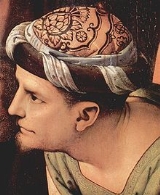
Joseph of Arimathea

Encyclopedia
Joseph of Arimathea was, according to the Gospels, the man who donated his own prepared tomb
for the burial of Jesus
after Jesus' Crucifixion
. He is mentioned in all four Gospels.
, in Judea
, Joseph was apparently a man of wealth—and probably a member of the Sanhedrin
, which is the way bouleutēs, literally "counsellor", is most often interpreted. According to Mark 15
:43, Joseph was an "honourable counsellor, who waited (or "was searching") for the kingdom of God
". In Matthew 27:57
he is not described as a counsellor, but as a rich man and a disciple of Jesus. In he was secretly a disciple
of Jesus: as soon as he heard the news of Jesus' death, he "went in boldly unto Pilate
, and craved the body of Jesus." R.J. Miller notes this act as "unexpected… Is Joseph in effect bringing Jesus into his family?"
Pilate, reassured by a centurion that the death had taken place, allowed Joseph's request. Joseph immediately purchased fine linen (Mark 15:46) and proceeded to Golgotha
to take the body of Jesus down from the cross. There, assisted by Nicodemus
, Joseph took the body and wrapped it in the fine linen and applied myrrh
and aloes
(these are substances which Nicodemus
had brought, according to John 19:39). Jesus' body then was conveyed to the place that had been prepared for Joseph's own body, a man-made cave hewn from rock in the garden of his house nearby.
This was done speedily, "for the Sabbath
was drawing on".
According to Roman law, a close family member could come and take away the body of an executed person. But there was no entitlement for a non-relative. There was a risk that a request from a non-relative would be denied and the body dumped, denying it proper burial. Tradition and sentiment also demanded that the body be interred with those of other family members, and not in the tomb of a stranger.
by the Catholic
, Lutheran, Eastern Orthodox
and some Anglican churches. His feast-day is March 17 in the West, July 31 in the East and in Lutheran churches. The Orthodox also commemorate him on the Sunday of the Myrrhbearers
—the third Sunday of Pascha
(second Sunday after Easter)—as well as on July 31. He appears in some early New Testament apocrypha
, and a series of legends grew around him during the Middle Ages
, which tied him to Britain
and the Holy Grail
.
Christians interpret Joseph's role as fulfilling Isaiah
's prediction that the grave of the "Suffering Servant" would be with a rich man (Isaiah
53:9), assuming that Isaiah meant Messiah
. The skeptical tradition, which reads the various fulfillment of prophecies in the life of Jesus as inventions designed for that purpose, reads Joseph of Arimathea as a story created to fulfill this prophecy in Isaiah, although the gospel accounts do not claim a prophesied fulfillment at that point. The prophecy in Isaiah chapter 53, is known as the "Man of Sorrows
" passage:
The Greek Septuagint text:
In the Qumran
community's Great Isaiah Scroll, dated at c. 100 BC, the words are not identical to the Masoretic text
:
, a text often appended to the medieval Gospel of Nicodemus and The Narrative of Joseph, and mentioned in the works of early church
historians such as Irenaeus
(125 – 189), Hippolytus
(170 – 236), Tertullian
(155 – 222) and Eusebius (260 – 340), who added details not found in the canonical accounts. Hilary of Poitiers
(300 – 367) enriched the legend, and Saint John Chrysostom
(347 – 407), the Patriarch of Constantinople
, was the first to write that Joseph was one of the Seventy Apostles appointed in Luke 10.
During the late 12th century, Joseph became connected with the Arthurian cycle, appearing in them as the first keeper of the Holy Grail
. This idea first appears in Robert de Boron
's Joseph d'Arimathie, in which Joseph receives the Grail from an apparition of Jesus and sends it with his followers to Britain. This theme is elaborated upon in Boron's sequels and in subsequent Arthurian works penned by others. Later retellings of the story contend that Joseph of Arimathea himself travelled to Britain and became the first Christian bishop in the Isles.
The Jewish elders then captured Joseph, and imprisoned him, and placed a seal on the door to his cell after first posting a guard. Joseph warned the elders:
Once the elders returned to the cell, the seal was still in place, but Joseph was gone. The elders later discover that Joseph had returned to Arimathea. Having a change in heart, the elders desired to have a more civil conversation with Joseph about his actions and sent a letter of apology to him by means of seven of his friends. Joseph travelled back from Arimathea to Jerusalem to meet with the elders, where they questioned him about his escape. He told them this story;
According to the Gospel of Nicodemus, Joseph testified to the Jewish elders, and specifically to chief priests Caiaphas
and Annas
that Jesus had risen from the dead and ascended to heaven and he indicated that others were raised from the dead at the resurrection of Christ (repeating Matt 27:52–53
). He specifically identified the two sons of the high-priest Simeon (again in Luke 2:25–35). The elders Annas, Caiaphas, Nicodemus, and Joseph himself, along with Gamaliel
under whom Paul of Tarsus
studied, travelled to Arimathea to interview Simeon's sons Charinus and Lenthius.
(even before it had taken hold in Rome), and that of Joseph as the original guardian of the Holy Grail.
(AD 155–222) wrote in Adversus Judaeos that Britain had already received and accepted the Gospel in his lifetime, writing of:
Tertullian does not say how the Gospel came to Britain before AD 222. However, Eusebius of Caesarea
, (AD 260–340), one of the earliest and most comprehensive of church historians, wrote of Christ's disciples in Demonstratio Evangelica, saying that "some have crossed the Ocean and reached the Isles of Britain." Saint Hilary of Poitiers
(AD 300–376) also wrote that the Apostles had built churches and that the Gospel had passed into Britain.
Hippolytus
(AD 170–236), considered to have been one of the most learned Christian historians, puts names to the seventy disciples
whom Jesus sent forth in Luke 10, includes Aristobulus
of Romans 16:10 with Joseph, and states that he ended up becoming a pastor in Britain.
In none of these earliest references to Christianity’s arrival in Britain is Joseph of Arimathea mentioned. The first literary connection of Joseph of Arimathea with Britain had to wait for the ninth-century Life of Mary Magdalene attributed to Rabanus Maurus
(AD 766–856), Archbishop of Mainz; however, the earliest authentic copy of the Maurus text is one housed in the Bodleian Library of Oxford University. Rabanus states that Joseph of Arimathea was sent to Britain, and he goes on to detail who travelled with him as far as France, claiming that he was accompanied by "the two Bethany sisters, Mary
and Martha
, Lazarus
(who was raised from the dead), St. Eutropius, St. Salome
, St. Cleon, St. Saturnius
, St. Mary Magdalen, Marcella (the maid of the Bethany sisters), St. Maxium or Maximin, St. Martial
, and St. Trophimus or Restitutus
." Rabanus Maurus describes their voyage to Britain:
The route he describes follows that of a supposed Phoenicia
n trade route to Britain, as described by Diodorus Siculus
.
William of Malmesbury
mentions Joseph's going to Britain in one passage of his Chronicle of the English Kings, written in the 1120s. He says Philip the Apostle
sent twelve Christians to Britain, one of whom was his dearest friend, Joseph of Arimathea. William does not mention Joseph by name again, but he mentions the twelve evangelists generally. He claims that Glastonbury Abbey
was founded by them; Glastonbury would be associated specifically with Joseph in later literature. Cardinal Caesar Baronius
, the Vatican Librarian and historian (d. 1609), recorded this voyage by Joseph of Arimathea, Lazarus, Mary Magdalene, Martha, Marcella and others in his Annales Ecclesiatici, volume 1, section 35.
The accretion of legends around Joseph of Arimathea in Britain, encapsulated by the poem hymn of William Blake
And did those feet in ancient time
held as "an almost secret yet passionately held article of faith among certain otherwise quite orthodox Christians", was critically examined by A. W. Smith in 1989. In its most developed version, Joseph, a tin merchant, visited Cornwall, accompanied by his nephew, the boy Jesus. C.C. Dobson made a case for the authenticity of the Glastonbury legenda.
was the product of Robert de Boron
, who essentially expanded upon stories from Acts of Pilate. In Boron's Joseph d'Arimathe, Joseph is imprisoned much as in the Acts, but it is the Grail that sustains him during his captivity. Upon his release he founds his company of followers, who take the Grail to Britain. The origin of the association between Joseph and Britain is not entirely clear, but it is probably through this association that Boron attached him to the Grail. In the Lancelot-Grail
Cycle, a vast Arthurian composition that took much from Boron, it is not Joseph but his son Josephus
who is considered the primary holy man of Britain.
Later authors sometimes mistakenly or deliberately treated the Grail story as truth – John of Glastonbury, who assembled a chronicle of the history of Glastonbury Abbey around 1350, claims that when Joseph came to Britain, he brought with him a wooden cup used in the Last Supper
and two cruets, one holding the blood of Christ, and the other his sweat, washed from his wounded body on the Cross. This legend is the source of the Grail claim by the Nanteos Cup
on display in the museum in Aberystwyth
; however, it should be noted that there is no reference to this tradition in ancient or medieval text. John further claims King Arthur was descended from Joseph, listing the following imaginative pedigree through King Arthur's mother:
Elizabeth I cited Joseph's missionary work in England when she told Roman Catholic bishops that the Church of England pre-dated the Roman Church in England.
". The retelling of such miracles did encourage the pilgrimage trade at Glastonbury until the Abbey was dissolved in 1539, during the English Reformation
.
The mytheme
of the staff that Joseph of Arimathea set in the ground at Glastonbury
, which broke into leaf and flower as the Glastonbury Thorn
is a common miracle in hagiography
. Such a miracle is told of the Anglo-Saxon saint Etheldreda:
Medieval interest in genealogy
raised claims that Joseph was a relative of Jesus; specifically, Mary
's uncle, or according to some genealogies, Joseph's uncle. A genealogy for the family of Joseph of Arimathea and the history of his further adventures in the east provide material for Holy Grail
romances
Estoire del Saint Graal, Perlesvaus, and the Queste del Saint Graal. Modern speculation initiated by Sabine Baring-Gould, A Book of Cornwall (1899) makes of him a tin
merchant, whose connection with Britain came by the abundant tin mines of Cornwall. One version, popular during the Romantic
period, even claims Joseph had taken Jesus to Britain as a boy. This was the inspiration for William Blake
's mystical hymn Jerusalem
.
Another legend, as recorded in Flores Historiarum
is that Joseph is in fact the Wandering Jew
, a man cursed by Jesus to walk the Earth until the Second Coming
.
itself is not otherwise documented, though it was "a city of Judea" according to Luke 23:51. Arimathea is usually identified with either Ramleh or Ramathaim-Zophim
, where David
came to Samuel (1 Samuel
chapter 19).
Sepulchre
The rock-cut tombs in ancient Israel are a group of hundreds of rock-cut tombs constructed in Israel in ancient times. They were cut into the rock, sometimes with elaborate facades and multiple burial chambers. Some are free-standing, but most are caves. Each tomb typically belonged to a...
for the burial of Jesus
Jesus
Jesus of Nazareth , commonly referred to as Jesus Christ or simply as Jesus or Christ, is the central figure of Christianity...
after Jesus' Crucifixion
Crucifixion of Jesus
The crucifixion of Jesus and his ensuing death is an event that occurred during the 1st century AD. Jesus, who Christians believe is the Son of God as well as the Messiah, was arrested, tried, and sentenced by Pontius Pilate to be scourged, and finally executed on a cross...
. He is mentioned in all four Gospels.
Gospel references
A native of ArimatheaArimathea
Arimathea , according to the Gospel of Luke , was "a city of Judea". It was reportedly the home town of Joseph of Arimathea, who appears in all four Gospel accounts of the Passion for having donated his new tomb outside Jerusalem to receive the body of Jesus...
, in Judea
Judea
Judea or Judæa was the name of the mountainous southern part of the historic Land of Israel from the 8th century BCE to the 2nd century CE, when Roman Judea was renamed Syria Palaestina following the Jewish Bar Kokhba revolt.-Etymology:The...
, Joseph was apparently a man of wealth—and probably a member of the Sanhedrin
Sanhedrin
The Sanhedrin was an assembly of twenty-three judges appointed in every city in the Biblical Land of Israel.The Great Sanhedrin was the supreme court of ancient Israel made of 71 members...
, which is the way bouleutēs, literally "counsellor", is most often interpreted. According to Mark 15
Mark 15
Mark 15 is the fifteenth chapter of the Gospel of Mark in the New Testament of the Christian Bible. It continues Jesus' Passion with his trial before Pontius Pilate and then his crucifixion, death and burial.- Trial before Pilate :...
:43, Joseph was an "honourable counsellor, who waited (or "was searching") for the kingdom of God
Kingdom of God
The Kingdom of God or Kingdom of Heaven is a foundational concept in the Abrahamic religions: Judaism, Christianity and Islam.The term "Kingdom of God" is found in all four canonical gospels and in the Pauline epistles...
". In Matthew 27:57
Matthew 27:57
Matthew 27:57 is the fifty-seventh verse of the twenty-seventh chapter of the Gospel of Matthew in the New Testament. This verse begins a discussion of the burial of Jesus and introduces Joseph of Arimathea....
he is not described as a counsellor, but as a rich man and a disciple of Jesus. In he was secretly a disciple
Disciple (Christianity)
In Christianity, the disciples were the students of Jesus during his ministry. While Jesus attracted a large following, the term disciple is commonly used to refer specifically to "the Twelve", an inner circle of men whose number perhaps represented the twelve tribes of Israel...
of Jesus: as soon as he heard the news of Jesus' death, he "went in boldly unto Pilate
Pontius Pilate
Pontius Pilatus , known in the English-speaking world as Pontius Pilate , was the fifth Prefect of the Roman province of Judaea, from AD 26–36. He is best known as the judge at Jesus' trial and the man who authorized the crucifixion of Jesus...
, and craved the body of Jesus." R.J. Miller notes this act as "unexpected… Is Joseph in effect bringing Jesus into his family?"
Pilate, reassured by a centurion that the death had taken place, allowed Joseph's request. Joseph immediately purchased fine linen (Mark 15:46) and proceeded to Golgotha
Calvary
Calvary or Golgotha was the site, outside of ancient Jerusalem’s early first century walls, at which the crucifixion of Jesus is said to have occurred. Calvary and Golgotha are the English names for the site used in Western Christianity...
to take the body of Jesus down from the cross. There, assisted by Nicodemus
Nicodemus
Saint Nicodemus was a Pharisee and a member of the Sanhedrin, who, according to the Gospel of John, showed favour to Jesus...
, Joseph took the body and wrapped it in the fine linen and applied myrrh
Myrrh
Myrrh is the aromatic oleoresin of a number of small, thorny tree species of the genus Commiphora, which grow in dry, stony soil. An oleoresin is a natural blend of an essential oil and a resin. Myrrh resin is a natural gum....
and aloes
Aloes
Aloe may refer:*Aloe, a genus of succulent plants, which includes several species:**Aloe arborescens**Aloe aristata**Aloe camperi**Aloe dichotoma**Aloe ngobitensis**Aloe vera**Aloe wildii*Aloe Ridge Game Reserve, in Gauteng, South Africa...
(these are substances which Nicodemus
Nicodemus
Saint Nicodemus was a Pharisee and a member of the Sanhedrin, who, according to the Gospel of John, showed favour to Jesus...
had brought, according to John 19:39). Jesus' body then was conveyed to the place that had been prepared for Joseph's own body, a man-made cave hewn from rock in the garden of his house nearby.
This was done speedily, "for the Sabbath
Biblical Sabbath
Sabbath in the Bible is usually a weekly day of rest and time of worship. The Sabbath is first mentioned in the Genesis creation narrative. The seventh day is there set aside as a day of rest—the Sabbath. It is observed differently in Judaism and Christianity and informs a similar occasion in...
was drawing on".
According to Roman law, a close family member could come and take away the body of an executed person. But there was no entitlement for a non-relative. There was a risk that a request from a non-relative would be denied and the body dumped, denying it proper burial. Tradition and sentiment also demanded that the body be interred with those of other family members, and not in the tomb of a stranger.
Veneration
Joseph of Arimathea is venerated as a saintSaint
A saint is a holy person. In various religions, saints are people who are believed to have exceptional holiness.In Christian usage, "saint" refers to any believer who is "in Christ", and in whom Christ dwells, whether in heaven or in earth...
by the Catholic
Roman Catholic Church
The Catholic Church, also known as the Roman Catholic Church, is the world's largest Christian church, with over a billion members. Led by the Pope, it defines its mission as spreading the gospel of Jesus Christ, administering the sacraments and exercising charity...
, Lutheran, Eastern Orthodox
Eastern Orthodox Church
The Orthodox Church, officially called the Orthodox Catholic Church and commonly referred to as the Eastern Orthodox Church, is the second largest Christian denomination in the world, with an estimated 300 million adherents mainly in the countries of Belarus, Bulgaria, Cyprus, Georgia, Greece,...
and some Anglican churches. His feast-day is March 17 in the West, July 31 in the East and in Lutheran churches. The Orthodox also commemorate him on the Sunday of the Myrrhbearers
Myrrhbearers
In Eastern Orthodoxy the Myrrhbearers are the individuals mentioned in the New Testament who were directly involved in the burial or who discovered the empty tomb following the resurrection of Jesus...
—the third Sunday of Pascha
Easter
Easter is the central feast in the Christian liturgical year. According to the Canonical gospels, Jesus rose from the dead on the third day after his crucifixion. His resurrection is celebrated on Easter Day or Easter Sunday...
(second Sunday after Easter)—as well as on July 31. He appears in some early New Testament apocrypha
New Testament apocrypha
The New Testament apocrypha are a number of writings by early Christians that claim to be accounts of Jesus and his teachings, the nature of God, or the teachings of his apostles and of their lives. These writings often have links with books regarded as "canonical"...
, and a series of legends grew around him during the Middle Ages
Middle Ages
The Middle Ages is a periodization of European history from the 5th century to the 15th century. The Middle Ages follows the fall of the Western Roman Empire in 476 and precedes the Early Modern Era. It is the middle period of a three-period division of Western history: Classic, Medieval and Modern...
, which tied him to Britain
Great Britain
Great Britain or Britain is an island situated to the northwest of Continental Europe. It is the ninth largest island in the world, and the largest European island, as well as the largest of the British Isles...
and the Holy Grail
Holy Grail
The Holy Grail is a sacred object figuring in literature and certain Christian traditions, most often identified with the dish, plate, or cup used by Jesus at the Last Supper and said to possess miraculous powers...
.
Old Testament prophecy
Christians interpret Joseph's role as fulfilling Isaiah
Isaiah
Isaiah ; Greek: ', Ēsaïās ; "Yahu is salvation") was a prophet in the 8th-century BC Kingdom of Judah.Jews and Christians consider the Book of Isaiah a part of their Biblical canon; he is the first listed of the neviim akharonim, the later prophets. Many of the New Testament teachings of Jesus...
's prediction that the grave of the "Suffering Servant" would be with a rich man (Isaiah
Book of Isaiah
The Book of Isaiah is the first of the Latter Prophets in the Hebrew Bible, preceding the books of Ezekiel, Jeremiah and the Book of the Twelve...
53:9), assuming that Isaiah meant Messiah
Messiah
A messiah is a redeemer figure expected or foretold in one form or another by a religion. Slightly more widely, a messiah is any redeemer figure. Messianic beliefs or theories generally relate to eschatological improvement of the state of humanity or the world, in other words the World to...
. The skeptical tradition, which reads the various fulfillment of prophecies in the life of Jesus as inventions designed for that purpose, reads Joseph of Arimathea as a story created to fulfill this prophecy in Isaiah, although the gospel accounts do not claim a prophesied fulfillment at that point. The prophecy in Isaiah chapter 53, is known as the "Man of Sorrows
Man of Sorrows
Among the passages in the Hebrew Bible that have been identified by Christians as prefigurations of the Messiah, the Man of Sorrows of Isaiah 53 is paramount - the various theological traditions are discussed at that article...
" passage:
He was assigned a grave with the wicked, and with the rich in his death, though he had done no violence, nor was any deceit in his mouth.
The Greek Septuagint text:
And I will give the wicked for his burial, and the rich for his death; for he practised no iniquity, nor craft with his mouth.
In the Qumran
Qumran
Qumran is an archaeological site in the West Bank. It is located on a dry plateau about a mile inland from the northwestern shore of the Dead Sea, near the Israeli settlement and kibbutz of Kalia...
community's Great Isaiah Scroll, dated at c. 100 BC, the words are not identical to the Masoretic text
Masoretic Text
The Masoretic Text is the authoritative Hebrew text of the Jewish Bible and is regarded as Judaism's official version of the Tanakh. While the Masoretic Text defines the books of the Jewish canon, it also defines the precise letter-text of these biblical books, with their vocalization and...
:
And they gave wicked ones his grave and [a scribbled word, probably accusative sign "eth"] rich ones in his death although he worked no violence neither deceit in his mouth.
Development of legends
Since the 2nd century, a mass of legendary detail has accumulated around the figure of Joseph of Arimathea in addition to the New Testament references. Joseph is referenced in apocryphal and non-canonical accounts such as the Acts of PilateActs of Pilate
The Acts of Pilate , also called the Gospel of Pilate, is a book of New Testament apocrypha. The dates of its accreted sections are uncertain, but scholars agree in assigning the resulting work to the middle of the fourth century...
, a text often appended to the medieval Gospel of Nicodemus and The Narrative of Joseph, and mentioned in the works of early church
Early Christianity
Early Christianity is generally considered as Christianity before 325. The New Testament's Book of Acts and Epistle to the Galatians records that the first Christian community was centered in Jerusalem and its leaders included James, Peter and John....
historians such as Irenaeus
Irenaeus
Saint Irenaeus , was Bishop of Lugdunum in Gaul, then a part of the Roman Empire . He was an early church father and apologist, and his writings were formative in the early development of Christian theology...
(125 – 189), Hippolytus
Hippolytus (writer)
Hippolytus of Rome was the most important 3rd-century theologian in the Christian Church in Rome, where he was probably born. Photios I of Constantinople describes him in his Bibliotheca Hippolytus of Rome (170 – 235) was the most important 3rd-century theologian in the Christian Church in Rome,...
(170 – 236), Tertullian
Tertullian
Quintus Septimius Florens Tertullianus, anglicised as Tertullian , was a prolific early Christian author from Carthage in the Roman province of Africa. He is the first Christian author to produce an extensive corpus of Latin Christian literature. He also was a notable early Christian apologist and...
(155 – 222) and Eusebius (260 – 340), who added details not found in the canonical accounts. Hilary of Poitiers
Hilary of Poitiers
Hilary of Poitiers was Bishop of Poitiers and is a Doctor of the Church. He was sometimes referred to as the "Hammer of the Arians" and the "Athanasius of the West." His name comes from the Latin word for happy or cheerful. His optional memorial in the Roman Catholic calendar of saints is 13...
(300 – 367) enriched the legend, and Saint John Chrysostom
John Chrysostom
John Chrysostom , Archbishop of Constantinople, was an important Early Church Father. He is known for his eloquence in preaching and public speaking, his denunciation of abuse of authority by both ecclesiastical and political leaders, the Divine Liturgy of St. John Chrysostom, and his ascetic...
(347 – 407), the Patriarch of Constantinople
Patriarch of Constantinople
The Ecumenical Patriarch is the Archbishop of Constantinople – New Rome – ranking as primus inter pares in the Eastern Orthodox communion, which is seen by followers as the One, Holy, Catholic, and Apostolic Church....
, was the first to write that Joseph was one of the Seventy Apostles appointed in Luke 10.
During the late 12th century, Joseph became connected with the Arthurian cycle, appearing in them as the first keeper of the Holy Grail
Holy Grail
The Holy Grail is a sacred object figuring in literature and certain Christian traditions, most often identified with the dish, plate, or cup used by Jesus at the Last Supper and said to possess miraculous powers...
. This idea first appears in Robert de Boron
Robert de Boron
Robert de Boron was a French poet of the late 12th and early 13th centuries who is most notable as the author of the poems Joseph d'Arimathe and Merlin.-Work:...
's Joseph d'Arimathie, in which Joseph receives the Grail from an apparition of Jesus and sends it with his followers to Britain. This theme is elaborated upon in Boron's sequels and in subsequent Arthurian works penned by others. Later retellings of the story contend that Joseph of Arimathea himself travelled to Britain and became the first Christian bishop in the Isles.
Gospel of Nicodemus
The Gospel of Nicodemus, a text appended to the Acts of Pilate, provides additional, though even more mythologized, details about Joseph. For instance, after Joseph asked Pilate for the body of the Christ, and prepared the body with Nicodemus' help, Christ's body was delivered to a new tomb that Joseph had built for himself. In the Gospel of Nicodemus, the Jewish elders express anger at Joseph for burying the body of Christ, saying:The Jewish elders then captured Joseph, and imprisoned him, and placed a seal on the door to his cell after first posting a guard. Joseph warned the elders:
Once the elders returned to the cell, the seal was still in place, but Joseph was gone. The elders later discover that Joseph had returned to Arimathea. Having a change in heart, the elders desired to have a more civil conversation with Joseph about his actions and sent a letter of apology to him by means of seven of his friends. Joseph travelled back from Arimathea to Jerusalem to meet with the elders, where they questioned him about his escape. He told them this story;
According to the Gospel of Nicodemus, Joseph testified to the Jewish elders, and specifically to chief priests Caiaphas
Caiaphas
Joseph, son of Caiaphas, Hebrew יוסף בַּר קַיָּפָא or Yosef Bar Kayafa, commonly known simply as Caiaphas in the New Testament, was the Roman-appointed Jewish high priest who is said to have organized the plot to kill Jesus...
and Annas
Annas
Annas [also Ananus or Ananias], son of Seth , was appointed by the Roman legate Quirinius as the first High Priest of the newly formed Roman province of Iudaea in 6 AD; just after the Romans had deposed Archelaus, Ethnarch of Judaea, thereby putting Judaea directly under Roman rule.Annas officially...
that Jesus had risen from the dead and ascended to heaven and he indicated that others were raised from the dead at the resurrection of Christ (repeating Matt 27:52–53
Matthew 27:53
Matthew 27:53 is the fifty-third verse of the twenty-seventh chapter of the Gospel of Matthew in the New Testament. This verse describes some of the events that occurred upon death of Jesus. The previous verse mentioned that tombs broke open and the saints inside were resurrected...
). He specifically identified the two sons of the high-priest Simeon (again in Luke 2:25–35). The elders Annas, Caiaphas, Nicodemus, and Joseph himself, along with Gamaliel
Gamaliel
Gamaliel the Elder , or Rabban Gamaliel I , was a leading authority in the Sanhedrin in the mid 1st century CE. He was the grandson of the great Jewish teacher Hillel the Elder, and died twenty years before the destruction of the Second Temple in Jerusalem...
under whom Paul of Tarsus
Paul of Tarsus
Paul the Apostle , also known as Saul of Tarsus, is described in the Christian New Testament as one of the most influential early Christian missionaries, with the writings ascribed to him by the church forming a considerable portion of the New Testament...
studied, travelled to Arimathea to interview Simeon's sons Charinus and Lenthius.
Other medieval texts
Medieval interest in Joseph centered on two themes, that of Joseph as the founder of British ChristianityCeltic Christianity
Celtic Christianity or Insular Christianity refers broadly to certain features of Christianity that were common, or held to be common, across the Celtic-speaking world during the Early Middle Ages...
(even before it had taken hold in Rome), and that of Joseph as the original guardian of the Holy Grail.
Britain
Legends about the arrival of Christianity in Britain abounded during the Middle Ages. Early writers do not connect Joseph to this activity, however. TertullianTertullian
Quintus Septimius Florens Tertullianus, anglicised as Tertullian , was a prolific early Christian author from Carthage in the Roman province of Africa. He is the first Christian author to produce an extensive corpus of Latin Christian literature. He also was a notable early Christian apologist and...
(AD 155–222) wrote in Adversus Judaeos that Britain had already received and accepted the Gospel in his lifetime, writing of:
Tertullian does not say how the Gospel came to Britain before AD 222. However, Eusebius of Caesarea
Eusebius of Caesarea
Eusebius of Caesarea also called Eusebius Pamphili, was a Roman historian, exegete and Christian polemicist. He became the Bishop of Caesarea in Palestine about the year 314. Together with Pamphilus, he was a scholar of the Biblical canon...
, (AD 260–340), one of the earliest and most comprehensive of church historians, wrote of Christ's disciples in Demonstratio Evangelica, saying that "some have crossed the Ocean and reached the Isles of Britain." Saint Hilary of Poitiers
Hilary of Poitiers
Hilary of Poitiers was Bishop of Poitiers and is a Doctor of the Church. He was sometimes referred to as the "Hammer of the Arians" and the "Athanasius of the West." His name comes from the Latin word for happy or cheerful. His optional memorial in the Roman Catholic calendar of saints is 13...
(AD 300–376) also wrote that the Apostles had built churches and that the Gospel had passed into Britain.
Hippolytus
Hippolytus (writer)
Hippolytus of Rome was the most important 3rd-century theologian in the Christian Church in Rome, where he was probably born. Photios I of Constantinople describes him in his Bibliotheca Hippolytus of Rome (170 – 235) was the most important 3rd-century theologian in the Christian Church in Rome,...
(AD 170–236), considered to have been one of the most learned Christian historians, puts names to the seventy disciples
Seventy Disciples
The seventy disciples or seventy-two disciples were early followers of Jesus mentioned in the Gospel of Luke . According to Luke, the only gospel in which they appear, Jesus appointed them and sent them out in pairs on a specific mission which is detailed in the text...
whom Jesus sent forth in Luke 10, includes Aristobulus
Aristobulus of Britannia
Aristobulus of Britannia Aristobulus of Britannia Aristobulus of Britannia (Full title, in Greek: Aghios Apostolos Aristovoulos, Martyras, kai Protos Episkopos Vretannias; Welsh: Arwystli Hen Episcob Cyntaf Prydain; Latin: Sanctus Aristobulus Senex, Apostolus, Martyr, Episcopus Primus Britanniae;...
of Romans 16:10 with Joseph, and states that he ended up becoming a pastor in Britain.
In none of these earliest references to Christianity’s arrival in Britain is Joseph of Arimathea mentioned. The first literary connection of Joseph of Arimathea with Britain had to wait for the ninth-century Life of Mary Magdalene attributed to Rabanus Maurus
Rabanus Maurus
Rabanus Maurus Magnentius , also known as Hrabanus or Rhabanus, was a Frankish Benedictine monk, the archbishop of Mainz in Germany and a theologian. He was the author of the encyclopaedia De rerum naturis . He also wrote treatises on education and grammar and commentaries on the Bible...
(AD 766–856), Archbishop of Mainz; however, the earliest authentic copy of the Maurus text is one housed in the Bodleian Library of Oxford University. Rabanus states that Joseph of Arimathea was sent to Britain, and he goes on to detail who travelled with him as far as France, claiming that he was accompanied by "the two Bethany sisters, Mary
Mary, sister of Lazarus
Mary of Bethany is a biblical figure described in the Gospels of John and Luke in the Christian New Testament...
and Martha
Martha
Martha of Bethany is a biblical figure described in the Gospels of Luke and John. Together with her siblings Lazarus and Mary, she is described as living in the village of Bethany near Jerusalem...
, Lazarus
Lazarus of Bethany
Lazarus of Bethany, also known as Saint Lazarus or Lazarus of the Four Days, is the subject of a prominent miracle attributed to Jesus in the Gospel of John, in which Jesus restores him to life four days after his death...
(who was raised from the dead), St. Eutropius, St. Salome
Salome (disciple)
Salome , sometimes venerated as Mary Salome, was a follower of Jesus who appears briefly in the canonical gospels and in more detail in apocryphal writings...
, St. Cleon, St. Saturnius
Saint Saturninus
Saint Saturninus may refer to:*Saturninus , companion of Saints Perpetua and Felicity, martyred in Carthage, feast day: 7 March*Saturnin of Toulouse , first bishop of Toulouse, France, feast day: 29 November*Saturninus Saint Saturninus may refer to:*Saturninus (died c. 203), companion of Saints...
, St. Mary Magdalen, Marcella (the maid of the Bethany sisters), St. Maxium or Maximin, St. Martial
Saint Martial
Saint Martial was the first bishop of Limoges in today's France, according to a lost vita of Saturnin, first bishop of Toulouse, which Gregory of Tours quotes in his History of the Franks.-Life:...
, and St. Trophimus or Restitutus
Trophimus of Arles
According to Catholic lore, Saint Trophimus of Arles was the first bishop of Arles, in today's southern France.It was an early tradition of the Church that under the co-Emperors Decius and Herennius Etruscus , Pope Fabian sent out seven bishops from Rome to Gaul, to preach the Gospel: Gatien to...
." Rabanus Maurus describes their voyage to Britain:
The route he describes follows that of a supposed Phoenicia
Phoenicia
Phoenicia , was an ancient civilization in Canaan which covered most of the western, coastal part of the Fertile Crescent. Several major Phoenician cities were built on the coastline of the Mediterranean. It was an enterprising maritime trading culture that spread across the Mediterranean from 1550...
n trade route to Britain, as described by Diodorus Siculus
Diodorus Siculus
Diodorus Siculus was a Greek historian who flourished between 60 and 30 BC. According to Diodorus' own work, he was born at Agyrium in Sicily . With one exception, antiquity affords no further information about Diodorus' life and doings beyond what is to be found in his own work, Bibliotheca...
.
William of Malmesbury
William of Malmesbury
William of Malmesbury was the foremost English historian of the 12th century. C. Warren Hollister so ranks him among the most talented generation of writers of history since Bede, "a gifted historical scholar and an omnivorous reader, impressively well versed in the literature of classical,...
mentions Joseph's going to Britain in one passage of his Chronicle of the English Kings, written in the 1120s. He says Philip the Apostle
Philip the Apostle
Philip the Apostle was one of the Twelve Apostles of Jesus. Later Christian traditions describe Philip as the apostle who preached in Greece, Syria, and Phrygia....
sent twelve Christians to Britain, one of whom was his dearest friend, Joseph of Arimathea. William does not mention Joseph by name again, but he mentions the twelve evangelists generally. He claims that Glastonbury Abbey
Glastonbury Abbey
Glastonbury Abbey was a monastery in Glastonbury, Somerset, England. The ruins are now a grade I listed building, and a Scheduled Ancient Monument and are open as a visitor attraction....
was founded by them; Glastonbury would be associated specifically with Joseph in later literature. Cardinal Caesar Baronius
Caesar Baronius
Cesare Baronio was an Italian Cardinal and ecclesiastical historian...
, the Vatican Librarian and historian (d. 1609), recorded this voyage by Joseph of Arimathea, Lazarus, Mary Magdalene, Martha, Marcella and others in his Annales Ecclesiatici, volume 1, section 35.
The accretion of legends around Joseph of Arimathea in Britain, encapsulated by the poem hymn of William Blake
William Blake
William Blake was an English poet, painter, and printmaker. Largely unrecognised during his lifetime, Blake is now considered a seminal figure in the history of both the poetry and visual arts of the Romantic Age...
And did those feet in ancient time
And did those feet in ancient time
"And did those feet in ancient time" is a short poem by William Blake from the preface to his epic Milton a Poem, one of a collection of writings known as the Prophetic Books. The date on the title page of 1804 for Milton is probably when the plates were begun, but the poem was printed c. 1808...
held as "an almost secret yet passionately held article of faith among certain otherwise quite orthodox Christians", was critically examined by A. W. Smith in 1989. In its most developed version, Joseph, a tin merchant, visited Cornwall, accompanied by his nephew, the boy Jesus. C.C. Dobson made a case for the authenticity of the Glastonbury legenda.
Holy Grail
The legend that Joseph was given the responsibility of keeping the Holy GrailHoly Grail
The Holy Grail is a sacred object figuring in literature and certain Christian traditions, most often identified with the dish, plate, or cup used by Jesus at the Last Supper and said to possess miraculous powers...
was the product of Robert de Boron
Robert de Boron
Robert de Boron was a French poet of the late 12th and early 13th centuries who is most notable as the author of the poems Joseph d'Arimathe and Merlin.-Work:...
, who essentially expanded upon stories from Acts of Pilate. In Boron's Joseph d'Arimathe, Joseph is imprisoned much as in the Acts, but it is the Grail that sustains him during his captivity. Upon his release he founds his company of followers, who take the Grail to Britain. The origin of the association between Joseph and Britain is not entirely clear, but it is probably through this association that Boron attached him to the Grail. In the Lancelot-Grail
Lancelot-Grail
The Lancelot–Grail, also known as the Prose Lancelot, the Vulgate Cycle, or the Pseudo-Map Cycle, is a major source of Arthurian legend written in French. It is a series of five prose volumes that tell the story of the quest for the Holy Grail and the romance of Lancelot and Guinevere...
Cycle, a vast Arthurian composition that took much from Boron, it is not Joseph but his son Josephus
Josephus of Arimathea
Josephus, also called Josephe or Josephes, is the son of Joseph of Arimathea and an early keeper of the Holy Grail in some tellings of the Arthurian legend...
who is considered the primary holy man of Britain.
Later authors sometimes mistakenly or deliberately treated the Grail story as truth – John of Glastonbury, who assembled a chronicle of the history of Glastonbury Abbey around 1350, claims that when Joseph came to Britain, he brought with him a wooden cup used in the Last Supper
Last Supper
The Last Supper is the final meal that, according to Christian belief, Jesus shared with his Twelve Apostles in Jerusalem before his crucifixion. The Last Supper provides the scriptural basis for the Eucharist, also known as "communion" or "the Lord's Supper".The First Epistle to the Corinthians is...
and two cruets, one holding the blood of Christ, and the other his sweat, washed from his wounded body on the Cross. This legend is the source of the Grail claim by the Nanteos Cup
Nanteos Cup
The Nanteos Cup is a medieval mazer bowl, held for many years at Nanteos Mansion, Rhydyfelin, near Aberystwyth, Wales. Legend claimed it to be the Holy Grail....
on display in the museum in Aberystwyth
Aberystwyth
Aberystwyth is a historic market town, administrative centre and holiday resort within Ceredigion, Wales. Often colloquially known as Aber, it is located at the confluence of the rivers Ystwyth and Rheidol....
; however, it should be noted that there is no reference to this tradition in ancient or medieval text. John further claims King Arthur was descended from Joseph, listing the following imaginative pedigree through King Arthur's mother:
Elizabeth I cited Joseph's missionary work in England when she told Roman Catholic bishops that the Church of England pre-dated the Roman Church in England.
Other legends
When Joseph set his walking staff on the ground to sleep, it miraculously took root, leafed out, and blossomed as the "Glastonbury ThornGlastonbury Thorn
The Glastonbury Thorn is a form of Common Hawthorn, Crataegus monogyna 'Biflora' , found in and around Glastonbury, Somerset, England. Unlike ordinary hawthorn trees, it flowers twice a year , the first time in winter and the second time in spring...
". The retelling of such miracles did encourage the pilgrimage trade at Glastonbury until the Abbey was dissolved in 1539, during the English Reformation
English Reformation
The English Reformation was the series of events in 16th-century England by which the Church of England broke away from the authority of the Pope and the Roman Catholic Church....
.
The mytheme
Mytheme
In the study of mythology, a mytheme is the essential kernel of a myth—an irreducible, unchanging element, a minimal unit that is always found shared with other, related mythemes and reassembled in various ways—"bundled" was Claude Lévi-Strauss's image— or linked in more...
of the staff that Joseph of Arimathea set in the ground at Glastonbury
Glastonbury
Glastonbury is a small town in Somerset, England, situated at a dry point on the low lying Somerset Levels, south of Bristol. The town, which is in the Mendip district, had a population of 8,784 in the 2001 census...
, which broke into leaf and flower as the Glastonbury Thorn
Glastonbury Thorn
The Glastonbury Thorn is a form of Common Hawthorn, Crataegus monogyna 'Biflora' , found in and around Glastonbury, Somerset, England. Unlike ordinary hawthorn trees, it flowers twice a year , the first time in winter and the second time in spring...
is a common miracle in hagiography
Hagiography
Hagiography is the study of saints.From the Greek and , it refers literally to writings on the subject of such holy people, and specifically to the biographies of saints and ecclesiastical leaders. The term hagiology, the study of hagiography, is also current in English, though less common...
. Such a miracle is told of the Anglo-Saxon saint Etheldreda:
Medieval interest in genealogy
Genealogy
Genealogy is the study of families and the tracing of their lineages and history. Genealogists use oral traditions, historical records, genetic analysis, and other records to obtain information about a family and to demonstrate kinship and pedigrees of its members...
raised claims that Joseph was a relative of Jesus; specifically, Mary
Mary (mother of Jesus)
Mary , commonly referred to as "Saint Mary", "Mother Mary", the "Virgin Mary", the "Blessed Virgin Mary", or "Mary, Mother of God", was a Jewish woman of Nazareth in Galilee...
's uncle, or according to some genealogies, Joseph's uncle. A genealogy for the family of Joseph of Arimathea and the history of his further adventures in the east provide material for Holy Grail
Holy Grail
The Holy Grail is a sacred object figuring in literature and certain Christian traditions, most often identified with the dish, plate, or cup used by Jesus at the Last Supper and said to possess miraculous powers...
romances
Romance (genre)
As a literary genre of high culture, romance or chivalric romance is a style of heroic prose and verse narrative that was popular in the aristocratic circles of High Medieval and Early Modern Europe. They were fantastic stories about marvel-filled adventures, often of a knight errant portrayed as...
Estoire del Saint Graal, Perlesvaus, and the Queste del Saint Graal. Modern speculation initiated by Sabine Baring-Gould, A Book of Cornwall (1899) makes of him a tin
Tin
Tin is a chemical element with the symbol Sn and atomic number 50. It is a main group metal in group 14 of the periodic table. Tin shows chemical similarity to both neighboring group 14 elements, germanium and lead and has two possible oxidation states, +2 and the slightly more stable +4...
merchant, whose connection with Britain came by the abundant tin mines of Cornwall. One version, popular during the Romantic
Romanticism
Romanticism was an artistic, literary and intellectual movement that originated in the second half of the 18th century in Europe, and gained strength in reaction to the Industrial Revolution...
period, even claims Joseph had taken Jesus to Britain as a boy. This was the inspiration for William Blake
William Blake
William Blake was an English poet, painter, and printmaker. Largely unrecognised during his lifetime, Blake is now considered a seminal figure in the history of both the poetry and visual arts of the Romantic Age...
's mystical hymn Jerusalem
And did those feet in ancient time
"And did those feet in ancient time" is a short poem by William Blake from the preface to his epic Milton a Poem, one of a collection of writings known as the Prophetic Books. The date on the title page of 1804 for Milton is probably when the plates were begun, but the poem was printed c. 1808...
.
Another legend, as recorded in Flores Historiarum
Flores Historiarum
The Flores Historiarum is a Latin chronicle dealing with English history from the creation to 1326 . It was compiled by various persons and quickly acquired contemporary popularity, for it was continued by many hands in many manuscript traditions...
is that Joseph is in fact the Wandering Jew
Wandering Jew
The Wandering Jew is a figure from medieval Christian folklore whose legend began to spread in Europe in the 13th century. The original legend concerns a Jew who taunted Jesus on the way to the Crucifixion and was then cursed to walk the earth until the Second Coming...
, a man cursed by Jesus to walk the Earth until the Second Coming
Second Coming
In Christian doctrine, the Second Coming of Christ, the Second Advent, or the Parousia, is the anticipated return of Jesus Christ from Heaven, where he sits at the Right Hand of God, to Earth. This prophecy is found in the canonical gospels and in most Christian and Islamic eschatologies...
.
Arimathea
ArimatheaArimathea
Arimathea , according to the Gospel of Luke , was "a city of Judea". It was reportedly the home town of Joseph of Arimathea, who appears in all four Gospel accounts of the Passion for having donated his new tomb outside Jerusalem to receive the body of Jesus...
itself is not otherwise documented, though it was "a city of Judea" according to Luke 23:51. Arimathea is usually identified with either Ramleh or Ramathaim-Zophim
Ramathaim-Zophim
Ramathaim-Zophim , also called Ramah and Ramatha in the Douay-Rheims, is a town that has been identified with the modern Neby Samwil , about 4 or 5 miles north-west of Jerusalem...
, where David
David
David was the second king of the united Kingdom of Israel according to the Hebrew Bible and, according to the Gospels of Matthew and Luke, an ancestor of Jesus Christ through both Saint Joseph and Mary...
came to Samuel (1 Samuel
Books of Samuel
The Books of Samuel in the Jewish bible are part of the Former Prophets, , a theological history of the Israelites affirming and explaining the Torah under the guidance of the prophets.Samuel begins by telling how the prophet Samuel is chosen by...
chapter 19).
See also
- Christian mythologyChristian mythologyChristian mythology is the body of myths associated with Christianity. In the study of mythology, the term "myth" refers to a traditional story, often one which is regarded as sacred and which explains how the world and its inhabitants came to have their present form.Classicist G.S. Kirk defines a...
- MyrrhbearersMyrrhbearersIn Eastern Orthodoxy the Myrrhbearers are the individuals mentioned in the New Testament who were directly involved in the burial or who discovered the empty tomb following the resurrection of Jesus...
- Seven Sorrows of MaryOur Lady of SorrowsOur Lady of Sorrows , the Sorrowful Mother or Mother of Sorrows , and Our Lady of the Seven Sorrows or Our Lady of the Seven Dolours are names by which the Blessed Virgin Mary is referred to in relation to sorrows in her life...