
All Topics  
Mark the Evangelist

 
Mark the Evangelist

   Email Print
   Bookmark   Link


Mark the Evangelist


Saint Mark the Evangelist (Hebrew
Hebrew language

Hebrew is a Semitic languages of the Afro-Asiatic languages. Modern Hebrew is spoken by more than seven million people in Israel and Classical Hebrew is used for prayer or study in Jews communities around the world....
: ?????; Greek
Greek language

Greek is an Indo-European languages native to the southern Balkan peninsula, the language of the Greek people. It forms an independent branch within Indo-European....
: ??????; 1st century
1st century

The 1st century was the century that lasted from 1 to 100 according the Julian calendar. It is considered part of the Classical era, epoch, or History by period...
), also known as John Mark, is traditionally believed to be the author of the Gospel of Mark
Gospel of Mark

The Gospel of Mark is the second of the four canonical gospels in the New Testament and was probably the first of the three synoptic gospels to be written....
 and a companion of Saint Peter
Saint Peter

Saint Peter was a leader of the early Christianity church, who features prominently in the New Testament Gospels and the Acts of the Apostles....
. He accompanied Paul of Tarsus
Paul of Tarsus

Saint Paul, also called Paul the Apostle, the Apostle Paul or Paul of Tarsus , was a Hellenistic Judaism, who called himself the "Apostle to the Gentiles", and was, together with Saint Peter and James the Just, the most notable of early Christian missionaries....
 and Barnabas
Barnabas

Saint Barnabas , born Joseph, was an early Christianity convert, one of the earliest disciples in Jerusalem. Like almost all Christians at the time, Barnabas was Jewish, specifically a Levite....
 on Paul's first missionary journey. After a sharp dispute, Barnabas separated from Paul, taking Mark to Cyprus
Cyprus

Cyprus , officially the Republic of Cyprus , is an island country situated in the eastern Mediterranean Sea, east of Greece, west of Lebanon, Syria, and Israel, south of Turkey and north of Egypt....
 (Acts
Acts of the Apostles

The Acts of the Apostles is a book of the Bible, which now stands fifth in the New Testament. It is commonly referred to as simply Acts. The title "Acts of the Apostles" was first used by Irenaeus in the late second century, but some have suggested that the title "Acts" be interpreted as "the Acts of the Holy Spirit" or even "the Acts...
 15:36-40). Later Paul called upon the services of Mark, the kinsman of Barnabas, and Mark was named as Paul's fellow worker.

His feast day is celebrated on 25 April, the anniversary of his martyrdom.


Discussion
Ask a question about 'Mark the Evangelist'
Start a new discussion about 'Mark the Evangelist'
Answer questions from other users
Full Discussion Forum


Recent Posts


Encyclopedia


Saint Mark the Evangelist (Hebrew
Hebrew language

Hebrew is a Semitic languages of the Afro-Asiatic languages. Modern Hebrew is spoken by more than seven million people in Israel and Classical Hebrew is used for prayer or study in Jews communities around the world....
: ?????; Greek
Greek language

Greek is an Indo-European languages native to the southern Balkan peninsula, the language of the Greek people. It forms an independent branch within Indo-European....
: ??????; 1st century
1st century

The 1st century was the century that lasted from 1 to 100 according the Julian calendar. It is considered part of the Classical era, epoch, or History by period...
), also known as John Mark, is traditionally believed to be the author of the Gospel of Mark
Gospel of Mark

The Gospel of Mark is the second of the four canonical gospels in the New Testament and was probably the first of the three synoptic gospels to be written....
 and a companion of Saint Peter
Saint Peter

Saint Peter was a leader of the early Christianity church, who features prominently in the New Testament Gospels and the Acts of the Apostles....
. He accompanied Paul of Tarsus
Paul of Tarsus

Saint Paul, also called Paul the Apostle, the Apostle Paul or Paul of Tarsus , was a Hellenistic Judaism, who called himself the "Apostle to the Gentiles", and was, together with Saint Peter and James the Just, the most notable of early Christian missionaries....
 and Barnabas
Barnabas

Saint Barnabas , born Joseph, was an early Christianity convert, one of the earliest disciples in Jerusalem. Like almost all Christians at the time, Barnabas was Jewish, specifically a Levite....
 on Paul's first missionary journey. After a sharp dispute, Barnabas separated from Paul, taking Mark to Cyprus
Cyprus

Cyprus , officially the Republic of Cyprus , is an island country situated in the eastern Mediterranean Sea, east of Greece, west of Lebanon, Syria, and Israel, south of Turkey and north of Egypt....
 (Acts
Acts of the Apostles

The Acts of the Apostles is a book of the Bible, which now stands fifth in the New Testament. It is commonly referred to as simply Acts. The title "Acts of the Apostles" was first used by Irenaeus in the late second century, but some have suggested that the title "Acts" be interpreted as "the Acts of the Holy Spirit" or even "the Acts...
 15:36-40). Later Paul called upon the services of Mark, the kinsman of Barnabas, and Mark was named as Paul's fellow worker.

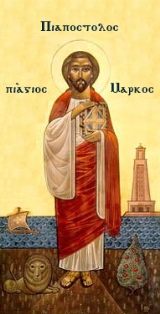
His feast day is celebrated on 25 April, the anniversary of his martyrdom. St Mark is also believed by various traditions to be the first bishop of Alexandria and the first Pope of Alexandria. He is considered the founder of the church in Alexandria, according to the Coptic church understanding, and thus the founder of Christianity in Africa
Christianity in Africa

Christians in Africa form one of the largest religious group. The presence of Christianity in Africa began by the end of the first century in Egypt, and by the end of the second century in the region around Carthage....
. His evangelistic
Four Evangelists

The Four Evangelists refers to the authors of the four Gospel accounts in the New Testament that bear the following ancient titles:*Gospel according to Matthew ,...
 symbol is the lion
Lion

The lion is a member of the family Felidae and one of four big cats in the genus Panthera. With exceptionally large males exceeding 250 kg in weight, it is the second-largest living cat after the tiger....
.

Biblical and traditional information

According to the Coptic church, Saint Mark was born in the Pentapolis of North Africa. This tradition adds that he returned to Pentapolis later in life after being sent by Saint Paul to Colosse (Col 4:10) and serving with him in Rome
Rome

Rome is the capital city of Italy and Lazio, and is Italy's largest and most populous city, with 2,724,347 residents in an urban area of some ....
 (Phil 24; 2 Tim 4:11) ; from Pentapolis he made his way to Alexandria
Alexandria

Alexandria , with a population of 4.1 million, is the second-largest city in Egypt, and is the country's largest seaport, serving about 80% of Egypt's imports and exports....
.

Mark of the Pauline Epistles is specified as a cousin of Barnabas (Colossians 4:10); this would explain Barnabas' special attachment to the Mark of Acts over whom he disputed with Paul (Acts 15:37-40). Mark's mother was a prominent member of the earliest group of Christians in Jerusalem
Jerusalem

Jerusalem is the capital of Israel and its List of Israeli cities in both population and area, with a population of 747,600 residents over an area of if Positions on Jerusalem East Jerusalem is included....
. It was to her house that Peter turned on his release from prison; the house was a meeting-place for the brethren, "many" of whom were praying there on the night Peter arrived from prison (Acts 12:12-17). Evidence for Mark's authorship of the Gospel that bears his name originates with Papias
Papias

Papias was one of the early leaders of the Christianity church, canonization as a saint. Eusebius of Caesarea calls him "Bishop of Hierapolis" which is 22km from Denizli and near Colossae , in the Lycus river valley in Phrygia, Asia Minor, not to be confused with the Manbij....
.

Folio 19v   the Martyrdom of Saint Mark
A number of traditions have built up around Mark, though none can be verified from the New Testament
New Testament

The New Testament is the name given to the second major division of the Christianity Bible, the first such division being the much longer Old Testament....
. It is suggested that Mark was one of the servants at the Marriage at Cana
Marriage at Cana

The Marriage at Cana or Wedding at Cana is an event reported by the Gospel of John but not by any of the Synoptic Gospels. John 2:1-11 reports that Jesus was attending a wedding in Cana with his disciple ....
 who poured out the water that Jesus turned to wine (John 2:1-11). Mark is also said to have been one of the Seventy Apostles sent out by Christ (Luke 10:1), the man who carried water to the house where the Last Supper
Last Supper

In the Christian Gospels, the Last Supper was the last meal Jesus shared with his Twelve Apostles and Disciple before Crucifixion of Jesus. The Last Supper has been the subject of many paintings, perhaps The Last Supper by Leonardo da Vinci....
 took place (Mark 14:13), the young man who ran away naked when Jesus was arrested (Mark 14:51-52), the one who hosted the disciples in his house after the death of Jesus and into whose house the resurrected Jesus Christ came (John 20). When Mark returned to Alexandria, the people there are said to have resented his efforts to turn them away from the worship of their traditional Egyptian gods. In AD 68 they tied him to several horses and dragged him through the streets until he was dead.

Fate of his remains

Stmark
In 828, relics believed to be the body of St. Mark were stolen from Alexandria
Alexandria

Alexandria , with a population of 4.1 million, is the second-largest city in Egypt, and is the country's largest seaport, serving about 80% of Egypt's imports and exports....
 by two Venetian merchants and were taken to Venice
Venice

Venice is a city in northern Italy, the capital city of the Italian regions Veneto, a population of 271,251 . Together with Padua, Italy, the city is included in the Padua-Venice Metropolitan Area ....
, where the Byzantine
Byzantine

The word Byzantine may refer to:Topics directly related to the Byzantine Empire* A citizen of Byzantine Empire, or native Greeks during the Middle Ages ....
 Theodore of Amasea
Theodore of Amasea

Saint Theodore of Amasea is one of the Greek military saints of the 4th century, the earlier patron saint of Venice, now outshone there by Saint Mark, but still represented atop one of the two Byzantine columns standing in the Piazzetta of the Piazza San Marco, treading upon the sacred crocodile of Egypt....
 had previously been the patron saint
Patron saint

A patron saint is a saint who is regarded as the intercessor and advocate in heaven of a nation, place, craft, activity, class, or person. Patron saints, because they have already transcended to the metaphysical, are able to intercede effectively for the needs of their special charges....
. A basilica
Basilica

The Latin word basilica , was originally used to describe a ancient Rome public building , usually located in the Forum of a Roman town. In Hellenistic cities, public basilicas appeared in the 2nd century BC....
 was built there to house the relics.

There is a mosaic on this Venetian basilica showing how the sailors covered the body relics with a layer of pork. Since Muslims are not allowed to touch pork, this action was done to prevent Muslim intervention in the relics removal.

Copts believe that the head of the saint remained in Alexandria. Every year, on the 30th day of the month of Babah, the Coptic Orthodox Church celebrates the commemoration of the consecration of the church of St. Mark, and the appearance of the head of the saint in the city of Alexandria.

This takes place inside St. Mark Coptic Orthodox Cathedral in Alexandria
Saint Mark's Coptic Orthodox Cathedral (Alexandria)

Saint Mark's Coptic Orthodox Church in Alexandria is considered a Cathedral as it is Seat of the Coptic Orthodox Pope of Alexandria of the Pope of Alexandria, the head of the Coptic Orthodox Church since 60 AD....
, where the saint's head is preserved.

The Eastern Orthodox Church
Eastern Orthodox Church

The Eastern Orthodox Church is the second largest single Christian communion in the world with an estimated 225 million members worldwide. It is considered by its adherents to be the Four Marks of the Church established by Jesus Christ and his Apostles nearly 2000 years ago....
 celebrates his feast day on January 4 (for those churches which follow the traditional Julian Calendar
Julian calendar

The Julian calendar, a reform of the Roman calendar, was introduced by Julius Caesar in 46 BC, and came into force in 45 BC . It was chosen after consultation with the astronomer Sosigenes of Alexandria and was probably designed to approximate the tropical year, known at least since Hipparchus....
, January 4 currently falls on January 17 of the modern Gregorian Calendar
Gregorian calendar

The Gregorian calendar is the internationally accepted civil calendar. It was first proposed by the Calabrian doctor Aloysius Lilius, and decreed by Pope Gregory XIII, after whom it was named, on 24 February 1582 by the papal bull Inter gravissimas....
).

In 1063, during the construction of a new basilica in Venice
St Mark's Basilica

Saint Mark's Basilica , the cathedral of Venice, is the most famous of the city's Church and one of the best known examples of Byzantine architecture....
, St. Mark's relics could not be found. However, according to tradition, in 1094 the saint himself revealed the location of his remains by extending an arm from a pillar. The newfound remains were placed in a sarcophagus in the basilica.

Trapezunt Gospel
In June 1968, Pope Cyril VI of Alexandria
Pope Cyril VI of Alexandria

Pope Cyril VI of Alexandria also called Kyrillos VI, born Azer Youssef Atta , was the Coptic Pope of the Coptic Orthodox Church of Alexandria ....
 sent an official delegation to Rome to receive a relic of St. Mark from Pope Paul VI
Pope Paul VI

Pope Paul VI , born Giovanni Battista Enrico Antonio Maria Montini , reigned as Pope of the Roman Catholic Church and monarch of Vatican City from 1963 to 1978....
. The delegation consisted of ten metropolitan
Metropolitan bishop

In Christian churches with episcopal polity, the rank of metropolitan bishop, or simply metropolitan, pertains to the diocesan bishop or archbishop of a metropolis ; that is, the chief city of a historical Roman province, ecclesiastical province, or regional capital....
s and bishops, seven of whom were Coptic and three Ethiopian, and three prominent Coptic lay leaders.

The relic was said to be a small piece of bone that had been given to the Roman pope by Giovanni Cardinal Urbani, Patriarch of Venice. Pope Paul, in an address to the delegation, said that the rest of the relics of the saint remained in Venice.

The delegation received the relic on June 22, 1968. The next day, the delegation celebrated a pontifical liturgy in the Church of Saint Athanasius the Apostolic in Rome. The metropolitans, bishops, and priests of the delegation all served in the liturgy. Members of the Roman papal delegation, Copts who lived in Rome, newspaper and news agency reporters, and many foreign dignitaries attended the liturgy.

In the book The Lost Tomb of Alexander, historian Andrew Chugg argues that the relics of St. Mark in Venice are actually those of Alexander the Great
Alexander the Great

Alexander the Great , also known as Alexander III of Macedon was an ancient Greeks King of Macedon . He was one of the most successful military commanders of all time and is presumed undefeated in battle....
. Few historians, however, accept this claim.

See also

  • Feast of Saint Mark
    Feast of Saint Mark

    The Feast of Saint Mark commemerates Mark the Evangelist an takes place on April 25....
  • Collège Saint Marc, Alexandria
    Collège Saint Marc, Alexandria

    Coll?ge Saint Marc is a Roman Catholic school in Alexandria, Egypt. It was founded in 1928 by the Institute of the Brothers of the Christian Schools ....
  • Gospel of Mark
    Gospel of Mark

    The Gospel of Mark is the second of the four canonical gospels in the New Testament and was probably the first of the three synoptic gospels to be written....
  • Gospel of John
    Gospel of John

    The Gospel of John is the fourth gospel in the Biblical canon of the New Testament, traditionally ascribed to John the Evangelist. Like the three synoptic gospels, it contains an account of some of the actions and sayings of Jesus of Nazareth, but differs from them in ethos and theological emphases....
  • Gospel of Matthew
    Gospel of Matthew

    The Gospel of Matthew is one of the four canonical gospels in the New Testament and is a synoptic gospel. It narrates an account of the New Testament view on Jesus' life and Ministry of Jesus of Jesus of Nazareth....
  • Gospel of Luke
    Gospel of Luke

    The Gospel of Luke is a Synoptic Gospels, and is the third and longest of the four Biblical canonical Gospels of the New Testament. The text narrates the life of Jesus of Nazareth....
  • John the Evangelist
    John the Evangelist

    Saint John the Evangelist , or the Beloved Disciple, is traditionally the name used to refer to the author of the Gospel of John and the First Epistle of John....
  • Luke the Evangelist
    Luke the Evangelist

    Luke the Evangelist was an early Christianity leader who is said by tradition to be the author of both the Gospel of Luke and the Acts of the Apostles....
  • Matthew the Evangelist
    Matthew the Evangelist

    Matthew the Evangelist , most often called Saint Matthew, is a Christian figure, and one of Jesus's Twelve Apostles. He is credited by tradition with writing the Gospel of Matthew, and is identified in that gospel as being the same person as Levi the publican ....


External links

  • Orthodox icon
    Icon

    An 'icon' is a religious work of art, most commonly a painting, from Eastern Christianity. More broadly the term is used in a wide number of contexts for an image, picture, or representation; it is a sign or likeness that stands for an object by signifying or representing it either concretely or by analogy, as in semiotics; by extension, ...
     and synaxarion