

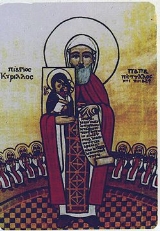
Cyril of Alexandria

Encyclopedia
Cyril of Alexandria was the Patriarch of Alexandria
from 412 to 444. He came to power when the city was at its height of influence and power within the Roman Empire
. Cyril wrote extensively and was a leading protagonist in the Christological controversies of the later 4th and 5th centuries. He was a central figure in the First Council of Ephesus in 431, which led to the deposition of Nestorius
as Patriarch of Constantinople
.
Cyril is counted among the Church Fathers
and the Doctors of the Church, and his reputation within the Christian world has resulted in his titles Pillar of Faith and Seal of all the Fathers, but Theodosius II
, the Roman Emperor
, condemned him for behaving like a "proud pharaoh", and the Nestorian
bishops at the Council of Ephesus declared him a heretic, labelling him as a "monster, born and educated for the destruction of the church".
Cyril is controversial because of his involvement in the expulsion of Novatians and Jews from Alexandria and the murder of the Hellenistic philosopher
Hypatia. Historians disagree over the extent of his responsibility for these events.
The Roman Catholic Church
did not commemorate Saint Cyril in the Tridentine Calendar
: it added his feast only in 1882, assigning to it the date of 9 February. The 1969 revision moved it to 27 June, considered to be the day of the saint's death, as celebrated by the Coptic Orthodox Church. The same date has been chosen for the Lutheran calendar. The Eastern Orthodox Church
and Eastern Catholic Church celebrate his feast day on 9 June and also, together with Pope Athanasius I of Alexandria, on 18 January.
. A few years after his birth, his maternal uncle Theophilus
rose to the powerful position of Patriarch of Alexandria
. His mother remained close to her brother and under his guidance, Cyril was well educated. His education showed through his knowledge, in his writings, of Christian writers of his day, including Eusebius
, Origen
, Didymus the Blind
, and writers of the Church of Alexandria
. He received the formal education standard for his day: he studied grammar from age twelve to fourteen (390-392), rhetoric and humanities from fifteen to twenty (393-397) and finally theology and biblical studies (398-402).
on 18 October 412, against the party favouring Archdeacon
Timothy.
, Jewish
, and Christian inhabitants.
He began to exert his authority by causing the churches of the Novatians to be closed and their sacred vessels to be seized.
Orestes
, Praefectus augustalis of the Diocese of Egypt, steadfastly resisted Cyril's agenda of ecclesiastical encroachment onto secular prerogatives. On one occasion, Cyril sent the grammaticus Hierax to secretly discover the content of an edict that Orestes was to promulgate on the mimes shows, which attracted great crowds. When the Jews, with whom Cyril had clashed before, discovered the presence of Hierax, they rioted, complaining that Hierax's presence was aimed at provoking them. Then Orestes had Hierax tortured in public in a theatre. This order had two aims: the first was to quell the riot, the other to mark Orestes' authority over Cyril.
According to Christian sources, the Jews of Alexandria schemed against the Christians and killed many of them; Cyril reacted and expelled either all of the Jews, or else only the murderers, from Alexandria, actually exerting a power that belonged to the civil officer, Orestes. Orestes was powerless, but nonetheless rejected Cyril's gesture of offering him a Bible, which would mean that the religious authority of Cyril would require Orestes' acquiescence in the bishop's policy.
This refusal almost cost Orestes his life. Nitrian monks
came from the desert and instigated a riot against Orestes among the population of Alexandria. These monks' violence had already been used, 15 years before, by Theophilus (Cyril's uncle) against the "Tall Brothers
"; furthermore, it is said that Cyril had spent five years among them in ascetic training. The monks assaulted Orestes and accused him of being a pagan. Orestes rejected the accusations, showing that he had been baptised by the Archbishop of Constantinople. However, the monks were not satisfied, and one of them, Ammonius, threw a stone and hit Orestes in the head, and so much blood flowed out that he was covered in it. Orestes' guard, fearing to be stoned by the monks, fled leaving Orestes alone. The people of Alexandria, however, came to his help, captured Ammonius and put the monks to flight. Orestes was cured and put Ammonius under torture in a public place, killing him. The prefect then wrote to the emperor Theodosius II
, telling him of the events. Cyril also wrote to the Emperor, telling his version of the events. The bishop also seized the body of Ammonius and put it in a church, conferring upon him the title of Thaumasius and putting his name in the list of the martyrs. However, the Christian population of Alexandria knew that Ammonius had been killed for his assault and not for his faith, and Cyril was obliged to remain silent about the events.
 Prefect Orestes
enjoyed the political backing of Hypatia, an astronomer, philosopher and mathematician who had considerable moral authority in the city of Alexandria, and who had extensive influence. Indeed many students from wealthy and influential families came to Alexandria purposely to study privately with Hypatia, and many of these later attained high posts in government and the Church. Several Christians thought that Hypatia's influence had caused Orestes to reject all reconciliatory offerings by Cyril. Modern historians think that Orestes had cultivated his relationship with Hypatia to strengthen a bond with the Pagan community of Alexandria, as he had done with the Jewish one, to handle better the difficult political life of the Egyptian capital. A Christian mob possibly led by Parabalani, however, grabbed Hypatia out of her chariot and brutally murdered her, hacking her body apart and burning the pieces outside the city walls.
Modern studies represent Hypatia's death as the result of a struggle between two Christian factions, the moderate Orestes, supported by Hypatia, and the more rigid Cyril. According to lexicographer William Smith
, "She was accused of too much familiarity with Orestes, prefect of Alexandria, and the charge spread among the clergy, who took up the notion that she interrupted the friendship of Orestes with their archbishop, Cyril."
Orthodox Christian scholar John Anthony McGuckin
states: "At this time Cyril is revealed as at the head of dangerously volatile forces: at their head, but not always in command of them."
and Antiochian schools of ecclesiastical reflection, piety, and discourse. This long running conflict widened with the third canon of the First Council of Constantinople
which granted the see of Constantinople primacy over the older sees of Alexandria and Antioch. Thus, the struggle between the sees of Alexandria and Antioch now included Constantinople. The conflict came to a head in 428 after Nestorius
, who originated in Antioch, was made Archbishop of Constantinople.
Cyril gained an opportunity to restore Alexandria's pre-eminence over both Antioch and Constantinople when an Antiochine priest who was in Constantinople at Nestorius' behest began to preach against calling Mary
the "Mother of God". As the term "Mother of God" had long been attached to Mary, the laity in Constantinople complained against the priest. Rather than repudiating the priest, Nestorius intervened on his behalf. Nestorius argued that Mary was neither a "Mother of Man" nor "Mother of God
" as these referred to Christ's two natures; rather, Mary was the "Mother of Christ". Christ, according to Nestorius, was the conjunction of the Godhead with his "temple" (which Nestorius was fond of calling his human nature). The controversy seemed to be centered on the issue of the suffering of Christ. Cyril maintained that the Son of God or the divine Word, truly suffered "in the flesh." However, Nestorius claimed that the Son of God was altogether incapable of suffering, even within his union with the flesh. Eusebius of Dorylaeum went so far as to accuse Nestorius of adoptionism
. By this time, news of the controversy in the capital had reached Alexandria. At Easter 429 A.D., Cyril wrote a letter to the Egyptian monks warning them of Nestorius' views. A copy of this letter reached Constantinople where Nestorius preached a sermon against it. This began a series of letters between Cyril and Nestorius which gradually became more strident in tone. Finally, Emperor Theodosius II
convoked a council in Ephesus
to solve the dispute. Cyril selected Ephesus as the venue since it supported the veneration of Mary (a transference from the city's pre-Christian veneration of the Greek goddess Artemis). Ephesus was friendly to Cyril, Cyril and his supporters started the Council of Ephesus (in 431) before Nestorius's supporters from Antioch and Syria had arrived and thus Nestorius refused to attend when summoned. Predictably, the Council ordered the deposition and exile of Nestorius for heresy.
However, when John of Antioch
and the other pro-Nestorius bishops finally reached Ephesus, they assembled their own Council, condemned Cyril for heresy, deposed him from his see, and labelled him as a monster, born and educated for the destruction of the church. Theodosius, by now old enough to hold power by himself, annulled the verdict of the Council and arrested Cyril, but Cyril eventually escaped. Having fled to Egypt, Cyril bribed Theodosius' courtiers, and sent a mob led by Dalmatius
, a hermit
, to besiege Theodosius' palace, and shout abuse; the Emperor eventually gave in, sending Nestorius into minor exile (Upper Egypt).
Cyril died about 444, but the controversies were to continue for decades, from the "Robber Synod" of Ephesus
(449) to the Council of Chalcedon (451) and beyond.
in the person of Jesus Christ to be so mystically powerful that it spread out from the body of the God-man
into the rest of the race, to reconstitute human nature into a graced and deified condition of the saints, one that promised immortality and transfiguration
to believers. Nestorius
, on the other hand, saw the incarnation as primarily a moral and ethical example to the faithful, to follow in the footsteps of Jesus. Cyril's constant stress was on the simple idea that it was God who walked the streets of Nazareth (hence Mary was Theotokos
(God Bearer)), and God who had appeared in a transfigured humanity. Nestorius spoke of the distinct 'Jesus the man' and 'the divine Logos
' in ways that Cyril thought were too dichotomous, widening the ontological gap between man and God in a way that some of his contemporaries believed would annihilate the person of Christ.
The main issue that prompted this dispute between Cyril and Nestorius was the question which arose at the Council of Constantinople: What exactly was the being to which Mary gave birth? Cyril posited that the composition of the Trinity consisted of one divine essence (ousia) in three distinct modes of being (hypostases.) These distinct modes of being were the Father, the Son and the Holy Spirit. Then, when the Son became flesh and entered into the world, these two divine and human natures both remained but became united in the person of Jesus. This resulted in the slogan "One Nature united out of two" being used to encapsulate the theological position of this Alexandrian bishop.
According to Cyril's theology, there were two states for the Son: the state that existed prior to the Son (or Word/Logos) becoming enfleshed in the person of Jesus and the state that actually became enfleshed. Thus, only the Logos incarnate suffered and died on the Cross and therefore the Son was able to suffer without suffering. Cyril's concern was that there needed to be continuity of the divine subject between the Logos and the incarnate Word—and so in Jesus Christ the divine Logos was really present in the flesh and in the world.
” during the First Council of Ephesus (431).
His writings include the homily given in Ephesus and several other sermons. Some of his alleged homilies are in dispute as to his authorship. In several writings, Cyril focuses on the love of Jesus to his mother. On the Cross
, he overcomes his pain and thinks of his mother. At the wedding in Cana
, he bows to her wishes. The overwhelming merit of Cyril of Alexandria is the cementation of the centre of dogmatic mariology for all times. Cyril is credited with creating a basis for all other mariological
developments through his teaching of the blessed Virgin Mary, as the Mother of God.
novel
Azazeel by the Egyptian scholar Youssef Ziedan
. The novel, which won the 2009 International Prize for Arabic Fiction
and will be published in English under the title Azazeel, is set in 5th-century Egypt and Syria and deals with the early history of Christianity. The book has generated controversy for depicting religious fanaticism
and mob violence among early Christians in Roman Egypt. The narrator, Hypa, witnesses the lynching of Hypatia and finds himself involved in the schism of 431, when Cyril deposed Nestorius. Cyril is portrayed as a fanatic who kills Jews and others who have not converted to Christianity from the traditional religions of antiquity. This portrayal has angered many Christians.
Cyril has also been portrayed in Ki Longfellow
's Flow Down Like Silver, Hypatia of Alexandria. Though Longfellow does not accuse Cyril of ordering the death of Hypatia, her work does not shy away from speculating on his part in the murder.
In the 2009 film Agora
, Cyril is played by Sami Samir as an extremist that opposes Orestes's attempts to harmonize the different communities of Alexandria.
, Thesaurus, Discourse Against Arians
Commentary on St. John's Gospel
, and Dialogues on the Trinity
. In 429 as the Christological controversies increased, his output of writings was that which his opponents could not match. His writings and his theology have remained central to tradition of the Fathers and to all Orthodox to this day.
Patriarch of Alexandria
The Patriarch of Alexandria is the Archbishop of Alexandria and Cairo, Egypt. Historically, this office has included the designation of Pope , and did so earlier than that of the Bishop of Rome...
from 412 to 444. He came to power when the city was at its height of influence and power within the Roman Empire
Roman Empire
The Roman Empire was the post-Republican period of the ancient Roman civilization, characterised by an autocratic form of government and large territorial holdings in Europe and around the Mediterranean....
. Cyril wrote extensively and was a leading protagonist in the Christological controversies of the later 4th and 5th centuries. He was a central figure in the First Council of Ephesus in 431, which led to the deposition of Nestorius
Nestorius
Nestorius was Archbishop of Constantinople from 10 April 428 to 22 June 431.Drawing on his studies at the School of Antioch, his teachings, which included a rejection of the long-used title of Theotokos for the Virgin Mary, brought him into conflict with other prominent churchmen of the time,...
as Patriarch of Constantinople
Patriarch of Constantinople
The Ecumenical Patriarch is the Archbishop of Constantinople – New Rome – ranking as primus inter pares in the Eastern Orthodox communion, which is seen by followers as the One, Holy, Catholic, and Apostolic Church....
.
Cyril is counted among the Church Fathers
Church Fathers
The Church Fathers, Early Church Fathers, Christian Fathers, or Fathers of the Church were early and influential theologians, eminent Christian teachers and great bishops. Their scholarly works were used as a precedent for centuries to come...
and the Doctors of the Church, and his reputation within the Christian world has resulted in his titles Pillar of Faith and Seal of all the Fathers, but Theodosius II
Theodosius II
Theodosius II , commonly surnamed Theodosius the Younger, or Theodosius the Calligrapher, was Byzantine Emperor from 408 to 450. He is mostly known for promulgating the Theodosian law code, and for the construction of the Theodosian Walls of Constantinople...
, the Roman Emperor
Roman Emperor
The Roman emperor was the ruler of the Roman State during the imperial period . The Romans had no single term for the office although at any given time, a given title was associated with the emperor...
, condemned him for behaving like a "proud pharaoh", and the Nestorian
Nestorianism
Nestorianism is a Christological doctrine advanced by Nestorius, Patriarch of Constantinople from 428–431. The doctrine, which was informed by Nestorius's studies under Theodore of Mopsuestia at the School of Antioch, emphasizes the disunion between the human and divine natures of Jesus...
bishops at the Council of Ephesus declared him a heretic, labelling him as a "monster, born and educated for the destruction of the church".
Cyril is controversial because of his involvement in the expulsion of Novatians and Jews from Alexandria and the murder of the Hellenistic philosopher
Hellenistic philosophy
Hellenistic philosophy is the period of Western philosophy that was developed in the Hellenistic civilization following Aristotle and ending with the beginning of Neoplatonism.-Pythagoreanism:...
Hypatia. Historians disagree over the extent of his responsibility for these events.
The Roman Catholic Church
Roman Catholic Church
The Catholic Church, also known as the Roman Catholic Church, is the world's largest Christian church, with over a billion members. Led by the Pope, it defines its mission as spreading the gospel of Jesus Christ, administering the sacraments and exercising charity...
did not commemorate Saint Cyril in the Tridentine Calendar
Tridentine Calendar
The Tridentine Calendar is the calendar of saints to be honoured in the course of the liturgical year in the official liturgy of the Roman Rite as reformed by Pope Pius V, implementing a decision of the Council of Trent, which entrusted the task to the Pope....
: it added his feast only in 1882, assigning to it the date of 9 February. The 1969 revision moved it to 27 June, considered to be the day of the saint's death, as celebrated by the Coptic Orthodox Church. The same date has been chosen for the Lutheran calendar. The Eastern Orthodox Church
Eastern Orthodox Church
The Orthodox Church, officially called the Orthodox Catholic Church and commonly referred to as the Eastern Orthodox Church, is the second largest Christian denomination in the world, with an estimated 300 million adherents mainly in the countries of Belarus, Bulgaria, Cyprus, Georgia, Greece,...
and Eastern Catholic Church celebrate his feast day on 9 June and also, together with Pope Athanasius I of Alexandria, on 18 January.
Early life
Cyril was born in 376 circa, in the small town of Theodosios, Egypt, near modern day El-Mahalla El-KubraEl-Mahalla El-Kubra
El-Mahalla El-Kubra is a large industrial and agricultural city in Egypt, located in the middle of the Nile Delta on the western bank of the Damietta branch. It is known for its dominant textile industry...
. A few years after his birth, his maternal uncle Theophilus
Theophilus of Alexandria
Theophilus of Alexandria was Patriarch of Alexandria, Egypt, from 385 to 412. He is regarded as a saint by the Coptic Orthodox Church....
rose to the powerful position of Patriarch of Alexandria
Patriarch of Alexandria
The Patriarch of Alexandria is the Archbishop of Alexandria and Cairo, Egypt. Historically, this office has included the designation of Pope , and did so earlier than that of the Bishop of Rome...
. His mother remained close to her brother and under his guidance, Cyril was well educated. His education showed through his knowledge, in his writings, of Christian writers of his day, including Eusebius
Eusebius of Caesarea
Eusebius of Caesarea also called Eusebius Pamphili, was a Roman historian, exegete and Christian polemicist. He became the Bishop of Caesarea in Palestine about the year 314. Together with Pamphilus, he was a scholar of the Biblical canon...
, Origen
Origen
Origen , or Origen Adamantius, 184/5–253/4, was an early Christian Alexandrian scholar and theologian, and one of the most distinguished writers of the early Church. As early as the fourth century, his orthodoxy was suspect, in part because he believed in the pre-existence of souls...
, Didymus the Blind
Didymus the Blind
Didymus the Blind was a Coptic Church theologian of Alexandria, whose famous Catechetical School he led for about half a century. He became blind at a very young age, and therefore ignorant of the rudiments of learning...
, and writers of the Church of Alexandria
Church of Alexandria
The Church of Alexandria in Egypt is the particular church headed by the Patriarch of Alexandria. It is one of the original four Apostolic Sees of Christianity, with Rome, Antioch and Jerusalem ....
. He received the formal education standard for his day: he studied grammar from age twelve to fourteen (390-392), rhetoric and humanities from fifteen to twenty (393-397) and finally theology and biblical studies (398-402).
Patriarch of Alexandria
Theophilus died on October 15, 412, and Cyril was made Pope or Patriarch of AlexandriaPatriarch of Alexandria
The Patriarch of Alexandria is the Archbishop of Alexandria and Cairo, Egypt. Historically, this office has included the designation of Pope , and did so earlier than that of the Bishop of Rome...
on 18 October 412, against the party favouring Archdeacon
Archdeacon
An archdeacon is a senior clergy position in Anglicanism, Syrian Malabar Nasrani, Chaldean Catholic, and some other Christian denominations, above that of most clergy and below a bishop. In the High Middle Ages it was the most senior diocesan position below a bishop in the Roman Catholic Church...
Timothy.
Persecution of the Novatians and Jews
Thus, Cyril followed his uncle in a position that had become powerful and influential, rivalling that of the prefect in a time of turmoil and frequently violent conflict between the cosmopolitan city's PaganPaganism
Paganism is a blanket term, typically used to refer to non-Abrahamic, indigenous polytheistic religious traditions....
, Jewish
Jews
The Jews , also known as the Jewish people, are a nation and ethnoreligious group originating in the Israelites or Hebrews of the Ancient Near East. The Jewish ethnicity, nationality, and religion are strongly interrelated, as Judaism is the traditional faith of the Jewish nation...
, and Christian inhabitants.
He began to exert his authority by causing the churches of the Novatians to be closed and their sacred vessels to be seized.
Orestes
Orestes (prefect)
Orestes was the Praefectus augustalis of the Diocese of Egypt, that is, the Roman governor of the province of Egypt, in 415...
, Praefectus augustalis of the Diocese of Egypt, steadfastly resisted Cyril's agenda of ecclesiastical encroachment onto secular prerogatives. On one occasion, Cyril sent the grammaticus Hierax to secretly discover the content of an edict that Orestes was to promulgate on the mimes shows, which attracted great crowds. When the Jews, with whom Cyril had clashed before, discovered the presence of Hierax, they rioted, complaining that Hierax's presence was aimed at provoking them. Then Orestes had Hierax tortured in public in a theatre. This order had two aims: the first was to quell the riot, the other to mark Orestes' authority over Cyril.
According to Christian sources, the Jews of Alexandria schemed against the Christians and killed many of them; Cyril reacted and expelled either all of the Jews, or else only the murderers, from Alexandria, actually exerting a power that belonged to the civil officer, Orestes. Orestes was powerless, but nonetheless rejected Cyril's gesture of offering him a Bible, which would mean that the religious authority of Cyril would require Orestes' acquiescence in the bishop's policy.
This refusal almost cost Orestes his life. Nitrian monks
Wadi El Natrun
Wadi El Natrun is a valley located in Beheira Governorate, Egypt, including a town with the same name. The name refers to the presence of eight different lakes in the region that produce natron salt. In Christian literature, the region is also referred to as the Nitrian Desert...
came from the desert and instigated a riot against Orestes among the population of Alexandria. These monks' violence had already been used, 15 years before, by Theophilus (Cyril's uncle) against the "Tall Brothers
Tall Brothers
The "Tall Brothers" were four brothers among the Egyptian monks of Nitria in the fifth century by the names of Ammonius, Dioscorus, Eusebius, and Euthymius. They were referred to as the "Tall Brothers" because they were tall in stature and demanding in appearance....
"; furthermore, it is said that Cyril had spent five years among them in ascetic training. The monks assaulted Orestes and accused him of being a pagan. Orestes rejected the accusations, showing that he had been baptised by the Archbishop of Constantinople. However, the monks were not satisfied, and one of them, Ammonius, threw a stone and hit Orestes in the head, and so much blood flowed out that he was covered in it. Orestes' guard, fearing to be stoned by the monks, fled leaving Orestes alone. The people of Alexandria, however, came to his help, captured Ammonius and put the monks to flight. Orestes was cured and put Ammonius under torture in a public place, killing him. The prefect then wrote to the emperor Theodosius II
Theodosius II
Theodosius II , commonly surnamed Theodosius the Younger, or Theodosius the Calligrapher, was Byzantine Emperor from 408 to 450. He is mostly known for promulgating the Theodosian law code, and for the construction of the Theodosian Walls of Constantinople...
, telling him of the events. Cyril also wrote to the Emperor, telling his version of the events. The bishop also seized the body of Ammonius and put it in a church, conferring upon him the title of Thaumasius and putting his name in the list of the martyrs. However, the Christian population of Alexandria knew that Ammonius had been killed for his assault and not for his faith, and Cyril was obliged to remain silent about the events.
Murder of Hypatia
Orestes (prefect)
Orestes was the Praefectus augustalis of the Diocese of Egypt, that is, the Roman governor of the province of Egypt, in 415...
enjoyed the political backing of Hypatia, an astronomer, philosopher and mathematician who had considerable moral authority in the city of Alexandria, and who had extensive influence. Indeed many students from wealthy and influential families came to Alexandria purposely to study privately with Hypatia, and many of these later attained high posts in government and the Church. Several Christians thought that Hypatia's influence had caused Orestes to reject all reconciliatory offerings by Cyril. Modern historians think that Orestes had cultivated his relationship with Hypatia to strengthen a bond with the Pagan community of Alexandria, as he had done with the Jewish one, to handle better the difficult political life of the Egyptian capital. A Christian mob possibly led by Parabalani, however, grabbed Hypatia out of her chariot and brutally murdered her, hacking her body apart and burning the pieces outside the city walls.
Modern studies represent Hypatia's death as the result of a struggle between two Christian factions, the moderate Orestes, supported by Hypatia, and the more rigid Cyril. According to lexicographer William Smith
William Smith (lexicographer)
Sir William Smith Kt. was a noted English lexicographer.-Early life:Born at Enfield in 1813 of Nonconformist parents, he was originally destined for a theological career, but instead was articled to a solicitor. In his spare time he taught himself classics, and when he entered University College...
, "She was accused of too much familiarity with Orestes, prefect of Alexandria, and the charge spread among the clergy, who took up the notion that she interrupted the friendship of Orestes with their archbishop, Cyril."
Orthodox Christian scholar John Anthony McGuckin
John Anthony McGuckin
John Anthony McGuckin is an Orthodox Christian scholar, priest and poet.McGuckin was raised Roman Catholic and at 19 became a member of the Passionist religious order. In 1989 he became Greek Orthodox and was ordained a priest for the Romanian Orthodox Church, now serving at the St. Gregory the...
states: "At this time Cyril is revealed as at the head of dangerously volatile forces: at their head, but not always in command of them."
Conflict with Nestorius
Another major conflict was between the AlexandrianAlexandrian school
The Alexandrian school is a collective designation for certain tendencies in literature, philosophy, medicine, and the sciences that developed in the Hellenistic cultural center of Alexandria, Egypt during the Hellenistic and Roman periods....
and Antiochian schools of ecclesiastical reflection, piety, and discourse. This long running conflict widened with the third canon of the First Council of Constantinople
First Council of Constantinople
The First Council of Constantinople is recognized as the Second Ecumenical Council by the Assyrian Church of the East, the Oriental Orthodox, the Eastern Orthodox, the Roman Catholics, the Old Catholics, and a number of other Western Christian groups. It was the first Ecumenical Council held in...
which granted the see of Constantinople primacy over the older sees of Alexandria and Antioch. Thus, the struggle between the sees of Alexandria and Antioch now included Constantinople. The conflict came to a head in 428 after Nestorius
Nestorius
Nestorius was Archbishop of Constantinople from 10 April 428 to 22 June 431.Drawing on his studies at the School of Antioch, his teachings, which included a rejection of the long-used title of Theotokos for the Virgin Mary, brought him into conflict with other prominent churchmen of the time,...
, who originated in Antioch, was made Archbishop of Constantinople.
Cyril gained an opportunity to restore Alexandria's pre-eminence over both Antioch and Constantinople when an Antiochine priest who was in Constantinople at Nestorius' behest began to preach against calling Mary
Mary (mother of Jesus)
Mary , commonly referred to as "Saint Mary", "Mother Mary", the "Virgin Mary", the "Blessed Virgin Mary", or "Mary, Mother of God", was a Jewish woman of Nazareth in Galilee...
the "Mother of God". As the term "Mother of God" had long been attached to Mary, the laity in Constantinople complained against the priest. Rather than repudiating the priest, Nestorius intervened on his behalf. Nestorius argued that Mary was neither a "Mother of Man" nor "Mother of God
Theotokos
Theotokos is the Greek title of Mary, the mother of Jesus used especially in the Eastern Orthodox, Oriental Orthodox, and Eastern Catholic Churches. Its literal English translations include God-bearer and the one who gives birth to God. Less literal translations include Mother of God...
" as these referred to Christ's two natures; rather, Mary was the "Mother of Christ". Christ, according to Nestorius, was the conjunction of the Godhead with his "temple" (which Nestorius was fond of calling his human nature). The controversy seemed to be centered on the issue of the suffering of Christ. Cyril maintained that the Son of God or the divine Word, truly suffered "in the flesh." However, Nestorius claimed that the Son of God was altogether incapable of suffering, even within his union with the flesh. Eusebius of Dorylaeum went so far as to accuse Nestorius of adoptionism
Adoptionism
Adoptionism, sometimes called dynamic monarchianism, is a minority Christian belief that Jesus was adopted as God's son at his baptism...
. By this time, news of the controversy in the capital had reached Alexandria. At Easter 429 A.D., Cyril wrote a letter to the Egyptian monks warning them of Nestorius' views. A copy of this letter reached Constantinople where Nestorius preached a sermon against it. This began a series of letters between Cyril and Nestorius which gradually became more strident in tone. Finally, Emperor Theodosius II
Theodosius II
Theodosius II , commonly surnamed Theodosius the Younger, or Theodosius the Calligrapher, was Byzantine Emperor from 408 to 450. He is mostly known for promulgating the Theodosian law code, and for the construction of the Theodosian Walls of Constantinople...
convoked a council in Ephesus
Ephesus
Ephesus was an ancient Greek city, and later a major Roman city, on the west coast of Asia Minor, near present-day Selçuk, Izmir Province, Turkey. It was one of the twelve cities of the Ionian League during the Classical Greek era...
to solve the dispute. Cyril selected Ephesus as the venue since it supported the veneration of Mary (a transference from the city's pre-Christian veneration of the Greek goddess Artemis). Ephesus was friendly to Cyril, Cyril and his supporters started the Council of Ephesus (in 431) before Nestorius's supporters from Antioch and Syria had arrived and thus Nestorius refused to attend when summoned. Predictably, the Council ordered the deposition and exile of Nestorius for heresy.
However, when John of Antioch
John of Antioch
John of Antioch was Patriarch of Antioch and led a group of moderate Eastern bishops during the Nestorian controversy. He is sometimes confused with John Chrysostom, who is occasionally also referred to as John of Antioch. John gave active support to his friend Nestorius in the latter's dispute...
and the other pro-Nestorius bishops finally reached Ephesus, they assembled their own Council, condemned Cyril for heresy, deposed him from his see, and labelled him as a monster, born and educated for the destruction of the church. Theodosius, by now old enough to hold power by himself, annulled the verdict of the Council and arrested Cyril, but Cyril eventually escaped. Having fled to Egypt, Cyril bribed Theodosius' courtiers, and sent a mob led by Dalmatius
Dalmatius of Constantinople
Saint Dalmatius was a saint venerated in Constantinople. His feast day was August 3. An archimandrite, he was an opponent of the Nestorians....
, a hermit
Hermit
A hermit is a person who lives, to some degree, in seclusion from society.In Christianity, the term was originally applied to a Christian who lives the eremitic life out of a religious conviction, namely the Desert Theology of the Old Testament .In the...
, to besiege Theodosius' palace, and shout abuse; the Emperor eventually gave in, sending Nestorius into minor exile (Upper Egypt).
Cyril died about 444, but the controversies were to continue for decades, from the "Robber Synod" of Ephesus
Second Council of Ephesus
The Second Council of Ephesus was a church synod in 449 AD. It was convoked by Emperor Theodosius II as an ecumenical council but because of the controversial proceedings it was not accepted as ecumenical, labelled a Robber Synod and later repudiated at the Council of Chalcedon.-The first...
(449) to the Council of Chalcedon (451) and beyond.
Theology
Cyril regarded the embodiment of GodGod
God is the English name given to a singular being in theistic and deistic religions who is either the sole deity in monotheism, or a single deity in polytheism....
in the person of Jesus Christ to be so mystically powerful that it spread out from the body of the God-man
God-man (mystic)
God-man refers to a divine Incarnation as described within various religious faiths including Christian theology and mysticism.- Origins :The first usage of the term God-man as a theological concept appears in the writing of the Christian Apostolic Father Origen in the 3rd century A.D.:The Council...
into the rest of the race, to reconstitute human nature into a graced and deified condition of the saints, one that promised immortality and transfiguration
Transfiguration of Jesus
The Transfiguration of Jesus is an event reported in the New Testament in which Jesus is transfigured and becomes radiant upon a mountain. The Synoptic Gospels describe it, and 2 Peter 1:16-18 refers to it....
to believers. Nestorius
Nestorius
Nestorius was Archbishop of Constantinople from 10 April 428 to 22 June 431.Drawing on his studies at the School of Antioch, his teachings, which included a rejection of the long-used title of Theotokos for the Virgin Mary, brought him into conflict with other prominent churchmen of the time,...
, on the other hand, saw the incarnation as primarily a moral and ethical example to the faithful, to follow in the footsteps of Jesus. Cyril's constant stress was on the simple idea that it was God who walked the streets of Nazareth (hence Mary was Theotokos
Theotokos
Theotokos is the Greek title of Mary, the mother of Jesus used especially in the Eastern Orthodox, Oriental Orthodox, and Eastern Catholic Churches. Its literal English translations include God-bearer and the one who gives birth to God. Less literal translations include Mother of God...
(God Bearer)), and God who had appeared in a transfigured humanity. Nestorius spoke of the distinct 'Jesus the man' and 'the divine Logos
Logos
' is an important term in philosophy, psychology, rhetoric and religion. Originally a word meaning "a ground", "a plea", "an opinion", "an expectation", "word," "speech," "account," "reason," it became a technical term in philosophy, beginning with Heraclitus ' is an important term in...
' in ways that Cyril thought were too dichotomous, widening the ontological gap between man and God in a way that some of his contemporaries believed would annihilate the person of Christ.
The main issue that prompted this dispute between Cyril and Nestorius was the question which arose at the Council of Constantinople: What exactly was the being to which Mary gave birth? Cyril posited that the composition of the Trinity consisted of one divine essence (ousia) in three distinct modes of being (hypostases.) These distinct modes of being were the Father, the Son and the Holy Spirit. Then, when the Son became flesh and entered into the world, these two divine and human natures both remained but became united in the person of Jesus. This resulted in the slogan "One Nature united out of two" being used to encapsulate the theological position of this Alexandrian bishop.
According to Cyril's theology, there were two states for the Son: the state that existed prior to the Son (or Word/Logos) becoming enfleshed in the person of Jesus and the state that actually became enfleshed. Thus, only the Logos incarnate suffered and died on the Cross and therefore the Son was able to suffer without suffering. Cyril's concern was that there needed to be continuity of the divine subject between the Logos and the incarnate Word—and so in Jesus Christ the divine Logos was really present in the flesh and in the world.
Mariology
Cyril of Alexandria became noted in Church history because of his spirited fight for the title “TheotokosTheotokos
Theotokos is the Greek title of Mary, the mother of Jesus used especially in the Eastern Orthodox, Oriental Orthodox, and Eastern Catholic Churches. Its literal English translations include God-bearer and the one who gives birth to God. Less literal translations include Mother of God...
” during the First Council of Ephesus (431).
His writings include the homily given in Ephesus and several other sermons. Some of his alleged homilies are in dispute as to his authorship. In several writings, Cyril focuses on the love of Jesus to his mother. On the Cross
Cross
A cross is a geometrical figure consisting of two lines or bars perpendicular to each other, dividing one or two of the lines in half. The lines usually run vertically and horizontally; if they run obliquely, the design is technically termed a saltire, although the arms of a saltire need not meet...
, he overcomes his pain and thinks of his mother. At the wedding in Cana
Cana
In the Christian New Testament, the Gospel of John refers a number of times to a town called Cana of Galilee.-The marriage at Cana:Among Christians and other students of the New Testament, Cana is best known as the place where, according to the Fourth Gospel, Jesus performed his first public...
, he bows to her wishes. The overwhelming merit of Cyril of Alexandria is the cementation of the centre of dogmatic mariology for all times. Cyril is credited with creating a basis for all other mariological
Mariology
Roman Catholic Mariology is theology concerned with the Virgin Mary, the mother of Jesus Christ as developed by the Catholic Church. Roman Catholic teachings on the subject have been based on the belief that "The Blessed Virgin, because she is the Mother of God, is believed to hold a certain...
developments through his teaching of the blessed Virgin Mary, as the Mother of God.
In modern culture
Cyril plays a controversial role in the ArabicArabic language
Arabic is a name applied to the descendants of the Classical Arabic language of the 6th century AD, used most prominently in the Quran, the Islamic Holy Book...
novel
Novel
A novel is a book of long narrative in literary prose. The genre has historical roots both in the fields of the medieval and early modern romance and in the tradition of the novella. The latter supplied the present generic term in the late 18th century....
Azazeel by the Egyptian scholar Youssef Ziedan
Youssef Ziedan
Youssef Ziedan is an Egyptian scholar who specializes in Arabic and Islamic studies. He works as director of the Manuscript Center and Museum affiliated to the Bibliotheca Alexandrina...
. The novel, which won the 2009 International Prize for Arabic Fiction
International Prize for Arabic Fiction
The International Prize for Arabic Fiction is a literary prize managed in association with the Booker Prize Foundation in London, and supported by the Emirates Foundation in Abu Dhabi. The prize is specifically for prose fiction by Arabic authors, along the lines of the Man Booker Prize...
and will be published in English under the title Azazeel, is set in 5th-century Egypt and Syria and deals with the early history of Christianity. The book has generated controversy for depicting religious fanaticism
Religious fanaticism
Religious fanaticism is fanaticism related to a person's, or a group's, devotion to a religion. However, religious fanaticism is a subjective evaluation defined by the culture context that is performing the evaluation. What constitutes fanaticism in another's behavior or belief is determined by the...
and mob violence among early Christians in Roman Egypt. The narrator, Hypa, witnesses the lynching of Hypatia and finds himself involved in the schism of 431, when Cyril deposed Nestorius. Cyril is portrayed as a fanatic who kills Jews and others who have not converted to Christianity from the traditional religions of antiquity. This portrayal has angered many Christians.
Cyril has also been portrayed in Ki Longfellow
Ki Longfellow
Ki Longfellow is an American novelist, playwright, theatrical producer, theater director and entrepreneur. In Britain, as the widow of Vivian Stanshall, she is well known as the guardian of his artistic heritage, but elsewhere she is best known for her own work, especially the novel The Secret...
's Flow Down Like Silver, Hypatia of Alexandria. Though Longfellow does not accuse Cyril of ordering the death of Hypatia, her work does not shy away from speculating on his part in the murder.
In the 2009 film Agora
Agora (film)
Agora is a 2009 Spanish historical drama film directed by Alejandro Amenábar and written by Amenábar and Mateo Gil. The biopic stars Rachel Weisz as Hypatia, a female mathematician, philosopher and astronomer in 4th century Roman Egypt who investigates the flaws of the geocentric Ptolemaic system...
, Cyril is played by Sami Samir as an extremist that opposes Orestes's attempts to harmonize the different communities of Alexandria.
Works
Cyril was a scholarly archbishop and a prolific writer. In the early years of his active life in the Church he wrote several exegeses. Among these were: Commentaries on the Old TestamentOld Testament
The Old Testament, of which Christians hold different views, is a Christian term for the religious writings of ancient Israel held sacred and inspired by Christians which overlaps with the 24-book canon of the Masoretic Text of Judaism...
, Thesaurus, Discourse Against Arians
Arianism
Arianism is the theological teaching attributed to Arius , a Christian presbyter from Alexandria, Egypt, concerning the relationship of the entities of the Trinity and the precise nature of the Son of God as being a subordinate entity to God the Father...
Commentary on St. John's Gospel
Gospel of John
The Gospel According to John , commonly referred to as the Gospel of John or simply John, and often referred to in New Testament scholarship as the Fourth Gospel, is an account of the public ministry of Jesus...
, and Dialogues on the Trinity
Trinity
The Christian doctrine of the Trinity defines God as three divine persons : the Father, the Son , and the Holy Spirit. The three persons are distinct yet coexist in unity, and are co-equal, co-eternal and consubstantial . Put another way, the three persons of the Trinity are of one being...
. In 429 as the Christological controversies increased, his output of writings was that which his opponents could not match. His writings and his theology have remained central to tradition of the Fathers and to all Orthodox to this day.
- Becoming Temples of God (in Greek original and English
- Second Epistle of Cyril to Nestorius
- Third Epistle of Cyril to Nestorius (containing the twelve anathemas)
- Formula of Reunion: In Brief (A summation of the reunion between Cyril and John of Antioch)
- The 'Formula of Reunion' between Cyril and John of Antioch
- Five tomes against Nestorius (Adversus Nestorii blasphemias)
- That Christ is One (Quod unus sit Christus)
- Scholia on the incarnation of the Only-Begotten (Scholia de incarnatione Unigeniti)
- Against Diodore of Tarsus and Theodore of Mopsuestia (fragments)
- Against the synousiasts (fragments)
- Commentary on the Gospel of Luke
- Commentary on the Gospel of John
- Against Julian the Apostate
Further reading
- McGuckin, John A. St. Cyril of Alexandria and the Christological Controversy. Crestwood, NY: St. Vladimir’s Seminary Press, 2004. ISBN 0-88141-259-7
- Wessel, Susan. Cyril of Alexandria and the Nestorian Controversy:The Making of a Saint and a Heretic. Oxford 2004. ISBN 0-19-926846-0
- Artemi, Eirini «Τό μυστήριο της Ενανθρωπήσεως στούς δύο διαλόγους «ΠΕΡΙ ΤΗΣ ΕΝΑΝΘΡΩΠΗΣΕΩΣ ΤΟΥ ΜΟΝΟΓΕΝΟΥΣ»και «ΟΤΙ ΕΙΣ Ο ΧΡΙΣΤΟΣ» του Αγίου Κυρίλλου Αλεξανδρείας», Εκκλησιαστικός Φάρος, ΟΕ (2004), 145-271.
- Artemi, Eirini, «Τό μυστήριο της Ενανθρωπήσεως στούς δύο διαλόγους «ΠΕΡΙ ΤΗΣ ΕΝΑΝΘΡΩΠΗΣΕΩΣ ΤΟΥ ΜΟΝΟΓΕΝΟΥΣ»και «ΟΤΙ ΕΙΣ Ο ΧΡΙΣΤΟΣ» του Αγίου Κυρίλλου Αλεξανδρείας», Εκκλησιαστικός Φάρος, ΟΕ (2004), 145-271.
- Artemi, Eirini,Ο Άγιος Κύριλλος Αλεξανδρείας και οι σχέσεις του με τον έπαρχο Ορέστη και τη φιλόσοφο Υπατία, Εκκλησιαστικός Φάρος, τ. ΟΗ (2007), 7-15.
- Artemi, Eirini,Μία φύσις του Θεού λόγου σεσαρκωμένη. α). Απολιναρική ανάγνωση, β)Κυρίλλειος ανάγνωση, Εκκλησιαστικός Φάρος, τ. ΟΔ (2003), 293 – 304.
- Artemi, Eirini,Αι Ιστορικαί Ανακρίβιαι της ταινίας AGORA του Αλεχάντρο Αμπεναμπέρ, Ορθόδοξος Τύπος, τεύχ. 1819(2010),7.
- Artemi, Eirini,Οι χρήσεις της εθνικής γραμματείας στο έργο του Κυρίλλου Αλεξανδρείας, ΠΟΡΕΙΑ ΜΑΡΤΥΡΙΑΣ, αφιερωματικός τόμος στη μνήμη του Μακαριστού Πάπα και Πατριάρχη Αλεξανδρείας και πάσης Αφρικής κυρού Πέτρου του Ζ, (2010), 114-125.. ISBN 9788482390185
External links
- "The Life and Writings of Cyril of Alexandria" as it relates to the Christological Controversy
- Early Church Fathers Includes text written by Cyril of Alexandria
- Multilanguage Opera Omnia (Greek Edition by Migne Patrologia Graeca)
- St Cyril the Archbishop of Alexandria Eastern Orthodox iconIconAn icon is a religious work of art, most commonly a painting, from Eastern Christianity and in certain Eastern Catholic churches...
and synaxarion - Early Church Fathers: Cyril of Alexandria