
All Topics  
Religious symbolism

 
Religious Symbolism

   Email Print
   Bookmark   Link


Religious symbolism


Religious symbolism is the use of symbol
Symbol

A symbol is something such as an entity, picture, written word, sound, or particular mark that represents something else by association, resemblance, or convention....
s, including archetypes, acts, artwork, events, or natural phenomena, by a religion. Religions view religious texts, ritual
Ritual

A ritual is a set of repeated actions, often thought to have symbolic value, the performance of which is usually prescribed by a religion or by the traditions of a community by religious or political laws because of the perceived efficacy of those actions....
s, and works of art as symbols of compelling ideas or ideals. Symbols help create a resonant mythos
Mythos

Mythos is a Greek word meaning "story, legend, plot" and may refer to:* Myth or Mythology** The shared elements, characters, settings and themes in a set of works, e.g....
 expressing the moral
Moral

A moral is a message conveyed or a lesson to be learned from a story or event. The moral may be left to the hearer, reader or viewer to determine for themselves, or may be explicitly encapsulated in a maxim....
 values of the society
Society

A society is a group of humans characterized by patterns of relationships between individuals that share a distinctive culture and/or institutions....
 or the teachings of the religion, foster solidarity among adherents, and bring adherents closer to their object of worship.

The study of religious symbolism is either universalist, as a component of comparative religion
Comparative religion

Comparative religion is a field of religious study that analyzes the similarities and differences of themes, myths, rituals and concepts among the Religions of the world....
 and mythology
Mythology

The word mythology refers to a body of folklore/myths/legends that a particular culture believes to be true and that often use the supernatural to interpret natural events and to explain the nature of the universe and humanity....
, or in localized scope, within the confines of a religion's limits and boundaries.

gious symbolism may have a long history that could be over 100,000 years old.


Discussion
Ask a question about 'Religious symbolism'
Start a new discussion about 'Religious symbolism'
Answer questions from other users
Full Discussion Forum


Encyclopedia


Religious symbolism is the use of symbol
Symbol

A symbol is something such as an entity, picture, written word, sound, or particular mark that represents something else by association, resemblance, or convention....
s, including archetypes, acts, artwork, events, or natural phenomena, by a religion. Religions view religious texts, ritual
Ritual

A ritual is a set of repeated actions, often thought to have symbolic value, the performance of which is usually prescribed by a religion or by the traditions of a community by religious or political laws because of the perceived efficacy of those actions....
s, and works of art as symbols of compelling ideas or ideals. Symbols help create a resonant mythos
Mythos

Mythos is a Greek word meaning "story, legend, plot" and may refer to:* Myth or Mythology** The shared elements, characters, settings and themes in a set of works, e.g....
 expressing the moral
Moral

A moral is a message conveyed or a lesson to be learned from a story or event. The moral may be left to the hearer, reader or viewer to determine for themselves, or may be explicitly encapsulated in a maxim....
 values of the society
Society

A society is a group of humans characterized by patterns of relationships between individuals that share a distinctive culture and/or institutions....
 or the teachings of the religion, foster solidarity among adherents, and bring adherents closer to their object of worship.

The study of religious symbolism is either universalist, as a component of comparative religion
Comparative religion

Comparative religion is a field of religious study that analyzes the similarities and differences of themes, myths, rituals and concepts among the Religions of the world....
 and mythology
Mythology

The word mythology refers to a body of folklore/myths/legends that a particular culture believes to be true and that often use the supernatural to interpret natural events and to explain the nature of the universe and humanity....
, or in localized scope, within the confines of a religion's limits and boundaries.
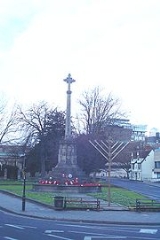
Crossmenorahoxford 20051225kaihsutai
Religion or philosophy Name Symbol
Atheism
Atheism

Atheism is the absence or rejection of belief in deity, or the explicit view that Existence of God.Many list of atheists are Skepticism of all supernatural beings and cite a lack of empiricism evidence for the existence of deities....
Atheist Atom
Atheism

Atheism is the absence or rejection of belief in deity, or the explicit view that Existence of God.Many list of atheists are Skepticism of all supernatural beings and cite a lack of empiricism evidence for the existence of deities....
 (commonly used but unofficial)
Ayyavazhi
Ayyavazhi

Ayyavazhi is a Dharmic religion system that originated in South India in the 19th century. It is cited as an independent monism religion by several newspapers and academic researchers....
 
Lotus Carrying Namam
Ayyavazhi symbolism

The Ayyavazhi symbolism deals with the symbols which are used in or used to represent Ayyavazhi. Though Akilam the scripture of Ayyavazhi does not point out any symbol directly, there are a few symbols which are used for representing Ayyavazhi which came into practice gradually....
Bahá'í Faith
Bahá'í Faith

The 'Bah?'? Faith' is a monotheism religion founded by Bah?'u'll?h in nineteenth-century Persian Empire#Persia and Europe , emphasizing the spiritual unity of all humankind....
 
Nine Pointed Star
Bahá'í symbols

Bah?'? symbols are symbols that have been used, or are used, to express identification with the Bah?'? Faith. While the five-pointed star is the official symbol of the religion, being used to represent the human body and Manifestation of God, more common symbols include the nine-pointed star, the Greatest Name, and the Ringstone symbol, rep...
Bahai Star
Buddhism
Buddhism

Buddhism is a family of beliefs and practices considered by most to be a religionand is based on the teachings attributed to Siddhartha Gautama, commonly known as "The Buddha" , who was born in what is today Nepal....
 
Wheel of Dharma
Dharmacakra

The Dharmachakra or Dhammachakka , Tibetan language chos kyi 'khor lo, Chinese language fal?n ??, "Wheel of Dharma" is a symbol representing Dharma , the Gautama Buddha's teaching of the path to Bodhi....
Lotus Flower
Nelumbo nucifera

Nelumbo nucifera, known by a number of names including Indian lotus, sacred lotus, bean of India, or simply lotus. Botanically, Nelumbo nucifera may also be referred to by its Synonym , Nelumbium speciosum or Nymphaea nelumbo. This plant is an aquatic perennial....
Christianity
Christianity

Christianity is a Monotheistic religion #Christian view religion centered on the life and teachings of Jesus as New Testament view on Jesus' life....
 
Ichthys
Ichthys

Ichthys or Ichthus is the ancient and classical Greek word for "fish." In English it refers to a symbol consisting of two intersecting arcs, the ends of the right side extending beyond the meeting point so as to resemble the profile of a fish, said to have been used by early Christianitys as a secret symbol and now known colloquiall...
 (fish)
Ichthus
Christian cross
Christian cross

The Christian cross is the best-known religious symbol of Christianity. It is a representation of the instrument of the crucifixion of Jesus Christ....
Christian Cross
Patriarchal cross
Patriarchal cross

The Patriarchal cross is a variant of the Christian cross, the universal religious symbol of Christianity. Similar to the familiar Latin cross, the Patriarchal cross possesses a smaller crossbar placed above the main one, so that both crossbars are near the top....
Orthodoxcross
Ethnic religions, Polytheistic reconstructionism
Polytheistic reconstructionism

Polytheistic reconstructionism is an approach to Neopaganism first emerging in the late 1960s to early 1970s, and gathering momentum in the 1990s to 2000s....

Paganism
Paganism

Paganism is the blanket term given to describe religions and spiritual practices of pre-Christian Europe, and by extension a term for polytheistic?traditions or folk religion?worldwide seen from a Western or Christian viewpoint....
, Neopaganism
Neopaganism

Neopaganism or Neo-Paganism is an umbrella term used to identify a wide variety of new religious movement, particularly those influenced by pre-Christian "Paganism" beliefs of Europe....
, Wicca
Wicca

Wicca is a neopaganism, nature-based religion. It was re-popularised in 1954 by Gerald Gardner, a retired United Kingdom civil servant, who at the time called it Witchcraft and its adherents "the Wica"....
Hands of God
Hands of God

The Hands of God is a pre-Christian Slavic mythology symbol representing Supreme God and universe. For Slavs , the cross was mainly associated with fire and life, but generally associated with the sun, as well as the balance of the universe....
Handsgod
Mjolnir
Mjolnir

In Norse mythology, Mj?llnir or Mj?lner is the hammer of Thor, a major god associated with thunder in Norse mythology. Distinctively shaped, Mj?llnir is depicted in Norse mythology as one of the most fearsome weapons, capable of leveling mountains....
 (Thor's Hammer)
Mjollnir
Pentagram
Pentagram

A pentagram is the shape of a five-pointed star drawn with five straight strokes. The word pentagram comes from the Greek language word pe?t???a???? , a noun form of pe?t???a???? or pe?t???a???? , a word meaning roughly "five-lined" or "five lines"....
 (also used as a Christian symbol)
Pentagram Green
Sun cross
Sun cross

File:Muiredach s Cross.jpgThe sun cross, a cross inside a circle, is one of the oldest and most widespread of symbols. The Neolithic symbol combining cross and circle is the simplest conceivable representation of the union of opposed polarities in the Western world....
Simple Crossed Circle
Gnosticism
Gnosticism

Gnosticism refers to diverse, syncretistic religious movements in antiquity consisting of various belief systems generally united in the teaching that humans are divine souls trapped in a Nature created by an imperfect god, the demiurge; this being is frequently identified with the Abrahamic God, and is contrasted with a superior entity, ref...
Sun cross
Sun cross

File:Muiredach s Cross.jpgThe sun cross, a cross inside a circle, is one of the oldest and most widespread of symbols. The Neolithic symbol combining cross and circle is the simplest conceivable representation of the union of opposed polarities in the Western world....
 (also a symbol of neopaganism
Neopaganism

Neopaganism or Neo-Paganism is an umbrella term used to identify a wide variety of new religious movement, particularly those influenced by pre-Christian "Paganism" beliefs of Europe....
)
Simple Crossed Circle
Ouroboros
Ouroboros

The Ouroboros , is an ancient symbol depicting a Serpent or European dragon swallowing its own tail and forming a circle.The Ouroboros often represents self-reflexivity or cyclicality, especially in the sense of something constantly re-creating itself, the eternal return, and other things perceived as cycles that begin anew as soon as th...
 (also a symbol of Alchemy
Alchemy

Alchemy , a part of the Occult Tradition, is both a philosophy and a practice with an aim of achieving ultimate wisdom as well as immortality, involving the improvement of the alchemist as well as the making of several substances described as possessing unusual properties....
 and Hermeticism
Hermeticism

Hermeticism is a set of philosophy and Religion beliefs based primarily upon the Hellenistic Egyptian Pseudepigrapha attributed to Hermes Trismegistus who is the representation of the congruence of the Egyptian god Thoth and the Greek Hermes....
)
Humanism
Humanism

Humanism is a broad category of ethics that affirm the dignity and worth of all people, based on the ability to determine right and wrong by appealing to universal human qualities, particularly rationalism, without resorting to the supernatural or alleged divine authority from religious texts....
Happy Human
Happy Human

The trademark is still held by the British Humanist Association, which freely licenses use of the symbol by bona fide Humanist organisations worldwide....
Hinduism
Hinduism

'Hinduism' is the predominant religion of the Indian subcontinent. Hinduism is often referred to as , a Sanskrit phrase meaning "the eternal dharma", by its practitioners....
 
Omkar (Aum)
Aum

This article is about the mystical syllable. For other uses of "om" or "aum" or similar, see Om .Aum is a mystical or sacred syllable in the Hinduism, Jainism, and Buddhism religions....
Aum
Lotus Flower
Nelumbo nucifera

Nelumbo nucifera, known by a number of names including Indian lotus, sacred lotus, bean of India, or simply lotus. Botanically, Nelumbo nucifera may also be referred to by its Synonym , Nelumbium speciosum or Nymphaea nelumbo. This plant is an aquatic perennial....
Swastika
Swastika

The swastika is an equilateral cross with its arms bent at Angle#Types of angles, in either right-facing form or its mirrored left-facing form....
Hinduswastika
Islam
Islam

Islam is a Monotheism, Abrahamic religion originating with the teachings of the Prophets of Islam Muhammad, a 7th century Arab religious and political figure....
 
Kalima/Shahadah
Shahadah

The Shahada, also spelled shahadah, is the Islamic creed. The Shahada is the Muslim Profession in the tawhid and acceptance of Muhammad as his Prophets of Islam....
Name of Allah
Allah

Allah is the standard Arabic language word for God. While the term is best known in the Western world for its use by Muslims as a reference to God, it is used by Arabic-speakers of all Abrahamic faiths, including Christians and Jews, in reference to "God"....
Star and crescent
Star and crescent

The star and crescent originally was a symbol used by the Zhou Dynasty, Greeks, Mongol-Turkic and Persians among others. It was used for the city of Byzantium in pre-Christian times and then more widely in the Hellenistic world, while the coins cut by the Sassanid kings carried this emblem....
 (Ottoman
Ottoman Empire

The Ottoman Empire , also known by its contemporaries as the Turkish Empire or Turkey , was an empire that lasted from 1299?1923. It was Treaty of Lausanne by the Republic of Turkey, which was officially proclaimed on October 29, 1923....
 symbol)
Rub el Hizb
Rub El Hizb

The Rub el Hizb is an Islamic symbol which is found on a number of emblems and flags. In Arabic, Rub means lord, sustainer, provider, supporter, nourisher, sovereign, ruler, master, or protector, while Hizb means a group, party, or sect....
Jainism
Jainism

Jainism is one of the oldest Indian religions that originated in India. Jains believe that every soul is divine and has the potential to achieve God-consciousness....
Swastika
Swastika

The swastika is an equilateral cross with its arms bent at Angle#Types of angles, in either right-facing form or its mirrored left-facing form....
Hinduswastika
Ahimsa Hand
Ahimsa in Jainism

means ?non-violence?, ?non-injury? or absence of desire to harm any life forms. Ahi?sa is the fundamental principle of Jainism forming the cornerstone of its ethics and doctrine....
Judaism
Judaism

Judaism is a set of beliefs and practices originating in the Hebrew Bible , as later further explored and explained in the Talmud and other texts....
 
Star of David
Star of David

The Star of David or Shield of David is a generally recognized symbol of Jewish identity and Judaism.It is named after King David of History of ancient Israel and Judah; and its earliest known communal usage began in the Middle Ages, alongside the more ancient symbol of the Menorah ....
Black Star of David
Menorah
LaVeyan Satanism
LaVeyan Satanism

LaVeyan Satanism is a religion founded in 1966 by Anton Szandor LaVey. Its teachings are based on individualism, hedonism, and "eye for an eye" morality, borrowing philosophically from Friedrich Nietzsche and Ayn Rand, and drawing from the rituals and ceremonies of occultist Aleister Crowley....
Sigil of Baphomet
Sigil of Baphomet

The Sigil of Baphomet is the official insignia for the Church of Satan. It is also a symbol that is used by several other organizations, usually those associated with Satanism and the Left-Hand Path....
Slavic neopaganism
Slavic neopaganism

Slavic Neopaganism is a modern polytheistic, polytheistic reconstructionism, and Neopaganism religion; its adherents call themselves Rodnovers, and consider themselves to be the legitimate continuation of Slavic mythology....
Hands of God
Hands of God

The Hands of God is a pre-Christian Slavic mythology symbol representing Supreme God and universe. For Slavs , the cross was mainly associated with fire and life, but generally associated with the sun, as well as the balance of the universe....
Handsgod
Pastafarianism Spaghethys
Sikhism
Sikhism

Sikhism , founded on the teachings of Guru Nanak and ten successive Sikh Gurus in fifteenth century Punjab region, is the Major religious groups organized religion in the world....
Khanda
Ek Onkar
Ek Onkar

Ik Onkar means God and is a central tenet of Sikh religious philosophy. It is also a symbol of the unity of God in Sikhism, and is found on all religious scriptures and places such as Gurdwaras....
Ekonkar
Shinto
Shinto

is the former state religion of Japan and remains the most common name for the nation's non-Buddhist ethnic religion practices. It was formed from disparate local mythologies, beginning with the Kojiki of 712, into an imperial cult called State Shinto that solidified in the Meiji period....
Torii
Torii

A is a traditional Japanese gate commonly found at the entry to a Jinja , although it can be found at Buddhism in Japan temples as well.The basic structure of a torii is two columns called that are topped with a horizontal rail called the kasagi....
Torii
Southeastern Ceremonial Complex

The Southeastern Ceremonial Complex is the name given to the regional stylistic similarity of artifact , iconography, ceremony and mythology of the Mississippian culture that coincided with their adoption of maize agriculture and chiefdom-level complex social organization from 1200 CE to 1650 CE....
Solar cross
Sun cross

File:Muiredach s Cross.jpgThe sun cross, a cross inside a circle, is one of the oldest and most widespread of symbols. The Neolithic symbol combining cross and circle is the simplest conceivable representation of the union of opposed polarities in the Western world....
Southern Cult Solar Cross
Taoism (Daoism)
Taoism

Taoism refers to a variety of related philosophical and religious traditions and concepts. These traditions have influenced East Asia for over two thousand years and some have spread to the West....
Yin and yang
Yin and yang

In Chinese philosophy, the concept of yin yang is used to describe how seemingly disjunct or opposing forces are interconnected and interdependent in the natural world, giving rise to each other in turn....
 (Taiji
Taiji

Taiji in Chinese philosophy is a description of a Cosmology. The term is used to represent a state of undifferentiated absolute, and of infinite potentiality....
)
Yin Yang
Thelema
Thelema

Thelema is a philosophy of life based on the rule or law, "Do what thou wilt." The ideal of "Do what thou wilt" and its association with the word Thelema goes back to Fran?ois Rabelais, but was more fully developed and proselytized by Aleister Crowley, who founded a religion named Thelema based on this ideal....
Unicursal Hexagram
Unicursal Hexagram

The unicursal hexagram is a hexagram or six-pointed star that can be traced or drawn unicursally, in one continuous line rather than two overlaid triangles....
Universal Sufism
Universal Sufism

Universal Sufism is a Spirituality and universalist movement founded by Hazrat Inayat Khan early in the 20th century. The philosophy of Universal Sufism is based on Cooperation of all people and religions, and the presence of spiritual guidance in all people, places and things....
Tughra Inayati
Universal Sufism

Universal Sufism is a Spirituality and universalist movement founded by Hazrat Inayat Khan early in the 20th century. The philosophy of Universal Sufism is based on Cooperation of all people and religions, and the presence of spiritual guidance in all people, places and things....
Unitarian Universalism

Unitarian Universalism is a liberal religion religion characterized by its support for a "free and responsible search for truth and meaning." Unitarian Universalists do not share a creed; rather, they are unified by their shared search for spiritual growth....
Flaming chalice
Flaming chalice

A flaming Chalice is the most widely used symbol of Unitarianism and Unitarian Universalism and the official logo of the Unitarian Universalist Association and other Unitarian and UU churches and societies....
Zoroastrianism
Zoroastrianism

Zoroastrianism is the religion and philosophy based on the teachings ascribed to the prophet Zoroaster, after whom the religion is named. The term Zoroastrianism is in general usage, essentially synonymous with Mazdaism, i.e., the worship of Ahura Mazda, exalted by Zoroaster as the supreme divine authority....
Faravahar
Faravahar

The faravahar is one of the best-known symbols of Zoroastrianism. Phonemically significant is only /frwr/, and the word is thus variously pronounced/written farohar, frohar, frawahr, fravahr etc....


Evolutionary perspectives

Religious symbolism may have a long history that could be over 100,000 years old. Ritual burials with grave goods are often interpreted as early human use of religious symbolism.

The cross together with the crown is an important symbol of Christianity which symbolizes not only the sufferings of life that Jesus experienced (the cross), but also the victory Jesus proved was possible by following his teachings about God as divine Love, proved by the healing he accomplished, and which we see throughout the world today in his name (the crown).

See also