

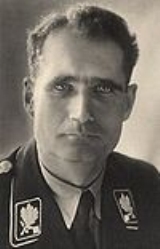
Rudolf Hess

Encyclopedia
Rudolf Walter Richard Hess (26 April 1894 in Alexandria
, Khedivate of Egypt
– 17 August 1987 in Berlin
, Germany
) was a prominent Nazi politician who was Adolf Hitler
's deputy
in the Nazi Party during the 1930s and early 1940s. On the eve of war with the Soviet Union
, he flew solo to Scotland in an attempt to negotiate peace with the United Kingdom, but was arrested and became a prisoner of war
. Hess was tried at Nuremberg
and sentenced to life imprisonment
, which he served at Spandau Prison
, Berlin
, where he died in 1987. There have been conspiracy theories
linked to Hess. After World War II Winston Churchill
wrote of Hess, "He was a medical and not a criminal case, and should be so regarded."
On 27–28 September 2007, numerous British news services published descriptions of disagreement between his Western
and Soviet captors over his treatment and how the Soviet captors were steadfast in denying his release.
In July 2011, the remains of Rudolf Hess were exhumed from a grave in Bavaria
after it became a focus of a pilgrimage
for neo-Nazis.
, the eldest of four children, to Fritz H. Hess, a prosperous German Lutheran importer/exporter from Bavaria, and Clara (née Münch). The family lived in luxury on the Egyptian coast, near Alexandria, and visited Germany often during the summers, allowing the Hess children to learn the German language and to absorb German culture. The family moved back to Germany in 1908, where Rudolf was subsequently enrolled in boarding school in Bad Godesberg
, at the Evangelical School. Hess showed aptitude in science and mathematics, and expressed interest in becoming an astronomer
. However, his father wished him to eventually continue the family business, Hess & Co., and in 1911 convinced Rudolf to study business for one year in Neuchâtel, Switzerland
, at the Ecole Supérieure de Commerce.
trading company Feldt, Stein & Co. as an apprentice in 1912. At the outbreak of World War I
he enlisted in the 7th Bavarian Field Artillery
Regiment, became an infantryman and was awarded the Iron Cross
, second class. He saw heavy action both on the Western Front (at Ypres
and Verdun
) and in the Carpathian Mountains
. After being wounded on several occasions—including a chest wound severe enough to prevent his return to the front as an infantry
man—he transferred to the Imperial Air Corps (after being rejected once). He then took aeronautical training and served as a pilot
in an operational squadron, Jasta 35b (Bavarian), with the rank of lieutenant
from 16 October 1918. He won no victories. The war ended on 11 November 1918.
(18 November 1937 – 24 October 2001).
After the war, the successful Hess family business collapsed. Hess went to Munich
, and took a job at a textile
importing firm. He joined the Freikorps
. He also joined the Thule Society
, a right-wing völkisch
occult
-mystical
organization. After the end of the war, Bavaria underwent fierce infighting between right-wing groups and left-wing forces, some of which were Soviet-backed.
, history
, economics
, and geopolitics
under Professor Karl Haushofer
, whom he had first met in the summer of 1919 in a social setting. From their first meeting, Hess became a disciple of Karl Haushofer, the two became close friends, and their families would also become close in the ensuing years, as Hess and Karl's son Albrecht Haushofer
also developed a strong friendship.
, a powerful orator, speak for the first time in May 1920 at a Munich rally, Hess became completely devoted to him, and spent much of his time and effort for the next several years organizing for Hitler at the local level in Bavaria. Hess joined the fledgling Nazi Party in 1920 as one of its first members. Hess introduced Karl Haushofer
to Hitler in the spring of 1921, following a rally at a beerhall. This was a critical and vital development in the eventual Nazi rise to power. Haushofer and Hitler connected immediately on a personal level. Haushofer's geopolitical theories found a strong convert in Hitler, who used this material to form the basis of his own plans for the rebuilding of Germany; Hitler soon began using Haushofer's material in his speeches, which drew ever-larger audiences and attention. Haushofer would become a close adviser to Hitler, and assume prominence in Germany with Hitler's rise.
Hess commanded an SA
battalion
during the Hitler-led Beer Hall Putsch
in 1923, which failed. Hess served seven and a half months in Landsberg Prison
; Hitler was sentenced to five years in the same prison, but eventually served just nine months. Acting as Hitler's private secretary in prison, Hess transcribed and partially edited Hitler's book Mein Kampf
. While in prison, Hitler and Hess were frequently visited and tutored by Karl Haushofer. Hess also introduced Hitler at early Nazi Party rallies.
Hess retained his interest in flying after the end of his active military career, and competed successfully in several races during the 1920s and 1930s latterly in a BFW M35b monoplane. He also flew the Messerschmitt Bf 108
and Messerschmitt Bf 110
which he learned to fly under the tutelage of the company chief test pilot Willi Stör.
Writing in Mein Kampf
, Hitler said, 'under the old regime there was Prince Eulenburg, under the new, there is Rudolf Hess'. Anton Drexler
( known for being Adolf Hitler's mentor during his early days in politics) and his group resented Hess, considering him 'too intellectual'.
. Soon after Hitler assumed dictator
ial powers, beginning in early 1933, Hess was named "Deputy to the Fuhrer". Hess had a privileged position as Hitler's deputy in the early years of the Nazi movement and in the early years of the Third Reich. For instance, he had the power to take "merciless action" against any defendant who he thought got off too lightly—especially in cases of those found guilty of attacking the party, Hitler or the state. Hess also played a prominent part in the creation of the Nuremberg Laws
in 1935. Hitler biographer John Toland
described Hess's political insight and abilities as somewhat limited.
Hess had extensive dealings with senior leaders of major European nations during the 1930s. His education, family man image, high office, and calm, forthright manner all served to make him the more respectful and respectable representative of the often otherwise crude and vulgar Nazis. Compared with other Nazi leaders, Hess had a good reputation among foreign leaders.
Within Germany, Hess was somewhat marginalized as the 1930s progressed, as foreign policy
took greater prominence. His alienation increased during the early years of the war, as attention and glory were focused on military leaders, along with Hermann Göring
, Joseph Goebbels
and Heinrich Himmler
. Those three Nazi leaders in particular had much higher profiles than Hess. Though Hess worshipped Hitler more than the others, he was not nakedly ambitious and did not crave power in the same manner they did. However, as the Deputy Fuhrer
, he was definitely not a figurehead
. Hess held as much power as the other Nazi leaders, if not more, under Hitler. He controlled who could get an audience with the Fuhrer, as well as passing and veto
ing proposed bills, and managing party activities. Hitler appointed Hess as "Minister Without Portfolio".
On 1 September 1939, the day Germany invaded Poland and launched World War II, Hitler announced that should anything happen to both him and Göring, Hess would be next in the line of succession.
 Like Goebbels, Hess was privately distressed by the war with the United Kingdom because he, influenced by his academic advisor and in line with earlier statements by Hitler himself, hoped that Britain would accept Germany as an ally. Hess may have hoped to score a diplomatic victory by sealing a peace between the Third Reich and Britain, using the contact his adviser Albrecht Haushofer
had made in Nazi Germany, just before the war, with Douglas Douglas-Hamilton, 14th Duke of Hamilton
.
On 10 May 1941, at about 6:00pm, Hess took off from Augsburg
in a Messerschmitt Bf 110
(radio code VJ+OQ) which he had equipped with drop tank
s to increase its range. Hitler ordered the General of the Fighter Arm
to stop him but squadron leaders were ordered to scramble only one or two fighters, since Hess's particular aircraft could not be distinguished from others and he was soon out of their range over the North Sea.
and Scotland at low altitude and high speed. The aircraft was tracked on radar by RAF Station Ouston
at 22:08 and named raid 42. Fighter aircraft were scrambled to intercept. Evidence of Royal Air Force collusion was suggested in the Czech Republic in 1990 after the discovery of the personal log books of Sgt Vaclav 'Felix' Bauman and Sgt Leopold 'Polda' Srom of 245 Squadron at Aldergrove in Northern Ireland. The Czech Hurricane pilots recorded scrambling in the early evening of May 10, to attack a Messerschmitt Bf110 over southern Scotland. Bauman said he was closing when unexpectedly ordered to break off the attack. He recounted his reply: "This is perhaps not possible." His base radioed: "Felix, return, I repeat, Stop action and return. Confirm." Bauman answered: "He is just in shooting range..." "Sorry Felix, old boy. It's not possible. You must return. Now." Bauman: "I don't bloody know. Then why did we chase him?" On landing, Bauman said Squadron Leader J W C Simpson, DFC and bar, told him: "I rang Group and I requested an explanation of that... ehm, unusual procedure. I was told that during your pursuit you crossed the border of our sector. You were therefore recalled. Our neighbours should have taken over but when the German suddenly changed his altitude, they lost him." The radio traffic was independently confirmed by former 245 Squadron fIight mechanic, Francis ‘Mac’ MacCormack, a retired clerk at the House of Commons. Hess was later discovered in Renfrewshire
.
at 23.09pm and gave his name as "Alfred Horn", a friend of the Duke of Hamilton; he asked to be taken to the Duke. Hess, however, was taken to hospital for injuries sustained during his descent. Hamilton was informed of the prisoner and visited him whereupon he revealed his true identity. Hamilton immediately contacted Winston Churchill, and informed him of the Deputy Führer's arrival. (Cit. W.S. Churchill, The Second World War, Volume III, p. 43)
Hess was first taken by the Home Guard
to their H.Q. at Giffnock
and later moved to Maryhill Barracks
, Glasgow
. The flight of Hess, but not his destination or fate, was first announced by Munich Radio in Germany on the evening of Monday, May 12. Hess's capture was reported at the time in the British and international media and farmhand David McLean claimed to have arrested Hess with his pitchfork.
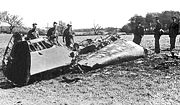
The wreckage of the aircraft was salvaged by 63 Maintenance Unit between 11 and 16 May 1941. The aeroplane
was found to be armed with machine guns in the nose but there was no ammunition on board.
In May 1943, the American Mercury magazine published a story from an anonymous source that indicated the British Secret Service lured Hess to Scotland to meet with Douglas Douglas-Hamilton, 14th Duke of Hamilton
, a member of the Anglo-German Fellowship
and that Hess was on a peace mission; this was denied by Hitler.The Queen's Lost Uncle, a television programme broadcast in November 2003 and March 2005 on Britain's Channel 4
, indicated involvement by Prince George, Duke of Kent
.
It appears that Hess was tricked into thinking he was in communication with the Duke of Hamilton
who Hess was led to believe was an opponent of Winston Churchill.
Hess was quoted by his wife Ilse as saying:
Hitler granted Hess's wife a pension
but stripped Hess of all of his party and state offices, and privately ordered him shot on sight if he ever returned to Germany. Martin Bormann
succeeded Hess as deputy under a newly created title.
that secret discussions were under way between Britain and Germany to attack the Soviet Union. Later, in a meeting with Stalin, Churchill would address the topic and find Stalin still believed secret agreements were discussed with Hess. "When I make a statement of facts within my knowledge I expect it to be accepted," Churchill responded to Stalin, again denying that the incident resulted in any communications with Nazi Germany. Files at The National Archives dated 1942 include Moscow Embassy correspondence concerning Hess; some pages are subject to non-disclosure under statute.
According to data published in a book about Wilhelm Canaris
, a number of contacts between Britain and Germany were kept during the war.
, making Hess the last in the long line of prominent people to be held in the 900 year-old fortress. Churchill gave orders that Hess was to be strictly isolated, but treated with dignity. He remained in the Tower until 20 May 1941. After being held in the Maryhill
army barracks, he was transferred to Mytchett Place near Aldershot
. He was kept under close guard. Frank Foley
and two other MI6 officers were given the job of debriefing Hess — or "Jonathan", as he was now known. Churchill's instructions were that Hess should be strictly isolated, and that every effort should be taken to get any information out of him that might be useful.
During his time as a prisoner of war
Hess was confined at Maindiff Court Military Hospital, Abergavenny, Wales for treatment for insanity
. He was treated well and enjoyed painting.
On 15 October 1941, Hess made his first suicide attempt by throwing himself over the rail of the first floor balcony, but he only broke his leg.
Hess was interviewed by psychiatrist
John Rawlings Rees
, who had worked at the Tavistock Clinic
prior to becoming a Brigadier
in the British Army
. Rees concluded that he was not insane, but certainly mentally ill
and suffering from depression
—probably due to the failure of his mission. Hess's diaries from his imprisonment in Britain after 1941 make many references to visits from Rees, whom he did not like and accused of poisoning him and "mesmerizing
" him. Rees took part in the Nuremberg Trials of 1945.
Hess was in captivity for almost four years of the war and thus he was absent from most of it, in contrast to the others who stood accused at Nuremberg. British government files released by The National Archives include a note concerning Hess's war crimes trial in which Judge Jackson considered whether Hess should be testified as insane. His case was considered by the Attorney-General.
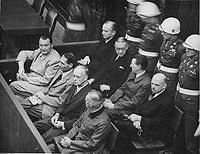
. He spent his time in court reading, occasionally laughing. In the British view, Hess was of unsound mind. Some of his last words before the tribunal were "I regret nothing".
In 1946, Hess was found guilty on two of four counts: crimes against peace (planning and preparation of aggressive war) and conspiracy
with other German leaders to commit crimes. He was found not guilty of war crime
s or crimes against humanity. Hess was given a life sentence.
and Albert Speer
, Hess was the sole remaining inmate of Spandau Prison
, partly at the insistence of the Soviets. Guards reportedly said he degenerated mentally and lost most of his memory. For the next 8 years, his main companion was warden Eugene K. Bird
, with whom he formed a close friendship. Bird wrote a 1974 book titled The Loneliest Man in the World: The Inside Story of the 30-Year Imprisonment of Rudolf Hess about his relationship with Hess. Frank Keller, a former guard at Spandau, said that "Hess would march by himself in the jail courtyard every day".
In the third volume of his book The Second World War Winston Churchill wrote:
In the early 1970s, the U.S., British and French governments had approached the Soviet government to propose that Hess be released on humanitarian grounds due to his age. The Soviet official response was apparently to reject these attempts and reportedly "refused to consider any reduction in Hess's life sentence." U.S. President Richard Nixon
was in favour of releasing Hess and stated that the U.S., Britain and France should continue to entreat the Soviet Union for his release.
In 1977, Britain's chief prosecutor at Nuremberg, Sir Hartley Shawcross, characterised Hess's continued imprisonment as a "scandal". In 1987, the new Soviet leadership agreed that Hess should be set free on humanitarian grounds.
Hess's letters and all communication were subject to censorship. British government files released by The National Archives detail a disagreement between the western powers and the Soviet Union regarding rights, especially censorship. The Soviet governor argued that uncensored letters to Hess's wife could be used to construct a propagandist essay.
British government files opened on 28 September 2007 by The National Archives from the period 6 May to 6 August 1974 contains a report of an altercation between Hess and a Soviet warder. The western governors raise issues of Soviet policy towards Hess, for example taking away Hess’s glasses before lights out, destroying his notebooks, increasing the strictness of censorship and blocking visits by Hess’s lawyer.
imprisonment at Spandau Prison in West Berlin
, at the age of 93. He was found in a summer house in a garden located in a secure area of the prison with an electrical cord wrapped around his neck. His death was ruled a suicide
by asphyxiation. He was buried at Wunsiedel
in a Hess family grave plot sold to his family by the Vetters of the Sechsämtertropfen bitter liquor company of Wunsiedel
. Spandau Prison was subsequently demolished to prevent it from becoming a shrine.
Hess was the last surviving member of Hitler's cabinet.
from Germany and Europe held gatherings in Wunsiedel for a memorial march and similar demonstrations that took place every year around the anniversary of Hess's death. These gatherings were banned from 1991 to 2000 and neo-Nazis tried to assemble in other cities and countries (such as the Netherlands
and Denmark
). Demonstrations in Wunsiedel were again legalized in 2001. After stricter German legislation regarding demonstrations by neo-Nazis was enacted in March 2005, the demonstrations were banned again.
With the grave's lease due to expire in October 2011, the Hess family applied for a 20-year extension which was denied. "We decided not to extend the lease because of all the unrest and disturbances," said parish council chairman Peter Seisser. After negotiations between the church's chaplin and Hess's granddaughter, the family agreed to remove his remains from the town. Hess's grave was re-opened on the morning of 20 July 2011 and his remains exhumed then cremated. Soon afterward his ashes were scattered at sea; the gravestone, which bore the epitaph "Ich hab's gewagt" ("I dared"), was destroyed.
s in the Third Reich. There is speculation that Hess was questioned by the British about Nazi interest in the occult.
Wolfgang Spann, who was in charge of the second autopsy, publicly stated that "we can't prove a third hand participated in the death of Rudolf Hess".
In 2008 Abdallah Melaouhi, a Tunisia
n who acted as Hess's medical caretaker in Spandau prison from 1984 to 1987, was dismissed from his position in his local German district parliament's advisory board for integration after he wrote a book, I Looked into the Murderer's Eyes. He had claimed in the book that his patient was murdered by MI6 (the British Secret Intelligence Service).
According to Hugh Thomas's book The Murder of Rudolf Hess (1979), the prisoner tried at Nuremberg and incarcerated in Spandau as Rudolf Hess was actually an imposter. Dutch author At Voorhorst contradicts Thomas's allegations with his study in which he compares biometric features of the prisoner in Spandau prison and deputy of Hitler in the Second World War.
Alexandria
Alexandria is the second-largest city of Egypt, with a population of 4.1 million, extending about along the coast of the Mediterranean Sea in the north central part of the country; it is also the largest city lying directly on the Mediterranean coast. It is Egypt's largest seaport, serving...
, Khedivate of Egypt
Khedivate of Egypt
The Khedivate of Egypt was an autonomous tributary state of the Ottoman Empire.- Rise of Muhammad Ali :The Egypt Eyalet was an eyalet of the Ottoman Empire. The eyalet was ruled locally by the Mamluk military caste and their various beys , who started to fight amongst themselves for control of...
– 17 August 1987 in Berlin
Berlin
Berlin is the capital city of Germany and is one of the 16 states of Germany. With a population of 3.45 million people, Berlin is Germany's largest city. It is the second most populous city proper and the seventh most populous urban area in the European Union...
, Germany
Germany
Germany , officially the Federal Republic of Germany , is a federal parliamentary republic in Europe. The country consists of 16 states while the capital and largest city is Berlin. Germany covers an area of 357,021 km2 and has a largely temperate seasonal climate...
) was a prominent Nazi politician who was Adolf Hitler
Adolf Hitler
Adolf Hitler was an Austrian-born German politician and the leader of the National Socialist German Workers Party , commonly referred to as the Nazi Party). He was Chancellor of Germany from 1933 to 1945, and head of state from 1934 to 1945...
's deputy
Deputy Führer
Deputy Führer was the title for the deputy head of the Nazi Party, which was held by Rudolf Hess until his flight to the United Kingdom in 1941. After this event, Adolf Hitler abolished the office and replaced it with the office of Party Chancellery, which was given to Martin Bormann....
in the Nazi Party during the 1930s and early 1940s. On the eve of war with the Soviet Union
Soviet Union
The Soviet Union , officially the Union of Soviet Socialist Republics , was a constitutionally socialist state that existed in Eurasia between 1922 and 1991....
, he flew solo to Scotland in an attempt to negotiate peace with the United Kingdom, but was arrested and became a prisoner of war
Prisoner of war
A prisoner of war or enemy prisoner of war is a person, whether civilian or combatant, who is held in custody by an enemy power during or immediately after an armed conflict...
. Hess was tried at Nuremberg
Nuremberg Trials
The Nuremberg Trials were a series of military tribunals, held by the victorious Allied forces of World War II, most notable for the prosecution of prominent members of the political, military, and economic leadership of the defeated Nazi Germany....
and sentenced to life imprisonment
Life imprisonment
Life imprisonment is a sentence of imprisonment for a serious crime under which the convicted person is to remain in jail for the rest of his or her life...
, which he served at Spandau Prison
Spandau Prison
Spandau Prison was a prison situated in the borough of Spandau in western Berlin, constructed in 1876 and demolished in 1987 after the death of its last prisoner, Rudolf Hess, to prevent it from becoming a neo-Nazi shrine. The prison was near, though not part of, the Renaissance-era Spandau Citadel...
, Berlin
Berlin
Berlin is the capital city of Germany and is one of the 16 states of Germany. With a population of 3.45 million people, Berlin is Germany's largest city. It is the second most populous city proper and the seventh most populous urban area in the European Union...
, where he died in 1987. There have been conspiracy theories
Conspiracy theory
A conspiracy theory explains an event as being the result of an alleged plot by a covert group or organization or, more broadly, the idea that important political, social or economic events are the products of secret plots that are largely unknown to the general public.-Usage:The term "conspiracy...
linked to Hess. After World War II Winston Churchill
Winston Churchill
Sir Winston Leonard Spencer-Churchill, was a predominantly Conservative British politician and statesman known for his leadership of the United Kingdom during the Second World War. He is widely regarded as one of the greatest wartime leaders of the century and served as Prime Minister twice...
wrote of Hess, "He was a medical and not a criminal case, and should be so regarded."
On 27–28 September 2007, numerous British news services published descriptions of disagreement between his Western
Western Allies
The Western Allies were a political and geographic grouping among the Allied Powers of the Second World War. It generally includes the United Kingdom and British Commonwealth, the United States, France and various other European and Latin American countries, but excludes China, the Soviet Union,...
and Soviet captors over his treatment and how the Soviet captors were steadfast in denying his release.
In July 2011, the remains of Rudolf Hess were exhumed from a grave in Bavaria
Bavaria
Bavaria, formally the Free State of Bavaria is a state of Germany, located in the southeast of Germany. With an area of , it is the largest state by area, forming almost 20% of the total land area of Germany...
after it became a focus of a pilgrimage
Pilgrimage
A pilgrimage is a journey or search of great moral or spiritual significance. Typically, it is a journey to a shrine or other location of importance to a person's beliefs and faith...
for neo-Nazis.
Early life
Hess was born in Alexandria, EgyptEgypt
Egypt , officially the Arab Republic of Egypt, Arabic: , is a country mainly in North Africa, with the Sinai Peninsula forming a land bridge in Southwest Asia. Egypt is thus a transcontinental country, and a major power in Africa, the Mediterranean Basin, the Middle East and the Muslim world...
, the eldest of four children, to Fritz H. Hess, a prosperous German Lutheran importer/exporter from Bavaria, and Clara (née Münch). The family lived in luxury on the Egyptian coast, near Alexandria, and visited Germany often during the summers, allowing the Hess children to learn the German language and to absorb German culture. The family moved back to Germany in 1908, where Rudolf was subsequently enrolled in boarding school in Bad Godesberg
Bad Godesberg
Bad Godesberg is a municipal district of Bonn, southern North Rhine-Westphalia, Germany. From 1949 till 1990 , the majority of foreign embassies to Germany were located in Bad Godesberg...
, at the Evangelical School. Hess showed aptitude in science and mathematics, and expressed interest in becoming an astronomer
Astronomy
Astronomy is a natural science that deals with the study of celestial objects and phenomena that originate outside the atmosphere of Earth...
. However, his father wished him to eventually continue the family business, Hess & Co., and in 1911 convinced Rudolf to study business for one year in Neuchâtel, Switzerland
Switzerland
Switzerland name of one of the Swiss cantons. ; ; ; or ), in its full name the Swiss Confederation , is a federal republic consisting of 26 cantons, with Bern as the seat of the federal authorities. The country is situated in Western Europe,Or Central Europe depending on the definition....
, at the Ecole Supérieure de Commerce.
World War I
Hess joined the HamburgHamburg
-History:The first historic name for the city was, according to Claudius Ptolemy's reports, Treva.But the city takes its modern name, Hamburg, from the first permanent building on the site, a castle whose construction was ordered by the Emperor Charlemagne in AD 808...
trading company Feldt, Stein & Co. as an apprentice in 1912. At the outbreak of World War I
World War I
World War I , which was predominantly called the World War or the Great War from its occurrence until 1939, and the First World War or World War I thereafter, was a major war centred in Europe that began on 28 July 1914 and lasted until 11 November 1918...
he enlisted in the 7th Bavarian Field Artillery
Artillery
Originally applied to any group of infantry primarily armed with projectile weapons, artillery has over time become limited in meaning to refer only to those engines of war that operate by projection of munitions far beyond the range of effect of personal weapons...
Regiment, became an infantryman and was awarded the Iron Cross
Iron Cross
The Iron Cross is a cross symbol typically in black with a white or silver outline that originated after 1219 when the Kingdom of Jerusalem granted the Teutonic Order the right to combine the Teutonic Black Cross placed above a silver Cross of Jerusalem....
, second class. He saw heavy action both on the Western Front (at Ypres
Ypres
Ypres is a Belgian municipality located in the Flemish province of West Flanders. The municipality comprises the city of Ypres and the villages of Boezinge, Brielen, Dikkebus, Elverdinge, Hollebeke, Sint-Jan, Vlamertinge, Voormezele, Zillebeke, and Zuidschote...
and Verdun
Verdun
Verdun is a city in the Meuse department in Lorraine in north-eastern France. It is a sub-prefecture of the department.Verdun is the biggest city in Meuse, although the capital of the department is the slightly smaller city of Bar-le-Duc.- History :...
) and in the Carpathian Mountains
Carpathian Mountains
The Carpathian Mountains or Carpathians are a range of mountains forming an arc roughly long across Central and Eastern Europe, making them the second-longest mountain range in Europe...
. After being wounded on several occasions—including a chest wound severe enough to prevent his return to the front as an infantry
Infantry
Infantrymen are soldiers who are specifically trained for the role of fighting on foot to engage the enemy face to face and have historically borne the brunt of the casualties of combat in wars. As the oldest branch of combat arms, they are the backbone of armies...
man—he transferred to the Imperial Air Corps (after being rejected once). He then took aeronautical training and served as a pilot
Aviator
An aviator is a person who flies an aircraft. The first recorded use of the term was in 1887, as a variation of 'aviation', from the Latin avis , coined in 1863 by G. de la Landelle in Aviation Ou Navigation Aérienne...
in an operational squadron, Jasta 35b (Bavarian), with the rank of lieutenant
Lieutenant
A lieutenant is a junior commissioned officer in many nations' armed forces. Typically, the rank of lieutenant in naval usage, while still a junior officer rank, is senior to the army rank...
from 16 October 1918. He won no victories. The war ended on 11 November 1918.
Marriage, family, early post-war years
On 20 December 1927, Hess married 27-year-old Ilse Pröhl (22 June 1900 – 7 September 1995) from Hannover. They had a son, Wolf Rüdiger HessWolf Rudiger Hess
Wolf Rüdiger Hess was the son of Rudolf Hess, an admirer of his godfather Adolf Hitler, an architect and a fixture of the post-war German far-right. He was also an outspoken critic of the investigation into his father's death, which he believed was a cover-up...
(18 November 1937 – 24 October 2001).
After the war, the successful Hess family business collapsed. Hess went to Munich
Munich
Munich The city's motto is "" . Before 2006, it was "Weltstadt mit Herz" . Its native name, , is derived from the Old High German Munichen, meaning "by the monks' place". The city's name derives from the monks of the Benedictine order who founded the city; hence the monk depicted on the city's coat...
, and took a job at a textile
Textile
A textile or cloth is a flexible woven material consisting of a network of natural or artificial fibres often referred to as thread or yarn. Yarn is produced by spinning raw fibres of wool, flax, cotton, or other material to produce long strands...
importing firm. He joined the Freikorps
Freikorps
Freikorps are German volunteer military or paramilitary units. The term was originally applied to voluntary armies formed in German lands from the middle of the 18th century onwards. Between World War I and World War II the term was also used for the paramilitary organizations that arose during...
. He also joined the Thule Society
Thule Society
The Thule Society , originally the Studiengruppe für germanisches Altertum , was a German occultist and völkisch group in Munich, named after a mythical northern country from Greek legend...
, a right-wing völkisch
Völkisch movement
The volkisch movement is the German interpretation of the populist movement, with a romantic focus on folklore and the "organic"...
occult
Occult
The word occult comes from the Latin word occultus , referring to "knowledge of the hidden". In the medical sense it is used to refer to a structure or process that is hidden, e.g...
-mystical
Mysticism
Mysticism is the knowledge of, and especially the personal experience of, states of consciousness, i.e. levels of being, beyond normal human perception, including experience and even communion with a supreme being.-Classical origins:...
organization. After the end of the war, Bavaria underwent fierce infighting between right-wing groups and left-wing forces, some of which were Soviet-backed.
University
In autumn of 1919, Hess left his job and enrolled in the University of Munich where he studied political sciencePolitical science
Political Science is a social science discipline concerned with the study of the state, government and politics. Aristotle defined it as the study of the state. It deals extensively with the theory and practice of politics, and the analysis of political systems and political behavior...
, history
History
History is the discovery, collection, organization, and presentation of information about past events. History can also mean the period of time after writing was invented. Scholars who write about history are called historians...
, economics
Economics
Economics is the social science that analyzes the production, distribution, and consumption of goods and services. The term economics comes from the Ancient Greek from + , hence "rules of the house"...
, and geopolitics
Geopolitics
Geopolitics, from Greek Γη and Πολιτική in broad terms, is a theory that describes the relation between politics and territory whether on local or international scale....
under Professor Karl Haushofer
Karl Haushofer
Karl Ernst Haushofer was a German general, geographer and geopolitician. Through his student Rudolf Hess, Haushofer's ideas may have influenced the development of Adolf Hitler's expansionist strategies, although Haushofer denied direct influence on the Nazi regime.-Biography:Haushofer belonged to...
, whom he had first met in the summer of 1919 in a social setting. From their first meeting, Hess became a disciple of Karl Haushofer, the two became close friends, and their families would also become close in the ensuing years, as Hess and Karl's son Albrecht Haushofer
Albrecht Haushofer
Albrecht Georg Haushofer was a German geographer, diplomat and author.Albrecht Haushofer's father was the retired General and geographer Karl Haushofer . His mother Martha . Albrecht had one brother, Heinz.Albrecht studied geography and history at Munich University...
also developed a strong friendship.
Hitler
After hearing Adolf HitlerAdolf Hitler
Adolf Hitler was an Austrian-born German politician and the leader of the National Socialist German Workers Party , commonly referred to as the Nazi Party). He was Chancellor of Germany from 1933 to 1945, and head of state from 1934 to 1945...
, a powerful orator, speak for the first time in May 1920 at a Munich rally, Hess became completely devoted to him, and spent much of his time and effort for the next several years organizing for Hitler at the local level in Bavaria. Hess joined the fledgling Nazi Party in 1920 as one of its first members. Hess introduced Karl Haushofer
Karl Haushofer
Karl Ernst Haushofer was a German general, geographer and geopolitician. Through his student Rudolf Hess, Haushofer's ideas may have influenced the development of Adolf Hitler's expansionist strategies, although Haushofer denied direct influence on the Nazi regime.-Biography:Haushofer belonged to...
to Hitler in the spring of 1921, following a rally at a beerhall. This was a critical and vital development in the eventual Nazi rise to power. Haushofer and Hitler connected immediately on a personal level. Haushofer's geopolitical theories found a strong convert in Hitler, who used this material to form the basis of his own plans for the rebuilding of Germany; Hitler soon began using Haushofer's material in his speeches, which drew ever-larger audiences and attention. Haushofer would become a close adviser to Hitler, and assume prominence in Germany with Hitler's rise.
Hess commanded an SA
Sturmabteilung
The Sturmabteilung functioned as a paramilitary organization of the National Socialist German Workers' Party . It played a key role in Adolf Hitler's rise to power in the 1920s and 1930s...
battalion
Battalion
A battalion is a military unit of around 300–1,200 soldiers usually consisting of between two and seven companies and typically commanded by either a Lieutenant Colonel or a Colonel...
during the Hitler-led Beer Hall Putsch
Beer Hall Putsch
The Beer Hall Putsch was a failed attempt at revolution that occurred between the evening of 8 November and the early afternoon of 9 November 1923, when Nazi Party leader Adolf Hitler, Generalquartiermeister Erich Ludendorff, and other heads of the Kampfbund unsuccessfully tried to seize power...
in 1923, which failed. Hess served seven and a half months in Landsberg Prison
Landsberg Prison
Landsberg Prison is a penal facility located in the town of Landsberg am Lech in the southwest of the German state of Bavaria, about west of Munich and south of Augsburg....
; Hitler was sentenced to five years in the same prison, but eventually served just nine months. Acting as Hitler's private secretary in prison, Hess transcribed and partially edited Hitler's book Mein Kampf
Mein Kampf
Mein Kampf is a book written by Nazi leader Adolf Hitler. It combines elements of autobiography with an exposition of Hitler's political ideology. Volume 1 of Mein Kampf was published in 1925 and Volume 2 in 1926...
. While in prison, Hitler and Hess were frequently visited and tutored by Karl Haushofer. Hess also introduced Hitler at early Nazi Party rallies.
Hess retained his interest in flying after the end of his active military career, and competed successfully in several races during the 1920s and 1930s latterly in a BFW M35b monoplane. He also flew the Messerschmitt Bf 108
Messerschmitt Bf 108
-Popular culture:Bf 108s and postwar Nord 1000s, played the role of Messerschmitt Bf 109 fighters in war movies, including The Longest Day, 633 Squadron, Von Ryan's Express and Indiana Jones and the Last Crusade.-See also:-References:Notes...
and Messerschmitt Bf 110
Messerschmitt Bf 110
The Messerschmitt Bf 110, often called Me 110, was a twin-engine heavy fighter in the service of the Luftwaffe during World War II. Hermann Göring was a proponent of the Bf 110, and nicknamed it his Eisenseiten...
which he learned to fly under the tutelage of the company chief test pilot Willi Stör.
Writing in Mein Kampf
Mein Kampf
Mein Kampf is a book written by Nazi leader Adolf Hitler. It combines elements of autobiography with an exposition of Hitler's political ideology. Volume 1 of Mein Kampf was published in 1925 and Volume 2 in 1926...
, Hitler said, 'under the old regime there was Prince Eulenburg, under the new, there is Rudolf Hess'. Anton Drexler
Anton Drexler
Anton Drexler was a German right-wing political leader of the 1920s, known for being Adolf Hitler's mentor during his early days in politics.-Biography:...
( known for being Adolf Hitler's mentor during his early days in politics) and his group resented Hess, considering him 'too intellectual'.
Deputy Führer
Eventually, Hess became the third-most powerful man in Germany, behind Hitler and Hermann GöringHermann Göring
Hermann Wilhelm Göring, was a German politician, military leader, and a leading member of the Nazi Party. He was a veteran of World War I as an ace fighter pilot, and a recipient of the coveted Pour le Mérite, also known as "The Blue Max"...
. Soon after Hitler assumed dictator
Dictator
A dictator is a ruler who assumes sole and absolute power but without hereditary ascension such as an absolute monarch. When other states call the head of state of a particular state a dictator, that state is called a dictatorship...
ial powers, beginning in early 1933, Hess was named "Deputy to the Fuhrer". Hess had a privileged position as Hitler's deputy in the early years of the Nazi movement and in the early years of the Third Reich. For instance, he had the power to take "merciless action" against any defendant who he thought got off too lightly—especially in cases of those found guilty of attacking the party, Hitler or the state. Hess also played a prominent part in the creation of the Nuremberg Laws
Nuremberg Laws
The Nuremberg Laws of 1935 were antisemitic laws in Nazi Germany introduced at the annual Nuremberg Rally of the Nazi Party. After the takeover of power in 1933 by Hitler, Nazism became an official ideology incorporating scientific racism and antisemitism...
in 1935. Hitler biographer John Toland
John Toland (author)
John Willard Toland was an American author and historian. He is best known for his bestselling biography of Adolf Hitler and for his Pulitzer Prize-winning World War II history of Japan, The Rising Sun.Toland was a graduate of Williams College, and he also attended the Yale School of Drama for a...
described Hess's political insight and abilities as somewhat limited.
Hess had extensive dealings with senior leaders of major European nations during the 1930s. His education, family man image, high office, and calm, forthright manner all served to make him the more respectful and respectable representative of the often otherwise crude and vulgar Nazis. Compared with other Nazi leaders, Hess had a good reputation among foreign leaders.
Within Germany, Hess was somewhat marginalized as the 1930s progressed, as foreign policy
Foreign policy
A country's foreign policy, also called the foreign relations policy, consists of self-interest strategies chosen by the state to safeguard its national interests and to achieve its goals within international relations milieu. The approaches are strategically employed to interact with other countries...
took greater prominence. His alienation increased during the early years of the war, as attention and glory were focused on military leaders, along with Hermann Göring
Hermann Göring
Hermann Wilhelm Göring, was a German politician, military leader, and a leading member of the Nazi Party. He was a veteran of World War I as an ace fighter pilot, and a recipient of the coveted Pour le Mérite, also known as "The Blue Max"...
, Joseph Goebbels
Joseph Goebbels
Paul Joseph Goebbels was a German politician and Reich Minister of Propaganda in Nazi Germany from 1933 to 1945. As one of Adolf Hitler's closest associates and most devout followers, he was known for his zealous oratory and anti-Semitism...
and Heinrich Himmler
Heinrich Himmler
Heinrich Luitpold Himmler was Reichsführer of the SS, a military commander, and a leading member of the Nazi Party. As Chief of the German Police and the Minister of the Interior from 1943, Himmler oversaw all internal and external police and security forces, including the Gestapo...
. Those three Nazi leaders in particular had much higher profiles than Hess. Though Hess worshipped Hitler more than the others, he was not nakedly ambitious and did not crave power in the same manner they did. However, as the Deputy Fuhrer
Deputy Führer
Deputy Führer was the title for the deputy head of the Nazi Party, which was held by Rudolf Hess until his flight to the United Kingdom in 1941. After this event, Adolf Hitler abolished the office and replaced it with the office of Party Chancellery, which was given to Martin Bormann....
, he was definitely not a figurehead
Figurehead
A figurehead is a carved wooden decoration found at the prow of ships largely made between the 16th and 19th century.-History:Although earlier ships had often had some form of bow ornamentation A figurehead is a carved wooden decoration found at the prow of ships largely made between the 16th and...
. Hess held as much power as the other Nazi leaders, if not more, under Hitler. He controlled who could get an audience with the Fuhrer, as well as passing and veto
Veto
A veto, Latin for "I forbid", is the power of an officer of the state to unilaterally stop an official action, especially enactment of a piece of legislation...
ing proposed bills, and managing party activities. Hitler appointed Hess as "Minister Without Portfolio".
On 1 September 1939, the day Germany invaded Poland and launched World War II, Hitler announced that should anything happen to both him and Göring, Hess would be next in the line of succession.
Flight to Scotland
Albrecht Haushofer
Albrecht Georg Haushofer was a German geographer, diplomat and author.Albrecht Haushofer's father was the retired General and geographer Karl Haushofer . His mother Martha . Albrecht had one brother, Heinz.Albrecht studied geography and history at Munich University...
had made in Nazi Germany, just before the war, with Douglas Douglas-Hamilton, 14th Duke of Hamilton
Douglas Douglas-Hamilton, 14th Duke of Hamilton
Air Commodore Douglas Douglas-Hamilton, 14th Duke of Hamilton and 11th Duke of Brandon, KT, GCVO, AFC, PC, DL, FRCSE, FRGS, was a Scottish nobleman and pioneering aviator....
.
On 10 May 1941, at about 6:00pm, Hess took off from Augsburg
Augsburg
Augsburg is a city in the south-west of Bavaria, Germany. It is a university town and home of the Regierungsbezirk Schwaben and the Bezirk Schwaben. Augsburg is an urban district and home to the institutions of the Landkreis Augsburg. It is, as of 2008, the third-largest city in Bavaria with a...
in a Messerschmitt Bf 110
Messerschmitt Bf 110
The Messerschmitt Bf 110, often called Me 110, was a twin-engine heavy fighter in the service of the Luftwaffe during World War II. Hermann Göring was a proponent of the Bf 110, and nicknamed it his Eisenseiten...
(radio code VJ+OQ) which he had equipped with drop tank
Drop tank
In aeronautics, a drop tank is used to describe auxiliary fuel tanks externally carried by aircraft. A drop tank is expendable and often jettisonable...
s to increase its range. Hitler ordered the General of the Fighter Arm
Adolf Galland
Adolf "Dolfo" Joseph Ferdinand Galland was a German Luftwaffe General and flying ace who served throughout World War II in Europe. He flew 705 combat missions, and fought on the Western and the Defence of the Reich fronts...
to stop him but squadron leaders were ordered to scramble only one or two fighters, since Hess's particular aircraft could not be distinguished from others and he was soon out of their range over the North Sea.
Arrival over Scotland
Hess then flew over NorthumberlandNorthumberland
Northumberland is the northernmost ceremonial county and a unitary district in North East England. For Eurostat purposes Northumberland is a NUTS 3 region and is one of three boroughs or unitary districts that comprise the "Northumberland and Tyne and Wear" NUTS 2 region...
and Scotland at low altitude and high speed. The aircraft was tracked on radar by RAF Station Ouston
Ouston, Stamfordham
Ouston, Stamfordham is a village in Northumberland, England.Ouston lies near the course of Hadrian's Wall, probably the most noted Roman monument in Britain. Further south, also in the North East of England is Ouston, County Durham.-References:...
at 22:08 and named raid 42. Fighter aircraft were scrambled to intercept. Evidence of Royal Air Force collusion was suggested in the Czech Republic in 1990 after the discovery of the personal log books of Sgt Vaclav 'Felix' Bauman and Sgt Leopold 'Polda' Srom of 245 Squadron at Aldergrove in Northern Ireland. The Czech Hurricane pilots recorded scrambling in the early evening of May 10, to attack a Messerschmitt Bf110 over southern Scotland. Bauman said he was closing when unexpectedly ordered to break off the attack. He recounted his reply: "This is perhaps not possible." His base radioed: "Felix, return, I repeat, Stop action and return. Confirm." Bauman answered: "He is just in shooting range..." "Sorry Felix, old boy. It's not possible. You must return. Now." Bauman: "I don't bloody know. Then why did we chase him?" On landing, Bauman said Squadron Leader J W C Simpson, DFC and bar, told him: "I rang Group and I requested an explanation of that... ehm, unusual procedure. I was told that during your pursuit you crossed the border of our sector. You were therefore recalled. Our neighbours should have taken over but when the German suddenly changed his altitude, they lost him." The radio traffic was independently confirmed by former 245 Squadron fIight mechanic, Francis ‘Mac’ MacCormack, a retired clerk at the House of Commons. Hess was later discovered in Renfrewshire
Renfrewshire (historic)
Renfrewshire or the County of Renfrew is a registration county, the Lieutenancy area of the Lord Lieutenant of Renfrewshire, and one of the counties of Scotland used for local government until 1975. Renfrewshire is located in the West Central Lowlands of Scotland, south of the River Clyde,...
.
Capture
Hess crash landed at Floors Farm near EagleshamEaglesham
Eaglesham , is a village and parish set in the west central Lowlands of Scotland - population 3,127 . Today it is chiefly a dormitory town for commuters to nearby Glasgow. The village is distinctive in being based around a large triangular green...
at 23.09pm and gave his name as "Alfred Horn", a friend of the Duke of Hamilton; he asked to be taken to the Duke. Hess, however, was taken to hospital for injuries sustained during his descent. Hamilton was informed of the prisoner and visited him whereupon he revealed his true identity. Hamilton immediately contacted Winston Churchill, and informed him of the Deputy Führer's arrival. (Cit. W.S. Churchill, The Second World War, Volume III, p. 43)
Hess was first taken by the Home Guard
Home Guard
-Military:*British Home Guard*Combat Groups of the Working Class *Confederate Home Guard, during the American Civil War*Croatian Home Guard and Imperial Croatian Home Guard*Danish Home Guard...
to their H.Q. at Giffnock
Giffnock
Giffnock is a wealthy, dormitory suburb of Glasgow in the East Renfrewshire Council area, within the historic county of Renfrewshire in the west central Lowlands of Scotland...
and later moved to Maryhill Barracks
Maryhill Barracks
Maryhill Barracks were built on of the Ruchill estate, in the Maryhill area of northern Glasgow, Scotland. They were opened as Garrioch Barracks in 1872. Built to accommodate an infantry regiment, a squadron of cavalry and a battery of field artillery, it dominated the area which is now the...
, Glasgow
Glasgow
Glasgow is the largest city in Scotland and third most populous in the United Kingdom. The city is situated on the River Clyde in the country's west central lowlands...
. The flight of Hess, but not his destination or fate, was first announced by Munich Radio in Germany on the evening of Monday, May 12. Hess's capture was reported at the time in the British and international media and farmhand David McLean claimed to have arrested Hess with his pitchfork.
The wreckage of the aircraft was salvaged by 63 Maintenance Unit between 11 and 16 May 1941. The aeroplane
was found to be armed with machine guns in the nose but there was no ammunition on board.
Motives for trip
Records released by the UK's National Archives confirm that Hess was on a peace mission. In early 1941 Germany tried to negotiate peace with Britain through diplomatic communications via Sweden. The Duke of Hamilton commenced libel action in 1941/42 and wanted to stand Hess in court as a witness. There is no evidence to implicate the Duke of Hamilton. National Archives files relating to Hess and concerning the nature and range of German peace feelers in early 1941 (C1687G, C1954, C2785G) were formerly closed until 2017, but were released in 2007.In May 1943, the American Mercury magazine published a story from an anonymous source that indicated the British Secret Service lured Hess to Scotland to meet with Douglas Douglas-Hamilton, 14th Duke of Hamilton
Douglas Douglas-Hamilton, 14th Duke of Hamilton
Air Commodore Douglas Douglas-Hamilton, 14th Duke of Hamilton and 11th Duke of Brandon, KT, GCVO, AFC, PC, DL, FRCSE, FRGS, was a Scottish nobleman and pioneering aviator....
, a member of the Anglo-German Fellowship
Anglo-German Fellowship
The Anglo-German Fellowship was a group which existed from 1935 to 1939 and aimed to build up friendship between the United Kingdom and Germany; it was widely perceived as being allied to Nazism...
and that Hess was on a peace mission; this was denied by Hitler.The Queen's Lost Uncle, a television programme broadcast in November 2003 and March 2005 on Britain's Channel 4
Channel 4
Channel 4 is a British public-service television broadcaster which began working on 2 November 1982. Although largely commercially self-funded, it is ultimately publicly owned; originally a subsidiary of the Independent Broadcasting Authority , the station is now owned and operated by the Channel...
, indicated involvement by Prince George, Duke of Kent
Prince George, Duke of Kent
Prince George, Duke of Kent was a member of the British Royal Family, the fourth son of George V and Mary of Teck, and younger brother of Edward VIII and George VI...
.
It appears that Hess was tricked into thinking he was in communication with the Duke of Hamilton
Douglas Douglas-Hamilton, 14th Duke of Hamilton
Air Commodore Douglas Douglas-Hamilton, 14th Duke of Hamilton and 11th Duke of Brandon, KT, GCVO, AFC, PC, DL, FRCSE, FRGS, was a Scottish nobleman and pioneering aviator....
who Hess was led to believe was an opponent of Winston Churchill.
Hess was quoted by his wife Ilse as saying:
Hitler granted Hess's wife a pension
Pension
In general, a pension is an arrangement to provide people with an income when they are no longer earning a regular income from employment. Pensions should not be confused with severance pay; the former is paid in regular installments, while the latter is paid in one lump sum.The terms retirement...
but stripped Hess of all of his party and state offices, and privately ordered him shot on sight if he ever returned to Germany. Martin Bormann
Martin Bormann
Martin Ludwig Bormann was a prominent Nazi official. He became head of the Party Chancellery and private secretary to Adolf Hitler...
succeeded Hess as deputy under a newly created title.
Soviet suspicion
Hess's flight raised suspicions with Soviet leader Joseph StalinJoseph Stalin
Joseph Vissarionovich Stalin was the Premier of the Soviet Union from 6 May 1941 to 5 March 1953. He was among the Bolshevik revolutionaries who brought about the October Revolution and had held the position of first General Secretary of the Communist Party of the Soviet Union's Central Committee...
that secret discussions were under way between Britain and Germany to attack the Soviet Union. Later, in a meeting with Stalin, Churchill would address the topic and find Stalin still believed secret agreements were discussed with Hess. "When I make a statement of facts within my knowledge I expect it to be accepted," Churchill responded to Stalin, again denying that the incident resulted in any communications with Nazi Germany. Files at The National Archives dated 1942 include Moscow Embassy correspondence concerning Hess; some pages are subject to non-disclosure under statute.
According to data published in a book about Wilhelm Canaris
Wilhelm Canaris
Wilhelm Franz Canaris was a German admiral, head of the Abwehr, the German military intelligence service, from 1935 to 1944 and member of the German Resistance.- Early life and World War I :...
, a number of contacts between Britain and Germany were kept during the war.
Prisoner of war
Churchill sent Hess initially to the Tower of LondonTower of London
Her Majesty's Royal Palace and Fortress, more commonly known as the Tower of London, is a historic castle on the north bank of the River Thames in central London, England. It lies within the London Borough of Tower Hamlets, separated from the eastern edge of the City of London by the open space...
, making Hess the last in the long line of prominent people to be held in the 900 year-old fortress. Churchill gave orders that Hess was to be strictly isolated, but treated with dignity. He remained in the Tower until 20 May 1941. After being held in the Maryhill
Maryhill
Maryhill is an area of the City of Glasgow in Scotland. Maryhill is a former burgh. The population of Maryhill is about 52,000. Maryhill stretches over along Maryhill Road...
army barracks, he was transferred to Mytchett Place near Aldershot
Aldershot
Aldershot is a town in the English county of Hampshire, located on heathland about southwest of London. The town is administered by Rushmoor Borough Council...
. He was kept under close guard. Frank Foley
Frank Foley
Major Francis Edward Foley CMG was a British Secret Intelligence Service officer...
and two other MI6 officers were given the job of debriefing Hess — or "Jonathan", as he was now known. Churchill's instructions were that Hess should be strictly isolated, and that every effort should be taken to get any information out of him that might be useful.
During his time as a prisoner of war
Prisoner of war
A prisoner of war or enemy prisoner of war is a person, whether civilian or combatant, who is held in custody by an enemy power during or immediately after an armed conflict...
Hess was confined at Maindiff Court Military Hospital, Abergavenny, Wales for treatment for insanity
Insanity
Insanity, craziness or madness is a spectrum of behaviors characterized by certain abnormal mental or behavioral patterns. Insanity may manifest as violations of societal norms, including becoming a danger to themselves and others, though not all such acts are considered insanity...
. He was treated well and enjoyed painting.
Hess's mental state
At the time of his capture, official London sources had claimed Hess was "sane and healthy" and had not brought any peace message. However, the Nazis claimed he had left behind a letter which "showed clearly traces of mental disorder which led to fears that Party Comrade Hess was a victim of hallucinations." In an official report to President Franklin Roosevelt "A Former Naval Person" wrote: "Hess seems in good health and not excited, and no ordinary signs of insanity can be detected."On 15 October 1941, Hess made his first suicide attempt by throwing himself over the rail of the first floor balcony, but he only broke his leg.
Hess was interviewed by psychiatrist
Psychiatry
Psychiatry is the medical specialty devoted to the study and treatment of mental disorders. These mental disorders include various affective, behavioural, cognitive and perceptual abnormalities...
John Rawlings Rees
John Rawlings Rees
John Rawlings Rees OBE MD RAMC was a wartime and civilian psychiatrist and became a brigadier in the British Army. He was a member of the group of key figures at the original Tavistock Clinic and became its medical director from 1934...
, who had worked at the Tavistock Clinic
Tavistock Clinic
The in London was founded in 1920 by Dr. Hugh Crichton-Miller, a psychiatrist who developed psychological treatments for shell-shocked soldiers during and after the First World War. The clinic's first patient was, however, a child. Its clinical services were always, therefore, for both children...
prior to becoming a Brigadier
Brigadier
Brigadier is a senior military rank, the meaning of which is somewhat different in different military services. The brigadier rank is generally superior to the rank of colonel, and subordinate to major general....
in the British Army
British Army
The British Army is the land warfare branch of Her Majesty's Armed Forces in the United Kingdom. It came into being with the unification of the Kingdom of England and Scotland into the Kingdom of Great Britain in 1707. The new British Army incorporated Regiments that had already existed in England...
. Rees concluded that he was not insane, but certainly mentally ill
Mental illness
A mental disorder or mental illness is a psychological or behavioral pattern generally associated with subjective distress or disability that occurs in an individual, and which is not a part of normal development or culture. Such a disorder may consist of a combination of affective, behavioural,...
and suffering from depression
Clinical depression
Major depressive disorder is a mental disorder characterized by an all-encompassing low mood accompanied by low self-esteem, and by loss of interest or pleasure in normally enjoyable activities...
—probably due to the failure of his mission. Hess's diaries from his imprisonment in Britain after 1941 make many references to visits from Rees, whom he did not like and accused of poisoning him and "mesmerizing
Hypnosis
Hypnosis is "a trance state characterized by extreme suggestibility, relaxation and heightened imagination."It is a mental state or imaginative role-enactment . It is usually induced by a procedure known as a hypnotic induction, which is commonly composed of a long series of preliminary...
" him. Rees took part in the Nuremberg Trials of 1945.
Hess was in captivity for almost four years of the war and thus he was absent from most of it, in contrast to the others who stood accused at Nuremberg. British government files released by The National Archives include a note concerning Hess's war crimes trial in which Judge Jackson considered whether Hess should be testified as insane. His case was considered by the Attorney-General.
Nuremberg Trials
Hess became a defendant at the Nuremberg Trials of the International Military Tribunal, on the insistence of the Soviet Union, despite his being in a state of almost complete forgetfulness. He was eventually flown to Nuremberg in October 1945. Hess regained his memory for a short period and was declared fit to stand trial. Partial memory loss returned and he went back into amnesiaAmnesia
Amnesia is a condition in which one's memory is lost. The causes of amnesia have traditionally been divided into categories. Memory appears to be stored in several parts of the limbic system of the brain, and any condition that interferes with the function of this system can cause amnesia...
. He spent his time in court reading, occasionally laughing. In the British view, Hess was of unsound mind. Some of his last words before the tribunal were "I regret nothing".
In 1946, Hess was found guilty on two of four counts: crimes against peace (planning and preparation of aggressive war) and conspiracy
Conspiracy (crime)
In the criminal law, a conspiracy is an agreement between two or more persons to break the law at some time in the future, and, in some cases, with at least one overt act in furtherance of that agreement...
with other German leaders to commit crimes. He was found not guilty of war crime
War crime
War crimes are serious violations of the laws applicable in armed conflict giving rise to individual criminal responsibility...
s or crimes against humanity. Hess was given a life sentence.
Spandau Prison
Following the release in 1966 of Baldur von SchirachBaldur von Schirach
Baldur Benedikt von Schirach was a Nazi youth leader later convicted of being a war criminal. Schirach was the head of the Hitler-Jugend and Gauleiter and Reichsstatthalter of Vienna....
and Albert Speer
Albert Speer
Albert Speer, born Berthold Konrad Hermann Albert Speer, was a German architect who was, for a part of World War II, Minister of Armaments and War Production for the Third Reich. Speer was Adolf Hitler's chief architect before assuming ministerial office...
, Hess was the sole remaining inmate of Spandau Prison
Spandau Prison
Spandau Prison was a prison situated in the borough of Spandau in western Berlin, constructed in 1876 and demolished in 1987 after the death of its last prisoner, Rudolf Hess, to prevent it from becoming a neo-Nazi shrine. The prison was near, though not part of, the Renaissance-era Spandau Citadel...
, partly at the insistence of the Soviets. Guards reportedly said he degenerated mentally and lost most of his memory. For the next 8 years, his main companion was warden Eugene K. Bird
Eugene K. Bird
Lieutenant Colonel Eugene K. Bird was US Commandant of the Spandau Allied Prison from 1964 to 1972 where, together with six others, Deputy Führer Rudolf Hess was incarcerated....
, with whom he formed a close friendship. Bird wrote a 1974 book titled The Loneliest Man in the World: The Inside Story of the 30-Year Imprisonment of Rudolf Hess about his relationship with Hess. Frank Keller, a former guard at Spandau, said that "Hess would march by himself in the jail courtyard every day".
In the third volume of his book The Second World War Winston Churchill wrote:
In the early 1970s, the U.S., British and French governments had approached the Soviet government to propose that Hess be released on humanitarian grounds due to his age. The Soviet official response was apparently to reject these attempts and reportedly "refused to consider any reduction in Hess's life sentence." U.S. President Richard Nixon
Richard Nixon
Richard Milhous Nixon was the 37th President of the United States, serving from 1969 to 1974. The only president to resign the office, Nixon had previously served as a US representative and senator from California and as the 36th Vice President of the United States from 1953 to 1961 under...
was in favour of releasing Hess and stated that the U.S., Britain and France should continue to entreat the Soviet Union for his release.
In 1977, Britain's chief prosecutor at Nuremberg, Sir Hartley Shawcross, characterised Hess's continued imprisonment as a "scandal". In 1987, the new Soviet leadership agreed that Hess should be set free on humanitarian grounds.
Restrictions and isolation
The restrictions of communication in prison for Hess were harsh. Family visits were restricted to a half-hour visit once a month; he considered this degrading and refused such short visits until 1968. In the 1970s he was visited by members of his family once a month, and later in the 1970s on "humanitarian grounds" visitation rights were extended to one hour per month. Hess was never allowed to discuss anything related to the period of World War II or to the Nazi regime.Hess's letters and all communication were subject to censorship. British government files released by The National Archives detail a disagreement between the western powers and the Soviet Union regarding rights, especially censorship. The Soviet governor argued that uncensored letters to Hess's wife could be used to construct a propagandist essay.
British government files opened on 28 September 2007 by The National Archives from the period 6 May to 6 August 1974 contains a report of an altercation between Hess and a Soviet warder. The western governors raise issues of Soviet policy towards Hess, for example taking away Hess’s glasses before lights out, destroying his notebooks, increasing the strictness of censorship and blocking visits by Hess’s lawyer.
Death and legacy
On 17 August 1987, Hess died while under Four-PowerFour-Power Authorities
Following the defeat of Nazi Germany and then the partition of German territory, two Four-Power Authorities, in which the four main victor nations , were created....
imprisonment at Spandau Prison in West Berlin
West Berlin
West Berlin was a political exclave that existed between 1949 and 1990. It comprised the western regions of Berlin, which were bordered by East Berlin and parts of East Germany. West Berlin consisted of the American, British, and French occupation sectors, which had been established in 1945...
, at the age of 93. He was found in a summer house in a garden located in a secure area of the prison with an electrical cord wrapped around his neck. His death was ruled a suicide
Suicide
Suicide is the act of intentionally causing one's own death. Suicide is often committed out of despair or attributed to some underlying mental disorder, such as depression, bipolar disorder, schizophrenia, alcoholism, or drug abuse...
by asphyxiation. He was buried at Wunsiedel
Wunsiedel
Wunsiedel is the county town of the Upper Franconian district of Wunsiedel in northeast Bavaria, Germany. The town became well known for its annual Luisenburg Festival and the Rudolf Hess Memorial March held by the Neo-Nazis here until 2005.- Geography :...
in a Hess family grave plot sold to his family by the Vetters of the Sechsämtertropfen bitter liquor company of Wunsiedel
Wunsiedel
Wunsiedel is the county town of the Upper Franconian district of Wunsiedel in northeast Bavaria, Germany. The town became well known for its annual Luisenburg Festival and the Rudolf Hess Memorial March held by the Neo-Nazis here until 2005.- Geography :...
. Spandau Prison was subsequently demolished to prevent it from becoming a shrine.
Hess was the last surviving member of Hitler's cabinet.
Neo-nazi pilgrimages and disinternment
Neo-NazisNeo-Nazism
Neo-Nazism consists of post-World War II social or political movements seeking to revive Nazism or some variant thereof.The term neo-Nazism can also refer to the ideology of these movements....
from Germany and Europe held gatherings in Wunsiedel for a memorial march and similar demonstrations that took place every year around the anniversary of Hess's death. These gatherings were banned from 1991 to 2000 and neo-Nazis tried to assemble in other cities and countries (such as the Netherlands
Netherlands
The Netherlands is a constituent country of the Kingdom of the Netherlands, located mainly in North-West Europe and with several islands in the Caribbean. Mainland Netherlands borders the North Sea to the north and west, Belgium to the south, and Germany to the east, and shares maritime borders...
and Denmark
Denmark
Denmark is a Scandinavian country in Northern Europe. The countries of Denmark and Greenland, as well as the Faroe Islands, constitute the Kingdom of Denmark . It is the southernmost of the Nordic countries, southwest of Sweden and south of Norway, and bordered to the south by Germany. Denmark...
). Demonstrations in Wunsiedel were again legalized in 2001. After stricter German legislation regarding demonstrations by neo-Nazis was enacted in March 2005, the demonstrations were banned again.
With the grave's lease due to expire in October 2011, the Hess family applied for a 20-year extension which was denied. "We decided not to extend the lease because of all the unrest and disturbances," said parish council chairman Peter Seisser. After negotiations between the church's chaplin and Hess's granddaughter, the family agreed to remove his remains from the town. Hess's grave was re-opened on the morning of 20 July 2011 and his remains exhumed then cremated. Soon afterward his ashes were scattered at sea; the gravestone, which bore the epitaph "Ich hab's gewagt" ("I dared"), was destroyed.
Occult
Hess ordered a mapping of all the ley lineLey line
Ley lines are alleged alignments of a number of places of geographical and historical interest, such as ancient monuments and megaliths, natural ridge-tops and water-fords...
s in the Third Reich. There is speculation that Hess was questioned by the British about Nazi interest in the occult.
Conspiracy theories
There have been conspiracy theories concerning his death, mainly from Wolf Rüdiger Hess.Wolfgang Spann, who was in charge of the second autopsy, publicly stated that "we can't prove a third hand participated in the death of Rudolf Hess".
In 2008 Abdallah Melaouhi, a Tunisia
Tunisia
Tunisia , officially the Tunisian RepublicThe long name of Tunisia in other languages used in the country is: , is the northernmost country in Africa. It is a Maghreb country and is bordered by Algeria to the west, Libya to the southeast, and the Mediterranean Sea to the north and east. Its area...
n who acted as Hess's medical caretaker in Spandau prison from 1984 to 1987, was dismissed from his position in his local German district parliament's advisory board for integration after he wrote a book, I Looked into the Murderer's Eyes. He had claimed in the book that his patient was murdered by MI6 (the British Secret Intelligence Service).
According to Hugh Thomas's book The Murder of Rudolf Hess (1979), the prisoner tried at Nuremberg and incarcerated in Spandau as Rudolf Hess was actually an imposter. Dutch author At Voorhorst contradicts Thomas's allegations with his study in which he compares biometric features of the prisoner in Spandau prison and deputy of Hitler in the Second World War.
Film and television
Rudolf Hess has been portrayed by the following actors in film, television and theater productions:- George Lynn in the 1943 United States short documentary film Plan for Destruction
- Victor VarconiVictor VarconiVictor Varconi was a highly successful silent film star in Hungary. Born Mihály Várkonyi in Kisvárda, Austria-Hungary, he was the first Hungarian actor to make a film in the United States....
in the 1944 American film The Hitler Gang - Carroll O'ConnorCarroll O'ConnorJohn Carroll O'Connor best known as Carroll O'Connor, was an American actor, producer and director whose television career spanned four decades...
in "Engineer of Death: The Eichmann Story", a 1960 episode of the American TV series Armstrong Circle TheatreArmstrong Circle TheatreArmstrong Circle Theatre is an American anthology drama television series which ran from 1950 to 1957 on NBC, and then until 1963 on CBS. It alternated weekly with The U.S. Steel Hour.-Synopsis:... - Predrag Lakovic in the 1971 YugoslaviaYugoslaviaYugoslavia refers to three political entities that existed successively on the western part of the Balkans during most of the 20th century....
n television production Nirnberski epilog - Wolfgang LukschyWolfgang LukschyWolfgang Lukschy was a German actor and dubber. He performed in theater, film and television.He made over 75 film and TV appearances between 1940 and 1979...
played "Reinhard Holtz", a former Nazi and the sole prisoner of a Spandau-like prison in the 1975 United States film Inside OutInside Out (1975 film)Inside Out is a 1975 British action thriller film directed by Peter Duffell and starring James Mason, Robert Culp and Telly Savalas. The movie aired on television in the United States on NBC on January 1, 1978 under the alternate title Hitler's Gold... - Maurice RoëvesMaurice RoëvesMaurice Roëves is a British actor, born in Sunderland, County Durham on 19 March 1937.His television roles include Danger UXB , The Nightmare Man , the 1984 Doctor Who serial The Caves of Androzani, Days of our Lives , Tutti Frutti , Rab C...
in the 1982 American television production Inside the Third Reich - Laurence OlivierLaurence OlivierLaurence Kerr Olivier, Baron Olivier, OM was an English actor, director, and producer. He was one of the most famous and revered actors of the 20th century. He married three times, to fellow actors Jill Esmond, Vivien Leigh, and Joan Plowright...
in the 1985 American action film Wild Geese IIWild Geese IIWild Geese II is a 1985 British action-thriller film, based on the 1982 novel The Square Circle by Daniel Carney, in which a group of mercenaries are hired to spring Rudolf Hess from Spandau Prison in Berlin. The film is a sequel to the 1978 film The Wild Geese, which was also adapted from a novel... - Richard EdsonRichard EdsonRichard Edson is an American actor and musician.-Biography:Edson was born in New Rochelle, New York. He has one brother, Steven, who resides in the Boston area, and two sisters: Andrea, who resides in Newton, Massachusetts and Jennifer, who resides in New York City. His father Arnold was one of...
in the 1997 American drama Snide and Prejudice - Roc LaFortune in the 2000 Canadian/U.S. TV production NurembergNuremberg (2000 film)Nuremberg is a 2000 Canadian/United States television docudrama, based on the book Nuremberg: Infamy on Trial by Joseph E. Persico, that tells the story of the Nuremberg Trials.-Part one:...
- James BabsonJames BabsonJames Babson is an American actor who studied at Carnegie Mellon University's School of Drama. Notable screen appearances include the roles of Rudolf Hess in Hitler: The Rise of Evil and Agent Moss in Hellboy.-External links:*...
in the 2003 Canadian/U.S. TV production Hitler: The Rise of EvilHitler: The Rise of EvilHitler: The Rise of Evil is a Canadian TV miniseries in two parts, directed by Christian Duguay and produced by Alliance Atlantis. It explores Adolf Hitler's rise and his early consolidation of power during the years after World War I and focuses on how the embittered, politically fragmented and... - Conor Timmis in the 2004 American documentary Hitler's Lost Plan.
- André HennickeAndré HennickeAndré Hennicke is a German actor.Hennicke was born in Johanngeorgenstadt in Saxony. He was awarded a German television award for his work in Toter Mann in 2002...
in the 2005 German TV miniseries Speer und ErSpeer und ErSpeer und Er is a three-part German docudrama starring Sebastian Koch as Albert Speer and Tobias Moretti as Adolf Hitler... - Victor Wagner in "Caso Mengele", a 2005 episode of the BrazilBrazilBrazil , officially the Federative Republic of Brazil , is the largest country in South America. It is the world's fifth largest country, both by geographical area and by population with over 192 million people...
lian TV series Linha DiretaLinha DiretaLinha Direta was a Brazilian television program broadcast by Globo Network. Similar in style and loosely based upon the United States program, America's Most Wanted, this program has also helped the Brazilian authorities apprehend many criminals at large trying to escape justice.... - Ben CrossBen CrossBen Cross is a British actor of the stage and screen, best known for his portrayal of the British Olympic athlete Harold Abrahams in the 1981 movie Chariots of Fire.-Early life:...
in the 2006 British/U.S. television production Nuremberg: Nazis on TrialNuremberg: Nazis on TrialNuremberg: Nazis on Trial, is a BBC documentary film series consisting of three one-hour films that re-enact the Nuremberg War Trials of Albert Speer, Hermann Göring and Rudolf Hess... - Attila Harsányi in the 2008 RomaniaRomaniaRomania is a country located at the crossroads of Central and Southeastern Europe, on the Lower Danube, within and outside the Carpathian arch, bordering on the Black Sea...
n theatre production The Ten Commandements of Rudolf Hess - Rob PaulsenRob PaulsenRobert Fredrick "Rob" Paulsen III , sometimes credited as Rob Paulson, is an American voice actor, best known as the voice behind Raphael from the 1987 cartoon of Teenage Mutant Ninja Turtles, Yakko Warner and Dr...
(voice only) in Rob ZombieRob ZombieRob Zombie is an American musician, film director, screenwriter and film producer. He founded the heavy metal band White Zombie and has been nominated three times as a solo artist for the Grammy Award for Best Metal Performance.Zombie has also established a career as a film director, creating the...
's 2009 animated feature The Haunted World of El SuperbeastoThe Haunted World of El SuperbeastoThe Haunted World of El Superbeasto is a 2009 animated comedy exploitation film that also combines elements of horror and thriller films. It is based upon the comic book series created by Rob Zombie that follows the character of El Superbeasto and his sidekick sister, Suzi-X, voiced by Sheri...
Literature
Rudolf Hess has been portrayed in literary works by the following authors:- James LeasorJames LeasorJames Leasor was a prolific British author, who wrote historical books and thrillers. Leasor's 1978 book, Boarding Party, about an incident that took place in the Second World War, was turned into a film, The Sea Wolves, starring Gregory Peck, Roger Moore and David Niven.-Biography:Leasor was born...
in Rudolf Hess: The Uninvited Envoy, Allen & Unwin, London, 1962, 2011. ISBN 978-1-908291-16-5 - Desmond ZwarDesmond ZwarDesmond Zwar is an author and a veteran reporter from Melbourne Australia, he formerly worked for the Border Morning Mail in Albury, New South Wales, The Herald , Melbourne, Desmond went on to work as a reporter, foreign correspondent, feature writer and latterly acting Features Editor of the...
in Talking To Rudolf Hess, The History Press UK, 2010. ISBN 9780752455228 - Eugene K. BirdEugene K. BirdLieutenant Colonel Eugene K. Bird was US Commandant of the Spandau Allied Prison from 1964 to 1972 where, together with six others, Deputy Führer Rudolf Hess was incarcerated....
in The Loneliest Man In The World: the inside story of the 30-year imprisonment of Rudolf Hess, Secker & Warburg, London, 1974. ISBN 978-0436042904. The book was also published in the United States by Viking, and in 10 other countries. - Upton SinclairUpton SinclairUpton Beall Sinclair Jr. , was an American author who wrote close to one hundred books in many genres. He achieved popularity in the first half of the twentieth century, acquiring particular fame for his classic muckraking novel, The Jungle . It exposed conditions in the U.S...
in his Lanny Budd Series - Eric KnightEric KnightEric Knight was an author who is mainly notable for creating the fictional collie Lassie.Born on 10 April 1897, in Menston in Yorkshire, England, Eric Mowbray Knight was the third of four sons born to Frederic Harrison and Marion Hilda Knight, both Quakers...
in 1942 novel Sam Small Flies Again - James Barwick in the 1978 novel Shadow of the Wolf
- Timothy FindleyTimothy FindleyTimothy Irving Frederick Findley, OC, O.Ont was a Canadian novelist and playwright. He was also informally known by the nickname Tiff or Tiffy, an acronym of his initials.-Biography:...
in 1981 novel Famous Last WordsFamous Last Words (novel)Famous Last Words is a 1981 novel by Canadian author Timothy Findley, in which Hugh Selwyn Mauberley is the main character.... - Daniel CarneyDaniel CarneyDaniel Carney was a white Zimbabwean novelist. Three of his novels have been made into films.-Biography:Daniel Carney was born in Beirut in 1944. In 1963 he settled in Rhodesia and joined the British South Africa Police, where he served for three and a half years...
in 1982 novel The Square CircleThe Square CircleThe Square Circle is a novel by Daniel Carney.After the success of his first novel, The Thin White Line, author Daniel Carney was asked by producer Euan Lloyd to write a follow up novel. Lloyd had already turned the Thin White Line into the hit movie The Wild Geese and was constantly being asked to... - Katherine KurtzKatherine KurtzKatherine Kurtz is the author of numerous fantasy novels, most notably the Deryni novels. Although born in America, for the past several years, up until just recently, she has lived in a castle in Ireland...
in 1992 novel The Lodge of the Lynx - Peter LoveseyPeter LoveseyPeter Lovesey is a British writer of historical and contemporary crime novels and short stories. His best-known series characters are Sergeant Cribb, a Victorian-era police detective based in London, and Peter Diamond, a modern-day police detective in Bath...
in 1992 novel The Secret of Spandau - Greg IlesGreg IlesGreg Iles is an American bestselling novelist who lives in Natchez, Mississippi.Iles was born in Stuttgart, Germany, where his father ran the U.S. Embassy Medical Clinic. He was raised in Natchez, Mississippi, where he attended Trinity Episcopal Day School and graduated from the University of...
in 1993 thriller novel Spandau Phoenix - Christopher Priest in the 2002 novel The SeparationThe SeparationThe Separation is a 2002 novel by Christopher Priest. It is an alternate history revolving around the experiences of identical twin brothers during the Second World War, during which one becomes a pilot for the RAF, and the other, a conscientious objector, becomes an ambulance driver for the Red...
- David EdgarDavid Edgar (playwright)David Edgar is a British playwright and author who has had more than sixty of his plays published and performed on stage, radio and television around the world, making him one of the most prolific dramatists of the post-1960s generation in Great Britain.He was resident playwright at the Birmingham...
in 2000 play Albert Speer - Michael MoorcockMichael MoorcockMichael John Moorcock is an English writer, primarily of science fiction and fantasy, who has also published a number of literary novels....
in 2001 novel The Dreamthief's Daughter - Peter Ho DaviesPeter Ho DaviesPeter Ho Davies is a contemporary British writer of Welsh and Chinese descent.-Biography:Born and raised in Coventry, Davies studied physics at Manchester University then English at Cambridge University....
in 2007 novel The Welsh Girl - Ethan MorddenEthan MorddenEthan Mordden is an American author.-Biography:Mordden was raised in Pennsylvania, in Venice, Italy, and on Long Island, and is a graduate of Friends Academy in Locust Valley, New York, and the University of Pennsylvania...
in 2008 novel The Jewcatcher - Bruce Weiss in his novel The Ghost of Rudolph Hess
- In the 2006 alternate-history novel FarthingFarthing (novel)Farthing is an alternate history novel written by Jo Walton and published by Tor Books in August, 2006. A sequel, Ha'penny, was released in October 2007 by Tor Books. A third novel in the series, Half a Crown, was released in September 2008, also from Tor.-Background:The novel is set in the 1949...
, by Jo WaltonJo WaltonJo Walton is a Welsh-Canadian fantasy and science fiction writer and poet. She won the John W. Campbell Award for Best New Writer in 2002 and the World Fantasy award for her novel Tooth and Claw in 2004. Her novel Ha'penny was a co-winner of the 2008 Prometheus Award...
, Hess is not portrayed, but his flight is the story's divergence point with real history: his entreaties have been accepted, and have led to a peace between United Kingdom and Nazi GermanyNazi GermanyNazi Germany , also known as the Third Reich , but officially called German Reich from 1933 to 1943 and Greater German Reich from 26 June 1943 onward, is the name commonly used to refer to the state of Germany from 1933 to 1945, when it was a totalitarian dictatorship ruled by...
, and to the former withdrawing from World War IIWorld War IIWorld War II, or the Second World War , was a global conflict lasting from 1939 to 1945, involving most of the world's nations—including all of the great powers—eventually forming two opposing military alliances: the Allies and the Axis...
. - Gary Manley in 2009 novel My Girlfriend is her Sister
- John Douglas-Gray in his thriller 'The Novak Legacy' ISBN 978-0-7552-1321-4
Music
- In Joy DivisionJoy DivisionJoy Division were an English rock band formed in 1976 in Salford, Greater Manchester. Originally named Warsaw, the band primarily consisted of Ian Curtis , Bernard Sumner , Peter Hook and Stephen Morris .Joy Division rapidly evolved from their initial punk rock influences...
's song "Warsaw", lyrics include reference to Hess's prison number, 31G-350125 - British punk rockPunk rockPunk rock is a rock music genre that developed between 1974 and 1976 in the United States, the United Kingdom, and Australia. Rooted in garage rock and other forms of what is now known as protopunk music, punk rock bands eschewed perceived excesses of mainstream 1970s rock...
band Angelic UpstartsAngelic UpstartsAngelic Upstarts are an English punk rock/Oi! band formed in South Shields in 1977. The band espoused an anti-fascist and socialist working class philosophy, and have been associated with the skinhead subculture...
released the song "Lonely Man of Spandau", which called for Hess's release - ChumbawambaChumbawambaChumbawamba is a British musical group who have, over a career spanning nearly three decades, played punk rock, pop-influenced music, world music, and folk music...
's song "The Day the Nazi Died" reflects on Hess' role as a symbol for neo-Nazis. - SkrewdriverSkrewdriverSkrewdriver was an English punk rock band formed by Ian Stuart Donaldson in Poulton-le-Fylde in 1976. They later evolved into one of the first neo-Nazi rock bands, playing a leading role in the Rock Against Communism movement and becoming known as the most prominent white power skinhead...
wrote two songs about Hess's incarceration, "Prisoner of Peace" and "46 Years". - LandserLandser (band)Landser was a neo-Nazi rock band from Germany. Landser is an old-fashioned German colloquialism for a low-ranking soldier. The band, which is outlawed in Germany, was previously called Endlösung , and was founded by members of the neo-Nazi group Die Vandalen - Ariogermanische Kampfgemeinschaft ,...
released the song, "Rudolf Heß" as part of their 1997 albumn, "Rock gegen oben."
External links
- Free online books about Rudolf Hess
- The Life and Death of My Father, Rudolf Hess by Wolf Rüdiger Hess
- Article about British release of information about Hess's crash-landing outside Glasgow
- Rudolf Hess's relationship to Rudolf Steiner's Anthroposophy
- Correspondence on Rudolph Hess's incarceration held by the National Archives of the UK
- Mail firm issues stamps of Hitler deputy ReutersReutersReuters is a news agency headquartered in New York City. Until 2008 the Reuters news agency formed part of a British independent company, Reuters Group plc, which was also a provider of financial market data...
22 May 2008 - Footage of Rudolf Hess plane after crash in Scotland in 1941
- Top Nazi Rudolf Hess exhumed from 'pilgrimage' grave BBC News onlineBBC News OnlineBBC News Online is the website of BBC News, the division of the BBC responsible for newsgathering and production. The website is the most popular news website in the United Kingdom and forms a major part of BBC Online ....
2011-07-21